


 Скачать презентацию The schools PPP experience in the U K
2107cfb67853017d08846b1c63e9763b.ppt
- Количество слайдов: 44
 The schools PPP experience in the U. K. Javier Encinas October 2011 UNCLASSIFIED
 AGENDA • PPP/PFI principles • PPP/PFI in schools : Jo Richardson Community School (JRCS) • UK PFI overview and lessons learnt UNCLASSIFIED 2
 What are Public Private Partnerships? • ‘Arrangements typified by joint working between the public and private sectors. In their broadest sense they can cover all types of collaboration across the private-public sector interface involving collaborative working together and risk sharing to deliver policies, services and infrastructure. ’ (HMT, Infrastructure Procurement: Delivering Long-Term Value, March 2008) • The Private Finance Initiative (PFI) is one type of PPP and the most common form used in the UK. This involves the procurement of specified services on a long term basis. • Typically a private sector partner designs, builds, finances, operates and maintains an infrastructure asset to provide the service. • Public sector pays annual unitary charge for 20 -30 years for specified service quality. 3
 INTERNATIONAL CONTEXT Countries with active / developing PPP programmes include: Australia, Austria, Brazil, Belgium, Bulgaria, Canada, Chile, Colombia, Cyprus, Czech Republic, Egypt, France, Germany, Greece, Hungary, India, Indonesia, Ireland, Italy, Japan, Korea, Malaysia, Malta, Mexico, Netherlands, Nigeria, Pakistan, Peru, Poland, Portugal, Romania, Russia, Saudi Arabia, Singapore, Slovak Republic, Slovenia, South Africa, Spain, Taiwan, Turkey, US and UK … and more …. UNCLASSIFIED 4
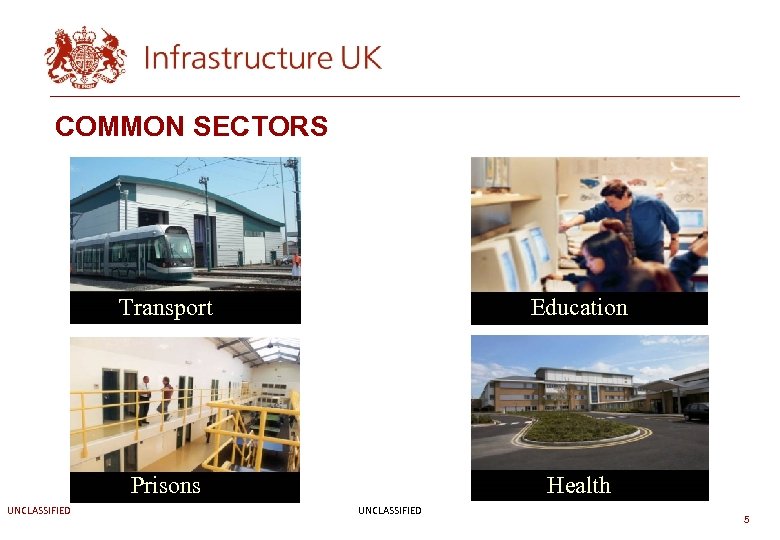 COMMON SECTORS Transport Prisons UNCLASSIFIED Education Health UNCLASSIFIED 5
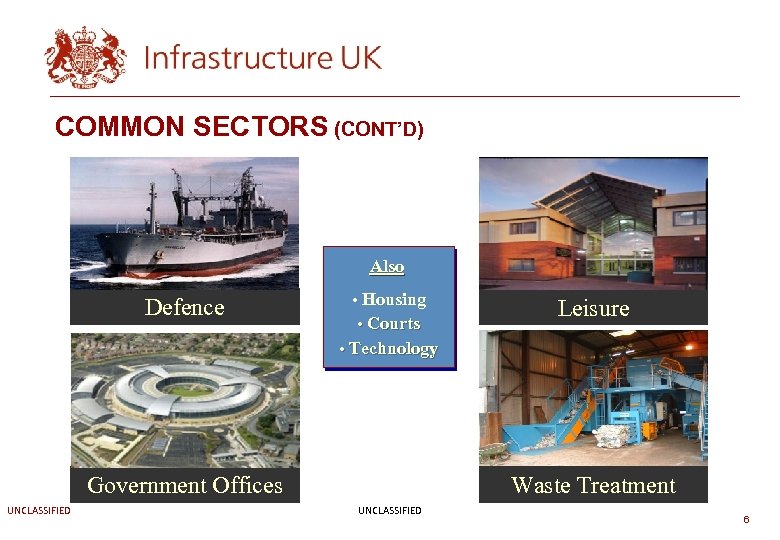 COMMON SECTORS (CONT’D) Also Defence • Housing • Courts Leisure • Technology Government Offices UNCLASSIFIED Waste Treatment UNCLASSIFIED 6
 DISTINCTION BETWEEN PRIVATISATION AND PPP? Where does accountability for public services delivery lie? UNCLASSIFIED 7
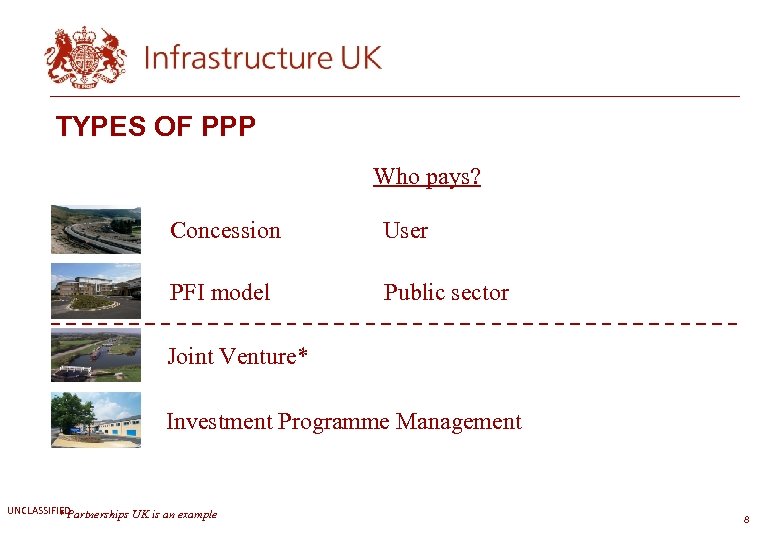 TYPES OF PPP Who pays? Concession User PFI model Public sector Joint Venture* Investment Programme Management UNCLASSIFIED * Partnerships UK is an example 8
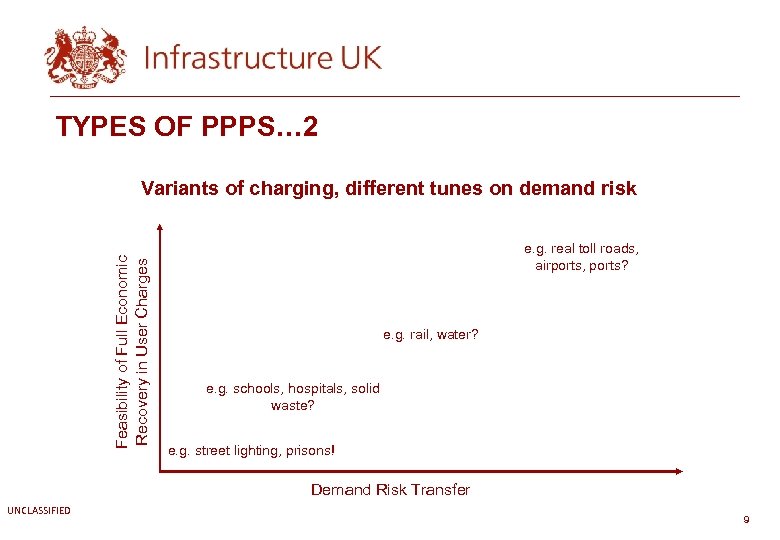 TYPES OF PPPS… 2 Feasibility of Full Economic Recovery in User Charges Variants of charging, different tunes on demand risk e. g. real toll roads, airports, ports? e. g. rail, water? e. g. schools, hospitals, solid waste? e. g. street lighting, prisons! Demand Risk Transfer UNCLASSIFIED 9
 PPP/PFI in the education sector Case study: Jo Richardson Community School UNCLASSIFIED
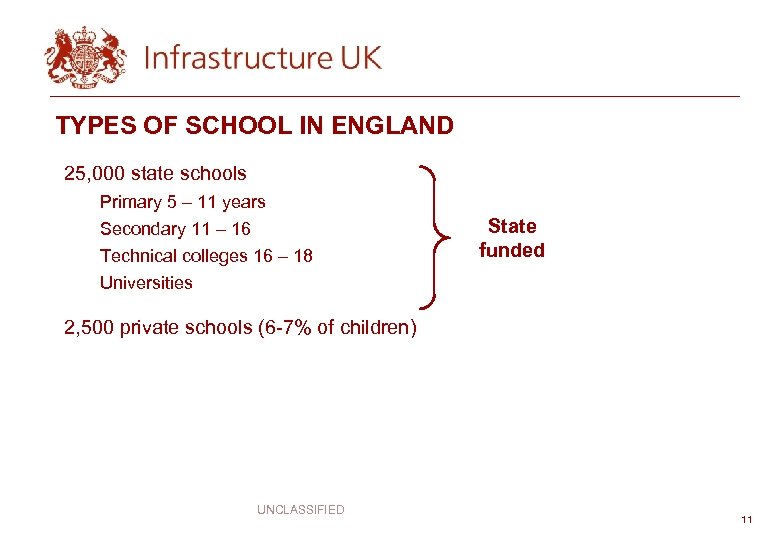 TYPES OF SCHOOL IN ENGLAND 25, 000 state schools Primary 5 – 11 years Secondary 11 – 16 Technical colleges 16 – 18 Universities State funded 2, 500 private schools (6 -7% of children) UNCLASSIFIED 11
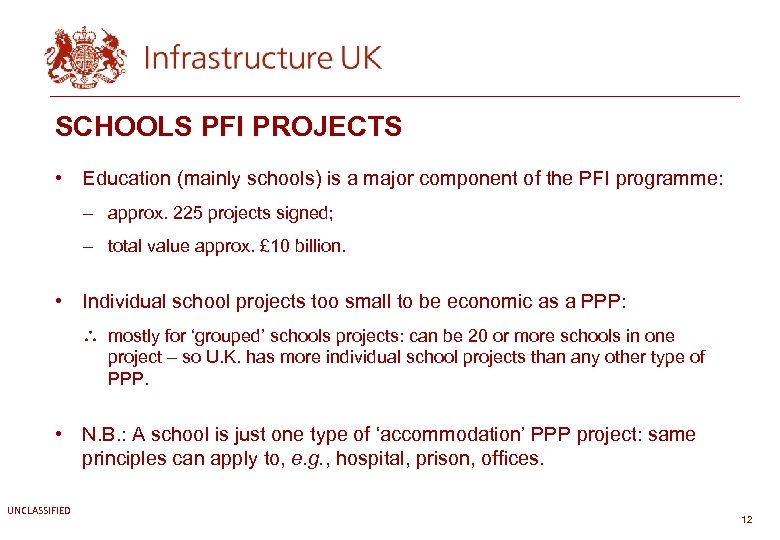 SCHOOLS PFI PROJECTS • Education (mainly schools) is a major component of the PFI programme: – approx. 225 projects signed; – total value approx. £ 10 billion. • Individual school projects too small to be economic as a PPP: mostly for ‘grouped’ schools projects: can be 20 or more schools in one project – so U. K. has more individual school projects than any other type of PPP. • N. B. : A school is just one type of ‘accommodation’ PPP project: same principles can apply to, e. g. , hospital, prison, offices. UNCLASSIFIED 12
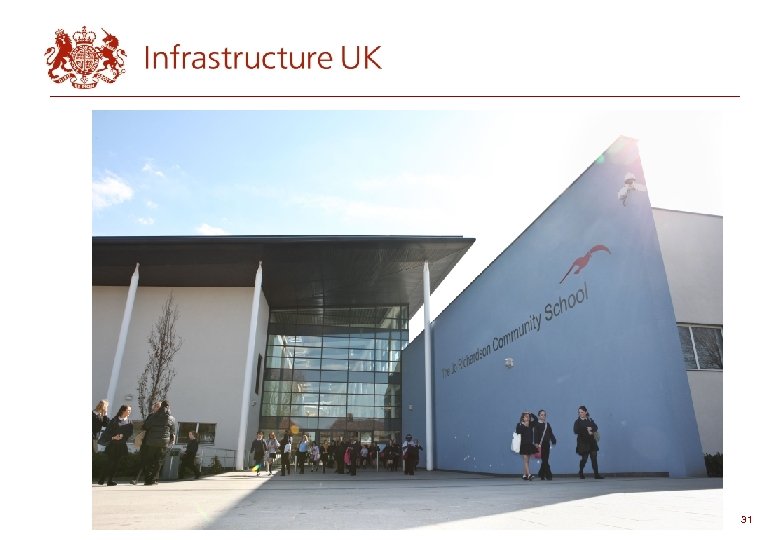
 JO RICHARDSON COMMUNITY SCHOOL (JRCS) BACKGROUND • Jo Richardson Community School (JRCS) is a PFI secondary school and community centre • It is the first new school to be built in over 40 years in Barking and Dagenham – Barking and Dagenham is one of the most deprived boroughs in London • JRCS currently has 1300 students, from 11 to 18 years old – 80% of the students come from deprived backgrounds UNCLASSIFIED 13
 JRCS – GENERAL OBJECTIVES The school and community centre address two important objectives: • the delivery of a new pedagogy. . . • School and vocational education • . . . and the provision of cultural, leisure, health and learning resources for the wider community. • Adult education centre / Learning Village • Children’s Centre • Health Centre • Library • Sports and Recreation spaces • Performing Arts resources • Café UNCLASSIFIED 14
 JRCS - PFI OBJECTIVES • To procure facilities that secure the Council’s education strategy and its community development and regeneration strategy • To procure school facilities that help deliver the Council’s new teaching and learning approach in particular • The procurement team learns actively from traditional/and PFI recent experience • The procurement delivers well designed, durable (expected life 50+ years) and serviceable accommodation • To develop a PFI methodology that can be taken forward by the Council • High quality vfm on outcomes 15
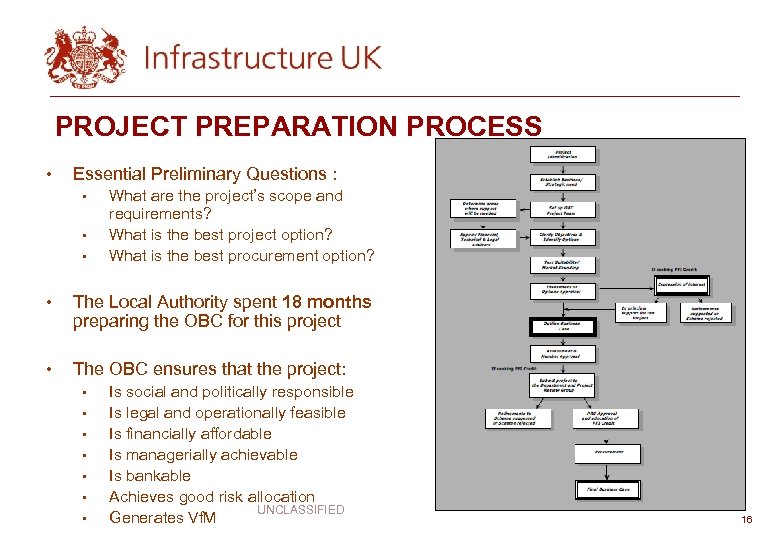 PROJECT PREPARATION PROCESS • Essential Preliminary Questions : • • • What are the project’s scope and requirements? What is the best project option? What is the best procurement option? • The Local Authority spent 18 months preparing the OBC for this project • The OBC ensures that the project: • • Is social and politically responsible Is legal and operationally feasible Is financially affordable Is managerially achievable Is bankable Achieves good risk allocation UNCLASSIFIED Generates Vf. M 16
 PROJECT DESIGN PROCESS • Design from the inside out (Design Council) • Design that ensures: • • • UNCLASSIFIED Efficient use of space Management of people Security Accesibility Client and end user involvement 17
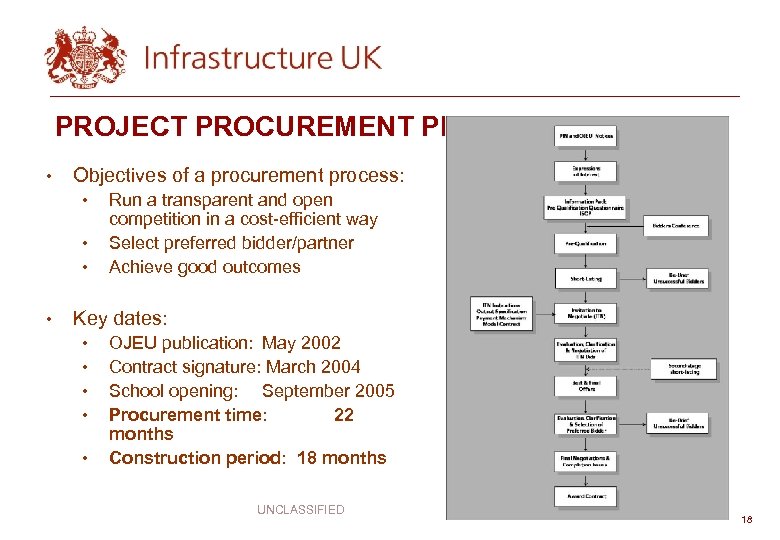 PROJECT PROCUREMENT PROCESS • Objectives of a procurement process: • • Run a transparent and open competition in a cost-efficient way Select preferred bidder/partner Achieve good outcomes Key dates: • • • OJEU publication: May 2002 Contract signature: March 2004 School opening: September 2005 Procurement time: 22 months Construction period: 18 months UNCLASSIFIED 18
 PROJECT PROCUREMENT PROCESS • Briefing and feedback – contractors • Use of exemplar designs • Use of Design Quality Indicators in selection • Contract award to Most Economically Advantageous Offer UNCLASSIFIED 19
 JRCS - PFI PRIVATE AND PUBLIC RESPONSABILITIES • Local Authority (Barking and Dagenham Council) in charge of providing : • educational services to the students, • extended services to the community (adult education, social integration, health, recreation) and management of shared facilities; • “Soft Facilities Management” services (reception, cleaning, catering, ect) and • monitoring of the “Hard Facilities Management” services performance • Role of private sector partner in charge of: • Design & Construction (Bouygues) • Financing (BNP Paribas, DEXIA Group, NIB, Barclays Equity) • Maintenance of the infrastructure / “Hard FM” services (Ecovert) · Building fabric maintenance · Mechanical & electrical engineering · Grounds maintenance · Utilities management · Health & safety management · Lifecycle fund management · Helpdesk 20
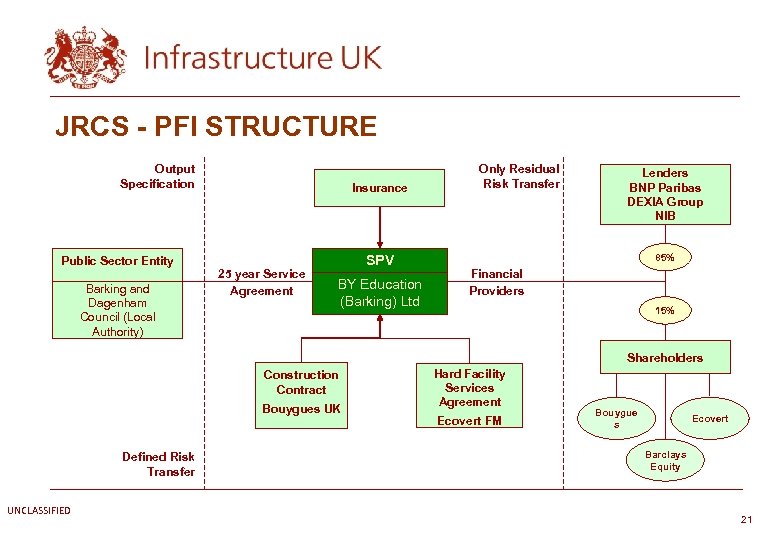 JRCS - PFI STRUCTURE Output Specification Public Sector Entity Barking and Dagenham Council (Local Authority) Insurance 25 year Service Agreement SPV BY Education (Barking) Ltd Only Residual Risk Transfer Lenders BNP Paribas DEXIA Group NIB 85% Financial Providers 15% Shareholders Construction Contract Bouygues UK Defined Risk Transfer UNCLASSIFIED Hard Facility Services Agreement Ecovert FM Bouygue s Ecovert Barclays Equity 21
 JRCS - PFI RISK ALLOCATION 1/2 Risk transfer under a school PFI contract follows same principles as any PFI: • Design / construction risk to Project Company • So if the school is completed late or over budget no payments are made and the revenue is therefore lost. • Construction sub-contractor will pay penalties to compensate. • Most operating risks to Project Company: • High opex / maintenance / lifecycle, or payment deductions, reduce net revenues • Some risks / deductions may be passed down to soft FM contractor (as discussed), or building maintenance sub-contractor. • Macro-economic risks may be shared: • High interest rates reduce revenues (unless fixed or hedged). • Payment mechanism may hedge against opex inflation. Insurance covers force majeure (Acts of God). UNCLASSIFIED 22
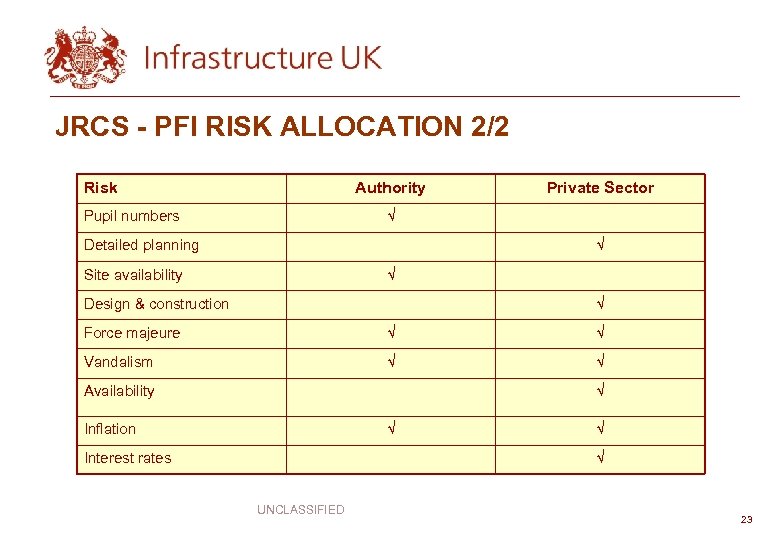 JRCS - PFI RISK ALLOCATION 2/2 Risk Authority Pupil numbers Private Sector √ Detailed planning √ Site availability √ Design & construction √ Force majeure √ √ Vandalism √ √ Availability √ Inflation √ Interest rates √ √ UNCLASSIFIED 23
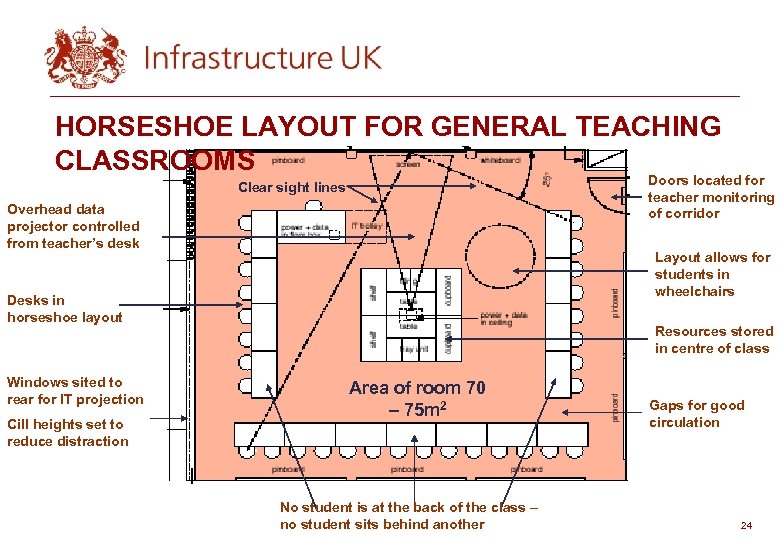 HORSESHOE LAYOUT FOR GENERAL TEACHING CLASSROOMS Doors located for teacher monitoring of corridor Clear sight lines Overhead data projector controlled from teacher’s desk Layout allows for students in wheelchairs Desks in horseshoe layout Windows sited to rear for IT projection Cill heights set to reduce distraction Resources stored in centre of class Area of room 70 – 75 m 2 No student is at the back of the class – no student sits behind another Gaps for good circulation 24
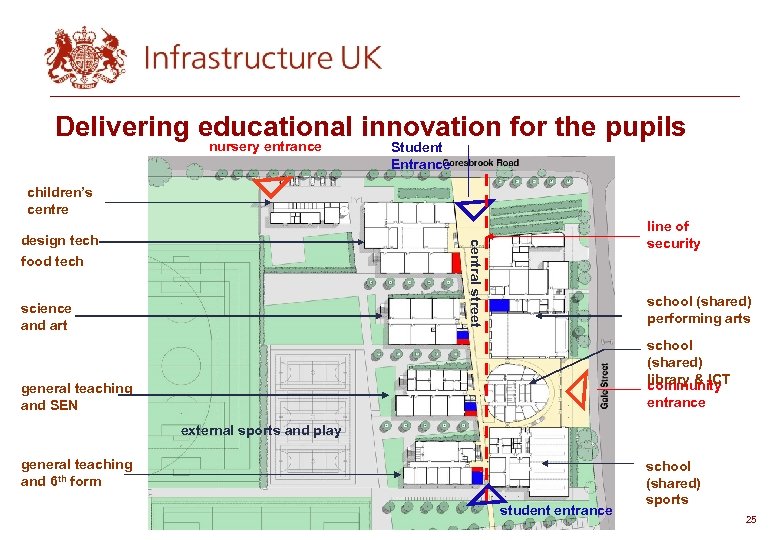 Delivering educational innovation for the pupils nursery entrance Student Entrance children’s centre central street design tech food tech line of security science and art school (shared) performing arts school (shared) library & ICT community general teaching and SEN entrance external sports and play general teaching and 6 th form UNCLASSIFIED student entrance school (shared) sports 25
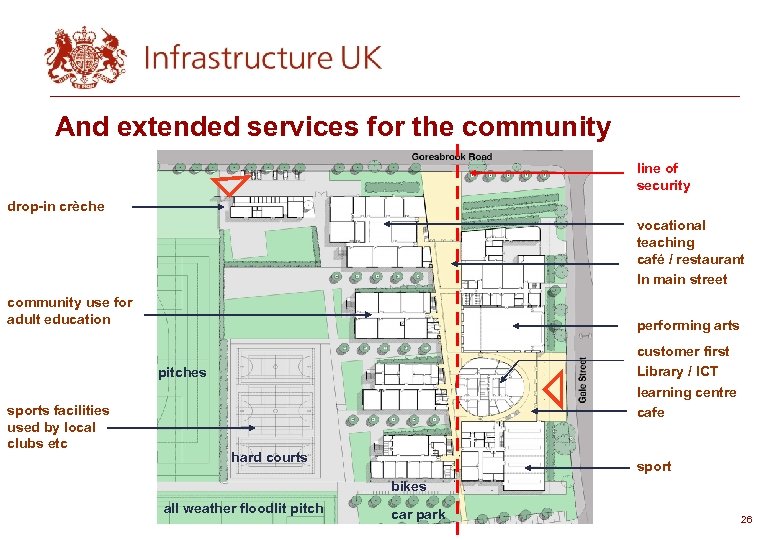 And extended services for the community line of security drop-in crèche vocational teaching café / restaurant In main street community use for adult education performing arts customer first Library / ICT learning centre cafe pitches sports facilities used by local clubs etc hard courts sport bikes all weather floodlit pitch car park 26
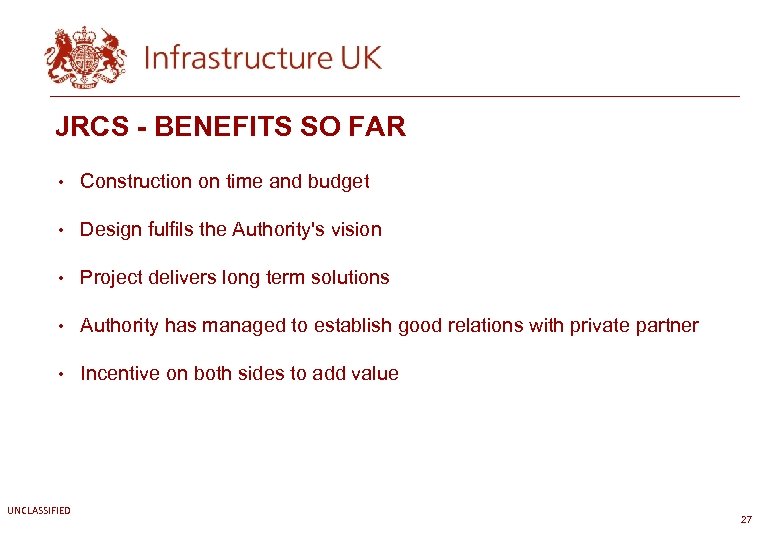 JRCS - BENEFITS SO FAR • Construction on time and budget • Design fulfils the Authority's vision • Project delivers long term solutions • Authority has managed to establish good relations with private partner • Incentive on both sides to add value UNCLASSIFIED 27
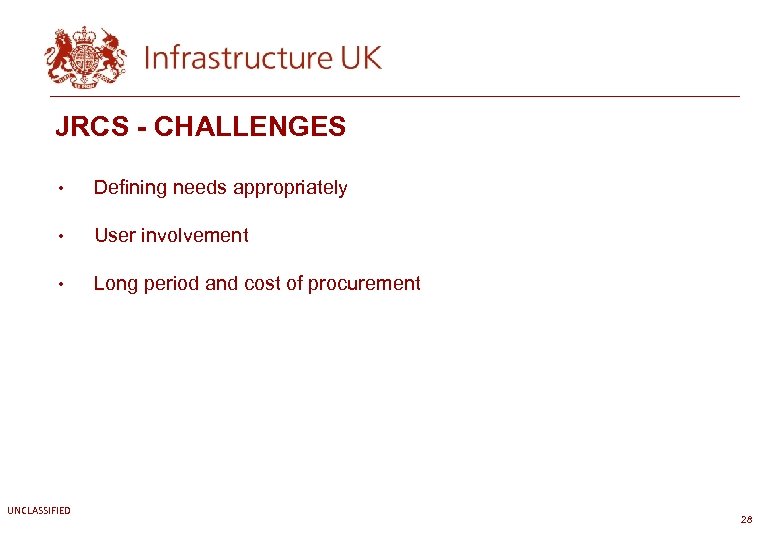 JRCS - CHALLENGES • Defining needs appropriately • User involvement • Long period and cost of procurement UNCLASSIFIED 28
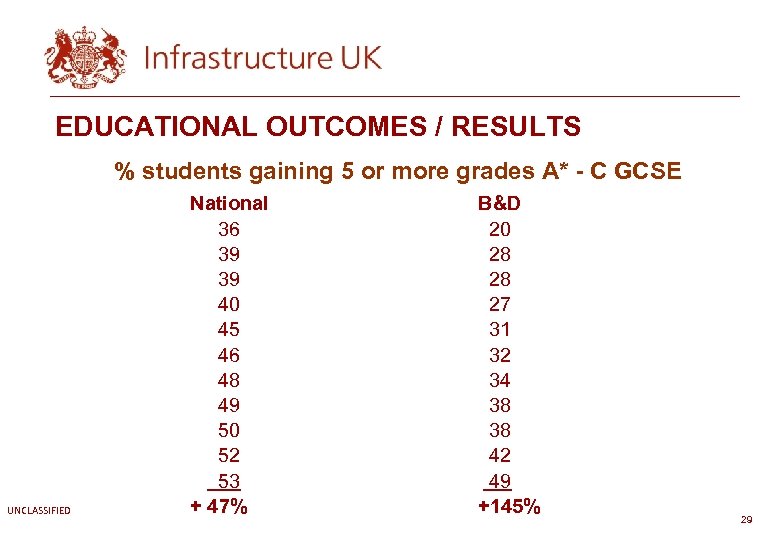 EDUCATIONAL OUTCOMES / RESULTS % students gaining 5 or more grades A* - C GCSE UNCLASSIFIED National 36 39 39 40 45 46 48 49 50 52 53 + 47% B&D 20 28 28 27 31 32 34 38 38 42 49 +145% 29
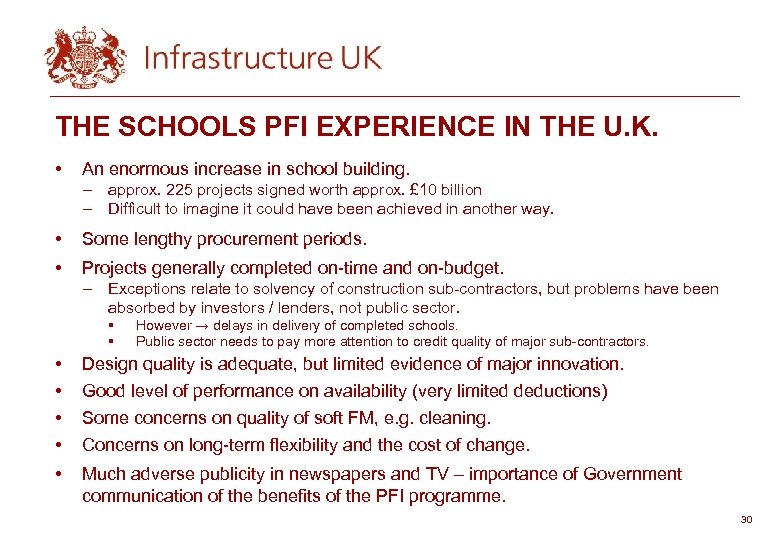 THE SCHOOLS PFI EXPERIENCE IN THE U. K. • An enormous increase in school building. – approx. 225 projects signed worth approx. £ 10 billion – Difficult to imagine it could have been achieved in another way. • Some lengthy procurement periods. • Projects generally completed on-time and on-budget. – Exceptions relate to solvency of construction sub-contractors, but problems have been absorbed by investors / lenders, not public sector. § § However → delays in delivery of completed schools. Public sector needs to pay more attention to credit quality of major sub-contractors. • • Design quality is adequate, but limited evidence of major innovation. Good level of performance on availability (very limited deductions) • Much adverse publicity in newspapers and TV – importance of Government communication of the benefits of the PFI programme. Some concerns on quality of soft FM, e. g. cleaning. Concerns on long-term flexibility and the cost of change. 30
 UNCLASSIFIED 31
 THE UK EXPERIENCE UNCLASSIFIED 32
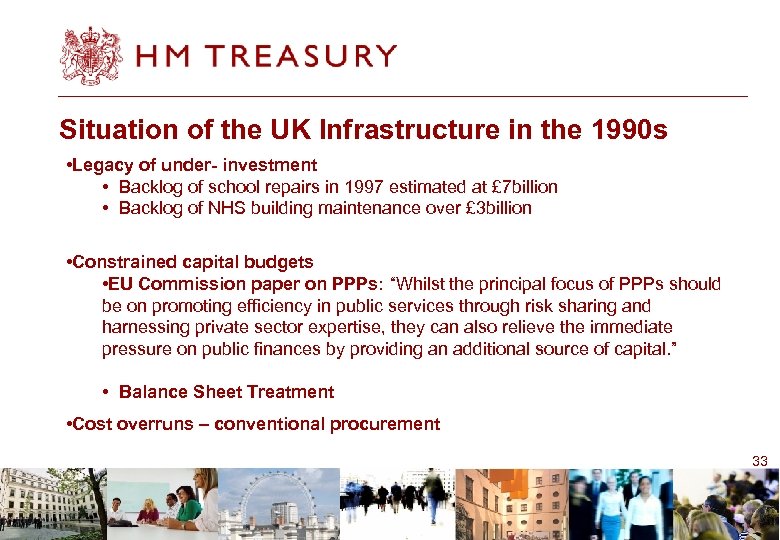 Situation of the UK Infrastructure in the 1990 s • Legacy of under- investment • Backlog of school repairs in 1997 estimated at £ 7 billion • Backlog of NHS building maintenance over £ 3 billion • Constrained capital budgets • EU Commission paper on PPPs: “Whilst the principal focus of PPPs should be on promoting efficiency in public services through risk sharing and harnessing private sector expertise, they can also relieve the immediate pressure on public finances by providing an additional source of capital. ” • Balance Sheet Treatment • Cost overruns – conventional procurement 33
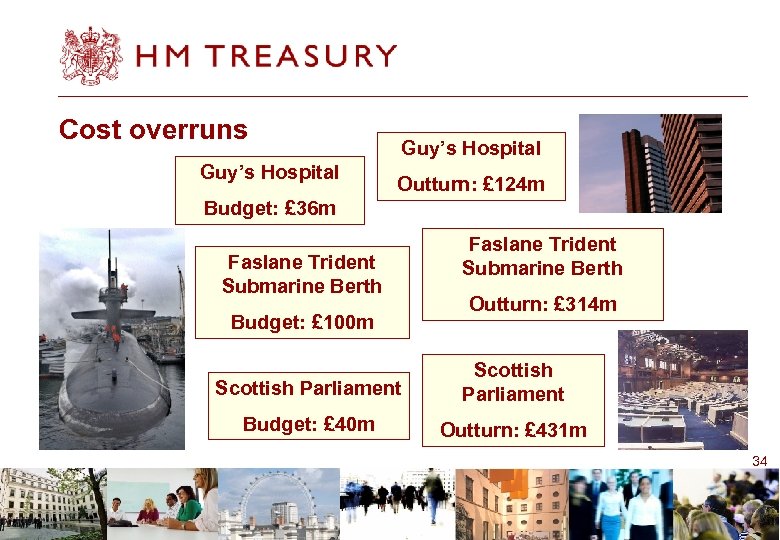 Cost overruns Guy’s Hospital Outturn: £ 124 m Budget: £ 36 m Faslane Trident Submarine Berth Budget: £ 100 m Faslane Trident Submarine Berth Outturn: £ 314 m Scottish Parliament Budget: £ 40 m Outturn: £ 431 m 34
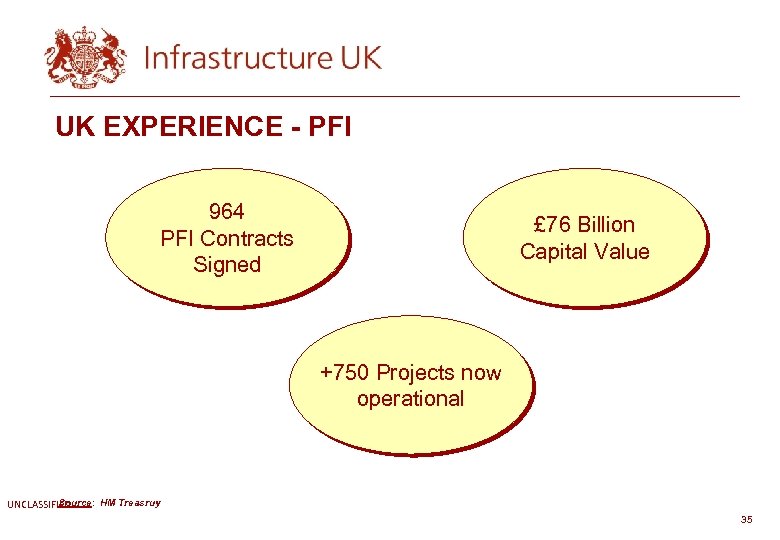 UK EXPERIENCE - PFI 964 PFI Contracts Signed £ 76 Billion Capital Value +750 Projects now operational Source: HM Treasruy UNCLASSIFIED 35
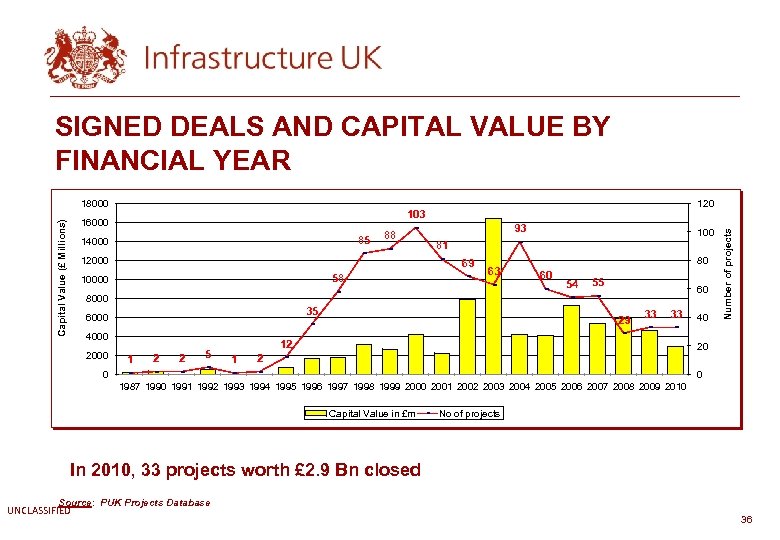 SIGNED DEALS AND CAPITAL VALUE BY FINANCIAL YEAR 16000 Capital Value (£ Millions) 120 103 85 14000 88 12000 93 81 69 58 10000 100 63 80 60 54 55 60 8000 35 6000 4000 2000 1 2 2 5 29 33 33 12 1 40 Number of projects 18000 20 2 0 0 1987 1990 1991 1992 1993 1994 1995 1996 1997 1998 1999 2000 2001 2002 2003 2004 2005 2006 2007 2008 2009 2010 Capital Value in £m No of projects In 2010, 33 projects worth £ 2. 9 Bn closed Source: PUK Projects Database UNCLASSIFIED 36
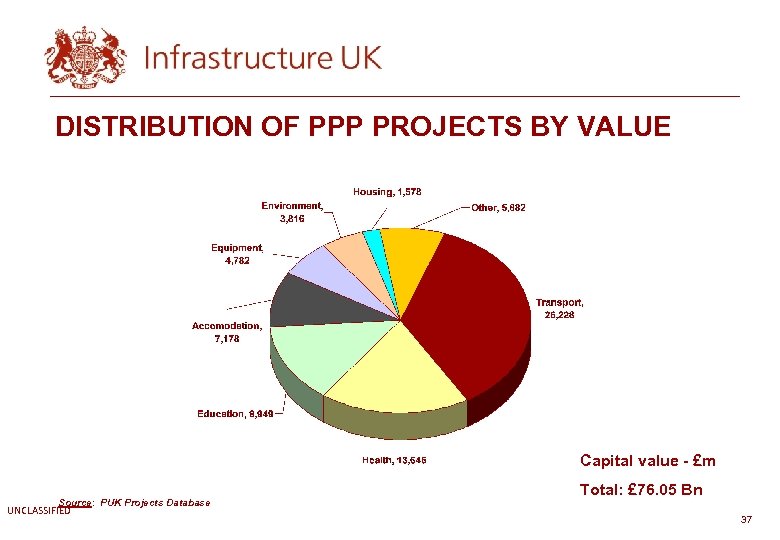 DISTRIBUTION OF PPP PROJECTS BY VALUE Capital value - £m Source: PUK Projects Database UNCLASSIFIED Total: £ 76. 05 Bn 37
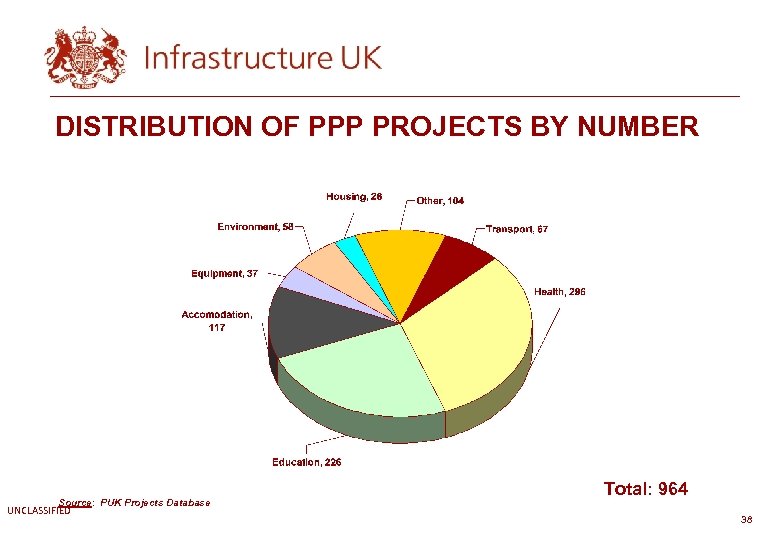 DISTRIBUTION OF PPP PROJECTS BY NUMBER Source: PUK Projects Database UNCLASSIFIED Total: 964 38
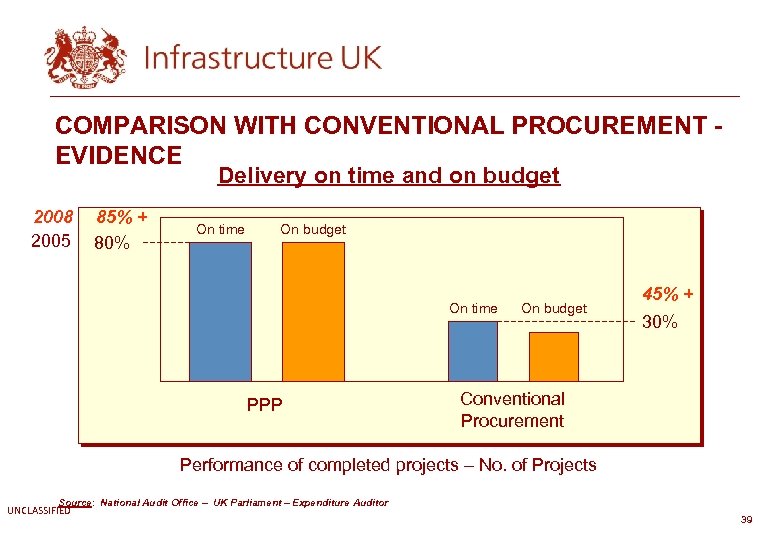 COMPARISON WITH CONVENTIONAL PROCUREMENT EVIDENCE Delivery on time and on budget 2008 2005 85% + 80% On time On budget On time PPP On budget 45% + 30% Conventional Procurement Performance of completed projects – No. of Projects Source: National Audit Office – UK Parliament – Expenditure Auditor UNCLASSIFIED 39
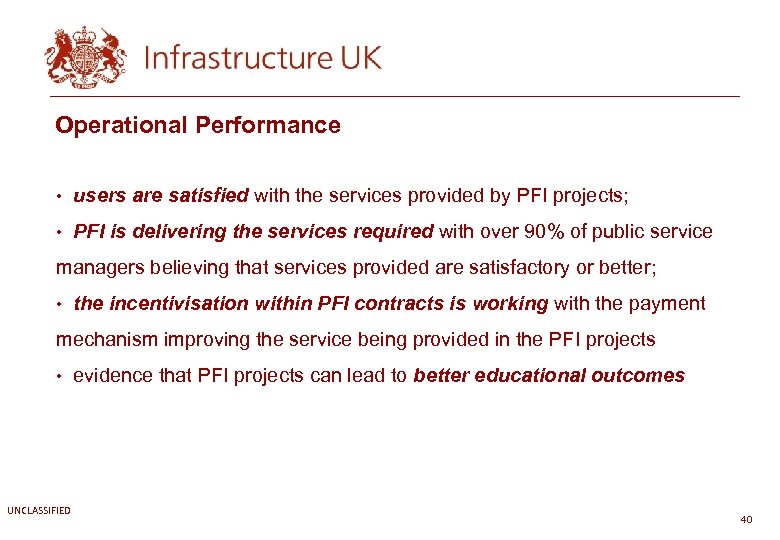 Operational Performance • users are satisfied with the services provided by PFI projects; • PFI is delivering the services required with over 90% of public service managers believing that services provided are satisfactory or better; • the incentivisation within PFI contracts is working with the payment mechanism improving the service being provided in the PFI projects • evidence that PFI projects can lead to better educational outcomes UNCLASSIFIED 40
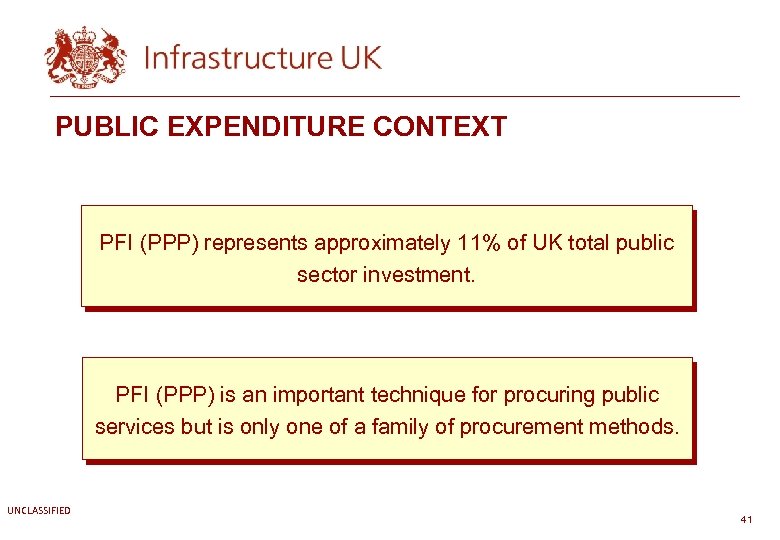 PUBLIC EXPENDITURE CONTEXT PFI (PPP) represents approximately 11% of UK total public sector investment. PFI (PPP) is an important technique for procuring public services but is only one of a family of procurement methods. UNCLASSIFIED 41
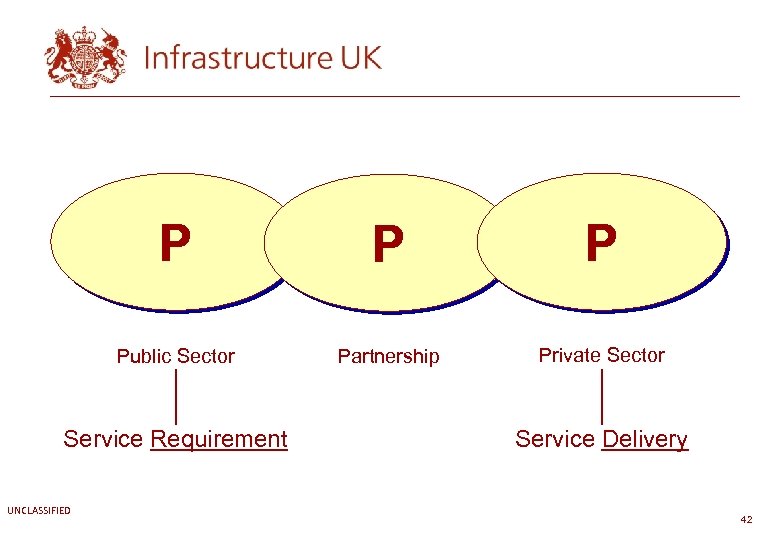 P P P Public Sector Partnership Private Sector Service Requirement UNCLASSIFIED Service Delivery 42
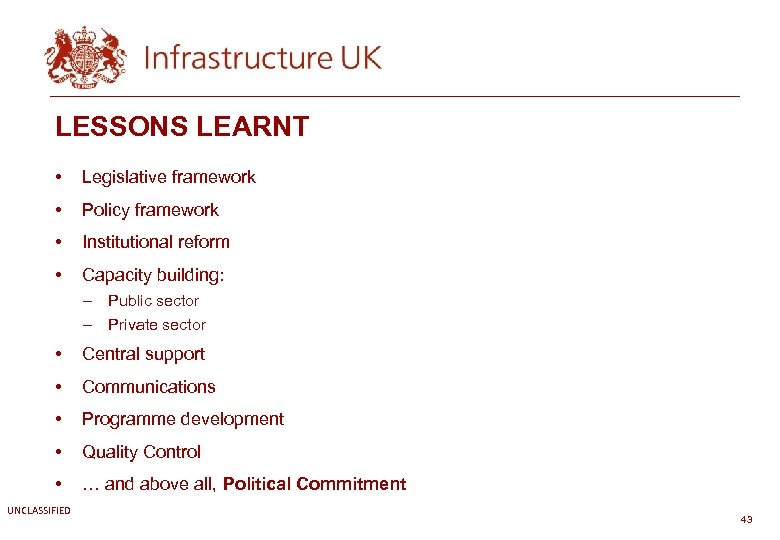 LESSONS LEARNT • Legislative framework • Policy framework • Institutional reform • Capacity building: – Public sector – Private sector • Central support • Communications • Programme development • Quality Control • … and above all, Political Commitment UNCLASSIFIED 43
 Infrastructure UK Contact: Javier. Encinas@hmtreasury. gsi. gov. uk 44 (0) 20 7270 1347 www. hm-treasury. gov. uk UNCLASSIFIED 44