


 Скачать презентацию The Scaling IQ Test When Dev and Admin
c726a318bd4d84f775fd976e5f4e67f1.ppt
- Количество слайдов: 23
 The Scaling IQ Test: When Dev and Admin Collide Richard Campbell Strangeloop Networks
 Richard Campbell § Background § After thirty years, done every job in the computer industry you’ve ever heard of § Currently § Co-Founder and Product Evangelist for Strangeloop Networks § Co-Host of. NET Rocks! § Host of Run. As Radio
 The IT/Dev Meeting § Every web application has this meeting eventually § Sooner is always better § The goal is to trade information § What IT needs to know about the app § What Dev needs to know about the operating environment
 The IT/Dev Meeting § Who needs to be in the room? § § The architect/senior dev Seniors devs that know the features in detail IT personnel that will operate the application Senior personnel that know the entire network
 The IT/Dev Meeting § When does the meeting need to happen? § When the application is being designed (collected as requirements) § While the application is being developed § After the application is deployed § After the application has crashed horribly § When the application is too slow
 The IT/Dev Meeting § Starting the meeting § What are the priorities § § Reliability Performance Scalability Accuracy § Put them in order, every site has different priorities
 The IT/Dev Meeting § What IT Needs to Know § What’s in the web. config file (a great starting point) § What load balancing strategies will work for the application § Any known performance bottlenecks
 Web. Config §
 Web. Config §
 Web. Config §
 Web. Config §
 Load Balancing § Find out what load balancing will work with the application § In-process session requires “sticky” load balancing § You only get to load balance the first request § Talk through server failure effects
 Performance Bottlenecks § Discuss known performance issues § Night time processing that conflicts with existing work § Administrators work that significant impacts performance of regular users § What parts of the application are more scalable than others?
 Things Dev Need to Know § The Network Diagram (in detail!) § How to get at production log data § What redundacy/failover/disaster recovery options there are
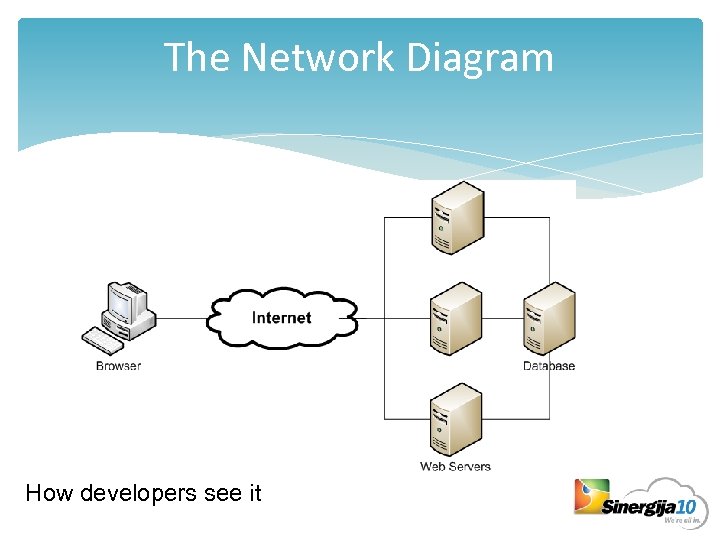 The Network Diagram How developers see it
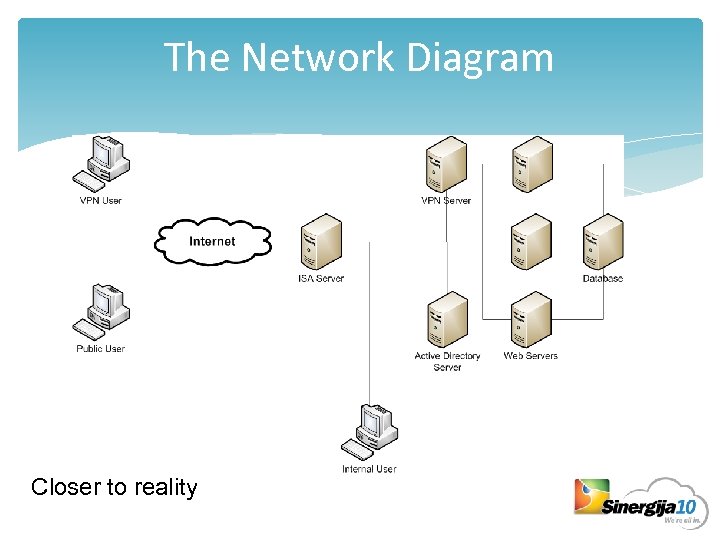 The Network Diagram Closer to reality
 Production Logs § Production logs are the truth of what happened with the application § Providing developers with production logs gives them a chance to help out § Provide access to the backups of the logs § Saying “I’ll give them to you when you ask” is not enough § You’re looking for proactive analysis
 Disaster Recovery § All DR strategies require at least some coding support § SQL Server failover still needs to have queries retried to be seamless § What happens between the time a server fails and the load balancing strategy detects it? § Is losing request acceptable in your scenario?
 Disaster Recovery § Switching to a backup site § Are DNS changes needed? § What references within the application need to be changed? § What does a switch-back look like? § Practice practice! § Don’t let your first failover test with an application be a real failure!
 After the Meeting § What follow ups are there for management? § You’ve probably made some business-related decisions, make sure you have buy-in § When do we need to meet again? § Preferably before the next disaster
 The Cooperative Firefight § IT is invariably on the front lines of an application failure § But when should development be brought in? § Post-mortem is often not enough
 The Cooperative Firefight § Make a strategy to involve development during the firefight § They often have deep insight into how the application works and so can understand why it might fail § Just make sure they’re educated to not make the problem worse § This is NOT a time for fixing code
 Summary § § Have the meeting early Repeat as necessary Each group must learn from the other Assist and seek assistance during a firefight