


 Скачать презентацию The Samaritan Textual Diaspora Delivery Rhetorical Velocity and
60bbd95f3a013dac165d42d096c239c6.ppt
- Количество слайдов: 24
 The Samaritan Textual Diaspora Delivery, Rhetorical Velocity, and Digital Composition University of Maryland, February 4, 2013 Jim Ridolfo - University of Cincinnati - @ridolfoj Assistant Professor of Composition and Rhetoric
 1. I’m fascinated by what people do with texts and how texts, move, circulate, travel in everyday life. I participate in field conversations on rhetorical delivery: Reynolds 1993; Skinner -Linnenberg 1999; Trimbur; 2000; Rude 2004; Welch 2005; Porter 2009; Mc. Corkle 2012 2. I research how people use texts in order to build theory for my discipline, but also to help build useful resources for communities (Influences: Ellen Cushman; Jeffrey Grabill) 3. I’m also interested in collaborative and complimentary field intersections between rhetoric and composition and other disciplines (example: Rhetoric and the Digital Humanities, advance contract with University of Chicago Press) Research interests Delivery, Reciprocity, Collaborative Research
 A concept of composing for strategic recomposition and a heuristic for analyzing recomposition “What will happen to my writing, video, image, sound clip? Who, how and why might someone else use what I deliver as a building block/stepping stone for other texts and videos? ” Do I as an [ activist / FY student / musician] want recomposition in ____ situation? Why? Rhetorical velocity – Work from 2004 -2013
 Remix Ridolfo, Jim and Dànielle Nicole De. Voss. “Composing for Recomposition: Rhetorical Velocity and Delivery. ” Kairos: A Journal of Rhetoric, Technology, and Pedagogy 13. 2 (2009). Copyright Ridolfo, Jim, and Martine Courant Rife. “Rhetorical Velocity and Copyright: A Case Study on the Strategies of Rhetorical Delivery. ” Copy(write): Intellectual Property in the Writing Classroom Eds. : Martine Rife, Shaun Slattery, and Dànielle De. Voss. WAC Clearinghouse and Parlor Press, 2011: 223 -244. Practitioner knowledge Ridolfo, Jim. “Rhetorical Delivery as Strategy: Researching the Fifth Canon Through Practitioner Stories. ” Rhetoric Review 31. 2 (2012): 117 -129. Rhetorical velocity – Work from 2004 -2013, cont.
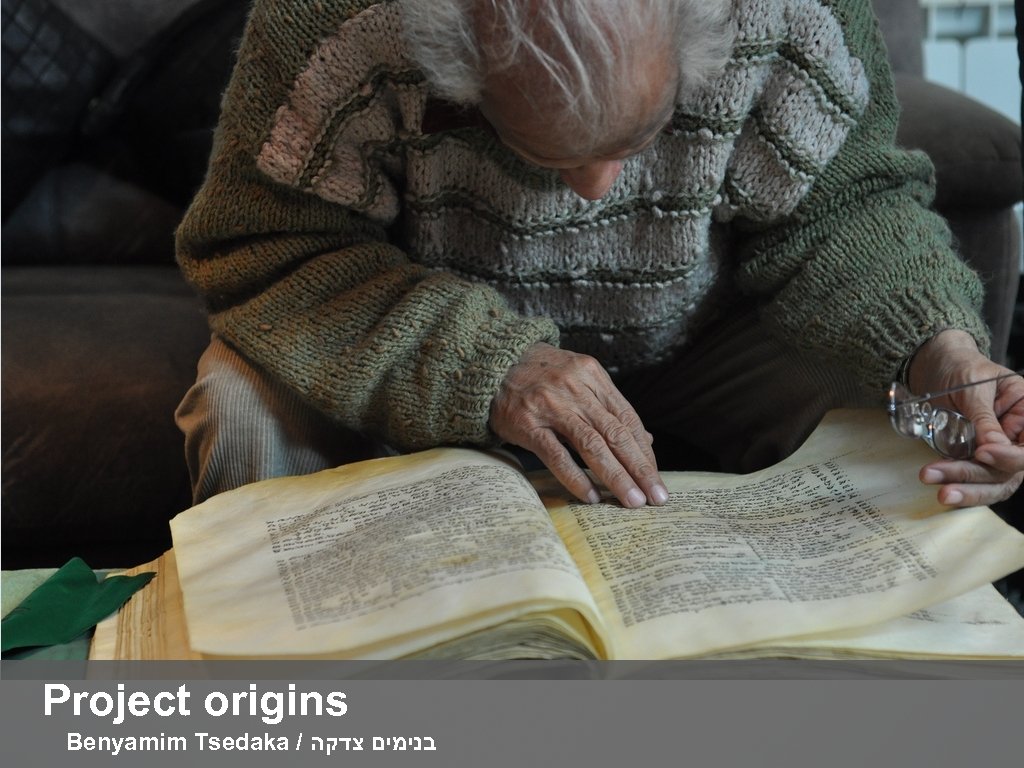 Project origins Benyamim Tsedaka / בנימים צדקה
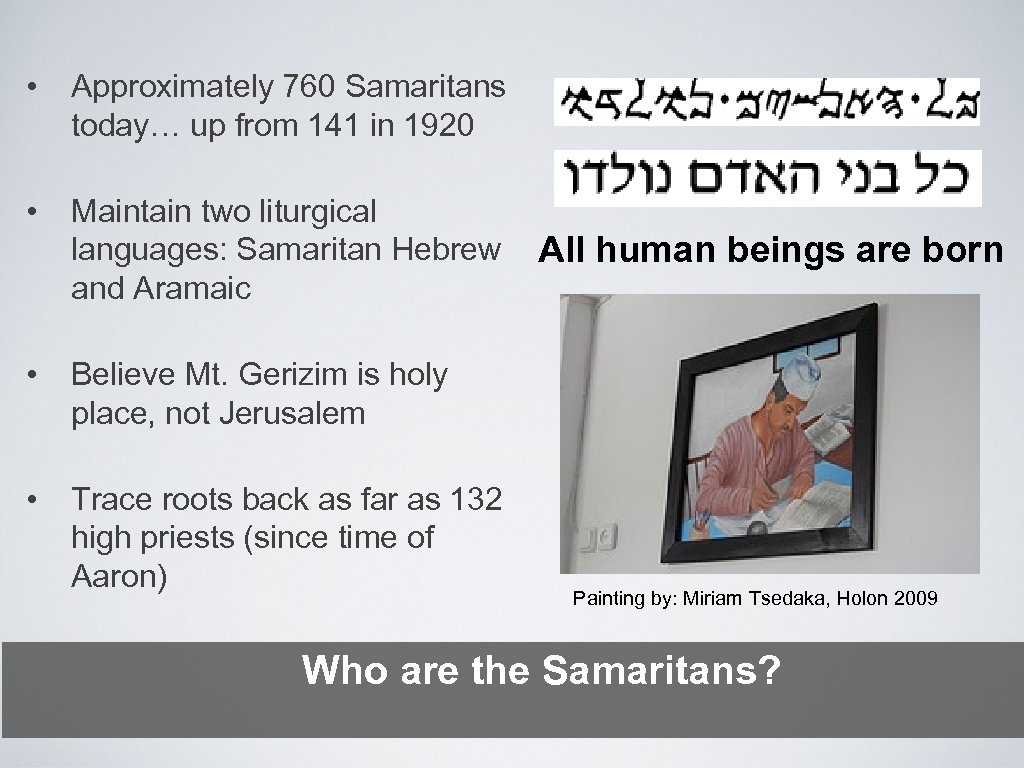 • Approximately 760 Samaritans today… up from 141 in 1920 • Maintain two liturgical languages: Samaritan Hebrew All human beings are born and Aramaic • Believe Mt. Gerizim is holy place, not Jerusalem • Trace roots back as far as 132 high priests (since time of Aaron) Painting by: Miriam Tsedaka, Holon 2009 Who are the Samaritans?
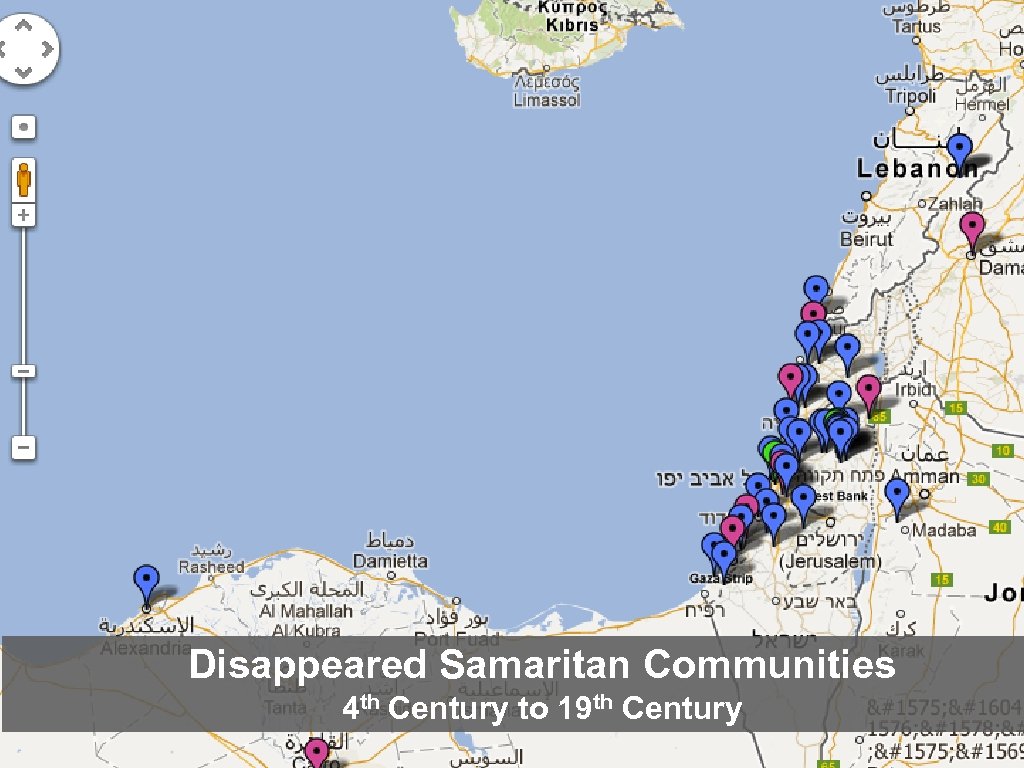 Disappeared Samaritan Communities 4 th Century to 19 th Century
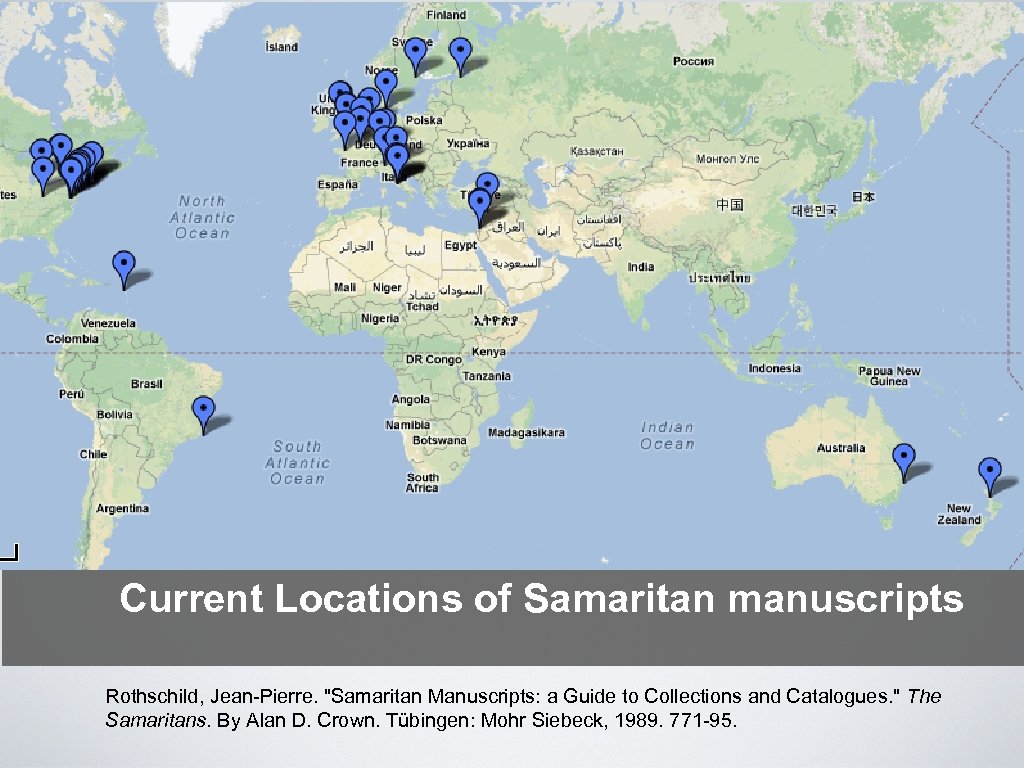 Current Locations of Samaritan manuscripts Rothschild, Jean-Pierre. "Samaritan Manuscripts: a Guide to Collections and Catalogues. " The Samaritans. By Alan D. Crown. Tübingen: Mohr Siebeck, 1989. 771 -95.
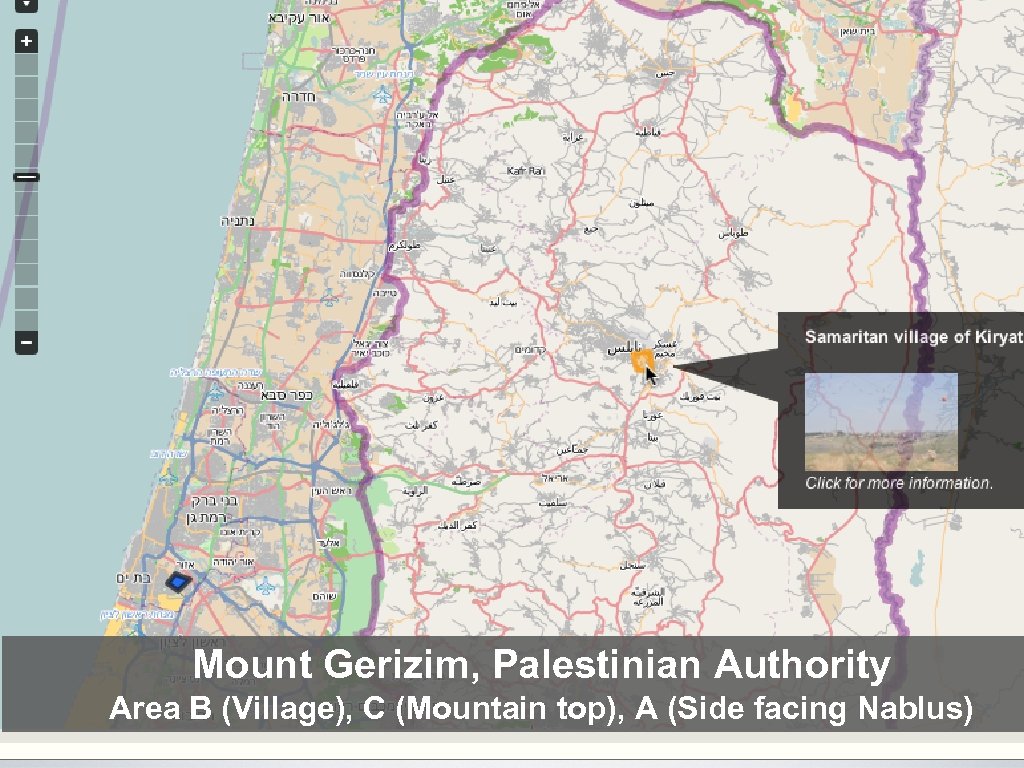 Mt. Gerizim Mount Gerizim, Palestinian Authority Area B (Village), C (Mountain top), A (Side facing Nablus)
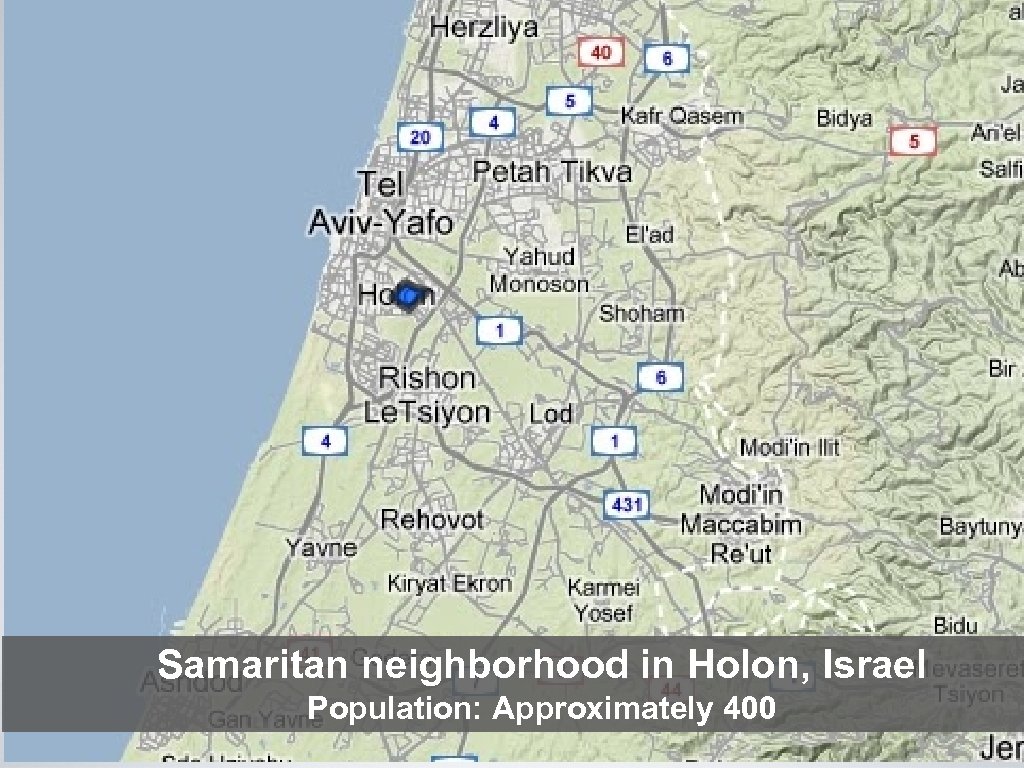 Samaritan neighborhood in Holon, Israel Population: Approximately 400
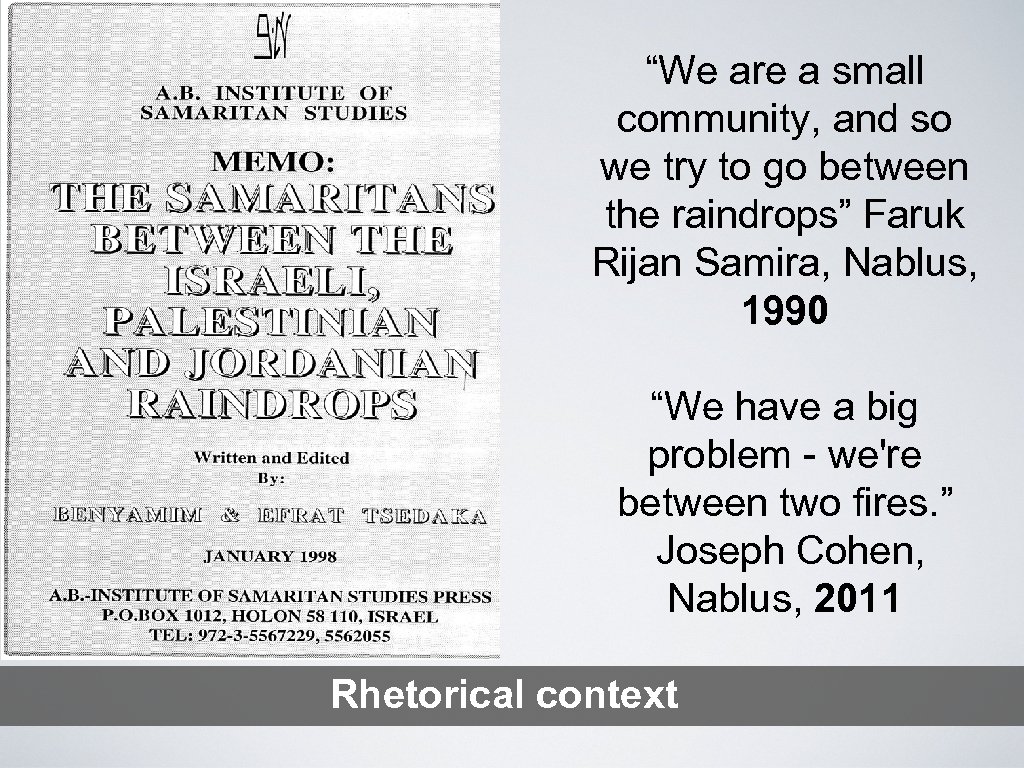 “We are a small community, and so we try to go between the raindrops” Faruk Rijan Samira, Nablus, 1990 “We have a big problem - we're between two fires. ” Joseph Cohen, Nablus, 2011 Rhetorical context
 I situate the diaspora of manuscripts and the willingness to digitize within the context of several recent events in Samaritan history: 1. 1920 National Geographic proclamation that the Samaritans would be extinct by end of 20 th century (down to 141 people in 1920) 1. 1948, and the establishment of the Samaritan neighborhood in Holon with the help of Yitzhak Ben-Tvi 1. 1949 -67 and the years of separation between the Samaritan communities in Holon and Nablus 1. Arafat’s appointment of a Samaritan from Nablus to the Palestinian Council in 1996 (Saloum Cohen, late High Priest) Rhetorical context, continued
 Start-up Project Goals (20082009) 1. Provide access to digital versions of the codices/scrolls at Michigan State University and other libraries/archives 2. To create a working model of a culturally-sensitive repository of Samaritan texts 3. Support a variety of learning activities including online teaching, learning, and research 4. Follow a model of system development consistent with best practices of user-centered design
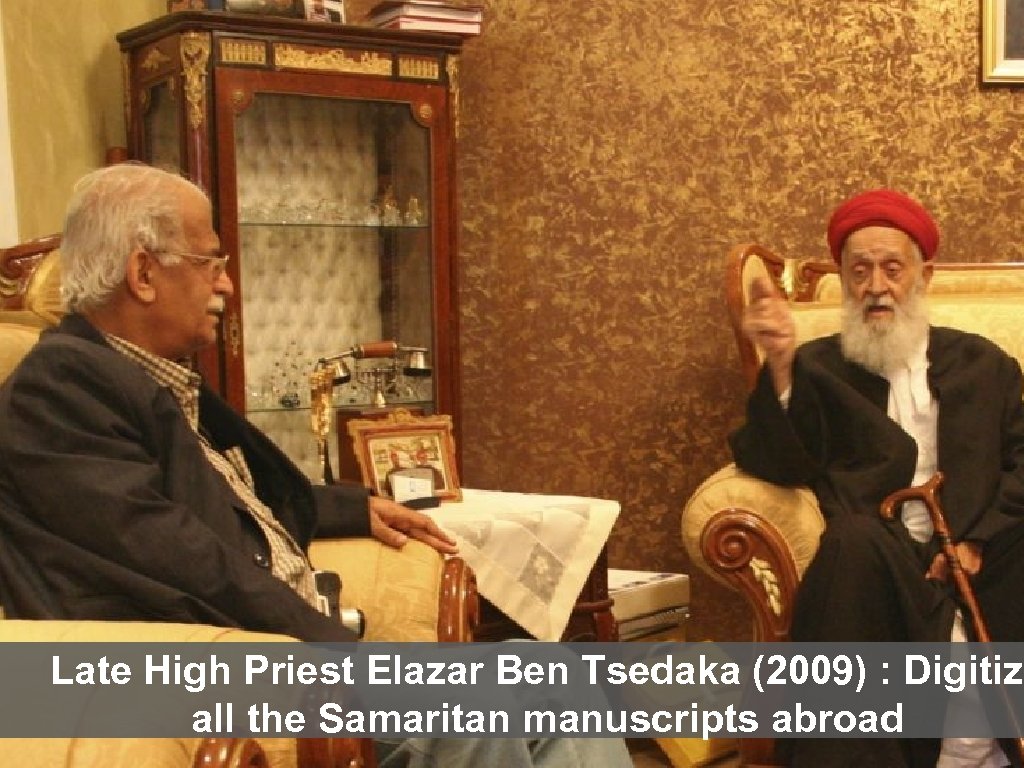 Late High Priest Elazar Ben Tsedaka (2009) : Digitize all the Samaritan manuscripts abroad
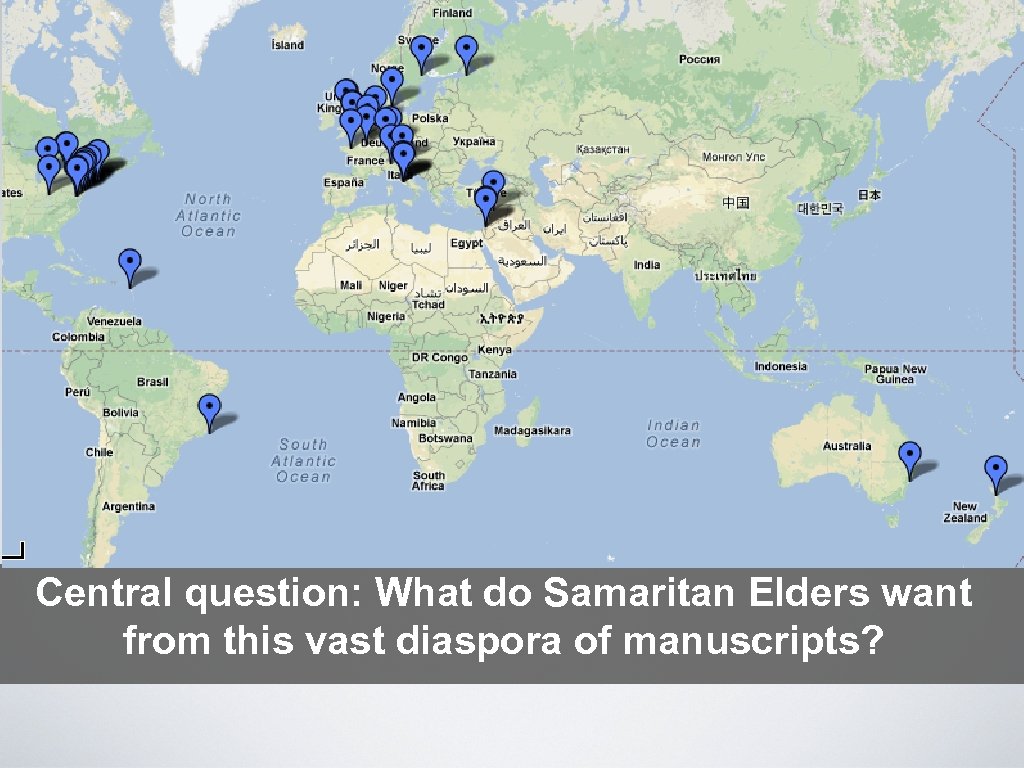 Central question: What do Samaritan Elders want from this vast diaspora of manuscripts?
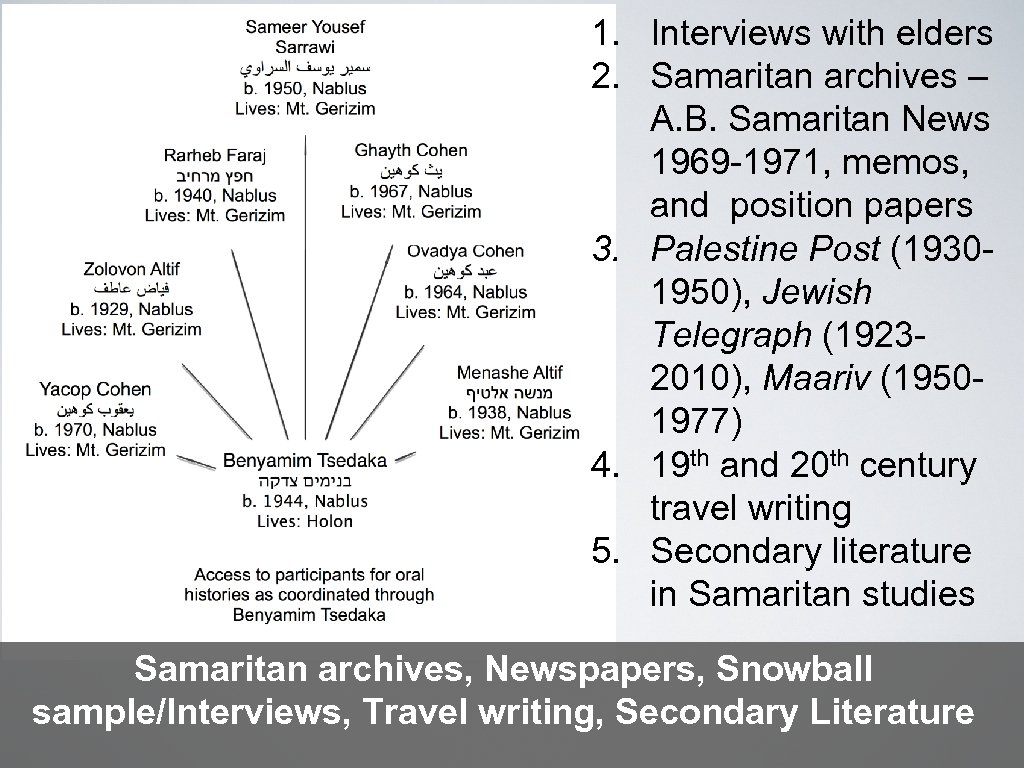 1. Interviews with elders 2. Samaritan archives – A. B. Samaritan News 1969 -1971, memos, and position papers 3. Palestine Post (19301950), Jewish Telegraph (19232010), Maariv (19501977) 4. 19 th and 20 th century travel writing 5. Secondary literature in Samaritan studies Samaritan archives, Newspapers, Snowball sample/Interviews, Travel writing, Secondary Literature
 I’ve been collecting oral histories with Samaritan elders in Holon and Mt. Gerizim. I’m specifically interested in the following questions: 1. What do Samaritan Elders think about their diaspora of manuscripts? 1. What do you hope from these manuscripts abroad? 1. What are some Samaritan attitudes towards manuscripts still in their possession? 1. How have attitudes towards manuscripts changed in the last 100+ years? Interview questions. Individual responses are not representative of entire community/situated in time/place/rhetorical situation
 1. Manuscripts in the community now have multiple owners, making it difficult to digitize or sell their texts. These manuscripts abroad do not have these fetters of local ownership. 2. All of the elders I’ve spoken with have expressed concerns about communicating their identity to their neighbors (“Jewish? Palestinian? Arab? Politics? ”). Most consider their manuscripts to be a key communicative tool. 1. Of the eight elders I’ve talked with, half felt strongly about the repatriation of some or all manuscripts; however, the majority also expressed that they would rather that some or all of these manuscripts remain abroad. Reasons for the latter include better preservation facilities and importance of spreading knowledge about the Samaritans. Interview trends
![“I believe that the way the manuscripts escaped [from the Samaritans], this is better](https://present5.com/presentation/60bbd95f3a013dac165d42d096c239c6/image-19.jpg "“I believe that the way the manuscripts escaped [from the Samaritans], this is better") “I believe that the way the manuscripts escaped [from the Samaritans], this is better for the manuscripts [today]. And you [researchers] can have access any time to see [the manuscripts]. In Michigan State library, I visit maybe 10 times… [and] the manuscripts are kept in a huge room… They are keeping the manuscripts so well. ” “It’s very good to digitize them [the manuscripts]- to preserve them - and also to present them. [It's important to present them] in order to get interest from students [in order to prompt them to] to make research about the Samaritans, in order to spread the knowledge [to the world] about the Samaritans. It's very important to me. Especially when there are so many prejudices about the Samaritans” Benyamim Tsedaka / Holon (b. 1944 in Nablus)
“I believe that the way the manuscripts escaped [from the Samaritans], this is better for the manuscripts [today]. And you [researchers] can have access any time to see [the manuscripts]. In Michigan State library, I visit maybe 10 times… [and] the manuscripts are kept in a huge room… They are keeping the manuscripts so well. ” “It’s very good to digitize them [the manuscripts]- to preserve them - and also to present them. [It's important to present them] in order to get interest from students [in order to prompt them to] to make research about the Samaritans, in order to spread the knowledge [to the world] about the Samaritans. It's very important to me. Especially when there are so many prejudices about the Samaritans” Benyamim Tsedaka / Holon (b. 1944 in Nablus)
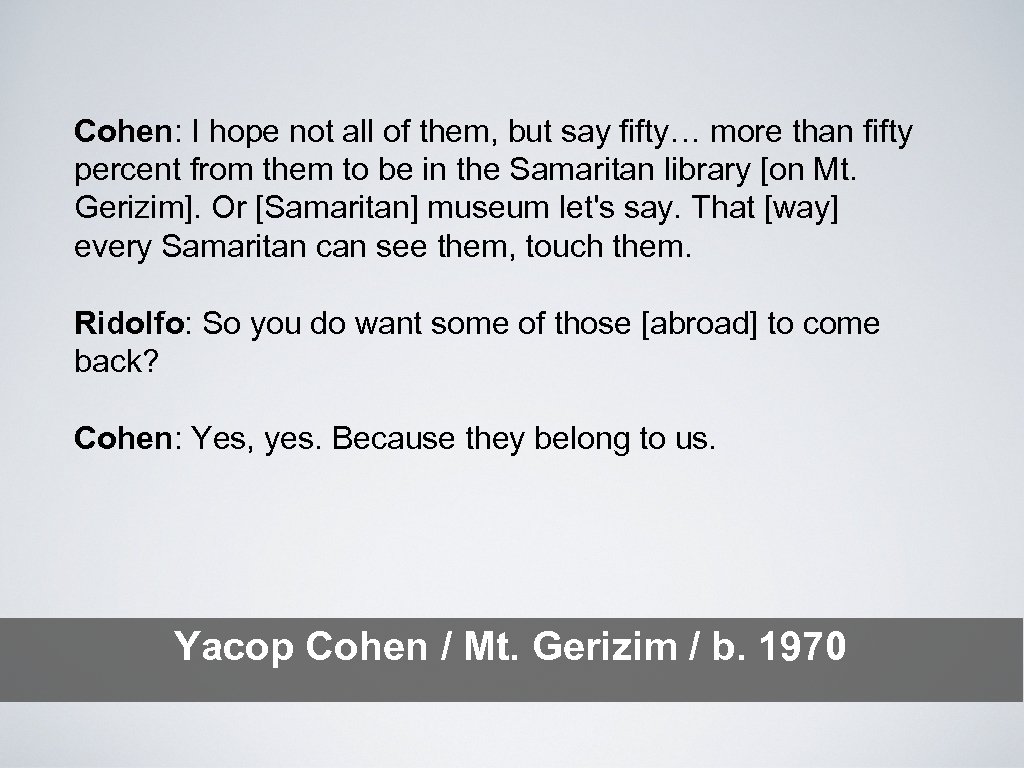 Cohen: I hope not all of them, but say fifty… more than fifty percent from them to be in the Samaritan library [on Mt. Gerizim]. Or [Samaritan] museum let's say. That [way] every Samaritan can see them, touch them. Ridolfo: So you do want some of those [abroad] to come back? Cohen: Yes, yes. Because they belong to us. Yacop Cohen / Mt. Gerizim / b. 1970
 “likes that all manuscripts will return back to the hands of the Samaritan community. ” But “knows that it is not real [not possible] and that it is not possible because each manuscript costs a lot of money and the Samaritan community has not that money in order to return their manuscripts. ” “As long as it [the manuscripts are] is with foreign libraries [and] not Samaritan libraries it [digitization] will be easier to do… when you come to the Samaritans every manuscript has many partners to it. ” Menashe Altif / Mt. Gerizim / b. 1938
 Textual diaspora theorizes the future potential of many texts out there in different places with a common cultural and historical bond 1. Situating their histories of removal (how they became dispersed) 2. Along side present institutional stewardship and the potential of future archival digital delivery 3. In relation to the rhetorical sovereignty (Lyons 2000) of living cultural stakeholders. Takeaway for Rhetoric and DH: Textual diaspora – a rhetorical heuristic for investigating the past delivery of texts in order to inform decisions about future digital archival delivery
 I agree with Trimbur (2000) that “neglecting delivery has lead writing teachers to equate the activity of composing with writing itself, and to miss altogether the complex delivery systems through which writing circulates” (189 -190). Ok, so what? What does this project have to do with composition theory or undergraduate teaching?
 To this end, Delivery research prompts me to 1) consider what cultural materials mainstream institutions value and reproduce in digital environments more generally? Why); 2) think about the future of undergraduate student writing generally (copyright issues, ethics, student privacy, engagement outside the classroom); 3) generate new assignment ideas such as a FY Wikipedia research project and press release quotation research assignment; Ok, so what? What does this project have to do with composition theory or undergraduate teaching? Cont.