


 Скачать презентацию The Rule Markup Initiative RDF Relationships and DTD
18d539602aa646c6221b9b297d70886b.ppt
- Количество слайдов: 21
 The Rule Markup Initiative: RDF Relationships and DTD Modularization Harold Boley Benjamin Grosof Said Tabet Updated (8 Mar 2001) from talk at: RDF Interest Group: Face to face meeting, Technical Plenary and WG Meeting Event, W 3 C, Cambridge, Mass. , 26/27 Feb 2001
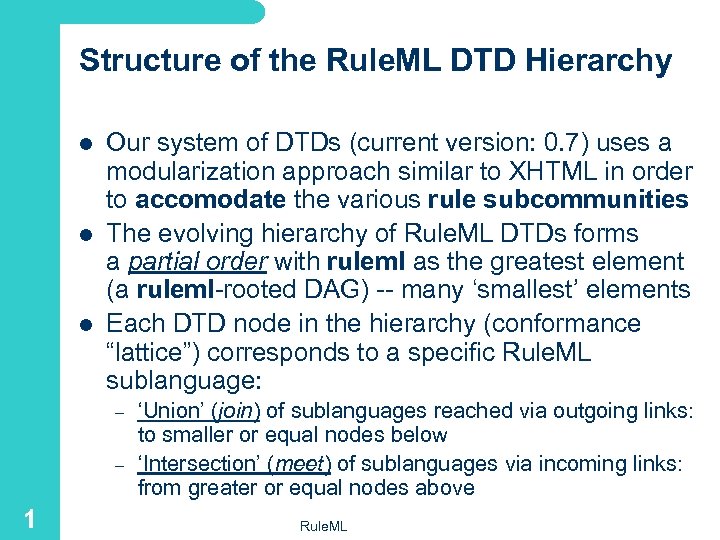 Structure of the Rule. ML DTD Hierarchy l l l Our system of DTDs (current version: 0. 7) uses a modularization approach similar to XHTML in order to accomodate the various rule subcommunities The evolving hierarchy of Rule. ML DTDs forms a partial order with ruleml as the greatest element (a ruleml-rooted DAG) -- many ‘smallest’ elements Each DTD node in the hierarchy (conformance “lattice”) corresponds to a specific Rule. ML sublanguage: – – 1 ‘Union’ (join) of sublanguages reached via outgoing links: to smaller or equal nodes below ‘Intersection’ (meet) of sublanguages via incoming links: from greater or equal nodes above Rule. ML
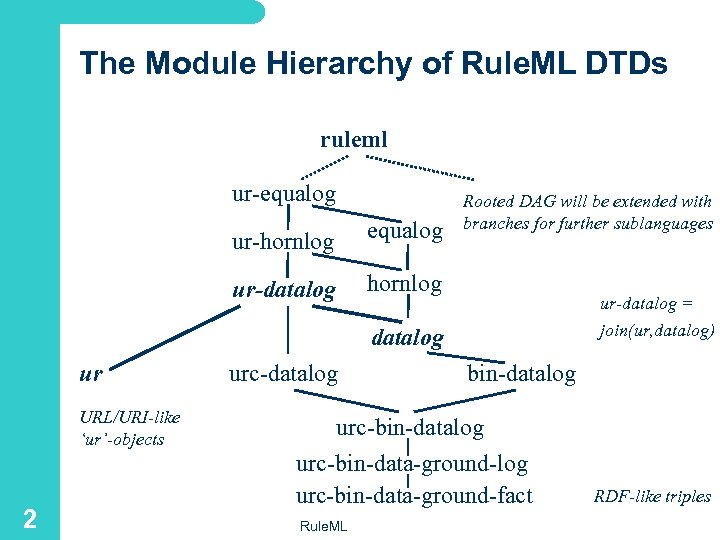 The Module Hierarchy of Rule. ML DTDs ruleml ur-equalog ur-hornlog equalog ur-datalog Rooted DAG will be extended with branches for further sublanguages hornlog ur-datalog = join(ur, datalog) datalog ur URL/URI-like ‘ur’-objects 2 urc-datalog bin-datalog urc-bin-data-ground-log urc-bin-data-ground-fact Rule. ML RDF-like triples
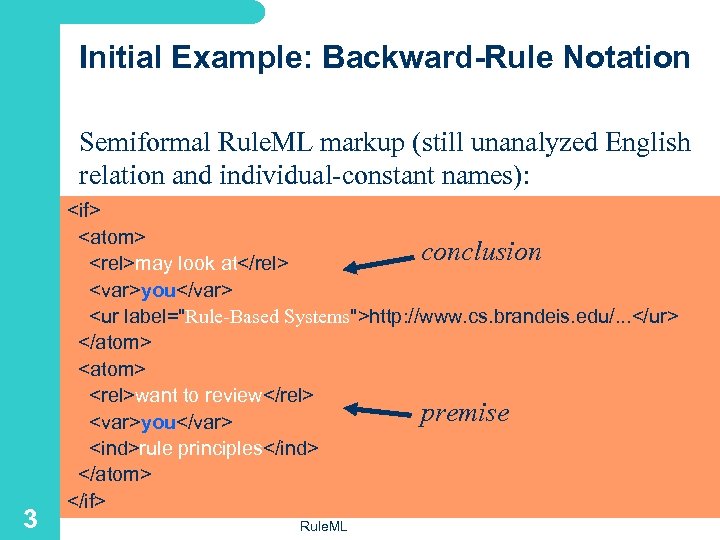 Initial Example: Backward-Rule Notation Semiformal Rule. ML markup (still unanalyzed English relation and individual-constant names): 3
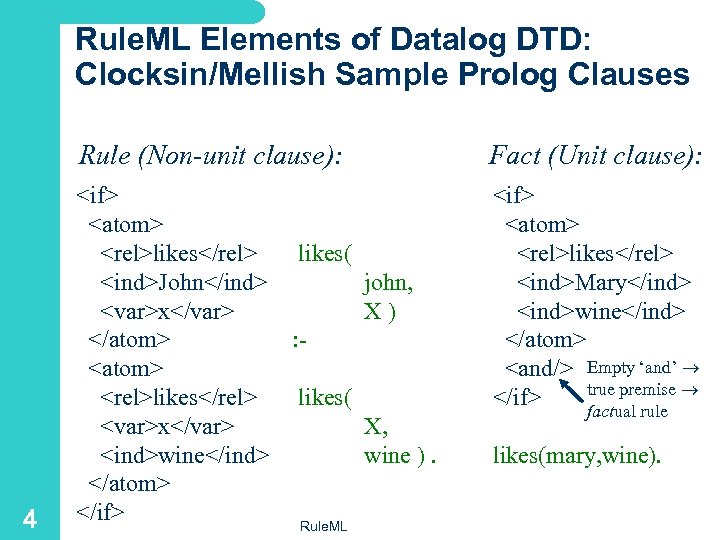 Rule. ML Elements of Datalog DTD: Clocksin/Mellish Sample Prolog Clauses Rule (Non-unit clause): 4 Fact (Unit clause):
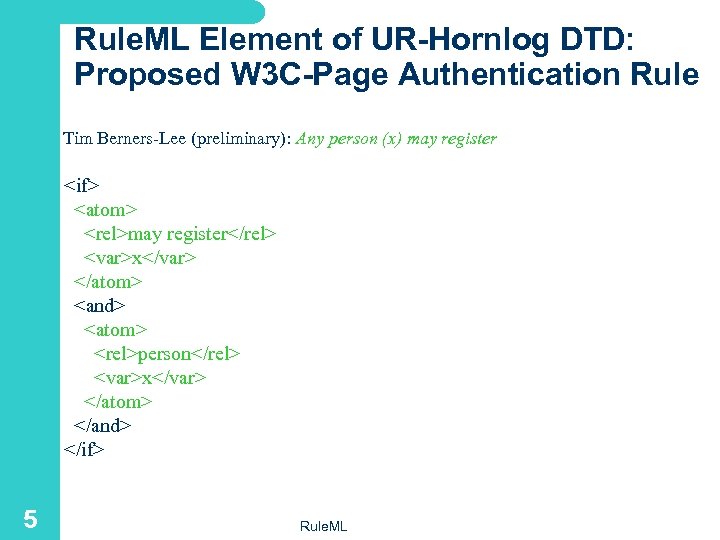 Rule. ML Element of UR-Hornlog DTD: Proposed W 3 C-Page Authentication Rule Tim Berners-Lee (preliminary): Any person (x) may register
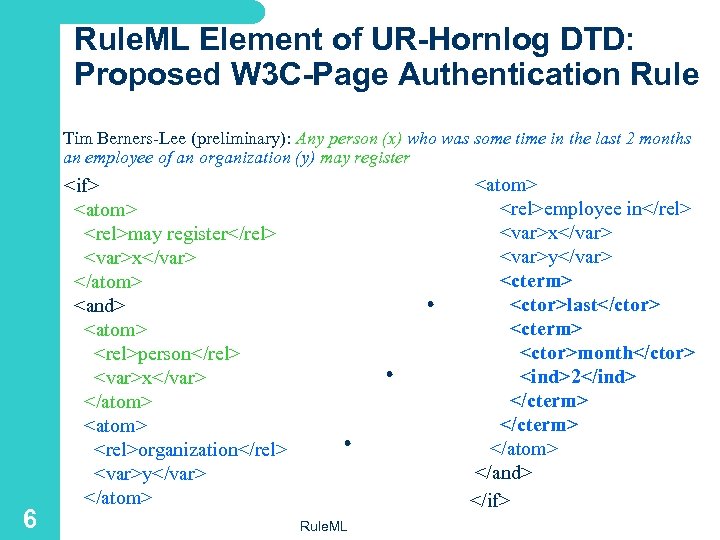 Rule. ML Element of UR-Hornlog DTD: Proposed W 3 C-Page Authentication Rule 6 . .
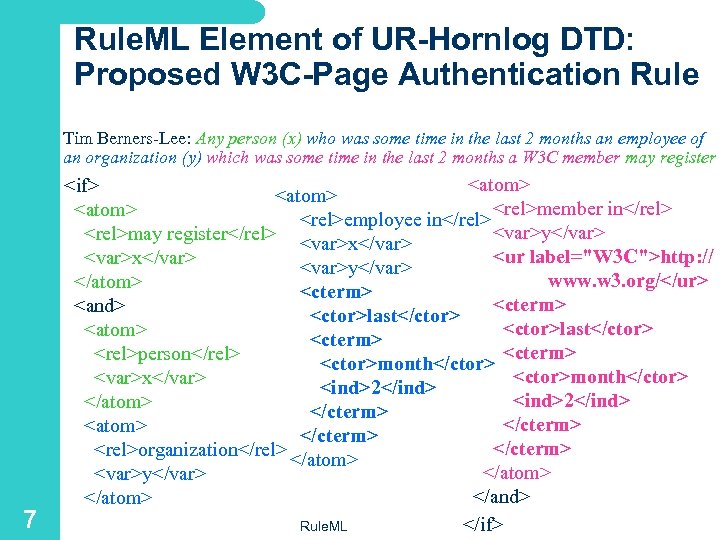 Rule. ML Element of UR-Hornlog DTD: Proposed W 3 C-Page Authentication Rule Tim Berners-Lee: Any person (x) who was some time in the last 2 months an employee of an organization (y) which was some time in the last 2 months a W 3 C member may register 7
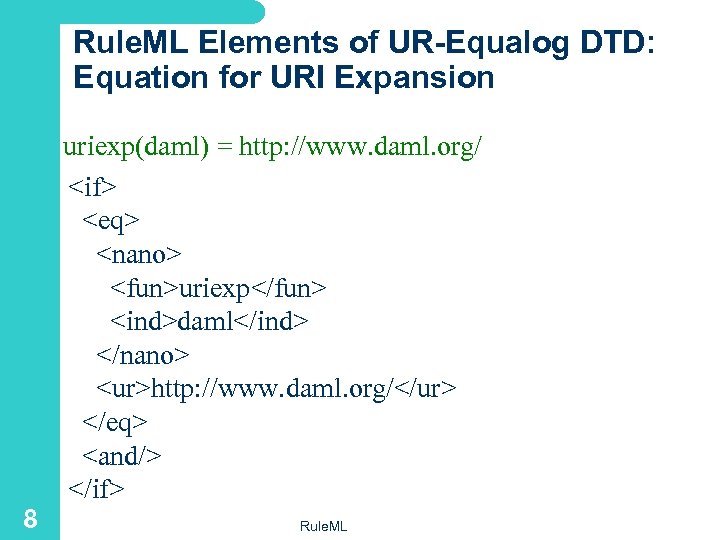 Rule. ML Elements of UR-Equalog DTD: Equation for URI Expansion uriexp(daml) = http: //www. daml. org/
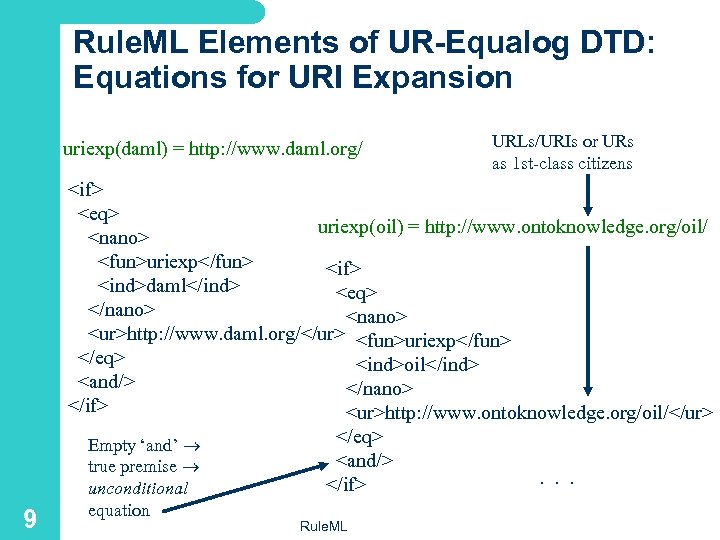 Rule. ML Elements of UR-Equalog DTD: Equations for URI Expansion uriexp(daml) = http: //www. daml. org/ URLs/URIs or URs as 1 st-class citizens
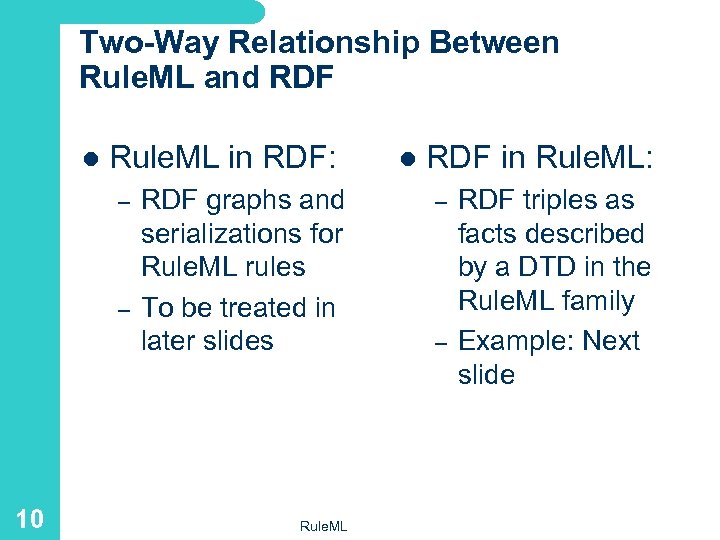 Two-Way Relationship Between Rule. ML and RDF l Rule. ML in RDF: – – 10 RDF graphs and serializations for Rule. ML rules To be treated in later slides Rule. ML l RDF in Rule. ML: – – RDF triples as facts described by a DTD in the Rule. ML family Example: Next slide
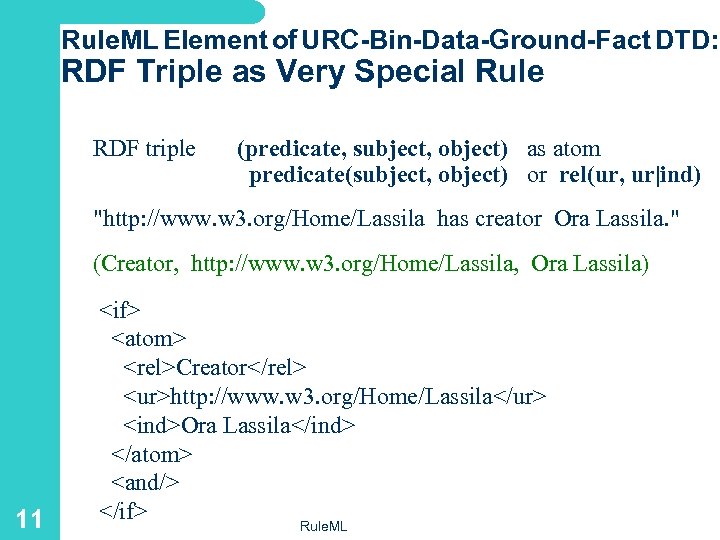 Rule. ML Element of URC-Bin-Data-Ground-Fact DTD: RDF Triple as Very Special Rule RDF triple (predicate, subject, object) as atom predicate(subject, object) or rel(ur, ur|ind) "http: //www. w 3. org/Home/Lassila has creator Ora Lassila. " (Creator, http: //www. w 3. org/Home/Lassila, Ora Lassila) 11
 From the XML Representation to Possible RDF Representations of Rule. ML Rules l l l 12 XML: N-ary, positional representation of rules RDF: Binary, labeled representation of rules with nodes for resources and labels as explicit role names Parallel labeled arcs for N-element rulebases and N-ary conjunctions; Operator, Arg 1, . . . , Arg. N for relation/function Operator applied to N arguments through atoms/nanos Rule. ML
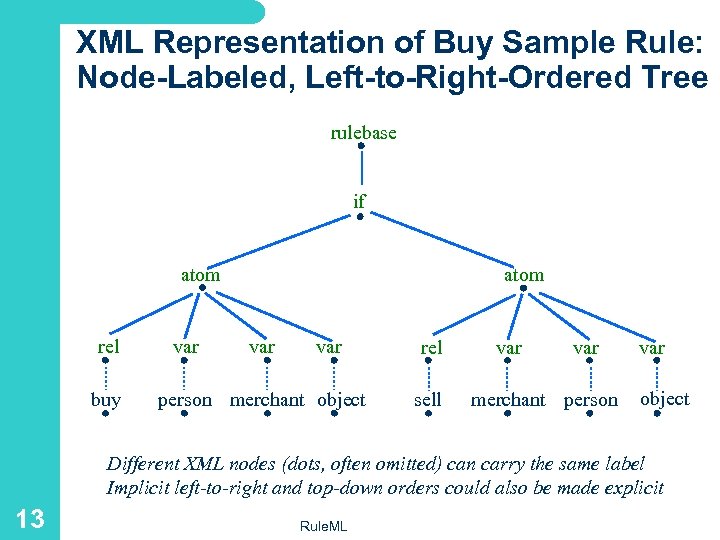 XML Representation of Buy Sample Rule: Node-Labeled, Left-to-Right-Ordered Tree rulebase if atom rel buy var atom var person merchant object rel sell var merchant person var object Different XML nodes (dots, often omitted) can carry the same label Implicit left-to-right and top-down orders could also be made explicit 13 Rule. ML
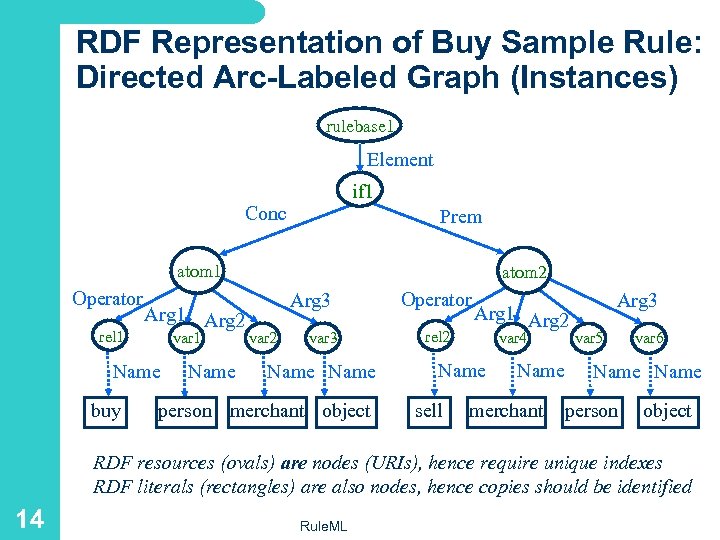 RDF Representation of Buy Sample Rule: Directed Arc-Labeled Graph (Instances) rulebase 1 Element if 1 Conc Prem atom 1 Operator rel 1 Arg 2 var 1 Name buy Name atom 2 Arg 3 var 2 var 3 Name person merchant object Operator rel 2 Arg 1 Arg 2 var 4 Name sell Name merchant Arg 3 var 5 var 6 Name person object RDF resources (ovals) are nodes (URIs), hence require unique indexes RDF literals (rectangles) are also nodes, hence copies should be identified 14 Rule. ML
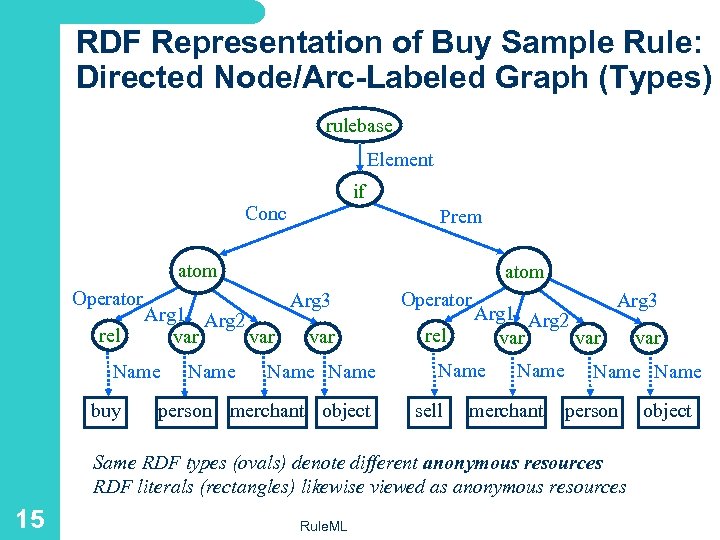 RDF Representation of Buy Sample Rule: Directed Node/Arc-Labeled Graph (Types) rulebase Element if Conc Prem atom Operator rel Arg 1 Arg 2 var Name buy atom Name Arg 3 var Name person merchant object Operator rel Arg 1 Arg 2 var Name sell Name merchant Arg 3 Name person Same RDF types (ovals) denote different anonymous resources RDF literals (rectangles) likewise viewed as anonymous resources 15 Rule. ML var object
 The Implemented RDF Representation: Rule. ML as RDF Serializations & Graphs l l l 16 RDF Container Bag for N-element rulebases and N -ary conjunctions (Set would be more precise); Seq for N-ary argument lists of atoms and nanos Preliminary serialization, open to change (see above): Joint work with DAML-Rules and Triple system, and possibly with Notation 3 and Euler Realized by XSLT translator from valid Rule. ML rulebases to RDF short (“Description type”) syntax (cf. nested property lists): http: //www. dfki. de/ruleml/rdf/ruledf. xsl Visualized by RDFViz tool: http: //www. dfki. de/ruleml/rdf/buy-rdfviz. gif Queries and inferences can, e. g. , be implemented via Triple and Euler Rule. ML
" src="https://present5.com/presentation/18d539602aa646c6221b9b297d70886b/image-18.jpg" alt=" " />
 Conclusions l l Rule. ML DTD 0. 7, a system of 12 DTDs, is available at http: //www. dfki. de/ruleml/indtd. html; sample files at http: //www. dfki. de/ruleml/exa The rule representation in RDF is described at http: //www. dfki. de/ruleml/inrdf. html l l 20 Further rule categories (e. g. ICs and triggers) and DTD updates will be available via main Rule. ML page at http: //www. dfki. de/ruleml Distributed KR can already be based on current DTDs -- using (XSLT) transformations to reach follow-up and Participants’ DTDs Rule. ML