 Скачать презентацию The Round Table of international shipping associations International
3031e8cd19246bd668faf625b7dd2287.ppt
- Количество слайдов: 74



The Round Table of international shipping associations International Shipping Federation 18 th. Asian Shipowners Forum The Round Table Seminar Tainan 26 May 2009
The Round Table of international shipping associations International Shipping Federation The ROUND TABLE of international shipping associations • BIMCO • INTERCARGO • International Chamber of Shipping/ International Shipping Federation (ICS / ISF) • INTERTANKO
The Round Table of international shipping associations International Shipping Federation The ROUND TABLE of international shipping associations MISSION • To work together to serve, represent and advance the international shipping industry VISION • A responsible and respected international shipping industry meeting the expectations of its stakeholders STRATEGIC OBJECTIVE • By acting in concert to avoid duplication on issues of consensus, where the combined effort of the Round Table can exceed the sum of the individual efforts
The Round Table of international shipping associations International Shipping Federation The ROUND TABLE of international shipping associations AGENDA • Climate Change / Green House Gas Emissions Philippe Embiricos / Niels Bjorn Mortensen - BIMCO • Ship Recycling Tony Mason - ICS / ISF • Piracy Rob Lomas - Intercargo • Environmental Overview Peter Swift / Tim Wilkins - INTERTANKO
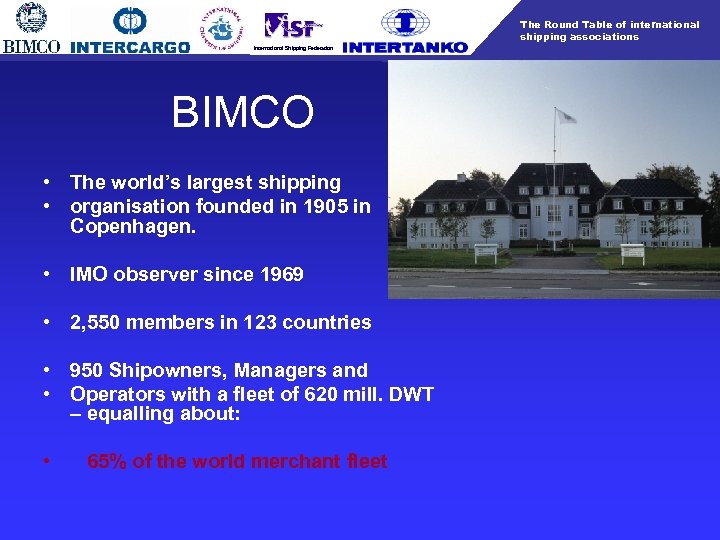
The Round Table of international shipping associations International Shipping Federation BIMCO • The world’s largest shipping • organisation founded in 1905 in Copenhagen. • IMO observer since 1969 • 2, 550 members in 123 countries • 950 Shipowners, Managers and • Operators with a fleet of 620 mill. DWT – equalling about: • 65% of the world merchant fleet
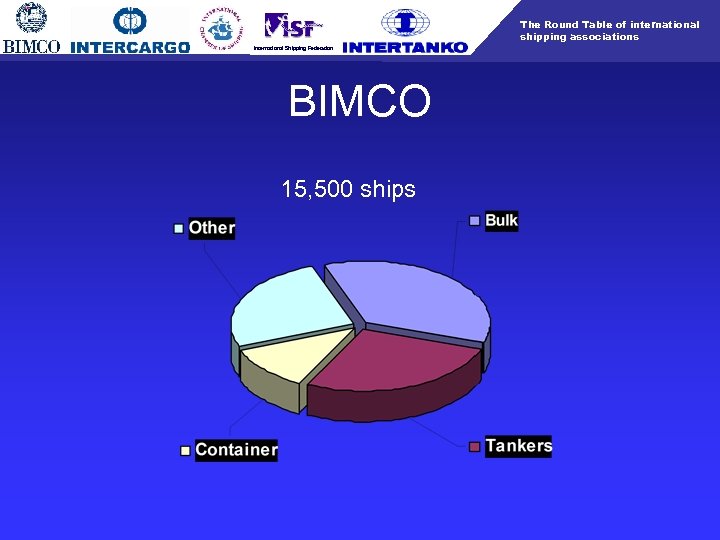
The Round Table of international shipping associations International Shipping Federation BIMCO 15, 500 ships
The Round Table of international shipping associations International Shipping Federation Global Warming Scientists have agreed to the necessity to limit Global Warming to 2 deg. C. A temperature increase of 2 -4 deg. C will lead to increased droughts in certain areas, increased precipitation in other areas and more frequent and violent hurricanes. A temperature increase of more than 4 deg. C would most likely change the planet as we know it today.
The Round Table of international shipping associations International Shipping Federation GHG & Global Warming Kyoto Annex I countries have agreed to reduce GHG by 5. 2% by 2012 compared to 1990. Scientists suggest a 50% reduction in GHG emissions by 2050 in order to limit Global Warming to 2 deg. C. At a recent meeting, 80% reduction by 2050 was suggested as being required to stay within the 2 deg. C. target.
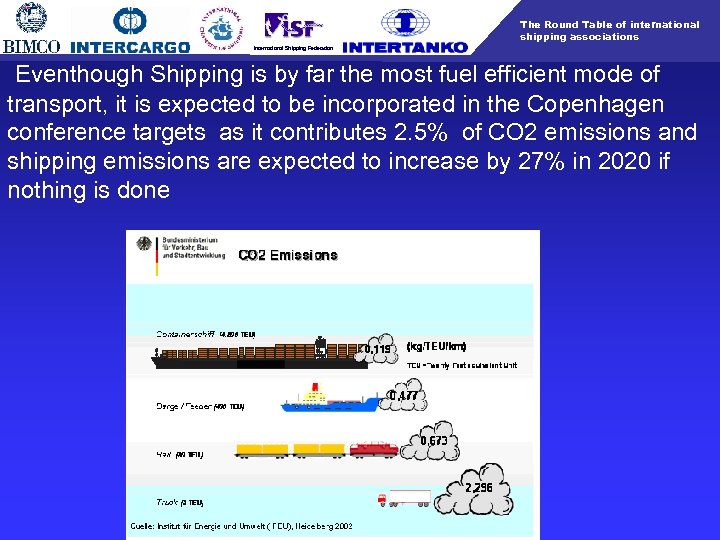
The Round Table of international shipping associations International Shipping Federation Eventhough Shipping is by far the most fuel efficient mode of transport, it is expected to be incorporated in the Copenhagen conference targets as it contributes 2. 5% of CO 2 emissions and shipping emissions are expected to increase by 27% in 2020 if nothing is done
The Round Table of international shipping associations International Shipping Federation IMO’s Principles Summary • Be cost effective in reducing global GHG emissions • Be binding on and applicable to all Flag States and all ships • Not distort competition • Assist sustainable environmental development without penalising trade growth • Promote technical innovation and leading technologies • Be practical, transparent, easy to administer & fraud-free
The Round Table of international shipping associations International Shipping Federation TOOLS What are the options for shipping to reduce CO 2 emissions? 1. Improve efficiency ( better designs for new ships and retofitting of energy saving devices on existing ships. 2. Slow steaming (increased crew requirements due to additional shipps needed to serve the trade. 3. Market Based Instruments (MBI) if 1&2 are not deemed sufficient contribution from Shipping.
The Round Table of international shipping associations International Shipping Federation Improve Efficiency • The Energy Efficiency Design Index (EEDI) will ensure that new ships are at least as efficient as the newest ships at the time of ordering. The target may be lowered over time. • Ship Efficiency Management Plan (SEMP)– a shipping Industry initiative: Lists 20+ various ship efficiency initiatives that can be implemented. • Voluntary Energy Efficiency Operational Indicator (EEOI) management tool for owners and charterers to measure energy efficiency on a voyage. Uniform application across all sectors difficult to implement. Up for final agreement by IMO at MEPC 59 in July 2009.
The Round Table of international shipping associations International Shipping Federation Ship Efficiency • It was estimated by the IMO Expert Group that fuel efficiency of new ships can be increased in the order of 30 -40%while retrofitting of energy saving equipment might reduce consumption by 10%. • Slow steaming is efficient, but will require more ships therefore more crews. • Given the predicted growth in shipping, fuel consumption is estimated to increase with 24% between 2007 and 2020. This may be revised downwards because of the slow down in trade. • If shipping is required to reduce its emissions by 50% or more, it cannot be done by technical and operational measures only. • Market Based Instruments (MBI) will need to be applied in the form of Emission Trading or Fuel Levy.
The Round Table of international shipping associations International Shipping Federation Slow Steaming • 8000 TEU Containership • Reduce speed by 20%: 25 -20 knots • Fuel consumption reduced by 51% • However, since 20% more ships will be needed to carry the same volume the saving will be 42. 5 % , a serious reduction.
The Round Table of international shipping associations International Shipping Federation Market Based Instruments • Emission Trading Schemes – ETS - are part of the Kyoto Protocol and are utilized in several land-based industries. • Aviation and Shipping were exempted from regulation by the Kyoto Protocol. • In July 2008 the EU Parliament decided to include Aviation in the EU ETS (an ETS scheme developed for Europe). • Several EU MEPs have expressed a need of also including Shipping in the EU ETS • IMO will discuss ETS and fixed carbon charges on unit fuel consumed at MEPC 59 in July 2009 as ETS may not be suitable for shipping.
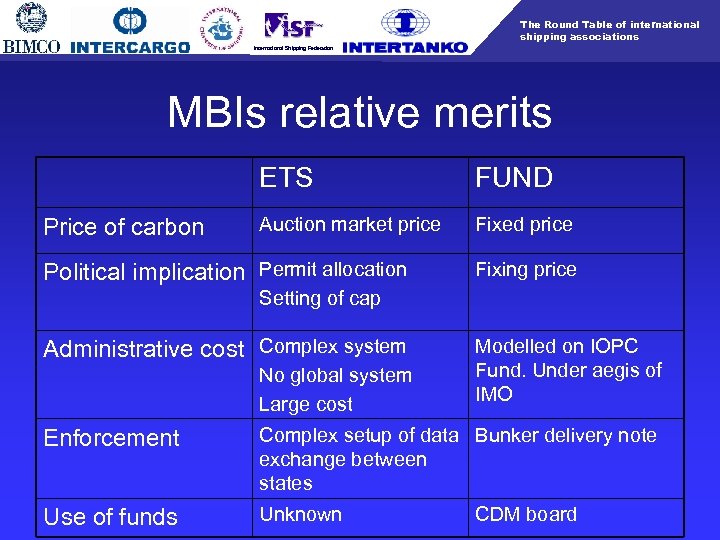
The Round Table of international shipping associations International Shipping Federation MBIs relative merits ETS Price of carbon FUND Auction market price Fixed price Political implication Permit allocation Fixing price Setting of cap Administrative cost Complex system No global system Large cost Modelled on IOPC Fund. Under aegis of IMO Enforcement Complex setup of data Bunker delivery note exchange between states Use of funds Unknown CDM board
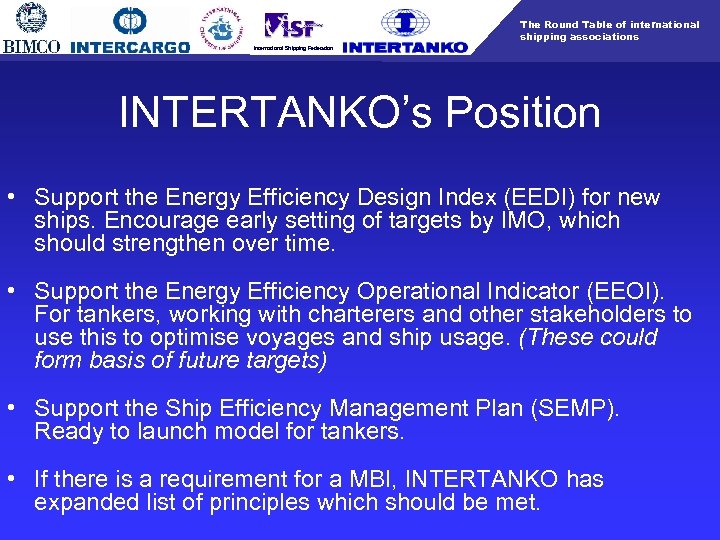
The Round Table of international shipping associations International Shipping Federation INTERTANKO’s Position • Support the Energy Efficiency Design Index (EEDI) for new ships. Encourage early setting of targets by IMO, which should strengthen over time. • Support the Energy Efficiency Operational Indicator (EEOI). For tankers, working with charterers and other stakeholders to use this to optimise voyages and ship usage. (These could form basis of future targets) • Support the Ship Efficiency Management Plan (SEMP). Ready to launch model for tankers. • If there is a requirement for a MBI, INTERTANKO has expanded list of principles which should be met.
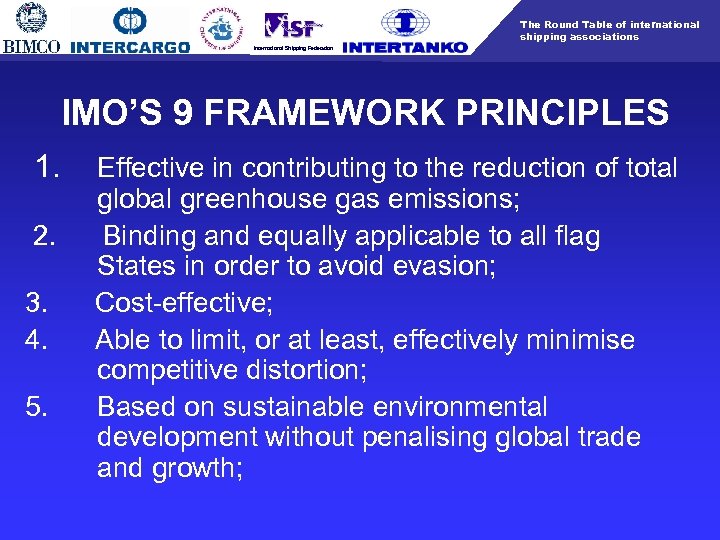
The Round Table of international shipping associations International Shipping Federation IMO’S 9 FRAMEWORK PRINCIPLES 1. Effective in contributing to the reduction of total global greenhouse gas emissions; 2. Binding and equally applicable to all flag States in order to avoid evasion; 3. Cost-effective; 4. Able to limit, or at least, effectively minimise competitive distortion; 5. Based on sustainable environmental development without penalising global trade and growth;
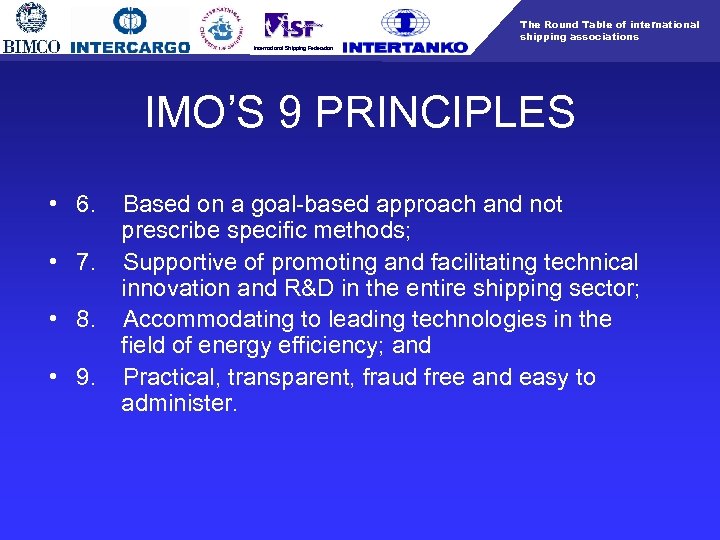
The Round Table of international shipping associations International Shipping Federation IMO’S 9 PRINCIPLES • 6. Based on a goal-based approach and not prescribe specific methods; • 7. Supportive of promoting and facilitating technical innovation and R&D in the entire shipping sector; • 8. Accommodating to leading technologies in the field of energy efficiency; and • 9. Practical, transparent, fraud free and easy to administer.
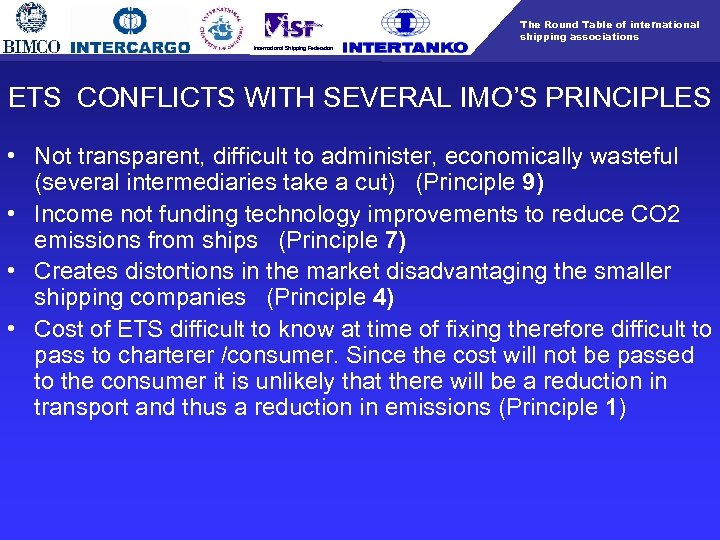
The Round Table of international shipping associations International Shipping Federation ETS CONFLICTS WITH SEVERAL IMO’S PRINCIPLES • Not transparent, difficult to administer, economically wasteful (several intermediaries take a cut) (Principle 9) • Income not funding technology improvements to reduce CO 2 emissions from ships (Principle 7) • Creates distortions in the market disadvantaging the smaller shipping companies (Principle 4) • Cost of ETS difficult to know at time of fixing therefore difficult to pass to charterer /consumer. Since the cost will not be passed to the consumer it is unlikely that there will be a reduction in transport and thus a reduction in emissions (Principle 1)
The Round Table of international shipping associations International Shipping Federation MBIs (Compensation Fund) • • The establishment of a Compensation Fund has been proposed to IMO MEPC 59 by Denmark. The Fund should be administrated by IMO similar to the IOPC Fund. The Fund could then either purchase carbon permits on the international emission trading market from Annex 1 Countries CDM - or finance other Green projects. Pr 7 The cost of a levy can be passed on to the charterer and to the consumer, reducing demand for transportation and thus CO 2. Pr 1. A levy is transparent and easy to administer Pr 9. A levy will not distort competition, thus fulfilling Pr 4. A levy is able to deal with the different situations prevailing in the shipping industry where bunkers are sometimes purchased by the charterer and other times by the shipowner. The amount of the levy will be predictable and steady and thus will not be detrimental to trade
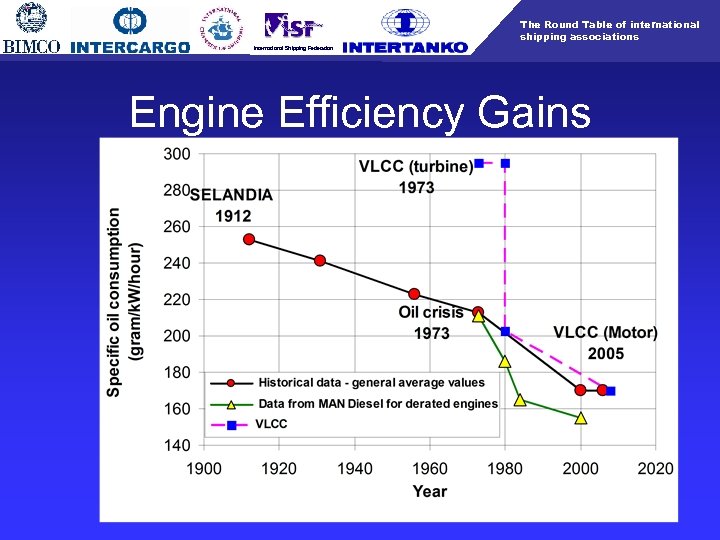
The Round Table of international shipping associations International Shipping Federation Engine Efficiency Gains
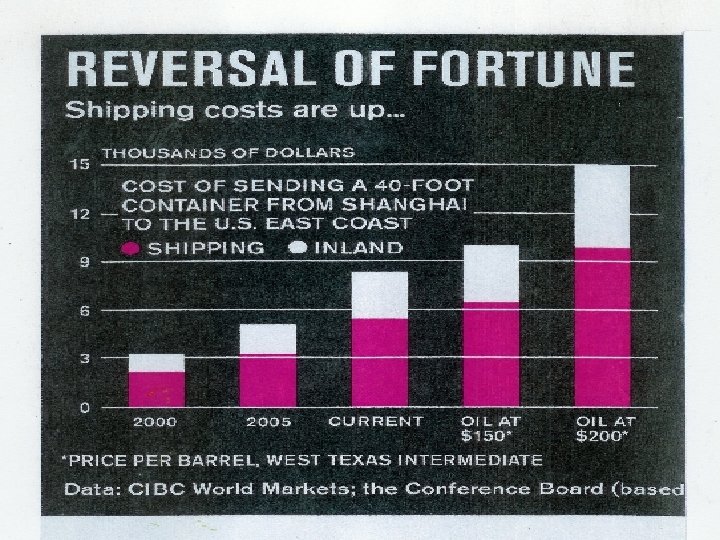
The Round Table of international shipping associations International Shipping Federation
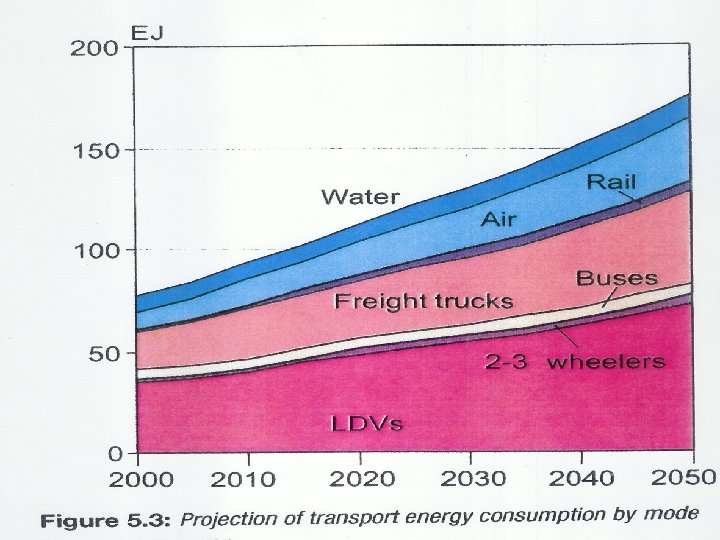
The Round Table of international shipping associations International Shipping Federation
The Round Table of international shipping associations International Shipping Federation Convey to the attendees of Copenhagen some of Joseph Stiglitz thoughts • Global warming is a long-run global problem, and needs to be addressed globally. • ETS are easy to implement for major sources of emissions, but harder to implement for multitude of small sources. • Carbon credit pricing is inequitable and biased. Bio fuels benefits are overpriced and ignore rising cost of food and cost of water. • The costs of reducing emissions will be much lower if all emissions in all countries & ways to reduce emissions are taken into account (in our case all transport modes) CONCLUSION: Any carbon compensation charge should be also applied to other forms of transport so as not to cause a shift cargo from the Sea to the road and increase overall CO 2 levels.
The Round Table of international shipping associations International Shipping Federation RT’s Position • Supports the Energy Efficiency Design Index (EEDI) for new ships. • Supports the Ship Efficiency Management Plan (SEMP). • Concerned with application of the Energy Efficiency Operational Indicator (EEOI). • Any MBI applied to shipping must follow the IMO principles, be established and administrated through the IMO. . . • . . . provided it does not shift traffic from sea to road thus increasing overall CO 2 from transport.
The Round Table of international shipping associations International Shipping Federation SHIP RECYCLING Tony Mason Secretary General International Chamber of Shipping
The Round Table of international shipping associations International Shipping Federation INTERNATIONAL CHAMBER OF SHIPPING/INTERNATIONAL SHIPPING FEDERATION • ICS – International Trade Association • ISF – Maritime Employers’ Association • Members are National Shipowners Associations (40 members) • Principal Areas of Activity Ø International Regulatory Issues – IMO/ILO Ø Legal Matters (IMO, UNCLOS, UNCITRAL, etc. ) Ø Shipping Policy Issues (OECD, CSG, etc) Ø Best Practice/Technical Publications
The Round Table of international shipping associations International Shipping Federation Industry’s Engagement • Industry Working Group On Ship Recycling (1998) – Shipowners – Class Societies – Trade Unions – P&I Clubs
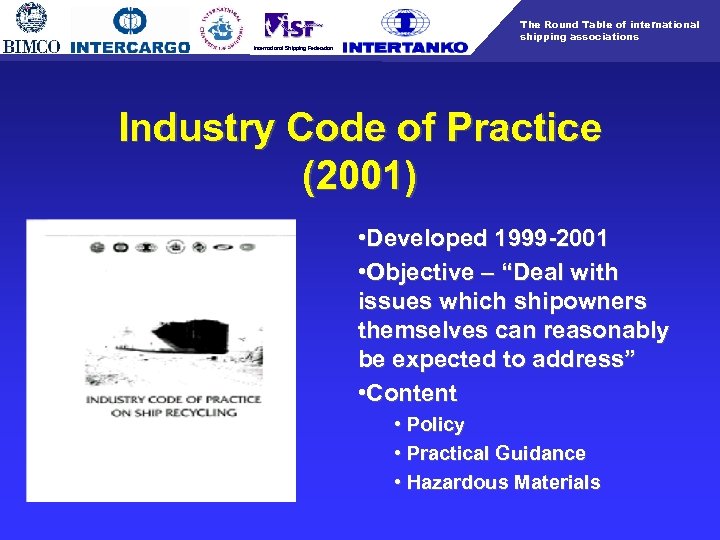
The Round Table of international shipping associations International Shipping Federation Industry Code of Practice (2001) • Developed 1999 -2001 • Objective – “Deal with issues which shipowners themselves can reasonably be expected to address” • Content • Policy • Practical Guidance • Hazardous Materials
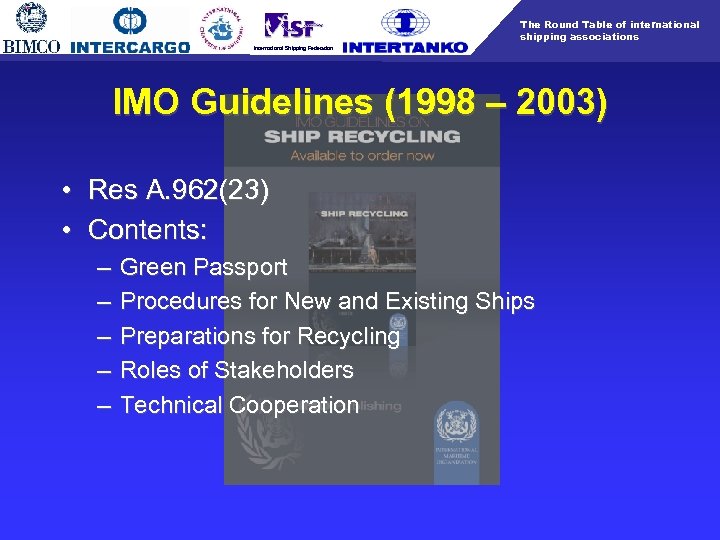
The Round Table of international shipping associations International Shipping Federation IMO Guidelines (1998 – 2003) • Res A. 962(23) • Contents: – – – Green Passport Procedures for New and Existing Ships Preparations for Recycling Roles of Stakeholders Technical Cooperation
The Round Table of international shipping associations International Shipping Federation IMO Convention (2004 – 2009) • Proposed by Norway (MEPC 53) • International Cooperation – IMO/ILO/Basel Convention Joint Working Groups • London and Geneva – IMO Seminars • Turkey, China, India, Bangladesh
The Round Table of international shipping associations International Shipping Federation INTERIM MEASURES (2007) • • • Yard Selection Inventory of Hazardous Materials Gas Freeing Ship Recycling Plan Reporting to Flag State
The Round Table of international shipping associations International Shipping Federation Diplomatic Conference • Hong Kong, China, 11 -15 May 2009 – Entry Into Force Criteria – Survey and Certification Requirements – Tonnage Limitations
The Round Table of international shipping associations International Shipping Federation Diplomatic Conference • Hong Kong International Convention on the Safe and Environmentally Sound Recycling of Ships, 2009 – Entry into Force Criteria: 15 States; 40% tonnage; 3% recycling capacity; 24 Months after the criteria are met
The Round Table of international shipping associations International Shipping Federation Diplomatic Conference • Key Provisions – Inventory of Hazardous Materials – Approved Recycling Facilities – Approved Ship Recycling Plans – Final Survey – Cleaning for Gas Freeing for Tankers on Delivery – Reporting Requirements
The Round Table of international shipping associations International Shipping Federation Problems with Transition • No universal legal regime amongst flag or recycling States • Fulfilling responsibilities without increasing liability • Changing nature of the global recycling environment
The Round Table of international shipping associations International Shipping Federation Commercial Mechanism • Making certain provisions a condition of sale • Due diligence for shipowners • Pressure to move towards best practice and pre-empt entry into force • Develop a picture of global compliance
The Round Table of international shipping associations International Shipping Federation Transitional Guidance • • • Lifetime requirements for ships Selling a ship Facility competence Certification and reporting Feedback
The Round Table of international shipping associations International Shipping Federation Transitional Guidance • Lifetime requirements for ships – Inventory of Hazardous Materials • Convention Requirements • Commercial Options – Objective: Increase current use throughout industry • Selling a ship – Methods of Sale • Cash Buyer vs. Direct to Yard • Implications for contract requirements
The Round Table of international shipping associations International Shipping Federation Transitional Guidance • Facility competence – Ship Recycling Plan • Provision of information • Checking against the IHM – Gas Freeing • Pre arrival cleaning • Contractual Guarantee – Facility Management Plan • Worker Health and Safety Programme • Waste Stream Management
The Round Table of international shipping associations International Shipping Federation Transitional Guidance • Certification and reporting – Class Society confirmation – Report to Flag State • Feedback – Help develop guidance to fit the reality of the burgeoning regime
The Round Table of international shipping associations International Shipping Federation EC Consultation • Non Legislative Stakeholder Interim Measures • Funding • List of End of Life Ships • Control and Enforcement of Existing Regimes • “Green” Facilities List
The Round Table of international shipping associations International Shipping Federation Intercargo • Formed 1980 • Dry Bulk Owners Association • Most of the largest Dry Bulk Owners as members • c 850 entered vessels (out of global fleet of c 6, 565) • Common Industry challenges addressed through 13 Point Work Programme : – Safety, Air Emissions, Excessive Loading Rates and Piracy
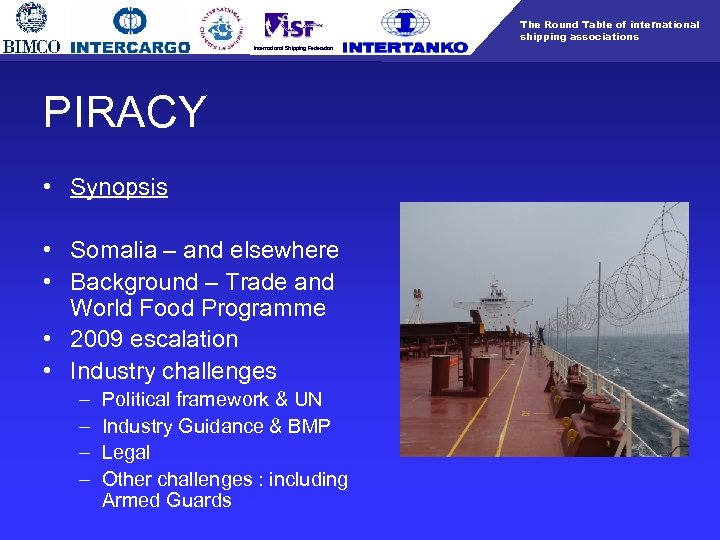
The Round Table of international shipping associations International Shipping Federation PIRACY • Synopsis • Somalia – and elsewhere • Background – Trade and World Food Programme • 2009 escalation • Industry challenges – – Political framework & UN Industry Guidance & BMP Legal Other challenges : including Armed Guards
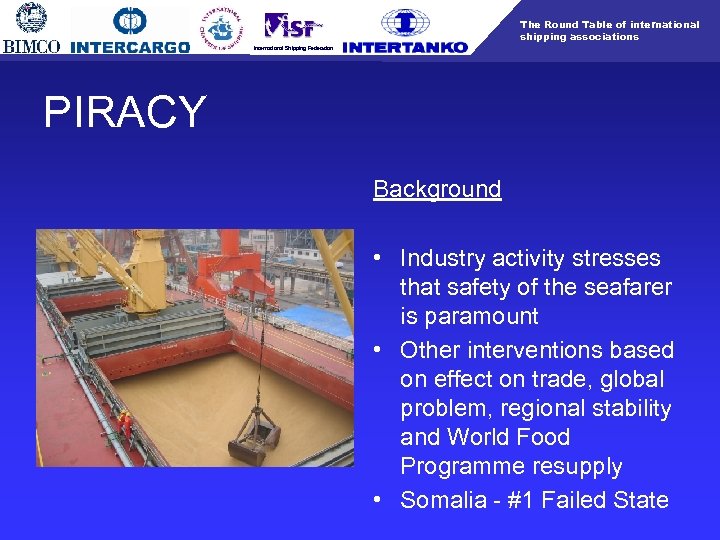
The Round Table of international shipping associations International Shipping Federation PIRACY Background • Industry activity stresses that safety of the seafarer is paramount • Other interventions based on effect on trade, global problem, regional stability and World Food Programme resupply • Somalia - #1 Failed State
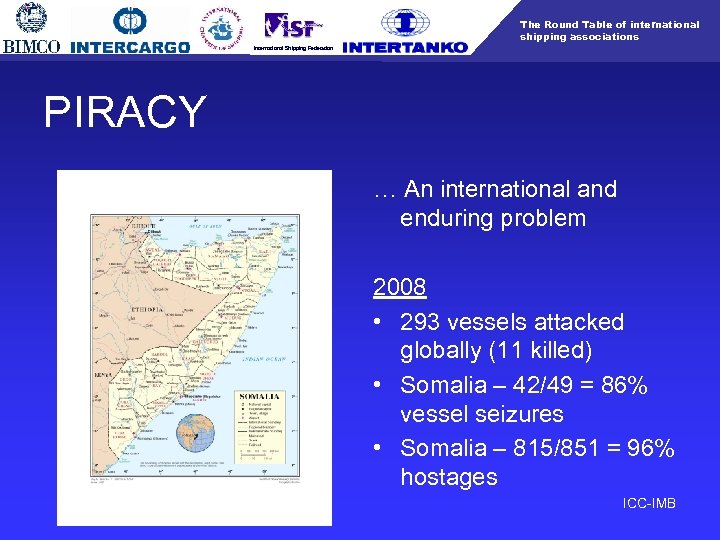
The Round Table of international shipping associations International Shipping Federation PIRACY … An international and enduring problem 2008 • 293 vessels attacked globally (11 killed) • Somalia – 42/49 = 86% vessel seizures • Somalia – 815/851 = 96% hostages ICC-IMB
The Round Table of international shipping associations International Shipping Federation PIRACY 2009 Update : SOMALIA • Up to 15 May, ships hijacked : 29; hostages : 472 (IMB) • Vessels attacked 1 April – 22 May : 63 – Gen Cargo (14); Bulk Carrier (14); Tanker (13); Other / n/r (13); Container (9) • April attacks – Gulf of Aden 45%; East of Somalia 45%, n/r 5%
The Round Table of international shipping associations International Shipping Federation PIRACY 1. Political framework & UN • Within the context of no functioning Somali Government… • UN and IMO actions included – – Emphasis on the roles of Warships to protect trade : 23 nations represented within EUNAVFOR, NATO and Non-aligned – Appropriate UN Security Council Resolutions to interdict : 1846 – UNCLOS extension; 1851 – Governments formed International Cooperative Mechanism (“The Contact Group” : meeting 29 May)
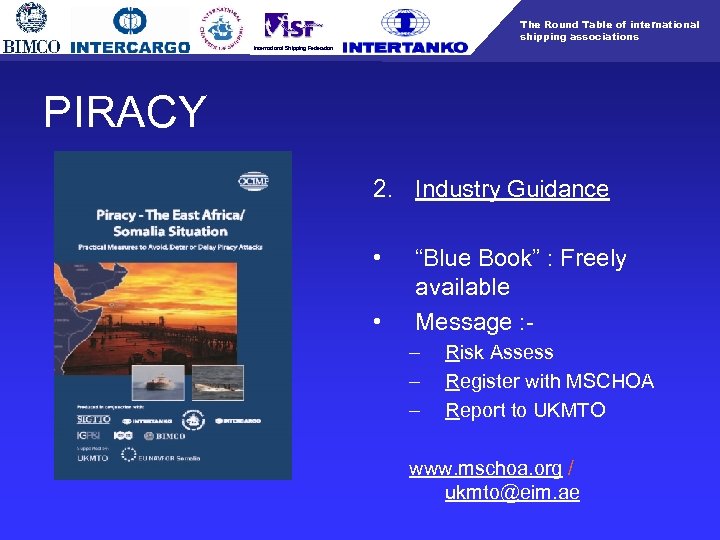
The Round Table of international shipping associations International Shipping Federation PIRACY 2. Industry Guidance • • “Blue Book” : Freely available Message : – – – Risk Assess Register with MSCHOA Report to UKMTO www. mschoa. org / ukmto@eim. ae
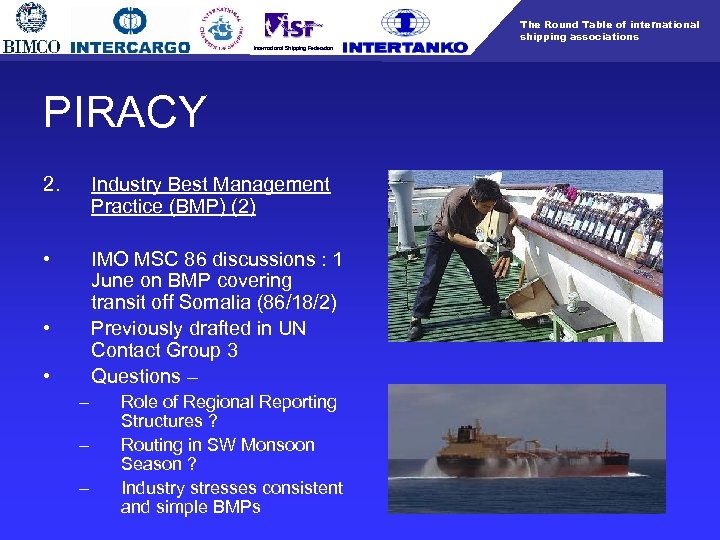
The Round Table of international shipping associations International Shipping Federation PIRACY 2. Industry Best Management Practice (BMP) (2) • IMO MSC 86 discussions : 1 June on BMP covering transit off Somalia (86/18/2) Previously drafted in UN Contact Group 3 Questions – • • – – – Role of Regional Reporting Structures ? Routing in SW Monsoon Season ? Industry stresses consistent and simple BMPs
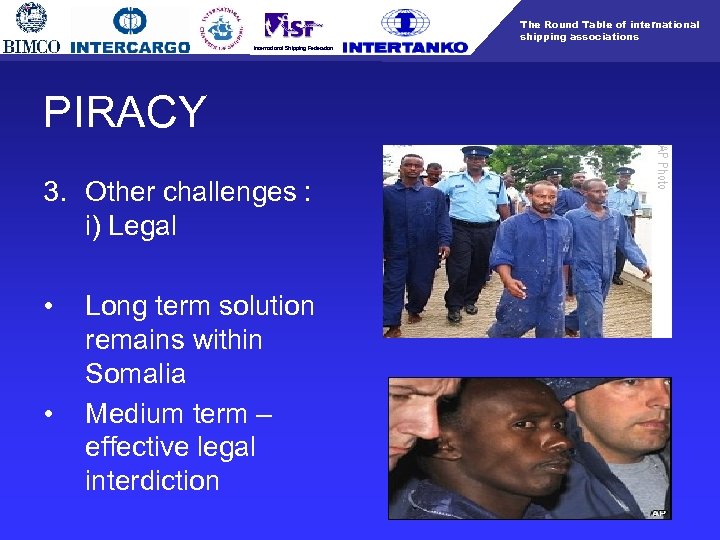
The Round Table of international shipping associations International Shipping Federation PIRACY 3. Other challenges : i) Legal • • Long term solution remains within Somalia Medium term – effective legal interdiction
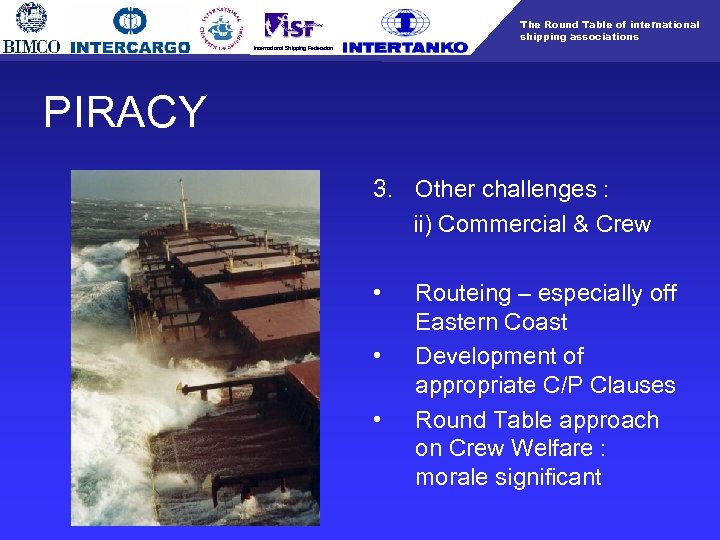
The Round Table of international shipping associations International Shipping Federation PIRACY 3. Other challenges : ii) Commercial & Crew • • • Routeing – especially off Eastern Coast Development of appropriate C/P Clauses Round Table approach on Crew Welfare : morale significant
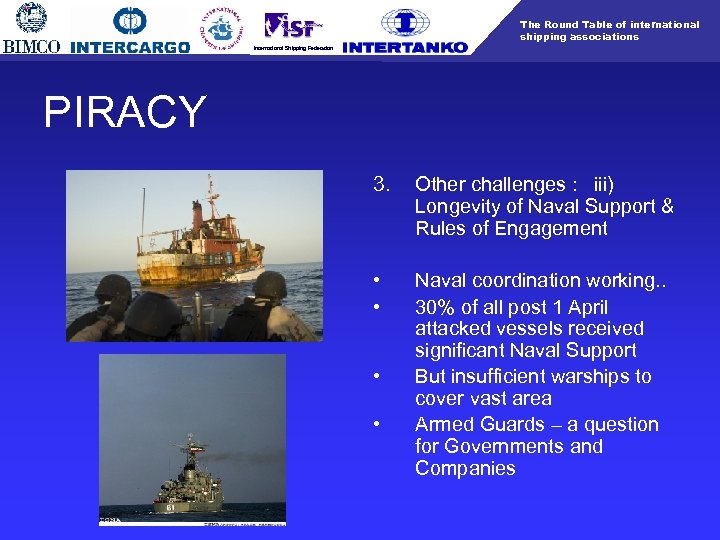
The Round Table of international shipping associations International Shipping Federation PIRACY 3. Other challenges : iii) Longevity of Naval Support & Rules of Engagement • • Naval coordination working. . 30% of all post 1 April attacked vessels received significant Naval Support But insufficient warships to cover vast area Armed Guards – a question for Governments and Companies • •
The Round Table of international shipping associations International Shipping Federation PIRACY CONCLUSIONS • Piracy here for some time • BMP Guidance – including : Risk Assessment / Registering / Reporting significantly reduces Risk • Proven - Evasive manoeuvring & Group Transit • BMP needs promulgation to all ships • IMO and Governmental pressure needed to maintain and enhance existing naval support for trade preservation • Seafarers are #1 priority…
The Round Table of international shipping associations International Shipping Federation INTERTANKO International Association of Independent Tanker Owners The Voice of the Tanker Industry London, Oslo, Singapore, Washington, Brussels, Manila “ Leading the way; Making a difference ” Committed to Continuous Improvement 2009 Seatrade Award for INTERTANKO’s TOTS initiative
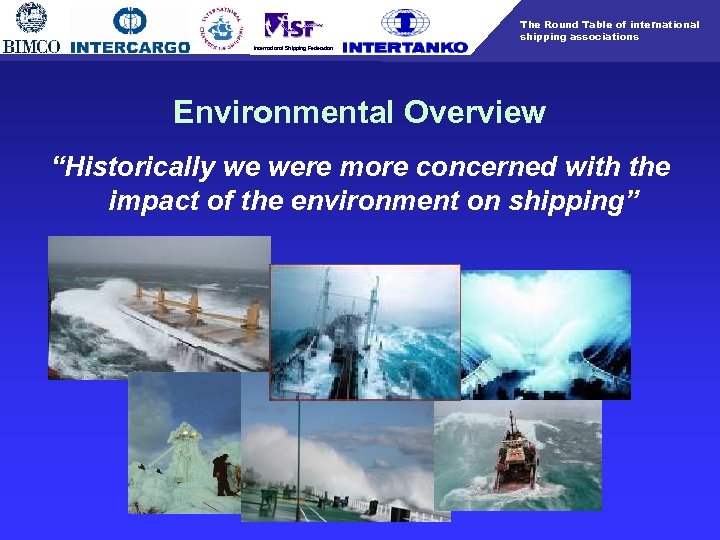
The Round Table of international shipping associations International Shipping Federation Environmental Overview “Historically we were more concerned with the impact of the environment on shipping”
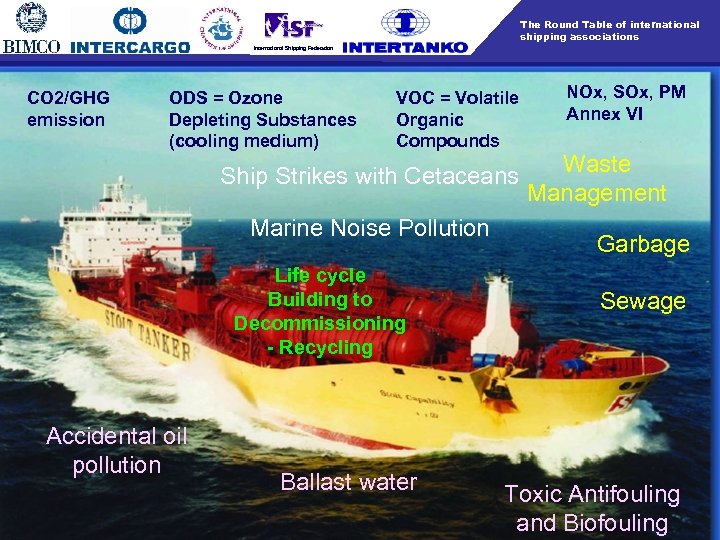
The Round Table of international shipping associations International Shipping Federation CO 2/GHG emission ODS = Ozone Depleting Substances (cooling medium) VOC = Volatile Organic Compounds Ship Strikes with Cetaceans Marine Noise Pollution Life cycle Building to Decommissioning - Recycling Accidental oil pollution Ballast water NOx, SOx, PM Annex VI Waste Management Garbage Sewage Toxic Antifouling and Biofouling
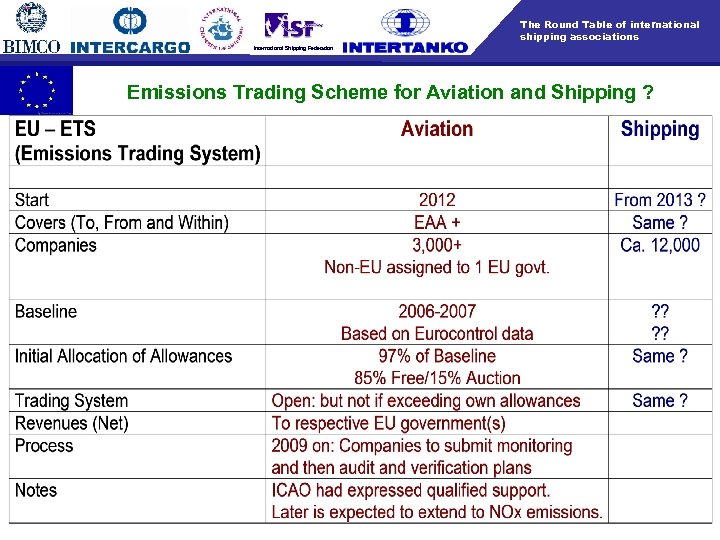
The Round Table of international shipping associations International Shipping Federation Emissions Trading Scheme for Aviation and Shipping ?
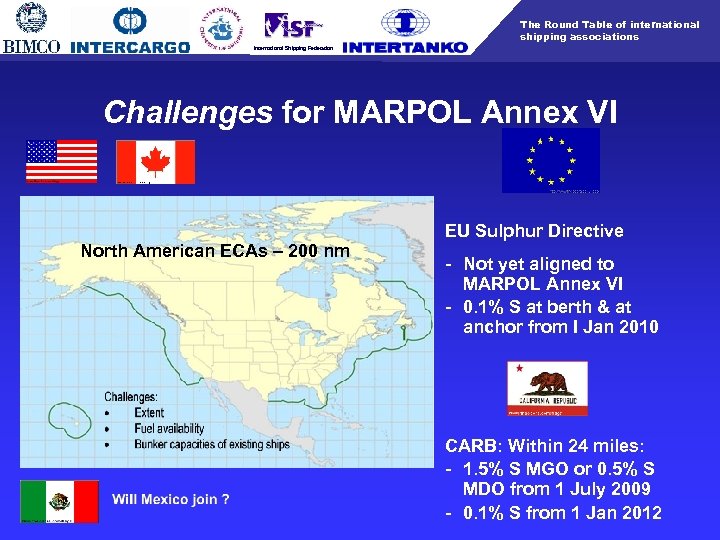
The Round Table of international shipping associations International Shipping Federation Challenges for MARPOL Annex VI North American ECAs – 200 nm EU Sulphur Directive - Not yet aligned to MARPOL Annex VI - 0. 1% S at berth & at anchor from I Jan 2010 CARB: Within 24 miles: - 1. 5% S MGO or 0. 5% S MDO from 1 July 2009 - 0. 1% S from 1 Jan 2012
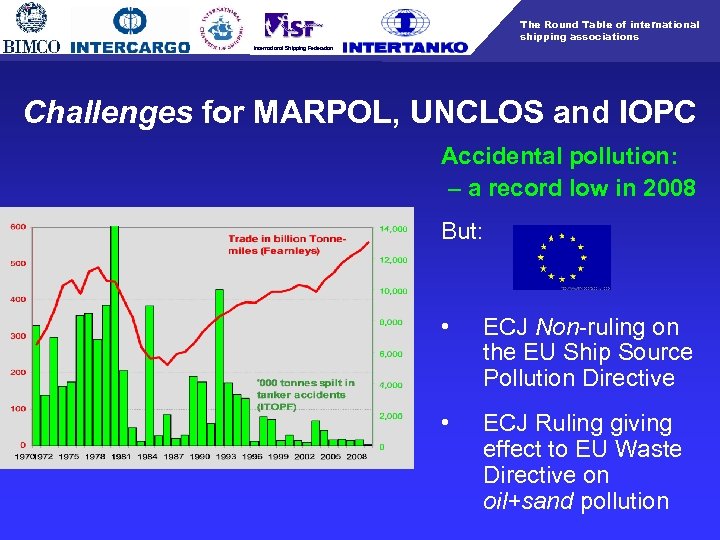
The Round Table of international shipping associations International Shipping Federation Challenges for MARPOL, UNCLOS and IOPC Accidental pollution: – a record low in 2008 But: • ECJ Non-ruling on the EU Ship Source Pollution Directive • ECJ Ruling giving effect to EU Waste Directive on oil+sand pollution
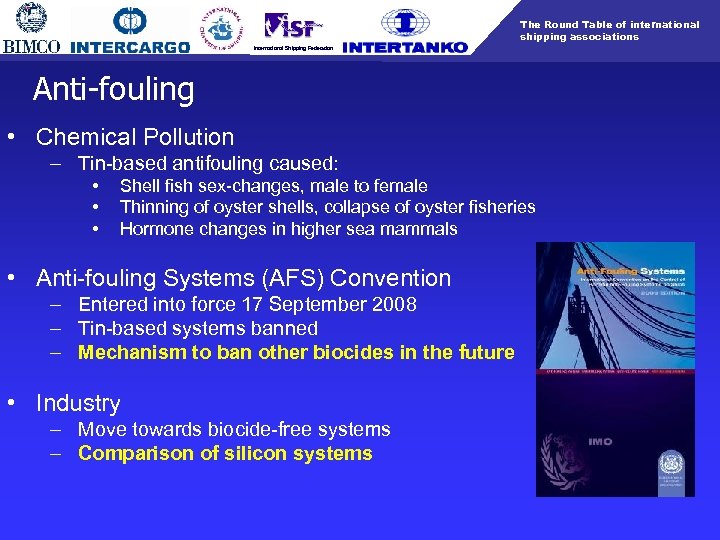
The Round Table of international shipping associations International Shipping Federation Anti-fouling • Chemical Pollution – Tin-based antifouling caused: • • • Shell fish sex-changes, male to female Thinning of oyster shells, collapse of oyster fisheries Hormone changes in higher sea mammals • Anti-fouling Systems (AFS) Convention – Entered into force 17 September 2008 – Tin-based systems banned – Mechanism to ban other biocides in the future • Industry – Move towards biocide-free systems – Comparison of silicon systems
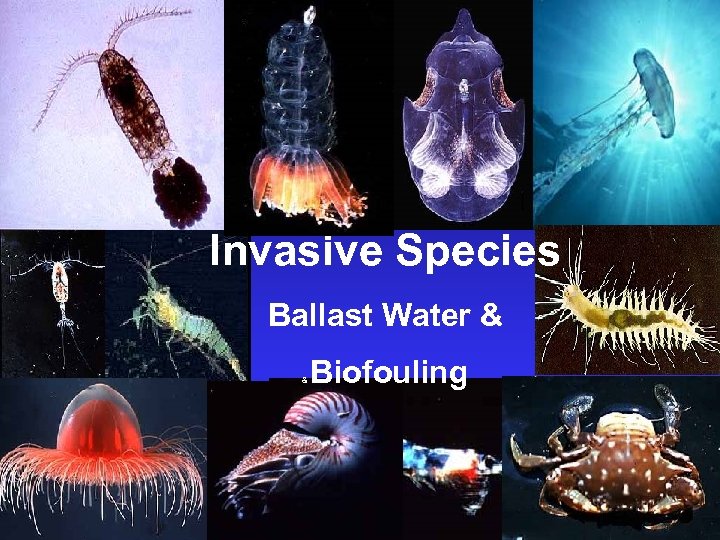
The Round Table of international shipping associations International Shipping Federation Invasive Species Ballast Water & & Biofouling
The Round Table of international shipping associations International Shipping Federation Ballast Water Management • Biological Pollution – • Invasive species IMO Ballast Water Convention – – – • Question over entry into force Will the technologies work? Regional requirements Industry – – Share information on experience with new technology Ballast Water Management plans as standard practice for over 5 years Awareness and implementation contained in the IMO guidelines Assist compliance by sharing information on regional and national regulations, . e. g. NPDES and the VGP. . .
The Round Table of international shipping associations International Shipping Federation US EPA NPDES VGP * National Pollutant Discharge Elimination System / Vessel General Permit APPLICABILITY • Applies to all commercial vessels 79 feet in length or greater • Covers US inland waters and within 3 nautical mile territorial sea • Applies to 28 discharges incidental to ship operations KEY PROVISIONS OF NPDES PROGRAM • Discharge limits • Best Management Practices for 23 of the discharges • Specific requirements for ballast water, gray water, bilge water, antifouling and underwater husbandry • Additional requirements for tankers for inert gas scrubber, deck seals, scuppers, Additional requirements for tankers inspections and crew training COMPLIANCE 1. 2. 3. 4. Corrective Action, self-policing Inspections and monitoring Reporting Record keeping
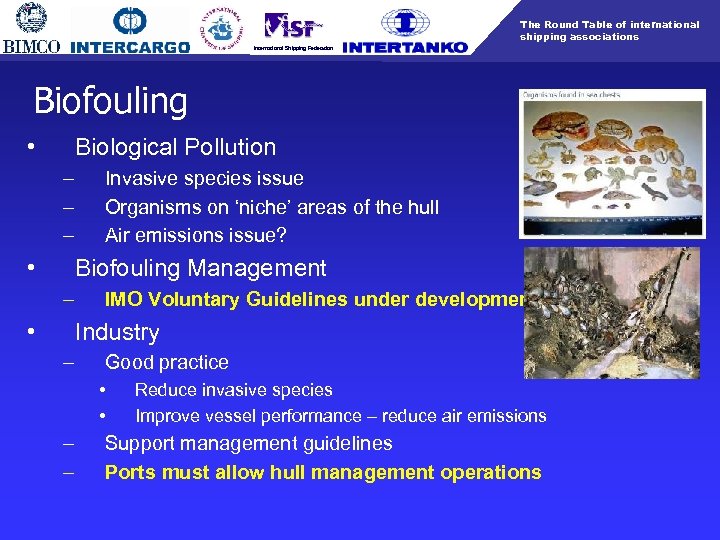
The Round Table of international shipping associations International Shipping Federation Biofouling • Biological Pollution – – – • Invasive species issue Organisms on ‘niche’ areas of the hull Air emissions issue? Biofouling Management – • IMO Voluntary Guidelines under development Industry – Good practice • • – – Reduce invasive species Improve vessel performance – reduce air emissions Support management guidelines Ports must allow hull management operations
The Round Table of international shipping associations International Shipping Federation Waste management - reception facilities • Zero tolerance on pollution • Reception facilities frequently an overlooked solution Regional Cooperation HELCOM The Baltic Sea REMPEC The Mediterranean Sea European Commission EU Directive Gulfs Area (ME) ROPME and MEMAC North America USCG Feedback Forms Asia-Pacific . . . .
The Round Table of international shipping associations International Shipping Federation Waste management - reception facilities Looking forward • Reporting of “lack/inadequacy” to IMO/flag administration • IMO Guide to Good Practice • Use of GISIS - New reporting Form (MEPC Circ. 469 Rev 1) - IMO momentum sustained: Action Plan and Correspondence Group – Industry input in CG – Adoption at MEPC 59 – What the industry should expect in terms of service at ports (and vice versa) - A Tool for the Industry: i. to report inadequate facilities ii. to view inadequate facility follow up iii. to gather facility information • Waste recycling - Benchmarking – waste minimization - Waste Delivery Receipt will become important
The Round Table of international shipping associations International Shipping Federation Waste management – special areas • Mediterranean Area received Special Area Status on 1 May • Dry Bulk Cargo Residues AND Hold washing Water to be discharged ashore • Lack of suitable tanks and pumping arrangements ashore • Doubts remain about availability of Reception Facilities • No consideration of Hold Washing Water facilities, so … MEPC 59 paper asking for continuation of existing arrangements, i. e. delay implementing Annex V.
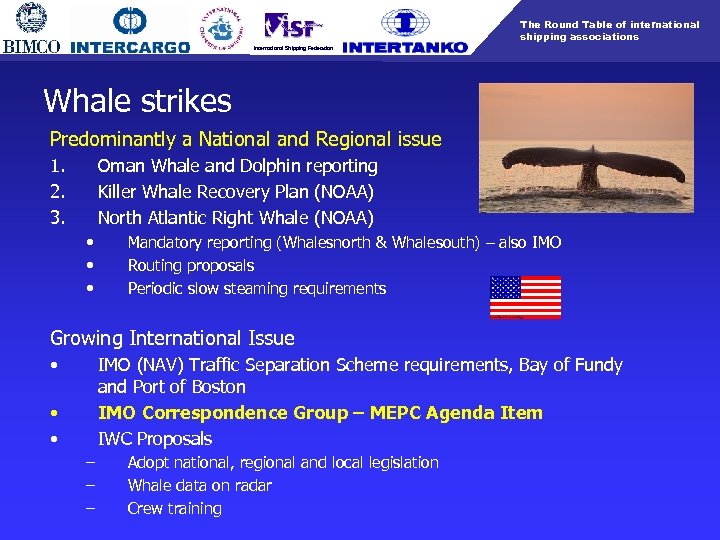
The Round Table of international shipping associations International Shipping Federation Whale strikes Predominantly a National and Regional issue 1. 2. 3. Oman Whale and Dolphin reporting Killer Whale Recovery Plan (NOAA) North Atlantic Right Whale (NOAA) • • • Mandatory reporting (Whalesnorth & Whalesouth) – also IMO Routing proposals Periodic slow steaming requirements Growing International Issue • IMO (NAV) Traffic Separation Scheme requirements, Bay of Fundy and Port of Boston IMO Correspondence Group – MEPC Agenda Item IWC Proposals • • – – – Adopt national, regional and local legislation Whale data on radar Crew training
The Round Table of international shipping associations International Shipping Federation Noise Pollution IMO MEPC Agenda item - Correspondence Group identify and address ways to minimize the incidental introduction of noise from commercial shipping operations into the marine environment to reduce potential adverse impacts on marine life • Technical Solutions 1. 2. • Hull/Propeller Design Underwater radiated noise from machinery CG Work will likely lead to: – – IMO Non-binding Technical Guidelines develop practical, effective guidance on solutions that can reduce the incidental introduction of underwater noise from commercial shipping in turn reducing potential adverse impacts to marine life
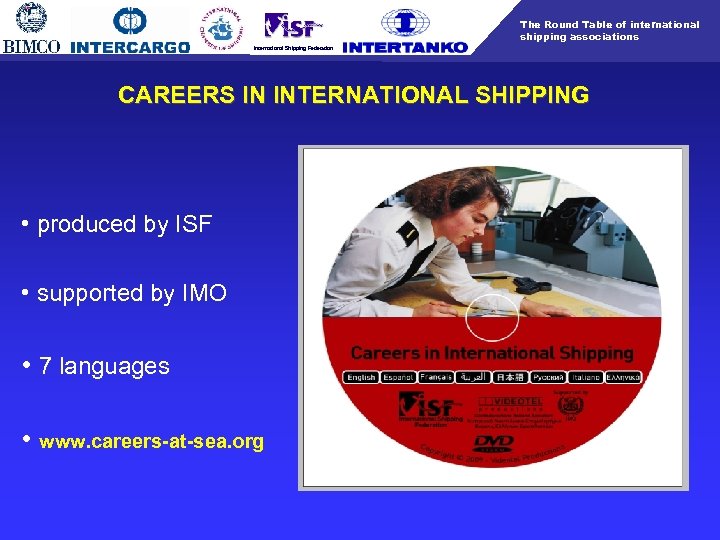
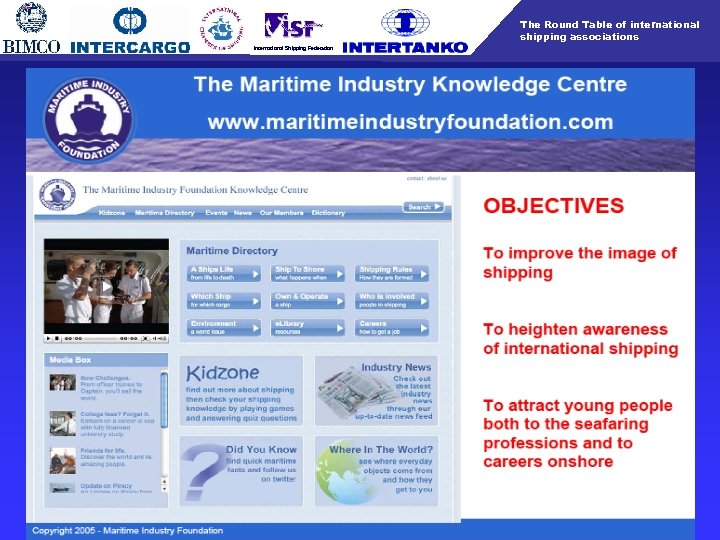
The Round Table of international shipping associations International Shipping Federation CAREERS IN INTERNATIONAL SHIPPING • produced by ISF • supported by IMO • 7 languages • www. careers-at-sea. org
The Round Table of international shipping associations International Shipping Federation
The Round Table of international shipping associations International Shipping Federation Thank you ! 谢谢大家 www. bimco. org www. intercargo. org www. marisec. org www. intertanko. com www. shippingfacts. com
Скачать презентацию The Round Table of international shipping associations International
3031e8cd19246bd668faf625b7dd2287.ppt