 Скачать презентацию The Ronald Coase Institutional Analysis Alexandra Benham The
a9cb5ef7d9c696443e8fc384d170c9b8.ppt
- Количество слайдов: 44



The Ronald Coase Institutional Analysis Alexandra Benham The Ronald Coase Institute Lee Benham Washington University & The Ronald Coase Institute PIDE, Islamabad May 15, 2007
The Ronald Coase Institute Mission: To better understand how real economic systems work, so that individuals and societies have greater opportunities to improve their well-being. www. coase. org
The Ronald Coase Institute In Pakistan the institutions--the formal and informal rules of the game-- are fundamental to economic performance. New Institutional Economics provides some tools to help local scholars understand the link between institutions and outcomes.
The Ronald Coase Institutions = rules of the game • formal rules • informal rules • their enforcement
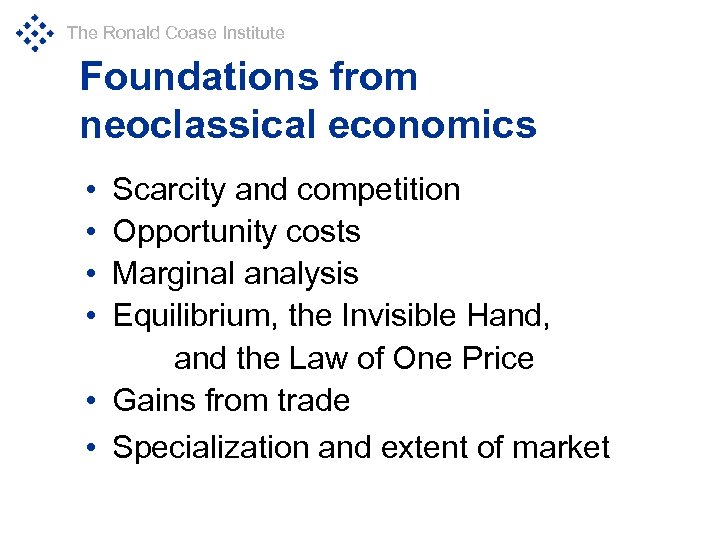
The Ronald Coase Institute Foundations from neoclassical economics • • Scarcity and competition Opportunity costs Marginal analysis Equilibrium, the Invisible Hand, and the Law of One Price • Gains from trade • Specialization and extent of market
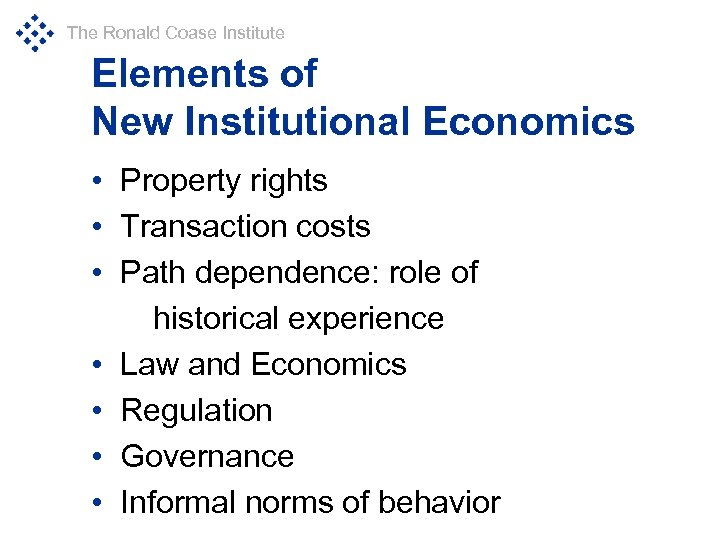
The Ronald Coase Institute Elements of New Institutional Economics • Property rights • Transaction costs • Path dependence: role of historical experience • Law and Economics • Regulation • Governance • Informal norms of behavior
The Ronald Coase Institute References for Institutional Analysis Menard and Shirley, eds. , Handbook of New Institutional Economics Douglass North, Structure and Change in Economic History www. coase. org
The Ronald Coase Institute Property Rights • Ronald Coase, social costs • Yoram Barzel, property rights • Gary Libecap and Lee Alston, Brazil • Sebastian Galiani, property rights • Handbook of New Institutional Economics • www. coase. org
The Ronald Coase Institute Transaction Costs • Ronald Coase • Oliver Williamson
The Ronald Coase Institute A conclusion of New Institutional Economics Clear definition of rights and clear enforcement of them are fundamental to good economic performance
The Ronald Coase Institute Investigating economic change We know very little about the dynamics of economic change To understand more, it is essential to know more about the options individuals actually face over time
The Ronald Coase Institute Outline of talk • Measuring the costs of exchange • Example: actual costs of registering a new firm officially in different countries • Relevance for Pakistan
The Ronald Coase Institute Transaction costs are a significant component of the options that individuals face
The Ronald Coase Institute To understand affect transaction costs, we need to know • • How big are they? Which are the highest? Who pays more – or less? What happens after reforms?
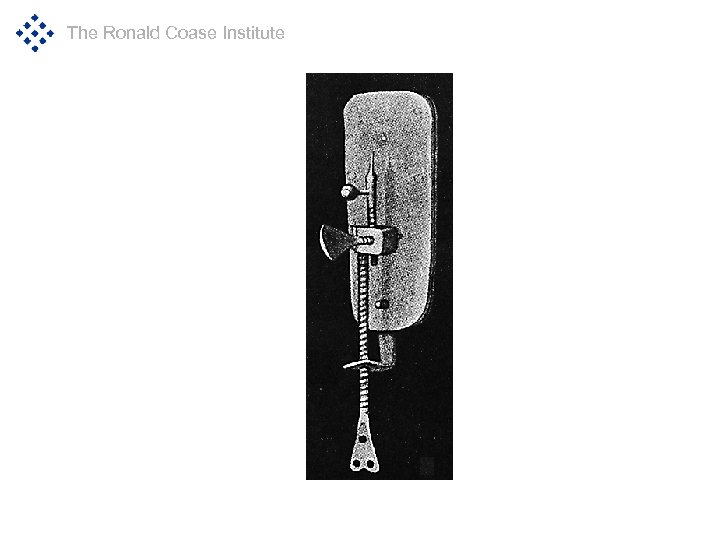
The Ronald Coase Institute To discover these things, we need a better measurement instrument
The Ronald Coase Institute
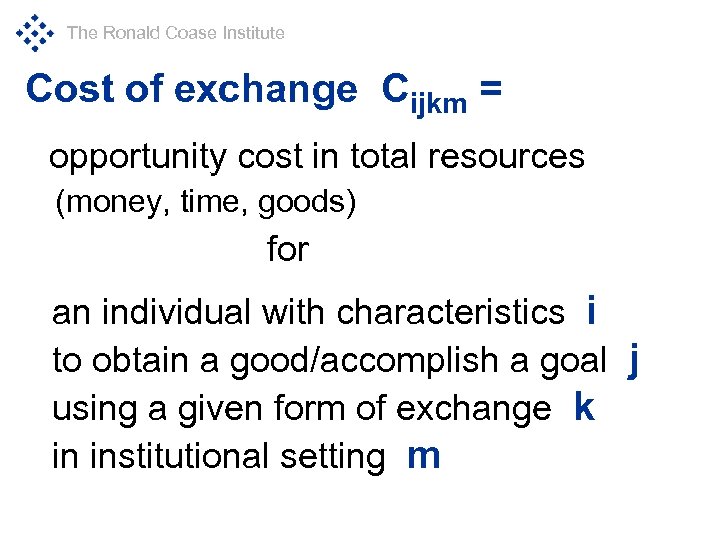
The Ronald Coase Institute Cost of exchange Cijkm = opportunity cost in total resources (money, time, goods) for an individual with characteristics i to obtain a good/accomplish a goal j using a given form of exchange k in institutional setting m
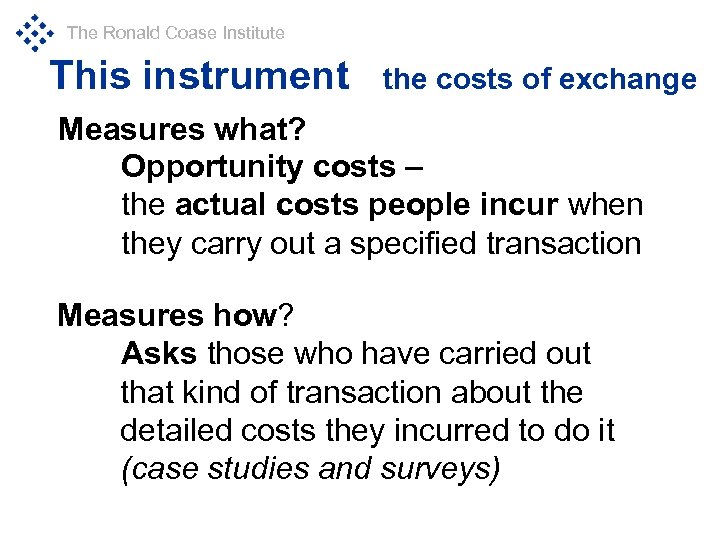
The Ronald Coase Institute This instrument the costs of exchange Measures what? Opportunity costs – the actual costs people incur when they carry out a specified transaction Measures how? Asks those who have carried out that kind of transaction about the detailed costs they incurred to do it (case studies and surveys)
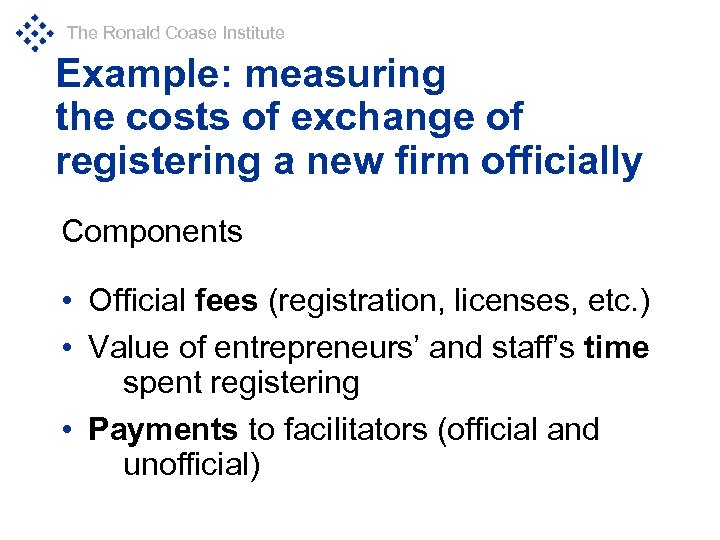
The Ronald Coase Institute Example: measuring the costs of exchange of registering a new firm officially Components • Official fees (registration, licenses, etc. ) • Value of entrepreneurs’ and staff’s time spent registering • Payments to facilitators (official and unofficial)
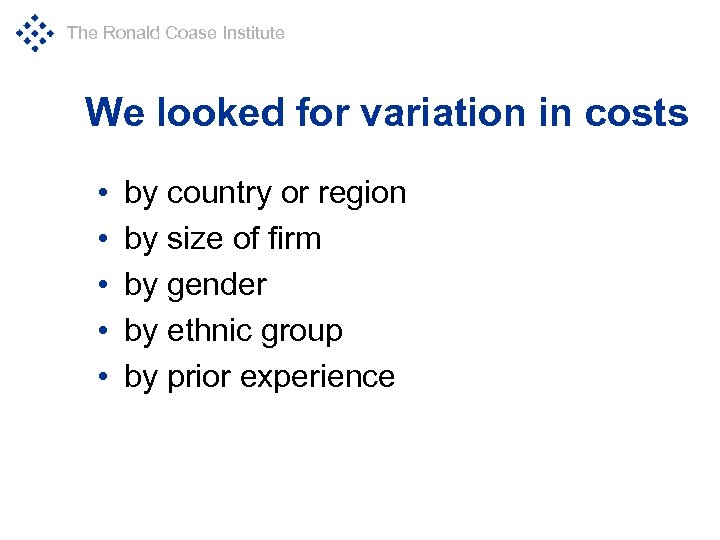
The Ronald Coase Institute We looked for variation in costs • • • by country or region by size of firm by gender by ethnic group by prior experience
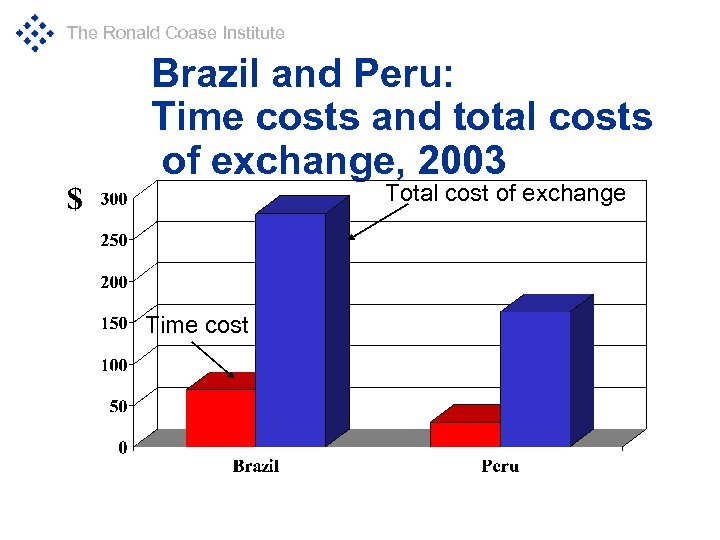
The Ronald Coase Institute $ Brazil and Peru: Time costs and total costs of exchange, 2003 Total cost of exchange Time cost
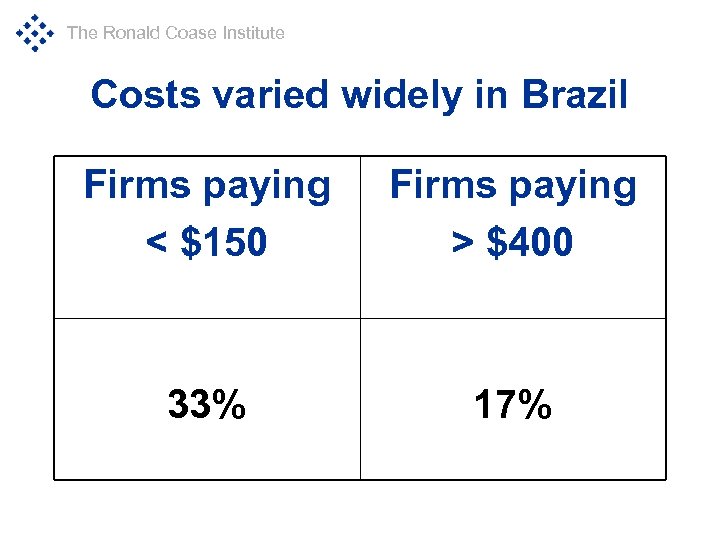
The Ronald Coase Institute Costs varied widely in Brazil Firms paying < $150 Firms paying > $400 33% 17%
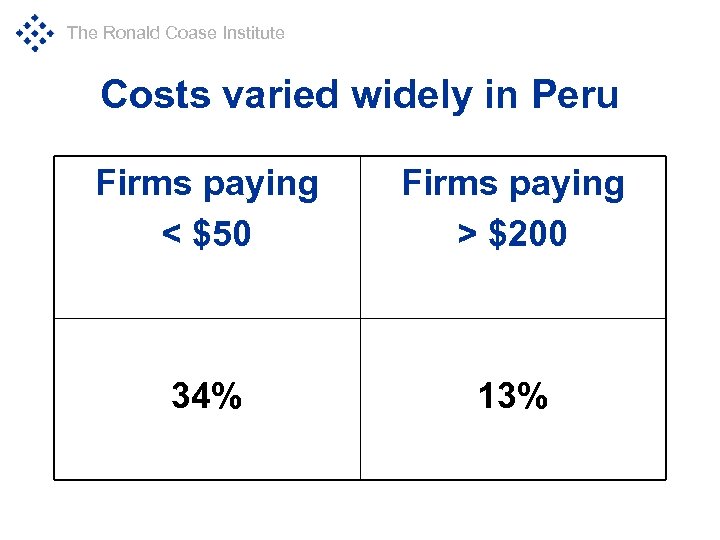
The Ronald Coase Institute Costs varied widely in Peru Firms paying < $50 Firms paying > $200 34% 13%
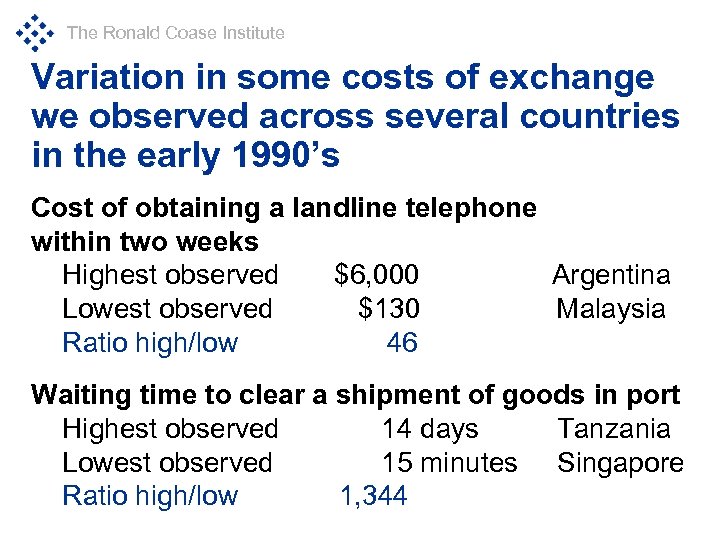
The Ronald Coase Institute Variation in some costs of exchange we observed across several countries in the early 1990’s Cost of obtaining a landline telephone within two weeks Highest observed $6, 000 Argentina Lowest observed $130 Malaysia Ratio high/low 46 Waiting time to clear a shipment of goods in port Highest observed 14 days Tanzania Lowest observed 15 minutes Singapore Ratio high/low 1, 344
The Ronald Coase Institute This instrument the costs of exchange • Measures elements of transaction costs in a new and systematic way • Like a microscope - has a narrow focus but shows things not heretofore seen
The Ronald Coase Institute What does this instrument reveal? • The costs of exchange – say, of registering a new firm officially - are often dramatically higher than the official money price • There are great variations in costs of exchange across countries across individuals • The law of one price does not apply
The Ronald Coase Institute How is this instrument useful? • Helps new entrepreneurs know the real costs • Makes processes more transparent • Reduces officials’ discretion • Encourages competition among jurisdictions • Informs citizens and officials • Tracks the actual effects of reforms • Monitors system through time
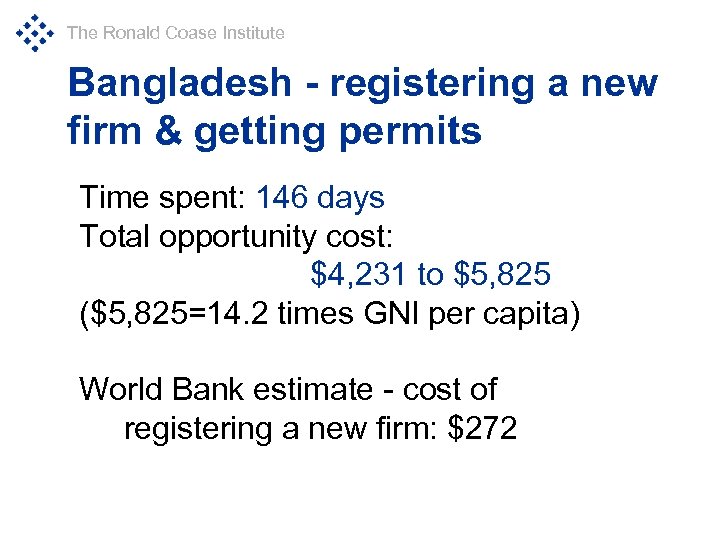
The Ronald Coase Institute Bangladesh - registering a new firm & getting permits Time spent: 146 days Total opportunity cost: $4, 231 to $5, 825 ($5, 825=14. 2 times GNI per capita) World Bank estimate - cost of registering a new firm: $272
The Ronald Coase Institute Why are the costs so high in Bangladesh? • Special permits are needed to import textiles intended for re-export • Regulations are designed to maintain high tariffs on internal consumption of textiles • Regulations change frequently in response to people’s efforts to use re-export textiles internally
The Ronald Coase Institute What next? • Examine other transactions: transferring property, etc. • Look for situations where the costs of exchange differ • Look at the consequences of these differences
The Ronald Coase Institute Effects of land titling on the poor Sebastian Galiani & Ernesto Schargrodsky Squatters in Argentina Unanticipated distribution of land titles to some and not others Consequences observed http: //coase. org/workingpapers/wp-7. pdf
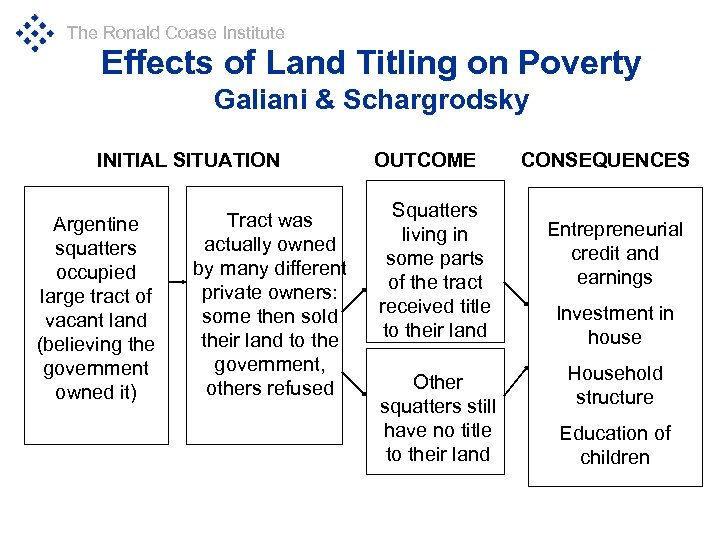
The Ronald Coase Institute Effects of Land Titling on Poverty Galiani & Schargrodsky INITIAL SITUATION Argentine squatters occupied large tract of vacant land (believing the government owned it) Tract was actually owned by many different private owners: some then sold their land to the government, others refused OUTCOME Squatters living in some parts of the tract received title to their land Other squatters still have no title to their land CONSEQUENCES Entrepreneurial credit and earnings Investment in house Household structure Education of children
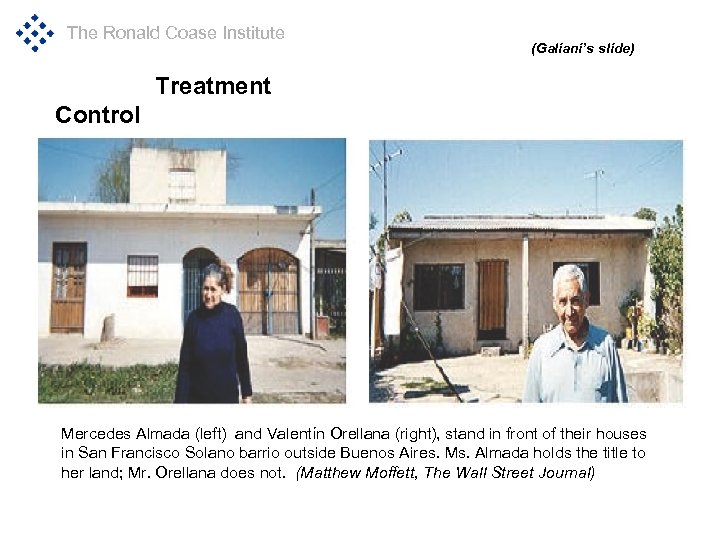
The Ronald Coase Institute (Galiani’s slide) Treatment Control Mercedes Almada (left) and Valentín Orellana (right), stand in front of their houses in San Francisco Solano barrio outside Buenos Aires. Ms. Almada holds the title to her land; Mr. Orellana does not. (Matthew Moffett, The Wall Street Journal)
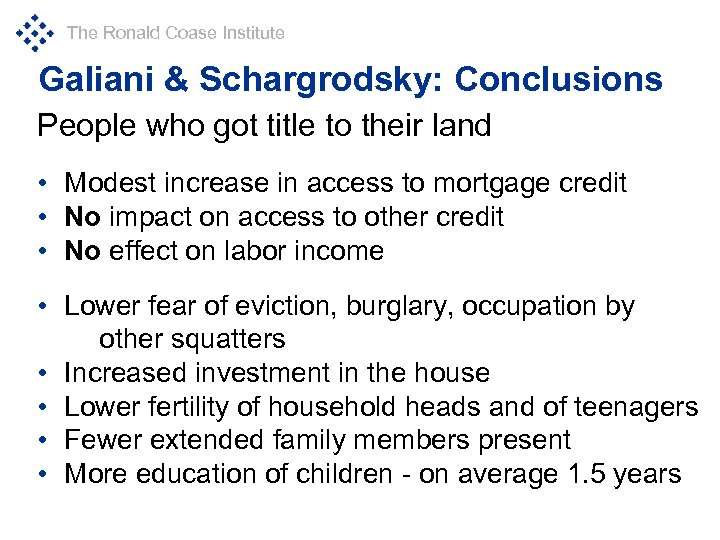
The Ronald Coase Institute Galiani & Schargrodsky: Conclusions People who got title to their land • Modest increase in access to mortgage credit • No impact on access to other credit • No effect on labor income • Lower fear of eviction, burglary, occupation by other squatters • Increased investment in the house • Lower fertility of household heads and of teenagers • Fewer extended family members present • More education of children - on average 1. 5 years
The Ronald Coase Institute Investigating changes in a system When a regulation is changed, what types of legal and illegal responses can follow? See Handbook of New Institutional Analysis, Menard and Shirley, editors
The Ronald Coase Institute The rules of the game form a system • Altering the rules in one area will change the system elsewhere • The forms of this change will depend on local conditions, history, interest groups, options
The Ronald Coase Institute Response to change in regulation - when free trade began between India and Nepal • Official customs fees were abolished • Customs officers then charged traders for facilitating the passage of their goods across the border • Traders’ actual costs of exchange to move goods across the border remained much the same

The Ronald Coase Institute Recognize and study relative success
The Ronald Coase Institute Legal responses to regulation Substitution of other goods other attributes of goods amenities barter vertical integration household production personalized exchange
The Ronald Coase Institute Legal responses to regulation Changes in governance and contractual relationships organization of the market
The Ronald Coase Institute Illegal responses to regulation Development of underground economy private coercion extralegal organizations discrimination corruption
The Ronald Coase Institute One regulation can • lead to other regulations • create long-lasting interest groups
The Ronald Coase Institute Use costs of exchange to investigate responses to regulation • Individuals and systems respond along many dimensions to changes in regulation • Measuring the costs of exchange allows us to trace out multiple consequences of these responses
The Ronald Coase Institute What next? • Try to discover what rules of the game cause the costs of exchange to differ • Examine the evolution of rules
Скачать презентацию The Ronald Coase Institutional Analysis Alexandra Benham The
a9cb5ef7d9c696443e8fc384d170c9b8.ppt