 Скачать презентацию The Roman Republic I ITALY S GEOGRAPHY 1
a08cd3cc577563dae1fa95b2e196f3b9.ppt
- Количество слайдов: 16



The Roman Republic
I. ITALY’S GEOGRAPHY 1. 2. 3. Alps form a wall to the north (barrier) Peninsula Traded with Greece, Egypt, and others a. influenced by a variety of cultures
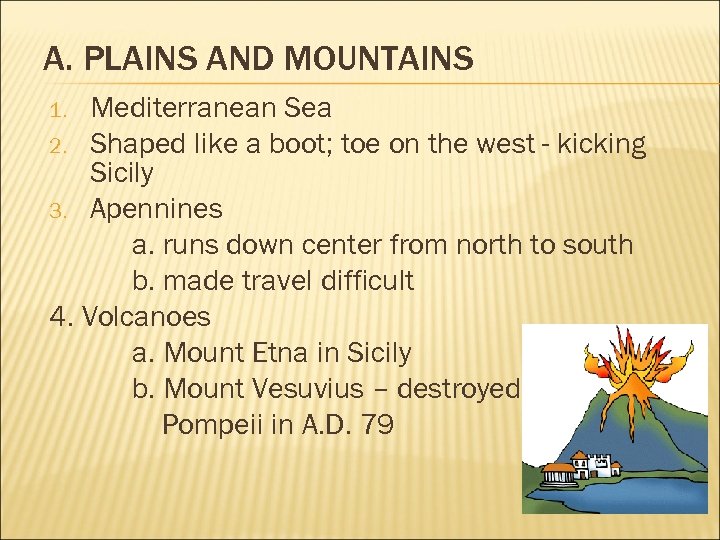
A. PLAINS AND MOUNTAINS Mediterranean Sea 2. Shaped like a boot; toe on the west - kicking Sicily 3. Apennines a. runs down center from north to south b. made travel difficult 4. Volcanoes a. Mount Etna in Sicily b. Mount Vesuvius – destroyed Pompeii in A. D. 79 1.
PLAINS AND MOUNTAINS CONTINUED 5. Fertile plains a. Po River valley b. Latium i. west coast of central Italy ii. The Tiber River runs through the center. 6. Tiber River a. Rome (start of Italy)
II. RULERS OF ROME 1. 2. 3. Earliest people = Etruscans 510 B. C. – Etruscan kings kicked out and Roman Republic was founded. Republic – government leaders voted into office
A. PATRICIANS AND PLEBIANS 1. 2. 3. Patricians – powerful group from Rome’s wealthiest families Plebians – poor farmers and shopkeepers who could not hold office Both = citizens a. person who is born in a country or who becomes a member of a country by law
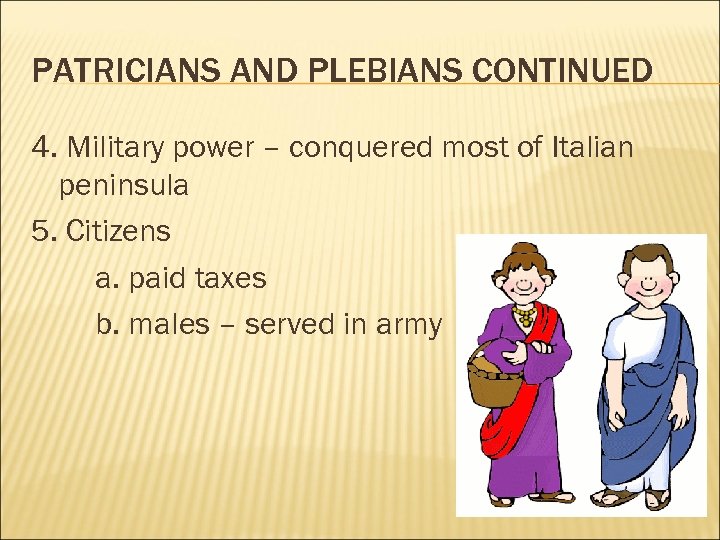
PATRICIANS AND PLEBIANS CONTINUED 4. Military power – conquered most of Italian peninsula 5. Citizens a. paid taxes b. males – served in army
PATRICIANS AND PLEBIANS CONTINUED 6. Consuls a. elected 2 leaders i. prevented forming of dictator (an oppressive ruler) or taking advantage of power b. both had to agree, but one could veto (turn down) other consul’s plan c. needed Senate body to approve plans
B. PLEBEIAN DEMANDS Citizens – who felt patrician government was unfair 2. 494 B. C. – went on strike a. refused to open shops b. serve in the army c. farmers refused to bring their crops into Rome 3. Result – plebeians were given a plebeian assembly to elect reps. called tribunes a. could veto laws and review judges’ decisions 1.
PLEBEIAN DEMANDS CONTINUED 4. 50 years later – new demand a. no idea of laws because never posted 5. Result – placed on display in Rome’s public marketplace 6. Laws = Twelve Tables (carved on stone tablets)
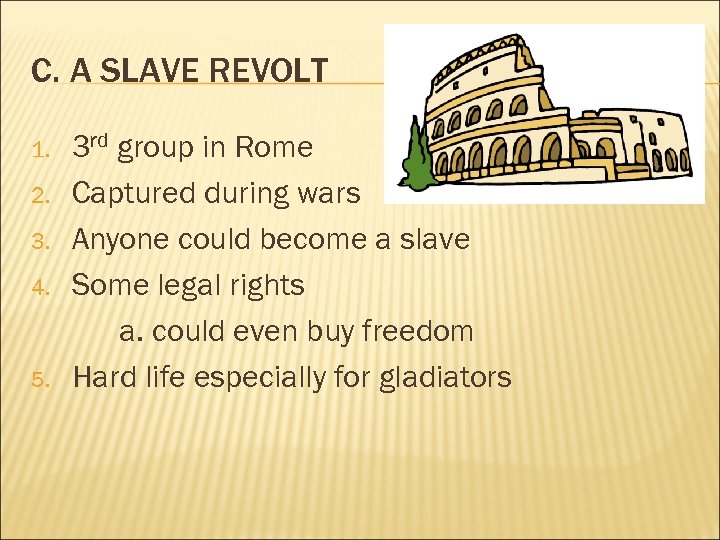
C. A SLAVE REVOLT 1. 2. 3. 4. 5. 3 rd group in Rome Captured during wars Anyone could become a slave Some legal rights a. could even buy freedom Hard life especially for gladiators
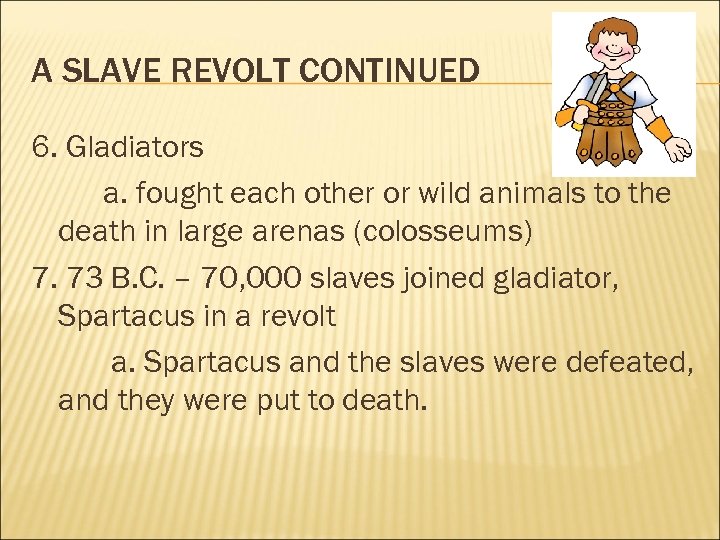
A SLAVE REVOLT CONTINUED 6. Gladiators a. fought each other or wild animals to the death in large arenas (colosseums) 7. 73 B. C. – 70, 000 slaves joined gladiator, Spartacus in a revolt a. Spartacus and the slaves were defeated, and they were put to death.
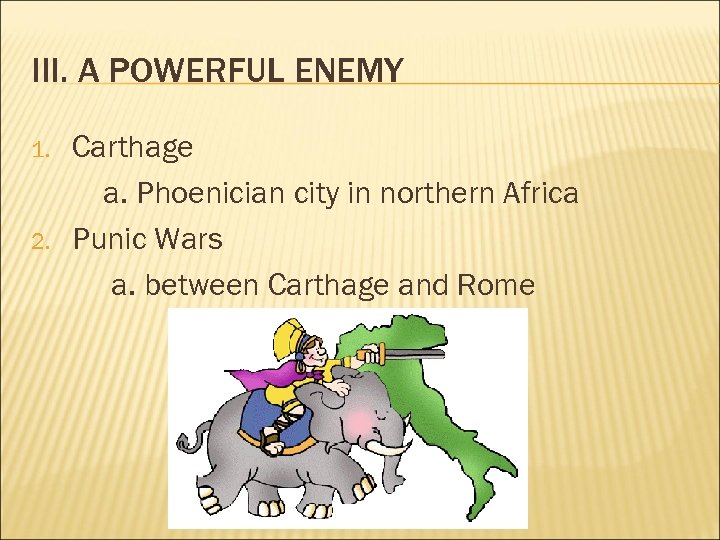
III. A POWERFUL ENEMY 1. 2. Carthage a. Phoenician city in northern Africa Punic Wars a. between Carthage and Rome
A. THE PUNIC WARS 1. 2. 3. 218 B. C. Carthaginian army invaded Italy and defeated Rome a. Hannibal – Carthaginian general Rome invaded northern Africa and Hannibal returned Rome defeated Carthage in 146 B. C. a. sold survivors into slavery and burned buildings b. Rome ruled Mediterranean world.
B. A BATTLE FOR POWER 1. 2. Civil War between wealthy Romans and powerful generals a. civil war – war between groups within a country Julius Caesar a. armies conquered Gaul, present-day France b. led soldiers into Rome and made himself dictator
BATTLE FOR POWER CONTINUED 2. Caesar’s changes a. revised Roman calendar b. gave land grain to the poor c. increased the number of people in the Senate d. granted citizenship to foreigners 3. Caesar had many enemies. (March 15 th)
Скачать презентацию The Roman Republic I ITALY S GEOGRAPHY 1
a08cd3cc577563dae1fa95b2e196f3b9.ppt