


 Скачать презентацию The Roles of the President President s Many
8abd44b78bf3f54fb63e92983ead05e8.ppt
- Количество слайдов: 33
 The Roles of the President
 President’s Many Roles For each section in the octagon, indicate a role of the president and a short description of that role.
 Formal Qualifications for the Presidency Must be at least 35 years of age n Must have lived in the US for 14 years n n Must be a “natural born” citizen – “Birther Issue”
 Presidential Term Framers were undecided – a single 7 year term v. a four year term with reelection n 4 years = 1 term in office n 2 terms or 10 years n
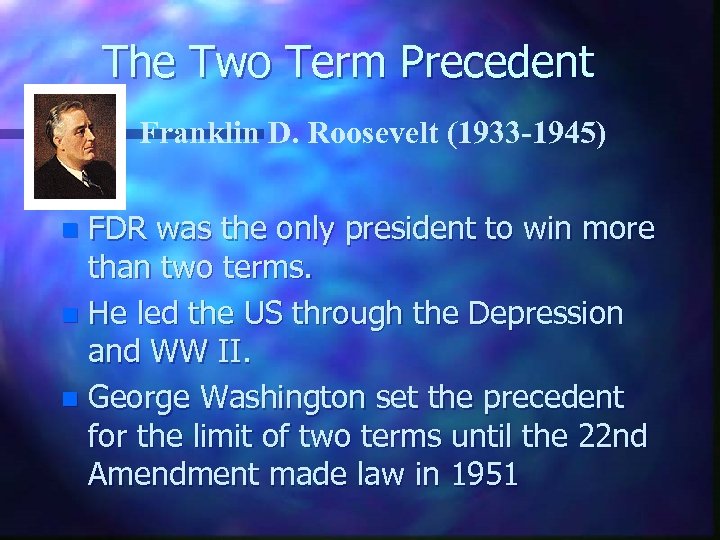 The Two Term Precedent Franklin D. Roosevelt (1933 -1945) FDR was the only president to win more than two terms. n He led the US through the Depression and WW II. n George Washington set the precedent for the limit of two terms until the 22 nd Amendment made law in 1951 n
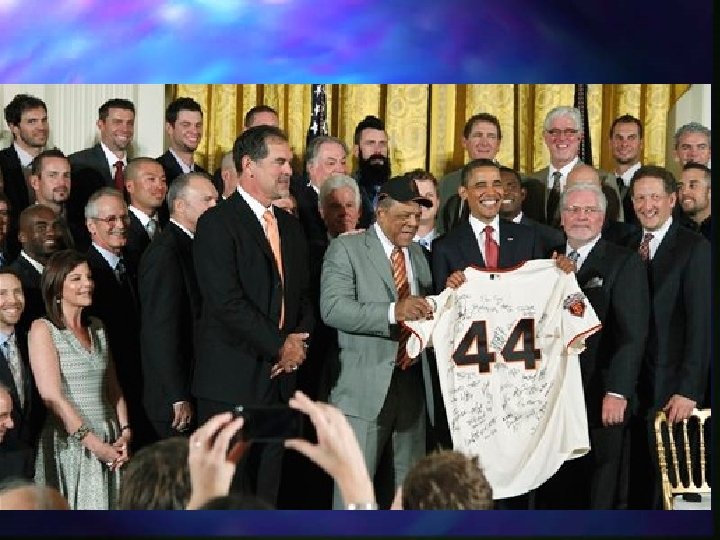
 Role: Chief of State Acts as example for and symbol of the United States n Represents America at special occasions and ceremonies. n Kings and Queens are heads of state. n Awarding medals and speechmaking are examples of this role. n “reigns but does not rule” n
 Role: Chief Executive Carries out the “executive powers” vested in him by the Constitution…duh n Enforces and administers the provisions of federal law n Grants Pardons/Amnesty n n Page 393 -395
 Role: Chief Administrator Acts as boss of federal government workers in 15 executive departments. n These departments help the President carry out, enforce, or execute the law. n The president chooses cabinet members to advise and assist him. n Example: Holding cabinet meetings and appointing federal officials. n Appointment Powers – Cabinet, Federal Judges, US Supreme Court n
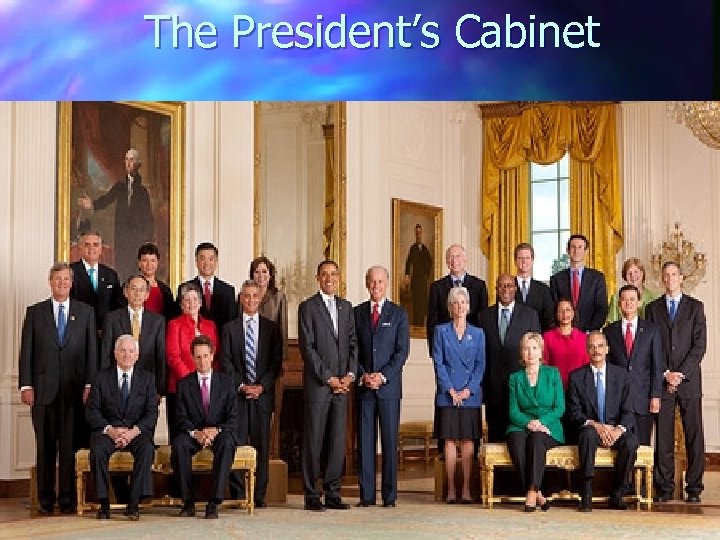 The President’s Cabinet
 The Chief Administrator Executive Departments. Department of Agriculture USDA) Department of Commerce (DOC)Department of Defense (DOD)Department of Education (ED)Department of Energy. DOE)Department of Health and Human Services (HHS)Department of Homeland Security (DHS)Department of Housing and Urban Development (HUD)Department of Justice (DOJ)Department of Labor (DOL)Department of State (DOS)Department of the Interior (DOI)Department of the Treasury. Department of Transportation (DOT)Department of Veterans Affairs (VA) n The Offices of the Executive Branch are found in the White House and other federal buildings in Washington D. C.
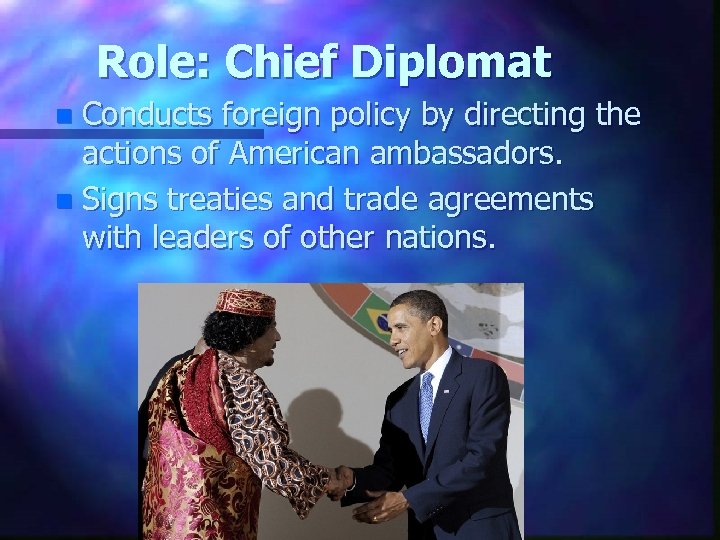 Role: Chief Diplomat Conducts foreign policy by directing the actions of American ambassadors. n Signs treaties and trade agreements with leaders of other nations. n
 Role: Chief Diplomat Main Architect of American Foreign Policy n Nation’s Chief spokesman to the rest of the world n Power to Make Treaties or Executive Agreements n Power to recognize other Nations n n Page 399 -401
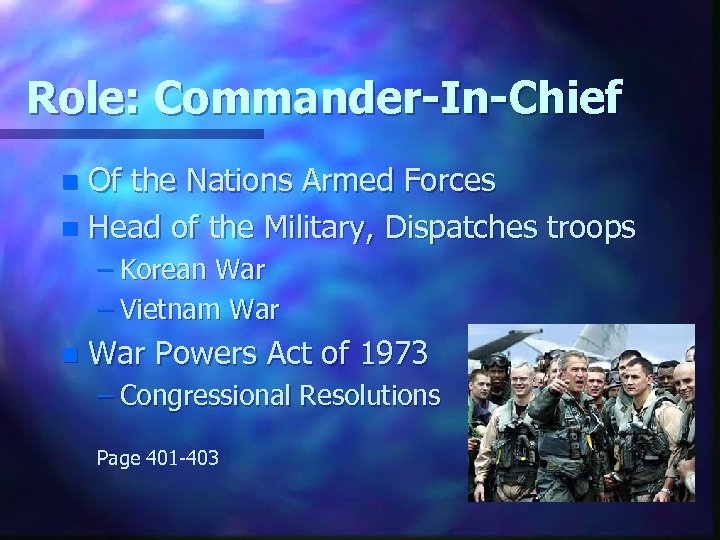 Role: Commander-In-Chief Of the Nations Armed Forces n Head of the Military, Dispatches troops n – Korean War – Vietnam War n War Powers Act of 1973 – Congressional Resolutions Page 401 -403
 Role: Commander-In-Chief In charge of US Armed Forces. n President decides where armed forces are to be stationed, weapons to be used. n Secretary of Defense under President. n Chairman of the Joint Chiefs is the top military commander under President. n
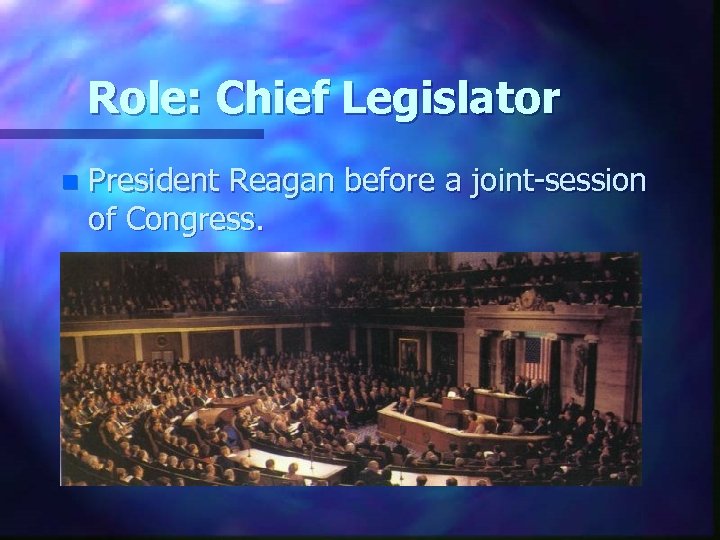 Role: Chief Legislator n President Reagan before a joint-session of Congress.
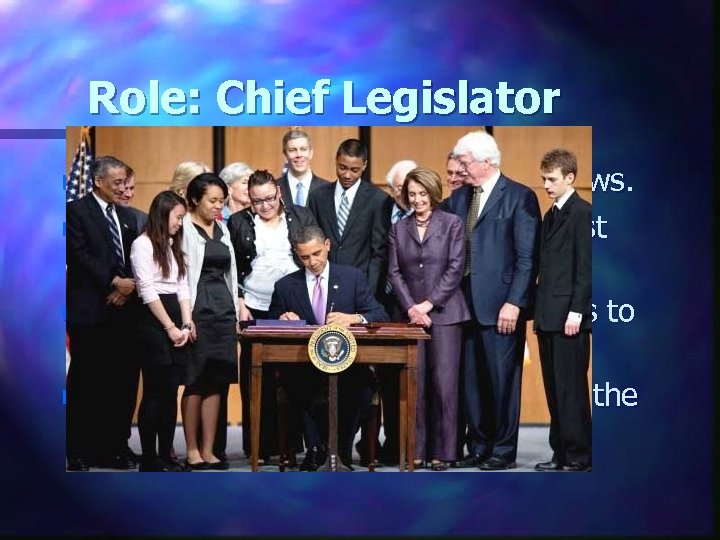 Role: Chief Legislator Congress has the power to make laws. n President can propose bills and must sign bills into law. n He often calls members of Congress to lobby for his agenda. n Presents his agenda to Congress in the annual State of the Union address. n
 Role: Chief Legislator n. Main Architect of Public Policy n. Helps to set the Congressional Agenda n. Encourages Congress to enact legislation n. Organizes and Presents his budget to Congress n. Signs Legislation into law n. Vetoes Legislation –Can be overturned by Congress with 2/3 vote in each Chamber Page 405 -top of 407
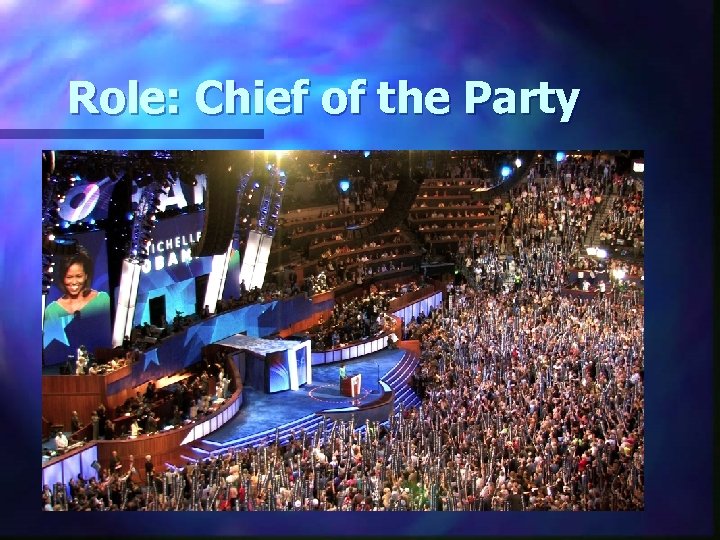 Role: Chief of the Party Presidents help members of their party get elected or appointed to office. n They make campaign speeches needed for re-election. n Head of fund-raising for the party. n
 Chief Citizen n The representative of the people
 Chief Guardian of the Economy n Monitors – unemployment, – Inflation, taxation, business, – and general welfare of the nation. – He does not control the economy, but he gets credit if it goes well.
 The Presidency Why do you think it is the most visible part of the American political system? n Does the President really serve the needs of the American people? n How does the office of the Presidency actually help the American people? n How can one man fulfill all these duties n
 Running the Government: Chief Executive Vice President Cabinet Executive Office White House Staff First Lady 12. 3
 Vice President Mainly ceremonial in previous years Increasing role in modern presidency n n Cheney Biden 12. 3
 Cabinet Traditional, not mandated Heads of federal agencies and executive departments 12. 3
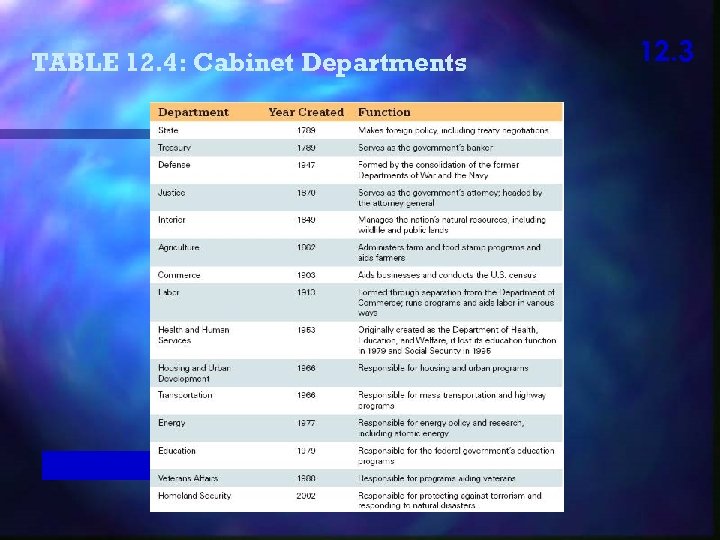 TABLE 12. 4: Cabinet Departments 12. 3
 Executive Office 12. 3 National Security Council (NSC) Council of Economic Advisers (CEA) Office of Management and Budget (OMB)
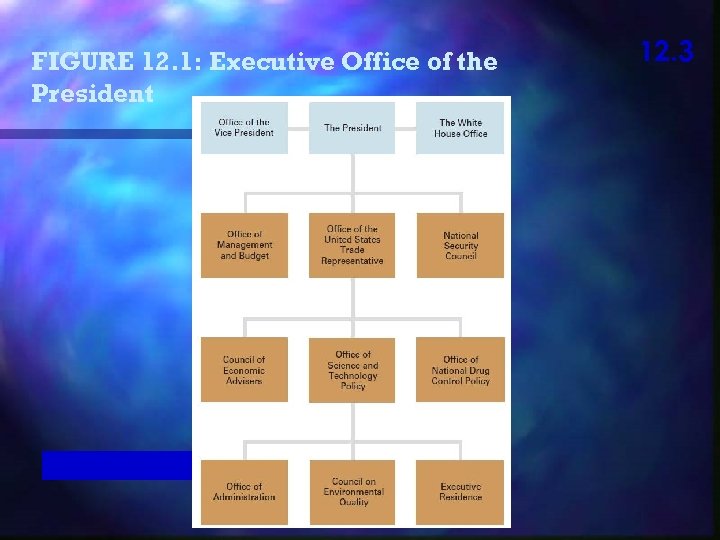 FIGURE 12. 1: Executive Office of the President 12. 3
 White House Staff President’s personal support team n n n Chief of staff Press secretary Anonymous and loyal President sets style and tone 12. 3
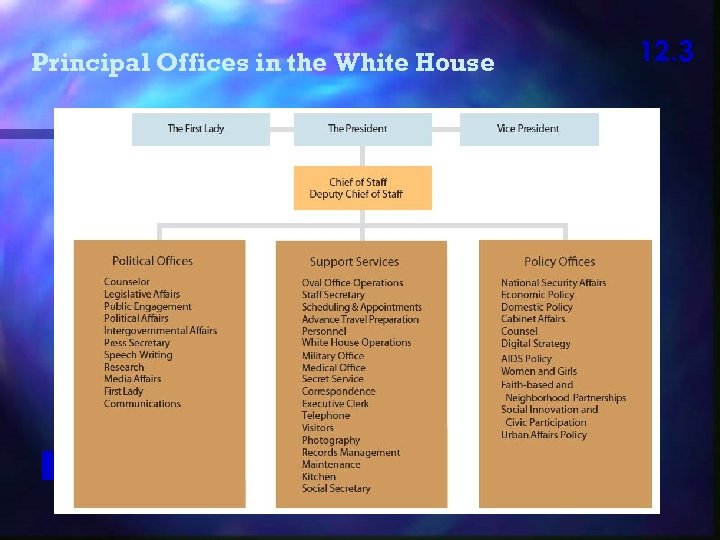 Principal Offices in the White House 12. 3
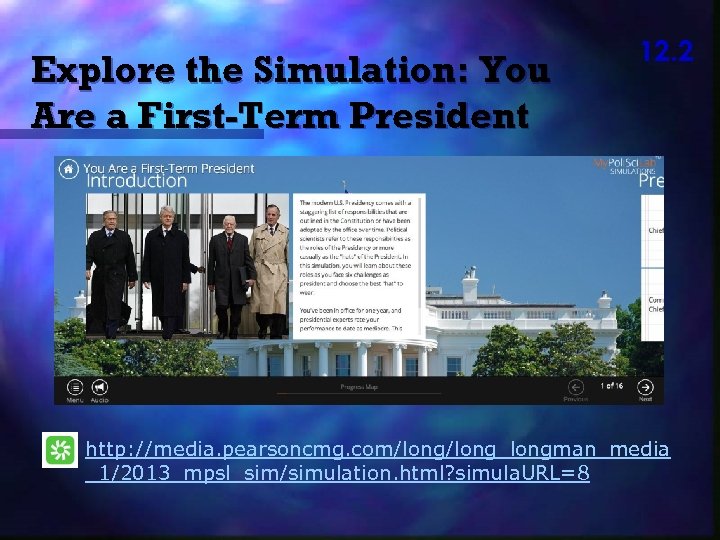 Explore the Simulation: You Are a First-Term President 12. 2 http: //media. pearsoncmg. com/long_longman_media _1/2013_mpsl_sim/simulation. html? simula. URL=8