


 Скачать презентацию THE ROLE OF VITAL STATISTICS IN THE HEALTH
3df44c70028ee1d673ec4ee0d1e4184b.ppt
- Количество слайдов: 30
 THE ROLE OF VITAL STATISTICS IN THE HEALTH RESOURCES AND SERVICES ADMINISTRATION’S PROGRAMS The National Association of Public Health Statistics and Information Systems Conference June 2004 Michael Kogan, Ph. D. Director Office of Data and Information Management Maternal and Child Health Bureau Health Resources and Services Administration U. S. Department of Health and Human Services
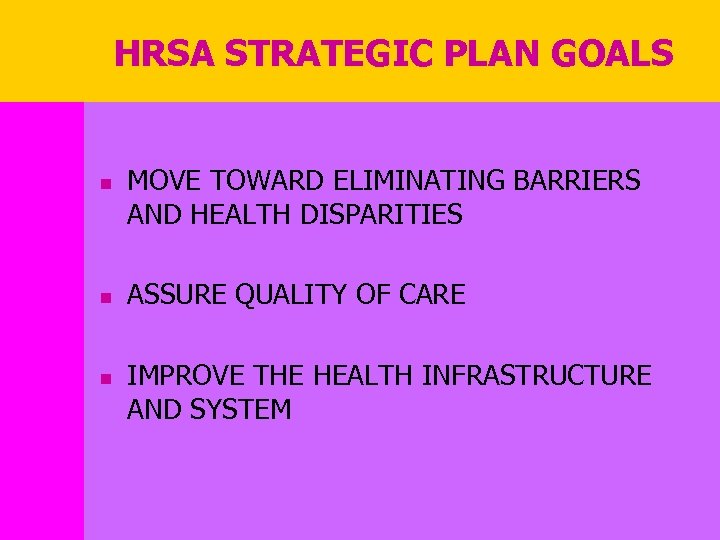 HRSA STRATEGIC PLAN GOALS n n n MOVE TOWARD ELIMINATING BARRIERS AND HEALTH DISPARITIES ASSURE QUALITY OF CARE IMPROVE THE HEALTH INFRASTRUCTURE AND SYSTEM
 HEALTH RESOURCES AND SERVICES ADMINISTRATION
 PROGRAMS AT THE MATERNAL AND CHILD HEALTH BUREAU – THE OFFICE OF DATA AND INFORMATION MANAGEMENT
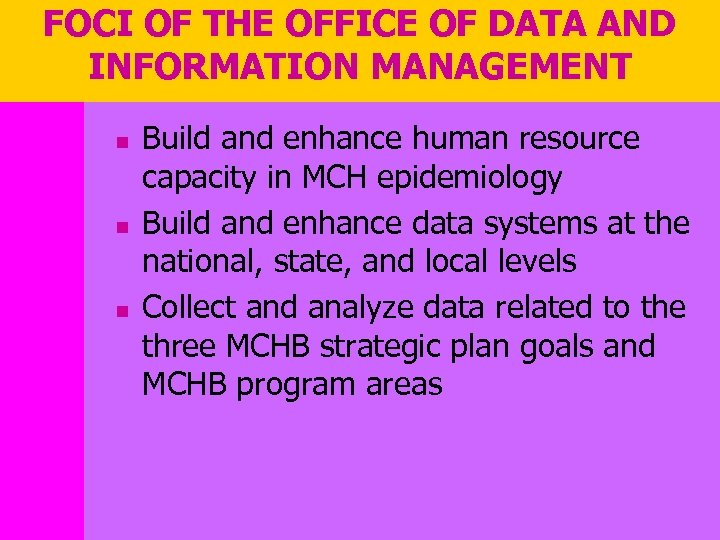 FOCI OF THE OFFICE OF DATA AND INFORMATION MANAGEMENT n n n Build and enhance human resource capacity in MCH epidemiology Build and enhance data systems at the national, state, and local levels Collect and analyze data related to the three MCHB strategic plan goals and MCHB program areas
 Survey of State and Territorial MCH Epidemiology Capacity Bao-Ping Zhu, MD, MS, Lead Epidemiologist Division of Reproductive Health, CDC Chief MCH Epidemiologist Michigan Department of Community Health
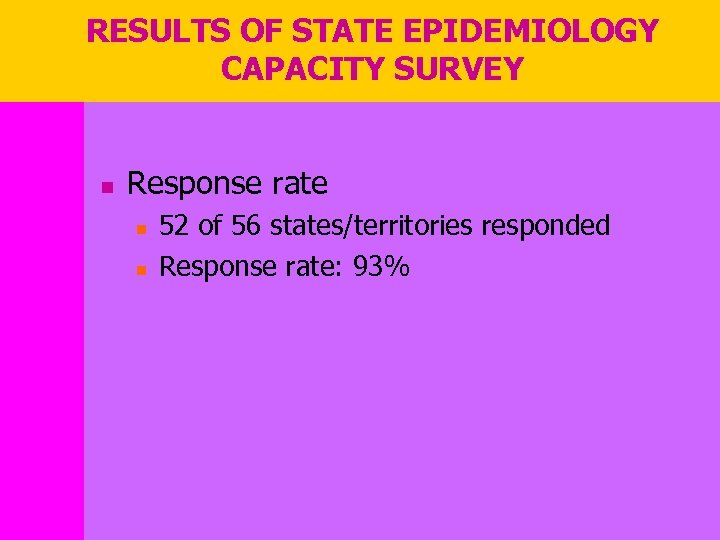 RESULTS OF STATE EPIDEMIOLOGY CAPACITY SURVEY n Response rate n n 52 of 56 states/territories responded Response rate: 93%
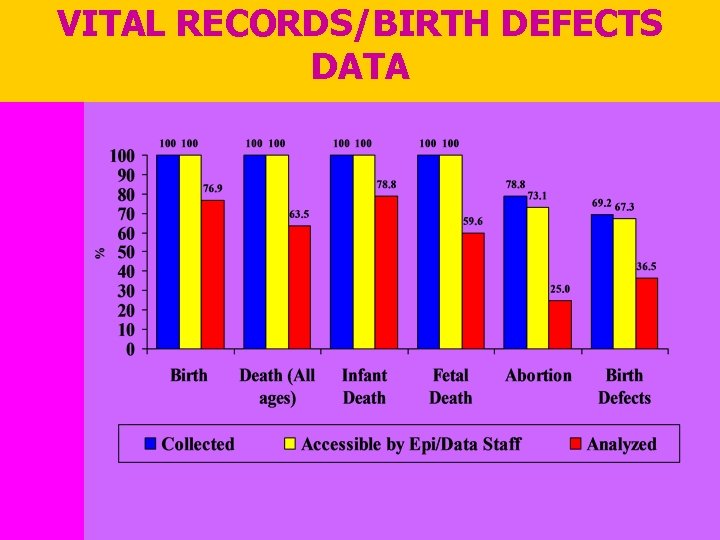 VITAL RECORDS/BIRTH DEFECTS DATA
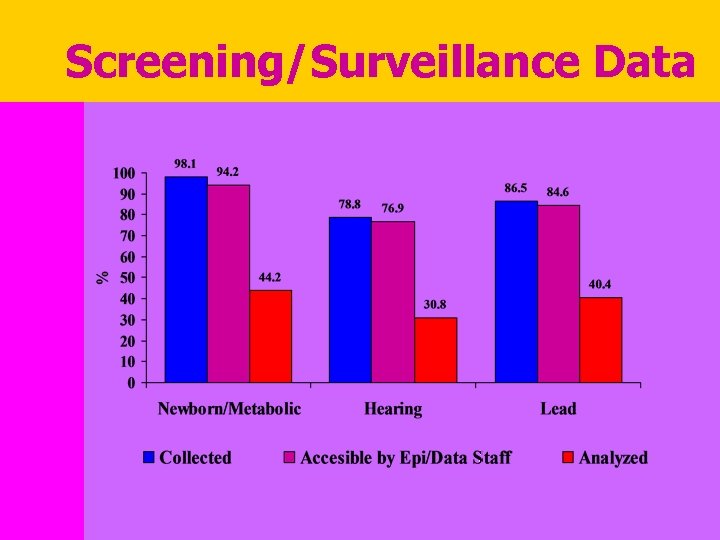 Screening/Surveillance Data
 TRAINING COURSE IN MCH EPIDEMIOLOGY n n n Co-sponsored by HRSA and CDC Purpose: To enhance data analysis capacity for State/local MCH and vital statistics staff Target Audience: State/local MCH and vital statistics staff who have responsibilities for collecting, processing, analyzing, & reporting MCH data
 THE MCH EPIDEMIOLOGY CONFERENCE n n With CDC, sponsor training opportunities through AMCHP at the MCH Epidemiology Conference on how to analyze complex survey data, do data linkage, or use Medicaid data. Be a co-sponsor to CDC for the Maternal, Infant, and Child Health Epidemiology Conference.
 NATIONAL SURVEY ON CHILD HEALTH n n HRSA/MCHB Partnership with CDC/NCHS Identifies 2000 children per state by random digit dialing telephone survey Gathers information on the physical, mental, and emotional health of children Main survey began January 2003
 INTEGRATING STATE INFORMATION SYSTEMS WITH NEWBORN SCREENING SERVICES SHORT-TERM GOALS: § § § To expand integrated State health information systems To improve State genetic newborn screening programs Grants to 5 states
 Child Health Profiles - 1 n n n LONGER-TERM GOALS – to provide up-to-date information about children’s health status to families, health care providers, and public health programs, thereby facilitating appropriate care Authorized users can determine at a glance child’s status Individual programs can assess information about child’s status with respect to other programs
 Child Health Profiles - 2 Start with 4 programmatic areas: n Newborn dried blood spot (NDBS) screening n Early hearing detection and intervention (EHDI) n Immunizations n Vital registration
 Framework for Integrating Child Health Information Systems n n n Federal, State, & Private Sector Partners State NBS Infrastructure Grantees Representatives from National Organizations
 Georgia Department of Human Resources n n Design and implement a statewide Newborn Surveillance and Tracking Integration Information System The core component of the system is the development of web-based birth and fetal death registries.
 Colorado Department of Public Health and Environment n n n Implement a state genetics plan for children with special health care needs. The State Genetics Coordinator will facilitate the medical homes process using the integrated data management system. The initial data that populates the centralized integrated database is extracted, in part, from vital records’ electronic birth certificate information.
 Minnesota Department of Health n n Develop a coordinated newborn screening and follow-up system through program and data integration. The newborn screening database will be linked with birth certificates to assure screening is provided to 100 percent of babies born in Minnesota.
 Oregon Department of Human Services n n n Help hospitals, public health programs and other medical homes identify newborns that need follow-up Coordinate and monitor service delivery. Utilize the “Family. Net” – a secure, integrated public health data system that includes birth certificate and health record information.
 Univ. of Tennessee Graduate School of Medicine n n n Track and evaluate system effectiveness for newborn screening. Coordinated through the Statewide Genetics Coordinating Committee (SGCC). Vital records has an integral role in reviewing the process through SGCC.
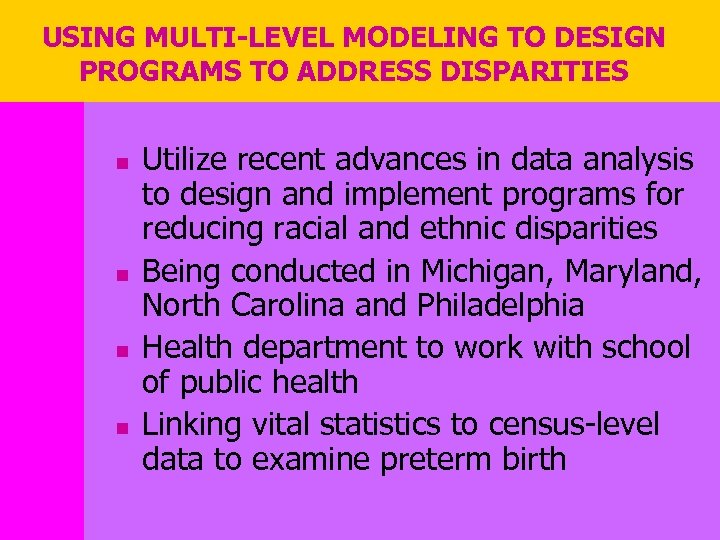 USING MULTI-LEVEL MODELING TO DESIGN PROGRAMS TO ADDRESS DISPARITIES n n Utilize recent advances in data analysis to design and implement programs for reducing racial and ethnic disparities Being conducted in Michigan, Maryland, North Carolina and Philadelphia Health department to work with school of public health Linking vital statistics to census-level data to examine preterm birth
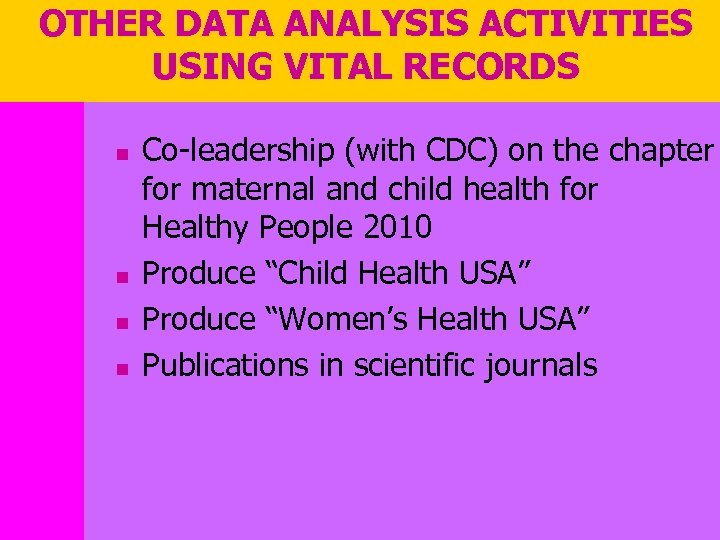 OTHER DATA ANALYSIS ACTIVITIES USING VITAL RECORDS n n Co-leadership (with CDC) on the chapter for maternal and child health for Healthy People 2010 Produce “Child Health USA” Produce “Women’s Health USA” Publications in scientific journals
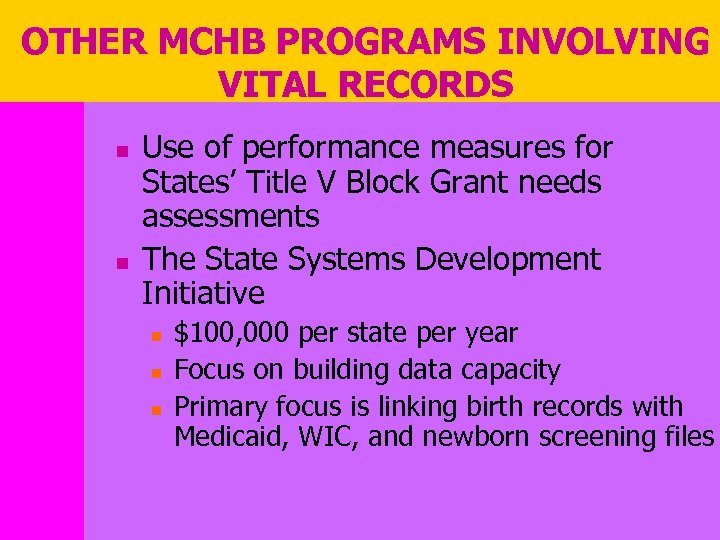 OTHER MCHB PROGRAMS INVOLVING VITAL RECORDS n n Use of performance measures for States’ Title V Block Grant needs assessments The State Systems Development Initiative n n n $100, 000 per state per year Focus on building data capacity Primary focus is linking birth records with Medicaid, WIC, and newborn screening files
 OTHER PROGRAMS AT HRSA
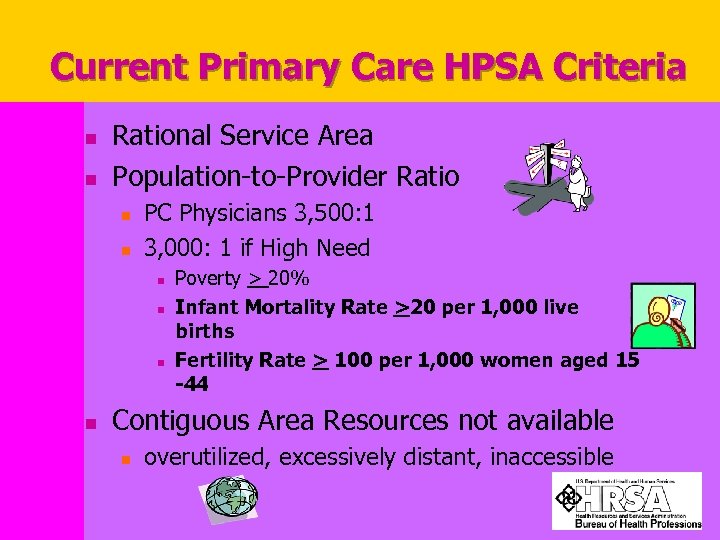 Current Primary Care HPSA Criteria n n Rational Service Area Population-to-Provider Ratio n n PC Physicians 3, 500: 1 3, 000: 1 if High Need n n Poverty > 20% Infant Mortality Rate >20 per 1, 000 live births Fertility Rate > 100 per 1, 000 women aged 15 -44 Contiguous Area Resources not available n overutilized, excessively distant, inaccessible
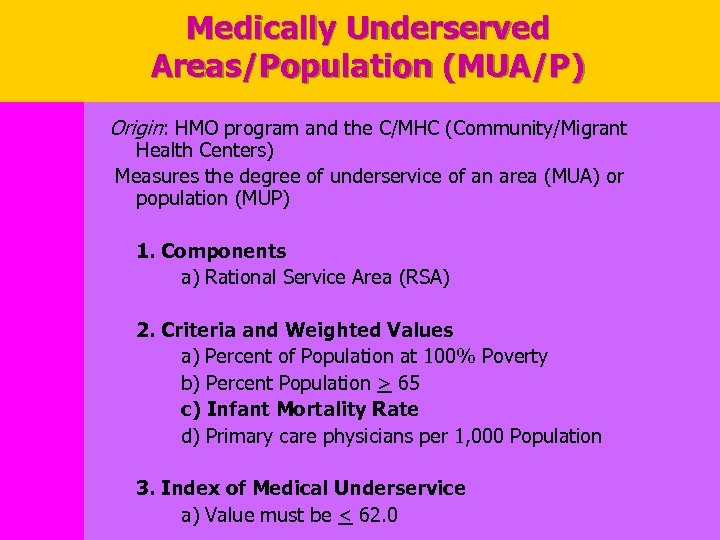 Medically Underserved Areas/Population (MUA/P) Origin: HMO program and the C/MHC (Community/Migrant Health Centers) Measures the degree of underservice of an area (MUA) or population (MUP) 1. Components a) Rational Service Area (RSA) 2. Criteria and Weighted Values a) Percent of Population at 100% Poverty b) Percent Population > 65 c) Infant Mortality Rate d) Primary care physicians per 1, 000 Population 3. Index of Medical Underservice a) Value must be < 62. 0
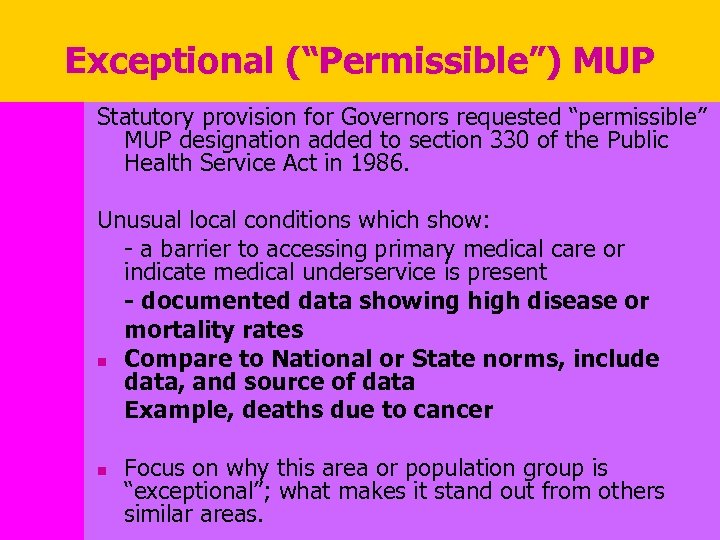 Exceptional (“Permissible”) MUP Statutory provision for Governors requested “permissible” MUP designation added to section 330 of the Public Health Service Act in 1986. Unusual local conditions which show: - a barrier to accessing primary medical care or indicate medical underservice is present - documented data showing high disease or mortality rates n Compare to National or State norms, include data, and source of data Example, deaths due to cancer n Focus on why this area or population group is “exceptional”; what makes it stand out from others similar areas.
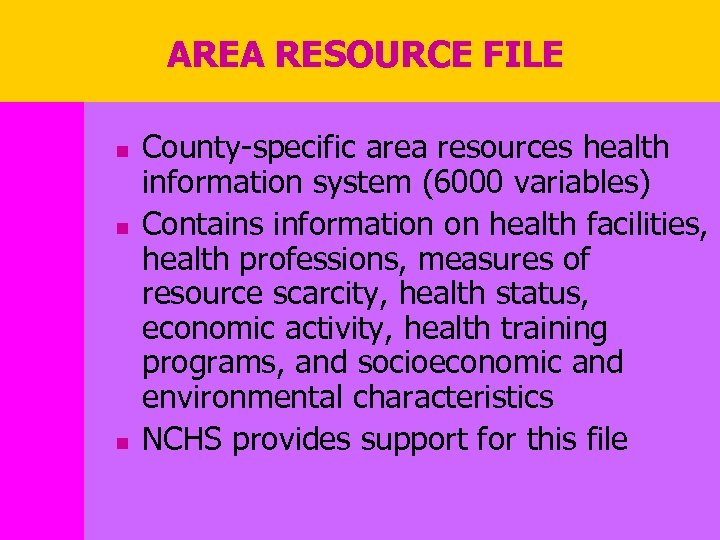 AREA RESOURCE FILE n n n County-specific area resources health information system (6000 variables) Contains information on health facilities, health professions, measures of resource scarcity, health status, economic activity, health training programs, and socioeconomic and environmental characteristics NCHS provides support for this file
 CONTACT INFORMATION Michael Kogan, Ph. D. Director, Office of Data and Information Management HRSA/MCHB 5600 Fishers Lane, Room 18 -41 Rockville, MD 20857 301 -443 -3145 mkogan@hrsa. gov