


 Скачать презентацию The Role of Virtual Tall Towers in the
e9f4866cbba3639f20649f2a4544da59.ppt
- Количество слайдов: 23
 The Role of Virtual Tall Towers in the Carbon Dioxide Observation Network Martha Butler The Pennsylvania State University Ch. EAS Meeting June 5 -6, 2006
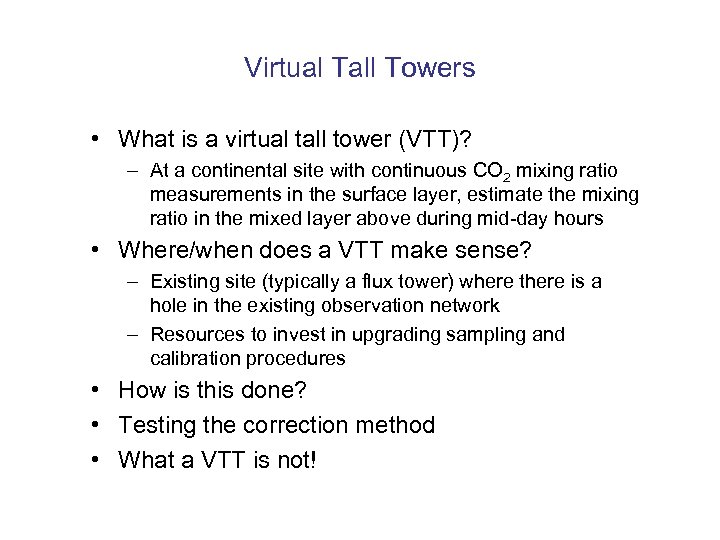 Virtual Tall Towers • What is a virtual tall tower (VTT)? – At a continental site with continuous CO 2 mixing ratio measurements in the surface layer, estimate the mixing ratio in the mixed layer above during mid-day hours • Where/when does a VTT make sense? – Existing site (typically a flux tower) where there is a hole in the existing observation network – Resources to invest in upgrading sampling and calibration procedures • How is this done? • Testing the correction method • What a VTT is not!
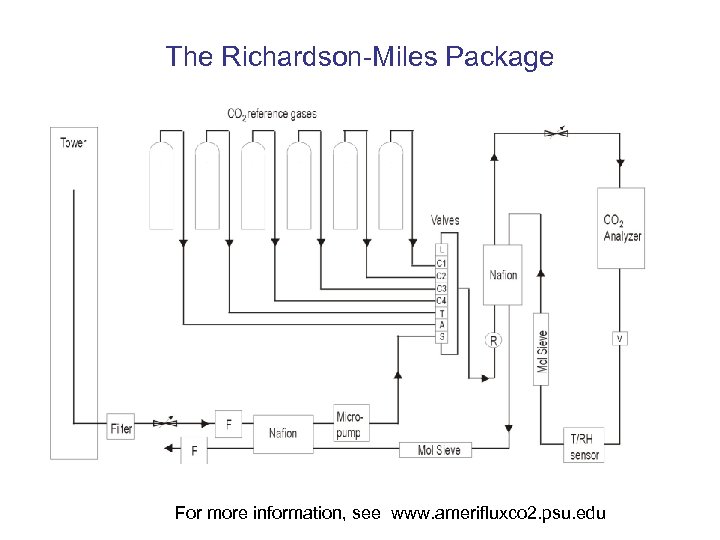 The Richardson-Miles Package For more information, see www. amerifluxco 2. psu. edu
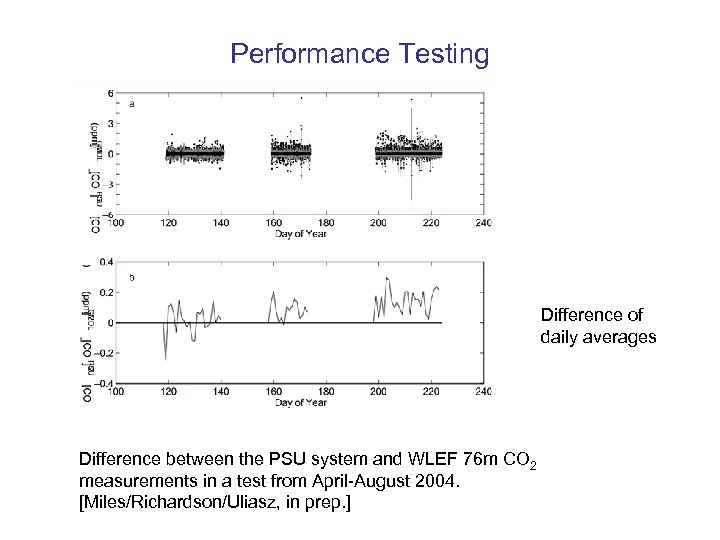 Performance Testing Difference of daily averages Difference between the PSU system and WLEF 76 m CO 2 measurements in a test from April-August 2004. [Miles/Richardson/Uliasz, in prep. ]
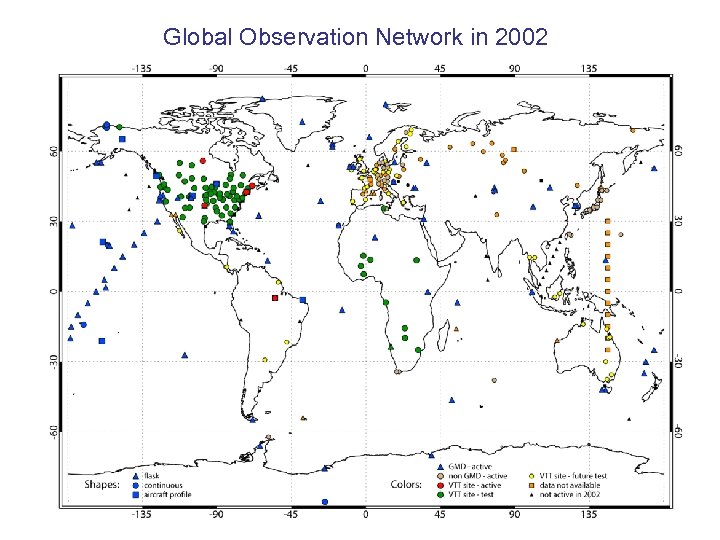 Global Observation Network in 2002
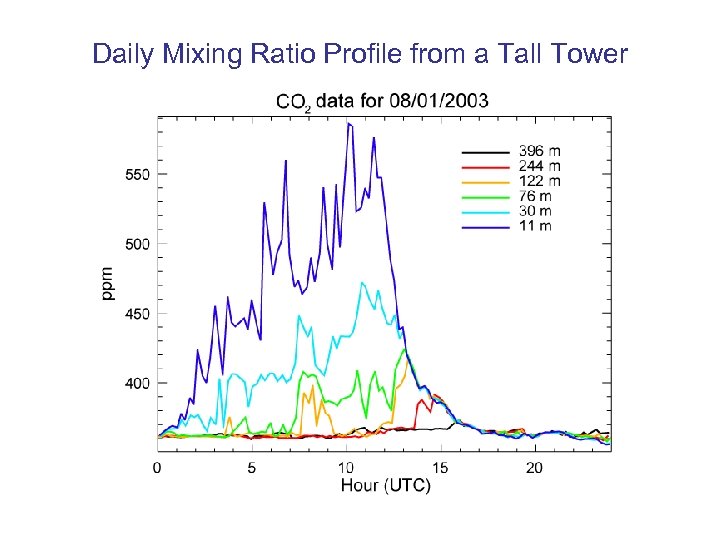 Daily Mixing Ratio Profile from a Tall Tower
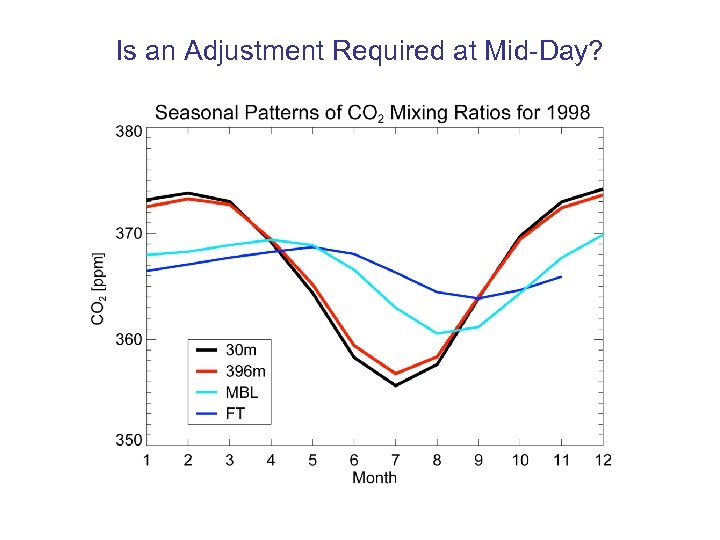 Is an Adjustment Required at Mid-Day?
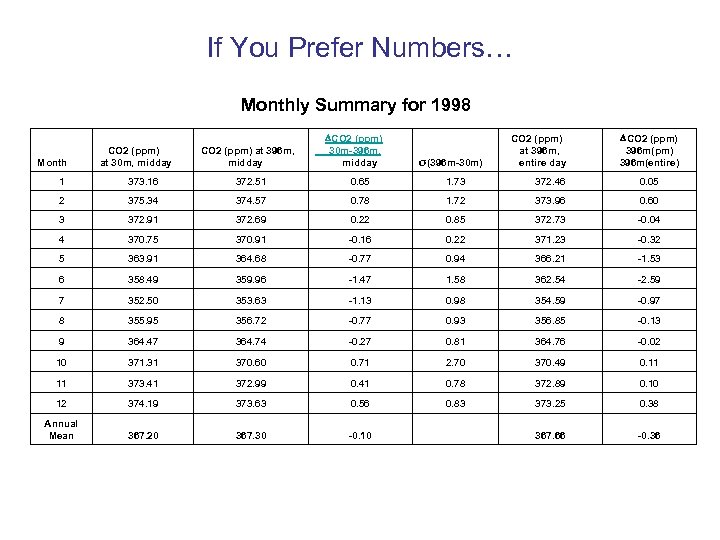 If You Prefer Numbers… Monthly Summary for 1998 Month CO 2 (ppm) at 30 m, midday CO 2 (ppm) at 396 m, midday DCO 2 (ppm) 30 m-396 m, midday σ(396 m-30 m) CO 2 (ppm) at 396 m, entire day DCO 2 (ppm) 396 m(entire) 1 373. 16 372. 51 0. 65 1. 73 372. 46 0. 05 2 375. 34 374. 57 0. 78 1. 72 373. 96 0. 60 3 372. 91 372. 69 0. 22 0. 85 372. 73 -0. 04 4 370. 75 370. 91 -0. 16 0. 22 371. 23 -0. 32 5 363. 91 364. 68 -0. 77 0. 94 366. 21 -1. 53 6 358. 49 359. 96 -1. 47 1. 58 362. 54 -2. 59 7 352. 50 353. 63 -1. 13 0. 98 354. 59 -0. 97 8 355. 95 356. 72 -0. 77 0. 93 356. 85 -0. 13 9 364. 47 364. 74 -0. 27 0. 81 364. 76 -0. 02 10 371. 31 370. 60 0. 71 2. 70 370. 49 0. 11 11 373. 41 372. 99 0. 41 0. 78 372. 89 0. 10 12 374. 19 373. 63 0. 56 0. 83 373. 25 0. 38 Annual Mean 367. 20 367. 30 -0. 10 367. 66 -0. 36
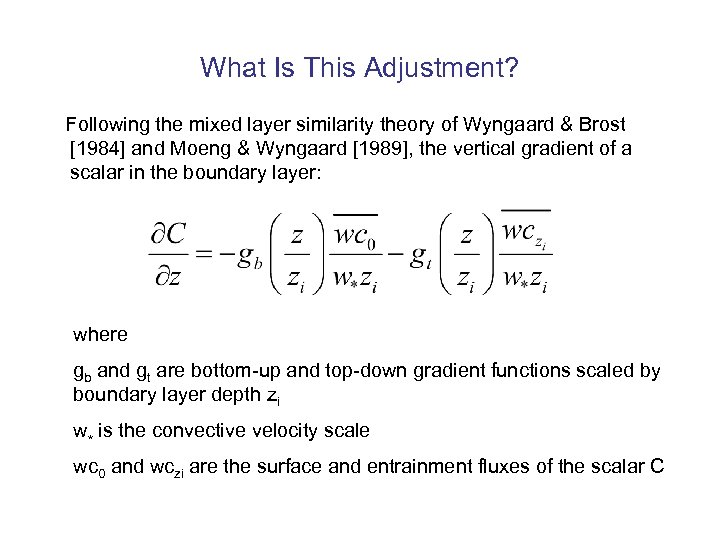 What Is This Adjustment? Following the mixed layer similarity theory of Wyngaard & Brost [1984] and Moeng & Wyngaard [1989], the vertical gradient of a scalar in the boundary layer: where gb and gt are bottom-up and top-down gradient functions scaled by boundary layer depth zi w* is the convective velocity scale wc 0 and wczi are the surface and entrainment fluxes of the scalar C
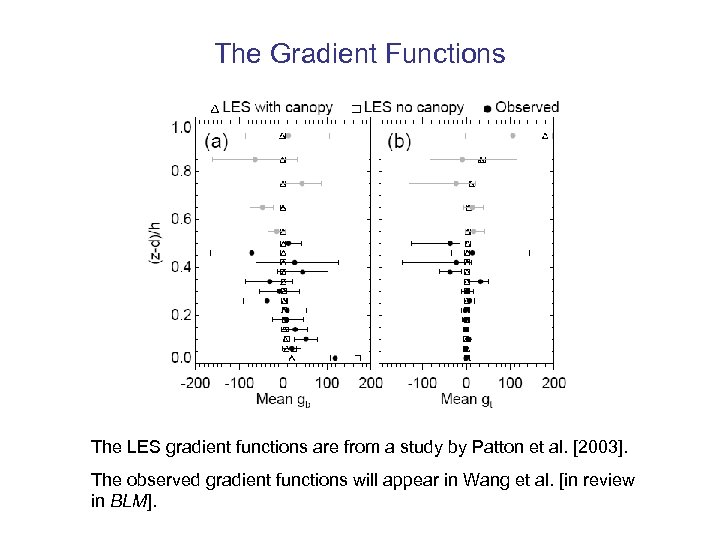 The Gradient Functions The LES gradient functions are from a study by Patton et al. [2003]. The observed gradient functions will appear in Wang et al. [in review in BLM].
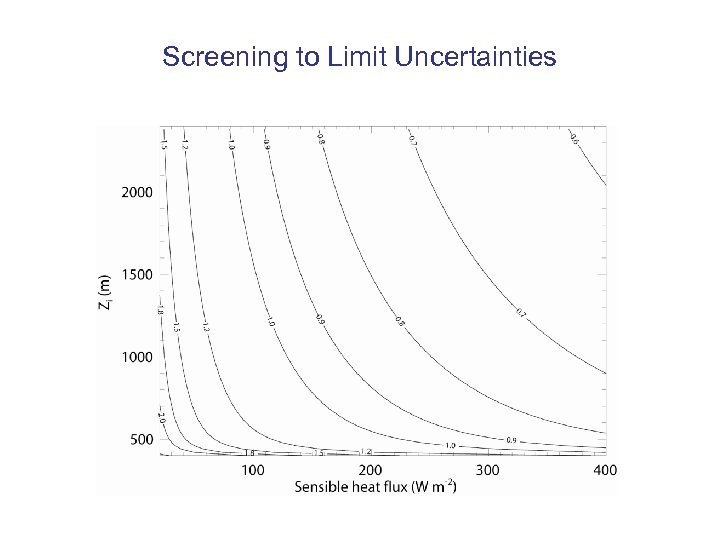
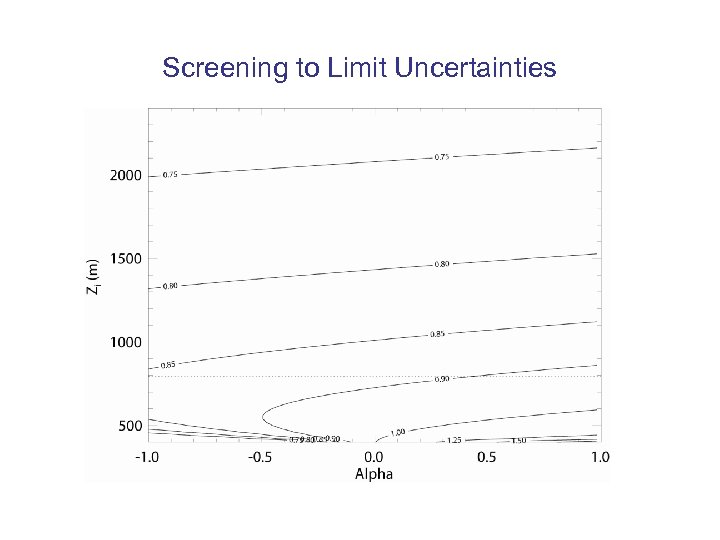
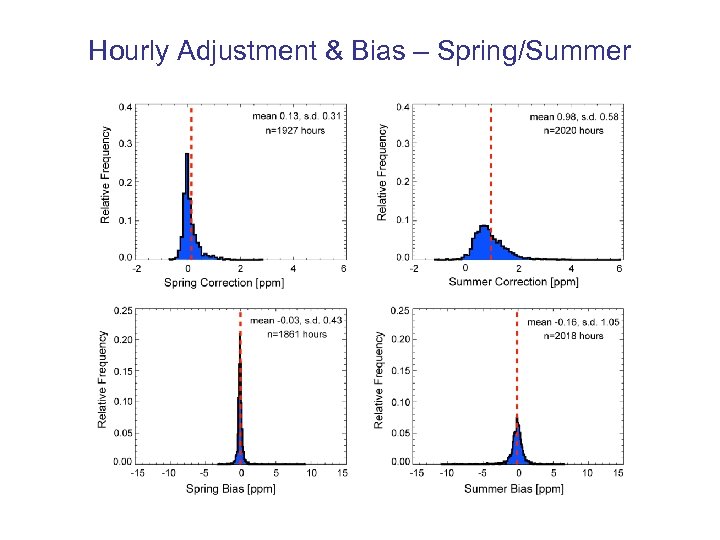
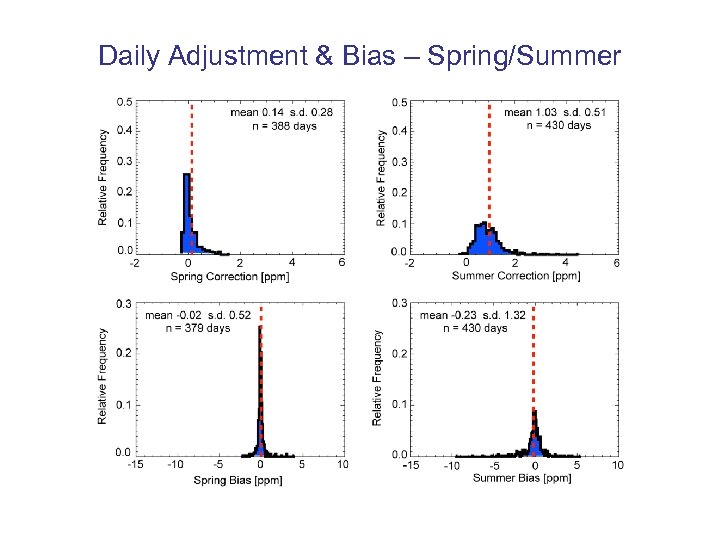
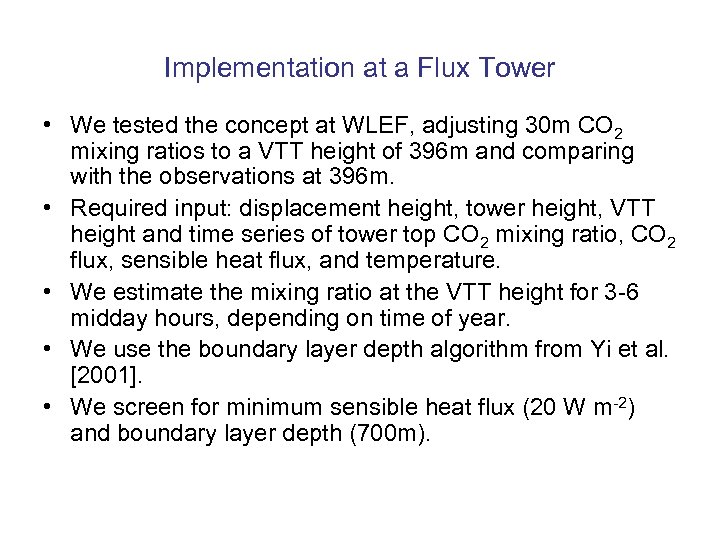 Implementation at a Flux Tower • We tested the concept at WLEF, adjusting 30 m CO 2 mixing ratios to a VTT height of 396 m and comparing with the observations at 396 m. • Required input: displacement height, tower height, VTT height and time series of tower top CO 2 mixing ratio, CO 2 flux, sensible heat flux, and temperature. • We estimate the mixing ratio at the VTT height for 3 -6 midday hours, depending on time of year. • We use the boundary layer depth algorithm from Yi et al. [2001]. • We screen for minimum sensible heat flux (20 W m-2) and boundary layer depth (700 m).
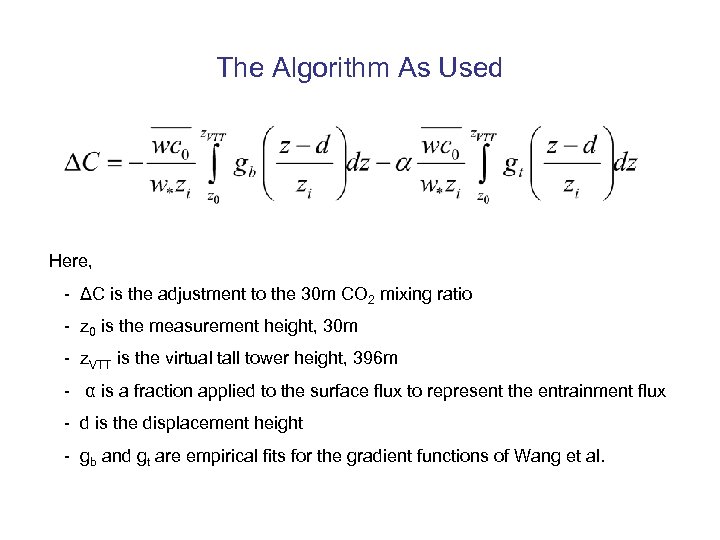 The Algorithm As Used Here, - ΔC is the adjustment to the 30 m CO 2 mixing ratio - z 0 is the measurement height, 30 m - z. VTT is the virtual tall tower height, 396 m - α is a fraction applied to the surface flux to represent the entrainment flux - d is the displacement height - gb and gt are empirical fits for the gradient functions of Wang et al.
 Screening to Limit Uncertainties
 Screening to Limit Uncertainties
 Hourly Adjustment & Bias – Spring/Summer
 Daily Adjustment & Bias – Spring/Summer
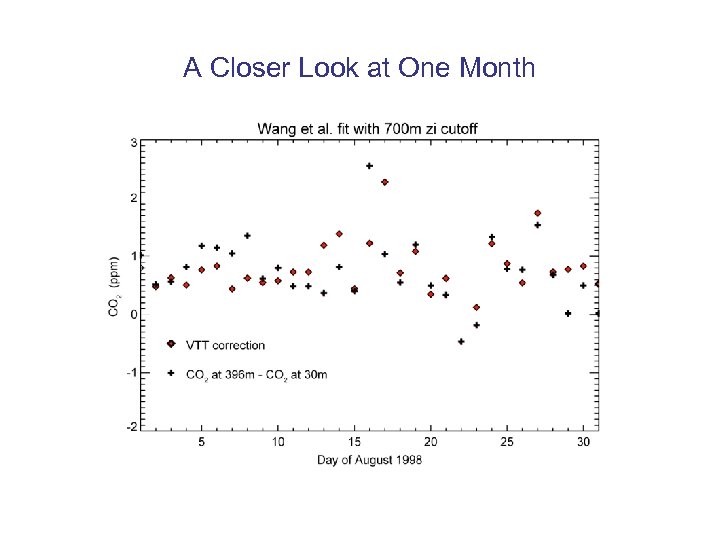 A Closer Look at One Month
 What a VTT is not…. • Unlike a tall tower: – – – Limited number of species observed Midday observations only More gaps in the observations Nocturnal boundary layer not represented Added uncertainty and bias • What if it isn’t a flux tower and/or permanent site? – Sample as high on a tower as possible – Infer the local flux for the micromet adjustment • By model • By sampling at multiple heights on tower
 Will VTTs Be Useful? • Adding a few more continental observation sites – Density of measurements – Spatial flux variability – Synoptic variability • Availability of VTT data • Tradeoffs…. – Is the bias and uncertainty a problem? – Can these data help constrain regional budgets?
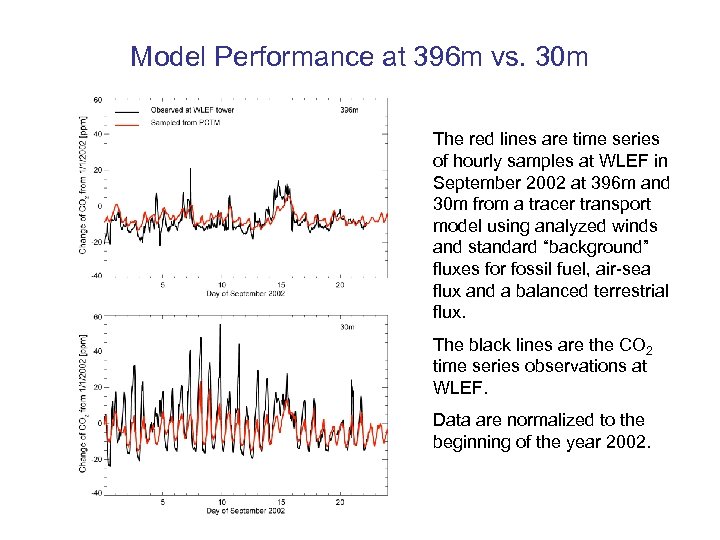 Model Performance at 396 m vs. 30 m The red lines are time series of hourly samples at WLEF in September 2002 at 396 m and 30 m from a tracer transport model using analyzed winds and standard “background” fluxes for fossil fuel, air-sea flux and a balanced terrestrial flux. The black lines are the CO 2 time series observations at WLEF. Data are normalized to the beginning of the year 2002.
 VTT References • • • Davis, K. J. , 2003, Well-calibrated CO 2 mixing ratio measurements at flux towers: The virtual tall towers approach, 12 th WMO/IAEA Meeting of Experts, Toronto. Davis, K. J. et al. , in prep, Methodology for a flux-tower based CO 2 observing network: Virtual tall towers. Moeng, C. -H. and J. C. Wyngaard, 1984, Statistics of conservative scalars in the convective boundary layer, JAS, 41(21), 3161 -3169. Moeng, C. -H. , and J. C. Wyngaard, 1989, Evaluation of turbulent transport and dissipation closure in second-order modeling, JAS, 45, 2311 -2330. Patton, E. G. , et al. , 2003, The influence of forest canopy on top-down and bottom-up diffusion in the planetary boundary layer, QJRMS, 129 A, 1415 -1434. Wang, W. et al. , in review, Observations of the top-down and bottom-up gradient functions in the convective boundary layer from a very tall tower, BLM. Wyngaard, J. C. , 1987, A physical mechanism for the asymmetry in top-down and bottom-up diffusion, JAS, 44(7), 1083 -1087. Wyngaard, J. C. and R. A. Brost, 1984, Top-down and bottom-up diffusion in the convective boundary layer, JAS, 41, 102 -112. Yi, C. et al. , 2001, Long-term observations of the dynamics of the continental boundary layer, JAS, 58(10), 1288 -1299.
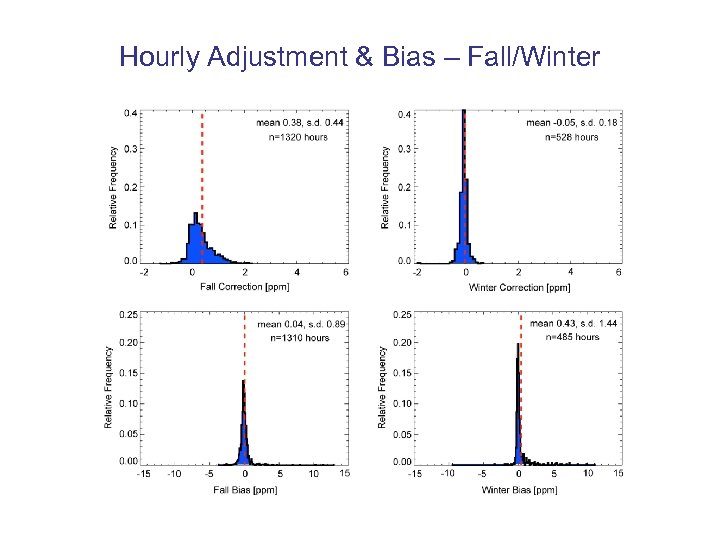 Hourly Adjustment & Bias – Fall/Winter
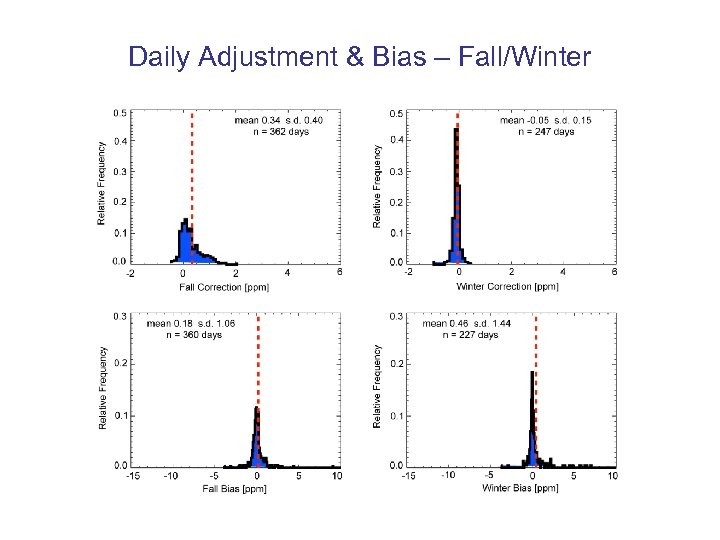 Daily Adjustment & Bias – Fall/Winter