 Скачать презентацию The role of tobacco price on consumption Dr
a47a6d9affdbea925c61f91cec3c45a5.ppt
- Количество слайдов: 12



The role of tobacco price on consumption Dr. Corné van Walbeek Senior Lecturer, School of Economics University of Cape Town 1
Two important principles of economics 1. The law of demand – As the price of a commodity increases, people are going to consume less of the product, all other factors held constant – By how much will consumption decrease? Not specified 2. Price elasticity – By how much does consumption decrease if the price increases by one per cent? – Distinguish between relatively elastic (ε > 1) and relatively inelastic (ε < 1) demand 2
More about price elasticity • If price elasticity = 0. 6, – For every 1 per cent increase in price, consumption decreases by 0. 6 per cent – For a 10 per cent increase in price, consumption decreases by 6 per cent • Estimates of price elasticity around the world: – – – Developed countries (ε of about 0. 4) Developing countries (ε between 0. 4 and 0. 8) South Africa (ε between 0. 6 and 0. 8) Chaloupka and Jha, 2000 and Van Walbeek, 2005 3
How does this work in practice? • Higher prices: – – – discourage smokers from starting to smoke encourage some smokers to quit reduces the average number of cigarettes smoked by smokers • Based on SA data, a 10 per cent increase in cigarette prices reduces cigarette consumption by about 6 per cent – Number of smokers decreases by about 3 per cent – Average consumption by remaining smokers decreases by about 3 per cent Van Walbeek, 2005 4
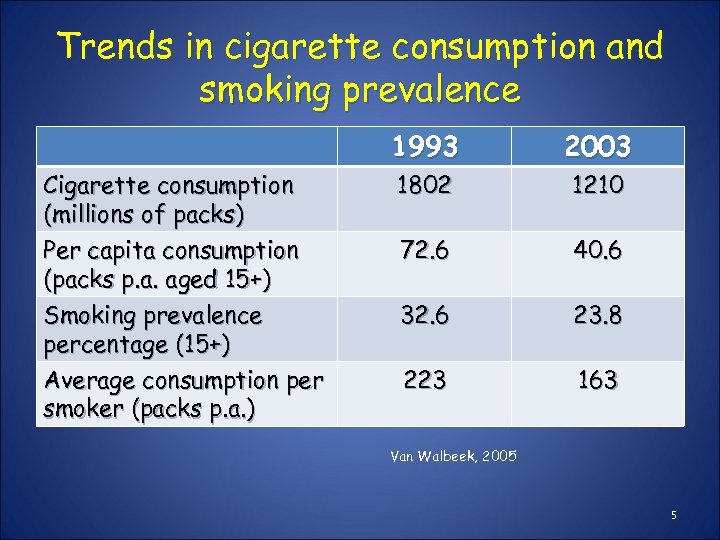
Trends in cigarette consumption and smoking prevalence 1993 Cigarette consumption (millions of packs) Per capita consumption (packs p. a. aged 15+) Smoking prevalence percentage (15+) Average consumption per smoker (packs p. a. ) 2003 1802 1210 72. 6 40. 6 32. 6 23. 8 223 163 Van Walbeek, 2005 5
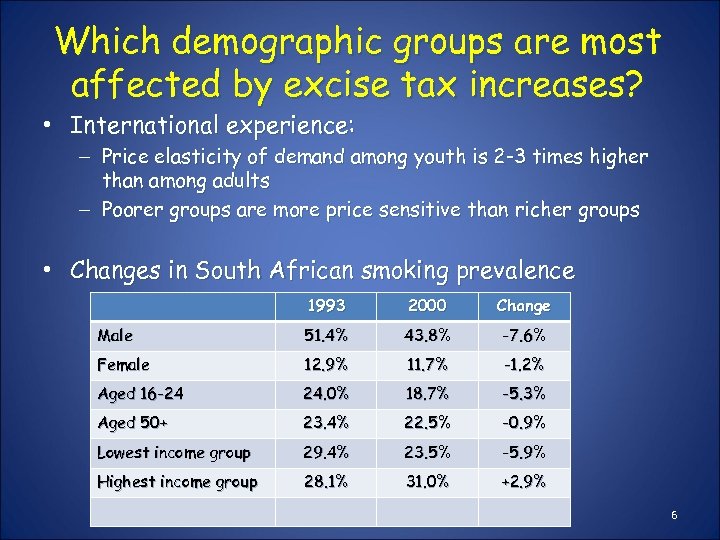
Which demographic groups are most affected by excise tax increases? • International experience: – Price elasticity of demand among youth is 2 -3 times higher than among adults – Poorer groups are more price sensitive than richer groups • Changes in South African smoking prevalence 1993 2000 Change Male 51. 4% 43. 8% -7. 6% Female 12. 9% 11. 7% -1. 2% Aged 16 -24 24. 0% 18. 7% -5. 3% Aged 50+ 23. 4% 22. 5% -0. 9% Lowest income group 29. 4% 23. 5% -5. 9% Highest income group 28. 1% 31. 0% +2. 9% 6
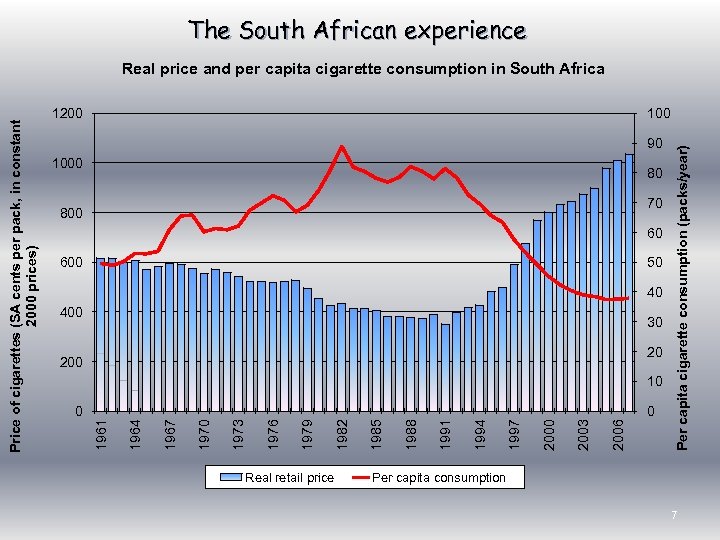
The South African experience 100 90 1000 80 70 800 60 600 50 40 400 30 20 200 10 Real retail price 2006 2003 2000 1997 1994 1991 1988 1985 1982 1979 1976 1973 1970 1967 0 1964 0 Per capita cigarette consumption (packs/year) 1200 1961 Price of cigarettes (SA cents per pack, in constant 2000 prices) Real price and per capita cigarette consumption in South Africa Per capita consumption 7
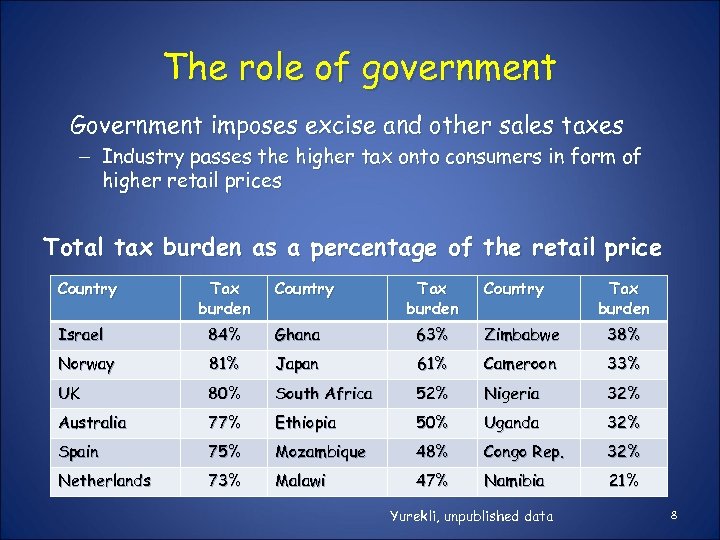
The role of government Government imposes excise and other sales taxes – Industry passes the higher tax onto consumers in form of higher retail prices Total tax burden as a percentage of the retail price Country Tax burden Israel 84% Ghana 63% Zimbabwe 38% Norway 81% Japan 61% Cameroon 33% UK 80% South Africa 52% Nigeria 32% Australia 77% Ethiopia 50% Uganda 32% Spain 75% Mozambique 48% Congo Rep. 32% Netherlands 73% Malawi 47% Namibia 21% Yurekli, unpublished data 8
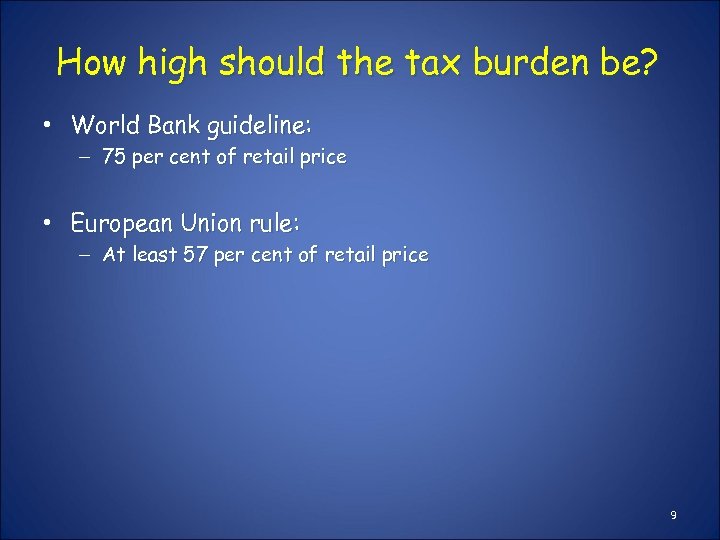
How high should the tax burden be? • World Bank guideline: – 75 per cent of retail price • European Union rule: – At least 57 per cent of retail price 9
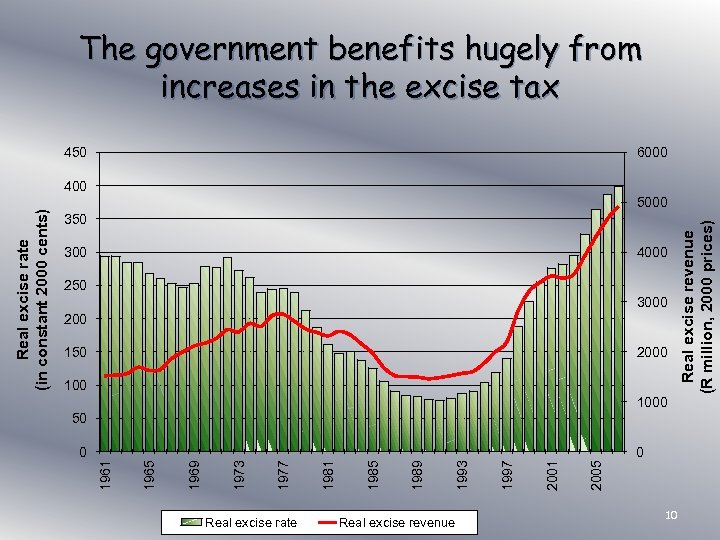
The government benefits hugely from increases in the excise tax 450 6000 350 300 4000 250 3000 200 150 2000 1000 50 Real excise rate Real excise revenue 2005 2001 1997 1993 1989 1985 1981 1977 1973 1969 0 1965 0 10 Real excise revenue (R million, 2000 prices) 5000 1961 Real excise rate (in constant 2000 cents) 400
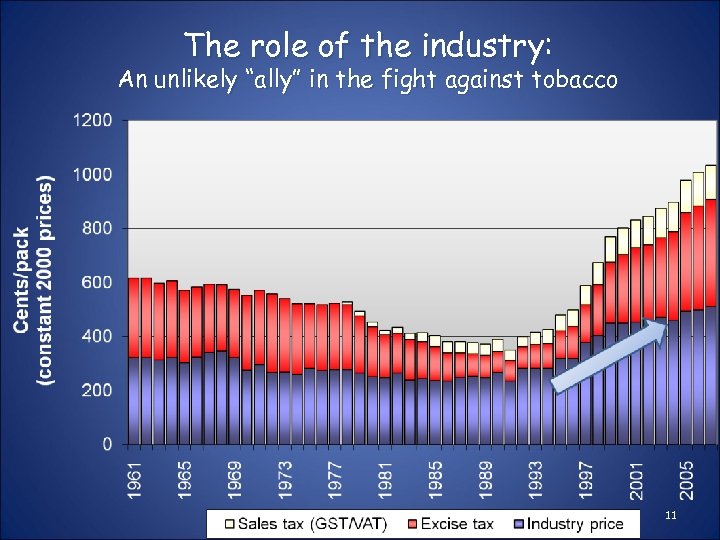
The role of the industry: An unlikely “ally” in the fight against tobacco 11
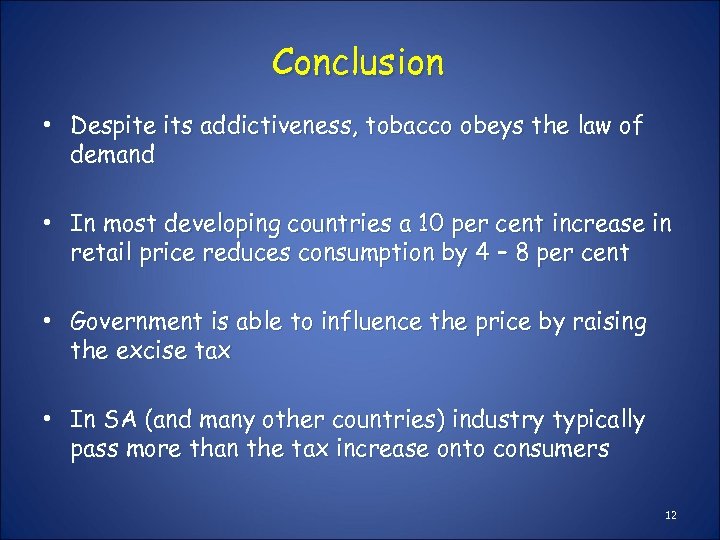
Conclusion • Despite its addictiveness, tobacco obeys the law of demand • In most developing countries a 10 per cent increase in retail price reduces consumption by 4 – 8 per cent • Government is able to influence the price by raising the excise tax • In SA (and many other countries) industry typically pass more than the tax increase onto consumers 12
Скачать презентацию The role of tobacco price on consumption Dr
a47a6d9affdbea925c61f91cec3c45a5.ppt