


 Скачать презентацию The Role of the Popular Article in Astronomical
a44afc3381c37a946833c11df95ca5d4.ppt
- Количество слайдов: 62
 The Role of the Popular Article in Astronomical Outreach T. J. Mahoney Science Editorial Unit Instituto de Astrofísica de Canarias
 Hamlet without the Prince: The Missing Role of the Popular Article in Astronomical Outreach T. J. Mahoney Scientific Editorial Service Instituto de Astrofísica de Canarias
 What Is a Popular Article? • One written for the periodical press/media (newspapers, magazines, radio, TV, WWW) • Can be: – Purely ephemeral (e. g. a news report) – Entertaining/informative – An opinion – A “think” piece
 Typology of Popular Articles • • News reports Interviews Book/equipment/software reviews Editorials Feature articles Essays Regular columns
 How Popular is “Popular”? • In general, not very – Except for news reports, which can get wide coverage and occ. grab headlines • Features & essays read mainly by “attentive audience” (i. e. confirmed astro buffs – see Barranger, this meeting)
 Is There a Problem? • Yes! – Astronomy feature articles are aimed at those “in the know” and are limited to astro mags – Feature writers in wider circulation magazines and newspapers generally have little or no knowledge of science: they know how to write for a wide audience but not what to write – Most astronomers know what to write but not how to write it for the wider market – And it gets worse. . .
 • The two-culture syndrome: the rift between arts and sciences seems as wide as ever – No good just pumping more science into the media – Science in general and astronomy in particular must be seen as somehow relevant to mainstream human thought and activity: it must be made culturally satisfying • Modern astronomy can occasionally come across to the public as a bit confusing. . .
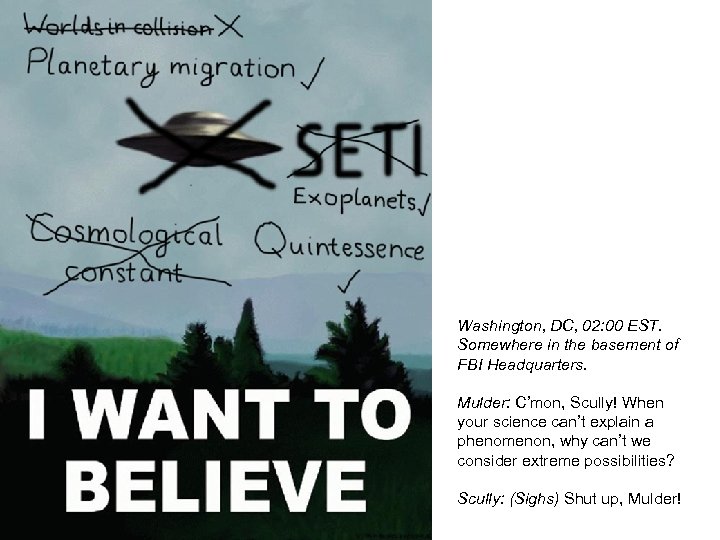 Washington, DC, 02: 00 EST. Somewhere in the basement of FBI Headquarters. Mulder: C’mon, Scully! When your science can’t explain a phenomenon, why can’t we consider extreme possibilities? Scully: (Sighs) Shut up, Mulder!
 So What Can We Do? • Start by examining current models of science communication
 Seeking a Flexible Model for Science Communication • A model must: – Describe actual communications practice – Be flexible enough to accommodate changes in practice – Predict the probable results of changes in communications strategy • Models are of several types, including: – Linear (either serial or parallel) – Networks
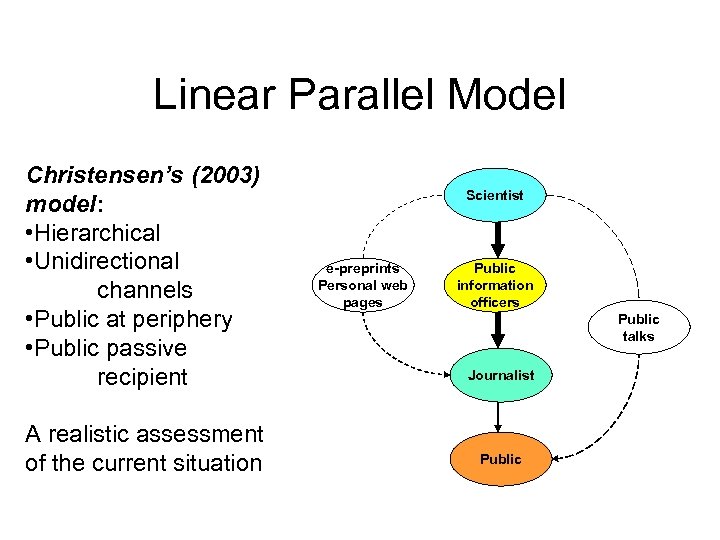 Linear Parallel Model Christensen’s (2003) model: • Hierarchical • Unidirectional channels • Public at periphery • Public passive recipient A realistic assessment of the current situation Scientist e-preprints Personal web pages Public information officers Public talks Journalist Public
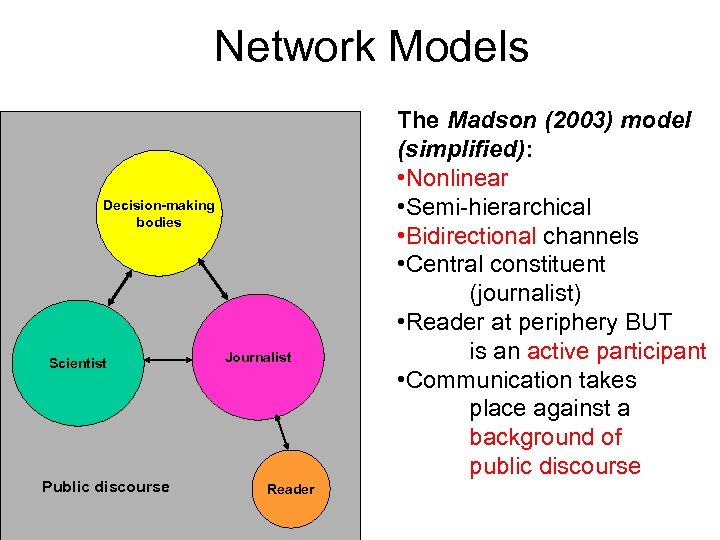 Network Models Decision-making bodies Scientist Public discourse Journalist Reader The Madson (2003) model (simplified): • Nonlinear • Semi-hierarchical • Bidirectional channels • Central constituent (journalist) • Reader at periphery BUT is an active participant • Communication takes place against a background of public discourse
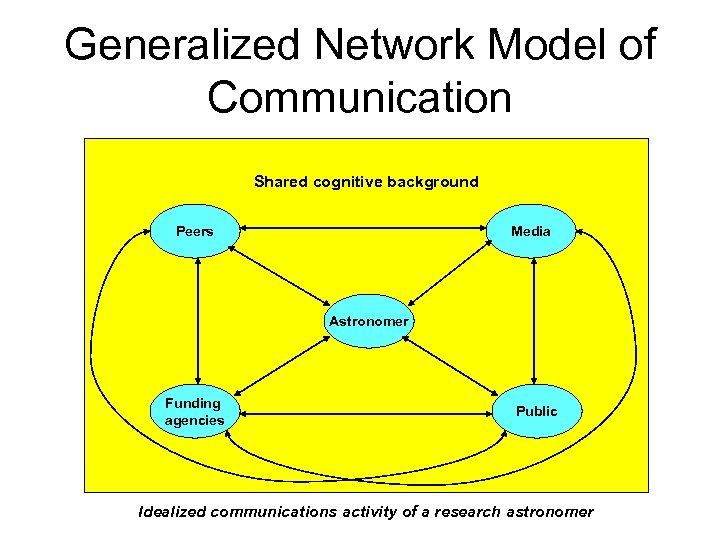 Generalized Network Model of Communication Shared cognitive background Peers Media Astronomer Funding agencies Public Idealized communications activity of a research astronomer
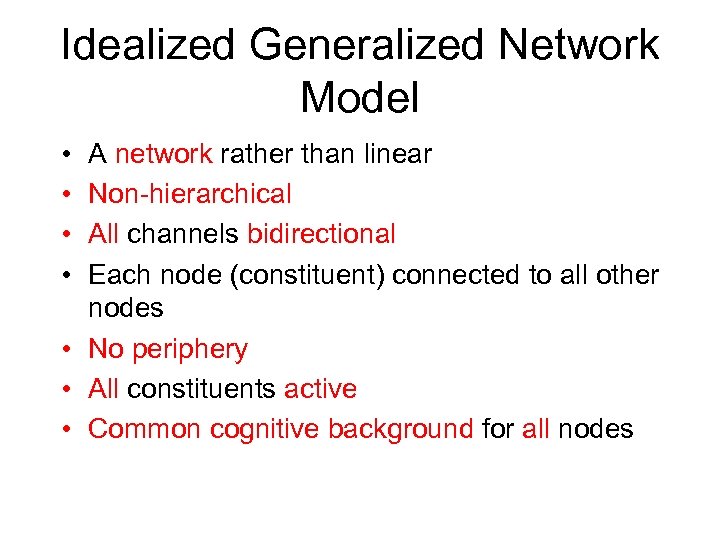 Idealized Generalized Network Model • • A network rather than linear Non-hierarchical All channels bidirectional Each node (constituent) connected to all other nodes • No periphery • All constituents active • Common cognitive background for all nodes
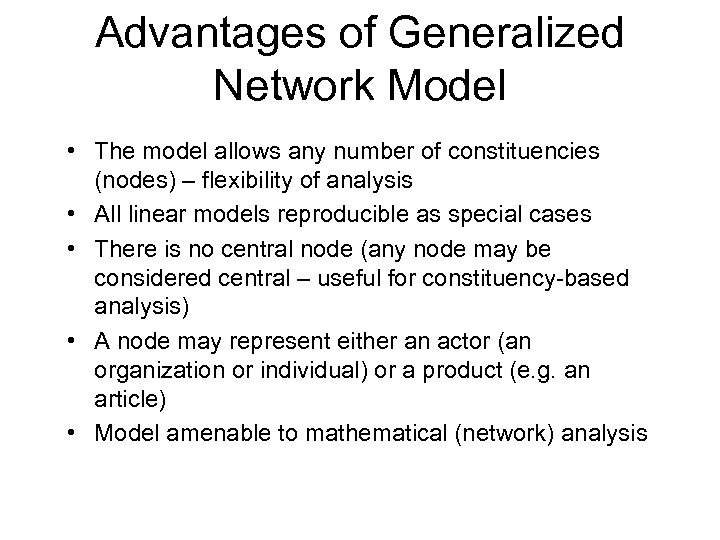 Advantages of Generalized Network Model • The model allows any number of constituencies (nodes) – flexibility of analysis • All linear models reproducible as special cases • There is no central node (any node may be considered central – useful for constituency-based analysis) • A node may represent either an actor (an organization or individual) or a product (e. g. an article) • Model amenable to mathematical (network) analysis
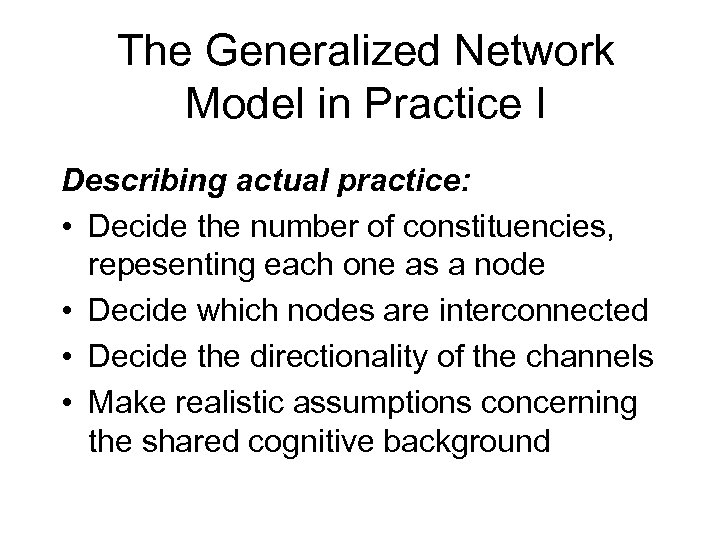 The Generalized Network Model in Practice I Describing actual practice: • Decide the number of constituencies, repesenting each one as a node • Decide which nodes are interconnected • Decide the directionality of the channels • Make realistic assumptions concerning the shared cognitive background
 The Generalized Network Model in Practice II Making changes in communications strategy • Decide a central constituency • In general, aim towards - not away from - the idealized model (i. e. progressively add complexity) • Add/subtract nodes • Add/subtract channels • Adjust directionality of existing channels
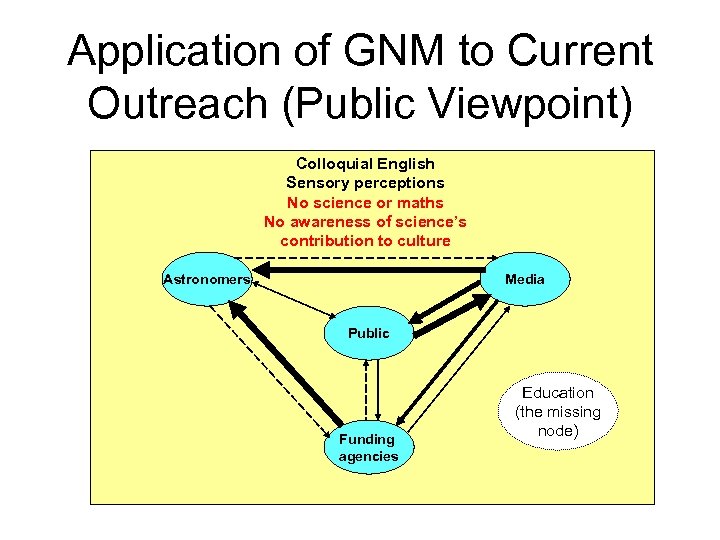 Application of GNM to Current Outreach (Public Viewpoint) Colloquial English Sensory perceptions No science or maths No awareness of science’s contribution to culture Astronomers Media Public Funding agencies Education (the missing node)
 Improvements in Communications • Raise the educational level of the general population (in both the arts and the sciences) – Long term!!! • Through the popular article and books, reestablish astronomy as an important part of the humanities by underscoring its role in the history of culture (together with the aesthetic beauty of the scientific quest) – Let’s start right now. – Read Heck (2001): ‘Creativity in arts and sciences’ (OSA II, p. 257)
 A Tiny Suggestion • Argue with reason where astrology et al. are concerned (an intemperate style could alienate much of the public) – Make sure you understand what you are criticizing (some astronomers don’t do this) – Avoid emotive language (“pseudoscience”, “superstition”, “nonsense”, “claptrap”, etc. ) ‘[F]or anger and fury, though they add strength to the sinews of the body, yet are found to relax those of the mind, and to render all its efforts feeble and useless. ’ – Swift
 Summary • News articles are so far the only genuinely popular articles: feature articles are mainly for astronomical consumption • GNM reveals need to educate • Popular articles should be aimed outside the readership of astronomy magazines and directly at the general media • Don’t be a man in black
 An Astronomer’s Communications Toolkit T. J. Mahoney Scientific Editorial Service Instituto de Astrofísica de Canarias
 Summary • Follows on from miniworkshop Writing to be Read: How to Improve Your Writing • Looks at (from the individual astronomer’s viewpoint): – – – – – Audiences and genres A network model for communication (astronomer’s viewpoint) Background research Necessary reference works Dealing with editors How your text is edited Handling the media Being an editor The writer’s rights Handling proofs
 You carry the marks of a few central issues. Reminders unfailingly arouse you to strongly partisan feelings. Though the issues may be few and personal, exploring them sincerely and intelligently will deeply touch your audience and keep you busy for life. Directing the Documentary (Michael Rabiger)
 The Voice of the Individual Astronomer • Might differ from corporate message of his peer community or institution • Research results must be expressed independently to ensure credibility • Astronomer’s doing outreach must always communicate as individuals • Research centres must encourage an individual approach to outreach among its research workers • Assertive but not hectoring
 Which Audience? Audience determines: • Genre • Media • Language (if English, is it UK, US or of some other region? ) • Language register • Visual requirements • Audio requirements
 The Astronomer’s Audiences • Funding agencies (grant applications) • Gate keepers (peer review, telescope time applications, commissioning editors) • Peers (meetings, conferences, journals, research monographs) • Students (lectures, textbooks) • The public (talks, planetaria, open days, star parties) • Media (books, newpapers, magazines, radio, TV, Internet)
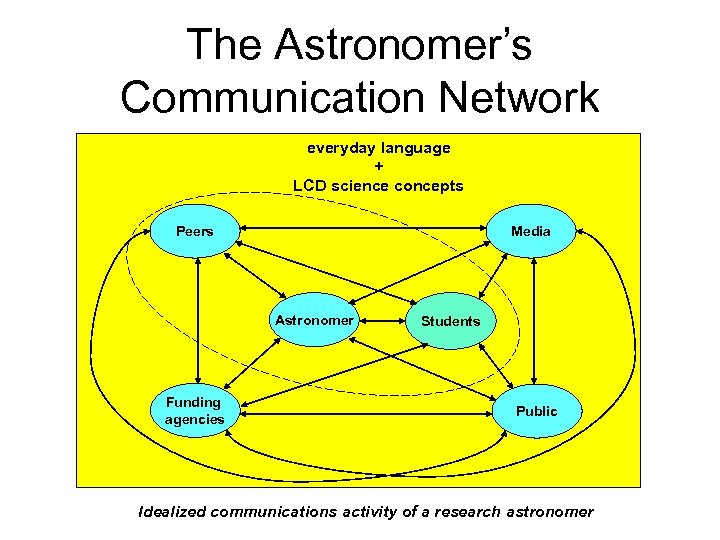 The Astronomer’s Communication Network everyday language + LCD science concepts Peers Media Astronomer Funding agencies Students Public Idealized communications activity of a research astronomer
 The Common Touch • Writers for the public must adopt the common shared knowledge of the expert and public as a working medium – Use only everyday language and build up technical concepts from basic knowledge possessed by the reader (little numeracy or science knowledge) – Assume the reader is otherwise as clever as you are!!! – Maintain a low fog index • This limitation makes popular writing very much more challenging than writing research papers (as far as writing skills are concerned) • Learning to write simply and clearly will improve the readability of your research papers
 Market Research I • You must write for a specific market (not for a general genre) • A market may be a newspaper, magazine, publishing house, TV programme, radio programme, or website • The market will determine the audience
 Market Research II • Start with Writers’ and Artists’ Yearbook (UK) or Writer’s Market (US) for full lists of newspapers, magazines, publishers, TV/radio companies, agents, etc. • Examine articles, books, programmes at first hand • Do a market analysis (see handouts)
 Market Analysis: Newspapers and Magazines • What is the mix of news, features & editorials? • What is the style? Note the register, length of sentences and paragraph size • Who writes for the publication/programme? Freelancers have bylines: staff often don’t. Are there opportunities for the freelancer? If not, stop here! • Advertising provides important information on readership/audience. – Periodicals: what is the advertising/text ratio? • How much do they pay? What about copyright? • Write up your analysis (see handouts)
 Approaching a Magazine Editor • NOT a good idea to send editors unsolicited work • INSTEAD, write a brief proposal covering: – Why you think an article on a given topic would interest readers of this magazine at this time – A succinct summary of the article and the approach to be adopted – Who you are and why you are the right person to tackle this topic – What illustrations will accompany the text • Give your COMPLETE contact details
 Researching a Story: Marshalling the Facts I keep six honest serving-men (they taught me all I new); Their names are What and Why and When And How and Where and Who.
 I send them over land sea, I send them east and west; But after they have worked for me, I give them all a rest. I let them rest from nine till five, For I am busy then, As well as breakfast, lunch, and tea, For they are hungry men. From The Elephant’s Child (Rudyard Kipling)
 Researching a Story: Giving It Depth If a writer of prose knows enough about what he is writing about he may omit things that he knows and the reader, if the writer is writing truly enough, will have a feeling of those things as strongly as though the writer had stated them. The dignity of movement of an iceberg is due to only one-eighth of it being above water. A writer who omits things because he does not know them only makes hollow places in his writing. Death in the Afternoon (Ernest Hemingway)
 Researching a Story: Form and Substance General Considerations: • Genre determines form • Research determines substance • Poor research shows by drawing the reader’s attention to the writer’s ignorance • Good research helps the story, even when it isn’t made visible • One investigation can generate many stories
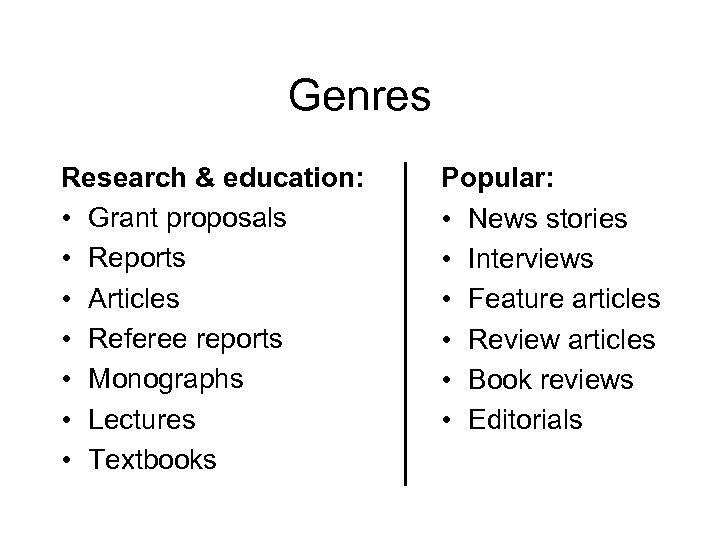 Genres Research & education: • Grant proposals • Reports • Articles • Referee reports • Monographs • Lectures • Textbooks Popular: • News stories • Interviews • Feature articles • Review articles • Book reviews • Editorials
 Media • • Print Direct audience contact Radio TV CD-ROM/DVD Videoconferences Internet/intranet e-mail
 British, American or Regional English? • The problems are largely those of spelling, but also minor differences in grammar and punctuation • Spelling differences between US and UK English may be minimized by using either Meriam-Webster’s Collegiate Dictionary (US) or the Concise Oxford Dictionary (UK) – all good science communicators in English should have both • See OUP for regional dictionaries (e. g. Australia, Canada and South Africa) • ALWAYS check your publisher’s house style (if any)
 Language Register • Adapt vocabulary and style to the genre and medium • Popular communications: – Absolutely no jargon – Short sentences and paragraphs (think in soundbites) • Research communications: – Jargon necessary for brevity (common knowledge background of expert peers) – Long audience attention span, so expository style acceptable
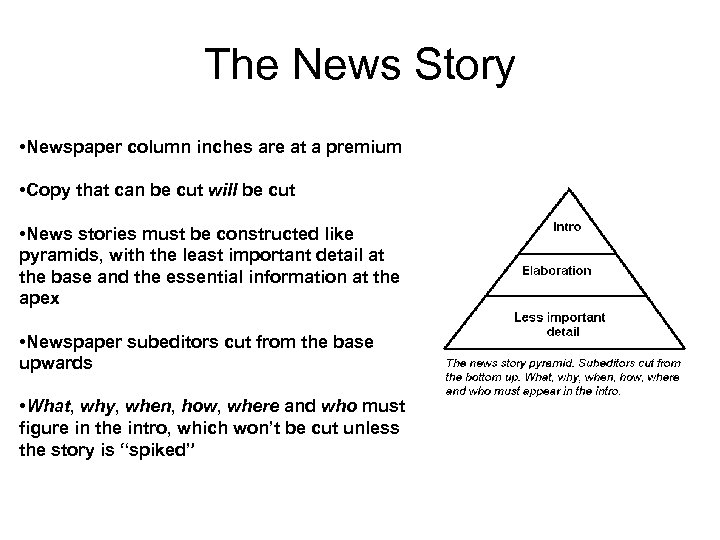 The News Story • Newspaper column inches are at a premium • Copy that can be cut will be cut • News stories must be constructed like pyramids, with the least important detail at the base and the essential information at the apex • Newspaper subeditors cut from the base upwards • What, why, when, how, where and who must figure in the intro, which won’t be cut unless the story is “spiked”
 The Feature Article I • 500 -3500 words on a theme • To be read at leisure and from start to finish • Must tell a story with a beginning, middle and end • Nowadays often accompanied by coloured illustrations • Technical details can be included in boxes to be read apart from the main text
 The Feature Article II • The opening must entice the reader to read further • The theme is the backbone holding the story together (needs planning) • Views should be contrasted (some sort of tension should sustain the reader’s interest) • The ending should provide a sense of closure. • Pictures should add to the narrative
 Interviewing • Arrange with editor who is to be interviewed • Do your homework prior to the interview • The person being interviewed is the interesting party, not the interviewer • Ask permission to record, make notes, etc. • Write up immediately after conducting the interview • Angle questions to get the best out of the interviewee
 Writing Reviews • Contact reviews editor to be put on the list of reviewers • Read the book thoroughly • Comment on what the book is about, not what you would like it to be about • Avoid harsh language, just state what’s wrong (if there is anything wrong) • Don’t catalogue long lists of errors: keep a broad sweep • Put the book in the market context
 Running a Regular Column • You’ll need to establish a track record beforehand! • Be realistic about the time you can dedicate to meeting regular deadlines • If you’re otherwise too busy, don’t take on a column
 Trade (Popular) Books • Do some market research beforehand • Write a letter of enquiry first, briefly (less than one page) explaining what the book will be about and why now is a good time for a book on this topic • If you already know the commissioning editor, you can send a full proposal, consisting of summary, sample chapters, CV, etc.
 Writing for Children • This market is a jungle with real live hungry tigers lurking behind every tree • Keep control over content • Writing for kids is very difficult! • Insist on full-colour proofs for packaged books • You might have to meet absurdly stiff deadlines
 Textbooks • You will need to develop the text in close collaboration with an editor who knows the needs of the market probably much better than you do • Can be profitable, but see Pasachoff & Pasachoff (2005)
 Reference Works • Very time-consuming • Needs considerable organization and management skills (or at least a willingness to learn them) • Very expensive to produce so you need to write a very careful proposal fully justifying the market potential for such a work)
 Consultancy • • Being interviewed Refereeing book proposals Radio and TV Cinema
 Being an Editor • Conference Proceedings • Multi-Author Works – Refereeing – Copy-editing • Reference Works • Magazines • Journals
 Copy-Editing • Only trade books can be guaranteed a professional copy-editor, otherwise you must do it • There must be only one copy-editor for a book • You need: – – Monumental patience An eye for detail A native grasp of the language concerned To define a clear consistent style of spelling, punctuation, referencing, etc. (style sheet) – 3 man-months available for a 300/500 page bk depending on number of authors & text complexity
 Style Sheets: How to Compile and Use Them Write down all decisions as they arise on: – – – – Spellings Date formats Math typesetting Physical units Abbreviations in the text Punctuation Referencing style Stick to these decisions rigorously throughout the volume
 Understanding Publishing • Read about the publishing process (see reading list) • Take courses in aspects of publishing (if your institution can afford them) – UK: The Publishing Training Centre (London, www. train 4 publishing. co. uk) – A course in proofreading would be instructive for all astronomers
 Sudden-Death Radio Interviews • If called for an interview, – Decide whether you are expert in the field or if a colleague might be more informed – If you put on the spot and you need to get your thoughts together (i. e. do some panic netsurfing) ask them to ring back in 10 min – Find out about the programme and whethere’s an agenda that might not meet with your approval
 Radio Interview Technique Fundamental media concept The SOUNDBITE: a brief ( 10 seconds) extract from an interview • Soundbites are often used in recordings for inserts – occasionally taken out of context! • Divide your message into succinct, directed soundbites that can be used independently • Draw word pictures (Rodríguez Hidalgo 2005) • Don’t waffle! Complete your message & stop!
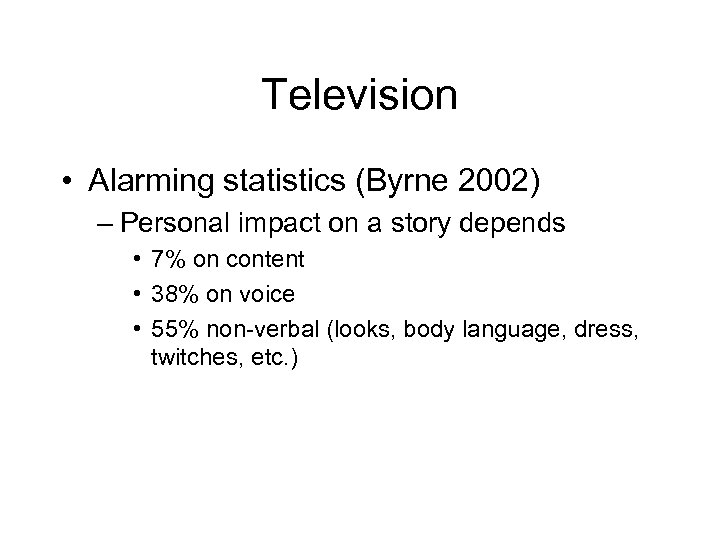 Television • Alarming statistics (Byrne 2002) – Personal impact on a story depends • 7% on content • 38% on voice • 55% non-verbal (looks, body language, dress, twitches, etc. )
 Rights • Normal to cede all publication rights for academic & research work, otherwise – • Reversion of copyright after O/P no becoming normal • For trade books, radio & TV, get an agent • DON’T LET GO OF YOUR COPYRIGHT! – Trade books should always be in author’s copyright – Popular articles should really be author copyright (isn’t this the case for syndicated excerpts from books? )
 Handling Proofs • Time-consuming • Proofs must be read character by character, not sentence by sentence • Use an established system of proofmarking • Follow the publisher’s instructions to the letter • Take a course in proofreading
 From Academia to Full-Time Authorship • • Weighing the risks Setting up Taxation and social security Should you have an agent?