


 Скачать презентацию The role of the intermediary Richard Savory richard
bd680e00968a9dd19d594a0cee9666f6.ppt
- Количество слайдов: 24
 The role of the intermediary Richard Savory richard. savory@everett. co. uk
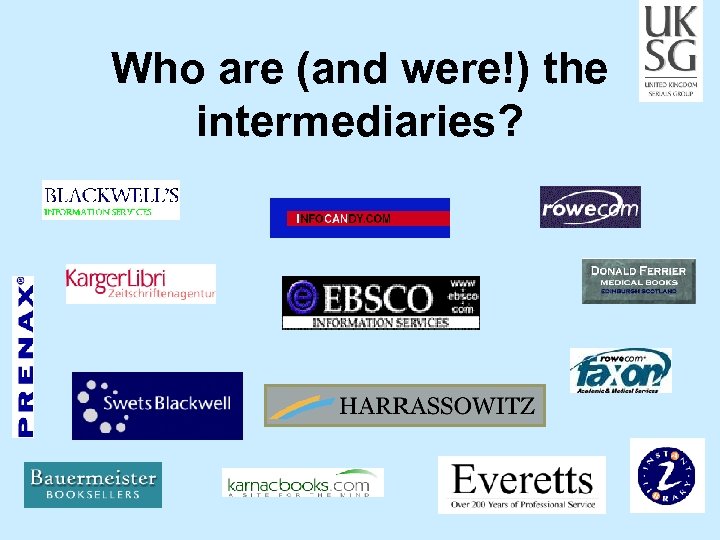 Who are (and were!) the intermediaries?
 1980 s: The age of choice • • • Blackwell’s † Dawson † Swets & Zeitlinger Bumpus, Haldane & Maxwell † Bailey’s † Ebsco Faxon † Universal † Stobart † Martinus Nijhoff † Harrassowitz Everetts (roughly in order of UK market share circa 1984)
 And there were more! • Karger, HKLewis, Bauermeister, Gothards, Collets, Karnac, Menzies, Wilshire, Bissets, Austicks, Galloway & Porter, Heyden & Sons, John Smith, Heffers, Haigh & Hochland, James Thin, Donald Ferrier, Munksgaard, Majors, Mc. Gregor…. . . • In the early 1980 s there were 32 UK-headquartered companies who were members of the ASA. Today there are somewhere between 0 and 2.
 2003: Slimmer pickings • Swets Blackwell • Ebsco • Everetts (with a UK base, active in all markets) • Harrassowitz • Karger (selling to mainly academic libraries from Europe) • Prenax, Infocandy, Instant Library (mainly active in the corporate market) Um……that’s about it really.
 Why the vanishing acts? • Smaller suppliers found it hard to make the investment necessary to compete in the electronic age • Larger suppliers keen to buy market share; attractive to directors of smaller private companies to sell out • Decreasing discounts from publishers • Pips squeezed by consortia Some jumped and some were pushed!
 So if they’re disappearing thick and fast, is there any reason now for the ‘middleman’ to exist? or “What has the intermediary ever done for us? ? ? ”
 Firstly, intermediaries are important to publishers • Consolidated and timely payments, orders and claims • Electronic payment • Automated renewals • Simplified communication • Efficient price-tracking & payments Services may or may not be rewarded by a discount from the publisher
 But it’s libraries that more obviously benefit from a raft of services • • Consolidated orders, claims and invoices Single cheque / payment point Single currency Binding service level agreement Single contact point for customer service Bibliographic services Financial management services Services may or may not be rewarded by a supplementary payment or ‘handling charge’ from the library (of which more later…. )
 As well as the core traditional services, intermediaries offer ‘added value’ services too: • • • Consolidation of print Customer-facing database (online services) Electronic license and access management Gateway products EDI Fixed-price deals for consortia
 Consolidation of print titles • • • Potential cost-savings on US subscriptions Automatic claiming of missing issues Outsourcing, e. g. labels, tattletape Machine-readable check-in data Secure delivery Single-issue bank
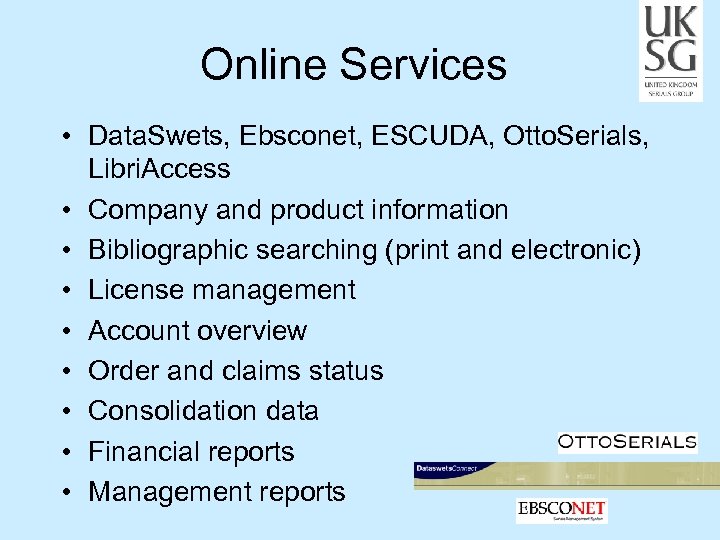 Online Services • Data. Swets, Ebsconet, ESCUDA, Otto. Serials, Libri. Access • Company and product information • Bibliographic searching (print and electronic) • License management • Account overview • Order and claims status • Consolidation data • Financial reports • Management reports
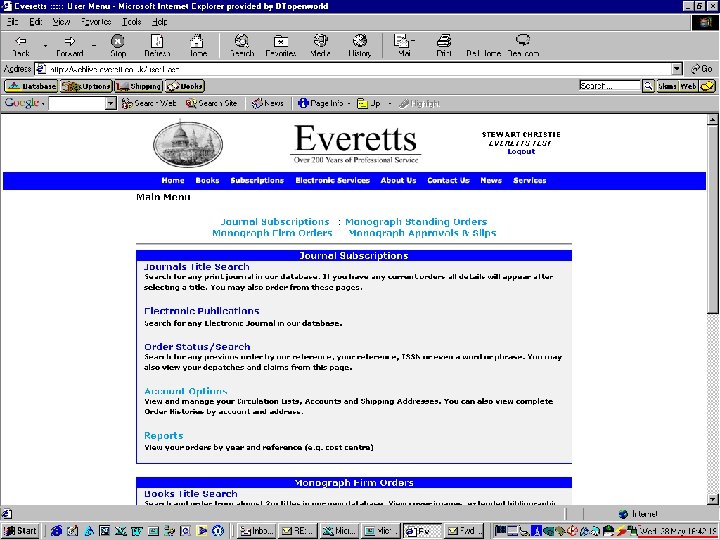
 Electronic License Management • To help libraries deal with electronic license management, intermediaries: • Have developed web-based databases • Enable searching by title, publisher, ISSN • Provide pricing information – Free With Print, Surcharge etc • Provide a link to the publisher’s license • Enable the license to be downloaded • Spend considerable time and money trying to keep the information current and accurate
 Gateway Services • Swets. Wise, Ebsco. Host EJS • “Gateway”= solution where content is “pointed to”, not hosted • Single source for ordering and accessing subscriptionbased full-text e-journals • Single source for e-journal authentication • Agents maintain URLs and passwords • Text stored on agents’ servers, or gateways to publishers’ servers. Internet delivery. Generally HTML for headers and PDF for full-text • Catalogue of titles in the service. Search by Title, Author, Subject across TOC, Abstract. Searching across titles • Some services allow searching through full-text
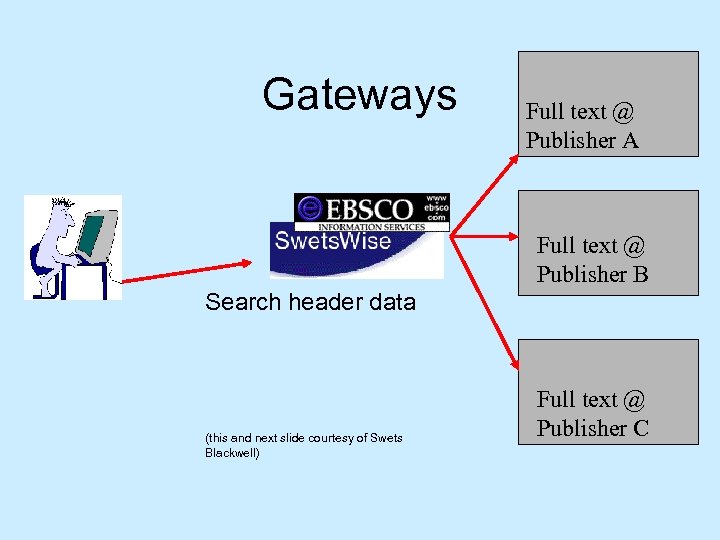 Gateways Full text @ Publisher A Full text @ Publisher B Search header data (this and next slide courtesy of Swets Blackwell) Full text @ Abstract & Publisher C Full Text
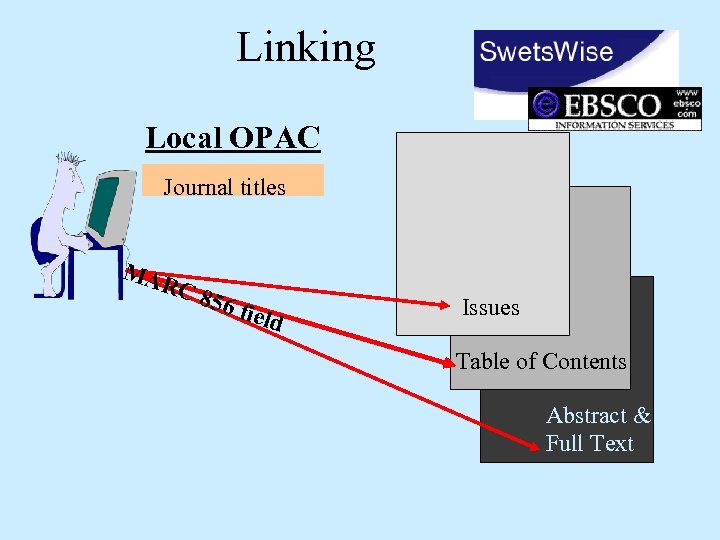 Linking Local OPAC Journal titles MA RC 85 6 fie ld Issues Table of Contents Abstract & Full Text
 What is EDI? • Electronic Data Interchange • A method of exchanging business information electronically in a standardized machine-readable format • Used in business over 20 years - more recently in library technology • Standards: ASC X 12, EDIFACT: Neutral languages for describing business data in a structured way
 EDI Transactions • Ordering – Library to Agent to Publisher • Invoicing – Agent to Library System • Claiming – Library to Agent to Publisher • Consolidation check-in data – Agent to Library System For more info, visit http: //www. icedis. org
 Consortia • Started in the 1990 s; in the UK there are 6 academic consortia + others such as CHILL, BRISC and the NHS • Consortia have depressed intermediaries’ margins through cut-throat competition • Attractive to publishers wanting to deal direct for electronic content (“Disintermediation”) • Consortia have contributed to the demise of some suppliers • Pricing pendulum swinging back?
 Who pays the ferryman? • Average publisher discount = 5% • Additional income from: – Service charges – Exchange-rate profits – Prepayment interest • Each £ 10 m turnover = maybe £ 750 k gross profit Low-margin businesses don’t come any lower
 and for many of you the beautiful truth is…. the large academic consortia have for the most part negotiated ‘listminus’ deals, so in effect agents actually PAY for the privilege of supplying them! <- would-be intermediary having head examined
 Subscription agents - the new model? • • End-User E-Procurement systems started in the late 1990 s divine/Faxon - k. Store Swets Blackwell – Swets. Wise EBSCO – EBSCO Corporate Services End-User Ordering, Claiming, Renewals All done electronically Linked with B 2 B commerce platforms (Ariba, Commerce. One, ERP’s (Enterprise Resource Planning), etc • More labour-intensive for the end user (customer service support may be thin or non-existent) • Agent levies per-line charge • Much interest in the corporate market
 Is there a future for the intermediary? • Yes. Well, probably. Depends: – On publishers acknowledging that there is a continuing advantage in intermediaries aggregating administrative tasks – On libraries accepting that ‘more for less’ is not a permanently sustainable situation – On intermediaries continuing to develop and refine their services (and making enough profit to afford to do so) As in most other walks of life, you get what you pay for