


 Скачать презентацию The Role of TAG Transport Advisory Group and
a33549b74e1aa74385c5790d4449c422.ppt
- Количество слайдов: 19
 The Role of TAG (Transport Advisory Group) and Engagement in Future Transport Policy Dr Delia DIMITRIU TAG member
 Designing a Research Programme at EU level Horizon 2020_Work Programme 2016 -2017 Transport Input from: • TAG Members (start Oct 2013) • European Technology Platforms (ETPs) • National experts via Programme Committees Process: • 2 -3 Drafts checked with MS national experts via Programme Committees~ 1. 5 year • Commission inter-service Consultation • Adoption- summer 2015 • Publication of calls - Oct 2015 2
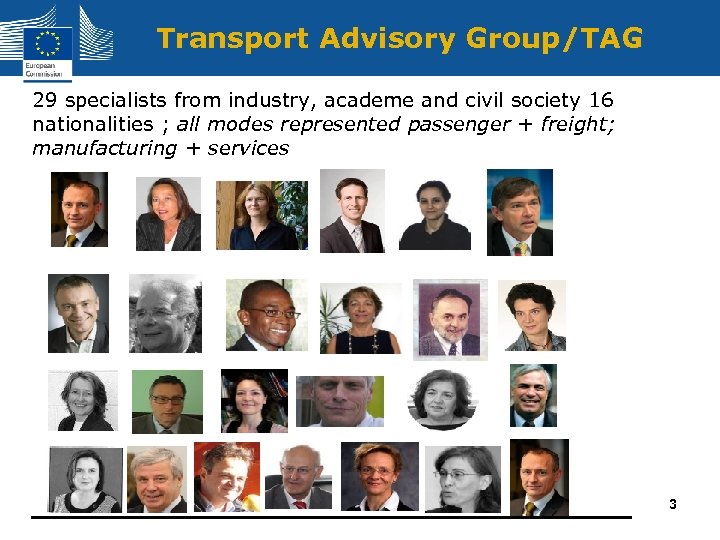 Transport Advisory Group/TAG 29 specialists from industry, academe and civil society 16 nationalities ; all modes represented passenger + freight; manufacturing + services 3
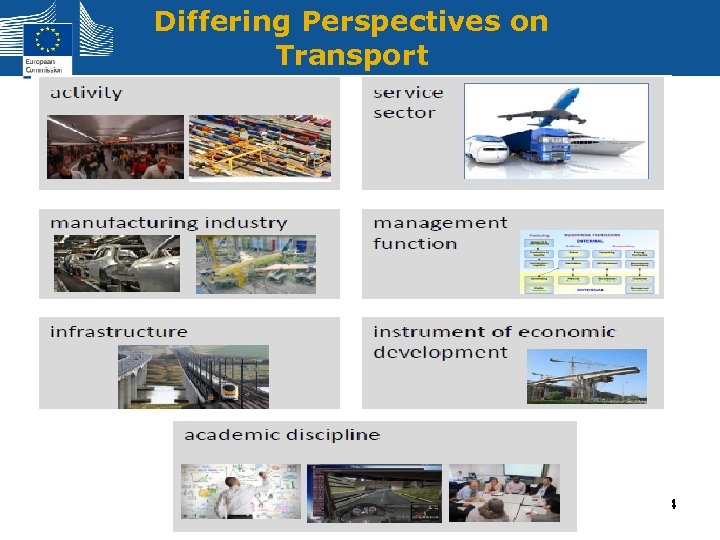 Differing Perspectives on Transport 4
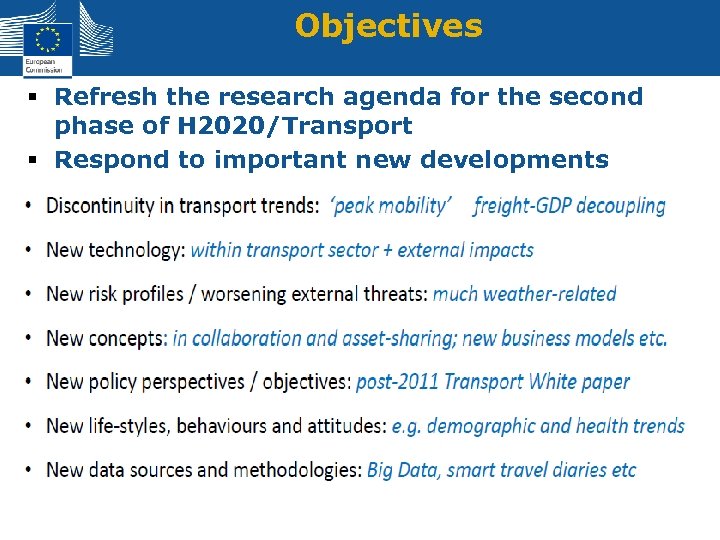 Objectives § Refresh the research agenda for the second phase of H 2020/Transport § Respond to important new developments 5
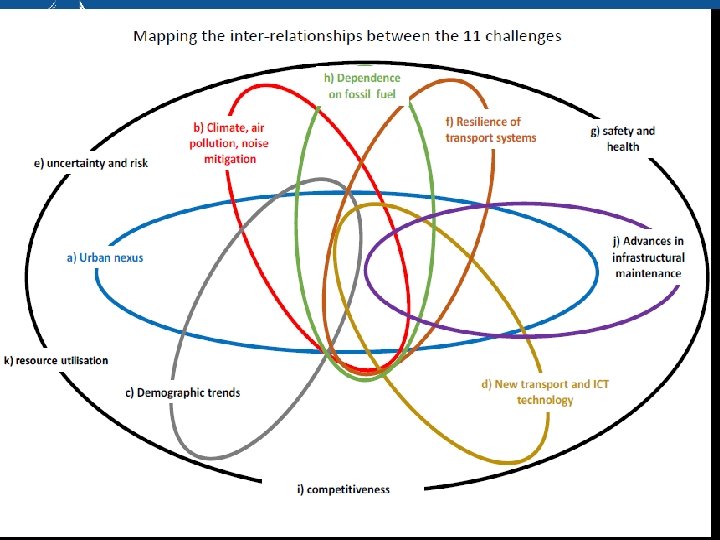
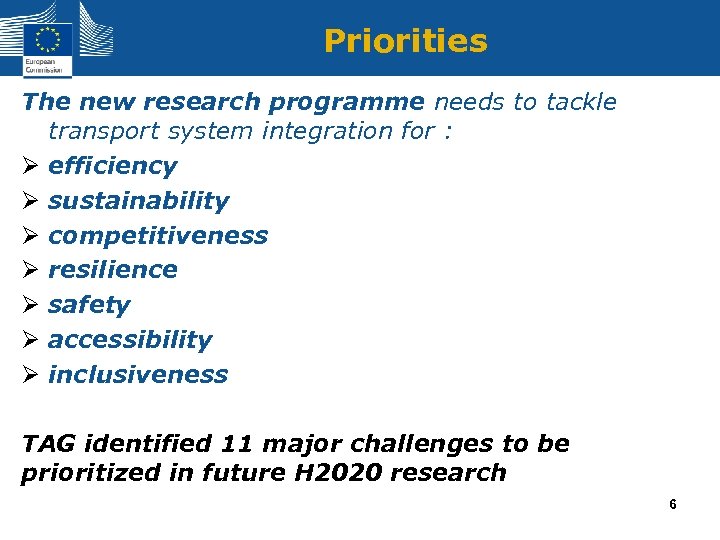 Priorities The new research programme needs to tackle transport system integration for : Ø efficiency Ø sustainability Ø competitiveness Ø resilience Ø safety Ø accessibility Ø inclusiveness TAG identified 11 major challenges to be prioritized in future H 2020 research 6
 7
7
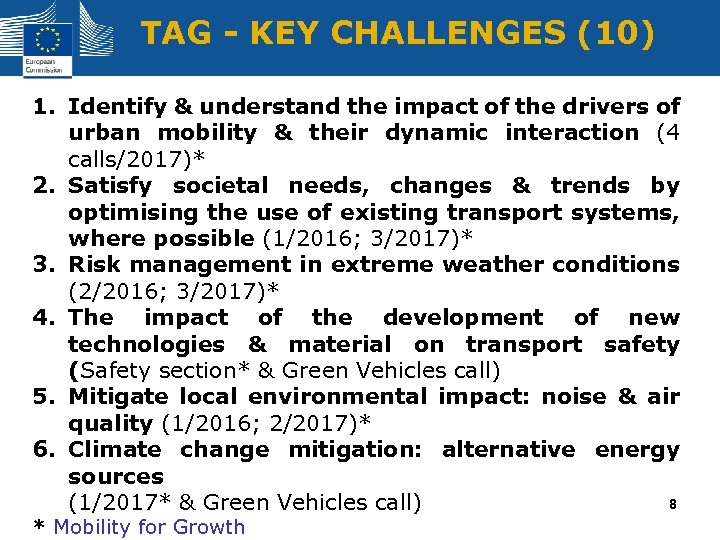 TAG - KEY CHALLENGES (10) 1. Identify & understand the impact of the drivers of urban mobility & their dynamic interaction (4 calls/2017)* 2. Satisfy societal needs, changes & trends by optimising the use of existing transport systems, where possible (1/2016; 3/2017)* 3. Risk management in extreme weather conditions (2/2016; 3/2017)* 4. The impact of the development of new technologies & material on transport safety (Safety section* & Green Vehicles call) 5. Mitigate local environmental impact: noise & air quality (1/2016; 2/2017)* 6. Climate change mitigation: alternative energy sources 8 (1/2017* & Green Vehicles call) * Mobility for Growth
 TAG - KEY CHALLENGES (cont. ) 7. Effectively harnessing new transport related ICT technology & data management opportunities (2/2017*); ‘Intelligent Transport Systems' section (1/2017*) 8. Deploying innovative technologies, materials, and processes of transport infrastructure management (2/2017*); ‘Infrastructure' section (1/2016*) 9. Competitiveness of the European transport sector in global markets: assessment of future opportunities & threats (1/2016*; 2/2017*); 'Automated Road Transport' call. 10. Cooperation & competitiveness in the European transport market (2/2016*; 3/2017*). Other actions: Support to policy activities * Mobility for Growth 9
 The Importance of ETPs European Technology Platforms (ETPs) are industry -led stakeholder fora recognised by the European Commission as key actors in driving innovation, knowledge transfer and European competitiveness. ETPs develop: • research and innovation agendas, and • roadmaps for action at EU and national level ETPs aim: • be supported by both private and public funding. • mobilise stakeholders to deliver on agreed priorities and share information across the EU. 10
 Transport oriented ETPs ACARE - Advisory Council for Aeronautics Research in Europe ERRAC - European Rail Transport Research Advisory Council ERTRAC - European Road Transport Research Advisory Council Logistics - European Technology Platform on Logistics Waterborne - Water transport 11
 Future Transport Policy A review of the research requirements: • Important topics to continue: Increasing the take up and scale -up of innovative solutions to achieve sustainable mobility in urban areas • Gaps to be identified (i. e. rail) Need: - To improve the dissemination, commercialization and adoption of EU transport research outputs Focus: European Transport Decarbonization 12
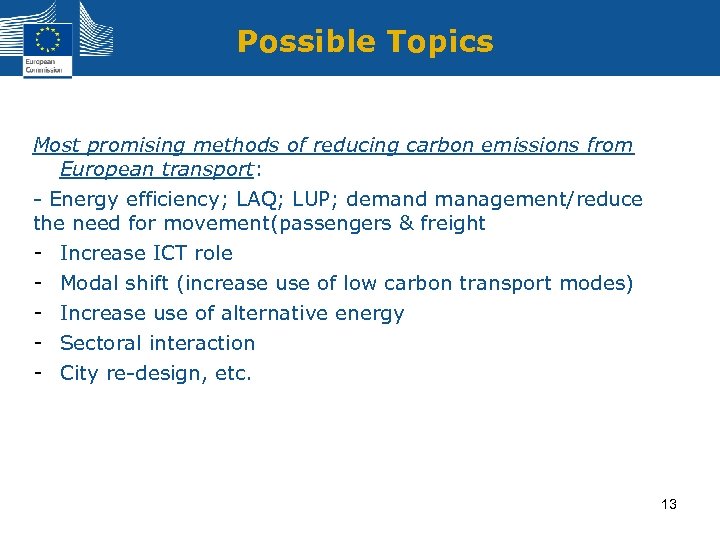 Possible Topics Most promising methods of reducing carbon emissions from European transport: - Energy efficiency; LAQ; LUP; demand management/reduce the need for movement(passengers & freight - Increase ICT role - Modal shift (increase use of low carbon transport modes) - Increase use of alternative energy - Sectoral interaction - City re-design, etc. 13
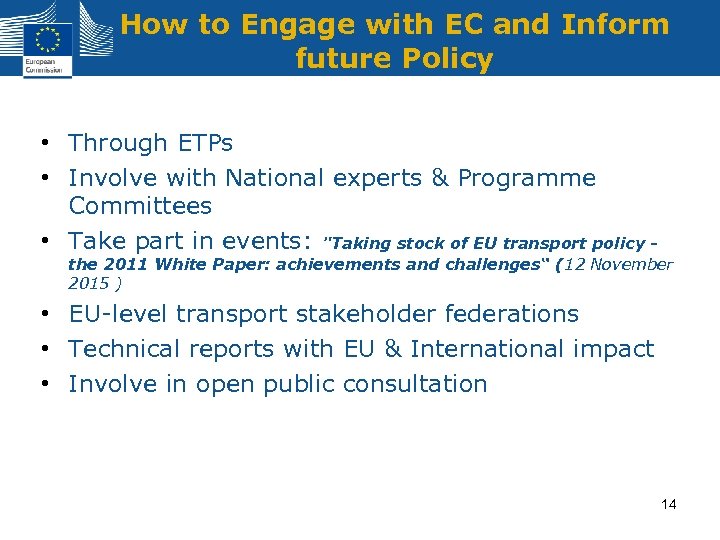 How to Engage with EC and Inform future Policy • Through ETPs • Involve with National experts & Programme Committees • Take part in events: "Taking stock of EU transport policy - the 2011 White Paper: achievements and challenges“ (12 November 2015 ) • EU-level transport stakeholder federations • Technical reports with EU & International impact • Involve in open public consultation 14
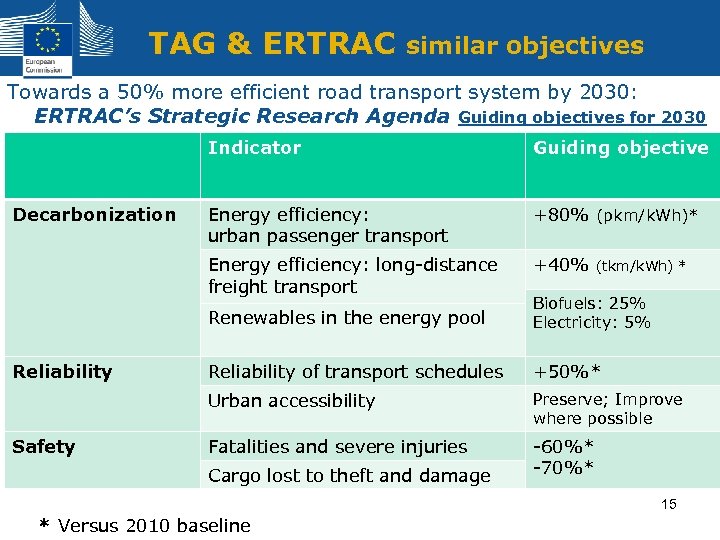 TAG & ERTRAC similar objectives Towards a 50% more efficient road transport system by 2030: ERTRAC’s Strategic Research Agenda Guiding objectives for 2030 Indicator Energy efficiency: urban passenger transport +80% (pkm/k. Wh)* Energy efficiency: long-distance freight transport Decarbonization Guiding objective +40% (tkm/k. Wh) * Renewables in the energy pool Safety Reliability of transport schedules +50%* Urban accessibility Reliability Biofuels: 25% Electricity: 5% Preserve; Improve where possible Fatalities and severe injuries -60%* -70%* Cargo lost to theft and damage 15 * Versus 2010 baseline
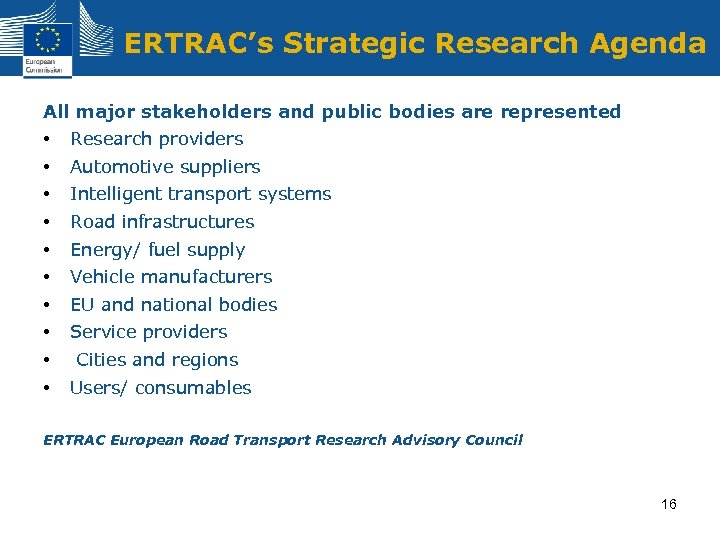 ERTRAC’s Strategic Research Agenda All major stakeholders and public bodies are represented • • • Research providers Automotive suppliers Intelligent transport systems Road infrastructures Energy/ fuel supply Vehicle manufacturers EU and national bodies Service providers Cities and regions Users/ consumables ERTRAC European Road Transport Research Advisory Council 16
 Sustainable Road Transport The need for a sustainable road transport system will shape the development of future vehicle concepts Ø Ø Ø Ø Ø Eco-friendly driving Passenger comfort Terminal efficiency Driver and transport efficiency Driving ‘safe and smart’ Logistics efficiency Basic, affordable vehicles Modularity Cost-effective vehicles Vehicle efficiency 17
 Recommendations ü Need to focus on inter-relationship between transport technology, social acceptance and behavioural change ü Emphasise integration and the dismantling of ‘silos’ in transport research ü Exploit the explosion in transport-related data likely to become available ü Broaden the definition and assessment of transport externalities 18
 Thank you! 19