


 Скачать презентацию THE ROLE OF RURAL ELECTRIFICATION IN POVERTY REDUCTION
2aee432f50c8736dd980c58a6b3c567f.ppt
- Количество слайдов: 22
 THE ROLE OF RURAL ELECTRIFICATION IN POVERTY REDUCTION National Poverty Policy Week 2013 Presented by: Gissima Nyamo-Hanga Rural Energy Agency P. O. BOX 7990 Dar es Salaam Email: info@rea. go. tz Website: www. rea. go. tz 25 th November, 2013.
 Contents Introduction Initiatives in the Energy Sector Legal and Regulatory Frameworks Access Rate: Energy Power Generation Power Transmission Power Distribution Rural Energy 1. 2. 3. 4. 5. 6. 7. 8. a) b) 9. 10. 2 Rural Electrification through Grid Extension Rural Electrification through Off-Grid Initiatives The Future Rural Electrification’s Contribution to Poverty 3/16/2018 Reduction
 1. Introduction Rural Energy Agency: • Government Institution, Autonomous: • Rural Energy Act No. 8 of 2005 Rural Energy Board (REB); • Rural Energy Fund (REF); • • Oversee matters related to: • Rural Energy in Mainland Tanzania through: Promotion and Facilitation; • Training and Capacity Building; • Technical Assistance • Provision of Grants: • Matching, Performance and Green Generation Grants; • Long Term Financing and a Credit Line arrangement. • 3
 2. Initiatives in the Energy Sector Initiatives : • Power System Master Plan (PSMP); • Big Results Now (BRN); • Power Africa; • Rural Energy Master Plan; • Scaling-up of Renewable Energy Programme (SREP); • Second Compact of the Millennium Challenge Corporation; • Annual Joint Energy Sector Reviews (JESR); • National Energy Policy Review; • Formulation of the Natural Gas Policy; • Investment Prospectus (REA). 4
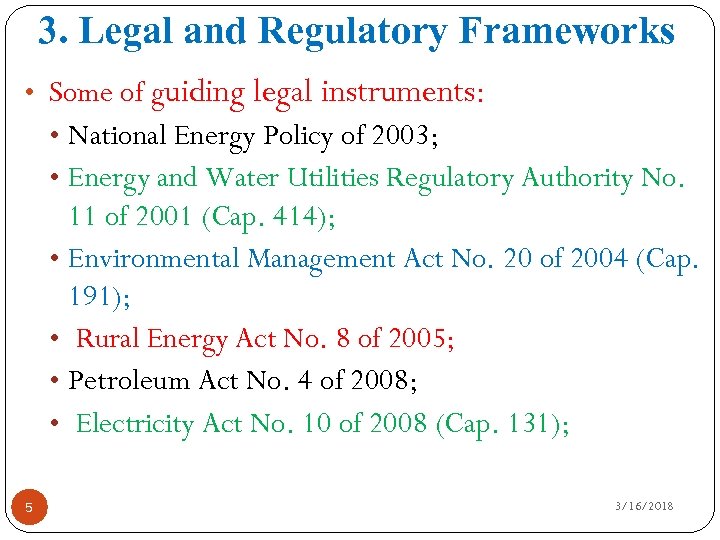 3. Legal and Regulatory Frameworks • Some of guiding legal instruments: • National Energy Policy of 2003; • Energy and Water Utilities Regulatory Authority No. 11 of 2001 (Cap. 414); • Environmental Management Act No. 20 of 2004 (Cap. 191); • Rural Energy Act No. 8 of 2005; • Petroleum Act No. 4 of 2008; • Electricity Act No. 10 of 2008 (Cap. 131); 5 3/16/2018
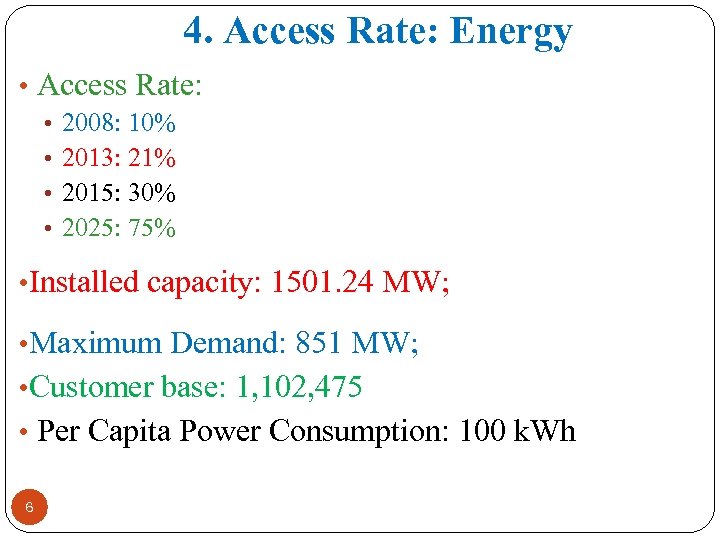 4. Access Rate: Energy • Access Rate: • 2008: 10% • 2013: 21% • 2015: 30% • 2025: 75% • Installed capacity: 1501. 24 MW; • Maximum Demand: 851 MW; • Customer base: 1, 102, 475 • Per Capita Power Consumption: 100 k. Wh 6
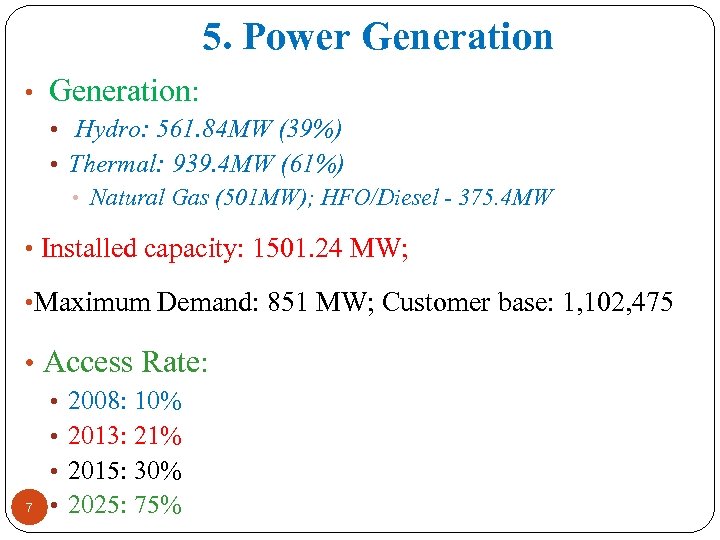 5. Power Generation • Generation: • Hydro: 561. 84 MW (39%) • Thermal: 939. 4 MW (61%) • Natural Gas (501 MW); HFO/Diesel - 375. 4 MW • Installed capacity: 1501. 24 MW; • Maximum Demand: 851 MW; Customer base: 1, 102, 475 • Access Rate: • 2008: 10% • 2013: 21% • 2015: 30% 7 • 2025: 75%
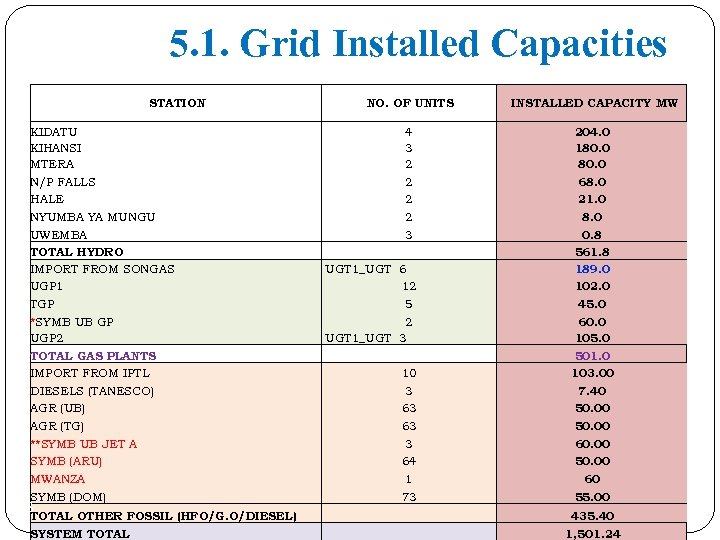 5. 1. Grid Installed Capacities STATION KIDATU KIHANSI MTERA N/P FALLS HALE NYUMBA YA MUNGU UWEMBA TOTAL HYDRO IMPORT FROM SONGAS UGP 1 TGP *SYMB UB GP UGP 2 TOTAL GAS PLANTS IMPORT FROM IPTL DIESELS (TANESCO) AGR (UB) AGR (TG) **SYMB UB JET A SYMB (ARU) MWANZA SYMB (DOM) 8 TOTAL OTHER FOSSIL (HFO/G. O/DIESEL) SYSTEM TOTAL NO. OF UNITS 4 3 2 2 3 UGT 1_UGT 6 12 5 2 UGT 1_UGT 3 10 3 63 63 3 64 1 73 INSTALLED CAPACITY MW 204. 0 180. 0 68. 0 21. 0 8. 0 0. 8 561. 8 189. 0 102. 0 45. 0 60. 0 105. 0 501. 0 103. 00 7. 40 50. 00 60. 00 50. 00 60 55. 00 435. 40 1, 501. 24
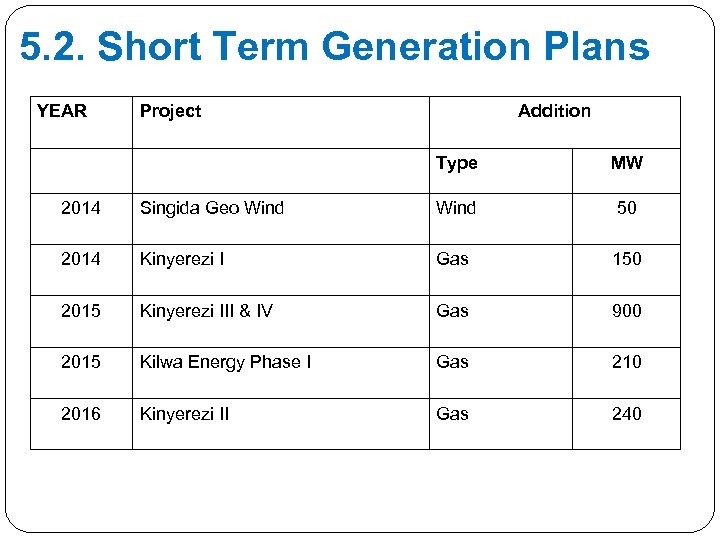 5. 2. Short Term Generation Plans YEAR Project Addition Type MW 2014 Wind 50 2014 Kinyerezi I Gas 150 2015 Kinyerezi III & IV Gas 900 2015 Kilwa Energy Phase I Gas 210 2016 9 Singida Geo Wind Kinyerezi II Gas 240
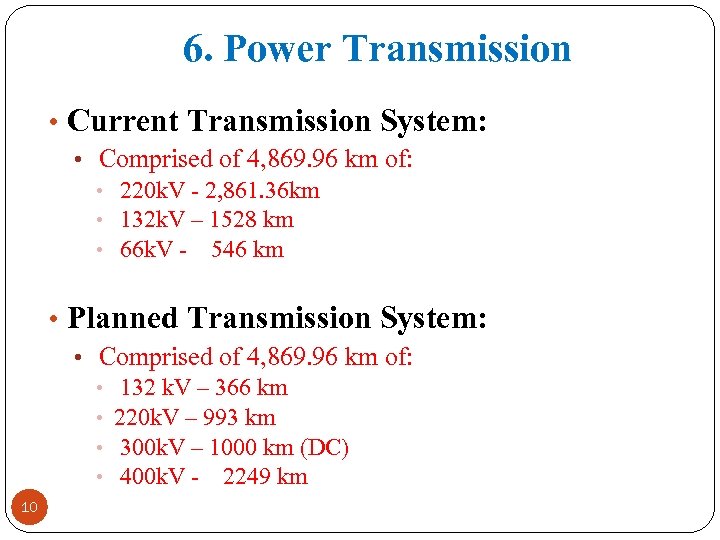 6. Power Transmission • Current Transmission System: • Comprised of 4, 869. 96 km of: • 220 k. V - 2, 861. 36 km • 132 k. V – 1528 km • 66 k. V - 546 km • Planned Transmission System: • Comprised of 4, 869. 96 km of: • • 10 132 k. V – 366 km 220 k. V – 993 km 300 k. V – 1000 km (DC) 400 k. V - 2249 km
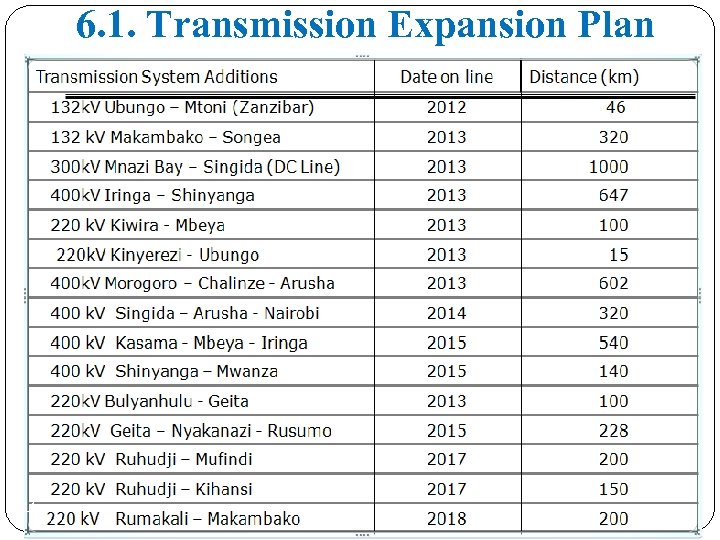 6. 1. Transmission Expansion Plan 11
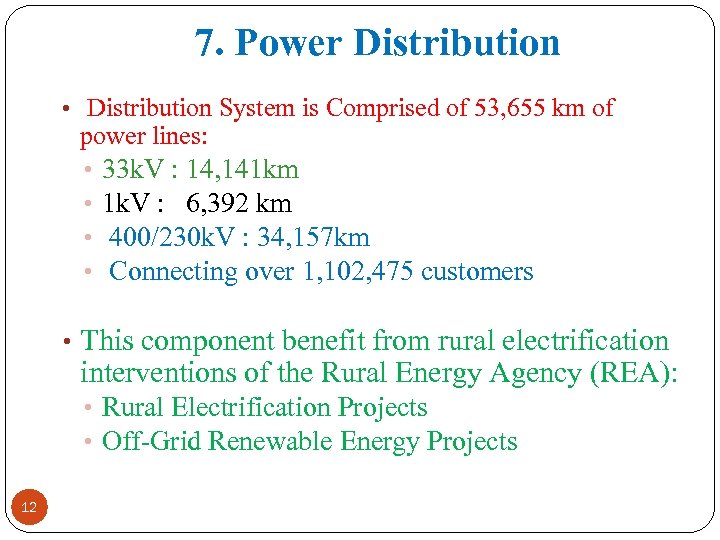 7. Power Distribution • Distribution System is Comprised of 53, 655 km of power lines: • • 33 k. V : 14, 141 km 1 k. V : 6, 392 km 400/230 k. V : 34, 157 km Connecting over 1, 102, 475 customers • This component benefit from rural electrification interventions of the Rural Energy Agency (REA): • Rural Electrification Projects • Off-Grid Renewable Energy Projects 12
 8. Rural Energy • Mainland Tanzania: Mandated to REA; • Governed by the Rural Energy Act No. 8 of 2005; • Consists of: • Grid extension based rural electrification; • Off-Grid based energy services and solutions 13
 8. 1. Grid Extension Based Rural Electrification • Grid Extension (Pilot Phase): (completed) • 39 Sub-projects: Major ones are: • District Headquarters: Kilolo, Bahi, Uyui, Kilindi and Mkinga, Kasulu, Kibondo, Nkasi, Ngorongoro and Rorya; • Active Commercial Centers: Matema Beach, Mto wa Mbu, Oswald Mang’ombe, Ngage A & B. 14
 8. 1. Grid Extension Based Rural Electrification • Grid Densification: (Underline Transformers) • 81 Villages • 90, 000 initial connections • Turnkey Projects • Phase I: 16 Regions: 22, 000 initial connections (completion stage) • Phase II: 25 Regions: 250, 000 initial connections (starting stage) • 13 New District Headquarters • Buhigwe, Busega, Chemba, Itilima, Kakonko, Kalambo, 15 Kyerwa, Mkalama, Mlele, Momba, Namtumbo, Nyasa, and Uvinza
 8. 1. Grid Extension Based Rural Electrification • Low Cost Design Project: • Kilombero: 14 villages: 2, 048 initial connections • Mbozi: 9 villages: 578 initial connections. • Backbone Transmission Investment Project (BTIP) • 647 km, 400 KV Line; • 51 Villages • Makambako Songea Project • 320 km, 132 KV Line; • 81 Villages 16 • Provide T-Offs Lines to Mbinga, Namtumbo and Ludewa.
 8. 2. Off-Grid Based Energy Services and Solutions • Small Hydropower based solutions: • 450 MW potential available; • 100 MW identified for studies; • 30 MW currently under study; • Mwenga (4 MW), Mawengi (300 KW) are operating; • Mapembasi (10 MW), Andoya (1 MW), Yovi (0. 95 MW), Tulila (6. 5 MW), Kiwira II (6. 5 MW) are prospective candidates. • Solar PV: • Prospective Farms: 5 MW (Kigoma); • SSMP 1, SSMP 2, LRTC 2010, LRTC 2012; • Demo Systems in Schools and Health Facilities: REA Capacity Building and Training Programmes. 17
 8. 2. Off-Grid Based Energy Services and Solutions • Biomass: • Gasification: Manyata Village Kongwa Dodoma • Biogas: In schools (Kibaha, Kwimba, Ngudu, Kahama and Kibondo); Prisons (Namajani –Songea); • Charcoal and Wood fuel Briquettes: Training for Youth and Women Groups in Kilosa, Mkuranga, Bagamoyo, Mtwara, and Lindi. Private Sector Based Capacity Building, Market Promotion: ARTI Tanzania, BEDOKO, Kiwia and Lausten, ENVOTEC, M&R Appro. Technologies. • Wind Energy: • Training and Capacity Building to rural entrepreneurs; • Demo installations in Schools and Health Facilities (Wama Nakayama Secondary School); • Site Assessments for large scale systems: Tendered 18
 9. The Future • The future of the energy sector in Tanzania will be influenced by a number of factors; perhaps the major ones being: • Shift in generation mix: Natural Gas and Renewables; • Increased private investment; • Growth in demand due industrial, agricultural, population and urbanization growth; • More regulated power industry; • Regional integrations: East Africa, SADC, Nile Basin Initiative, etc. ; • New Governance models and structures. 19
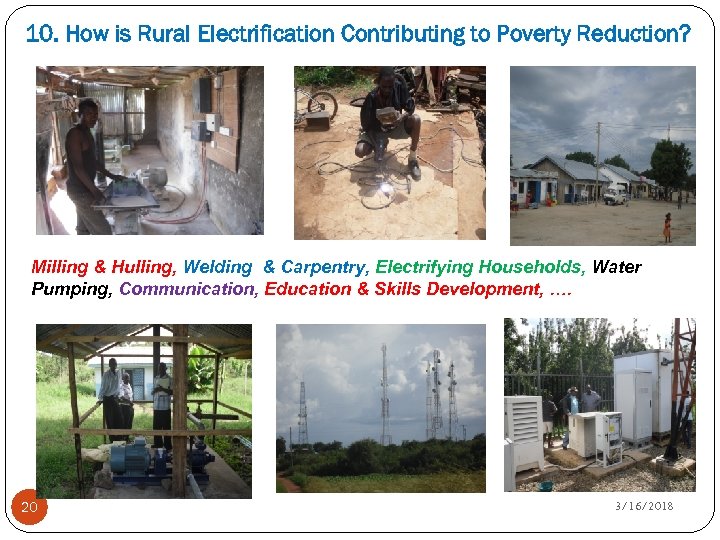 10. How is Rural Electrification Contributing to Poverty Reduction? Milling & Hulling, Welding & Carpentry, Electrifying Households, Water Pumping, Communication, Education & Skills Development, …. 20 3/16/2018
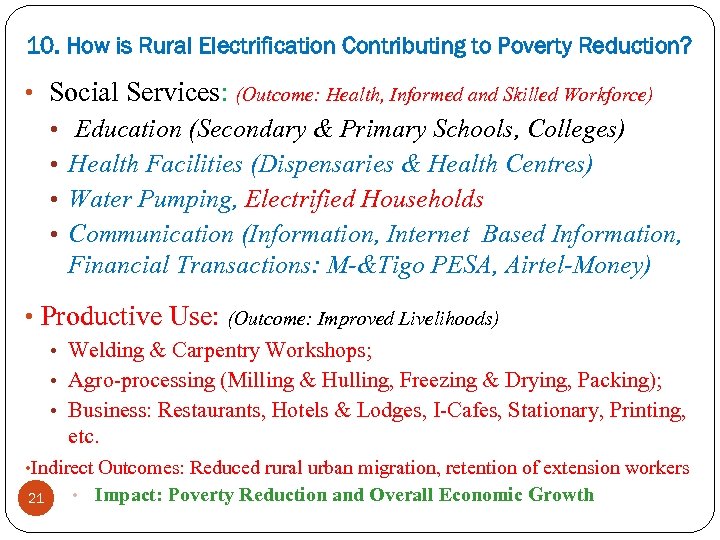 10. How is Rural Electrification Contributing to Poverty Reduction? • Social Services: (Outcome: Health, Informed and Skilled Workforce) • Education (Secondary & Primary Schools, Colleges) • Health Facilities (Dispensaries & Health Centres) • Water Pumping, Electrified Households • Communication (Information, Internet Based Information, Financial Transactions: M-&Tigo PESA, Airtel-Money) • Productive Use: (Outcome: Improved Livelihoods) • Welding & Carpentry Workshops; • Agro-processing (Milling & Hulling, Freezing & Drying, Packing); • Business: Restaurants, Hotels & Lodges, I-Cafes, Stationary, Printing, etc. • Indirect Outcomes: Reduced rural urban migration, retention of extension workers 21 • Impact: Poverty Reduction and Overall Economic Growth
 THANK YOU FOR LISTENING 22 3/16/2018