


 Скачать презентацию THE ROLE OF LEADERSHIP IN PERFORMANCE MANAGEMENT Donald
a86cd274d72ce7f2d20920a073692efb.ppt
- Количество слайдов: 71
 THE ROLE OF LEADERSHIP IN PERFORMANCE MANAGEMENT Donald P. Moynihan, La Follette School of Public Affairs, University of Wisconsin-Madison Presentation to Chicago Federal Leadership Forum
 Have you encountered? Strategic planning Performance measures Performance contracts Pay for performance
 The role of leadership • During my 20 years in the private sector as a CEO and advisor to CEOs, I found that leadership, measurement, and a motivated workforce create the foundation for good performance. I am confident that the same is true in government Jeff Zients – Chief Performance Officer, 2009
 Outline Defining terms Era of governance by performance management From Bush to Obama How do we use performance systems? What fosters use of performance data? Summary points
 Defining terms
 Performance management A system that generates performance information through strategic planning and performance measurement routines, and connects this information to decision venues,
 Performance regimes Performance tools create unprecedented pressure on public actors to perform, in a context where performance is defined by quantitative indicators
 Purposes of Performance Information Promote: How can I convince political actors, stakeholders and the public that my agency is doing a good job? Celebrate: What accomplishments are worthy of the important ritual of celebrating success? Learn: What is what working or not working? Improve: What exactly should who do differently to improve performance?
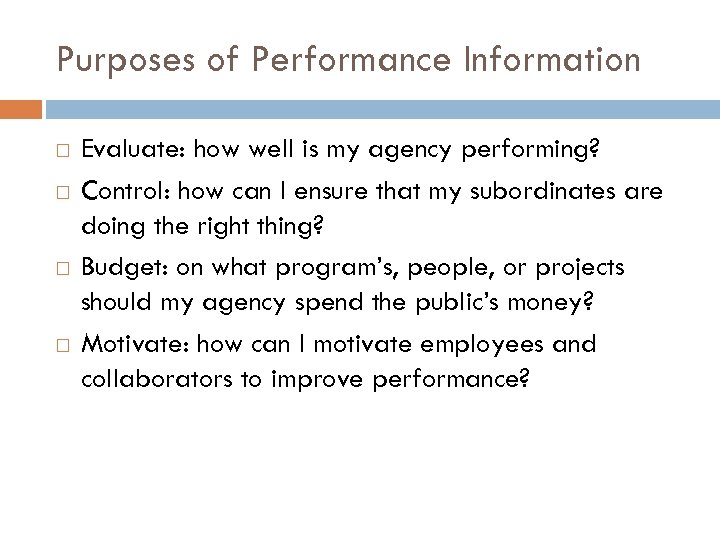 Purposes of Performance Information Evaluate: how well is my agency performing? Control: how can I ensure that my subordinates are doing the right thing? Budget: on what program’s, people, or projects should my agency spend the public’s money? Motivate: how can I motivate employees and collaborators to improve performance?
 ERA of governance by performance management
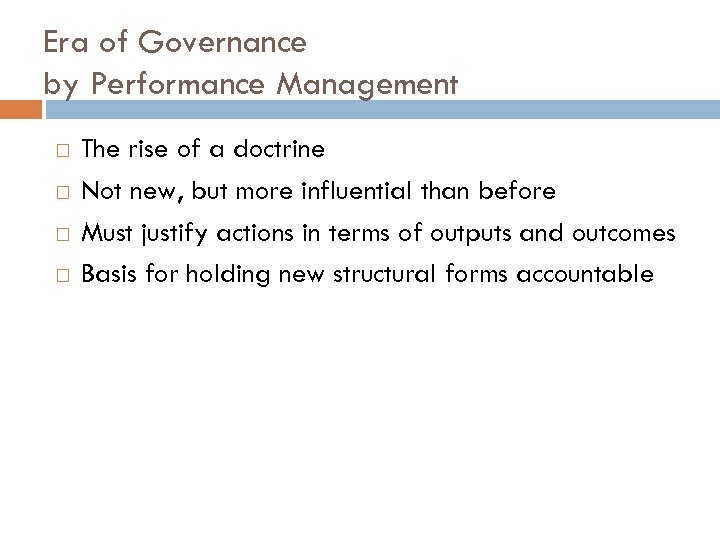 Era of Governance by Performance Management The rise of a doctrine Not new, but more influential than before Must justify actions in terms of outputs and outcomes Basis for holding new structural forms accountable
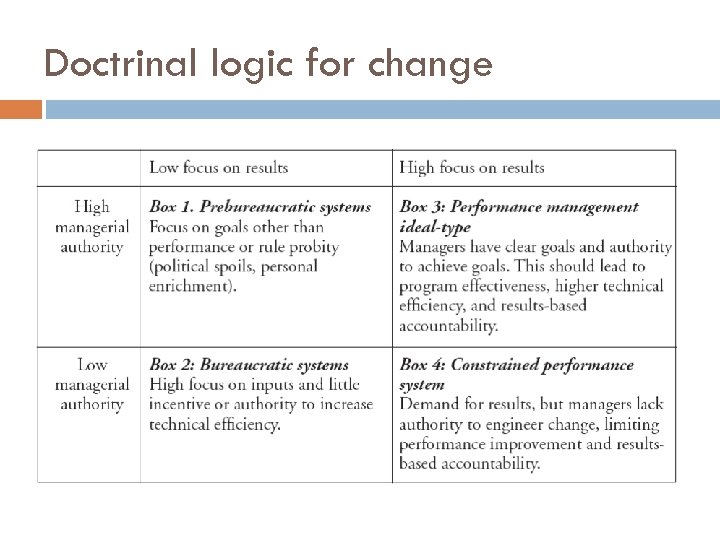 Doctrinal logic for change
 Government Performance and Results Act 1993 Mandated: 5 year strategic plans, updated every 3 years Specific goals and objectives Annual performance reviews and plans
 From Bush to Obama
 Bush approach Presidents Management Agenda “everyone agrees that scarce federal resources should be allocated to programs that deliver results” Wanted to integrate performance data into budget process
 Congressional Justifications Center around performance goals Pushback from Appropriations Committees Veteran’s Administration told; “to refrain from incorporating ‘performance-based’ budget documents”; later told: “If the Department wishes to continue the wasteful practice of submitting a budget structure that will not serve the needs of the Congress, the Congress has little choice but to reject that structure and continue providing appropriations that serve its purposes. ” Two budgets required
 Congressional Justifications Department of Transportation told: “agencies are directed to refrain from including substantial amounts of performance data within the budget justifications themselves, and to instead revert to the traditional funding information previously provided. Performance-related information may be submitted under separate cover. ” Negative consequences were promised for agencies that ignored this directive: “If the Office of Management and Budget or individual agencies do not heed the Committee’s direction, the Committee will assume that individual budget offices have excess resources that can be applied to other, more critical missions. ”
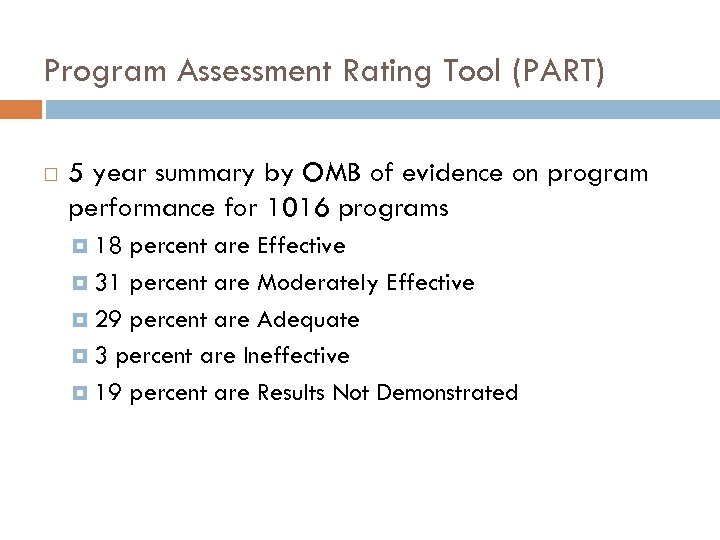 Program Assessment Rating Tool (PART) 5 year summary by OMB of evidence on program performance for 1016 programs 18 percent are Effective 31 percent are Moderately Effective 29 percent are Adequate 3 percent are Ineffective 19 percent are Results Not Demonstrated
 PART as Evidence-based Dialogue Third-party program review with a clear opinion Greater emphasis on performance The standard of proof for program performance can only be satisfied by positive evidence of results The burden of proof for performance rests on agencies Entire programs are evaluated on a regular basis The routine nature of PART creates an incentive to engage
 Obama: A Pragmatic approach “The question we ask today is not whether our government is too big or too small, but whether it works -- whether it helps families find jobs at a decent wage, care they can afford, a retirement that is dignified. Where the answer is yes, we intend to move forward. Where the answer is no, programs will end. And those of us who manage the public's dollars will be held to account, to spend wisely, reform bad habits, and do our business in the light of day, because only then can we restore the vital trust between a people and their government”
 Example: Pedometer challenge! Voluntary Belief that transparent performance numbers will change behavior, create a sense of competition and raise performance
 Early evidence on Obama Performance measurement will be important “The President is creating a focused team within the White House that will work with agency leaders and the OMB to improve the results and outcomes for Federal Government programs while eliminating waste and inefficiency” Chief performance officer Continue to maintain agency level performance positions
 What happens to PART? Not clear Criticized as ideological, as too broad, as a data collection exercise Analysis remains in place, but new PARTs have not started OMB have offered agencies funds for better evaluations
 New emphasis on leadership Focusing leaders on what matters – key goals Accelerating results – Performance Improvement Council; data driven meetings Style: focused collaboration
 New focus on information use Will be a central aspect of the Obama administration’s performance initiatives Jeff Zients: “The ultimate test of our performance management efforts is whether or not the information is used” Shelly Metzenbaum: “the key performance management challenge facing the Obama administration is to use—not just produce— performance goals and measures”
 How do we use performance systems?
 Why care about use? For reforms to succeed, implies that data is used Provides a tractable means of studying the impact of results-based reform Public organizations have devoted significant time and resources into creating routines to collect and disseminate data Almost no attention to creating routines of use How do you use performance data?
 Types of responses: 4 Ps Passive Perverse Political Purposeful
 Passive use of data Passive: Do the minimum to comply with requirements Do not actually use data Correlated with cynicism about reforms
 Perverse use of data Effort Substitution: Reducing effort on non-measured dimensions Cherry picking/Cream-skimming: Focusing effort on subgroups of clients most likely to provide greatest impact on performance measures while effectively denying services to others. Measure selection: Selecting metrics or data to measure that will offer the most favorable portrayal of a service Hiding numbers: Declining to present performance measures that may exist
 Perverse use of data Output distortion: Manipulating measurement processes to improve measured performance. Ratchet effects: Curbing productivity in one time period to avoid the setting of more challenging targets in another. Churning: Frequently adopting different targets or measures to prevent comparison across time. Cheating: Simply making up numbers, though rare, does occur.
 Responding to perversity Add new/additional measures Change existing measures Rely/cultivate intrinsic norms to limit misbehavior Avoid high-powered incentives
 Political uses of data Process of selecting measures means shaping a program narrative “Understand that measuring policy is not a science. It is an art. It is words, and pictures and numbers. And you create impressions, beliefs, understandings and persuasions. ”
 Political uses of data Data tells us what happened Program officials still need to interpret and explain: why performance did or did not occur; the context of performance; how implementation occurred; an understanding of outside influences on performance; and how to choose which program measure is a priority. Exploit ambiguity and subjectivity of data
 Political: Ambiguity of data Examine same programs, but disagree on data Agree on data, but disagree on meaning Agree on meaning, but not on next action steps/resources
 Political: Subjectivity of data Actors will select and interpret performance information consistent with institutional values and purposes
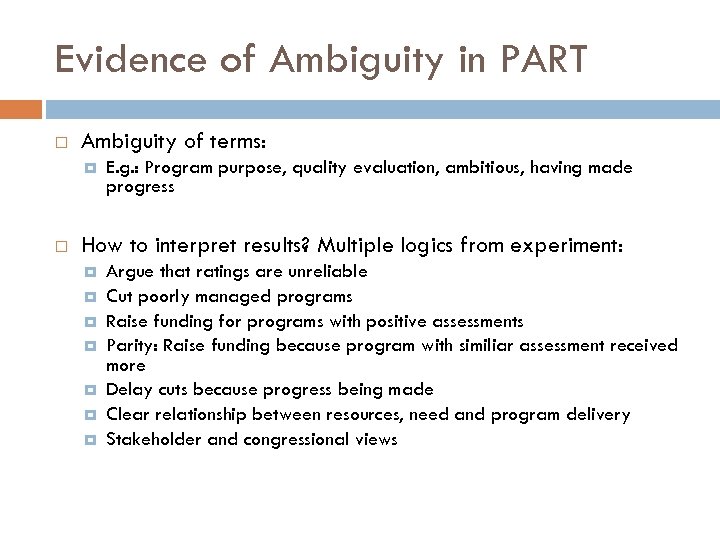 Evidence of Ambiguity in PART Ambiguity of terms: E. g. : Program purpose, quality evaluation, ambitious, having made progress How to interpret results? Multiple logics from experiment: Argue that ratings are unreliable Cut poorly managed programs Raise funding for programs with positive assessments Parity: Raise funding because program with similiar assessment received more Delay cuts because progress being made Clear relationship between resources, need and program delivery Stakeholder and congressional views
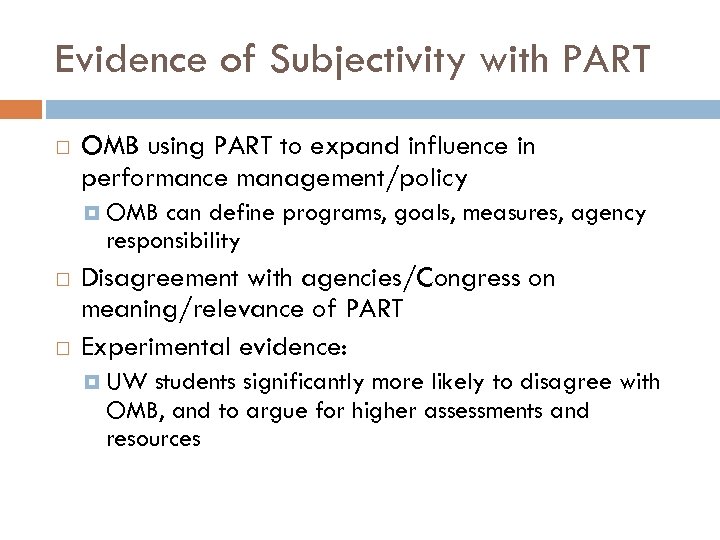 Evidence of Subjectivity with PART OMB using PART to expand influence in performance management/policy OMB can define programs, goals, measures, agency responsibility Disagreement with agencies/Congress on meaning/relevance of PART Experimental evidence: UW students significantly more likely to disagree with OMB, and to argue for higher assessments and resources
 Implications for Decisionmaking Performance information use reflects political process, does not replace it Performance information use does not lead to clarity Ability to structure dialogue tied to power
 Purposeful use of data Use data to improve program performance Goal-based learning efficiency improvements better targeting of resources more informed strategic decisions, tying indicators to rewards/sanctions in contract arrangements
 Purposeful use of data Use of performance information for problem-solving more likely to occur in intra-institutional settings Reduces competing interpretations Problem of neglect rarely do anything with information
 Learning forums Routines specifically focused on solution-seeking, where actors collectively examine information, consider its significance and decide how it will affect future action What measures are useful for agency officials? What other ways can we encourage learning forums?
 What fosters performance information use?
 The Right Context Simple function that is easy to measure Clear link between measures of actions, and measures of outcomes One-dimensional – relatively few measures that do not conflict with one another Stakeholder support – clear agreement about purpose
 Other factors Learning forums Mission-based culture/supportive culture Resources Administrative stability Administrative capacity
 Quantitative approach 3 studies using survey-based data Self-reported performance information use Results from Moynihan and Pandey (in press) and Moynihan, Wright and Pandey (2009; 2010)
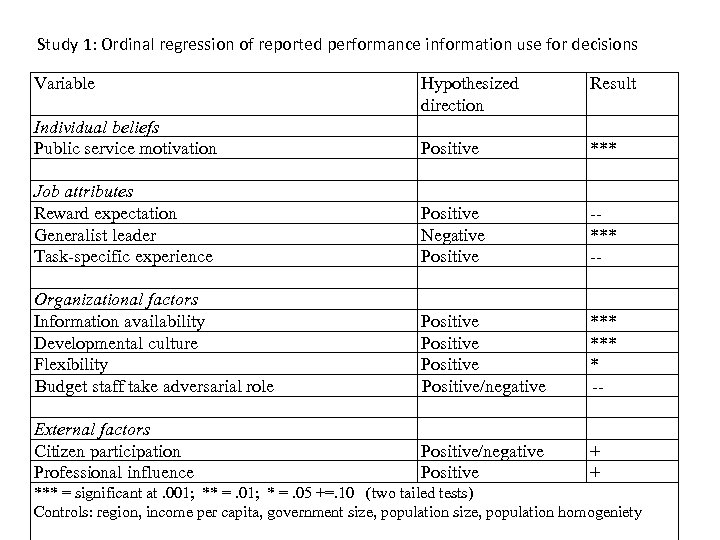 Study 1: Ordinal regression of reported performance information use for decisions Variable Hypothesized direction Result Individual beliefs Public service motivation Positive *** Job attributes Reward expectation Generalist leader Task-specific experience Positive Negative Positive -*** -- Organizational factors Information availability Developmental culture Flexibility Budget staff take adversarial role Positive/negative *** * -- External factors Citizen participation Professional influence Positive/negative Positive + + *** = significant at. 001; ** =. 01; * =. 05 +=. 10 (two tailed tests) Controls: region, income per capita, government size, population homogeniety
 Intrinsic vs. extrinsic motivation Sense of public service motivation mattered Possibility of extrinsic reward did not create an incentive to use data Implication: performance information use as extra role behavior
 Organizational factors Information availability Supply-side approach Use increases with better information, and when information is tied to management systems
 Organizational factors Demand side approach Culture matters Previous work focuses on whether culture welcomed performance management reforms What about broader measures of culture? Developmental culture (adaptability, readiness, growth) Flexibility – unlikely to use data if cannot apply insights
 Specialist vs. generalist leaders Task-specific knowledge provides context in which to interpret and apply data Leadership role Task-specific leaders more likely to use data than generalist leaders
 Other evidence of leadership Support/commitment Provision of resources Participation What other ways can leadership matter?
 Study 2: Transformational leadership Approach to leadership consistent with performance: Articulate an appealing vision of the organization’s mission and future Model behavior consistent with vision, inspiring role model Challenge old assumptions
 Propositions Transformational leadership behaviors will have an indirect, positive effect on performance information use through its influence on goal clarity Transformational leadership behaviors will have an indirect, positive effect on performance information use through its influence on organizational culture.
 Key measures Transformational leadership • Asked department heads/assistant city managers on extent to which city manager demonstrates transformational leadership: articulates his/her vision of the future. leads by setting a good example challenges me to think about old problems in new ways says things that make employees proud to be part of the organization. as a clear sense of where our organization should be in five years. Aggregated responses by organization
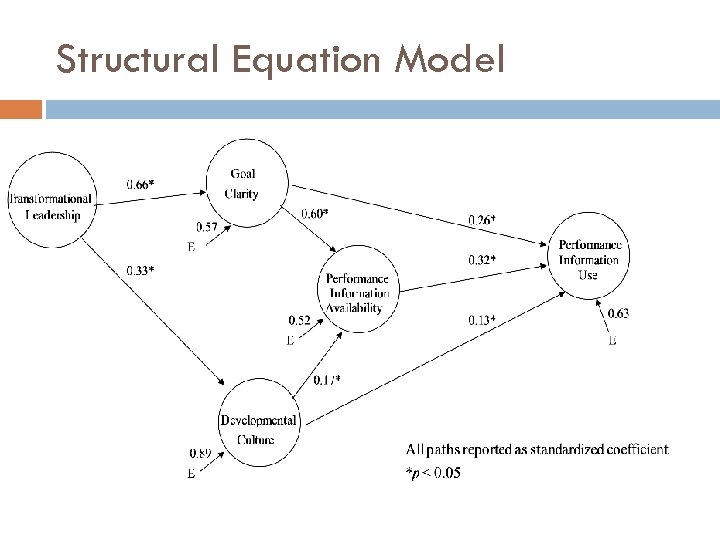 Structural Equation Model
 Implications Leadership and management Indirect effects are important “Setting the table” as long-term leadership strategy
 Study 3: Perceived social impact Individuals who see their work as helping others more likely to use performance information Some evidence that individuals who perceive greater social impact are motivated Why should it relate to performance information use?
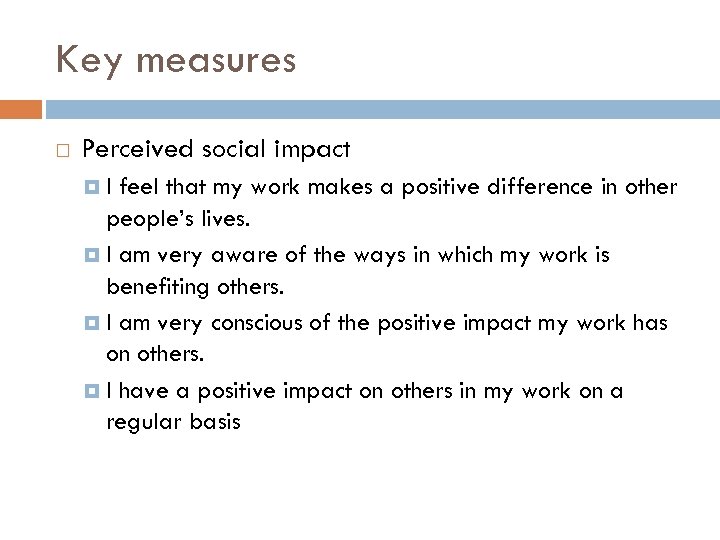 Key measures Perceived social impact I feel that my work makes a positive difference in other people’s lives. I am very aware of the ways in which my work is benefiting others. I am very conscious of the positive impact my work has on others. I have a positive impact on others in my work on a regular basis
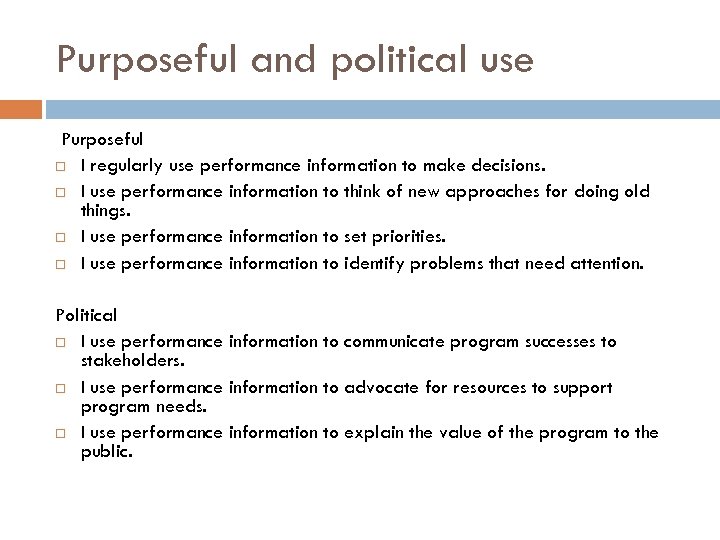 Purposeful and political use Purposeful I regularly use performance information to make decisions. I use performance information to think of new approaches for doing old things. I use performance information to set priorities. I use performance information to identify problems that need attention. Political I use performance information to communicate program successes to stakeholders. I use performance information to advocate for resources to support program needs. I use performance information to explain the value of the program to the public.
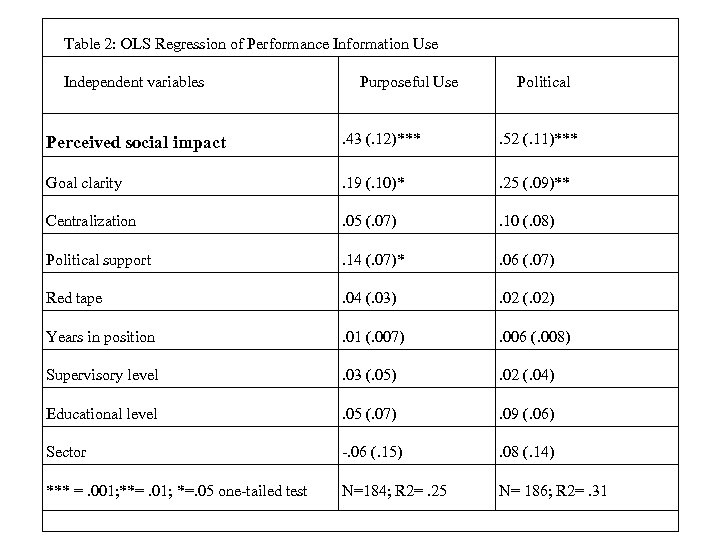 Table 2: OLS Regression of Performance Information Use Independent variables Purposeful Use Political Perceived social impact . 43 (. 12)*** . 52 (. 11)*** Goal clarity . 19 (. 10)* . 25 (. 09)** Centralization . 05 (. 07) . 10 (. 08) Political support . 14 (. 07)* . 06 (. 07) Red tape . 04 (. 03) . 02 (. 02) Years in position . 01 (. 007) . 006 (. 008) Supervisory level . 03 (. 05) . 02 (. 04) Educational level . 05 (. 07) . 09 (. 06) Sector -. 06 (. 15) . 08 (. 14) *** =. 001; **=. 01; *=. 05 one-tailed test N=184; R 2=. 25 N= 186; R 2=. 31
 Study 4: Experimental approach How does performance information matter to decisions? How does the framing of performance information affect decisions? Respondents given surveys with scenario – make budget recommendations Series of vignettes for different programs Half vignettes are control, half are treatment
 Theoretical background Research on decision frames from psychology and behavioral economics Performance information is strategically selected and presented – does this work?
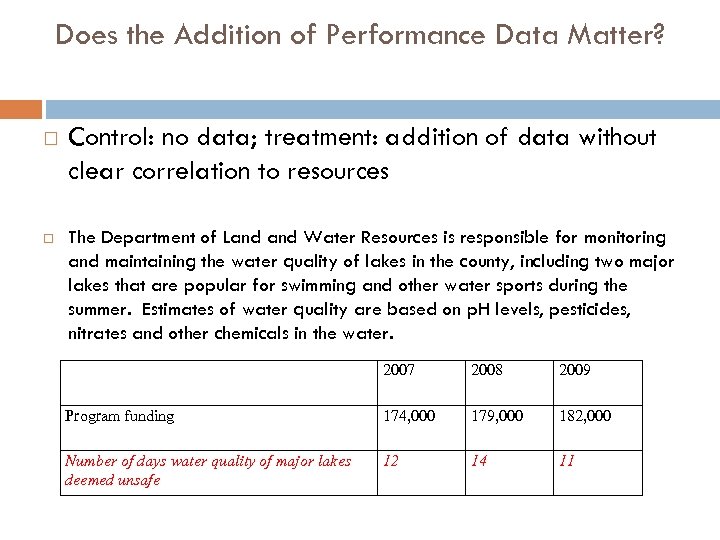 Does the Addition of Performance Data Matter? Control: no data; treatment: addition of data without clear correlation to resources The Department of Land Water Resources is responsible for monitoring and maintaining the water quality of lakes in the county, including two major lakes that are popular for swimming and other water sports during the summer. Estimates of water quality are based on p. H levels, pesticides, nitrates and other chemicals in the water. 2007 2008 2009 Program funding 174, 000 179, 000 182, 000 Number of days water quality of major lakes deemed unsafe 12 14 11
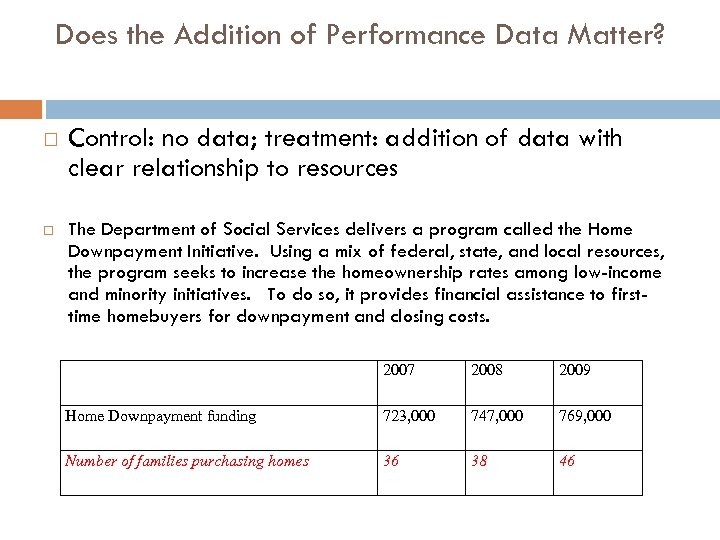 Does the Addition of Performance Data Matter? Control: no data; treatment: addition of data with clear relationship to resources The Department of Social Services delivers a program called the Home Downpayment Initiative. Using a mix of federal, state, and local resources, the program seeks to increase the homeownership rates among low-income and minority initiatives. To do so, it provides financial assistance to firsttime homebuyers for downpayment and closing costs. 2007 2008 2009 Home Downpayment funding 723, 000 747, 000 769, 000 Number of families purchasing homes 36 38 46
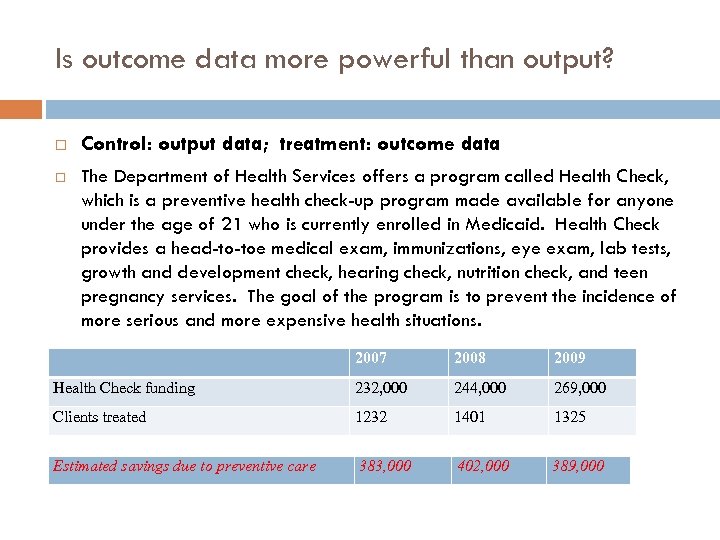 Is outcome data more powerful than output? Control: output data; treatment: outcome data The Department of Health Services offers a program called Health Check, which is a preventive health check-up program made available for anyone under the age of 21 who is currently enrolled in Medicaid. Health Check provides a head-to-toe medical exam, immunizations, eye exam, lab tests, growth and development check, hearing check, nutrition check, and teen pregnancy services. The goal of the program is to prevent the incidence of more serious and more expensive health situations. 2007 2008 2009 Health Check funding 232, 000 244, 000 269, 000 Clients treated 1232 1401 1325 Estimated savings due to preventive care 383, 000 402, 000 389, 000
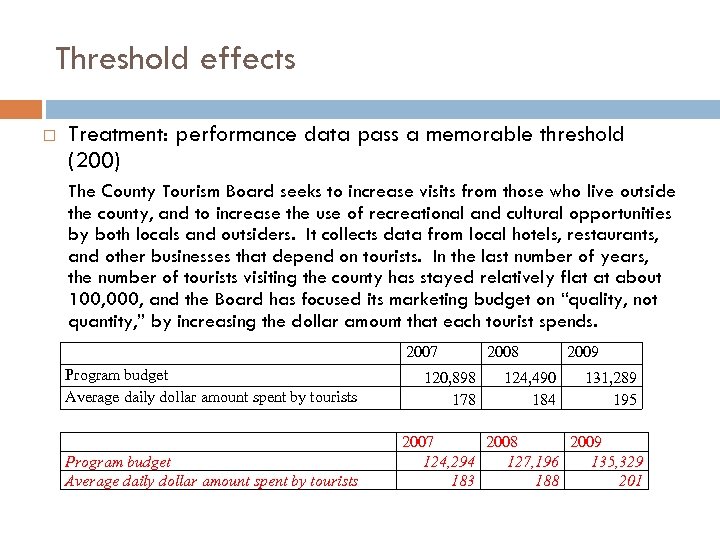 Threshold effects Treatment: performance data pass a memorable threshold (200) The County Tourism Board seeks to increase visits from those who live outside the county, and to increase the use of recreational and cultural opportunities by both locals and outsiders. It collects data from local hotels, restaurants, and other businesses that depend on tourists. In the last number of years, the number of tourists visiting the county has stayed relatively flat at about 100, 000, and the Board has focused its marketing budget on “quality, not quantity, ” by increasing the dollar amount that each tourist spends. 2007 Program budget Average daily dollar amount spent by tourists 120, 898 178 2008 124, 490 184 2009 131, 289 195 2007 2008 2009 124, 294 127, 196 135, 329 183 188 201
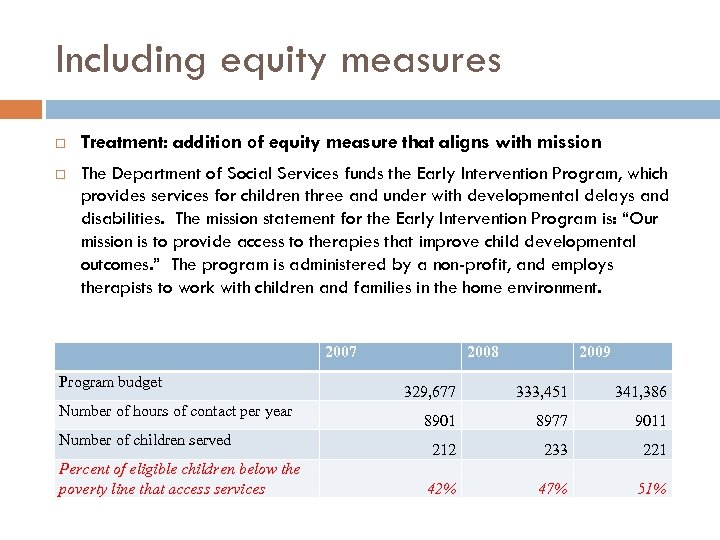 Including equity measures Treatment: addition of equity measure that aligns with mission The Department of Social Services funds the Early Intervention Program, which provides services for children three and under with developmental delays and disabilities. The mission statement for the Early Intervention Program is: “Our mission is to provide access to therapies that improve child developmental outcomes. ” The program is administered by a non-profit, and employs therapists to work with children and families in the home environment. 2007 Program budget Number of hours of contact per year Number of children served Percent of eligible children below the poverty line that access services 2008 2009 329, 677 333, 451 341, 386 8901 8977 9011 212 233 221 42% 47% 51%
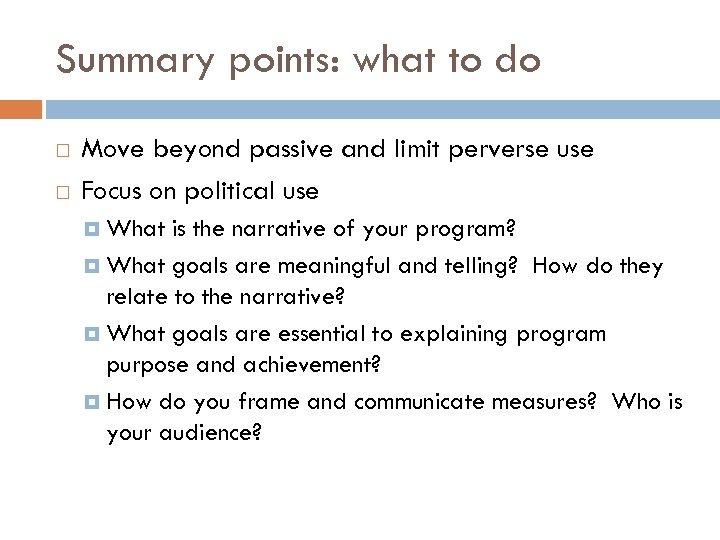 Summary points: what to do Move beyond passive and limit perverse use Focus on political use What is the narrative of your program? What goals are meaningful and telling? How do they relate to the narrative? What goals are essential to explaining program purpose and achievement? How do you frame and communicate measures? Who is your audience?
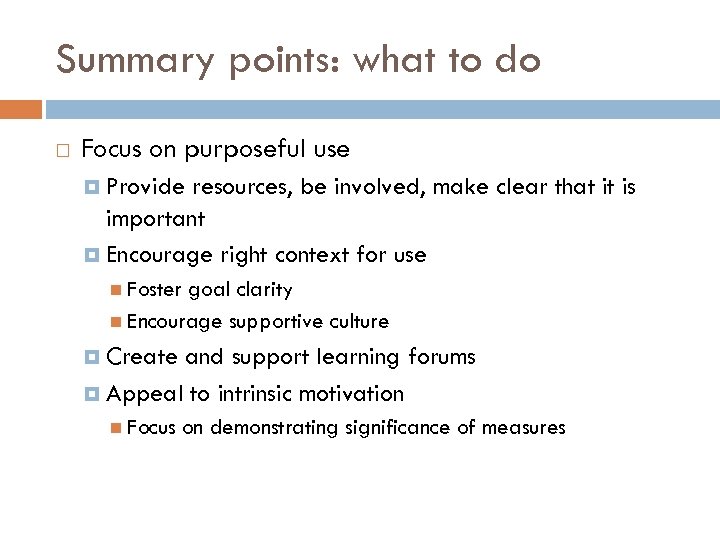 Summary points: what to do Focus on purposeful use Provide resources, be involved, make clear that it is important Encourage right context for use Foster goal clarity Encourage supportive culture Create and support learning forums Appeal to intrinsic motivation Focus on demonstrating significance of measures
 Questions/Comments dmoynihan@lafollette. wisc. edu http: //www. lafollette. wisc. edu/facultystaff/moynihandonald. html The Dynamics of Performance Management Georgetown University Press