 Скачать презентацию The role of law in planning Between devil
a6c6d17bb514af398b8d8a0c67748c65.ppt
- Количество слайдов: 23



The role of law in planning Between devil and angel Rachelle Alterman Planner and lawyer Professor emerita (non retired) Head – Lab on Comparative Planning Law and Property Rights Technion – Israel Institute of Technology Founding President, PLPR UN Habitat conference, Madrid July 10 2017
PLANNERS’ BEACON, COMPASS AND SCALE : PLANNING THEORY, IMPLEMENTATION ANALYSIS, AND PLANNING LAW RACHELLE ALTERMAN
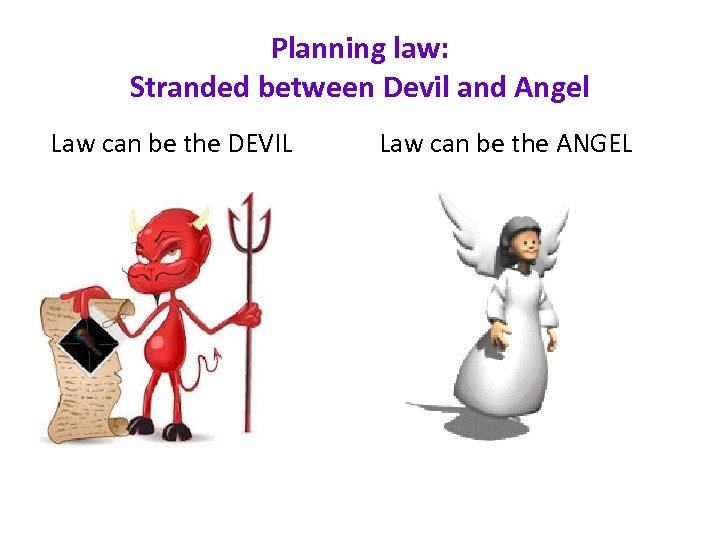
Planning law: Stranded between Devil and Angel Law can be the DEVIL Law can be the ANGEL
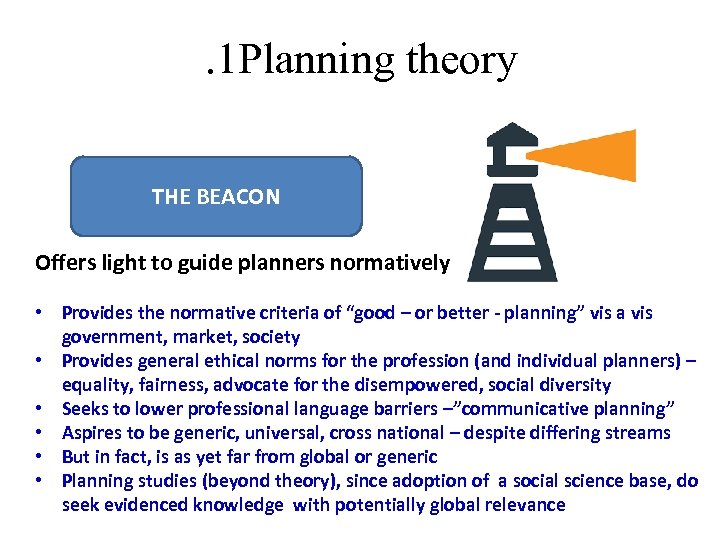
. 1 Planning theory THE BEACON Offers light to guide planners normatively • Provides the normative criteria of “good – or better - planning” vis a vis government, market, society • Provides general ethical norms for the profession (and individual planners) – equality, fairness, advocate for the disempowered, social diversity • Seeks to lower professional language barriers –”communicative planning” • Aspires to be generic, universal, cross national – despite differing streams • But in fact, is as yet far from global or generic • Planning studies (beyond theory), since adoption of a social science base, do seek evidenced knowledge with potentially global relevance
. 2 Implementation Analysis THE COMPASS Offers a “reality check” • Provides a bridge between aspirations and the realities of implementation • Provides empirically founded knowledge about how governance works • Provides methods to evaluate what alternatives may be acceptable or not • Combines universally relevant knowledge with sensitivity to local forms of governments, laws, and socio-cultural norms
. 3 Planning law THE SCALES OF JUSTICE Strained relationship with both planning theory and implementation analysis • Offers legislated, legally-legitimated norms – and demands compliance • But - “Law and justice” are not necessarily the same • In the land-related fields – largely domestic (local) doctrinaire, placebound, intransigent to transfer across jurisdictions, governance modes, cultures. Currently, very little evidence-based transferability • Offers both constraints and instruments for implementation • Legal language (even of plans) is usually a technical – closed professional language
Inherent tensions between the three spheres. Can they be reconciled with planning law?
Devil 1 – unnecessary and damaging • Self-regulated urbanity predates public planning – we love “vernacular” historic cities, villages • Current benefits of “informality” are often killed by imposition of planning regulations or transfer to planned areas • Public planning decisions predate planning laws – yet provided essential public services, produced Paris’ beauty, • Building codes, plus essential services and market are enough – eg. Houston TX - where the “unregulated” areas are similar to other cities; and the rich live in private-law estates • Planning laws are irrelevant for most residents of developing countries
Devil 2 – Guise for preserving the current power structure • Legislation of planning law in parliament – part of power structure. No cost-benefit analysis for extensive deregulation • Legislation is inflexible. Most planning laws aren’t responsive to needs; path dependency • Planning law is inherently discriminatory (across locations – zoning plans) • Enables social exclusion through zoning, design… • Unintentional social selection through piling up of regulations – higher costs • Plan-approval procedures long, unfit for urban dynamics • Access to hearings, judicial review costly, discriminatory • Enforcement is unequal - avenue for discrimination • In most societies – avenue to corruption in real-estate
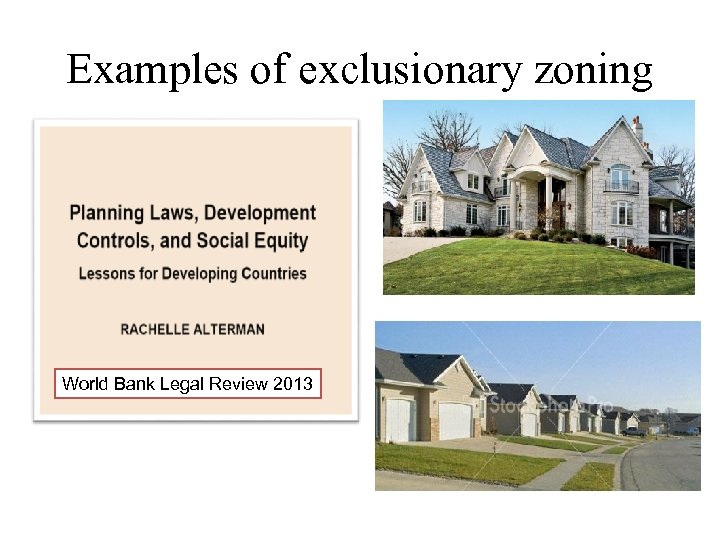
Examples of exclusionary zoning World Bank Legal Review 2013
Angel 1 - Substance • Can create minimal standards of quality of housing • Provide better distribution and fit of pubic amenities and services • Can mitigate market-driven social segregation, gating • Predictability through plans provide greater certainly for residents, investors, economy • Transportation planning reduces “free riding” and jams • Enhance public values through design, historic preservation • Sustain the environment, mitigate climate change or adapt measures • Enhance active life etc. • Enhanced global demand - compared with pre-1990’s – post-Socialist countries and recently, developing countries
Angel 2 – procedures • Planning laws did not exist in any Soviet-block country (some stayed on the books only). Unmitigated direct government action destroyed city structure and environments • All planning laws have some element of democratization – at least minimal participation. CHINA as the dramatic example – 1990 • Planning laws enable better intergovernmental coordination • Enhanced participation enables direct involvement of the clients / public, better fit with needs, services • Can enable planners to become direct advocates for the disempowered – in tandem with planning theory • Can transfer powers to citizen groups for accountability • Transparency mitigates corruption in the real-estate sector
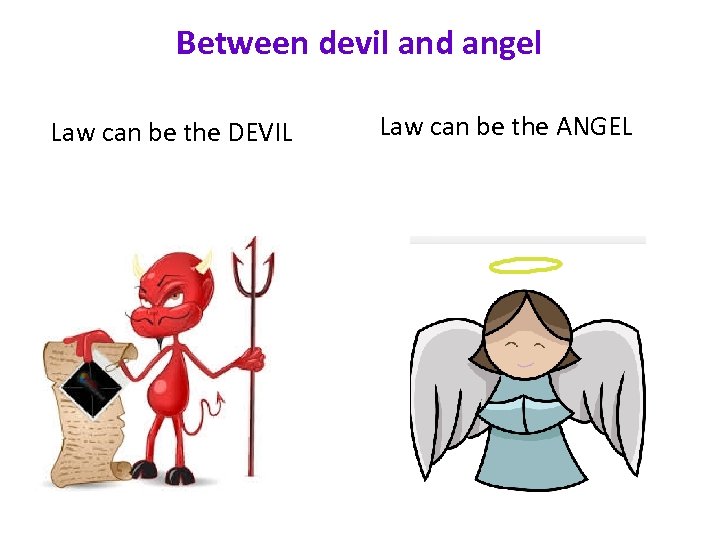
Between devil and angel Law can be the DEVIL Law can be the ANGEL
However, devils and angels are not absolute. They depend on real-life alternatives Which cannot be identified due to local-structural “blind-folders” Comparative law is not highly developed in most spheres related to planning - land - Municipal - Government structure - Housing law Comparative planning theory (empirical) is embryonic Comparative implementation analysis is rudimentary
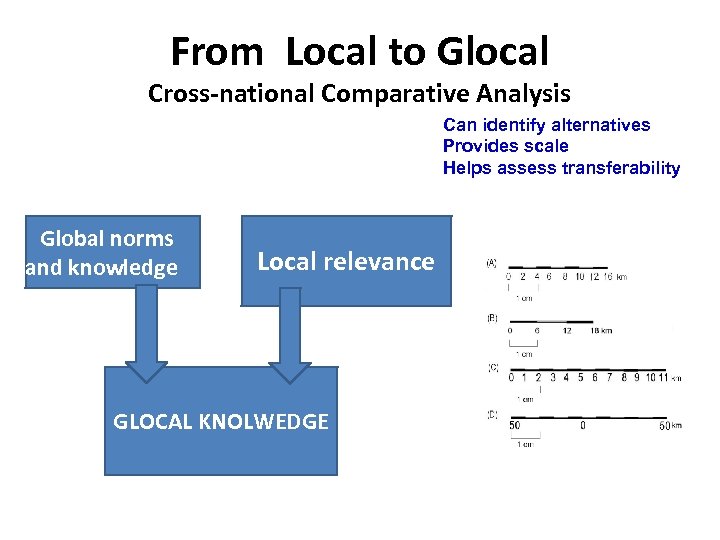
From Local to Glocal Cross-national Comparative Analysis Can identify alternatives Provides scale Helps assess transferability Global norms and knowledge Local relevance GLOCAL KNOLWEDGE
Examples of topics that can be enlightened by comparative analysis and scale 1. Is it just to compensate landowners for diminished land values due to planning, or is it their social responsibility? 2. How do planning laws treat the universal dilemma: should it be legal to negotiate with developers to fine-tune planning decisions, or is this call for discrimination, corruption 3. What is a good balance between socially extensive rights to object to planning/ appeal and the time-constraints, implementabiliy? 4. How is gating of housing approached in different societies/ planning-law regimes 5. What are different modes of law regarding enforcement and how effective are they? 6. What is historic preservation and how does the law relate?
More examples 7. How do different planning and property laws “handle” increasing tower condominium housing? 6. How is adaptation to climate change affected by property rights and planning-law constraints? 8. How do different constitutions around the world related to housing rights, and do the differences matter?
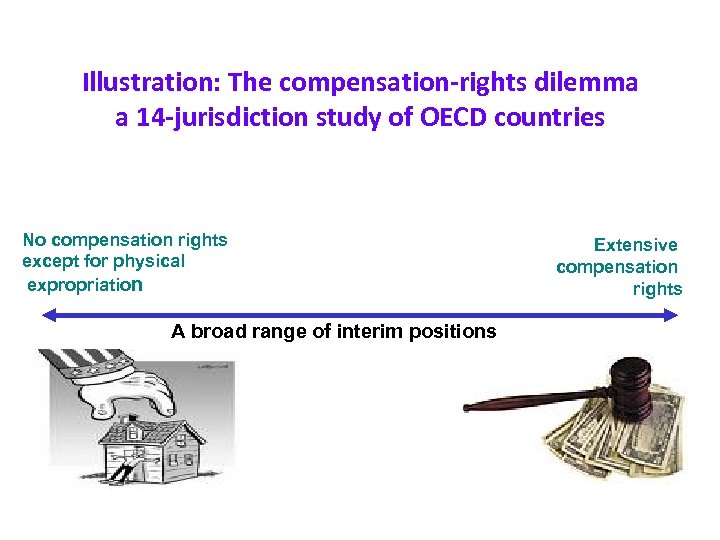
Illustration: The compensation-rights dilemma a 14 -jurisdiction study of OECD countries No compensation rights except for physical expropriation A broad range of interim positions Extensive compensation rights
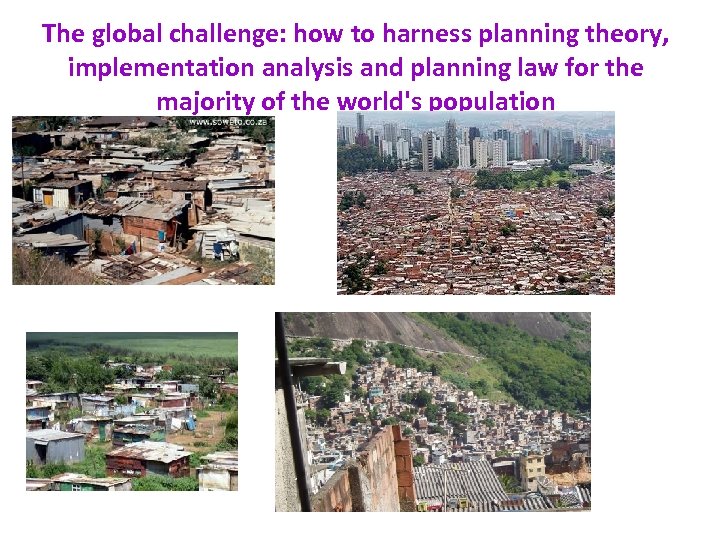
The global challenge: how to harness planning theory, implementation analysis and planning law for the majority of the world's population
PLPR IS creating a boost of knowledge in planning and law
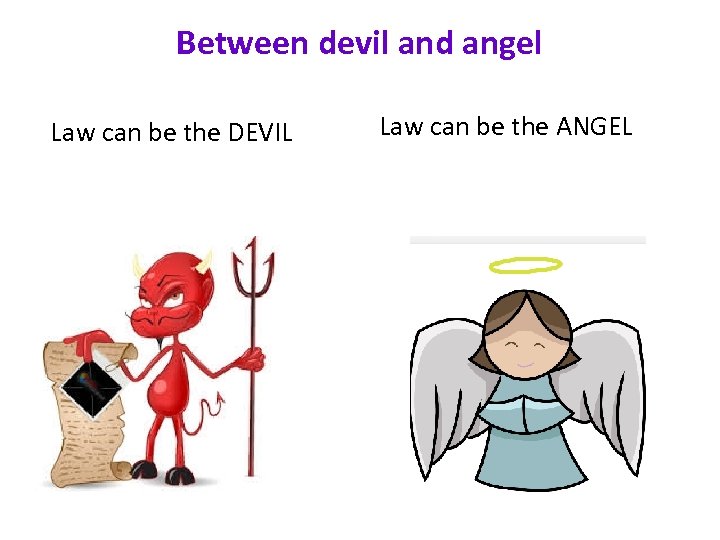
Between devil and angel Law can be the DEVIL Law can be the ANGEL

Accountability to future generations
THANKS!! Deep thanks to all my colleagues around the world who have made PLPR a reality! Special thanks to the former presidents: Leonie Jansen-Janssen Ben Davy And the current president – Richard Norton And thanks to CHRIS WEBSTER and the team!
Скачать презентацию The role of law in planning Between devil
a6c6d17bb514af398b8d8a0c67748c65.ppt