 Скачать презентацию The Role of Kinship in helping behavior among
White_fronted_bee_eaters (1).pptx
- Количество слайдов: 35



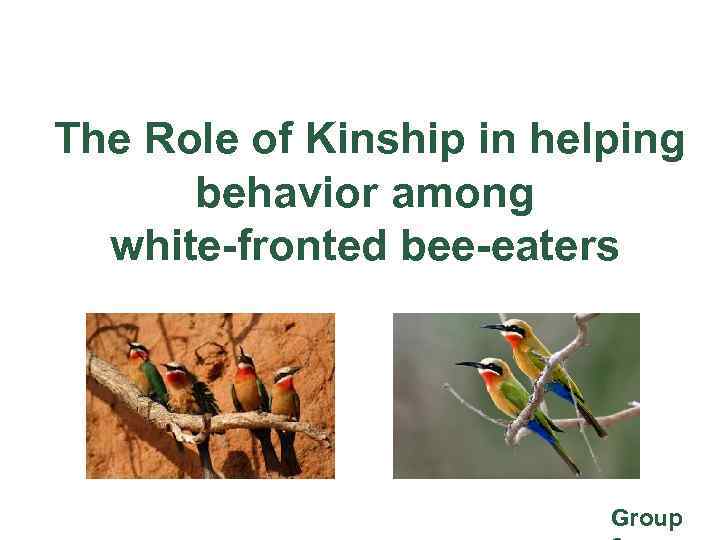
The Role of Kinship in helping behavior among white-fronted bee-eaters Group
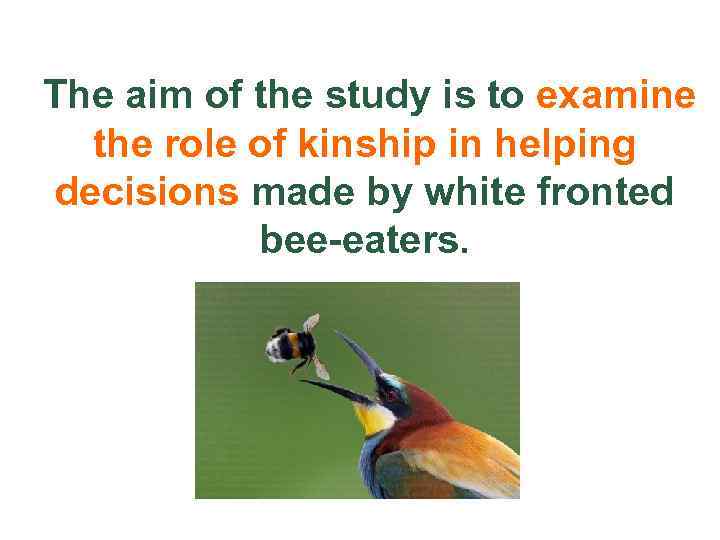
The aim of the study is to examine the role of kinship in helping decisions made by white fronted bee-eaters.
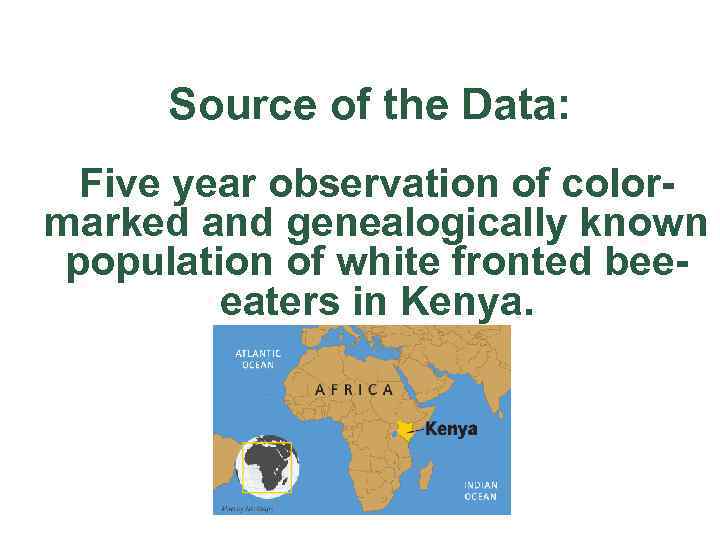
Source of the Data: Five year observation of colormarked and genealogically known population of white fronted beeeaters in Kenya.
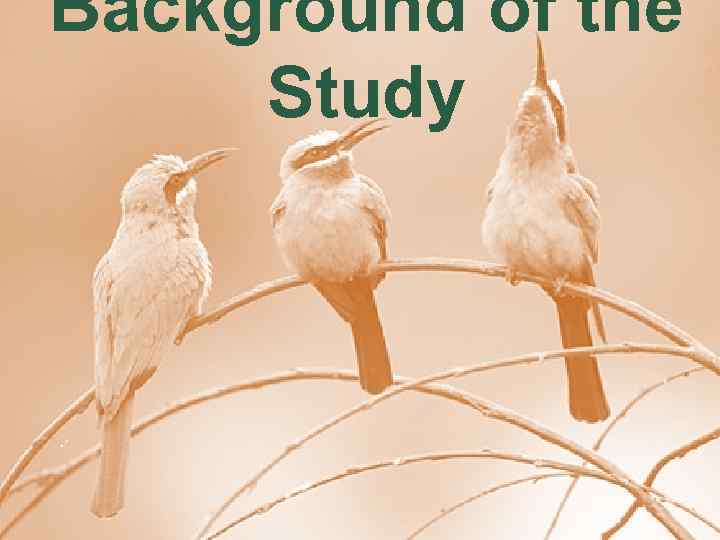
White-fronted bee-eaters
Background of the Study
How often do bee-eaters help each other? 1 Helping-at-the-nest is frequent, with half (50%) of all nesting attempts being attended by one or more helpers in addition to the breeding pair. The average number of helpers at nests with helpers is 1. 52 (Emlen 1988).
How bee-eaters help? 2 When a bee-eater becomes a helper, it attaches itself to one nesting group and assists at only that one nest until either the young fledge or the nesting attempt fails. If young fledge, the helper generally continues to feed the fledglings during their transition to independence.
Who helps more: male or female beeeaters? 3 Males and females contribute almost equally to the pool of helpers, 53 percent being female (Emlen 1988). Further, the likelihood that any given bird becomes a helper is independent of gender. There was no sexual bias in the probability of helping for any category of natal potential helper.
How bee-eaters become helpers? 4 White-fronted bee-eater helpers come from the ranks of breeders as well as nonbreeders. When a nesting attempt fails, it is common for one (and rarely both) breeders to shift and become "redirected helpers" at another nest within the clan (Emlen 1981, 1988).
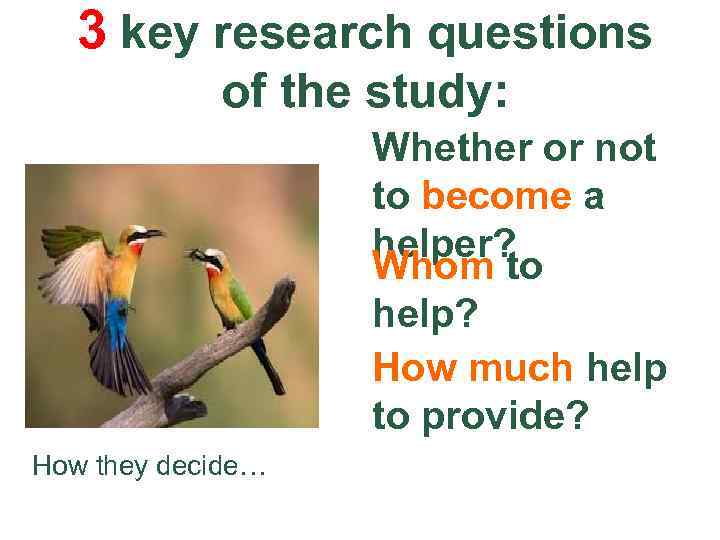
3 key research questions of the study: Whether or not to become a helper? Whom to help? How much help to provide? How they decide…
Whether or not to become a helper? that is the question
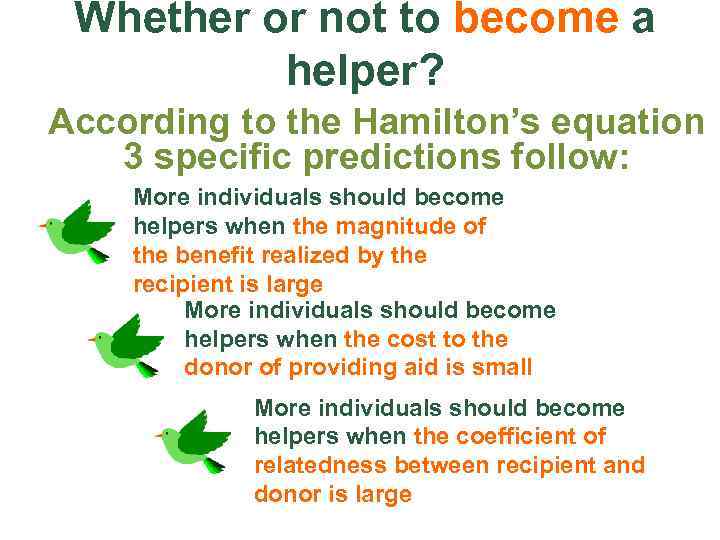
Whether or not to become a helper? According to the Hamilton’s equation 3 specific predictions follow: More individuals should become helpers when the magnitude of the benefit realized by the recipient is large More individuals should become helpers when the cost to the donor of providing aid is small More individuals should become helpers when the coefficient of relatedness between recipient and donor is large
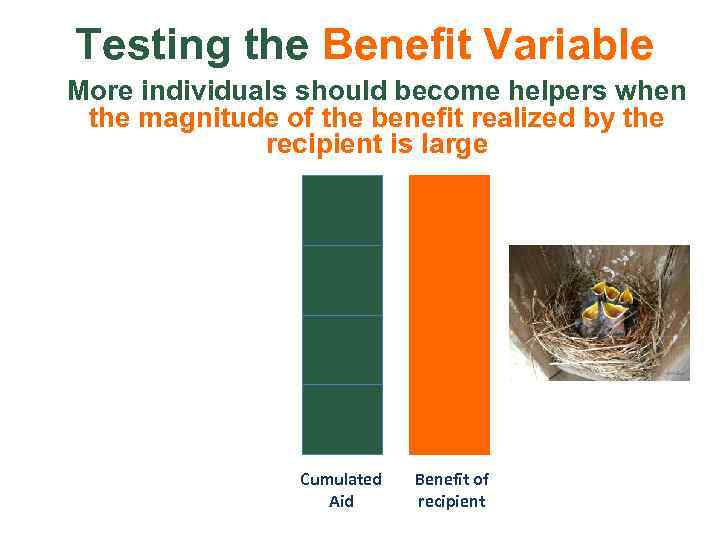
Testing the Benefit Variable More individuals should become helpers when the magnitude of the benefit realized by the recipient is large Cumulated Aid Benefit of recipient
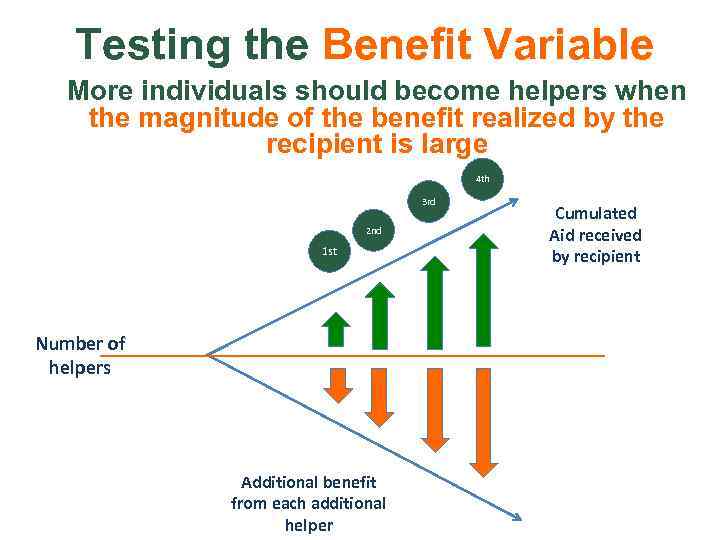
Testing the Benefit Variable More individuals should become helpers when the magnitude of the benefit realized by the recipient is large 4 th 3 rd 2 nd 1 st Number of helpers Additional benefit from each additional helper Cumulated Aid received by recipient
Benefit Variable Analysis Results The relationship between number of helpers and fledging success was linear: 0. 44 off-spring per additional helper Nestlings continue to benefit from increasing number of helpers and observed helper number has rarely reached the point of diminishing returns Prediction of decreasing likelihood of becoming helper cannot be tested with this species
Testing the Costs Variable More individuals should become helpers when the cost to the donor of providing aid is small Two types of costs were examined Energetic costs for helping Deferring one’s own reproduction
Testing the Costs Variable Energeticcosts for helping If the case of an initial nest failure beeeaters either renest or become helpers at other ongoing nests. Also some bee-eaters nest a second time after successful fledging first broods of young.
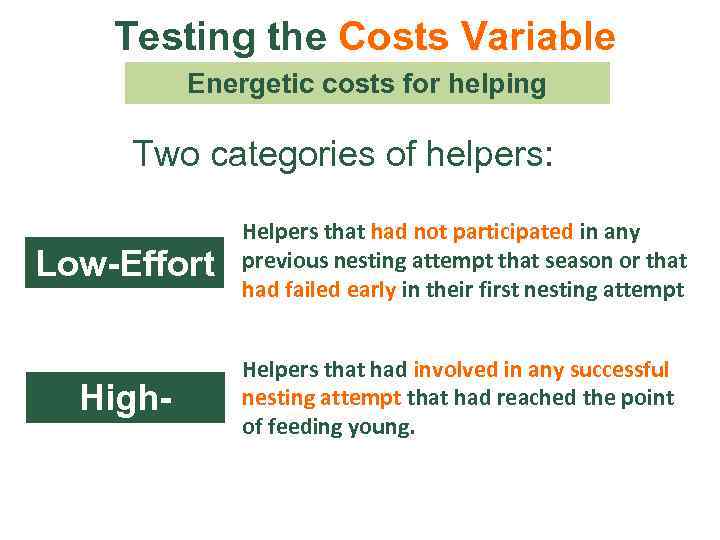
Testing the Costs Variable Energetic costs for helping Two categories of helpers: Low-Effort High. Effort Helpers that had not participated in any previous nesting attempt that season or that had failed early in their first nesting attempt Helpers that had involved in any successful nesting attempt that had reached the point of feeding young.
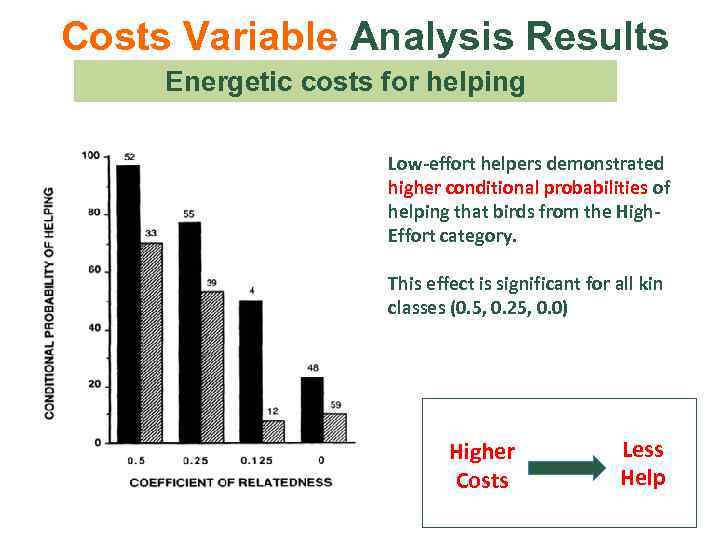
Costs Variable Analysis Results Energetic costs for helping Low-effort helpers demonstrated higher conditional probabilities of helping that birds from the High. Effort category. This effect is significant for all kin classes (0. 5, 0. 25, 0. 0) Higher Costs Less Help
Testing the Costs Variable Delayed breeding costs Two categories of helpers: Low Cost Single Birds High Cost Paired Birds
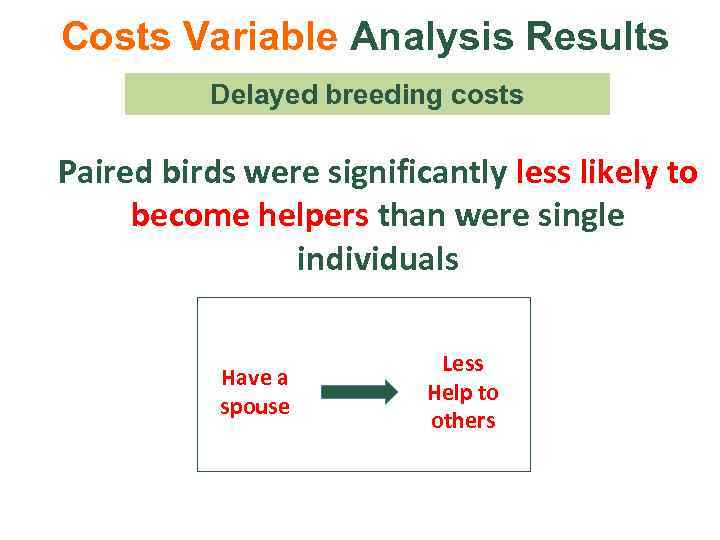
Costs Variable Analysis Results Delayed breeding costs Paired birds were significantly less likely to become helpers than were single individuals Have a spouse Less Help to others
Testing the Kinship Variable More individuals should become helpers when the Eergetic costs for helping coefficient of relatedness between recipient and donor is large If the case of an initial nest failure beeeaters either renest or become helpers at other ongoing nests. Also some bee-eaters nest a second time after successful fledging first broods of young.
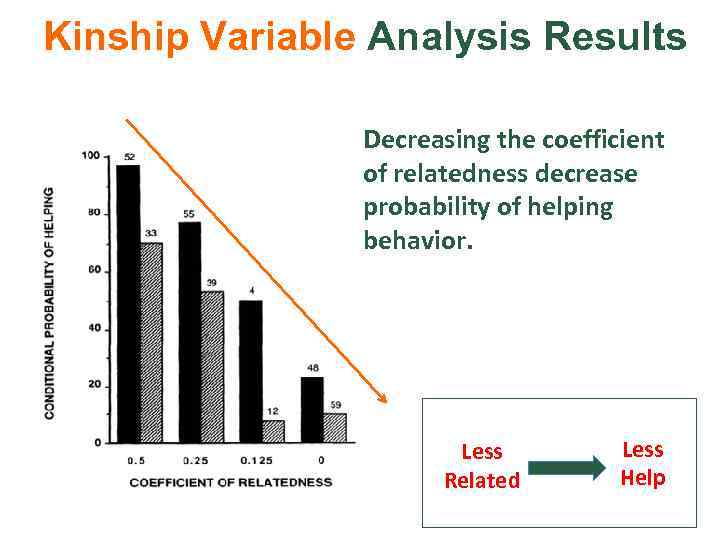
Kinship Variable Analysis Results Decreasing the coefficient of relatedness decrease probability of helping behavior. Less Related Less Help
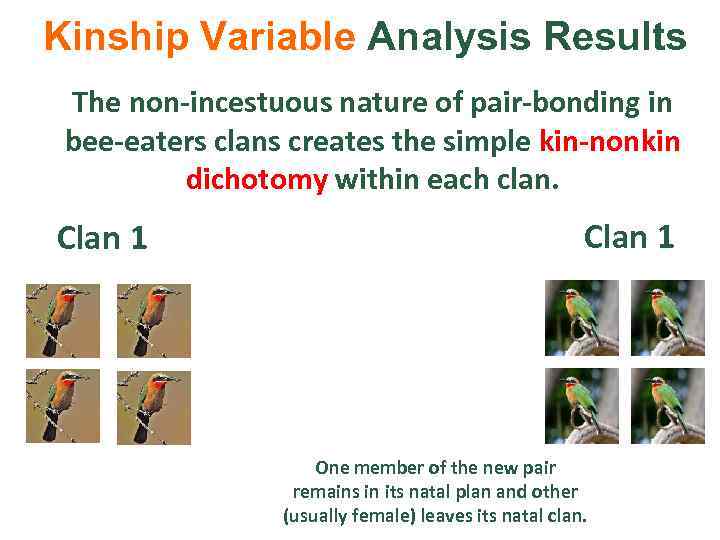
Kinship Variable Analysis Results The non-incestuous nature of pair-bonding in bee-eaters clans creates the simple kin-nonkin dichotomy within each clan. Clan 1 One member of the new pair remains in its natal plan and other (usually female) leaves its natal clan.
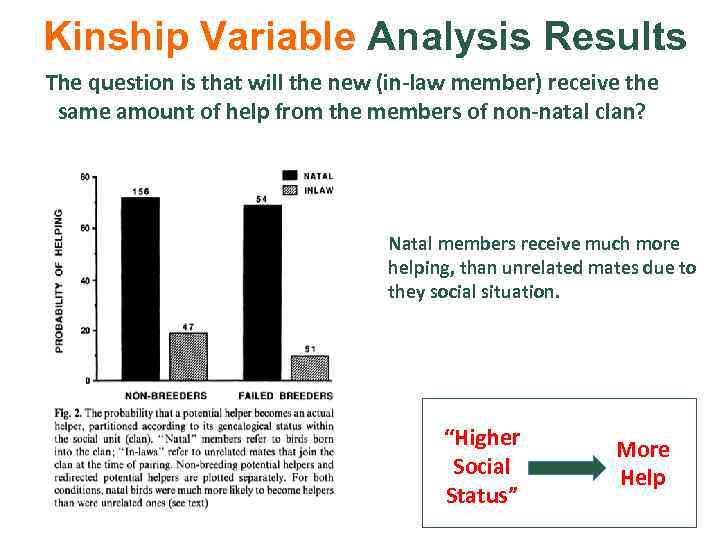
Kinship Variable Analysis Results The question is that will the new (in-law member) receive the same amount of help from the members of non-natal clan? Natal members receive much more helping, than unrelated mates due to they social situation. “Higher Social Status” More Help
Whom to help?
Whom to help?
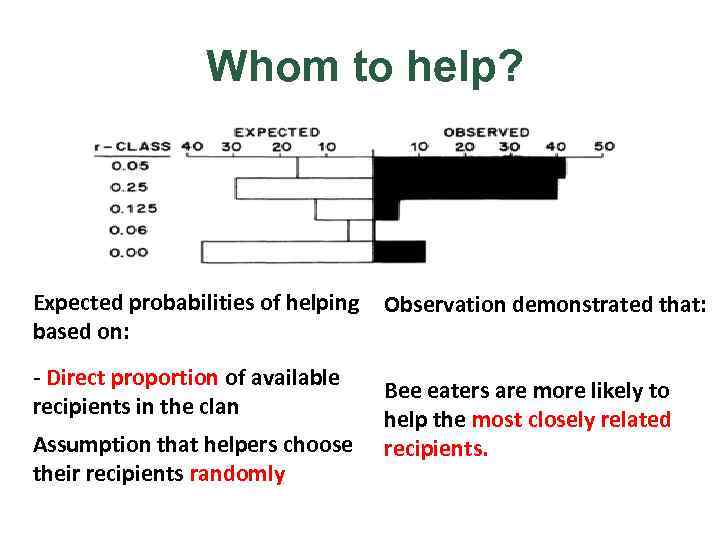
Whom to help? Expected probabilities of helping based on: - Direct proportion of available recipients in the clan Assumption that helpers choose their recipients randomly Observation demonstrated that: Bee eaters are more likely to help the most closely related recipients.
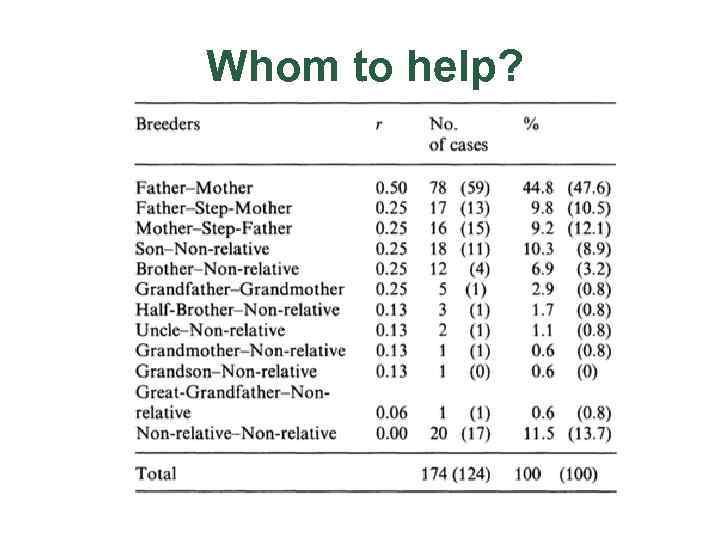
Whom to help? The average relatedness between helper and nestlings being helped was 0. 33 Kin recipients were involved in 88% of the cases and the most frequent associations were among the closest kin There were 10 instances in which helping was directed towards recipients outside of the clan. But, in 8 cases birds temporarily rejoined their natal groups to help their parents or step-parents.
How much help to provide?
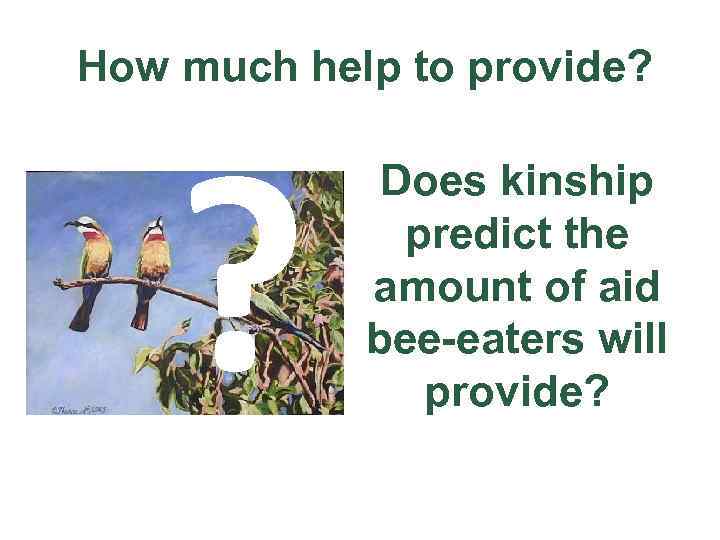
How much help to provide? ? Does kinship predict the amount of aid bee-eaters will provide?
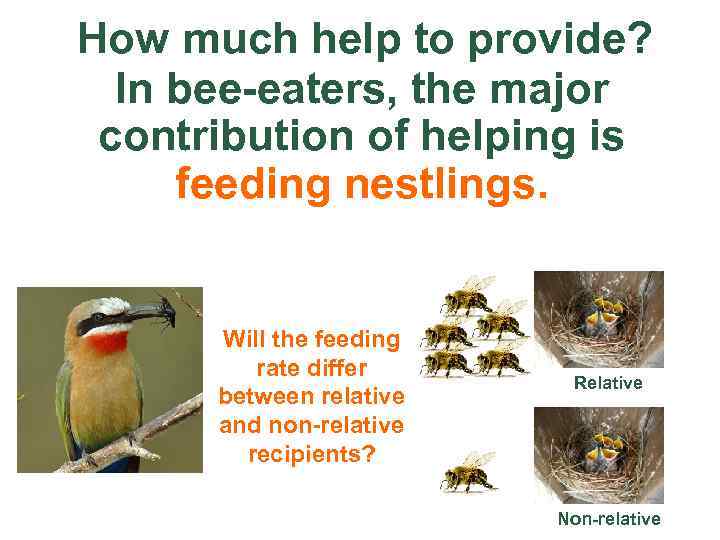
How much help to provide? In bee-eaters, the major contribution of helping is feeding nestlings. Will the feeding rate differ between relative and non-relative recipients? Relative Non-relative
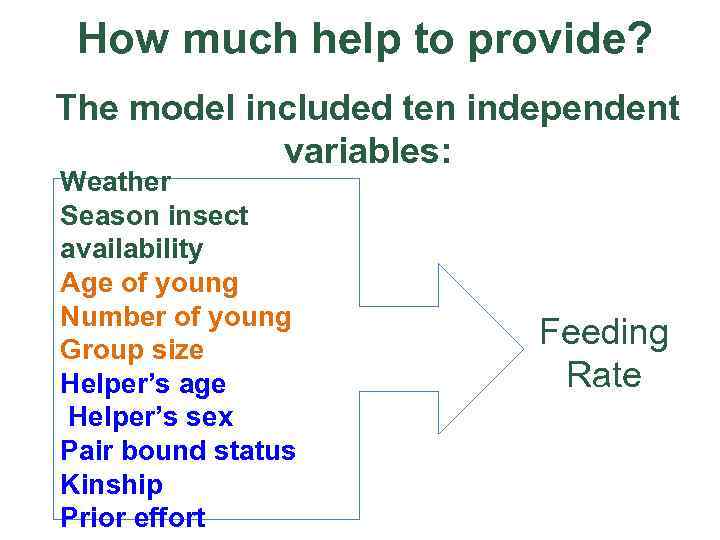
How much help to provide? The model included ten independent variables: Weather Season insect availability Age of young Number of young Group size Helper’s age Helper’s sex Pair bound status Kinship Prior effort Feeding Rate
How much help to provide? The model explained only 34% of variance Genetic relatedness explained only 4% of variance Bee eaters did not vary their amount of help in accordance with their degree of relatedness to the recipients
Thank you for your attention!
Скачать презентацию The Role of Kinship in helping behavior among
White_fronted_bee_eaters (1).pptx