


 Скачать презентацию The Role of GNSS in the GLAs Future
a97392fa0680207a24366e0ae5ca5bd2.ppt
- Количество слайдов: 22
 The Role of GNSS in the GLAs’ Future Service Provision Dr Sally Basker Director of Research & Radionavigation General Lighthouse Authorities of the United Kingdom & Ireland International Information Sub-Committee, Civil GPS Service Interface Committee, Manchester, 7 May 2006
 Content § § The GLAs Shipping trends and e-Navigation The Role of GNSS Securing e-Navigation Benefits
 The General Lighthouse Authorities
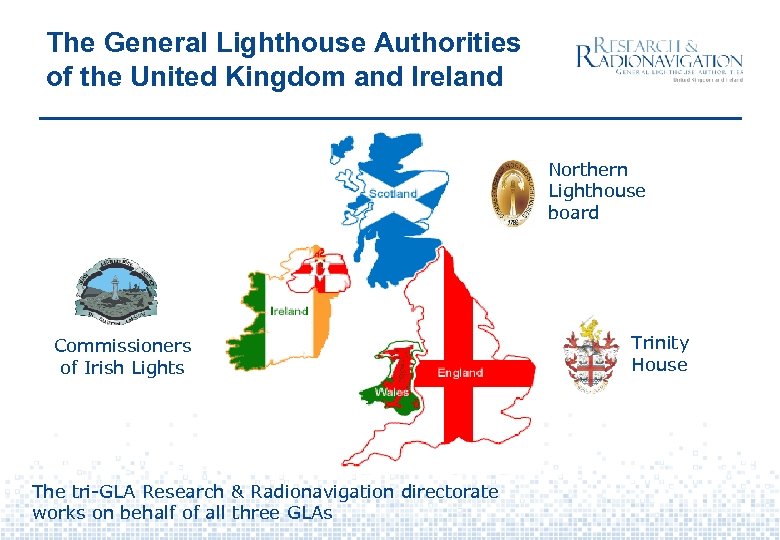 The General Lighthouse Authorities of the United Kingdom and Ireland Northern Lighthouse board Commissioners of Irish Lights The tri-GLA Research & Radionavigation directorate works on behalf of all three GLAs Trinity House
 Building on a track record of success § The GLAs shared mission is is the delivery of a reliable, efficient and cost effective Ato. N service for the benefit and safety of all mariners § The GLAs operate in a “user pays” cost-recovery environment based on “Light Dues” § Light dues have reduced by 50% in real terms in the last 10 years § This has been achieved by improving the cost-effectiveness of physical aids to navigation (lights and floating aids) § Taking this further means delivering a radionavigation dividend § cost-savings that result from the introduction of radionavigation services and their take-up in the maritime sector
 Shipping trends and e-Navigation
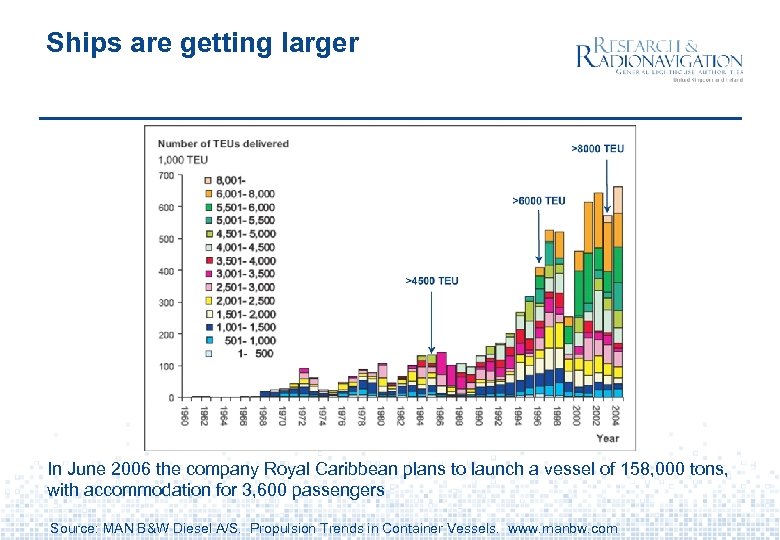 Ships are getting larger In June 2006 the company Royal Caribbean plans to launch a vessel of 158, 000 tons, with accommodation for 3, 600 passengers Source: MAN B&W Diesel A/S. Propulsion Trends in Container Vessels. www. manbw. com
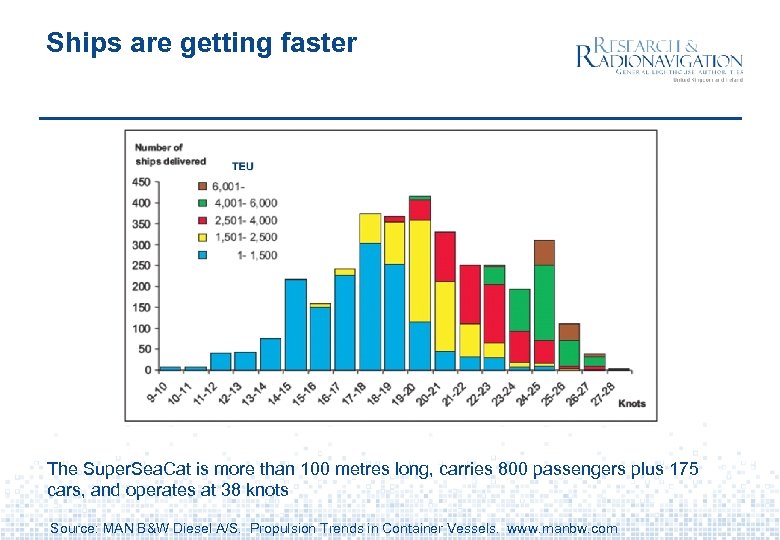 Ships are getting faster The Super. Sea. Cat is more than 100 metres long, carries 800 passengers plus 175 cars, and operates at 38 knots Source: MAN B&W Diesel A/S. Propulsion Trends in Container Vessels. www. manbw. com
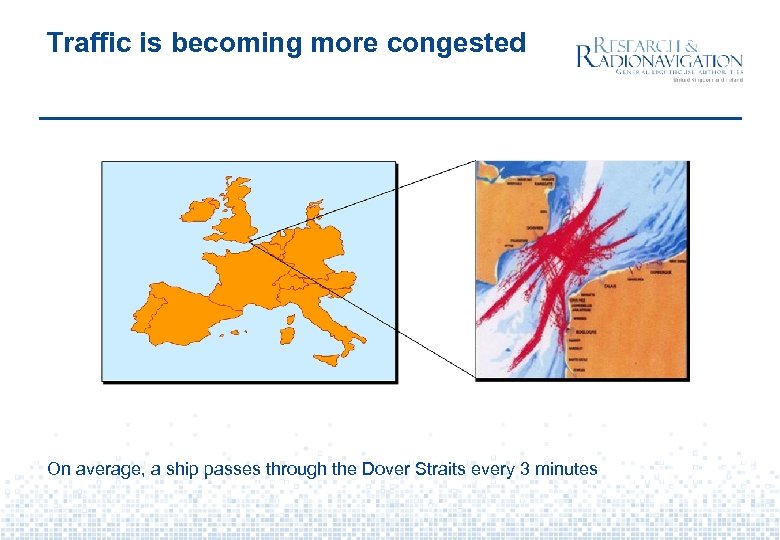 Traffic is becoming more congested On average, a ship passes through the Dover Straits every 3 minutes
 e-Navigation - making safe navigation easier and cheaper § The cost-effective collection, integration and display of maritime information onboard and ashore by electronic means, to enhance berth-to-berth navigation and related services, for safety and security at sea, and protection of the marine environment § Widespread support at IMO and IALA § Delivery § GNSS underpinned by fail-safe supplementary position signals § integrated displays – communications – information management – alarm prioritisation – shore-based monitoring & intervention § It will enable new applications § virtual Ato. Ns for the early marking of wrecks or other hazards before they are marked physically with wreck-marking buoys
 The Role of GNSS
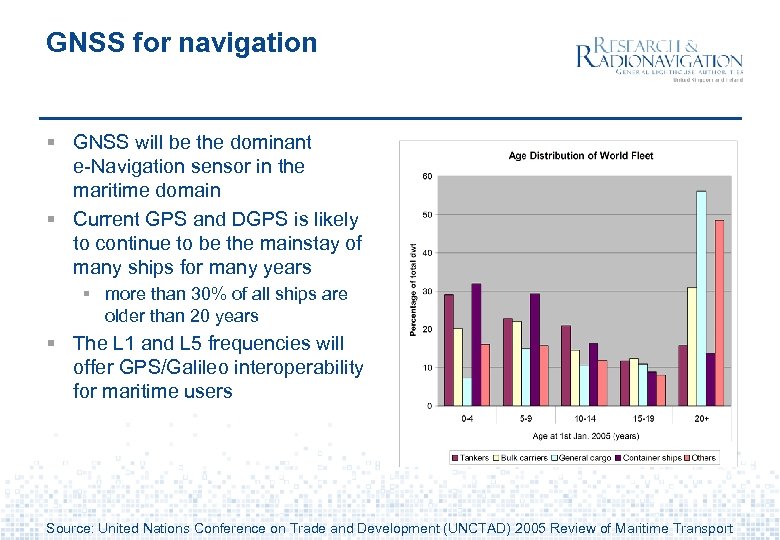 GNSS for navigation § GNSS will be the dominant e-Navigation sensor in the maritime domain § Current GPS and DGPS is likely to continue to be the mainstay of many ships for many years § more than 30% of all ships are older than 20 years § The L 1 and L 5 frequencies will offer GPS/Galileo interoperability for maritime users Source: United Nations Conference on Trade and Development (UNCTAD) 2005 Review of Maritime Transport
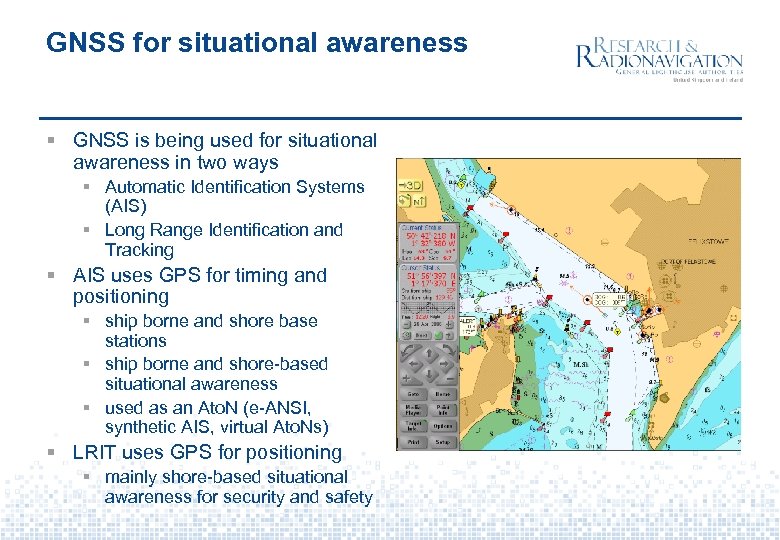 GNSS for situational awareness § GNSS is being used for situational awareness in two ways § Automatic Identification Systems (AIS) § Long Range Identification and Tracking § AIS uses GPS for timing and positioning § ship borne and shore base stations § ship borne and shore-based situational awareness § used as an Ato. N (e-ANSI, synthetic AIS, virtual Ato. Ns) § LRIT uses GPS for positioning § mainly shore-based situational awareness for security and safety
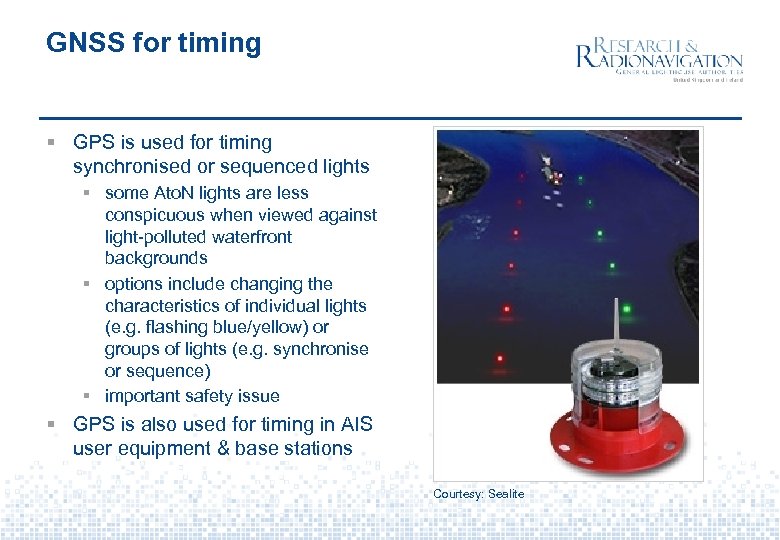 GNSS for timing § GPS is used for timing synchronised or sequenced lights § some Ato. N lights are less conspicuous when viewed against light-polluted waterfront backgrounds § options include changing the characteristics of individual lights (e. g. flashing blue/yellow) or groups of lights (e. g. synchronise or sequence) § important safety issue § GPS is also used for timing in AIS user equipment & base stations Courtesy: Sealite
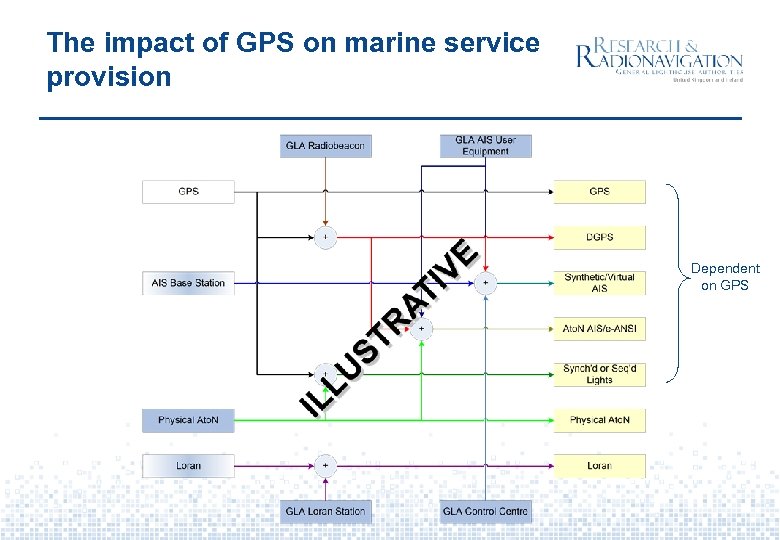 The impact of GPS on marine service provision Dependent on GPS
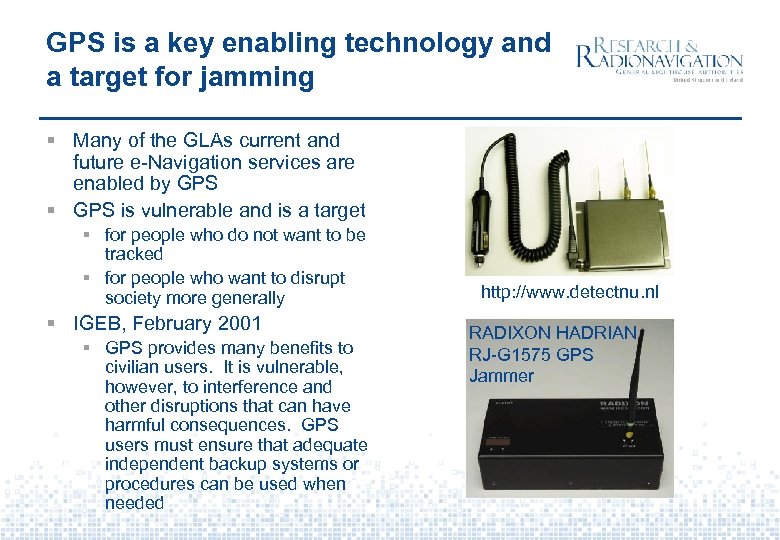 GPS is a key enabling technology and a target for jamming § Many of the GLAs current and future e-Navigation services are enabled by GPS § GPS is vulnerable and is a target § for people who do not want to be tracked § for people who want to disrupt society more generally § IGEB, February 2001 § GPS provides many benefits to civilian users. It is vulnerable, however, to interference and other disruptions that can have harmful consequences. GPS users must ensure that adequate independent backup systems or procedures can be used when needed http: //www. detectnu. nl RADIXON HADRIAN RJ-G 1575 GPS Jammer
 Securing GNSS Benefits for e-Navigation
 Reverting from e-Navigation to physical Ato. Ns § e-Navigation systems will be designed with high levels of availability and reliability to support one-man-bridge and other innovative operations § Reverting from e-Navigation based solely on GNSS to physical Ato. Ns will become less straightforward § Under some circumstances navigational safety might actually worsen § A second, complementary and dissimilar, multi-modal independent PNT service is needed to realise the full benefits of e-Navigation
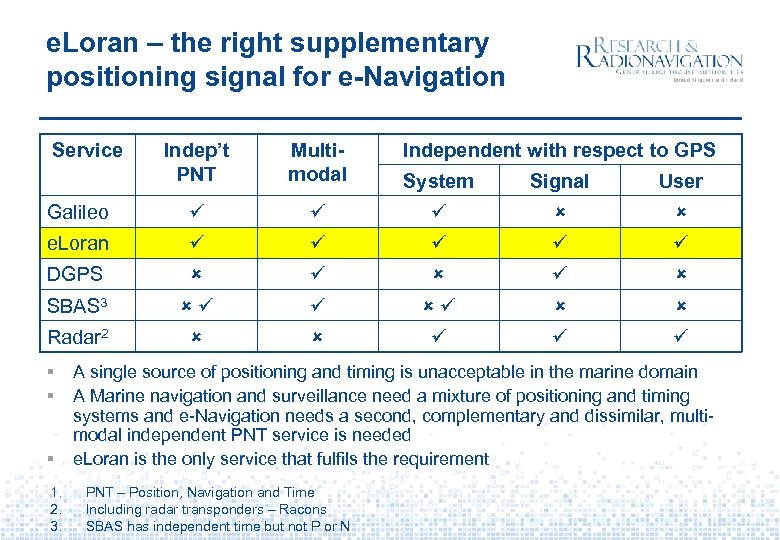 e. Loran – the right supplementary positioning signal for e-Navigation Service Indep’t PNT Multimodal System Signal User Galileo e. Loran DGPS SBAS 3 Radar 2 § § § 1. 2. 3. Independent with respect to GPS A single source of positioning and timing is unacceptable in the marine domain A Marine navigation and surveillance need a mixture of positioning and timing systems and e-Navigation needs a second, complementary and dissimilar, multimodal independent PNT service is needed e. Loran is the only service that fulfils the requirement PNT – Position, Navigation and Time Including radar transponders – Racons SBAS has independent time but not P or N
 e. Loran makes sense § The e. Loran objective § the provision of an international, globally-standardised e. Loran PNT (position, navigation and time) multi-modal service, based on interoperable multi-regional components both as a complement to GNSS and as a stand-alone backup in case of failure § e. Loran must make sense to governments, service providers and users § improving safety § meeting IMO A. 915 general navigation requirements § improving the cost-effectiveness of Ato. N service provision
 e. Loran will secure key GNSS benefits for e-Navigation § e. Loran will secure the important GNSS benefits for e-Navigation and Ato. N service provision § Increased operational flexibility and improved safety from new operational concepts § Greater throughput of freight § Virtual Ato. Ns § earlier marking of wrecks § traffic separation schemes § marking shifting channels and sand banks § Reduced cost of Ato. N service provision § Insurance against intentional or unintentional interference
 e. Loran at ENC § Briefing presentations § Monday – Shipping trends, e-Navigation, e. Loran White Paper § Tuesday – Harwich trials, container tracking, French experience § Wednesday – GLA R&RNAV procurements in 2006/7 § Papers § Mitch’s bit § GLA paper