


 Скачать презентацию The role of experience in children s acquisition of
8b7f33e39d97dab9728135a8789079f1.ppt
- Количество слайдов: 50
 The role of experience in children’s acquisition of space, time, and number words Elena Nicoladis University of Alberta
 The big question • How do children learn meaning of words referring to abstract concepts? – Development of abstract concepts – Relationship of language to conceptual development • Focus here: number, time and space
 How are number, space and time related? • Piaget vs. Kant • I have colleagues who are interested in these concepts • Children learn something about these concepts at an early age and their understanding/use of these concepts changes with age
 Outline • Background – Development of abstract concepts – Relationship between language and thought in development • • Number Time Space Do these have anything to do with each other?
 Development of abstract concepts • Piaget – Rational knowledge emerges from early sensorimotor experience – For example, infants have implicit understanding of causality – Therefore abstract concepts come from concrete concepts – For example, temporal concepts come from spatial concepts • Taller people are older
 Development of abstract concepts • Since Piaget – Infancy research • Infants react to perceptual stimuli on what could be described as abstract basis • E. g. , Can tell the difference between 1 and 2 visually; Can differentiate differently ordered images – The function of the concepts could be important • Particularly sociocultural function
 Language and thought in development • Language does not necessarily map onto preverbal concepts • For ex. , Korean- and English-speaking children encode different aspects of spatial relations (Bowerman & Choi, 1990) • Learning spatial language has to do with frequency in the input
 Language and thought in development • Chinese and English both encode: – path of motion (he goes up) – manner of motion (he’s running) – resultatives (he goes byebye) • Chinese-English bilingual children, graph of their dominant language
 How do children learn language referring to number, time and space? • I’m going to start with words – Number words 1 -100 (0) – Temporal words (particularly before and after) – Spatial word: Where • Converging methodology – “Naturalistic” data – Experimental data • Assumption: language use reflects thoughts
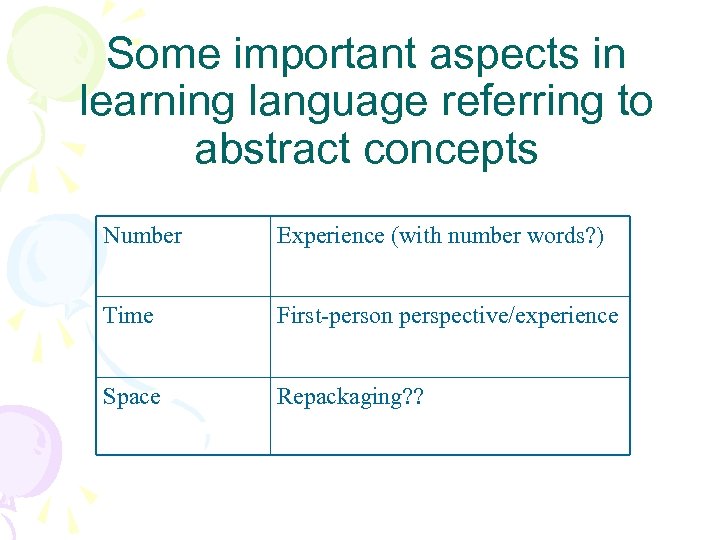
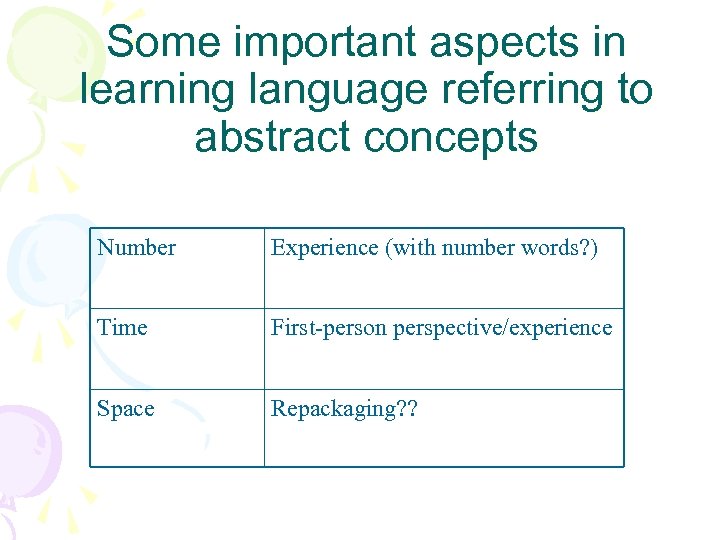 Some important aspects in learning language referring to abstract concepts Number Experience (with number words? ) Time First-person perspective/experience Space Repackaging? ?
 Number colleagues • • Jeff Bisanz Elaine Ho Joyce Leung Carmen Rasmussen
 Number language and thought • Miller, Smith, Zhu, & Zhang (1995) argued that language transparency was one factor in Chinese-speaking children’s early acquisition of number words • Study compared 3 -5 year old American English-speaking children with Chinesespeaking children in China • Asked them to count as high as they could
 Miller et al. ’s results
 Culture not controlled for • We asked 25 Chinese-English bilingual children living in Alberta to count as high as they could – Once in Chinese – Once in English • Bilingual children often speak one language better than the other

 By dominant language
 Number study conclusions • Children counted better in the language they knew better • Suggesting that experience plays a role in learning number words • We have not disproven language transparency-- it’s just later in development or less important than frequency
 Learning number words • How does experience could play a role? – Frequency of hearing – Frequency of practicing – Earlier and/or higher numbers heard – Earlier and/or higher numbers used • Study: looks at Chinese-speaking children in Hong Kong speaking with adults
 Children’s use of number words
 Adults’ use of number words
 Summary of results of number study • Children and adults talk a lot about 1 -3 and a fair bit about 4 -10 • Higher numbers are infrequent • Two hints about Chinese advantage – One child suddenly counted to 28 about a month after his third birthday – Two older sisters wandered through, assigning themselves math problems
 Take-home message about numbers • Experience matters with learning number words • We don’t yet know what about experience makes a difference: probably academic setting helps with 11+ – Peers? – Educators do something interesting with numbers?
 My partner in time • Peter J. Lee
 Time word background • Children are lousy with time words (concepts) before school age • They confuse before/after, yesterday/tomorrow • Four-year olds do not order events well • Piaget argued that children learn time as metaphor for space – Most experiments used speed as dependent measure
 But… • Do children learn about time as metaphor for space? • Infants are sensitive to order of images as young as 8 months • Marilyn Shatz has argued that children often learn a large category (like colour) and make mistakes within that category (blue for green)
 Study 1 • Time words in naturalistic conversation • We looked at lots of temporal words (before, after, yesterday, tomorrow, hour, minute, day, week, year, etc. ) • English-speaking child (Abe) in interaction with his parents from 2; 4 to 5 years
 Percentage errors by age
 Number of temporal references
 Summary of results • Abe made very few errors in using time words • Context of use of time words – Reconstructing past events for one parent – Negotiating future events • One study showed that four-year olds are better at ordering everyday events than decontextualized story events
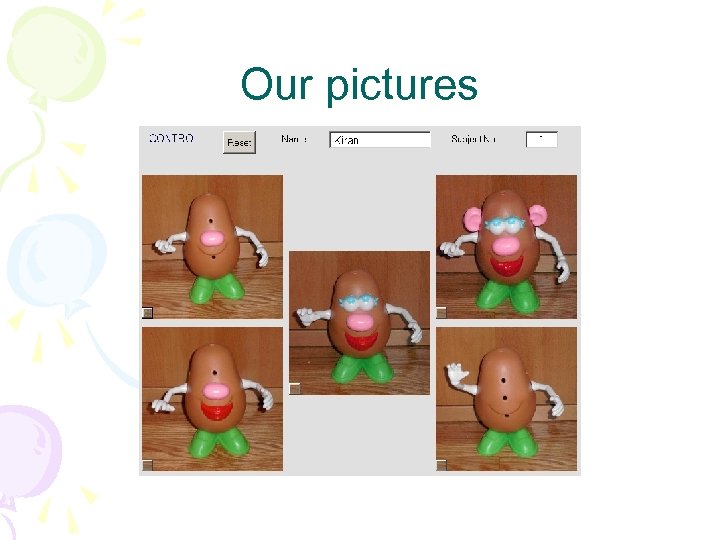
 Study 2 • We used the same events for children to sort but varied their experience with them • 3 Conditions: – Control condition: Sort Ms. Potatohead according to how she must have been built – Retrospective condition: Build Ms. Potatohead then sort the cards in that order – Prospective condition: Plan with experimenter how to build Ms. Potatohead then do it in that order
 Study 2 • 60 children between 3 and 5 years • Rank order correlations: – 0 -1, with higher number indicating a closer relationship between the two orders
 Our pictures
 Average rank order correlations t(28) = 1. 5, p > 0. 14 24% Control 100% 48% Prosp. 100%
 Average rank order correlations t(32) = -3. 54, p > 0. 001 24% Control 100% 57% Retro. 100%
 Summary of study 2 • We showed that children are better at retrospective ordering than logical ordering • They are not significantly better at prospective ordering than logical ordering on this task
 Take-home message • First-person experience can make a difference in understanding or performing on ordering task • Piaget correct that logic follows personal experience in development • Understanding time does not necessarily come from understanding space first
 Space colleagues • Edward Cornell • Melissa Gates
 What does “where” mean? • We know that children use “where” very early-- one of the earliest question words • Studies of children’s nonverbal conceptualizations of space have shown that they tend to think of route earlier than location • Easier to think along horizontal planes than vertical planes
 Does “where” mean route or location? • 5 children interacting with parents at 2; 0, 2; 6, 3; 0, 3; 6 • Looked at children’s responses to parents’ use of “where” • Transcripts already coded for children’s gesture use (including points)
 Results
 Summary of results • Children pointed more as parents asked more genuine “where” questions • We could not distinguish whether children meant location or route – points usually were along both route and location
 Space Study 2 • 42 children from 2 -4 years • Two questions about “where”: – Point to a hidden object – Point to rooms • Same floor • Different floor • Dependent measures: points to route vs. points to location
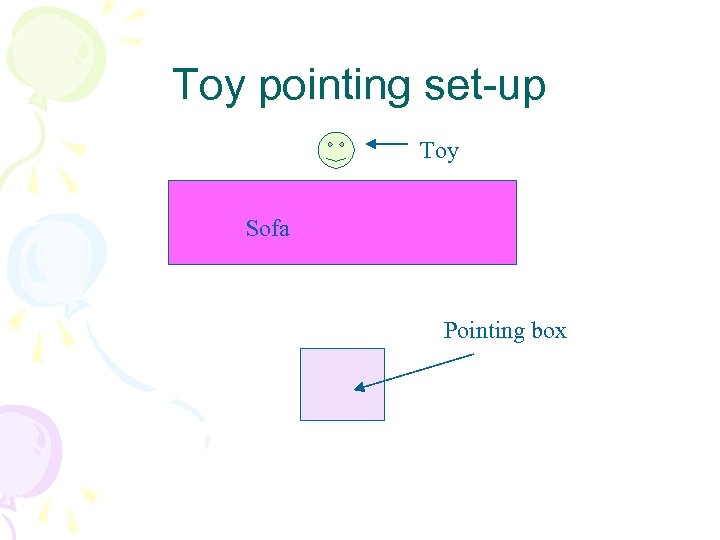 Toy pointing set-up Toy Sofa Pointing box
 Results
 Summary of results • Children always point to the location of a hidden object • Younger children point to route to rooms while older children (4 year olds) point to location
 Interpretation of results • As children get older they think of rooms as locations • They can think about large space AS IF it is small space • Maybe around 4 years of age children could switch strategies of “where” responses – “Where is the bathroom? ”
 Some important aspects in learning language referring to abstract concepts Number Experience (with number words? ) Time First-person perspective/experience Space Repackaging? ?
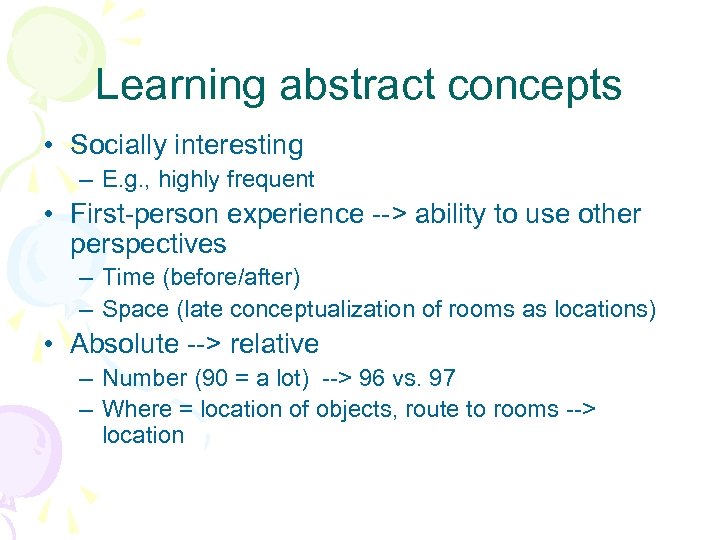 Learning abstract concepts • Socially interesting – E. g. , highly frequent • First-person experience --> ability to use other perspectives – Time (before/after) – Space (late conceptualization of rooms as locations) • Absolute --> relative – Number (90 = a lot) --> 96 vs. 97 – Where = location of objects, route to rooms --> location
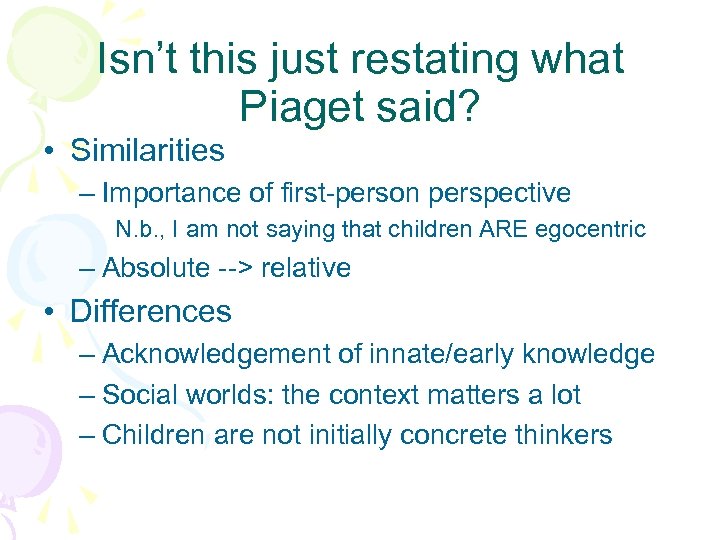 Isn’t this just restating what Piaget said? • Similarities – Importance of first-person perspective N. b. , I am not saying that children ARE egocentric – Absolute --> relative • Differences – Acknowledgement of innate/early knowledge – Social worlds: the context matters a lot – Children are not initially concrete thinkers
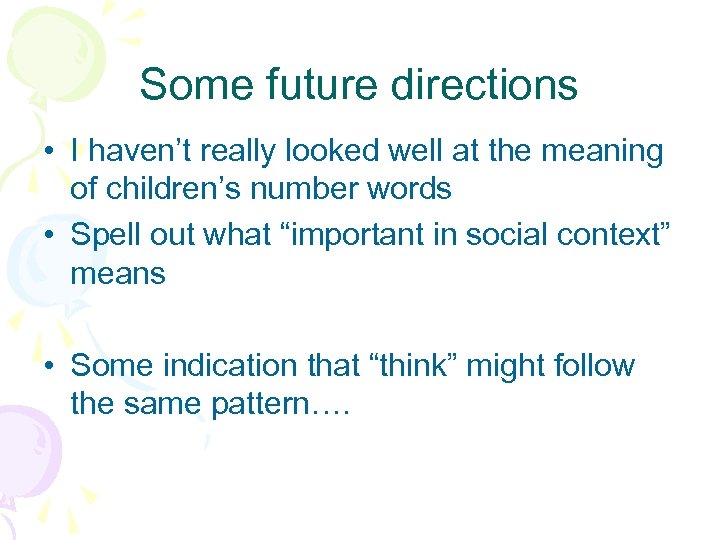 Some future directions • I haven’t really looked well at the meaning of children’s number words • Spell out what “important in social context” means • Some indication that “think” might follow the same pattern….