


 Скачать презентацию The Role of Education in Korea s Socioeconomic Development
5095c52e258e18e4e45be4af652fb844.ppt
- Количество слайдов: 29
 The Role of Education in Korea’s Socioeconomic Development: Achievements and Challenges October 3, 2006 Harvard University Jin-Pyo Kim Member of National Assembly Republic of Korea
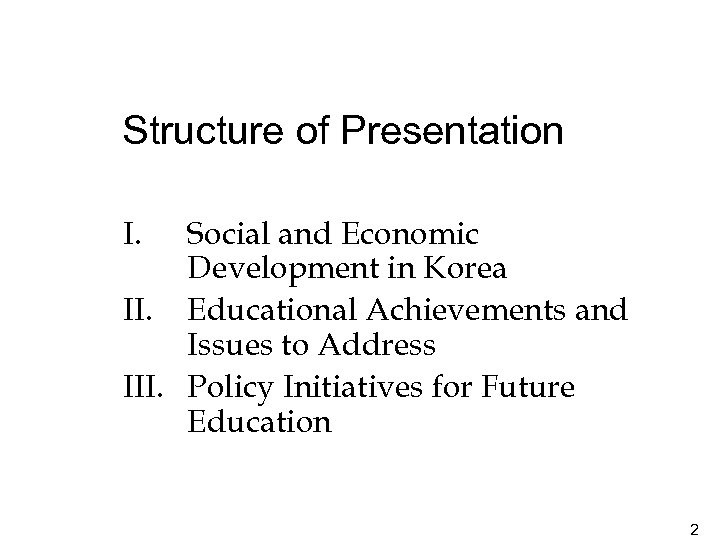 Structure of Presentation I. Social and Economic Development in Korea II. Educational Achievements and Issues to Address III. Policy Initiatives for Future Education 2
 I. Social and Economic Development in Korea 3
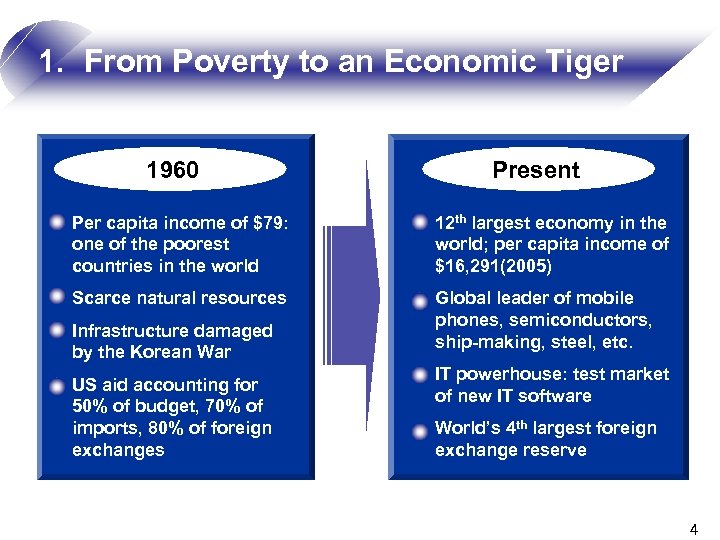 1. From Poverty to an Economic Tiger 1960 Present Per capita income of $79: one of the poorest countries in the world 12 th largest economy in the world; per capita income of $16, 291(2005) Scarce natural resources Global leader of mobile phones, semiconductors, ship-making, steel, etc. Infrastructure damaged by the Korean War US aid accounting for 50% of budget, 70% of imports, 80% of foreign exchanges IT powerhouse: test market of new IT software World’s 4 th largest foreign exchange reserve 4
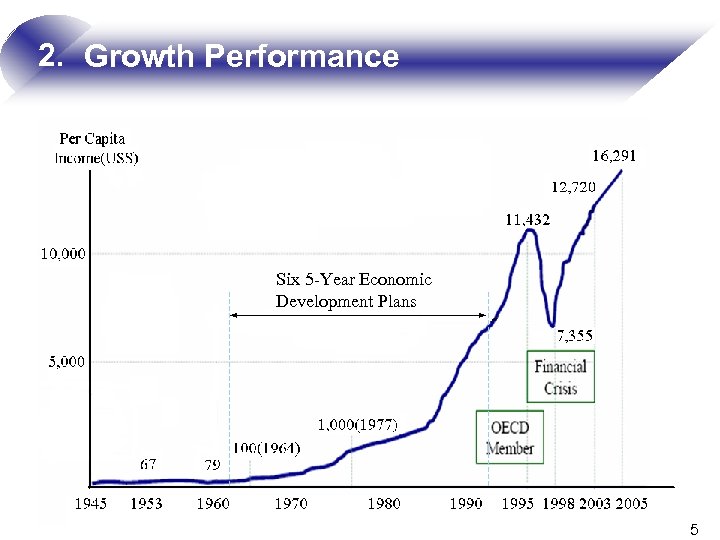 2. Growth Performance 한국 경제사회 발전과 교육의 역할 및 과제 Six 5 -Year Economic Development Plans 5
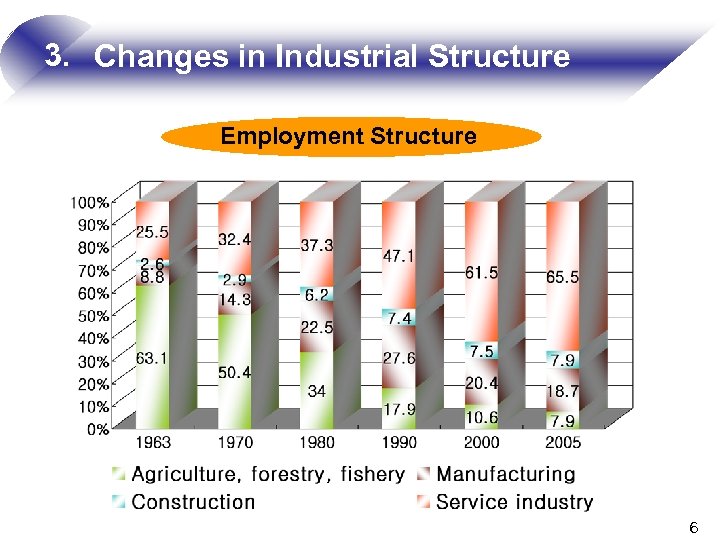 3. Changes in Industrial Structure Employment Structure 6
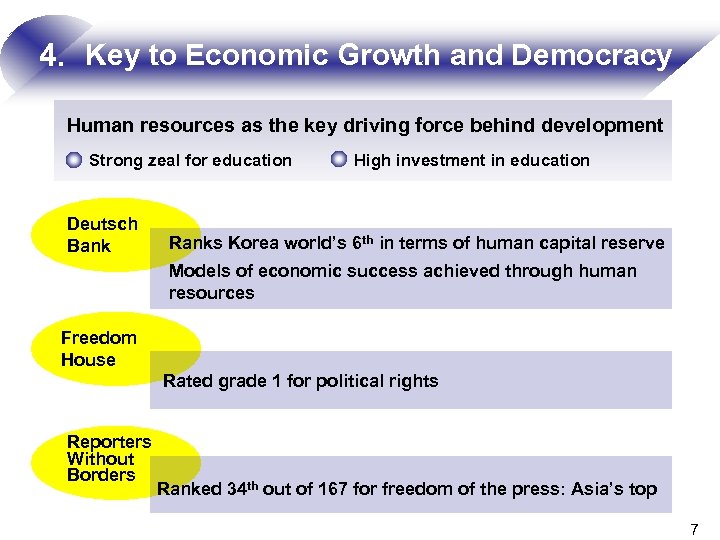 4. Key to Economic Growth and Democracy 한국 경제사회 발전과 교육의 역할 및 과제 Human resources as the key driving force behind development Strong zeal for education High investment in education Deutsch Bank Ranks Korea world’s 6 th in terms of human capital reserve Models of economic success achieved through human resources Freedom House Rated grade 1 for political rights Reporters Without Borders Ranked 34 th out of 167 for freedom of the press: Asia’s top 7
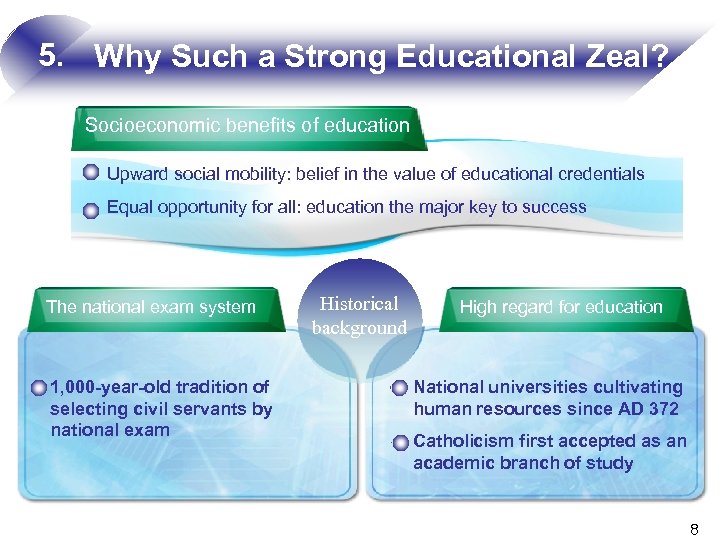 5. Why Such a Strong Educational Zeal? Socioeconomic benefits of education 학습효과 Upward social mobility: belief in the value of educational credentials Equal opportunity for all: education the major key to success The national exam system 1, 000 -year-old tradition of selecting civil servants by national exam Historical background High regard for education National universities cultivating human resources since AD 372 Catholicism first accepted as an academic branch of study 8
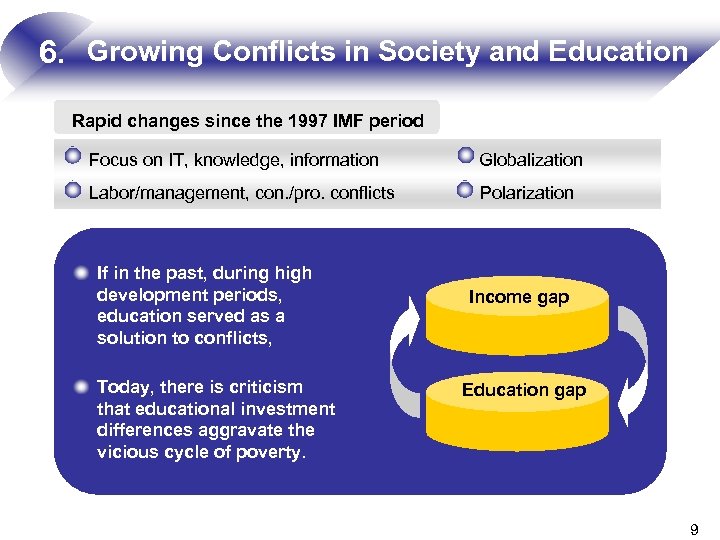 6. Growing Conflicts in Society and Education Rapid changes since the 1997 IMF period Focus on IT, knowledge, information Globalization Labor/management, con. /pro. conflicts Polarization If in the past, during high 과거 경제사회구조의 급변기 development periods, 에는 교육이 갈등을 해결 education served as a 최근에는 교육이 역할을 solution to conflicts, 못 하고 있음(악순환 초래) Today, there is criticism that educational investment differences aggravate the vicious cycle of poverty. 고등교육 질적 수준이 미흠하 Income gap 여 Skill Mismatch 발생 구직난 속의 구인난 심화 Education gap 9
 II. Educational Achievements and Issues to Address 10
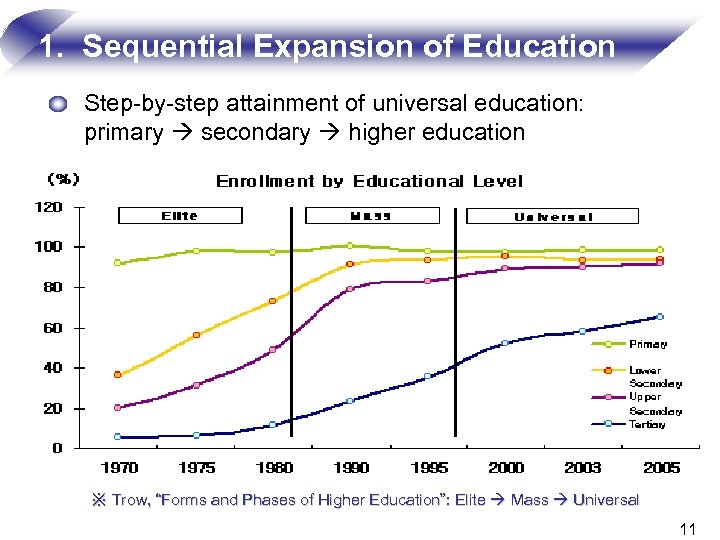 1. Sequential Expansion of Education Step-by-step attainment of universal education: primary secondary higher education ※ Trow, “Forms and Phases of Higher Education”: Elite Mass Universal 11
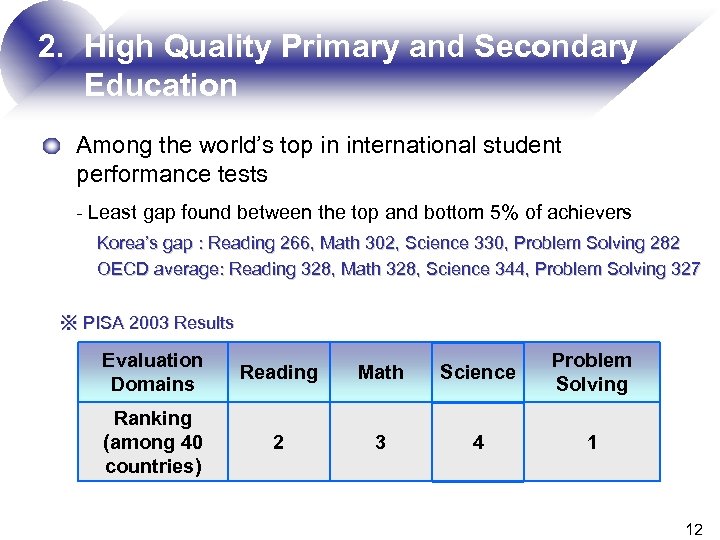 2. High Quality Primary and Secondary Education Among the world’s top in international student performance tests - Least gap found between the top and bottom 5% of achievers Korea’s gap : Reading 266, Math 302, Science 330, Problem Solving 282 OECD average: Reading 328, Math 328, Science 344, Problem Solving 327 ※ PISA 2003 Results Evaluation Domains Reading Math Science Problem Solving Ranking (among 40 countries) 2 3 4 1 12
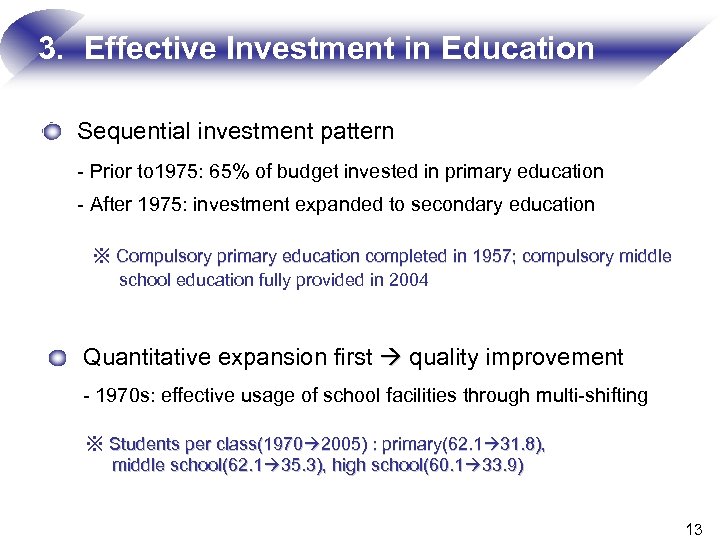 3. Effective Investment in Education Sequential investment pattern - Prior to 1975: 65% of budget invested in primary education - After 1975: investment expanded to secondary education ※ Compulsory primary education completed in 1957; compulsory middle school education fully provided in 2004 Quantitative expansion first quality improvement - 1970 s: effective usage of school facilities through multi-shifting ※ Students per class(1970 2005) : primary(62. 1 31. 8), middle school(62. 1 35. 3), high school(60. 1 33. 9) 13
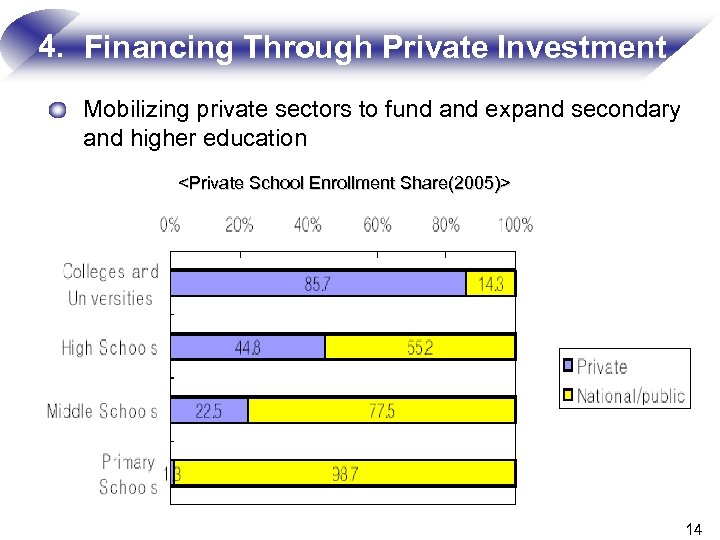 4. Financing Through Private Investment Mobilizing private sectors to fund and expand secondary and higher education
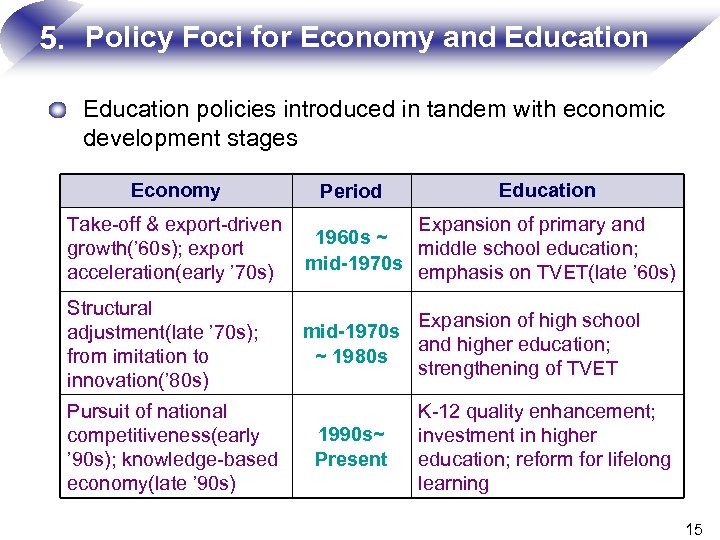 5. Policy Foci for Economy and Education policies introduced in tandem with economic development stages Economy Period Education Take-off & export-driven Expansion of primary and 1960 s ~ growth(’ 60 s); export middle school education; acceleration(early ’ 70 s) mid-1970 s emphasis on TVET(late ’ 60 s) Structural adjustment(late ’ 70 s); from imitation to innovation(’ 80 s) Pursuit of national competitiveness(early ’ 90 s); knowledge-based economy(late ’ 90 s) Expansion of high school mid-1970 s and higher education; ~ 1980 s strengthening of TVET 1990 s~ Present K-12 quality enhancement; investment in higher education; reform for lifelong learning 15
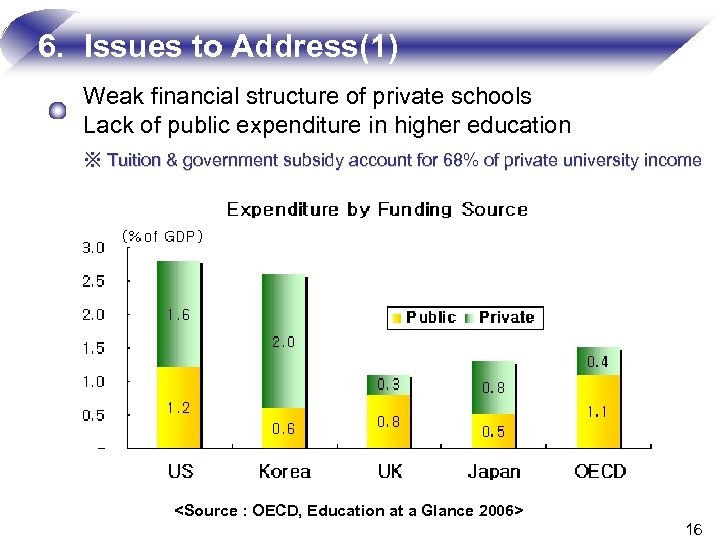 6. Issues to Address(1) Weak financial structure of private schools Lack of public expenditure in higher education ※ Tuition & government subsidy account for 68% of private university income
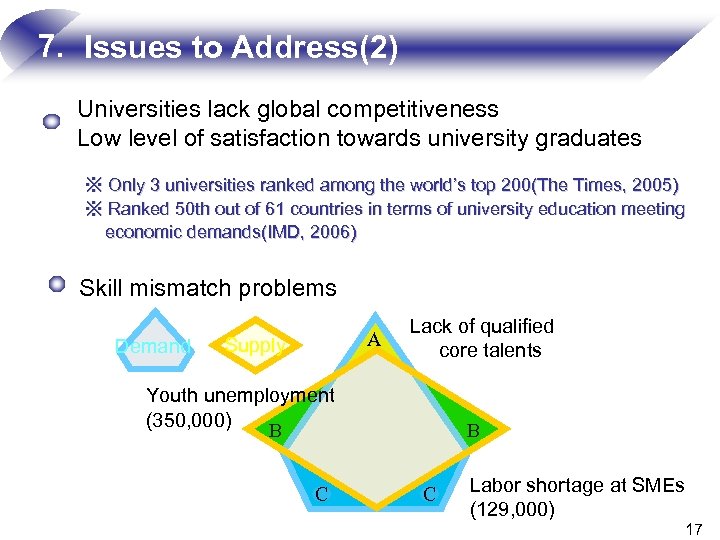 7. Issues to Address(2) Universities lack global competitiveness Low level of satisfaction towards university graduates ※ Only 3 universities ranked among the world’s top 200(The Times, 2005) ※ Ranked 50 th out of 61 countries in terms of university education meeting economic demands(IMD, 2006) Skill mismatch problems Demand A Supply Lack of qualified core talents Youth unemployment (350, 000) B C Labor shortage at SMEs (129, 000) 17
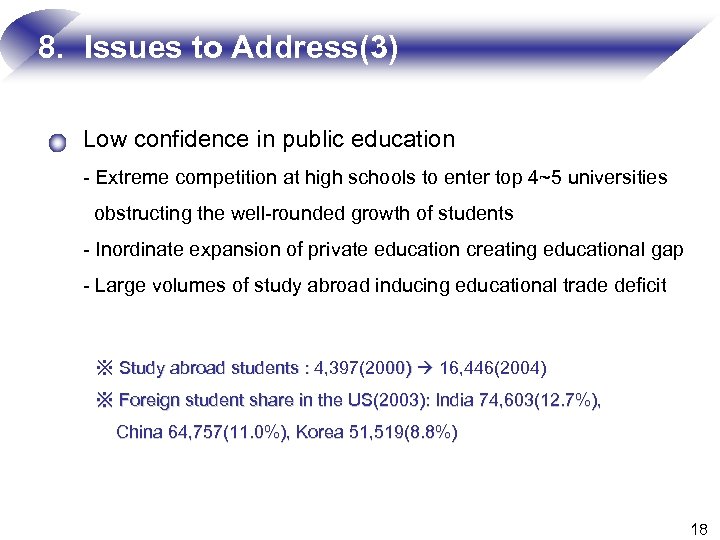 8. Issues to Address(3) Low confidence in public education - Extreme competition at high schools to enter top 4~5 universities obstructing the well-rounded growth of students - Inordinate expansion of private education creating educational gap - Large volumes of study abroad inducing educational trade deficit ※ Study abroad students : 4, 397(2000) 16, 446(2004) ※ Foreign student share in the US(2003): India 74, 603(12. 7%), China 64, 757(11. 0%), Korea 51, 519(8. 8%) 18
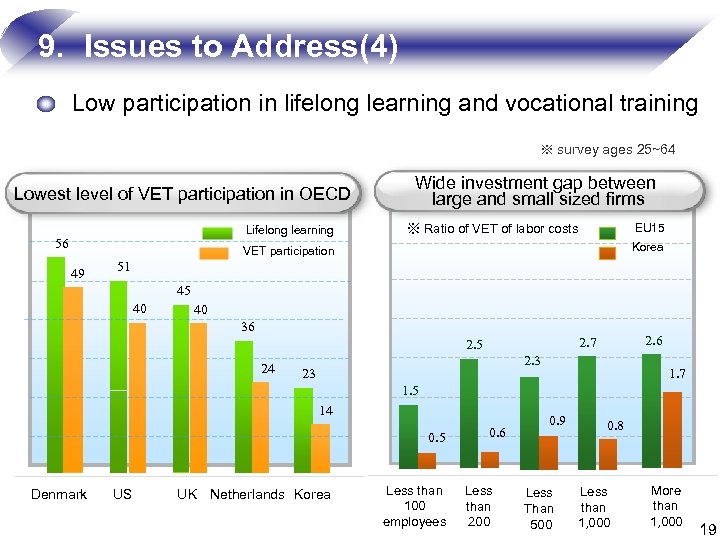 9. Issues to Address(4) Low participation in lifelong learning and vocational training ※ survey ages 25~64 Lowest level of VET participation in OECD Lifelong learning 56 Wide investment gap between large and small sized firms EU 15 ※ Ratio of VET of labor costs Korea VET participation 49 51 45 40 40 36 24 2. 6 2. 7 2. 5 2. 3 23 1. 7 1. 5 14 0. 5 Denmark US UK Netherlands Korea Less than 100 employees 0. 6 Less than 200 0. 9 Less Than 500 0. 8 Less than 1, 000 More than 1, 000 19
 III. Policy Initiatives for Future Education 20
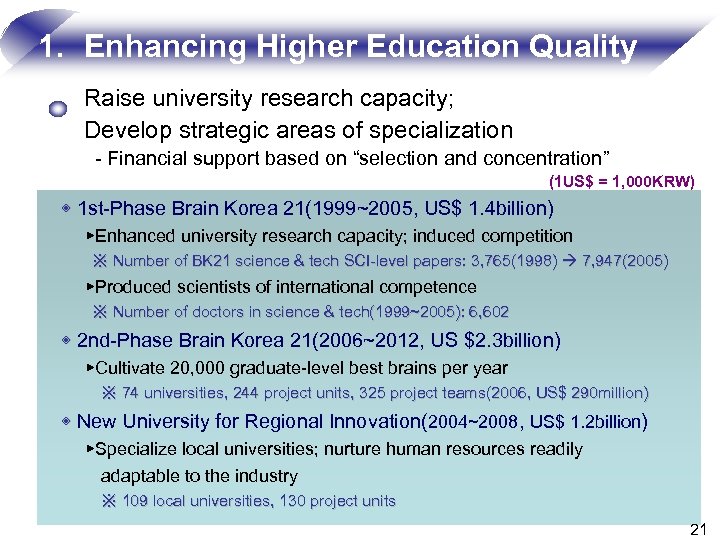 1. Enhancing Higher Education Quality Raise university research capacity; Develop strategic areas of specialization - Financial support based on “selection and concentration” (1 US$ = 1, 000 KRW) ◈ 1 st-Phase Brain Korea 21(1999~2005, US$ 1. 4 billion) ▶Enhanced university research capacity; induced competition ※ Number of BK 21 science & tech SCI-level papers: 3, 765(1998) 7, 947(2005) ▶Produced scientists of international competence ※ Number of doctors in science & tech(1999~2005): 6, 602 ◈ 2 nd-Phase Brain Korea 21(2006~2012, US $2. 3 billion) ▶Cultivate 20, 000 graduate-level best brains per year ※ 74 universities, 244 project units, 325 project teams(2006, US$ 290 million) ◈ New University for Regional Innovation(2004~2008, US$ 1. 2 billion) ▶Specialize local universities; nurture human resources readily adaptable to the industry ※ 109 local universities, 130 project units 21
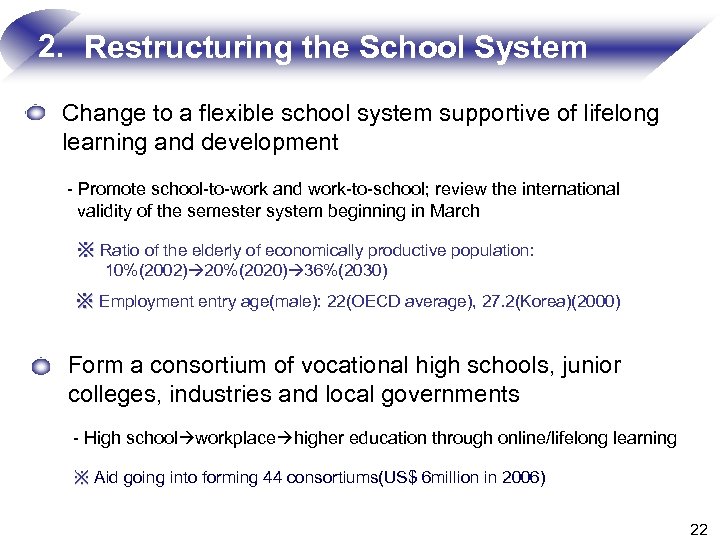 2. Restructuring the School System Change to a flexible school system supportive of lifelong learning and development - Promote school-to-work and work-to-school; review the international validity of the semester system beginning in March ※ Ratio of the elderly of economically productive population: 10%(2002) 20%(2020) 36%(2030) ※ Employment entry age(male): 22(OECD average), 27. 2(Korea)(2000) Form a consortium of vocational high schools, junior colleges, industries and local governments - High school workplace higher education through online/lifelong learning ※ Aid going into forming 44 consortiums(US$ 6 million in 2006) 22
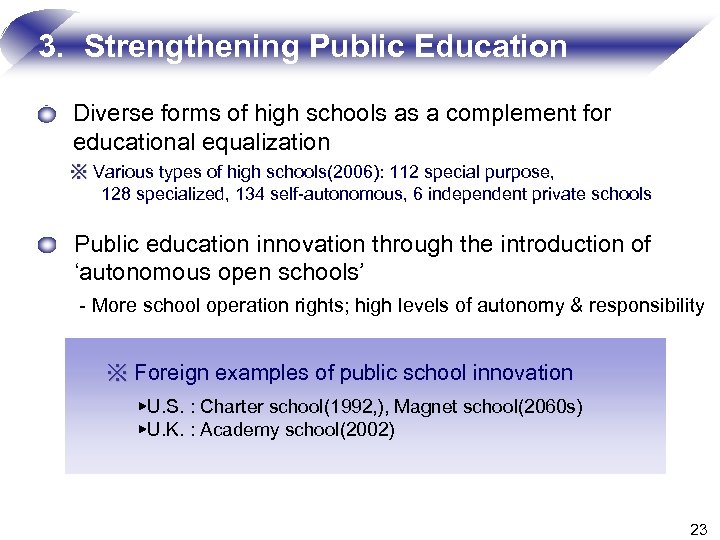 3. Strengthening Public Education Diverse forms of high schools as a complement for educational equalization ※ Various types of high schools(2006): 112 special purpose, 128 specialized, 134 self-autonomous, 6 independent private schools Public education innovation through the introduction of ‘autonomous open schools’ - More school operation rights; high levels of autonomy & responsibility ※ Foreign examples of public school innovation ▶U. S. : Charter school(1992, ), Magnet school(2060 s) ▶U. K. : Academy school(2002) 23
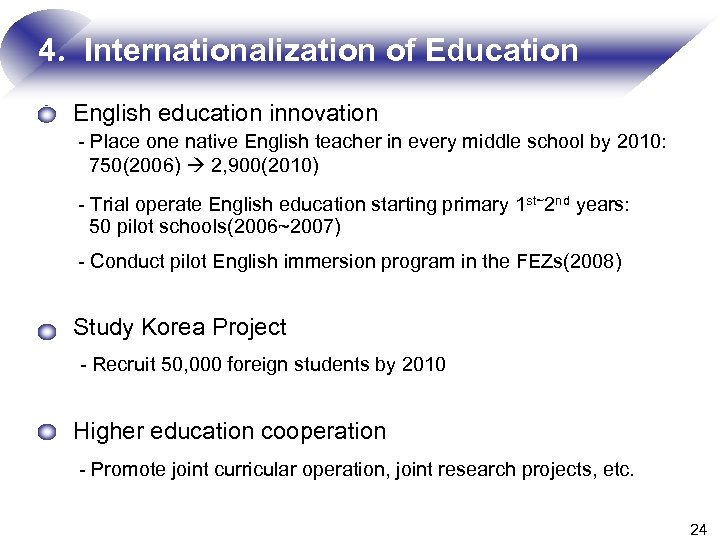 4. Internationalization of Education English education innovation - Place one native English teacher in every middle school by 2010: 750(2006) 2, 900(2010) - Trial operate English education starting primary 1 st~2 nd years: 50 pilot schools(2006~2007) - Conduct pilot English immersion program in the FEZs(2008) Study Korea Project - Recruit 50, 000 foreign students by 2010 Higher education cooperation - Promote joint curricular operation, joint research projects, etc. 24
 5. Working with Local Governments More public investment in educational welfare - Invest in priority areas that lack most in educational welfare(2004~); develop one excellent high school in one agricultural county - Diverse after-school programs(2005~) - Government-guaranteed student loan scheme(2005~) Central-local government cooperation system to increase public expenditure - Integrate education authorities and local governments secure educational diversity and enhance quality 25
 6. Support for Overseas Korean Studies Expansion of overseas Korean studies - Korean studies as a means of promoting national brand value ※ Overseas Korean studies programs/language courses: 661 universities in 60 countries - Financial support increasing for Korean studies ※ US$ 11. 6 million(2003) $13. 5 million(2004) $16 million(2005) Develop key knowledge bases for Korean studies(2006~) - Select and provide special grants for strategic Korean studies institutions by region ※ Role of selected institution: network with other institutions in the region to grow into a knowledge base of Korean studies information and research 26
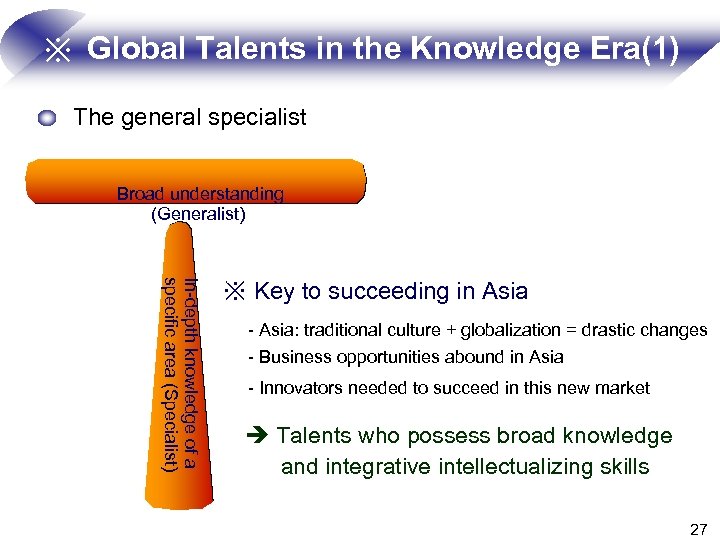 ※ Global Talents in the Knowledge Era(1) The general specialist Broad understanding (Generalist) In-depth knowledge of a specific area (Specialist) ※ Key to succeeding in Asia - Asia: traditional culture + globalization = drastic changes - Business opportunities abound in Asia - Innovators needed to succeed in this new market Talents who possess broad knowledge and integrative intellectualizing skills 27
 ※ Global Talents in the Knowledge Era(2) The risk taker - Future-orientation: making accurate projections - Ability to think and prepare ahead: figuring out what the CEO/boss needs in advance Practical strategies - Always think and see from two positions higher - Make judgments based on the knowledge & information level of your boss 28
 Thank you very much. jp 311@assembly. go. kr