 Скачать презентацию The Role of Dignity and Humiliation for Rebuilding
ee7ca04f1170e170689a44d359c14b5c.ppt
- Количество слайдов: 25



The Role of Dignity and Humiliation for Rebuilding Sustainable Communities after Disasters by Adenrele Awotona © University of Massachusetts Boston Awotona 1
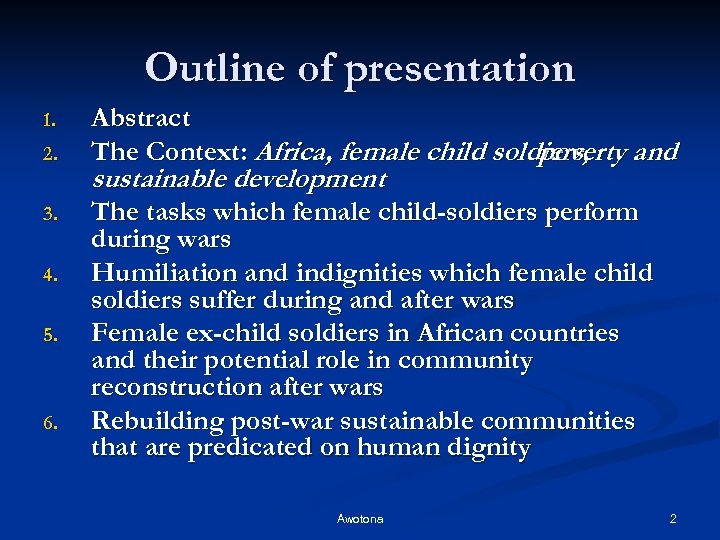
Outline of presentation 1. 2. 3. 4. 5. 6. Abstract The Context: Africa, female child soldiers, poverty and sustainable development The tasks which female child-soldiers perform during wars Humiliation and indignities which female child soldiers suffer during and after wars Female ex-child soldiers in African countries and their potential role in community reconstruction after wars Rebuilding post-war sustainable communities that are predicated on human dignity Awotona 2
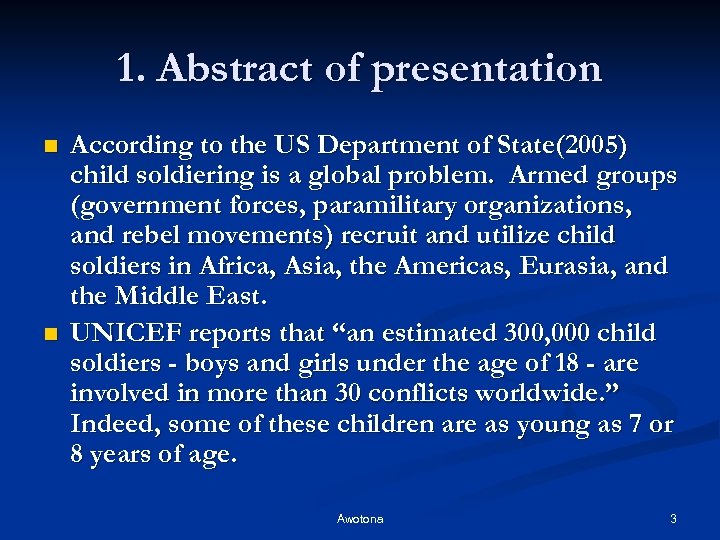
1. Abstract of presentation n n According to the US Department of State(2005) child soldiering is a global problem. Armed groups (government forces, paramilitary organizations, and rebel movements) recruit and utilize child soldiers in Africa, Asia, the Americas, Eurasia, and the Middle East. UNICEF reports that “an estimated 300, 000 child soldiers - boys and girls under the age of 18 - are involved in more than 30 conflicts worldwide. ” Indeed, some of these children are as young as 7 or 8 years of age. Awotona 3
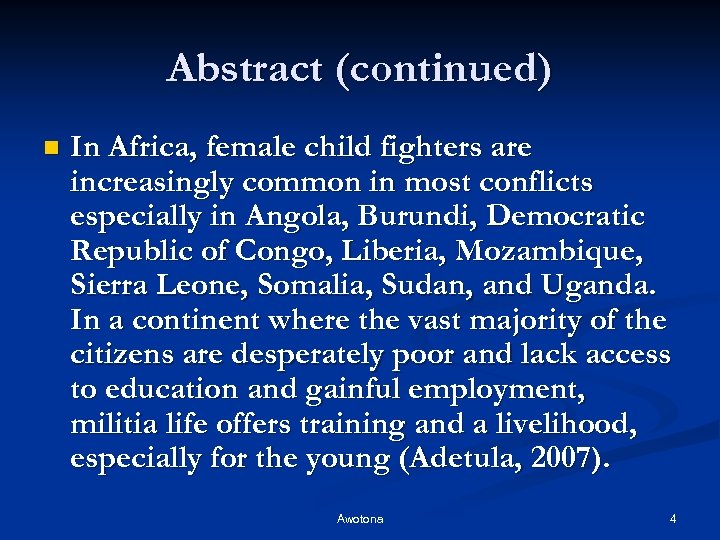
Abstract (continued) n In Africa, female child fighters are increasingly common in most conflicts especially in Angola, Burundi, Democratic Republic of Congo, Liberia, Mozambique, Sierra Leone, Somalia, Sudan, and Uganda. In a continent where the vast majority of the citizens are desperately poor and lack access to education and gainful employment, militia life offers training and a livelihood, especially for the young (Adetula, 2007). Awotona 4
Abstract (continued) In this presentation, I propose that if the female child-soldiers (indeed, all childsoldiers) are properly demobilized, emotionally and psychologically rehabilitated, and sensitively (especially in cultural terms) reintegrated into their communities with dignity, they would be an asset to the process of rebuilding their societies in a sustainable manner. Awotona 5
2. The Context: Africa, female child soldier poverty and sustainable development Most of Africa continues to be ravaged by extreme poverty, numerous armed conflicts, inadequate access to education and extensive pandemics such as HIV and malaria, factors which have combined to render sustainable development elusive for the continent. For example, in 2004, approximately 300 million people in sub-Saharan Africa (41% of the population) were living on a dollar a day or less (UN Department of Economic and Social Affairs). Awotona 6
3. The tasks which female child-soldiers perform during wars Some of the roles which girl-soldiers are forced to take on during conflicts include the following (UNICEF): Combatant soldiers; porters; spies; Trainers for recruits; looting; informants; Slave labour; suicide/bombing missions; messengers; Sex-slaves; mine sweepers; intelligence officers; Gather, prepare, and & cook food; childcare and rearing; and, communication. Awotona 7
4. Humiliation and indignities which female child soldiers suffer during and after wars Kenyan (2007) has observed that humiliation, as conceptualized and practiced in some parts of Africa, involve: n n Brutal military occupations Desecration and/or destruction of religious institutions symbols Forced religious conversions Reigns of terror Awotona 8
Humiliation and indignities (cont’d) n n n Execution of prominent figures and parading of victims and denying them timely and decent burial Rape and other forms of sexual abuse/violence Demonization and persecution of entire ethnic groups Destruction and looting of the economic assets and live of opponents, and Occupation and annexation of territory…” Awotona 9
Humiliation and indignities (cont’d) n For example, the Nigerian Civil War (July 6, 1967 to January 15, 1970) resulted in the destruction of about 53, 732 commercial and private buildings, 750 km. of roads, 65 bridges, about 781 primary and 73 post-primary schools in then East-Central State which was the major theater of the war (Awotona, 1992, p. 79). Also, the total value of capital assets in 1970 was only 36. 2% of those just before the outbreak of the war in that State. Awotona 10
Humiliation and indignities (cont’d) Similarly, Awotona and Johnson (1997, pp. 111 -120) have noted that during the war in Liberia, every citizen was adversely affected by the violence, destruction and human rights abuses, regardless of economic and social status or tribal affiliation. Displaced women in the country were targeted for special abuses because of both ethnicity and gender. Rape was used as a form of torture and many women suffered psychological and physical trauma as a result. Awotona 11
Humiliation and indignities (cont’d) After conflicts, in some African communities, female ex-child soldiers are further subjected to various forms of humiliations including the continuation of traditional discriminatory practices (e. g. , unequal rights to inheritance); unequal rights to housing and land; unequal access to health and educational facilities; and, “being bathed with traditional concoction purportedly to cleanse them from the evil effects of the conflicts” (Adetula, 2007) Awotona 12
5. Female ex-child soldiers in African countries and their potential role in community reconstruction after wars n n Some countries in Africa that are confronted with female ex-child soldiers include the following : Burundi, Central African Republic, Chad, Cote d’Ivoire, Democratic Republic of Congo, Rwanda, Somalia, Sudan, Uganda, Zimbabwe Although these female soldiers were used and abused during the war, their potential in contributing to the socio-economic development of their communities in post conflict situations is immense and should be appropriately utilized, provided that they are properly demobilised, treated and rehabilitated (Adetula, 2007). Awotona 13
6. Rebuilding post-war sustainable communities that are predicated on human dignity Rebuilding communities after conflicts in a manner that promotes social justice, economic and political sustainability, and the full participation of all stakeholders (including female ex-child soldiers) calls for the adoption of a comprehensive approach. Achieving peace through Negotiation, Reconciliation, reverence for human Dignity and the promotion of good governance at all levels of society “is vital for the mechanisms leading up to the full recovery and comprehensive development of the affected communities” (Adetula, 2007). Awotona 14
Rebuilding post-war sustainable communities (cont’d) These efforts require perseverance and dedication by the parties to the conflict to do the following: 1) Honour and respect the peace accords and negotiations which have been brokered by local, regional and international organizations (Adetula, 2007) 2) Reintegration (social, economic, political, psychological) of the female ex-Child Soldiers into their communities. Awotona 15
Rebuilding post-war sustainable communities (cont’d) 3) Implementation of the provisions of Chapter 3 of Agenda 21 of the United Nations 1992 Conference on Environment and Development in Rio which is focused on poverty eradication. The objectives of this program, which seek to address issues of “development, sustainable resource management and poverty eradication” simultaneously, are (UNCED, 2005): n “To provide all persons urgently with the opportunity opportunit earn a sustainable livelihood; Awotona 16
Rebuilding post-war sustainable communities (cont’d) n To implement policies and strategies that prom adequate levels of funding and focus on integr human development policies, including incom generation, increased local control of resource institution-strengthening and capacity-buildin greater involvement of non-governmental organizations and local levels of government a delivery mechanisms; Awotona 17
Rebuilding post-war sustainable communities (cont’d) To develop for all poverty-stricken areas integrated strategies and programs of sound and sustainable management of the environment, resource mobilizat poverty eradication and alleviation, employment and generation; n To create a focus in national development plans and on investment in human capital, with special policies programs directed at rural areas, the urban poor, wom and children. ” n Awotona 18
Rebuilding post-war sustainable communities (cont’d) 4) Diligently apply the various existing international human rights instruments to ensure that the dignity of the ex-child soldiers is upheld. This would guarantee that all the ex-child soldiers, boys and girls, are treated equally; and that they, like all the people and communities which have been affected by the conflicts, would fully participate in the design and implementation of reconstruction plans in a dignified manner. Some of these legal instruments are (Adetula, 2007; Batra and Chaudhry, 2005): Awotona 19
Rebuilding post-war sustainable communities (cont’d) n n African Charter on the Rights and Welfare of the Child (developed in 1990; became effective in 1999) Optional Protocol to the Convention on the Rights of the Child. Maputo Declaration on the Use of Children as Soldiers (April 1999) ILO Worst Forms of Child Labour Convention 182 (adopted 1999, effective November 2000) Awotona 20
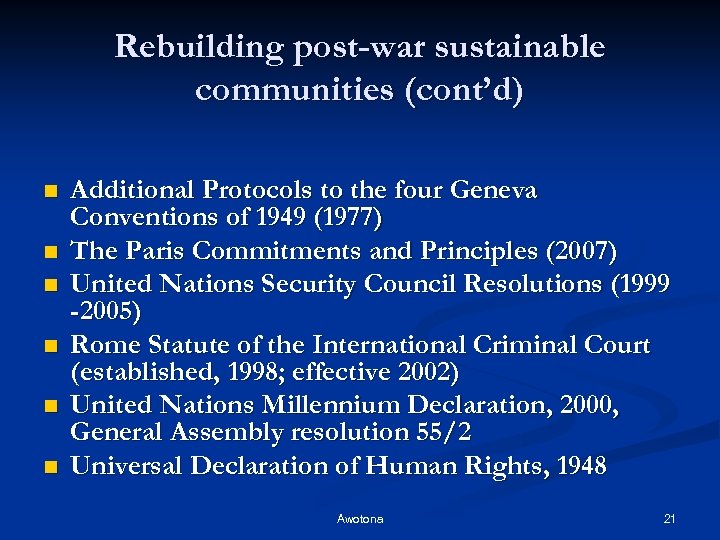
Rebuilding post-war sustainable communities (cont’d) n n n Additional Protocols to the four Geneva Conventions of 1949 (1977) The Paris Commitments and Principles (2007) United Nations Security Council Resolutions (1999 -2005) Rome Statute of the International Criminal Court (established, 1998; effective 2002) United Nations Millennium Declaration, 2000, General Assembly resolution 55/2 Universal Declaration of Human Rights, 1948 Awotona 21
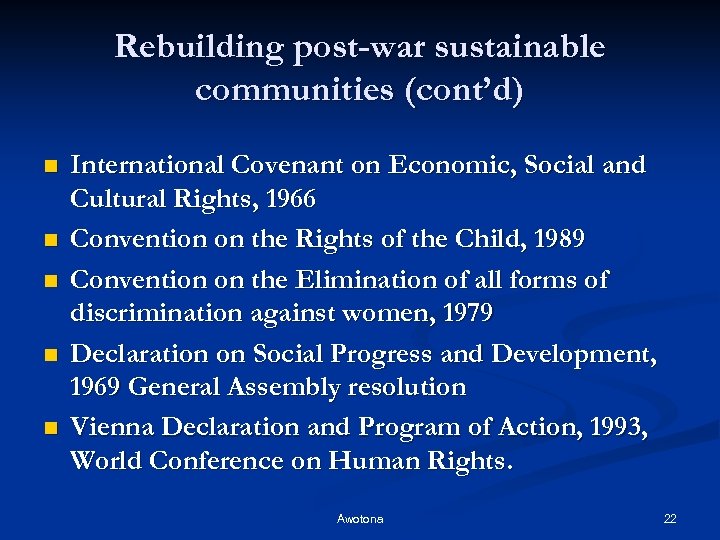
Rebuilding post-war sustainable communities (cont’d) n n n International Covenant on Economic, Social and Cultural Rights, 1966 Convention on the Rights of the Child, 1989 Convention on the Elimination of all forms of discrimination against women, 1979 Declaration on Social Progress and Development, 1969 General Assembly resolution Vienna Declaration and Program of Action, 1993, World Conference on Human Rights. Awotona 22
References n n Awotona, Adenrele and Johnson, Mulbah (1997). "Housing and Resettlement in Post-war Liberia", in Awotona, Adenrele (ed. ). Reconstruction after disaster: issues and practices, Aldershot, Ashgate, pp. 109 -130 Awotona, Adenrele (1992). "Approaches to post-war reconstruction and development: examples from Africa", Habitat International, Vol. 16, No. 4, pp. 79 -98. Adetula, Grace Oyebola (2007). Drugs in Conflicts: The Challenges of Demobilization, Disarmament and Reintegration (DDR) of Female Ex-child Soldie Africa A paper presented at the Workshop on the rehabilitation and , reintegration of female ex-child soldiers/captives in the Great Lakes Region, Organized by the Women, Gender and Development Directorate and the Peace and Security Directorate of the African Union Commission, December 6 -7, 2007, Kigali, Rwanda The US Department of State (2005). The Facts About Child Soldiers to , Office Monitor and Combat Trafficking in Persons, Washington, DC, August 8, http: //www. state. gov/g/tip/rls/fs/2005/50941. htm Awotona 23
References (continued) n n UNICEF. Child protection from violence, exploitation and abuse - Children in Conflic Emergencies , http: //www. unicef. org/protection/index_armedconflict. html Kenyan, Hassan A. (2007) Humiliation in the context of recent events in the Horn of African , http: //www. humiliationstudies. org/documents/Keynan. NY 07 meeting. pdf Batra, Bikram Jeet and Shivani Chaudhry(2005). International Human Rights Standards on Post-Disaster Resettlement and Rehabilitation, Working Document , Habitat International Coalition – Housing and Land Rights Network and People’s Movement for Human Rights Learning in collaboration with the United Nations Special Rapporteur on Adequate Housing, August. United Nations 1992 Conference on Environment and Development in Rio (2005). Combating poverty: Enabling the poor to achieve sustainable livelihoods, Agenda 21, Chapter 3, July 28, http: //www. un. org/esa/sustdev/documents/agenda 21/english/agenda 21 cha pter 3. htm Awotona 24

Thank you Awotona 25
Скачать презентацию The Role of Dignity and Humiliation for Rebuilding
ee7ca04f1170e170689a44d359c14b5c.ppt