


 Скачать презентацию The Role of Competitive Intelligence in Strategic Partnerships
3fc6c1aa7726f1e6172e26981ad51bfa.ppt
- Количество слайдов: 23
 The Role of Competitive Intelligence in Strategic Partnerships (M&A, Strategic Alliances, Consortia) Presented by: Arik R. Johnson arik@aurorawdc. com Managing Director Aurora WDC
 Introductory Remarks • About Arik • About Aurora • Agenda Items and Process for the Day
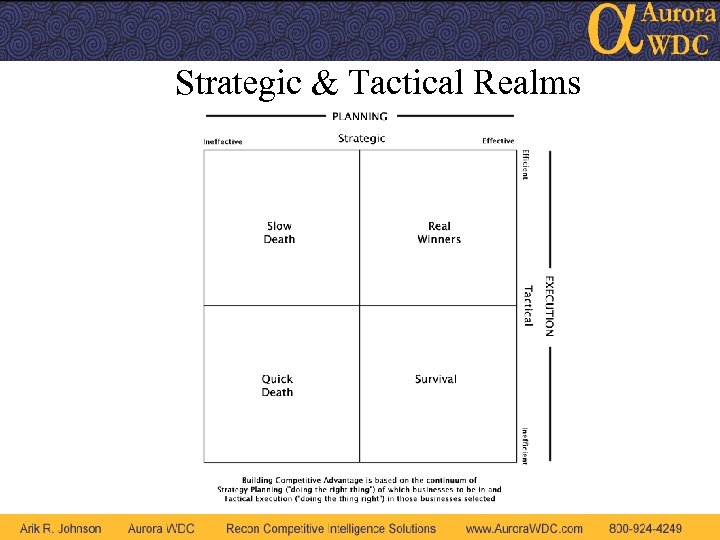 Strategic & Tactical Realms
 This session is for you if. . . • You would like to contribute to your firm’s relationship -building activity • You would like to expand the application and “addingvalue” of Intelligence within your firm • Your firm’s growth strategy includes M&A • You would like to learn what Intelligence processes are applied in relationship-building.
 What we have learned about M&A • Large consulting firms: – Casual scanning is norm – “Too-late” deals – Are not any more productive than “home-grown” talent in the initial M&A stages – Force their acquisition model on you (very large) • Firms’ radar screen had better resolution • Smaller deals were impressed and intimidated with consulting companies • In-house Intelligence departments Intelligence consultants are more efficient and effective on the frontend.
 Why M&A as an Intelligence activity? • Harvard Business Review reports in 1998 there were 5, 000 acquisitions in the US totaling $. 5 T • KPMG Peat Marwick says in 1999 $2 T was spent on acquisitions world-wide • Cisco Systems grew in 1999 to $12 B Rev. via 42 acquisitions, expected to make 25 in 2000 • IPO’s are at an all time high • Strong stock market produces buying leverage faster than lower interest rates
 Steps in the M&A process • • Relationship criteria Scan, Search, and Identify Targets Evaluation and Analysis “Due Diligence” - in situ Recommendation Negotiation Consummation Integration
 Steps in the M&A process • • Relationship Criteria Scan, Search, and Identify Targets Evaluation and Analyzation “Due Diligence” (in situ) Recommendation Negotiation Consummation Integration
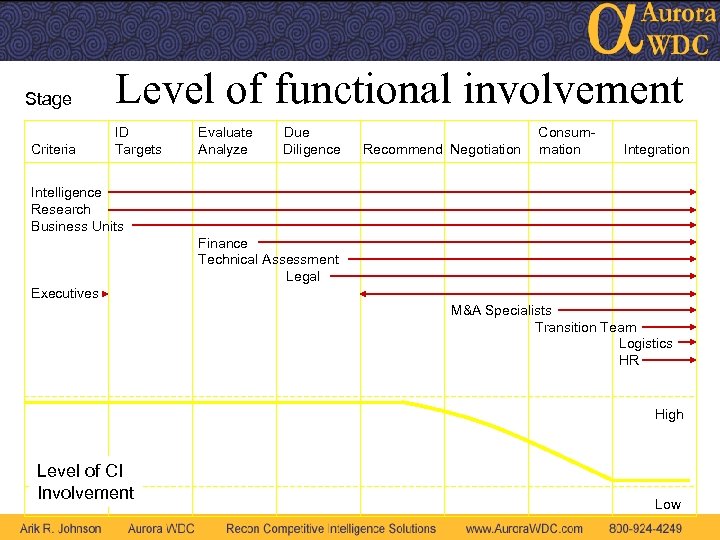 Stage Criteria Level of functional involvement ID Targets Evaluate Analyze Due Diligence Recommend Negotiation Consummation Integration Intelligence Research Business Units Finance Technical Assessment Legal Executives M&A Specialists Transition Team Logistics HR High Level of CI Involvement Low
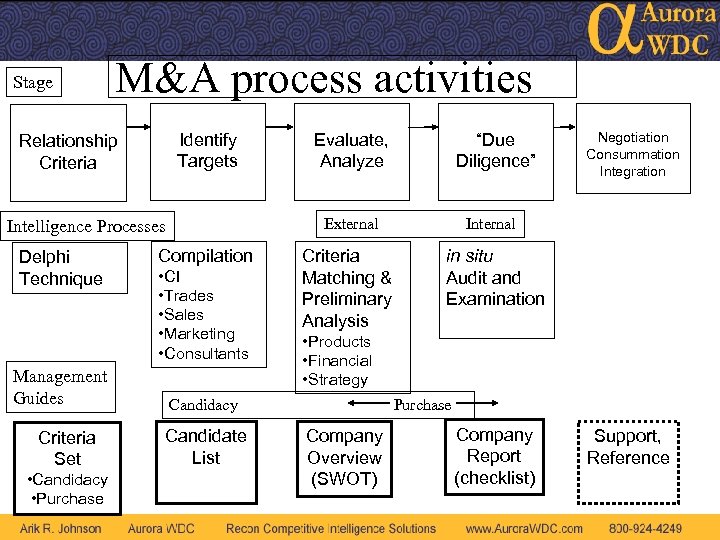 Stage M&A process activities Identify Targets Relationship Criteria Delphi Technique Management Guides Criteria Set • Candidacy • Purchase Compilation • CI • Trades • Sales • Marketing • Consultants “Due Diligence” External Intelligence Processes Evaluate, Analyze Internal Criteria Matching & Preliminary Analysis in situ Audit and Examination • Products • Financial • Strategy Candidacy Candidate List Negotiation Consummation Integration Purchase Company Overview (SWOT) Company Report (checklist) Support, Reference
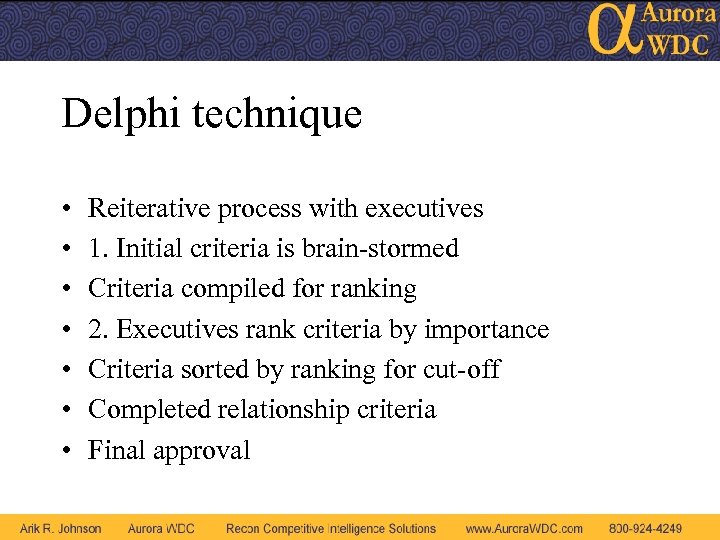 Delphi technique • • Reiterative process with executives 1. Initial criteria is brain-stormed Criteria compiled for ranking 2. Executives rank criteria by importance Criteria sorted by ranking for cut-off Completed relationship criteria Final approval
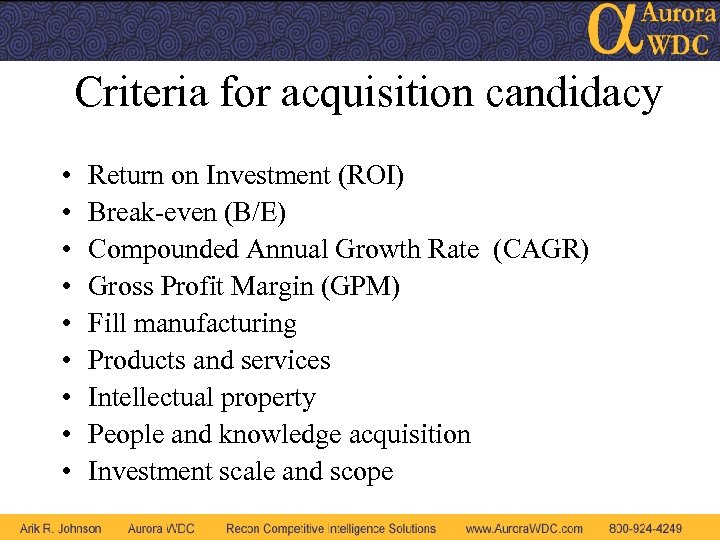 Criteria for acquisition candidacy • • • Return on Investment (ROI) Break-even (B/E) Compounded Annual Growth Rate (CAGR) Gross Profit Margin (GPM) Fill manufacturing Products and services Intellectual property People and knowledge acquisition Investment scale and scope
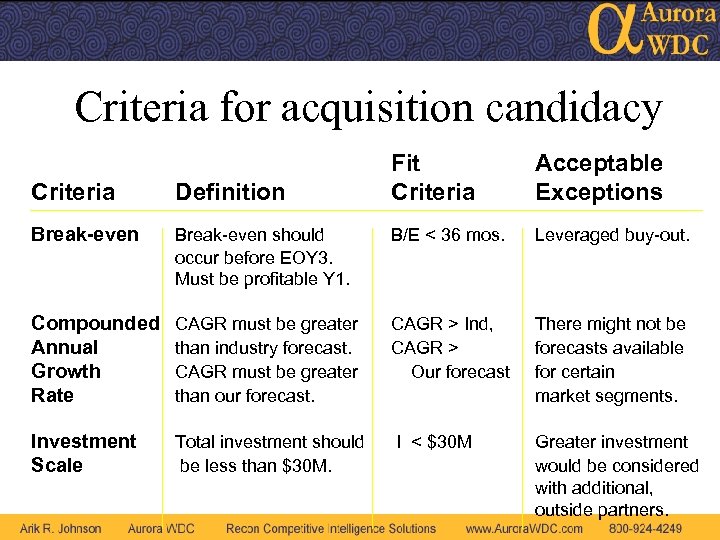 Criteria for acquisition candidacy Fit Criteria Acceptable Exceptions Criteria Definition Break-even should occur before EOY 3. Must be profitable Y 1. B/E < 36 mos. Leveraged buy-out. Compounded Annual Growth Rate CAGR must be greater than industry forecast. CAGR must be greater than our forecast. CAGR > Ind, CAGR > Our forecast There might not be forecasts available for certain market segments. Investment Scale Total investment should be less than $30 M. I < $30 M Greater investment would be considered with additional, outside partners.
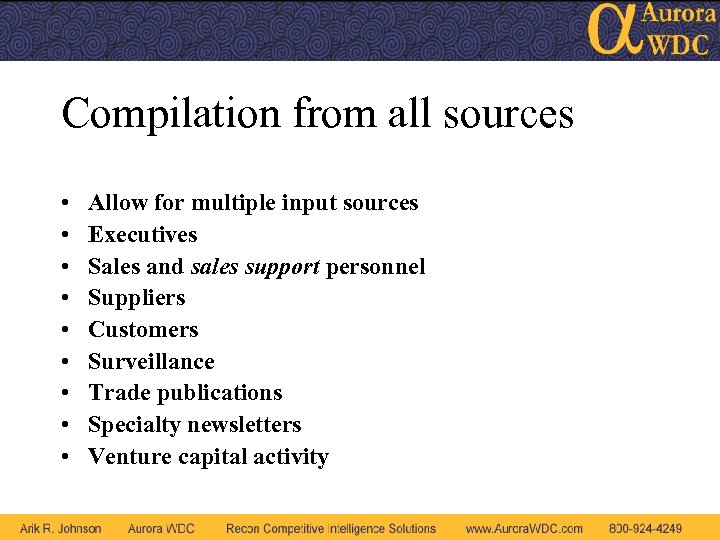 Compilation from all sources • • • Allow for multiple input sources Executives Sales and sales support personnel Suppliers Customers Surveillance Trade publications Specialty newsletters Venture capital activity
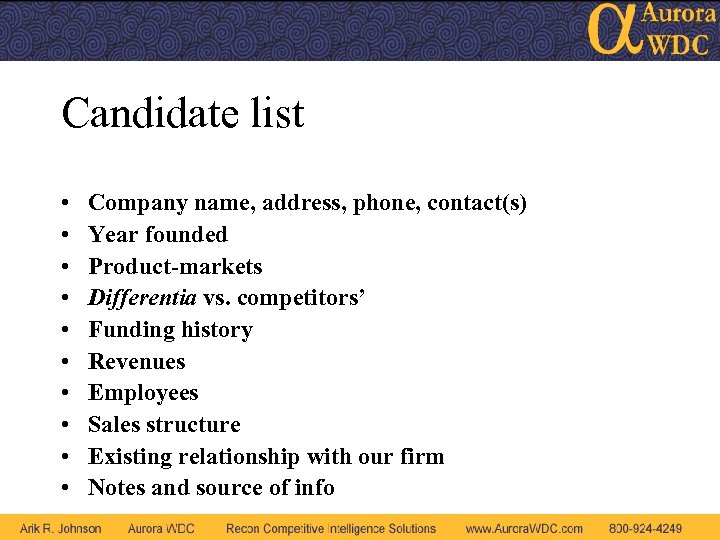 Candidate list • • • Company name, address, phone, contact(s) Year founded Product-markets Differentia vs. competitors’ Funding history Revenues Employees Sales structure Existing relationship with our firm Notes and source of info
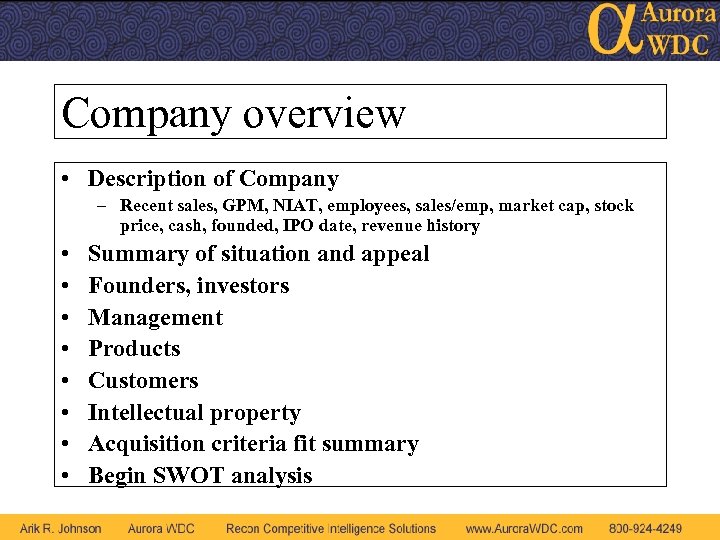 Company overview • Description of Company – Recent sales, GPM, NIAT, employees, sales/emp, market cap, stock price, cash, founded, IPO date, revenue history • • Summary of situation and appeal Founders, investors Management Products Customers Intellectual property Acquisition criteria fit summary Begin SWOT analysis
 In-situ audit and examination • “Due diligence” • Checklist – Topical – Specific questions for interviews • • • Preliminary Audit Presentations Interviews Extended SWOT analysis Company Report (20 - 50 pages) Recommendation
 Extended SWOT Analysis • • • Market share gain Market entry Intellectual property Financial Management team Owners, founders Products/services Manufacturing Strategic fit
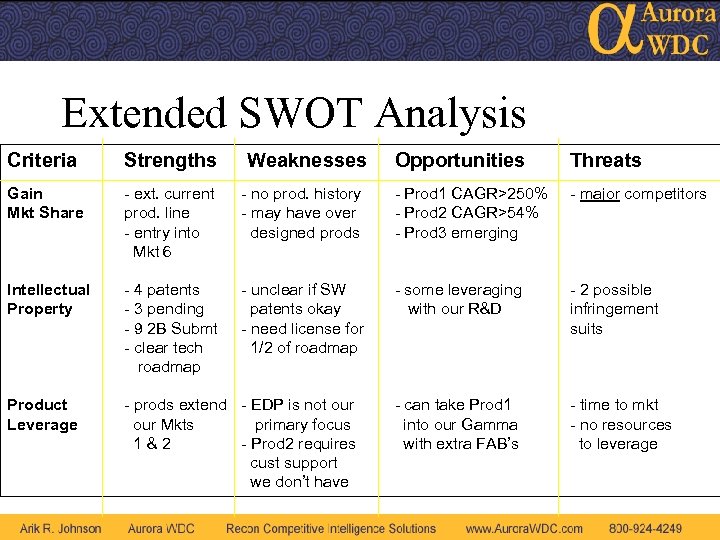 Extended SWOT Analysis Criteria Strengths Gain Mkt Share - ext. current prod. line - entry into Mkt 6 Intellectual Property Product Leverage Weaknesses Opportunities Threats - Prod 1 CAGR>250% - Prod 2 CAGR>54% - Prod 3 emerging - major competitors - 4 patents - unclear if SW - 3 pending patents okay - 9 2 B submt’d - need license for Submt - clear tech 1/2 of roadmap - some leveraging with our R&D - 2 possible infringement suits - prods extend - EDP is not our Mkts primary focus 1&2 - Prod 2 requires cust support we don’t have - can take Prod 1 into our Gamma with extra FAB’s - time to mkt - no resources to leverage - no prod. history - may have over designed prods
 Negotiation, consummation, integration • • Pass project to M&A specialists, stay involved Personal intelligence Negotiation strategy formulation Negotiation support Testing of assumptions Monitoring of directional changes Transitional support • On to the next project. . .
 Benefits from Intelligence involvement in M&A • To the firm – – Provides an “in-house” front end process Provides continuous scanning resource Reduces costs “Due diligence” vs. intelligence • To the Intelligence department – – Extension of service into high-impact activities Very visible “value-adding” service Cross-pollination learning Adrenaline rush
 Summary • Understand Intelligence’s contribution to business relationship development • Understand the M&A process and Intelligence’s role as a “front-end” processor • Possess a tested methodology for business relationship development • Access to templates and examples • Questions?
 For Further Information • Society of Competitive Intelligence Professionals www. SCIP. org • Recon Best Practices Knowledgebase: www. Aurora. WDC. com/essays