Скачать презентацию The role of Closed-Ended Funds in client portfolios
0f4d2b4b3e4e4b45696cf21b741b6eb9.ppt
- Количество слайдов: 27

 The role of Closed-Ended Funds in client portfolios in the post-RDR world Stephen Peters Investment Trust Analyst, For professional investors only
 Agenda • The benefits, the risks and the reality of the sector • What place do Closed-Ended Funds have in a portfolio? • Conclusions
 What are Investment Trusts? • Closed ended funds • Shares in a company traded on a stock exchange (such as • • the London Stock Exchange) Managed by a fund manager who is responsible to a board of directors and, ultimately, shareholders The share price may trade at a premium or a discount to the Net Asset Value (NAV) per share • Firms will need Part IV permission for advising or arranging on Investment Trusts
 Key differences with Exchange Traded and Open Ended Funds • Exchange Traded Funds (ETFs) & open-ended funds typically trade at or near, asset value – they can create and redeem shares according to demand • • Investment trusts should only issue shares if they trade at a premium to NAV • Investment trusts have independent boards. They are responsible to shareholders and can change the manager of the fund if they deem it appropriate to do so • Investment trusts may use a ‘revenue reserve’ to ensure dividend payments do not fall if earned income declines Investment trusts may use borrowing with the aim of enhancing returns, unlike open ended funds • ETFs & open ended funds can only pay out income received
 What are the risks of Investment Trusts? • Complexity - leverage, discounts, data availability • Liquidity - a problem for the whole market? • Choice - a small number from which to choose; some are not very good; some sectors are poorly represented • Regulation - current proposals may classify Venture Capital Trust (VCT) and Enterprise Investment Scheme (EIS) shares as Unregulated Collective Investment Schemes (UCIS) • Therefore only suitable for sophisticated and high net worth investors
 Why consider Investment Trusts? • Asset classes not investible via open-ended funds • Different sources of income - secured loans, Private Equity • Ability to enhance returns via the use of leverage and • • discounts Long-term outperformance of open-ended funds Leverage, better management, discount narrowing all possible causes Run by the same groups and individuals you already know Historically known as a ‘low cost’ investment option - but this is changing
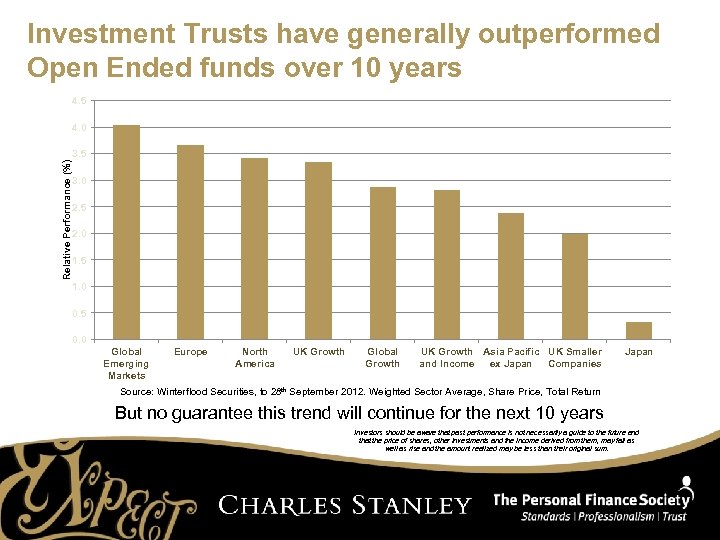 Investment Trusts have generally outperformed Open Ended funds over 10 years 4. 5 4. 0 Relative Performance (%) 3. 5 3. 0 2. 5 2. 0 1. 5 1. 0 0. 5 0. 0 Global Emerging Markets Europe North America UK Growth Global Growth UK Growth Asia Pacific UK Smaller and Income ex Japan Companies Japan Source: Winterflood Securities, to 28 th September 2012. Weighted Sector Average, Share Price, Total Return But no guarantee this trend will continue for the next 10 years Investors should be aware that past performance is not necessarily a guide to the future and that the price of shares, other investments and the income derived from them, may fall as well as rise and the amount realized may be less than their original sum.
 Leverage • Markets or assets fall in price; borrowings magnify losses • Borrowing covenants are breached; banks ‘call’ the loan • requiring the sale of assets at depressed prices Poor decisions by the board • Merchants - 1. 3 x leveraged, pays c 8% annual interest rate on that borrowing - until 2018 at the earliest • The risks and the benefits of gearing need to be fully understood by advisers and clients before investing
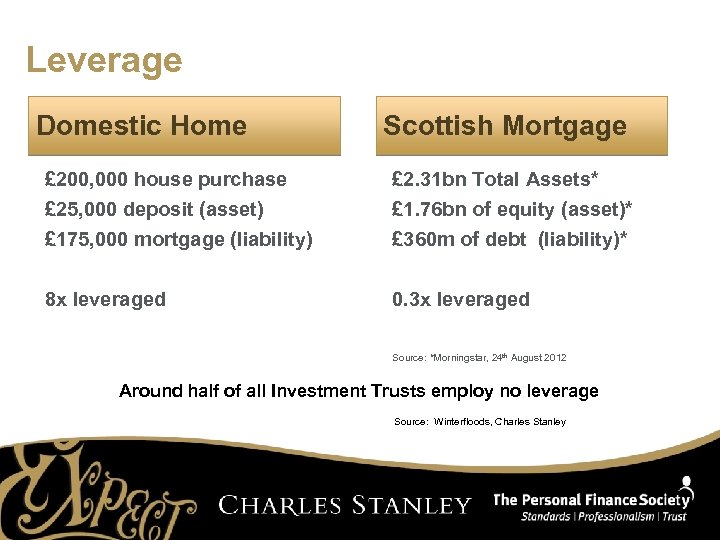 Leverage Domestic Home Scottish Mortgage £ 200, 000 house purchase £ 25, 000 deposit (asset) £ 2. 31 bn Total Assets* £ 1. 76 bn of equity (asset)* £ 175, 000 mortgage (liability) £ 360 m of debt (liability)* 8 x leveraged 0. 3 x leveraged Source: *Morningstar, 24 th August 2012 Around half of all Investment Trusts employ no leverage Source: Winterfloods, Charles Stanley
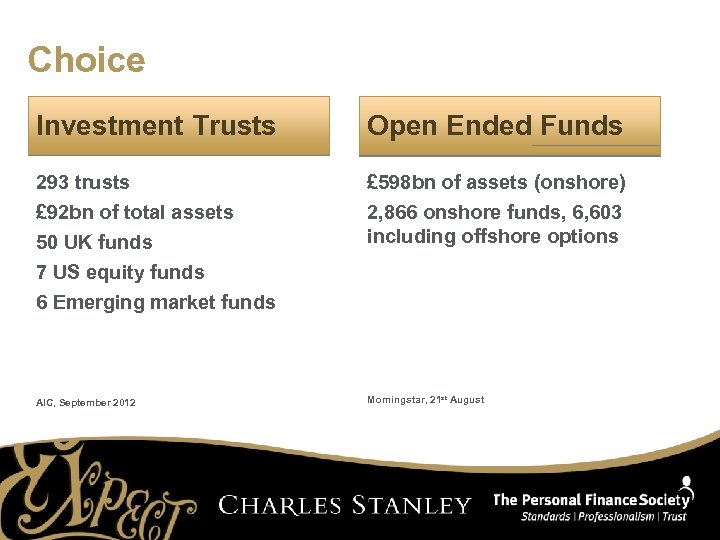 Choice Investment Trusts Open Ended Funds 293 trusts £ 92 bn of total assets £ 598 bn of assets (onshore) 2, 866 onshore funds, 6, 603 including offshore options 50 UK funds 7 US equity funds 6 Emerging market funds AIC, September 2012 Morningstar, 21 st August
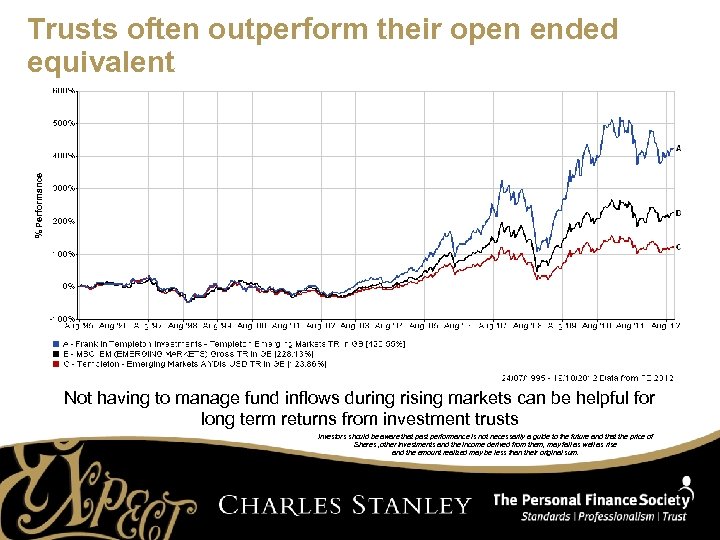 % Performance Trusts often outperform their open ended equivalent Not having to manage fund inflows during rising markets can be helpful for long term returns from investment trusts Investors should be aware that past performance is not necessarily a guide to the future and that the price of Shares , other investments and the income derived from them, may fall as well as rise and the amount realized may be less than their original sum.
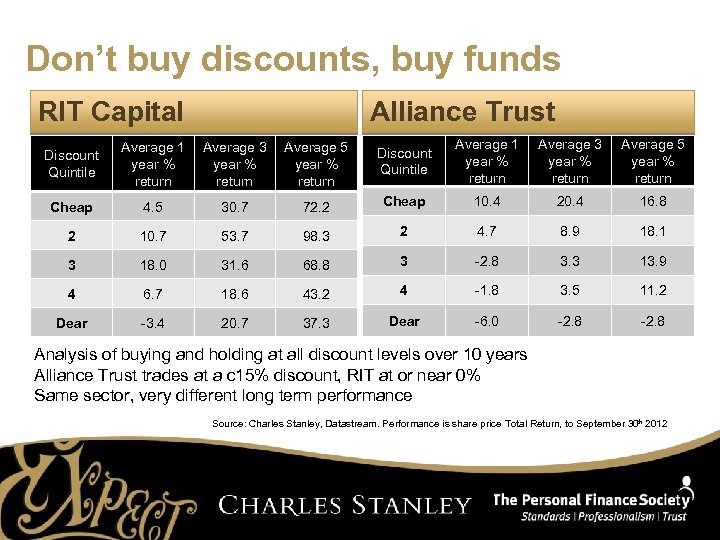 Don’t buy discounts, buy funds RIT Capital Alliance Trust Discount Quintile Average 1 year % return Average 3 year % return Average 5 year % return Cheap 4. 5 30. 7 72. 2 Cheap 10. 4 20. 4 16. 8 2 10. 7 53. 7 98. 3 2 4. 7 8. 9 18. 1 3 18. 0 31. 6 68. 8 3 -2. 8 3. 3 13. 9 4 6. 7 18. 6 43. 2 4 -1. 8 3. 5 11. 2 Dear -3. 4 20. 7 37. 3 Dear -6. 0 -2. 8 Analysis of buying and holding at all discount levels over 10 years Alliance Trust trades at a c 15% discount, RIT at or near 0% Same sector, very different long term performance Source: Charles Stanley, Datastream. Performance is share price Total Return, to September 30 th 2012
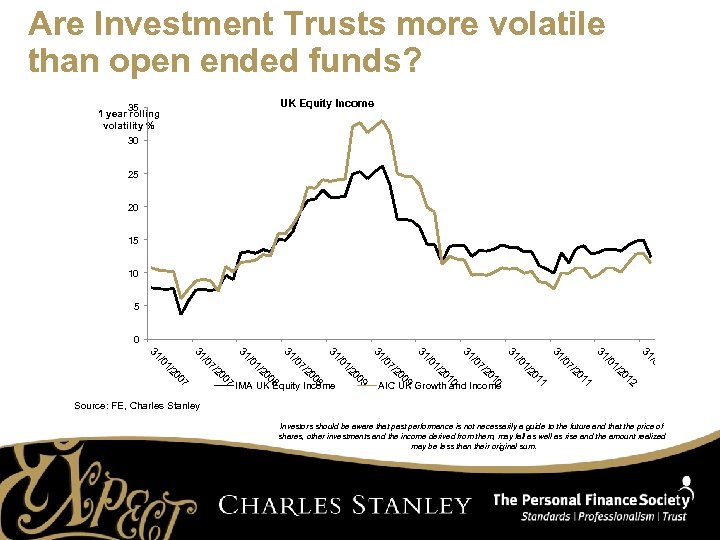 Are Investment Trusts more volatile than open ended funds? UK Equity Income 35 1 year rolling volatility % 30 25 20 15 10 5 0 Source: FE, Charles Stanley Investors should be aware that past performance is not necessarily a guide to the future and that the price of shares, other investments and the income derived from them, may fall as well as rise and the amount realized may be less than their original sum. 2 1 20 7/ 2 1 20 1/ /0 31 1 1 20 7/ /0 31 1 1 20 0 0 9 AIC UK Growth and Income 1/ 1 20 1/ 7/ /0 31 9 0 20 7/ /0 31 8 8 0 20 1/ 0 20 7/ /0 31 1/ 7 0 20 1/ 7/ /0 31 IMA UK Equity Income
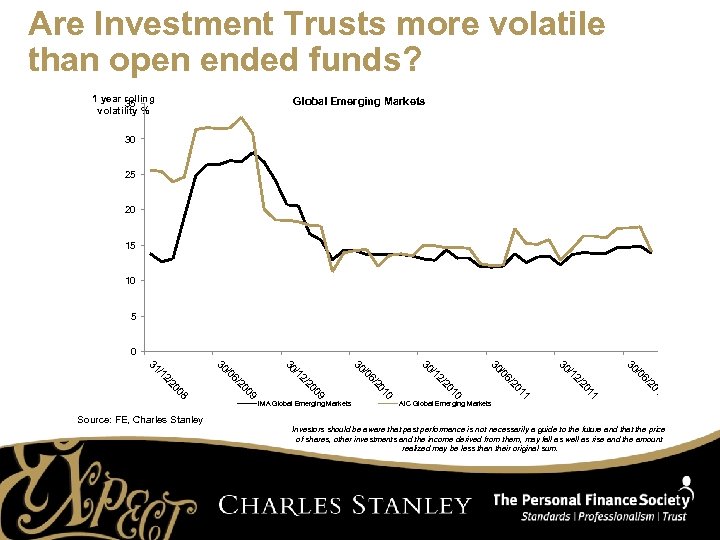 Are Investment Trusts more volatile than open ended funds? 1 year rolling 35 volatility % Global Emerging Markets 30 25 20 15 10 5 0 2 1 20 6/ /0 30 1 1 20 2/ 1 AIC Global Emerging Markets 1 20 0 1 20 2/ 6/ /1 30 /0 30 /1 30 0 1 20 6/ 9 0 20 8 0 20 2/ 6/ 2/ /0 30 /1 30 /0 30 /1 31 Source: FE, Charles Stanley IMA Global Emerging Markets Investors should be aware that past performance is not necessarily a guide to the future and that the price of shares, other investments and the income derived from them, may fall as well as rise and the amount realized may be less than their original sum.
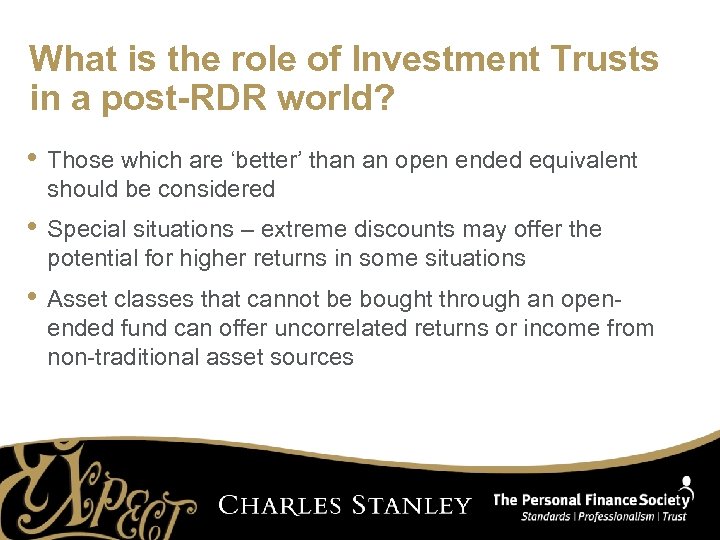 What is the role of Investment Trusts in a post-RDR world? • Those which are ‘better’ than an open ended equivalent should be considered • Special situations – extreme discounts may offer the potential for higher returns in some situations • Asset classes that cannot be bought through an openended fund can offer uncorrelated returns or income from non-traditional asset sources
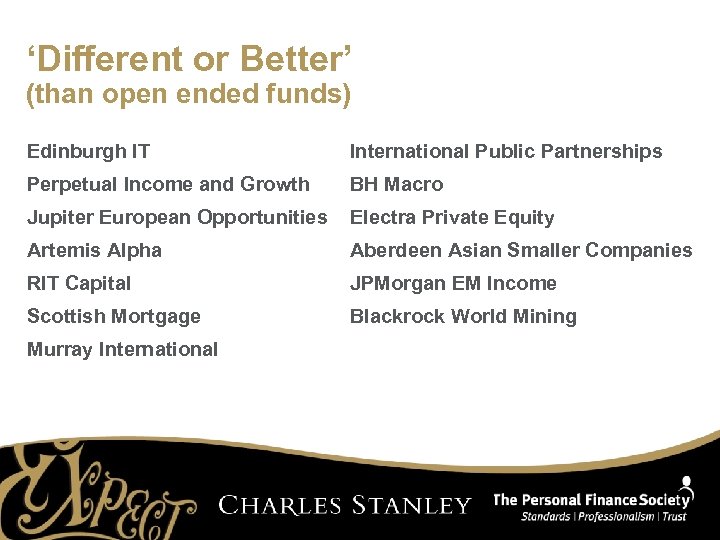 ‘Different or Better’ (than open ended funds) Edinburgh IT International Public Partnerships Perpetual Income and Growth BH Macro Jupiter European Opportunities Electra Private Equity Artemis Alpha Aberdeen Asian Smaller Companies RIT Capital JPMorgan EM Income Scottish Mortgage Blackrock World Mining Murray International
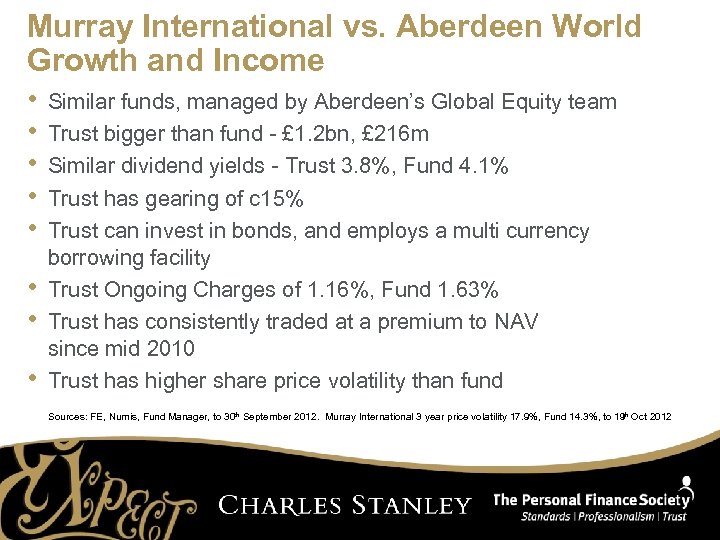 Murray International vs. Aberdeen World Growth and Income • • Similar funds, managed by Aberdeen’s Global Equity team Trust bigger than fund - £ 1. 2 bn, £ 216 m Similar dividend yields - Trust 3. 8%, Fund 4. 1% Trust has gearing of c 15% Trust can invest in bonds, and employs a multi currency borrowing facility Trust Ongoing Charges of 1. 16%, Fund 1. 63% Trust has consistently traded at a premium to NAV since mid 2010 Trust has higher share price volatility than fund th Sources: FE, Numis, Fund Manager, to 30 th September 2012. Murray International 3 year price volatility 17. 9%, Fund 14. 3%, to 19 Oct 2012
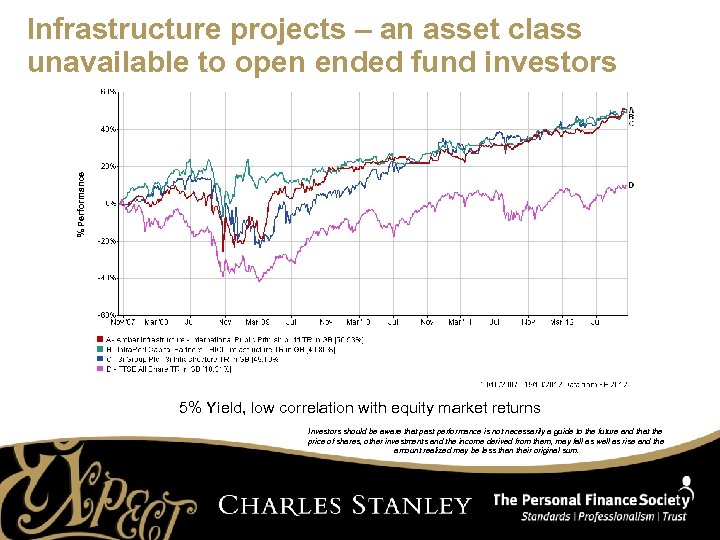 % Performance Infrastructure projects – an asset class unavailable to open ended fund investors 5% Yield, low correlation with equity market returns Investors should be aware that past performance is not necessarily a guide to the future and that the price of shares, other investments and the income derived from them, may fall as well as rise and the amount realized may be less than their original sum.
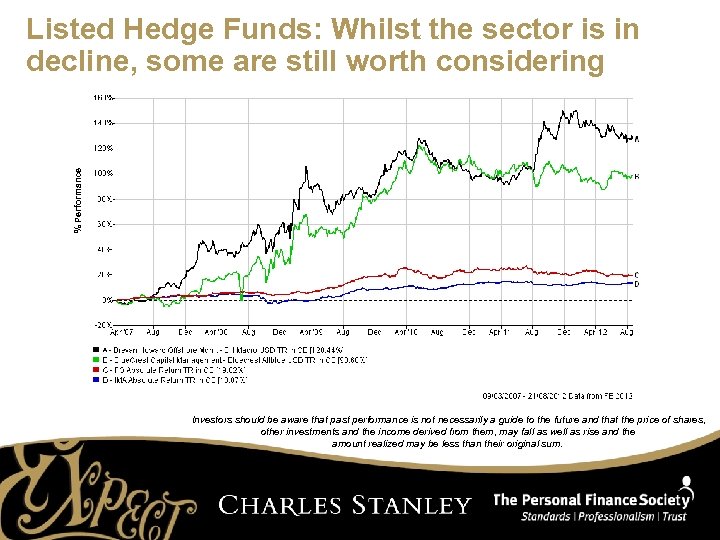 % Performance Listed Hedge Funds: Whilst the sector is in decline, some are still worth considering Investors should be aware that past performance is not necessarily a guide to the future and that the price of shares, other investments and the income derived from them, may fall as well as rise and the amount realized may be less than their original sum.
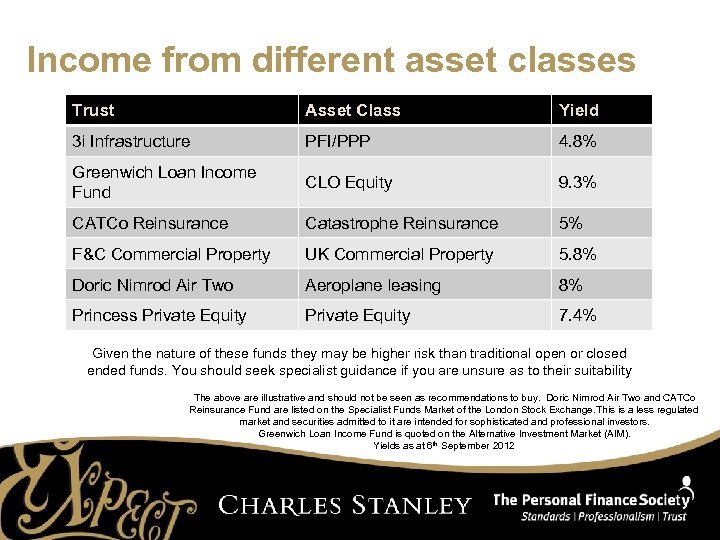 Income from different asset classes Trust Asset Class Yield 3 i Infrastructure PFI/PPP 4. 8% Greenwich Loan Income Fund CLO Equity 9. 3% CATCo Reinsurance Catastrophe Reinsurance 5% F&C Commercial Property UK Commercial Property 5. 8% Doric Nimrod Air Two Aeroplane leasing 8% Princess Private Equity 7. 4% Given the nature of these funds they may be higher risk than traditional open or closed ended funds. You should seek specialist guidance if you are unsure as to their suitability The above are illustrative and should not be seen as recommendations to buy. Doric Nimrod Air Two and CATCo Reinsurance Fund are listed on the Specialist Funds Market of the London Stock Exchange. This is a less regulated market and securities admitted to it are intended for sophisticated and professional investors. Greenwich Loan Income Fund is quoted on the Alternative Investment Market (AIM). Yields as at 6 th September 2012
 Income from Capital Gains New tax rules allow investment trusts to turn capital gains into income, something open ended funds cannot do • Blackrock World Mining • • • 133% dividend increase in 2012 agreed royalty off-take agreement with portfolio company Change in accounting for expenses • annual dividend increased from 4 p to 28 p per share • RIT Capital Investment Companies offer diverse sources of income - a key role for the sector in a post-RDR world
 Split Capital Trusts • A small and illiquid sector that has had its problems • Analysis of split capital trusts is far more complex than just looking at hurdle rates and gross redemption yields • Well managed and well covered split capital trusts still exist • Only to be considered by the very sophisticated clients and investors
 Conclusions • • Some Investment Trusts are worth getting to know The sector is not perfect and has risks Investment Trusts are not as complex as you might think The structure offers some useful advantages over open- ended funds Consider discounts last, not first Closed-ended funds may be useful for clients needing income • and within discretionary equity portfolios for larger clients Look at the sector in the same way as you would open ended funds Sector expertise is available and happy to help with the likes of gearing and discounts
 Contact Details Stephen Peters Investment Trust Analyst E: stephen. peters@charles-stanley. co. uk T: 0207 149 6433 Charles Stanley & Co. Limited 25 Luke Street London EC 2 A 4 AR
 Important Information The information given in this presentation is based upon sources we believe to be reliable, but its accuracy cannot be guaranteed. The information does not constitute advice or a personal recommendation and you are recommended to seek advice concerning suitability from your investment advisor. Charles Stanley & Co. Limited and connected companies, their directors, members, employees and members of their families may have positions in the securities mentioned. Tax reliefs are those currently applying and the levels and bases of taxation can change. Investors should be aware that past performance is not necessarily a guide to the future and that the price of shares and other investments, and the income derived from them, may fall as well as rise and the amount realised may be less than their original sum. Charles Stanley & Co. Limited is authorised and regulated by the Financial Services Authority. Charles Stanley & Co. Limited: 25 Luke Street London, EC 2 A 4 AR. 26