Скачать презентацию The Role of Certification in Demonstrating Quality Programs
8f784b4925a790ee07f902217fd06409.ppt
- Количество слайдов: 18
 The Role of Certification in Demonstrating Quality Programs The Third National Disease Management Summit Maureen Connors Potter Executive Director Disease-Specific Care May 13, 2003
 Mission Statement To continuously improve the quality and safety of care provided to the public…
 Accreditation Services • Ambulatory Health Care and Office. Based Surgery • Behavioral Health Care • Home Care • Hospitals • Laboratories • Long Term Care and Assisted Living • Networks (managed care plans, integrated delivery systems, managed behavioral health care organizations and preferred provider organizations)
 Accreditation vs. Certification • Accreditation – Surveys are organization-based, focused on quality and safe care processes and functions – Traditional JCAHO evaluation product – 50 years establishing expertise in evaluating health care organizations • Certification – Reviews are service-based, focused on quality, safety, and outcomes of improving clinical care – Voluntary—not an add-on to accreditation
 Implementing Disease-Specific Care Certification • Established Disease-Specific Care Advisory Committee • Established Advisory Council of Certified Programs • Pilot testing completed • Requests for Certification accepted beginning December 2001 • Final standards approved February 2002 • Certification reviews began February 2002
 Types of Services Certified • Services that provide clinical care directly to participants: – Examples—hospitals, clinics, home care companies, long term care facilities, rehabilitation centers, physician groups, etc. • Services that provide comprehensive clinical support and interact directly with participants onsite, telephonically, or through the use of on-line services or other electronic resources: – Examples—disease management companies, health plans providing disease management services, etc.
 Eligibility for Certification • The disease-specific care service – Uses a standardized method of delivering clinical care based on clinical guidelines and/or evidence-based practice – Has an organized approach to performance measurement
 Certificate of Distinction • One evaluation model for all disease states • Separate Distinction awarded for services based on guideline and outcomes review
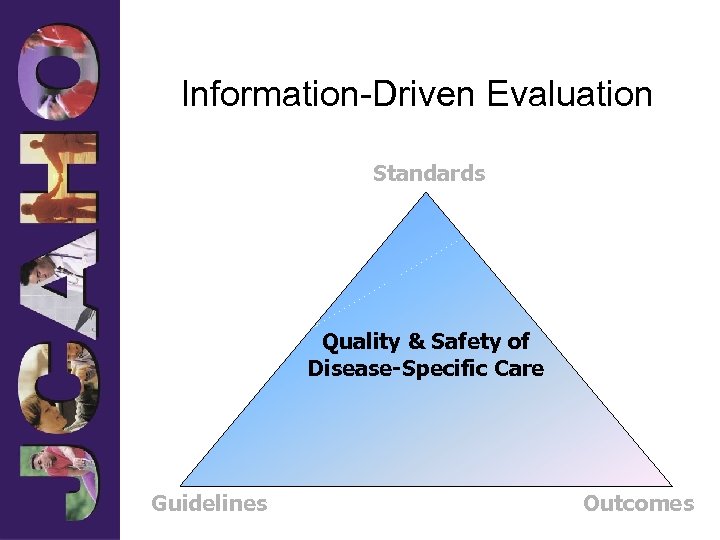 Information-Driven Evaluation Standards Quality & Safety of Disease-Specific Care Guidelines Outcomes
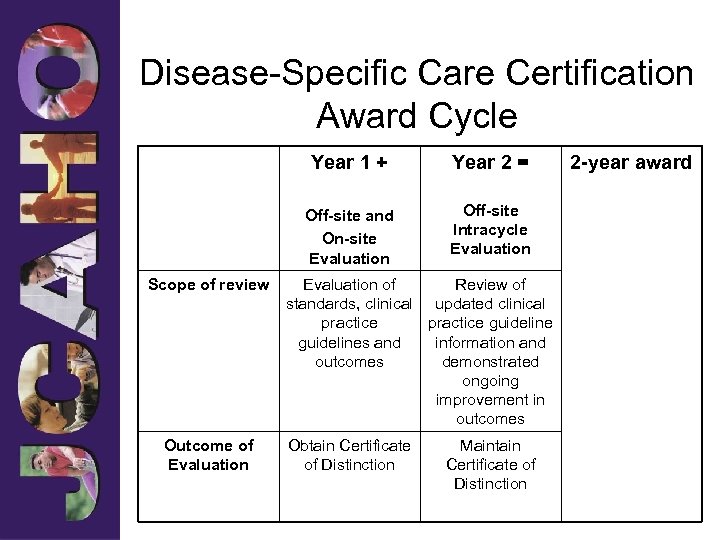 Disease-Specific Care Certification Award Cycle Year 1 + Off-site and On-site Evaluation Scope of review Outcome of Evaluation Year 2 = Off-site Intracycle Evaluation of Review of standards, clinical updated clinical practice guidelines and information and outcomes demonstrated ongoing improvement in outcomes Obtain Certificate of Distinction Maintain Certificate of Distinction 2 -year award
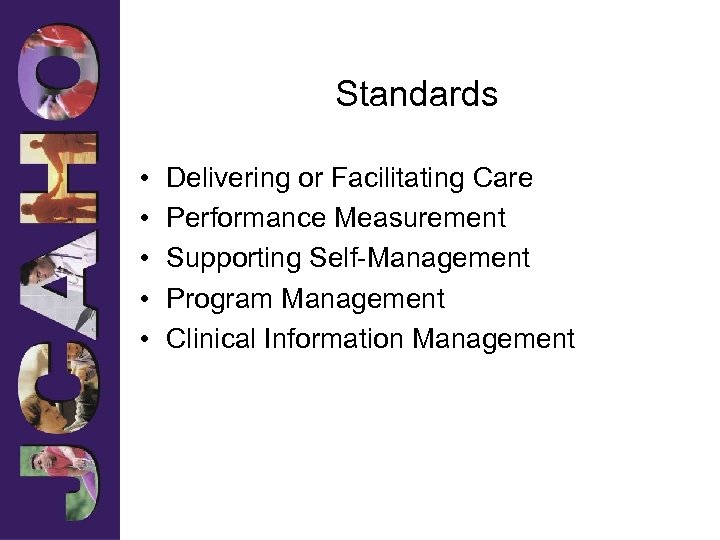 Standards • • • Delivering or Facilitating Care Performance Measurement Supporting Self-Management Program Management Clinical Information Management
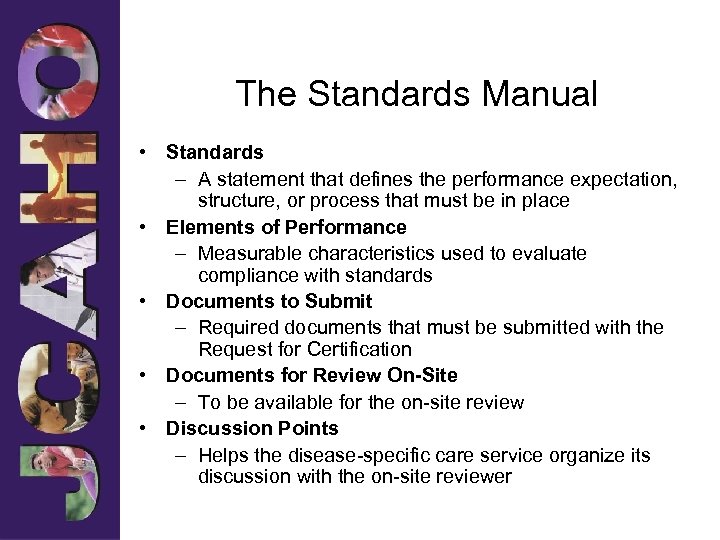 The Standards Manual • Standards – A statement that defines the performance expectation, structure, or process that must be in place • Elements of Performance – Measurable characteristics used to evaluate compliance with standards • Documents to Submit – Required documents that must be submitted with the Request for Certification • Documents for Review On-Site – To be available for the on-site review • Discussion Points – Helps the disease-specific care service organize its discussion with the on-site reviewer
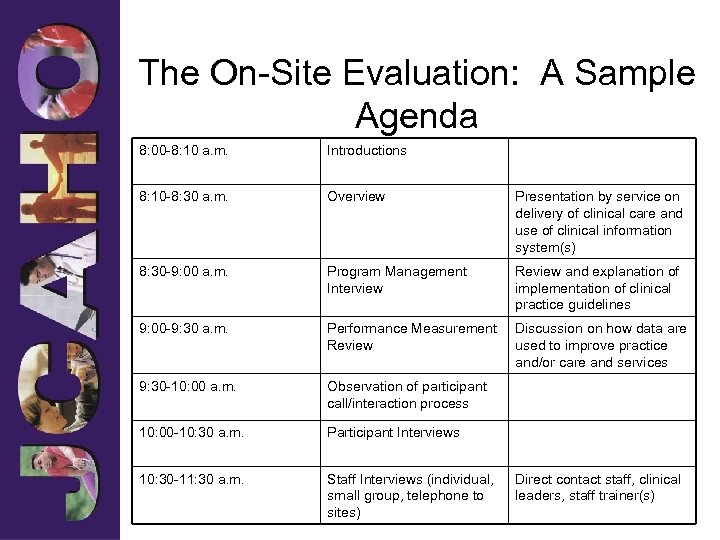 The On-Site Evaluation: A Sample Agenda 8: 00 -8: 10 a. m. Introductions 8: 10 -8: 30 a. m. Overview Presentation by service on delivery of clinical care and use of clinical information system(s) 8: 30 -9: 00 a. m. Program Management Interview Review and explanation of implementation of clinical practice guidelines 9: 00 -9: 30 a. m. Performance Measurement Review Discussion on how data are used to improve practice and/or care and services 9: 30 -10: 00 a. m. Observation of participant call/interaction process 10: 00 -10: 30 a. m. Participant Interviews 10: 30 -11: 30 a. m. Staff Interviews (individual, small group, telephone to sites) Direct contact staff, clinical leaders, staff trainer(s)
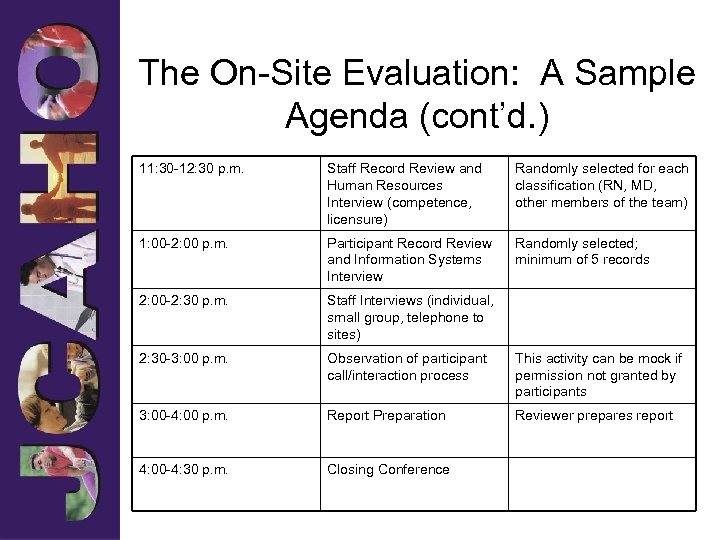 The On-Site Evaluation: A Sample Agenda (cont’d. ) 11: 30 -12: 30 p. m. Staff Record Review and Human Resources Interview (competence, licensure) Randomly selected for each classification (RN, MD, other members of the team) 1: 00 -2: 00 p. m. Participant Record Review and Information Systems Interview Randomly selected; minimum of 5 records 2: 00 -2: 30 p. m. Staff Interviews (individual, small group, telephone to sites) 2: 30 -3: 00 p. m. Observation of participant call/interaction process This activity can be mock if permission not granted by participants 3: 00 -4: 00 p. m. Report Preparation Reviewer prepares report 4: 00 -4: 30 p. m. Closing Conference
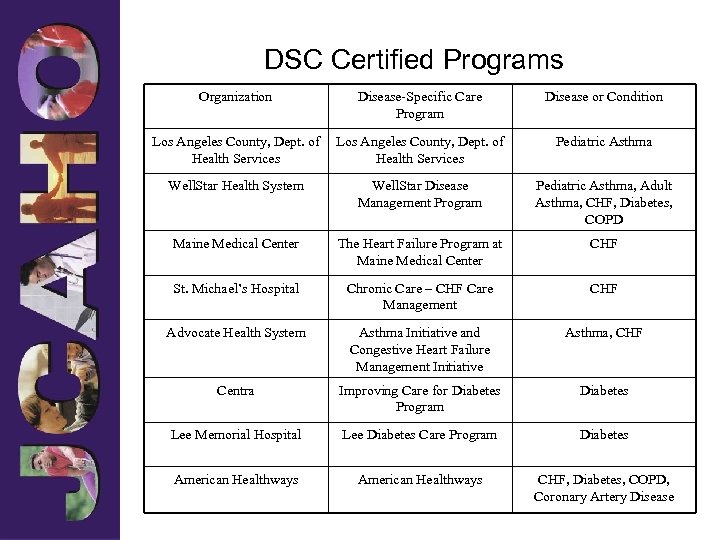 DSC Certified Programs Organization Disease-Specific Care Program Disease or Condition Los Angeles County, Dept. of Health Services Pediatric Asthma Well. Star Health System Well. Star Disease Management Program Pediatric Asthma, Adult Asthma, CHF, Diabetes, COPD Maine Medical Center The Heart Failure Program at Maine Medical Center CHF St. Michael’s Hospital Chronic Care – CHF Care Management CHF Advocate Health System Asthma Initiative and Congestive Heart Failure Management Initiative Asthma, CHF Centra Improving Care for Diabetes Program Diabetes Lee Memorial Hospital Lee Diabetes Care Program Diabetes American Healthways CHF, Diabetes, COPD, Coronary Artery Disease
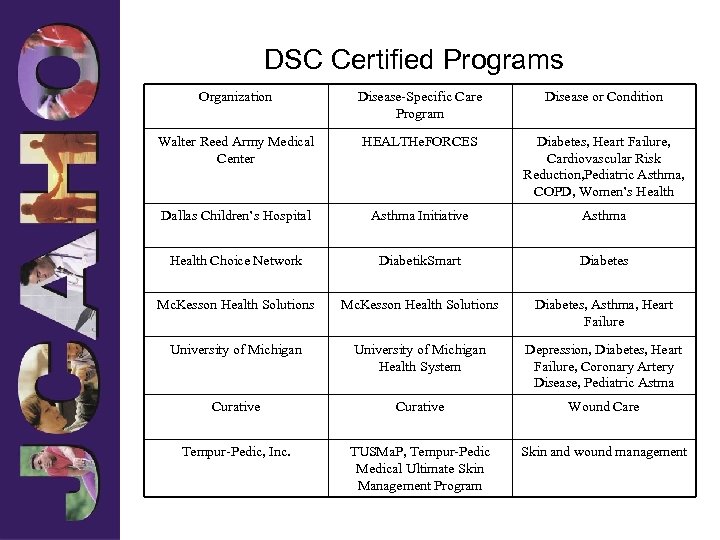 DSC Certified Programs Organization Disease-Specific Care Program Disease or Condition Walter Reed Army Medical Center HEALTHe. FORCES Diabetes, Heart Failure, Cardiovascular Risk Reduction, Pediatric Asthma, COPD, Women’s Health Dallas Children’s Hospital Asthma Initiative Asthma Health Choice Network Diabetik. Smart Diabetes Mc. Kesson Health Solutions Diabetes, Asthma, Heart Failure University of Michigan Health System Depression, Diabetes, Heart Failure, Coronary Artery Disease, Pediatric Astma Curative Wound Care Tempur-Pedic, Inc. TUSMa. P, Tempur-Pedic Medical Ultimate Skin Management Program Skin and wound management
 Why Choose Joint Commission Disease-Specific Care Certification • 50 years of recognized and respected excellence and expertise in evaluating clinical care quality • A Certificate of Distinction will distinguish program and service competencies • The certification evaluation provides a valued and objective assessment • Validate your service’s internal performance improvement initiatives • Meet nationally recognized criteria for disease management • May assist in obtaining contracts from employers and other purchaser groups