


 Скачать презентацию THE ROLE OF ANTENATAL CARE FOR CHILD GROWTH
1207c7871e1ac1976fb7edaa247d5802.ppt
- Количество слайдов: 15
 THE ROLE OF ANTENATAL CARE FOR CHILD GROWTH AND COGNITIVE DEVELOPMENT: A COMPARATIVE ANALYSIS IN ETHIOPIA, PERU, AND INDIA Mariachiara Di Cesare & Ricardo Sabates Centre for Internationa Education (CIE) University of Sussex
 BACKGROUND “Reducing social inequalities in health is an issue of social justice” (Marmot, 2005) Social gradient in health within and between countries - Health inequalities Health and nutrition strongly associated with school outcomes. Micronutrient deficiencies impacts cognitive development Positive life-course trajectories and adult outcomes linked to educational attainment.
 EARLY INTERVENTIONS School health programmes are beneficial for at risk and not at risk children Targeted interventions at school: Leave out a significant # out-school children Start at school age Health or educational interventions alone will not close the health gradient across generations (CSDH, 2008) Importance of early interventions
 RESEARCH QUESTION Is there evidence than early interventions can weaken the transmission of inequalities during early childhood? Early interventions: prenatal care Tranmission of inequalities: from health to cognitive development
 WHY PRENATAL CARE? Better prenatal care has direct positive effects on mother’s and foetus’ health Reduces mothers’ burden of responsibilities and increases meaning of motherhood Improves mothers’ confidence with health services and health care access
 DATA Young Lives (YL) YL is a long-term international research project investigating the changing nature of childhood poverty in order to: causes and consequences of childhood poverty how policies affect children’s well-being development and implementation of policies 12, 000 children over 15 years in Ethiopia, the state of Andhra Pradesh in India, Peru and Vietnam.
 SAMPLE Sample strategy “sentinel site surveillance”. Sample not nationally representative, but households are representative within sites. Index children: Group of 2000 children born in the year 2000/1 (an average of 1 year old during round one and aged 4 - 5 at round 2). Data used for first and second round
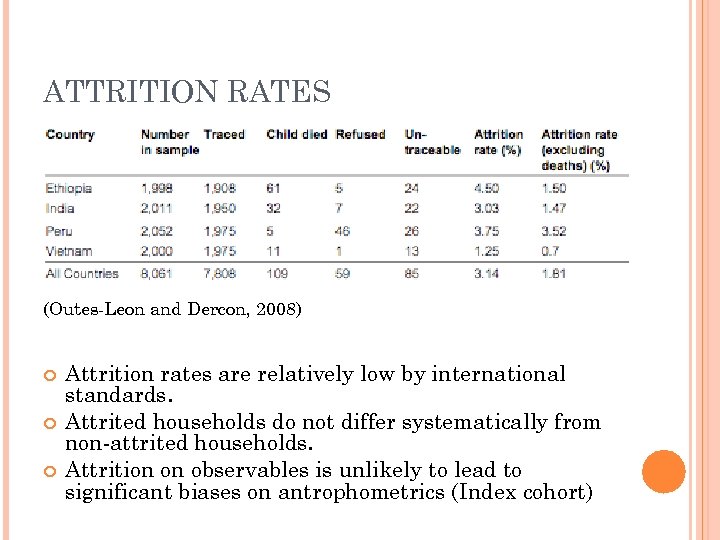 ATTRITION RATES (Outes-Leon and Dercon, 2008) Attrition rates are relatively low by international standards. Attrited households do not differ systematically from non-attrited households. Attrition on observables is unlikely to lead to significant biases on antrophometrics (Index cohort)
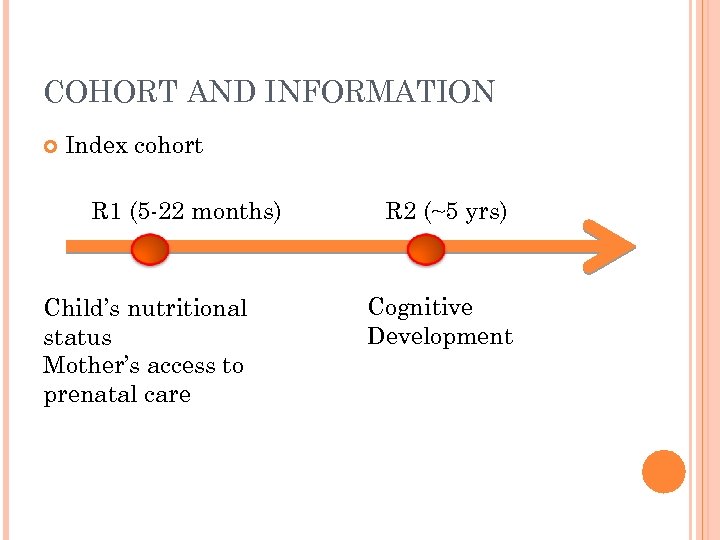 COHORT AND INFORMATION Index cohort R 1 (5 -22 months) Child’s nutritional status Mother’s access to prenatal care R 2 (~5 yrs) Cognitive Development
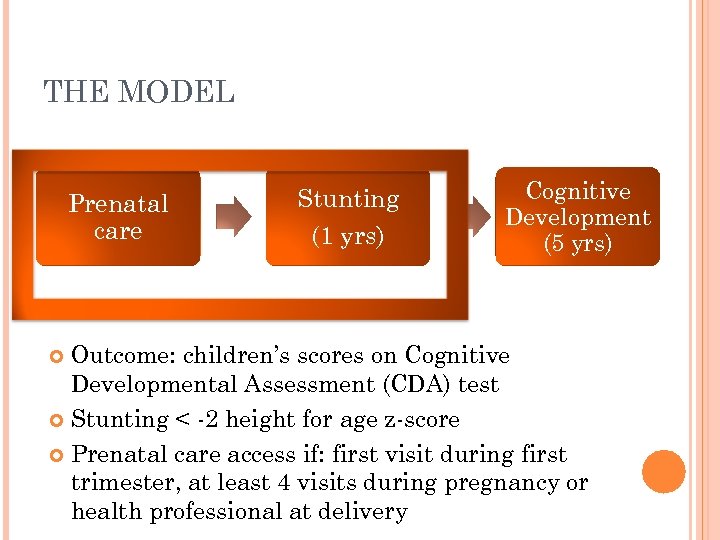 THE MODEL Prenatal care Stunting (1 yrs) Cognitive Development (5 yrs) Outcome: children’s scores on Cognitive Developmental Assessment (CDA) test Stunting < -2 height for age z-score Prenatal care access if: first visit during first trimester, at least 4 visits during pregnancy or health professional at delivery
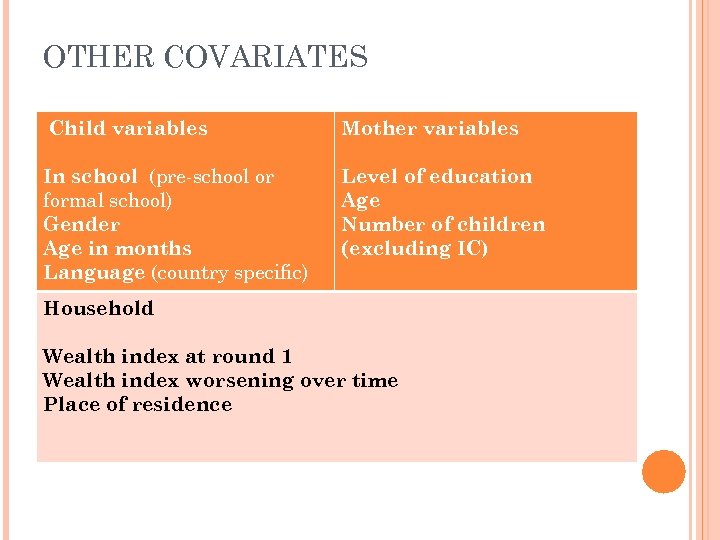 OTHER COVARIATES Child variables Mother variables In school (pre-school or formal school) Gender Age in months Language (country specific) Level of education Age Number of children (excluding IC) Household Wealth index at round 1 Wealth index worsening over time Place of residence
 RESULTS
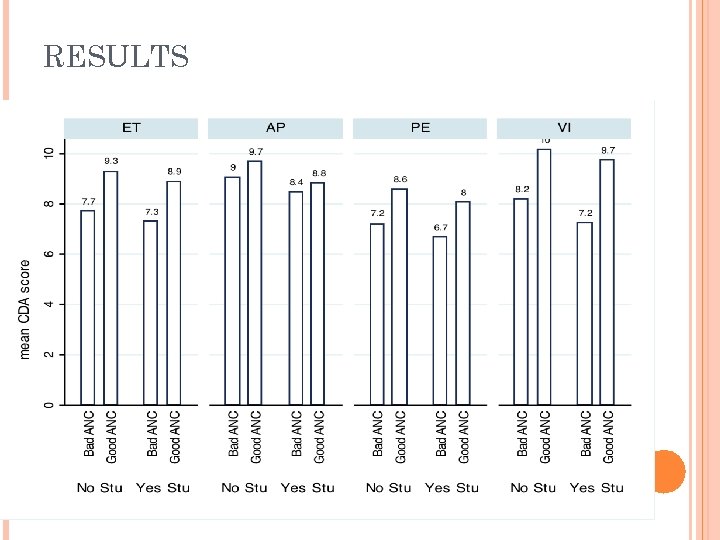
 RESULTS Access to antenatal care is positively associated with CDA in Ethiopia, Peru, and Vietnam. In all countries, children whose mothers had access to antenatal care services and who were not stunted during the first two years of life achieved the highest test scores. The effect of early nutritional deficiencies on subsequent cognitive development can be in part weakened if the mother had access to antenatal care in Peru and Vietnam.
 DISCUSSION As an early intervention, ANC services has the potential to reduce the impact of health inequalities on educational inequalities (in Peru & Vietnam). Lack of results in Andhra Pradesh and Ethiopia may be linked to quality of ANC. “If the major determinants of health are social so must be the remedies” (Marmot, 2005)
 THANK YOU Project funded by The BUPA Foundation, grant TBF-509 -034