


 Скачать презентацию The Role of Agonal Factors in Human Postmortem
13a3852e4bd79f41e4a69208920c7f95.ppt
- Количество слайдов: 18
 The Role of Agonal Factors in Human Postmortem CNS Research Daniel W. Mc. Keel, Jr. , M. D. ADRC Neuropathology Tissue Resource Washington U. School of Medicine St. Louis MO - 6/23/04
 MEDLINE Literature Review Category 4 citations were examined in detail for factors pertinent to using ADRC postmortem brain material for biochemical research
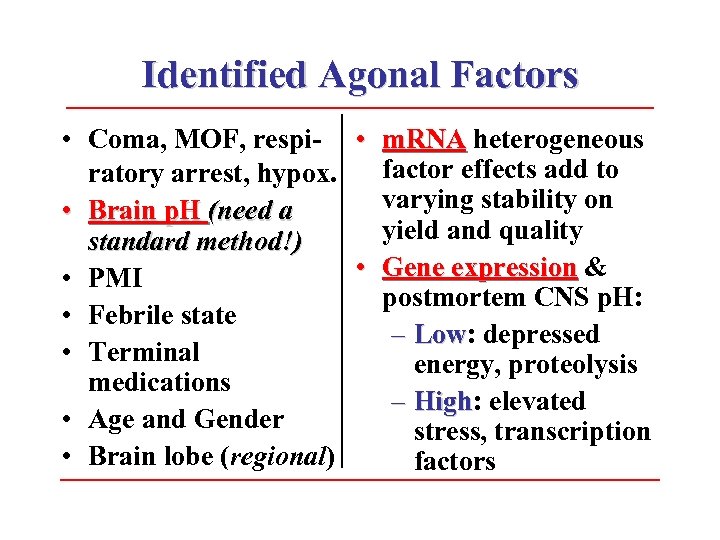 Identified Agonal Factors • Coma, MOF, respiratory arrest, hypox. • Brain p. H (need a standard method!) • PMI • Febrile state • Terminal medications • Age and Gender • Brain lobe (regional) • m. RNA heterogeneous factor effects add to varying stability on yield and quality • Gene expression & postmortem CNS p. H: – Low: depressed Low energy, proteolysis – High: elevated High stress, transcription factors
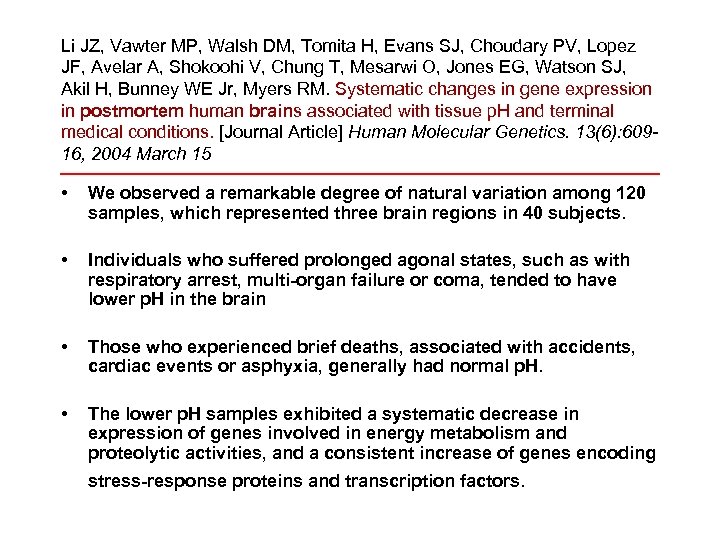 Li JZ, Vawter MP, Walsh DM, Tomita H, Evans SJ, Choudary PV, Lopez JF, Avelar A, Shokoohi V, Chung T, Mesarwi O, Jones EG, Watson SJ, Akil H, Bunney WE Jr, Myers RM. Systematic changes in gene expression in postmortem human brains associated with tissue p. H and terminal medical conditions. [Journal Article] Human Molecular Genetics. 13(6): 60916, 2004 March 15 • We observed a remarkable degree of natural variation among 120 samples, which represented three brain regions in 40 subjects. • Individuals who suffered prolonged agonal states, such as with respiratory arrest, multi-organ failure or coma, tended to have lower p. H in the brain • Those who experienced brief deaths, associated with accidents, cardiac events or asphyxia, generally had normal p. H. • The lower p. H samples exhibited a systematic decrease in expression of genes involved in energy metabolism and proteolytic activities, and a consistent increase of genes encoding stress-response proteins and transcription factors.
 Tomita H, Vawter MP, Walsh DM, Evans SJ, Choudary PV, Li J, Overman KM, Atz ME, Myers RM, Jones EG, Watson SJ, Akil H. Bunney WE Jr. Effect of agonal and postmortem factors on gene expression profile: quality control in microarray analyses of postmortem human brain. Biological Psychiatry. 55(4): 346 -52, 2004 • Coma and hypoxia do affect RNA integrity and gene expression profiles more than age, gender & postmortem factors. Propose “Average Correlation Index” to reduce specimen variability.
 Many factors affect m. RNA • Preece P, Cairns NJ. Quantifying m. RNA in postmortem human brain: influence of gender, age at death, postmortem interval, brain p. H, agonal state and inter-lobe m. RNA variance. [Journal Article] Brain Research. Molecular Brain Research. 118(12): 60 -71, 2003 Oct 21 – – – Taq. Man RT-PCR measured 7 m. RNAs 90 AD and 81 control brains (lobar m. RNA same) Females had less m. RNA than males Brain p. H & amount of RNA (+) corr. except GFAP “Agonal state a poor predictor of m. RNA levels”
 Cummings TJ, Strum JC, Yoon LW, Szymanski MH, Hulette CM. Recovery and expression of messenger RNA from postmortem human brain tissue. Modern Pathology. 14(11): 115761, 2001 Nov • Bryan ADRC Rapid Autopsy Program at Duke • 10 AD + 9 Controls (1 to 11 hr PMI) • 19 brains RNA integrity + m. RNA gene expression (CSF p. H, fever/sepsis, O 2, sudden? ) • “All samples yield intact RNA without degradation” (“successful gene expression may degradation require enhanced procurement efforts”)
 Bissette G, Seidler FJ, Nemeroff CB, Slotkin TA. High affinity choline transporter status in Alzheimer's disease tissue from rapid autopsy. [Review] [12 refs] [Review] Annals of the New York Academy of Sciences. 777: 197 -204, 1996 • Choline transporter degrades rapidly • Brains acquired within 2 hours of death • Choline transporter increased in AD cortex compared to non-AD controls • Putamen used as a “spared” control region
![What Can NACC/NIA Do? [1] • Advertise its frozen brain resources! • Broker tissue](https://present5.com/presentation/13a3852e4bd79f41e4a69208920c7f95/image-9.jpg "What Can NACC/NIA Do? [1] • Advertise its frozen brain resources! • Broker tissue") What Can NACC/NIA Do? [1] • Advertise its frozen brain resources! • Broker tissue distribution requests that involve multiple ADRCs (clearing house) • Encourage collaborative grants & symposia to standardize frozen tissue collection methods • Explore feasibility of regional specialized brain banks (genomics, proteomics, laser capture microdissection analysis of single and pooled cells) -- rigid acceptance criteria for specimens
What Can NACC/NIA Do? [1] • Advertise its frozen brain resources! • Broker tissue distribution requests that involve multiple ADRCs (clearing house) • Encourage collaborative grants & symposia to standardize frozen tissue collection methods • Explore feasibility of regional specialized brain banks (genomics, proteomics, laser capture microdissection analysis of single and pooled cells) -- rigid acceptance criteria for specimens
![What Can NACC/NIA Do? [2] • Gather and distribute center-specific specimen requests and distribution](https://present5.com/presentation/13a3852e4bd79f41e4a69208920c7f95/image-10.jpg "What Can NACC/NIA Do? [2] • Gather and distribute center-specific specimen requests and distribution") What Can NACC/NIA Do? [2] • Gather and distribute center-specific specimen requests and distribution data! • Tabulate center-specific practical experience with using agonal factor data to facilitate research. • Agonal factor use and outcome research within the ADRC community - what factors matter? • Add agonal factors to the NACC database and make this data widely available to investigators
What Can NACC/NIA Do? [2] • Gather and distribute center-specific specimen requests and distribution data! • Tabulate center-specific practical experience with using agonal factor data to facilitate research. • Agonal factor use and outcome research within the ADRC community - what factors matter? • Add agonal factors to the NACC database and make this data widely available to investigators
 What Can ADRC Pathologists Do? • Use existing brain banking protocols to formulate a standard protocol for all centers. • Develop standard tissue block label protocols to facilitate collaborative ADRC research • Adopt the Mc. Keel-Gado visual stds-based system (Brain Pathol 1994) for scoring brain atrophy and ventricular dilatation at autopsy. • Develop standard CSF collection protocols • Add banked CNS/CSF requests received and fulfilled to the NACC-reportable data
 Frozen Human Brain Protocols • Nochlin D et al. (U. Washington), Acta Neuropathologica. 86(6): 645 -50, 1993 – Aluminum plates chilled with dry ice (CO 2) – CNS suitable for LM, EM + biochemistry • Vonsattel, Mc. Kee, Hedley-Whyte et al. (Harvard), J Neuropathol Experimental Neurology. 54(1): 42 -56, 1995 – Aluminum plates chilled with dry ice (CO 2) – Top plate to flatten specimen (coronal slices) – Standardized block sampling protocol
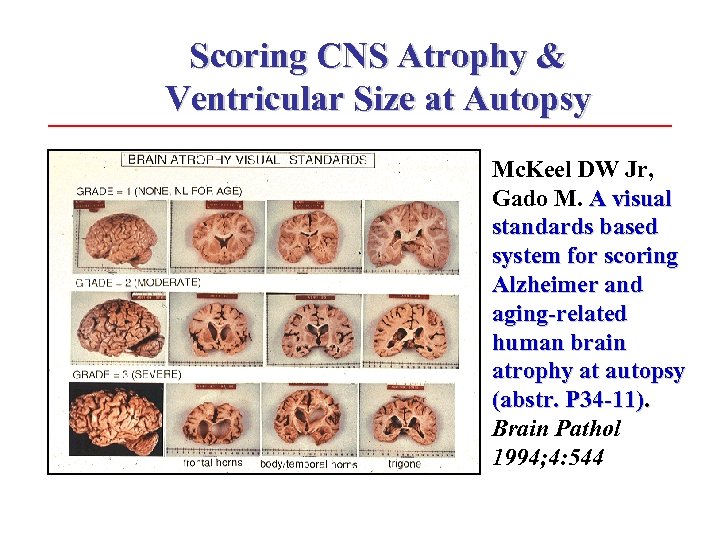 Scoring CNS Atrophy & Ventricular Size at Autopsy Mc. Keel DW Jr, Gado M. A visual standards based system for scoring Alzheimer and aging-related human brain atrophy at autopsy (abstr. P 34 -11). Brain Pathol 1994; 4: 544
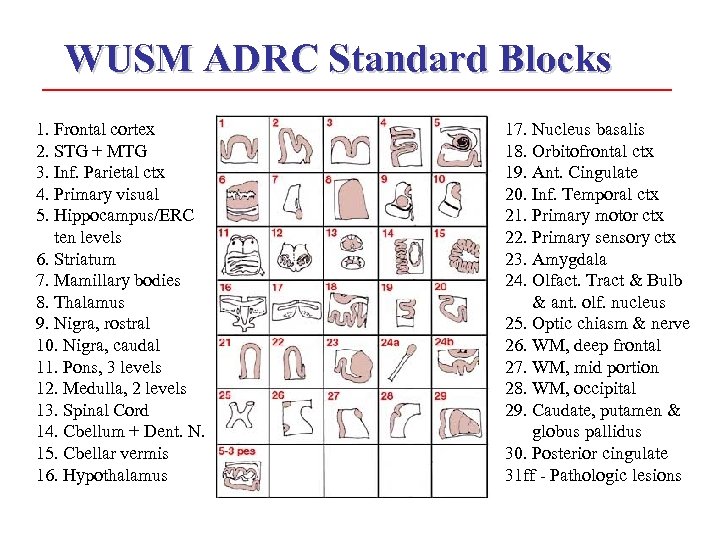 WUSM ADRC Standard Blocks 1. Frontal cortex 2. STG + MTG 3. Inf. Parietal ctx 4. Primary visual 5. Hippocampus/ERC ten levels 6. Striatum 7. Mamillary bodies 8. Thalamus 9. Nigra, rostral 10. Nigra, caudal 11. Pons, 3 levels 12. Medulla, 2 levels 13. Spinal Cord 14. Cbellum + Dent. N. 15. Cbellar vermis 16. Hypothalamus 17. Nucleus basalis 18. Orbitofrontal ctx 19. Ant. Cingulate 20. Inf. Temporal ctx 21. Primary motor ctx 22. Primary sensory ctx 23. Amygdala 24. Olfact. Tract & Bulb & ant. olf. nucleus 25. Optic chiasm & nerve 26. WM, deep frontal 27. WM, mid portion 28. WM, occipital 29. Caudate, putamen & globus pallidus 30. Posterior cingulate 31 ff - Pathologic lesions
 Standardized Immunohistochemistry • At present no standardization exists in IHC methodology among ADRCs • Includes fixation, embedding materials, pretreatment protocols, reagent sources, antibody working titers, substrates used, etc. • Hence results vary non-systematically and adversely affect comparisons among results obtained at various centers.
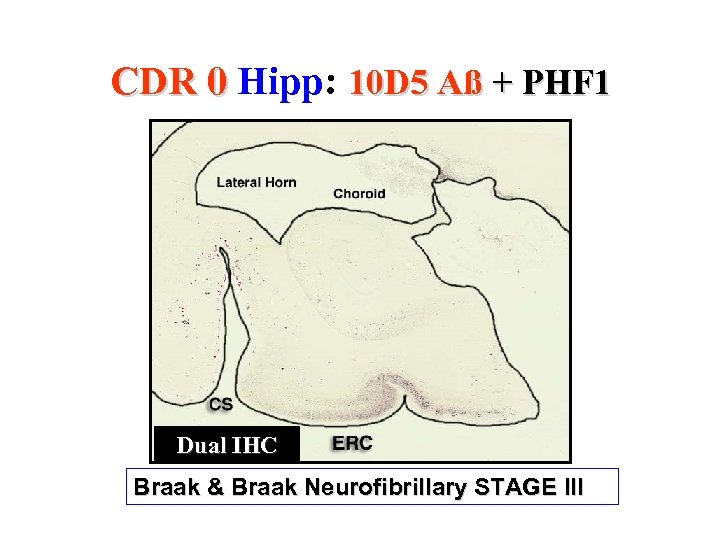 CDR 0 Hipp: 10 D 5 Aß + PHF 1 Dual IHC Braak & Braak Neurofibrillary STAGE III
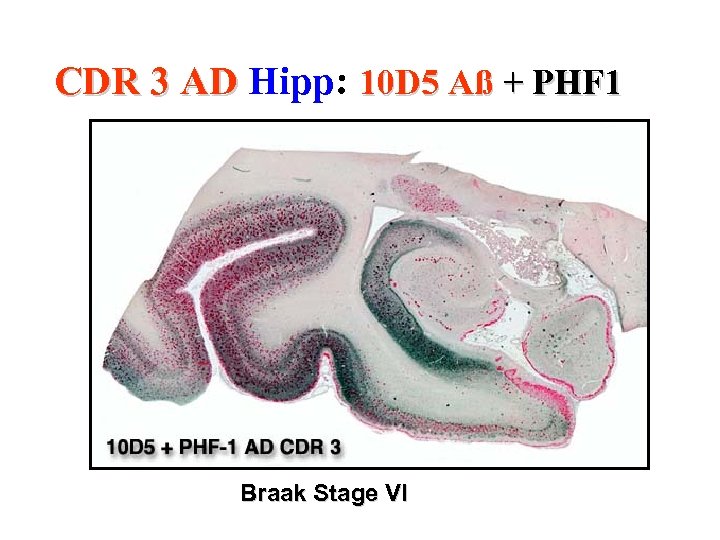 CDR 3 AD Hipp: 10 D 5 Aß + PHF 1 Braak Stage VI
 There is lots of Work to do! Standardization now will yield major dividends in the future.