 Скачать презентацию The Road to Performance Based Case Management Contracts
41e6b664bd95b2ef647dde38bb4aa02e.ppt
- Количество слайдов: 38




The Road to Performance Based Case Management Contracts Missouri’s Experience September, 2011
Presenters • Le. Ann Haslag, MSW, LCSW • Dr. Jerrie Jacobs-Kenner, Chief Executive Officer Jkenner@ma-cf. org (P) 573 -338 -5258 (F) 573 -632 -2761 • Ryan Dowis, Chief Operating Officer/Vice President ryan. dowis@cornerstonesofcare. org (P) 816 -508 -6201 (F) 816 -508 -1750 Contact information for Missouri Children’s Division: Susan Savage, MSW Susan. K. Savage@dss. mo. gov (P) 573 - 751 -2502 (F) 573 -526 -3971 2
Agenda • • • History of public/private partnership Preparation for Awards Model Overview Unique Characteristics Cost/Benefits/Outcomes Partnership/Quality Assurance 3
History of Partnership • Historically relied on private sector to deliver services – Mental health and residential treatment • 1988 - adoption recruitment/assessment – Limited adoption case mngt included • 1994 - foster recruitment/assessments – Case mngt services included 4
Partnership History Cont. • 1997 - Foster care case management became stand alone contract • 2000 - Case mngt contract re-bid – Significant growth of case mngt in private sector – Emphasis on permanency-adoption case mngt added 5
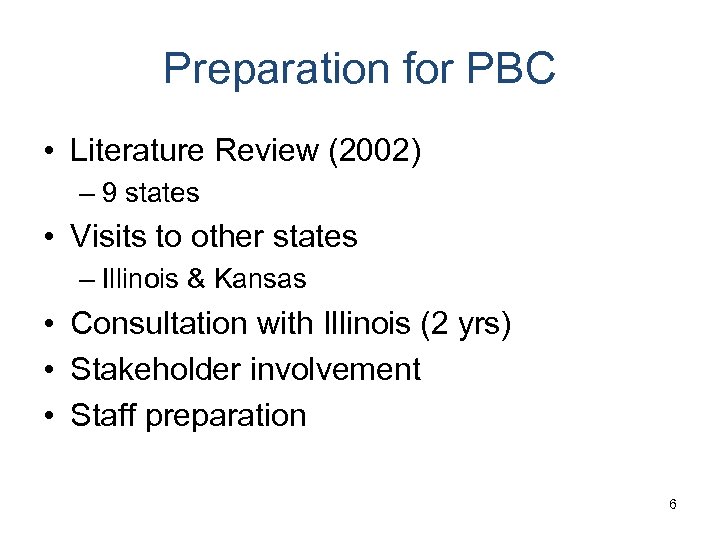
Preparation for PBC • Literature Review (2002) – 9 states • Visits to other states – Illinois & Kansas • Consultation with Illinois (2 yrs) • Stakeholder involvement • Staff preparation 6
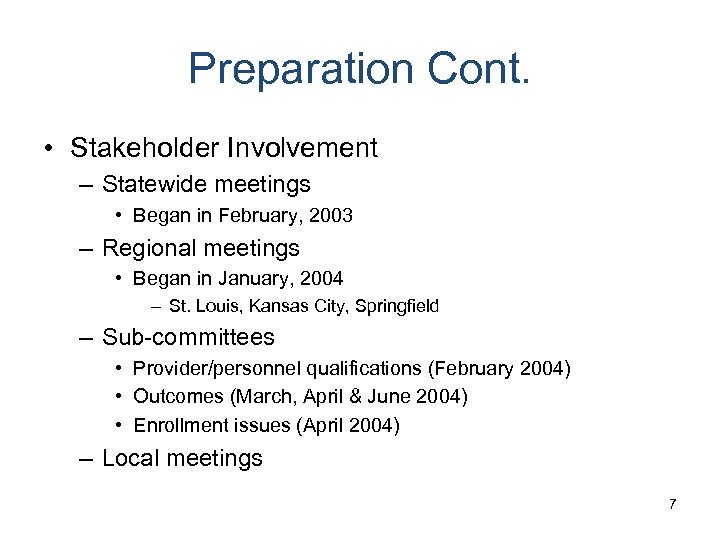
Preparation Cont. • Stakeholder Involvement – Statewide meetings • Began in February, 2003 – Regional meetings • Began in January, 2004 – St. Louis, Kansas City, Springfield – Sub-committees • Provider/personnel qualifications (February 2004) • Outcomes (March, April & June 2004) • Enrollment issues (April 2004) – Local meetings 7
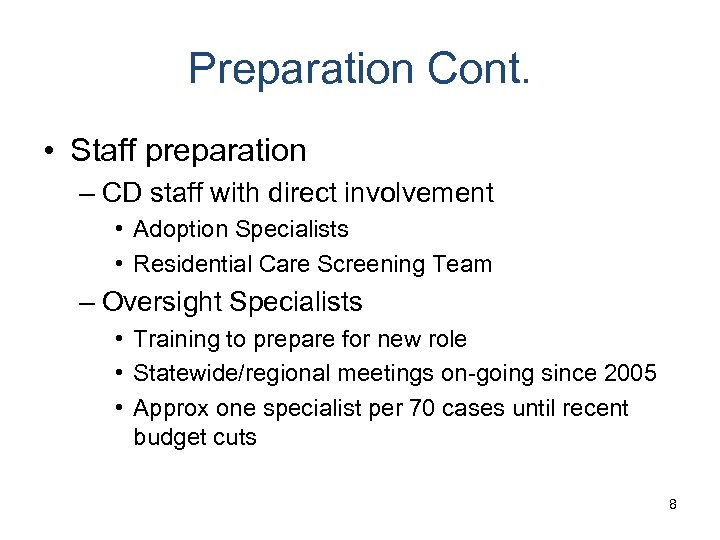
Preparation Cont. • Staff preparation – CD staff with direct involvement • Adoption Specialists • Residential Care Screening Team – Oversight Specialists • Training to prepare for new role • Statewide/regional meetings on-going since 2005 • Approx one specialist per 70 cases until recent budget cuts 8
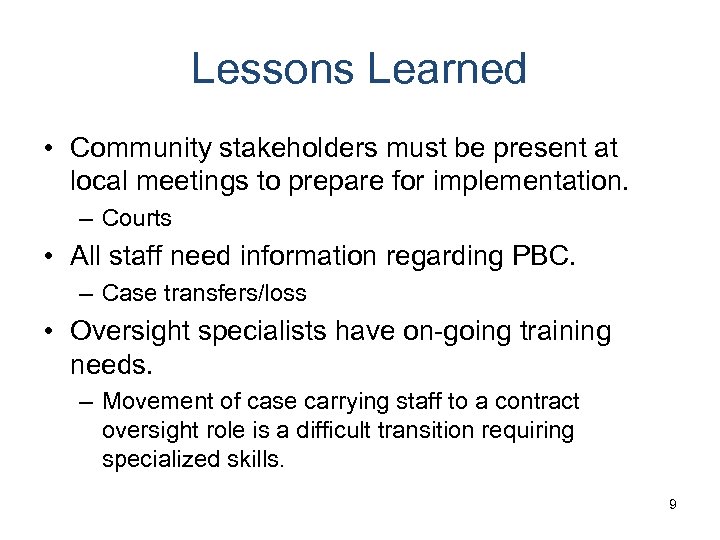
Lessons Learned • Community stakeholders must be present at local meetings to prepare for implementation. – Courts • All staff need information regarding PBC. – Case transfers/loss • Oversight specialists have on-going training needs. – Movement of case carrying staff to a contract oversight role is a difficult transition requiring specialized skills. 9
Awards • Performance based foster and adoption case mngt contracts awarded 6/1/05 – Competitive bid • Supervision and QA plans heavily weighted • Accreditation required within 2 yrs – Caseloads etc at COA accreditation standards – Services did not begin until 9/1/05 • Start up funding – 7 provider consortiums 10
Awards • 2 nd PBC awarded to the initial seven consortiums effective 8/11/08 – 3 additional contracts were awarded 9/1/08 • 12 counties in the central, south central and southwestern portions of the state – Foster care population served through the private sector has varied from 28%-38% 11
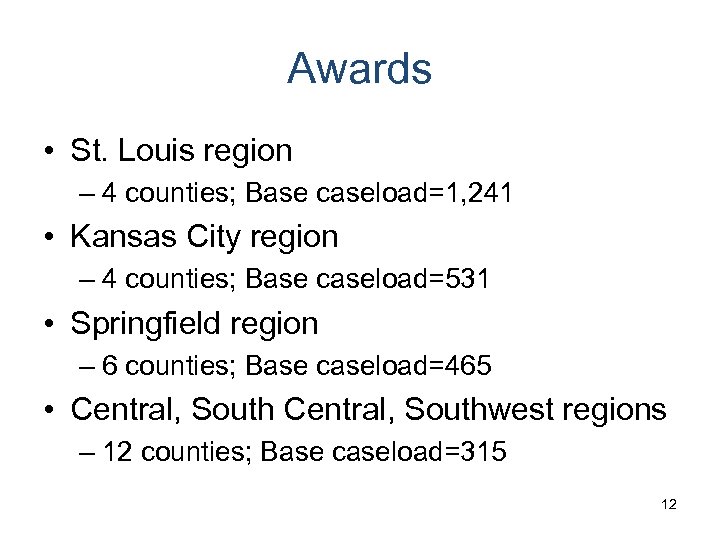
Awards • St. Louis region – 4 counties; Base caseload=1, 241 • Kansas City region – 4 counties; Base caseload=531 • Springfield region – 6 counties; Base caseload=465 • Central, Southwest regions – 12 counties; Base caseload=315 12
Model Overview • Includes all case management duties: – Assessment – Case planning – Placement planning – Service planning – Permanency planning – Resource development 13
Overview Cont. • Reward/Risk – Paid for base caseload • All inclusive case rate – Flexibility – Continuum of care – Monthly referrals to replace those expected to move to permanency, which are not paid for – Base caseload is not rebuilt until the end of the contract year – Re-entries into care within 12 months served for free 14
Lessons Learned • Time for implementation needs to be considered as PBC expands geographically. • Adoption services require specialized training. • Annual rebuilds and re-bids disrupts case mngt – At rebid cases will be replaced on a one-for-one basis • Post permanency work needs to be considered in design. • Financial risk needs to be monitored on-going. – Re-entries into care 15
Unique Characteristics • Financial – Actuary Study • Evaluation – Equalization of caseloads • Age, race, sex, length of time in care, placement type – Pilots • Provides opportunity to explain conditions necessary to produce outcomes • Opportunity for early detection of problems w/ design 16
Unique Characteristics Cont. • Matched criteria for pilots – – – Type of caseload served Caseload size Supervisory ratios Staff Development Random assignment/replacement cases • Differences – – – Education/experience Salaries Funding for special expenses and purchased services Flexibility in type of service purchased Counties served 17
Lessons Learned • The actuary needs to understand the business they are setting the rates for. – Labor intensive • The actuary may consider some information proprietary. 18
Lessons Learned Cont. • Equalization is difficult to achieve and maintain. – Siblings – Movement of cases – Increased privatization as entries into care decrease • Majority of cases privatized in St. Louis City – Majority of new cases assigned to contractors 19
Lessons Learned Cont. • Pilots are difficult to establish/maintain. – Staff buy in (co-workers with higher loads) – Worker turnover – Matched criteria • Area served – Region vs county – Out of county placements (ex. Residential) • Adoption services • Comparisons are helpful & harmful. 20
Cost • Must be evaluated in terms of cost effectiveness • Administration is difficult to compare – Economies of scale • Costs for state spread across multiple programs and thousands of employees • Contractors focused on one program and often times less than 100 employees 21
Benefits • Legislative Advocacy/Shared responsibility – Multiple systems to address complex issues – Share what works • Accreditation/Lower caseloads – Improved services to children • Healthy competition – Improved accountability for public and private • Improved outcomes for children 22
Permanency Outcome • % of children moving to permanency within 12 months • Different targets for each region based on historical data – Local variables impact performance • Courts ultimately decide when permanency is achieved • Local initiatives 23
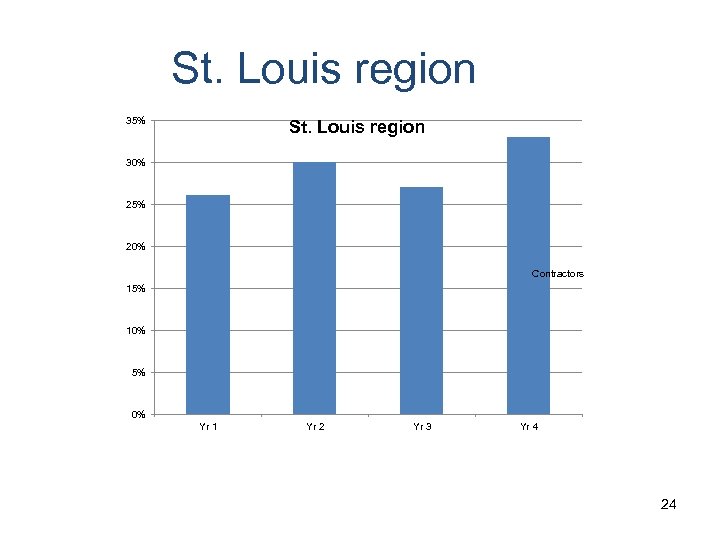
St. Louis region 35% St. Louis region 30% 25% 20% Contractors 15% 10% 5% 0% Yr 1 Yr 2 Yr 3 Yr 4 24
Permanency Cont. • None of the contractors met performance standards in Years 1, 2, and 3 – Performance standard was not weighted to consider % of cases from each county • Majority of cases come from the lowest performing county. • Two of the three contractors met standard in Year 4 25
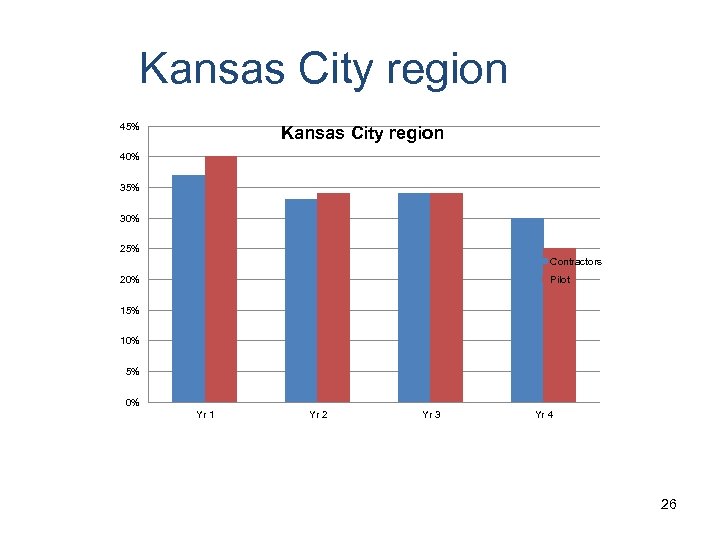
Kansas City region 45% Kansas City region 40% 35% 30% 25% Contractors Pilot 20% 15% 10% 5% 0% Yr 1 Yr 2 Yr 3 Yr 4 26
Permanency Cont. • Contractors & pilot exceeded target in Years 1, 2 and 3 – Performance standard was not weighted to consider a unique, sub-set of their population which has higher permanency rates • Contractors met target in Year 4 but pilot did not • Overall performance has declined. – Children under supervision only has declined 27
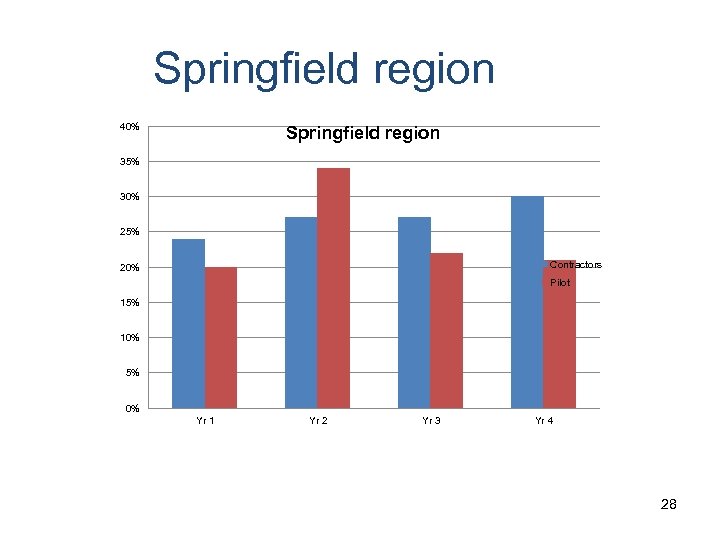
Springfield region 40% Springfield region 35% 30% 25% Contractors 20% Pilot 15% 10% 5% 0% Yr 1 Yr 2 Yr 3 Yr 4 28
Permanency Cont. • Springfield Pilot – Permanency rate declined by 12% from Year 2 to Year 3 – Significant worker turnover during the same time period • Caseloads went above 15 several months in a row • Performance of contractors has continued to increase 29
Re-entries into Care • % of children re-entering care within 12 months of previous exit • As number of children served and amount of time for re-entries into care increases performance expected to decline – Pattern seen from Year 1 to Year 2; All but one of the pilot groups still met target – All met the target in Years 3 & 4 30
Stability • % of children with 2 or fewer moves • Target based on total number of moves for a population, not moves for the year • Performance in Year 1 artificially inflated • Outcomes show an overall decrease in performance, declining each year as expected • With rebid and expansion, pattern would repeat so measure has been removed 31
Safety • % of children who were not abused/neglected by alternative caregiver • Trend difficult to evaluate as 3 contractors and 1 pilot achieved 100% in Year 1 • In Year 3 all contractors and pilots met the performance expectation • In Year 4 one contractor did not met the performance standard. 32
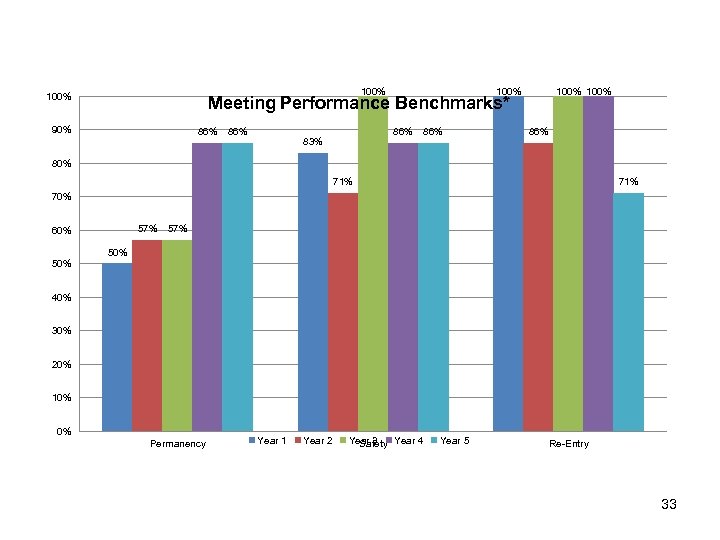
100% 100% Meeting Performance Benchmarks* 90% 86% 86% 83% 86% 80% 71% 70% 57% 60% 57% 50% 40% 30% 20% 10% 0% Permanency Year 1 Year 2 Year 3 Safety Year 4 Year 5 Re-Entry 33
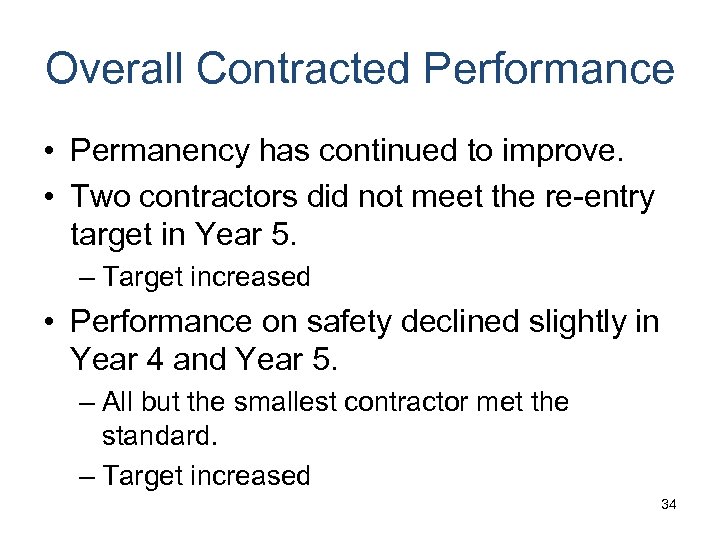
Overall Contracted Performance • Permanency has continued to improve. • Two contractors did not meet the re-entry target in Year 5. – Target increased • Performance on safety declined slightly in Year 4 and Year 5. – All but the smallest contractor met the standard. – Target increased 34
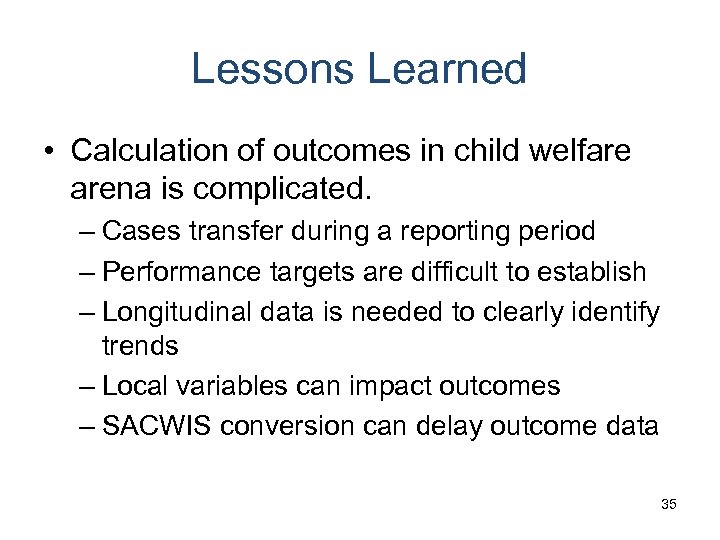
Lessons Learned • Calculation of outcomes in child welfare arena is complicated. – Cases transfer during a reporting period – Performance targets are difficult to establish – Longitudinal data is needed to clearly identify trends – Local variables can impact outcomes – SACWIS conversion can delay outcome data 35
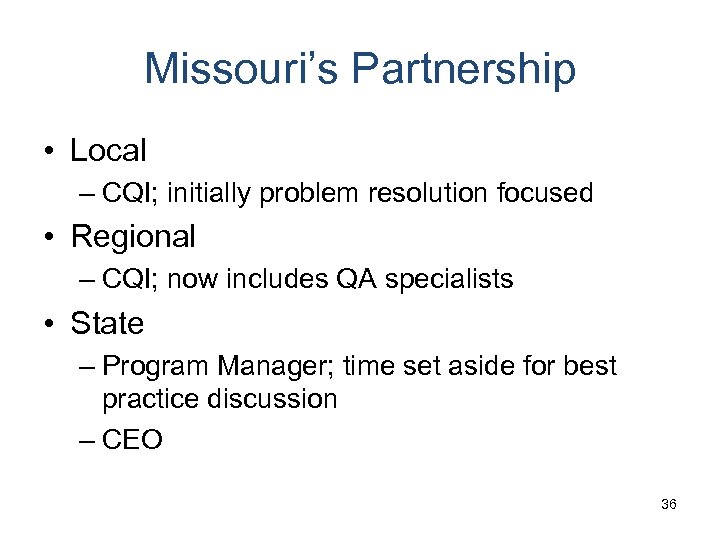
Missouri’s Partnership • Local – CQI; initially problem resolution focused • Regional – CQI; now includes QA specialists • State – Program Manager; time set aside for best practice discussion – CEO 36
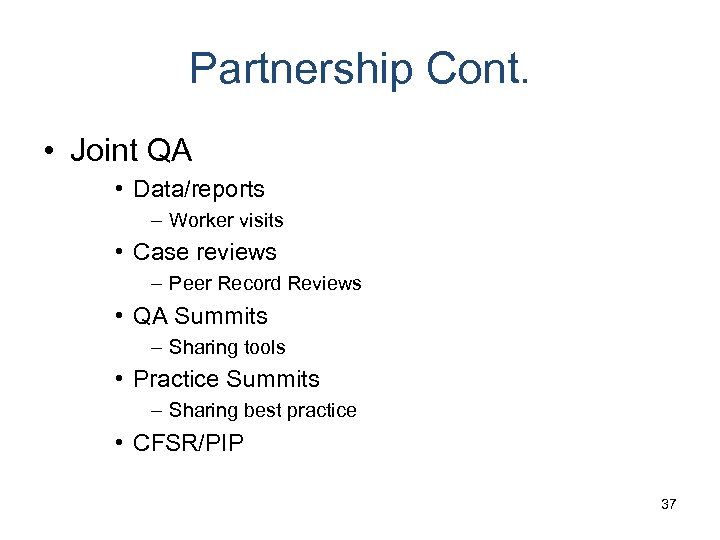
Partnership Cont. • Joint QA • Data/reports – Worker visits • Case reviews – Peer Record Reviews • QA Summits – Sharing tools • Practice Summits – Sharing best practice • CFSR/PIP 37
Lessons Learned • Problem resolution needs to begin at local level. • QA activities need to be joined to have the greatest impact. • COLLABORATION=PARTNERSHIP 38
Скачать презентацию The Road to Performance Based Case Management Contracts
41e6b664bd95b2ef647dde38bb4aa02e.ppt