


 Скачать презентацию The Road to Economic Freedom MADELEINE WILL Founder
182976430e7c27638157b284fa16b598.ppt
- Количество слайдов: 20
 The Road to Economic Freedom MADELEINE WILL Founder, Collaboration to Promote Self-Determination University of Memphis, TN OCTOBER 30, 2015
 The Tennessee Alliance for Postsecondary Opportunities for Students With Intellectual and Developmental Disabilities Hosted by the Tiger. Life Program University of Memphis Memphis, TN
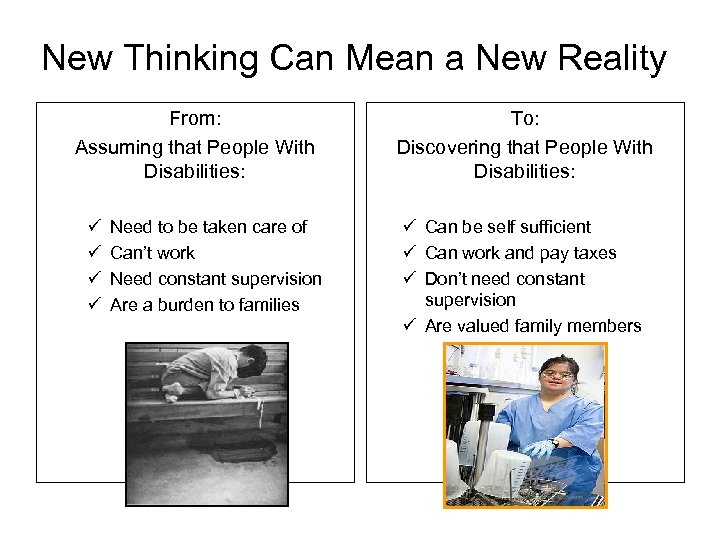 New Thinking Can Mean a New Reality From: Assuming that People With Disabilities: ü ü Need to be taken care of Can’t work Need constant supervision Are a burden to families To: Discovering that People With Disabilities: ü Can be self sufficient ü Can work and pay taxes ü Don’t need constant supervision ü Are valued family members
 LRE Data - Decades of Lessons Maryland Coalition for Inclusive Education (MCIE) Inclusion Works! Survey of research over a 20 year period by Xuan Bui, Carol Quirk, Selene Almazon, Michael Valenti (2010) Findings include: • • More instruction generally and addressed content more often with students with disabilities (Curry, Brennan, Sampson-Saul, 1998) Small- to positive academic gains for students with high incidence disabilities (Baker, Wang & Walberg, 1004; Waldron, Cole and Majid, 2001) Academic gains for students with significant disabilities (Hunt & Ferron. Davis, 1992) More students without disabilities made comparable or greater gains in math and reading when taught in inclusive settings versus traditional classrooms where no students with disabilities are included (Waldron, Cole, and Majd, 2001)
 LRE DATA from MCIE Meta-Analysis (cont. ) National Longitudinal Transition Study (NTLS-2) • • Mandated by Congress and funded by the US Department of Education Studied 501 LEAs and 38 special schools Involved over 11, 000 students with a broad range of disabilities from 2000 to 2009 Over nine years and five “waves” of data collection Findings highlighted better outcomes after high school in areas of employment and independent living, including more employment, higher wages, hours worked when student was educated in inclusive classroom www. ntls 2. org
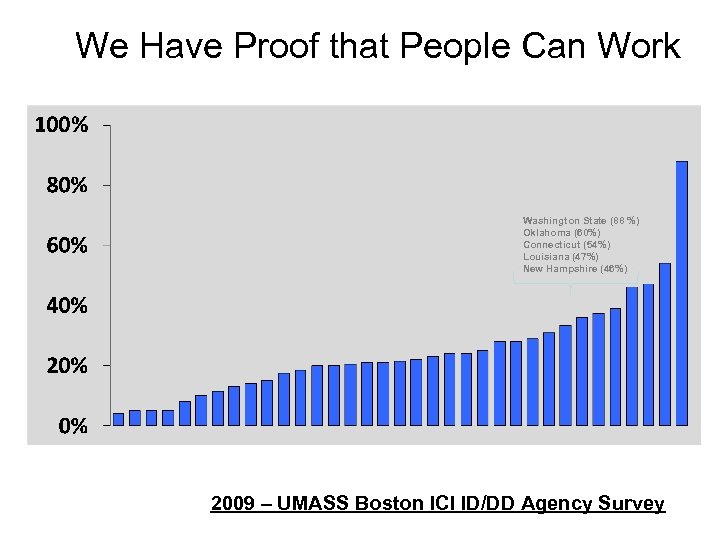 We Have Proof that People Can Work Washington State (88 %) Oklahoma (60%) Connecticut (54%) Louisiana (47%) New Hampshire (46%) 2009 – UMASS Boston ICI ID/DD Agency Survey
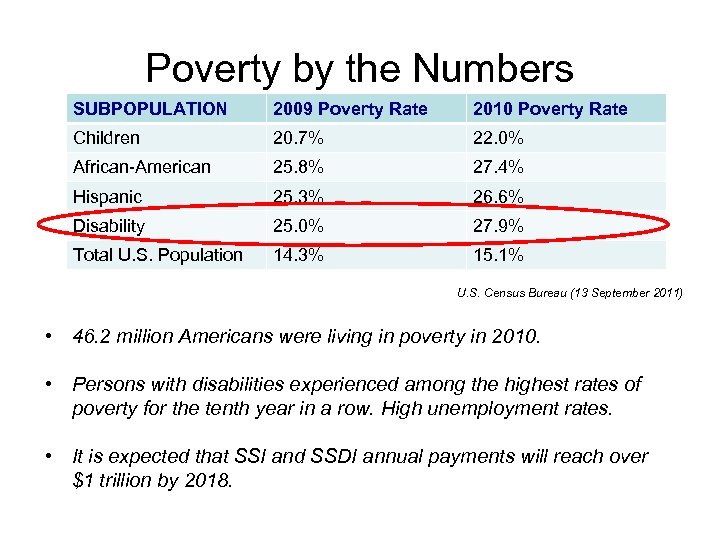 Poverty by the Numbers SUBPOPULATION 2009 Poverty Rate 2010 Poverty Rate Children 20. 7% 22. 0% African-American 25. 8% 27. 4% Hispanic 25. 3% 26. 6% Disability 25. 0% 27. 9% Total U. S. Population 14. 3% 15. 1% U. S. Census Bureau (13 September 2011) • 46. 2 million Americans were living in poverty in 2010. • Persons with disabilities experienced among the highest rates of poverty for the tenth year in a row. High unemployment rates. • It is expected that SSI and SSDI annual payments will reach over $1 trillion by 2018.
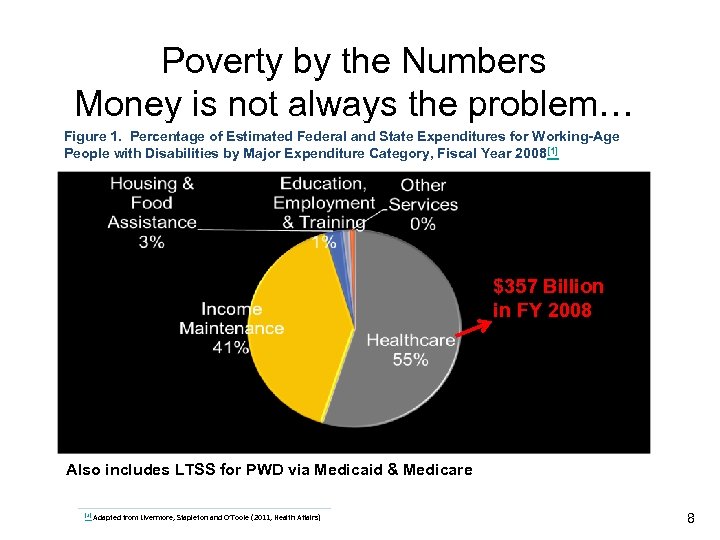 Poverty by the Numbers Money is not always the problem… Figure 1. Percentage of Estimated Federal and State Expenditures for Working-Age People with Disabilities by Major Expenditure Category, Fiscal Year 2008 [1] $357 Billion in FY 2008 Also includes LTSS for PWD via Medicaid & Medicare [1] Adapted from Livermore, Stapleton and O’Toole (2011, Health Affairs) 8
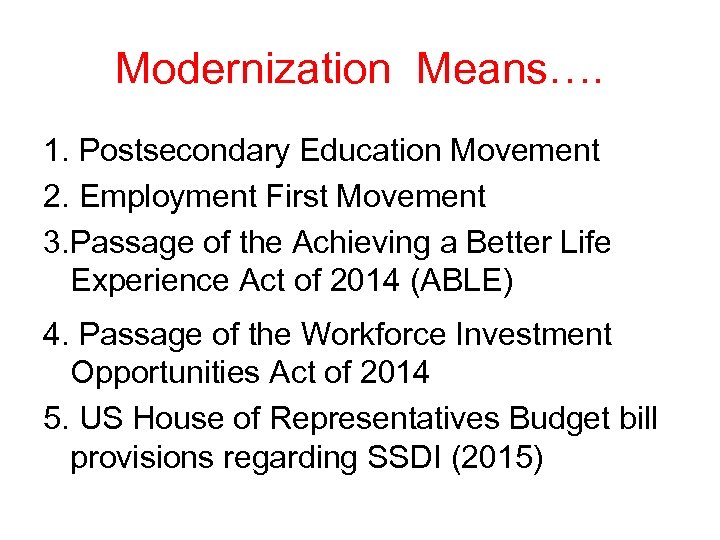 Modernization Means…. 1. Postsecondary Education Movement 2. Employment First Movement 3. Passage of the Achieving a Better Life Experience Act of 2014 (ABLE) 4. Passage of the Workforce Investment Opportunities Act of 2014 5. US House of Representatives Budget bill provisions regarding SSDI (2015)
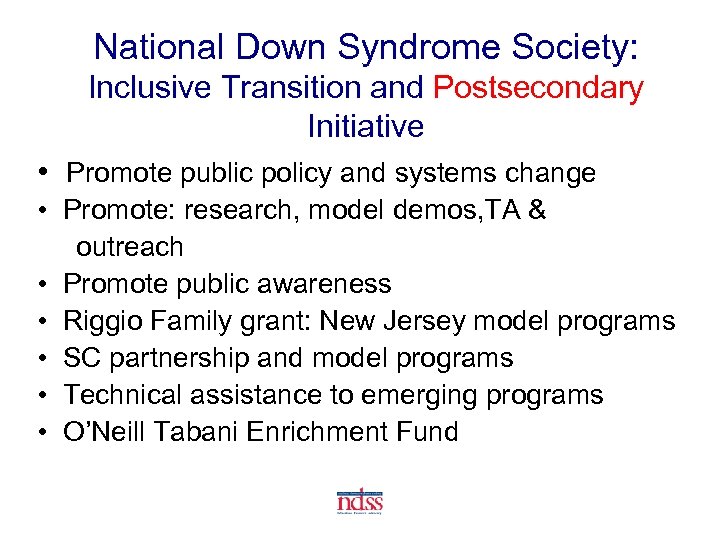 National Down Syndrome Society: Inclusive Transition and Postsecondary Initiative • Promote public policy and systems change • Promote: research, model demos, TA & outreach • Promote public awareness • Riggio Family grant: New Jersey model programs • SC partnership and model programs • Technical assistance to emerging programs • O’Neill Tabani Enrichment Fund
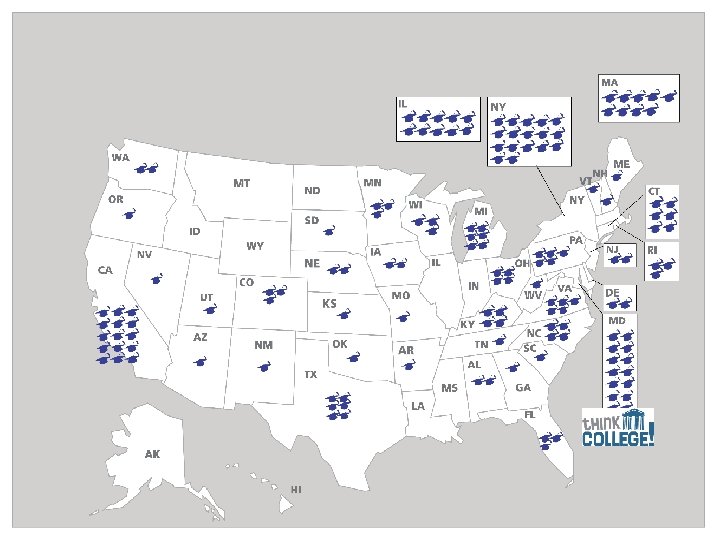
 Higher Education Opportunity Act 2008 • • • New eligibility for Financial Aid Model Demonstration Programs Coordinating Center at Think College
 Eligibility for Work-Study Jobs, Pell and SEOP Grants • Must meet definition of student with intellectual disability • Be enrolled or accepted for enrollment in a comprehensive…program • Be maintaining satisfactory progress in the program as determined by the IHE, in accordance with standards set by IHE
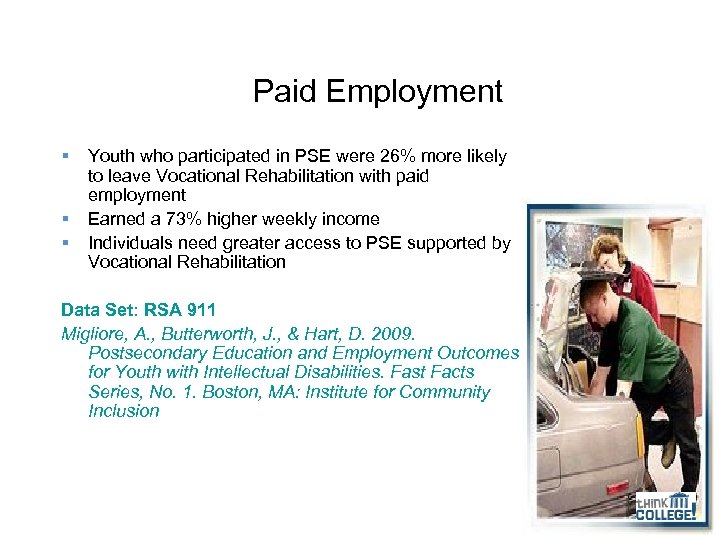 Paid Employment § § § Youth who participated in PSE were 26% more likely to leave Vocational Rehabilitation with paid employment Earned a 73% higher weekly income Individuals need greater access to PSE supported by Vocational Rehabilitation Data Set: RSA 911 Migliore, A. , Butterworth, J. , & Hart, D. 2009. Postsecondary Education and Employment Outcomes for Youth with Intellectual Disabilities. Fast Facts Series, No. 1. Boston, MA: Institute for Community Inclusion
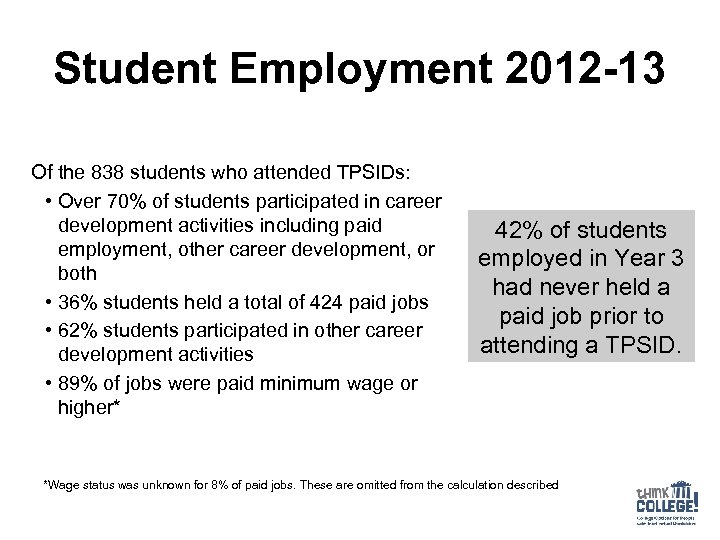 Student Employment 2012 -13 Of the 838 students who attended TPSIDs: • Over 70% of students participated in career development activities including paid employment, other career development, or both • 36% students held a total of 424 paid jobs • 62% students participated in other career development activities • 89% of jobs were paid minimum wage or higher* 42% of students employed in Year 3 had never held a paid job prior to attending a TPSID. *Wage status was unknown for 8% of paid jobs. These are omitted from the calculation described
 Employment First Activity • Preferred outcome must be competitive, integrated employment • 32 states have formal policy action— legislation, executive order or directive • 46 states have some activity underway • Some states focus on cross disability populations—others on a single disability • Much collaboration across agencies
 Workforce Investment Opportunities Act of 2014 Massive overhaul of workforce system change over time
 The Stephen H. Beck Achieving a Better Life Experience Act of 2014 Transformative tax advantaged savings account both in terms of concept and impact
 US House of Representatives’ Budget Bill of October 2015 Coherent and systemic focus on disincentives in SSDI and SSI programs
 Thank you friends and colleagues from Tennessee for accepting the challenge of leading the way down the road to personal and economic freedom for persons with disabilities. Not another generation in poverty!