


 Скачать презентацию The Road to Dignity ending poverty transforming lives
e90eed90c8337d732a63719d8bf9c917.ppt
- Количество слайдов: 36
 The Road to Dignity: ending poverty, transforming lives and protecting the planet Ilaria Carnevali and Luca Monge Roffarello UNDP Cabo Verde Praia, Cabo Verde, 9 march 2017
 Structure of the presentation I. Intro / Poverty and SDGs II. Poverty and related concepts III. Poverty trends: up to date facts & figures globally and for Africa/Challenges and consequences of inaction IV. Tackling poverty in Africa V. The role of trade unions
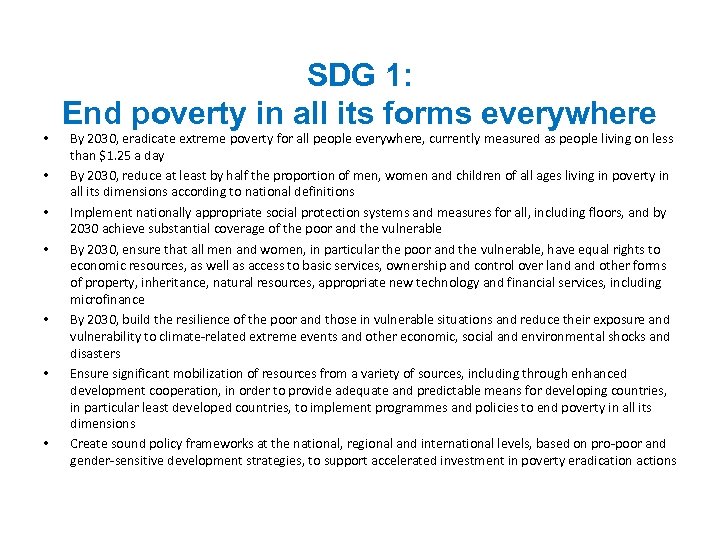 • • SDG 1: End poverty in all its forms everywhere By 2030, eradicate extreme poverty for all people everywhere, currently measured as people living on less than $1. 25 a day By 2030, reduce at least by half the proportion of men, women and children of all ages living in poverty in all its dimensions according to national definitions Implement nationally appropriate social protection systems and measures for all, including floors, and by 2030 achieve substantial coverage of the poor and the vulnerable By 2030, ensure that all men and women, in particular the poor and the vulnerable, have equal rights to economic resources, as well as access to basic services, ownership and control over land other forms of property, inheritance, natural resources, appropriate new technology and financial services, including microfinance By 2030, build the resilience of the poor and those in vulnerable situations and reduce their exposure and vulnerability to climate related extreme events and other economic, social and environmental shocks and disasters Ensure significant mobilization of resources from a variety of sources, including through enhanced development cooperation, in order to provide adequate and predictable means for developing countries, in particular least developed countries, to implement programmes and policies to end poverty in all its dimensions Create sound policy frameworks at the national, regional and international levels, based on pro poor and gender sensitive development strategies, to support accelerated investment in poverty eradication actions
 Poverty and related concepts What is poverty? • Does not have a single definition; • It changes over time in order to capture new realities • It can take on a multitude of meanings. The World Bank defined poverty in 2000 as a “pronounced deprivation in well being”.
 Poverty and related concepts. . • But then. . What is well being? Several things contribute to our well being • Ability to eat, but also with personal relations, with the community • It has to do with health, nutrition of our children, with the possession of goods • It implies security, freedom, happiness, etc. • And besides, we all have different perceptions of our well being and/or deprivation
 Perception of poverty: examples • When a person is poor, she has no opinion in public. She feels inferior. There's no food and there is hunger in the house; There's no clothing, and there is no progress in the house (Women of Uganda); • When there was plenty of food, people shared. In these days of hunger no even your family would help by giving you some food (young of Zambia); • "When my husband died, my in laws sent me away. So I had to move into the town and sleep on the floor "(a widow of Kenya).
 Definition has evolved. . Throughout history measurement and evaluation of poverty has changed: • The first approach to be developed was one that looked only to the aspects of income or consumption • However there are many other aspects that affect the human dignity, therefore your well being, which led to the emergence of new methodologies of measurement and evaluation
 • Absolute poverty refers to a state in which individual lack the resources necessary for subsistence. This requires ‘minimum’ income to buy neces sities of life. • Relative poverty refers to individuals or groups lack of resources when compared with that of other members of the society—in other words, their relative standard of living. ’
 One dimensional approach Most one dimensional poverty assessment methodologies are based on consumption or income and have the following characteristics: • Identification of indicator (ex. consumption. ) • Calculation of the poverty line (what is the cost of a basic basket of food and non food goods? ) • Calculating the poverty rate = % of people living below the poverty line Since 2015 the WB uses a threshold of 1. 9 USD a day (PPP 2011).
 Multidimensional approach • Over time new approaches have tried to encompass other dimensions of deprivation. • A big influence in this process was the capabilities theory, cited by Amartya Sen: – Presents the argument that a person can be poor for not having access to basic services and also for not having freedom of choice between different kinds of life that person has reason to value (Capability Approach) – This goes well beyond the observation of income/consumption. Considers the social, cultural and political characteristics that influence the quality of people life.
 Multidimensional approach. . The first approach "multidimensional" that earned interest at international level was the UNDP Human Development Index (HDI) The HDI considers the following dimensions: • Longevity (life expectancy at birth) • Education (the adult illiteracy rate and rate of enrollments of primary, secondary and higher education levels) • Income (GDP per capita)
 Multidimensional approach In recent years, many multidimensional approaches have been developed • Covering many more dimensions (child mortality, nutrition, average year of schooling, material well being like electricity, potable water, sanitations, fuel for cooking etc. . ) • Developing techniques for the aggregation of the same A largely used method is the “multidimensional poverty index” developed by Oxford University.
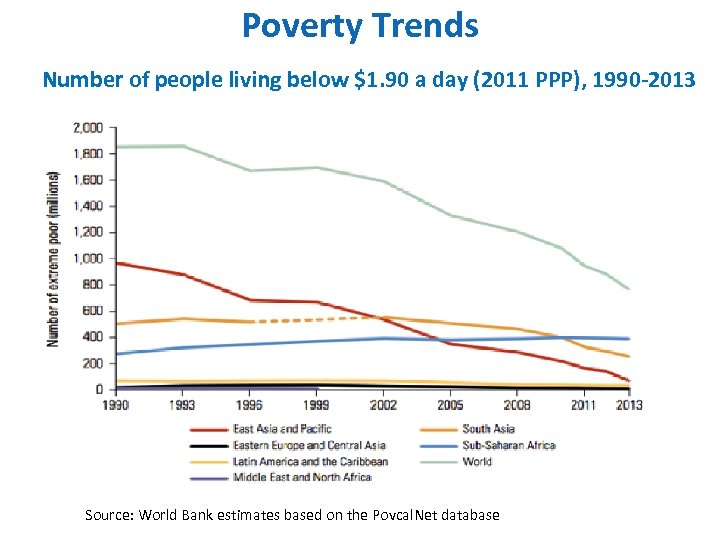 Poverty Trends Number of people living below $1. 90 a day (2011 PPP), 1990 -2013 Source: World Bank estimates based on the Povcal. Net database
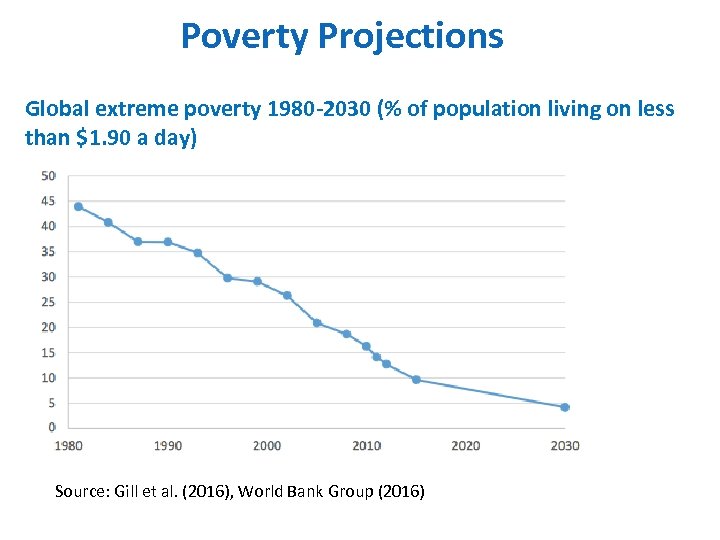 Poverty Projections Global extreme poverty 1980 -2030 (% of population living on less than $1. 90 a day) Source: Gill et al. (2016), World Bank Group (2016)
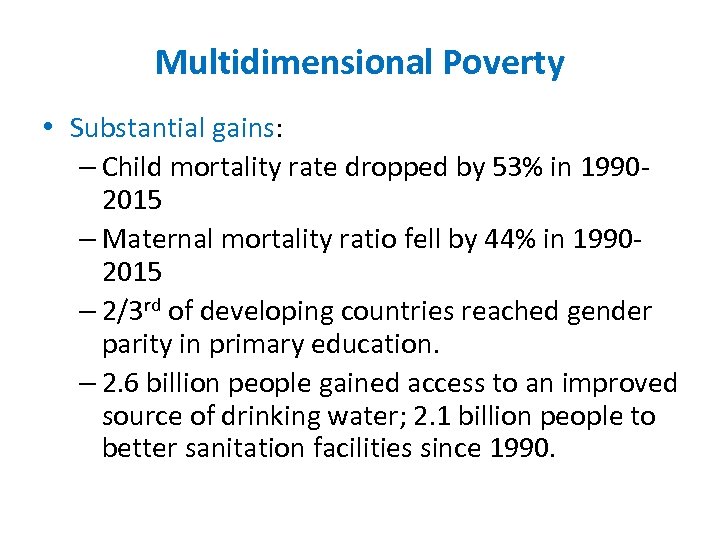 Multidimensional Poverty • Substantial gains: – Child mortality rate dropped by 53% in 1990 2015 – Maternal mortality ratio fell by 44% in 1990 2015 – 2/3 rd of developing countries reached gender parity in primary education. – 2. 6 billion people gained access to an improved source of drinking water; 2. 1 billion people to better sanitation facilities since 1990.
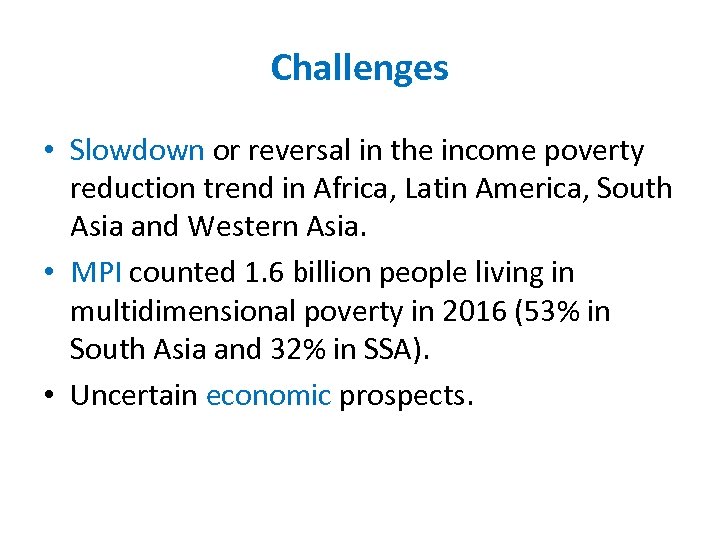 Challenges • Slowdown or reversal in the income poverty reduction trend in Africa, Latin America, South Asia and Western Asia. • MPI counted 1. 6 billion people living in multidimensional poverty in 2016 (53% in South Asia and 32% in SSA). • Uncertain economic prospects.
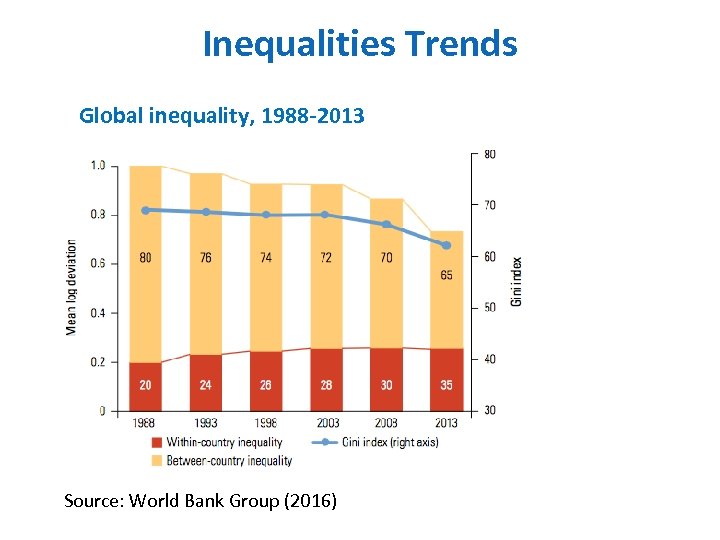 Inequalities Trends Global inequality, 1988 -2013 Source: World Bank Group (2016)
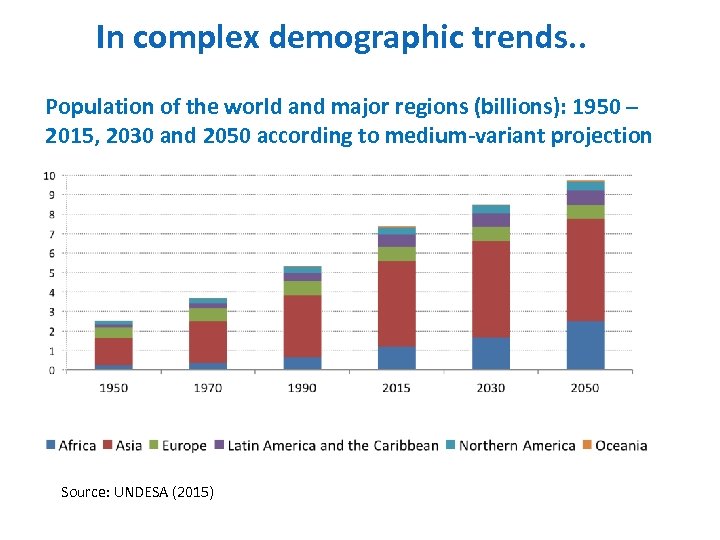 In complex demographic trends. . Population of the world and major regions (billions): 1950 – 2015, 2030 and 2050 according to medium-variant projection Source: UNDESA (2015)
 And acute environmental degradation and Climate Change • Major environmental trends on degradation of air and land, water scarcity, deforestation, marine pollution and decline in biodiversity, among others. • Examples: – 92% of the global population living in places where air pollution levels exceed WHO limits – Premature mortality is projected to double by 2050 due to air pollutants – Half of the world’s population projected to live in water stressed areas by 2025
 And acute environmental degradation and Climate Change… • Land degradation – affects 1. 5 billion people globally – may reduce global food production by 12% in the next two decades (30% rise in food prices) • Over the past 25 years the rate of global deforestation has slowed down – still alarmingly high e. g. in Africa and South America – If current trends continue, up to 170 million hectares of forests could be lost by 2030 • Half of the world’s population projected to live in water-stressed areas by 2025
 . . that also intensify inequalities – climate change and environmental degradation disproportionately impact on the most vulnerable countries and communities – The population living in extreme poverty could increase by 122 million by 2030 due to climate change – The cost of recovering from natural hazards is particularly high in SIDS and LDCs
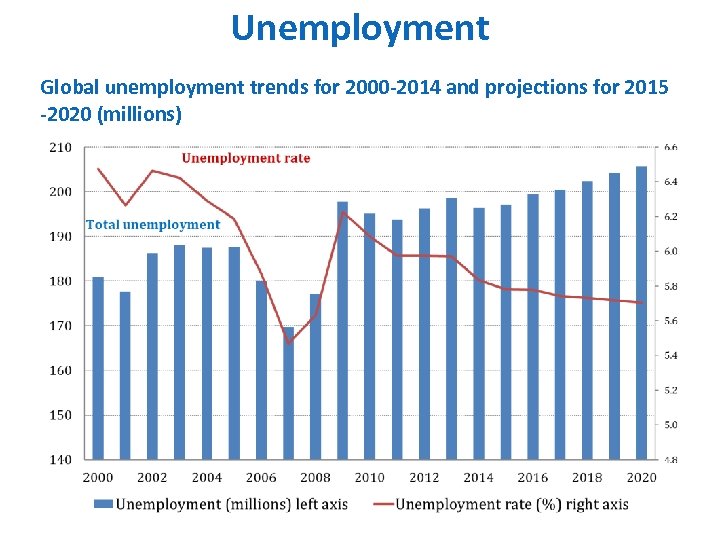 Unemployment Global unemployment trends for 2000 -2014 and projections for 2015 -2020 (millions)
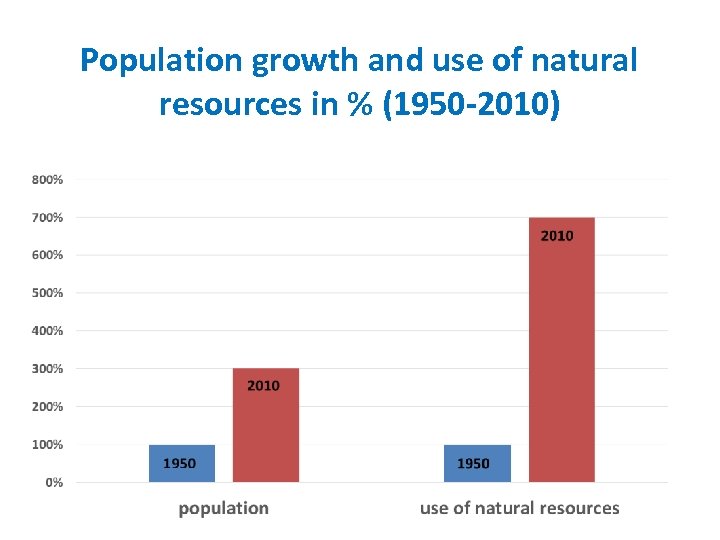 Population growth and use of natural resources in % (1950 -2010)
 So. . how to tackle poverty in Africa?
 How to tackle poverty in Africa? • There is no silver bullet to ending poverty, and strategies to reach the poor must be tailored to each country’s context • We know that economic growth must be “inclusive” (thus labor intensive) and generator of productive and decent employment. • That growth must be also be “Green” to be sustainable: changes in production and consumption patterns and energy use through legislation, regulation and public policies are required
 How to tackle poverty in Africa? • That social policy and scaled up public interventions are needed in: – people’s health, education, nutrition, and sanitation – effective safety net and social protection programs – gender equality • That increase investments in disaster and climate risk reduction and adaptive disaster responses is key for resilience and irreversibility of gains • And that we must reduce Hunger and Food Insecurity through sustainable agricultural productivity, and equitable access to food, assets and resources
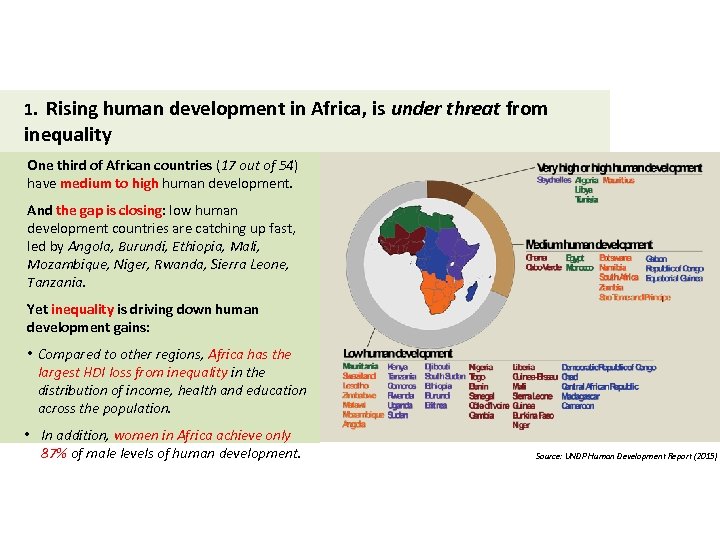 1. Rising human development in Africa, is under threat from inequality One third of African countries (17 out of 54) have medium to high human development. And the gap is closing: low human development countries are catching up fast, led by Angola, Burundi, Ethiopia, Mali, Mozambique, Niger, Rwanda, Sierra Leone, Tanzania. Yet inequality is driving down human development gains: • Compared to other regions, Africa has the largest HDI loss from inequality in the distribution of income, health and education across the population. • In addition, women in Africa achieve only 87% of male levels of human development. Source: UNDP Human Development Report (2015)
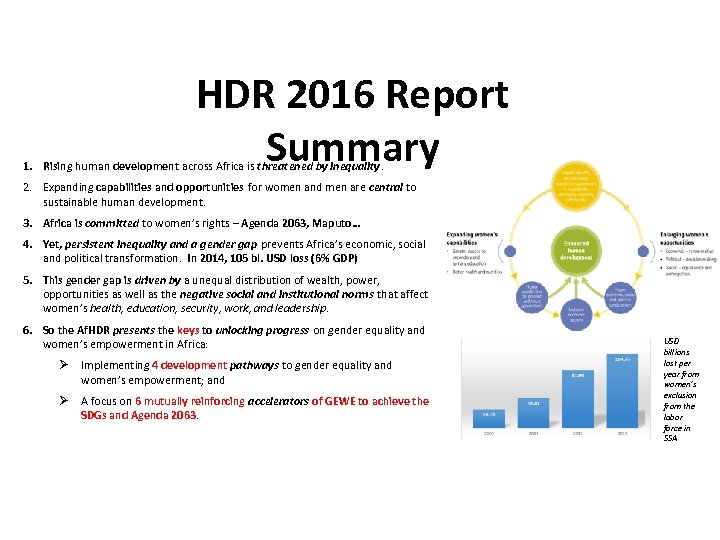 HDR 2016 Report Summary 1. Rising human development across Africa is threatened by inequality. 2. Expanding capabilities and opportunities for women and men are central to sustainable human development. 3. Africa is committed to women’s rights – Agenda 2063, Maputo… 4. Yet, persistent inequality and a gender gap prevents Africa’s economic, social and political transformation. In 2014, 105 bl. USD loss (6% GDP) 5. This gender gap is driven by a unequal distribution of wealth, power, opportunities as well as the negative social and institutional norms that affect women’s health, education, security, work, and leadership. 6. So the Af. HDR presents the keys to unlocking progress on gender equality and women’s empowerment in Africa: Ø Implementing 4 development pathways to gender equality and women’s empowerment; and Ø A focus on 6 mutually reinforcing accelerators of GEWE to achieve the SDGs and Agenda 2063. USD billions lost per year from women’s exclusion from the labor force in SSA
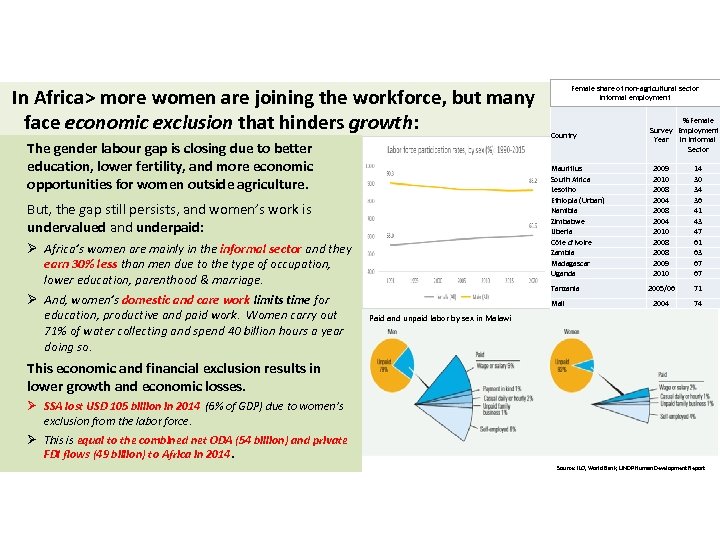 In Africa> more women are joining the workforce, but many face economic exclusion that hinders growth: The gender labour gap is closing due to better education, lower fertility, and more economic opportunities for women outside agriculture. Country Mauritius South Africa Lesotho Ethiopia (Urban) Namibia Zimbabwe Liberia Côte d'Ivoire Zambia Madagascar Uganda But, the gap still persists, and women’s work is undervalued and underpaid: Ø Africa’s women are mainly in the informal sector and they earn 30% less than men due to the type of occupation, lower education, parenthood & marriage. Ø And, women’s domestic and care work limits time for education, productive and paid work. Women carry out 71% of water collecting and spend 40 billion hours a year doing so. Female share of non agricultural sector informal employment Tanzania Mali % Female Survey Employment Year in Informal Sector 2009 2010 2008 2004 2010 2008 2009 2010 14 30 34 36 41 43 47 61 63 67 67 2005/06 71 2004 74 Paid and unpaid labor by sex in Malawi This economic and financial exclusion results in lower growth and economic losses. Ø SSA lost USD 105 billion in 2014 (6% of GDP) due to women’s exclusion from the labor force. Ø This is equal to the combined net ODA (54 billion) and private FDI flows (49 billion) to Africa in 2014. Source: ILO, World Bank, UNDP Human Development Report
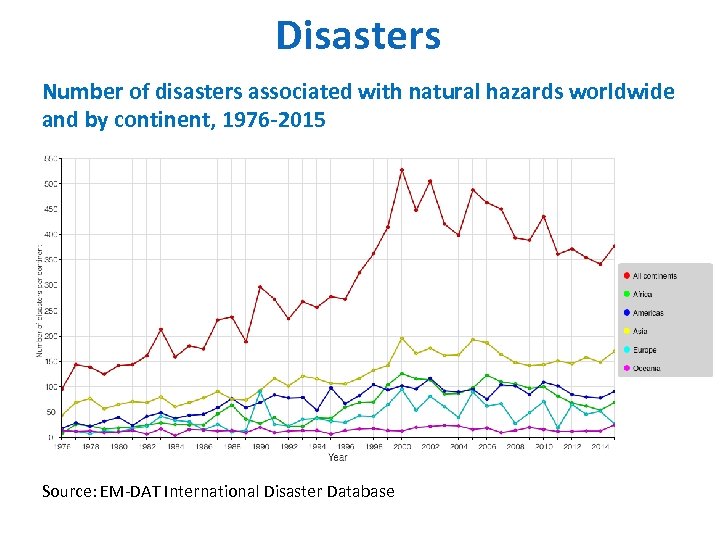 Disasters Number of disasters associated with natural hazards worldwide and by continent, 1976 -2015 Source: EM DAT International Disaster Database
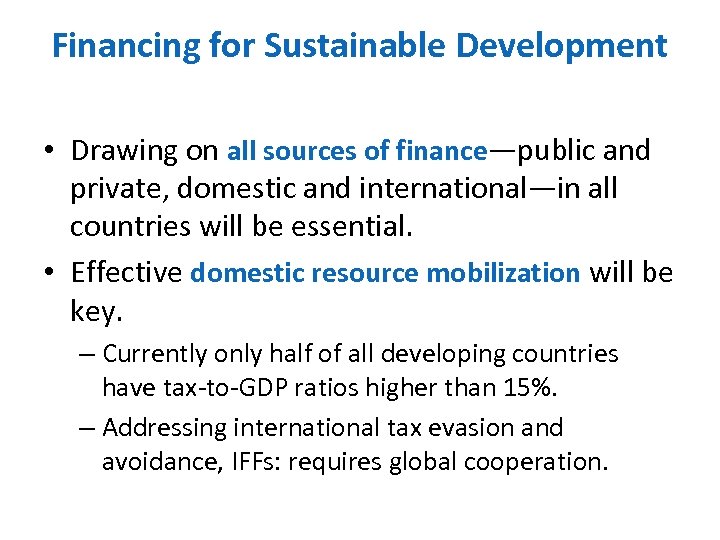 Financing for Sustainable Development • Drawing on all sources of finance—public and private, domestic and international—in all countries will be essential. • Effective domestic resource mobilization will be key. – Currently only half of all developing countries have tax to GDP ratios higher than 15%. – Addressing international tax evasion and avoidance, IFFs: requires global cooperation.
 SDGs Critical Paths in Africa: gross Multipliers
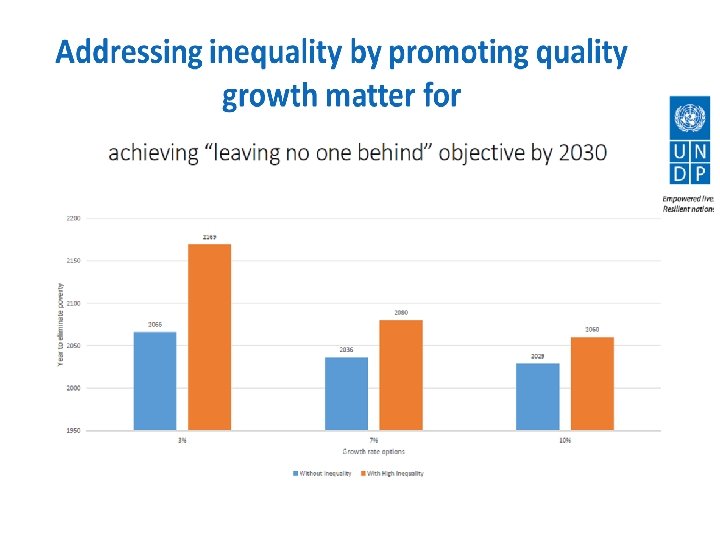
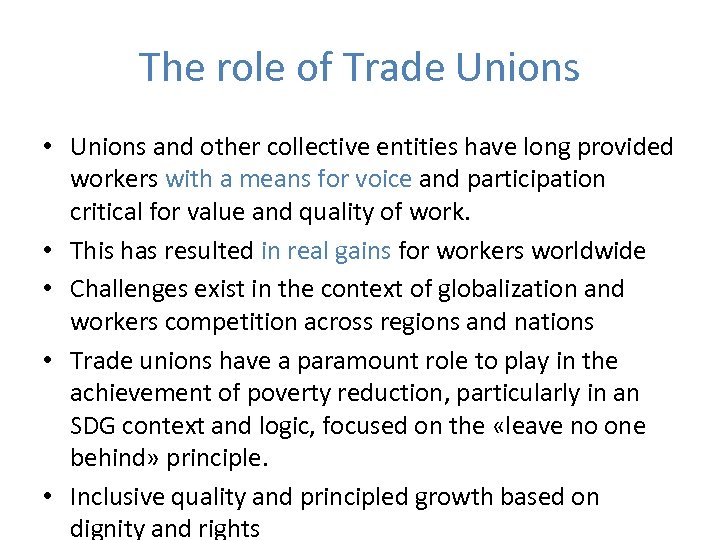 The role of Trade Unions • Unions and other collective entities have long provided workers with a means for voice and participation critical for value and quality of work. • This has resulted in real gains for workers worldwide • Challenges exist in the context of globalization and workers competition across regions and nations • Trade unions have a paramount role to play in the achievement of poverty reduction, particularly in an SDG context and logic, focused on the «leave no one behind» principle. • Inclusive quality and principled growth based on dignity and rights
 Thank you