 Скачать презентацию The Risks of Sovereign Finance Ugo Panizza Debt
8f0944c8a3f1a71a9032cc51db4ccf16.ppt
- Количество слайдов: 33



The Risks of Sovereign Finance Ugo Panizza Debt and Finance Analysis Unit DGDS UNCTAD http: //upanizza. googlepages. com
Outline • The risks of sovereign finance • Debt structure matters • Debt Sustainability Analysis
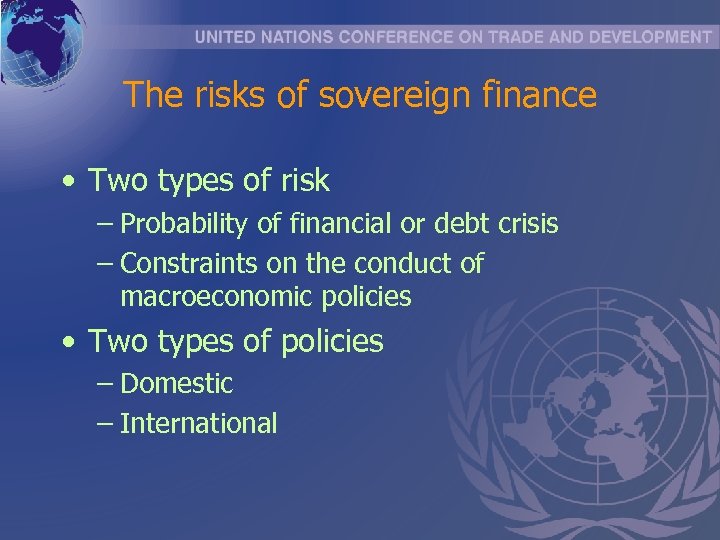
The risks of sovereign finance • Two types of risk – Probability of financial or debt crisis – Constraints on the conduct of macroeconomic policies • Two types of policies – Domestic – International
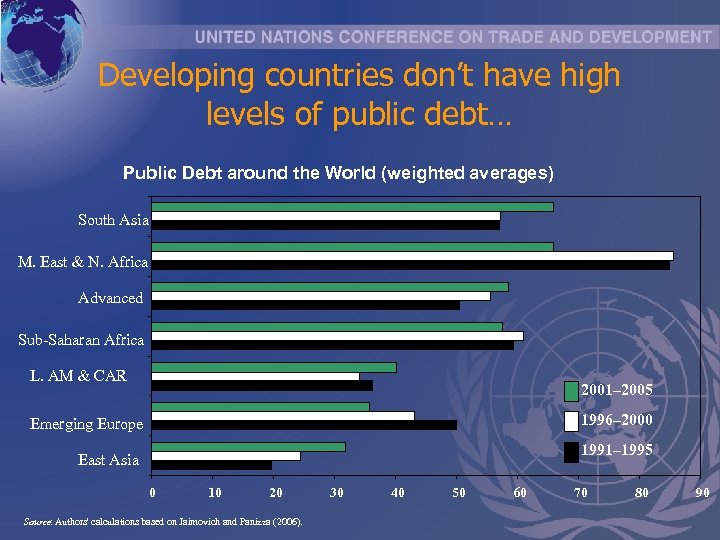
Developing countries don’t have high levels of public debt… Public Debt around the World (weighted averages) South Asia M. East & N. Africa Advanced Sub-Saharan Africa L. AM & CAR 2001– 2005 1996– 2000 Emerging Europe 1991– 1995 East Asia 0 10 20 Source Authors' calculations based on Jaimovich and Panizza (2006). : 30 40 50 60 70 80 90
Developing countries don’t have high levels of public debt… • …and yet, they tend to have low credit ratings • …and are the object of recurrent debt crises…
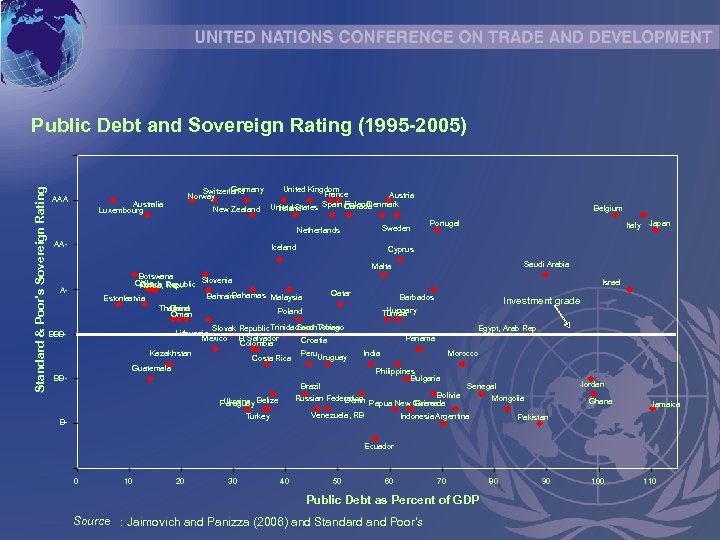
Standard & Poor's Sovereign Rating Public Debt and Sovereign Rating (1995 -2005) AAA Germany Switzerland Norway Australia Luxembourg New Zealand United Kingdom France Austria Denmark Canada United States Spain Finland Ireland Sweden Netherlands AA- Iceland Belgium Portugal Italy Cyprus Saudi Arabia Malta Botswana Slovenia Chile Czech Rep. Korea, Republic Bahamas Malaysia Bahrain Estonia Latvia Thailand China Poland Oman A- Israel Qatar BB- Egypt, Arab Rep. India Morocco Philippines Bulgaria Bolivia Papua New Guinea Grenada Venezuela, RB Turkey Investment grade Panama Brazil Russian Federation Benin Ukraine Paraguay Belize B- Barbados Hungary Tunisia South Africa Slovak Republic Trinidad and Tobago Lithuania Mexico El Salvador Croatia Colombia Kazakhstan Peru. Uruguay Costa Rica Guatemala BBB- Japan Jordan Senegal Mongolia Indonesia Argentina Ghana Jamaica Pakistan Ecuador 0 10 20 30 40 50 60 70 Public Debt as Percent of GDP Source : Jaimovich and Panizza (2006) and Standard and Poor's 80 90 100 110
Developing countries don’t have high levels of public debt… • …and yet tend to have low credit rating. • …and are the object of recurrent debt crises… • Why is it so? • Something may have to do with debt structure rather than debt levels
Outline • The risks of sovereign finance • Debt structure matters • Debt Sustainability Analysis
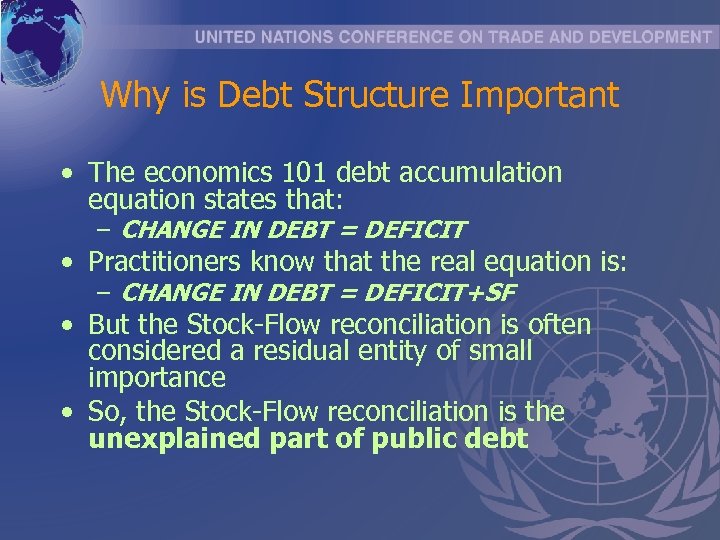
Why is Debt Structure Important • The economics 101 debt accumulation equation states that: – CHANGE IN DEBT = DEFICIT • Practitioners know that the real equation is: – CHANGE IN DEBT = DEFICIT+SF • But the Stock-Flow reconciliation is often considered a residual entity of small importance • So, the Stock-Flow reconciliation is the unexplained part of public debt
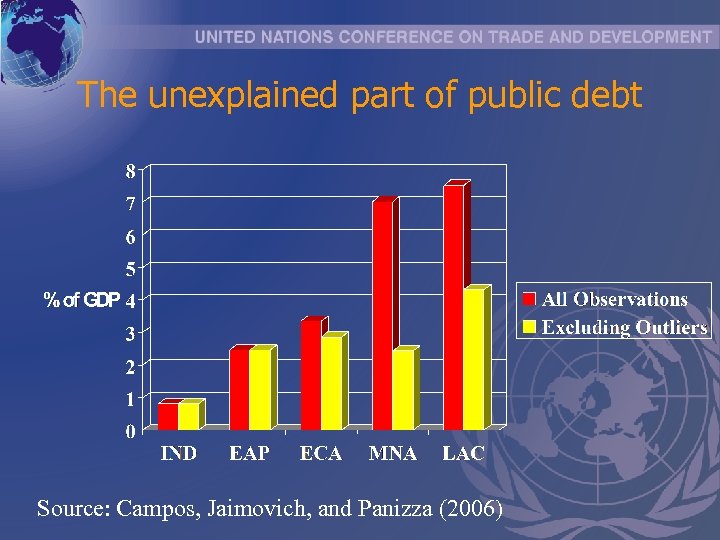
The unexplained part of public debt Source: Campos, Jaimovich, and Panizza (2006)
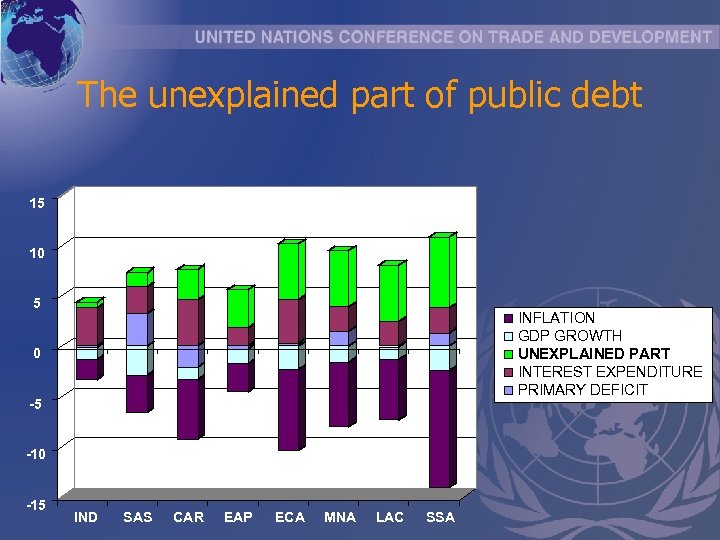
The unexplained part of public debt 15 10 5 INFLATION GDP GROWTH UNEXPLAINED PART INTEREST EXPENDITURE PRIMARY DEFICIT 0 -5 -10 -15 IND SAS CAR EAP ECA MNA LAC SSA
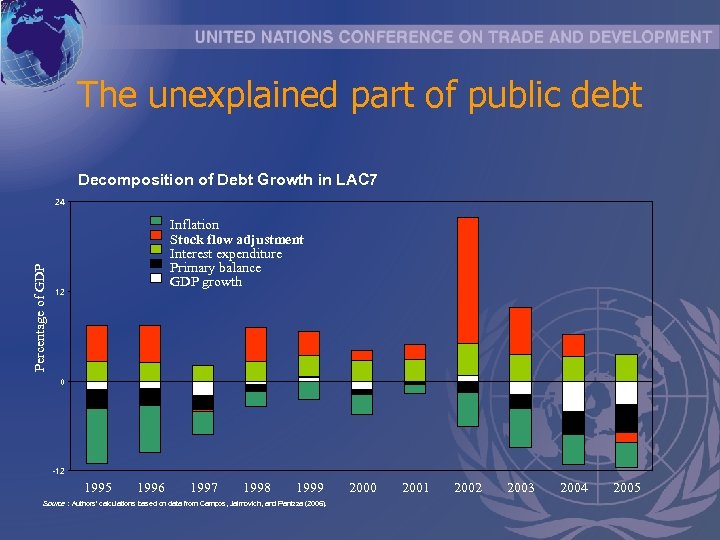
The unexplained part of public debt Decomposition of Debt Growth in LAC 7 Percentage of GDP 24 Inflation Stock flow adjustment Interest expenditure Primary balance GDP growth 12 0 -12 1995 1996 1997 1998 1999 Source : Authors' calculations based on data from Campos, Jaimovich, and Panizza (2006). 2000 2001 2002 2003 2004 2005
The unexplained part of debt • What explains the “Unexplained part of debt” – Skeletons • Fiscal policy matters! – Banking Crises – Defaults – Balance Sheet Effects due to debt composition
A tale of two devaluations
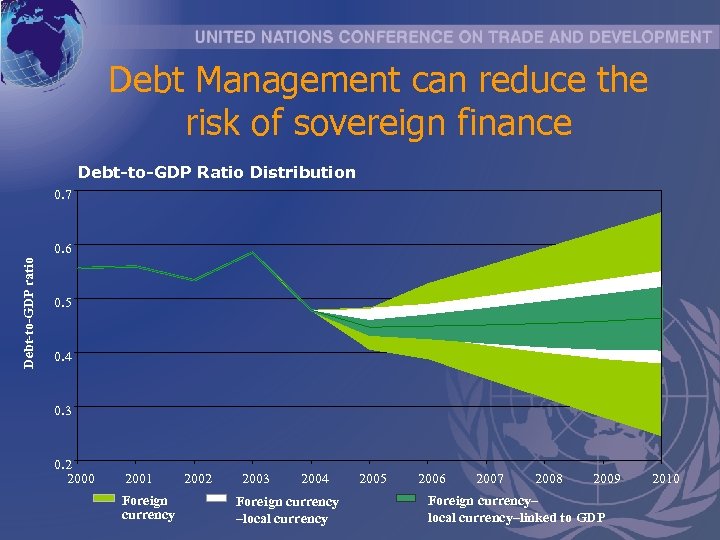
Debt Management can reduce the risk of sovereign finance Debt-to-GDP Ratio Distribution 0. 7 Debt-to-GDP ratio 0. 6 0. 5 0. 4 0. 3 0. 2 2000 2001 Foreign currency 2002 2003 2004 Foreign currency –local currency 2005 2006 2007 2008 2009 Foreign currency– local currency–linked to GDP 2010
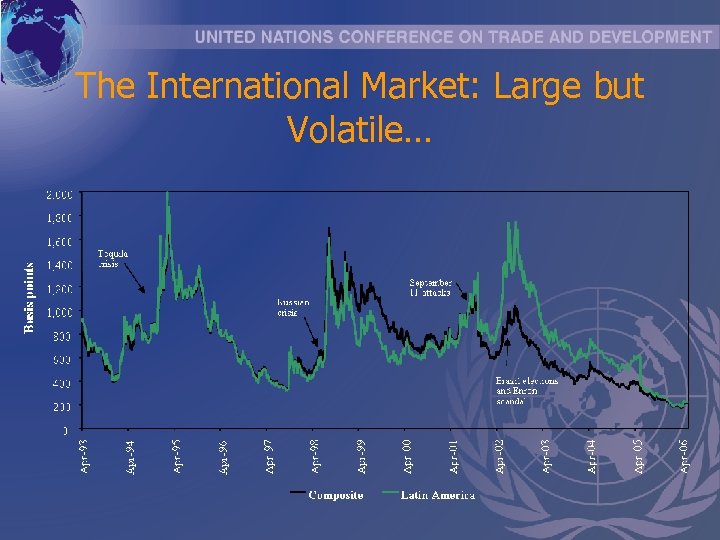
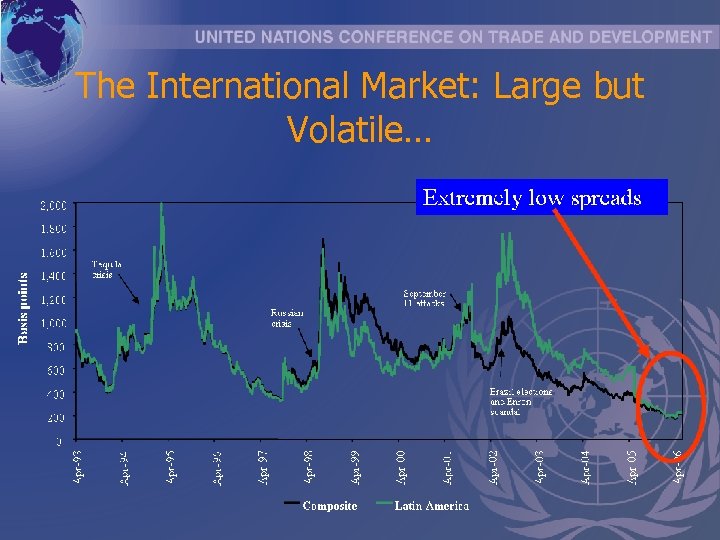
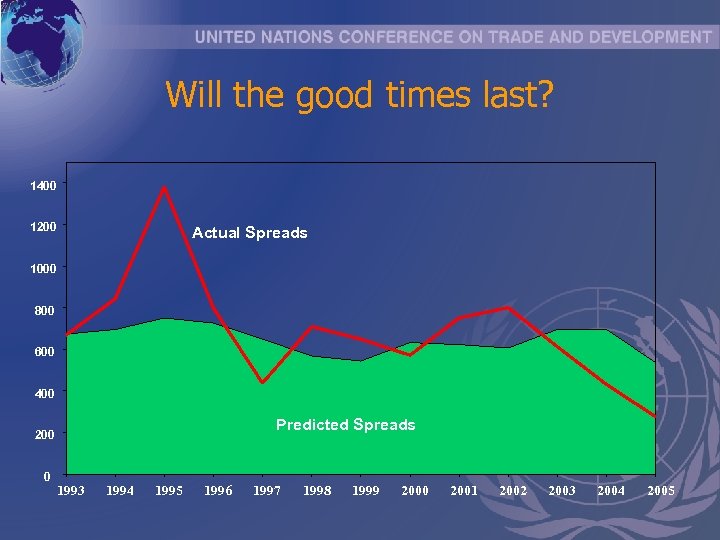
The problems with foreign borrowing • One problem has to do with the fact that foreign borrowing tend to be in foreign currency – Original sin • Another problem is that the international interest rate is very volatile – Only a problem for EM
The International Market: Large but Volatile…
The International Market: Large but Volatile…
Will the good times last? 1400 1200 Actual Spreads 1000 800 600 400 Predicted Spreads 200 0 1993 1994 1995 1996 1997 1998 1999 2000 2001 2002 2003 2004 2005
Mark Twain’s quote
Outline • The risks of sovereign finance • Debt structure matters • Debt Sustainability Analysis
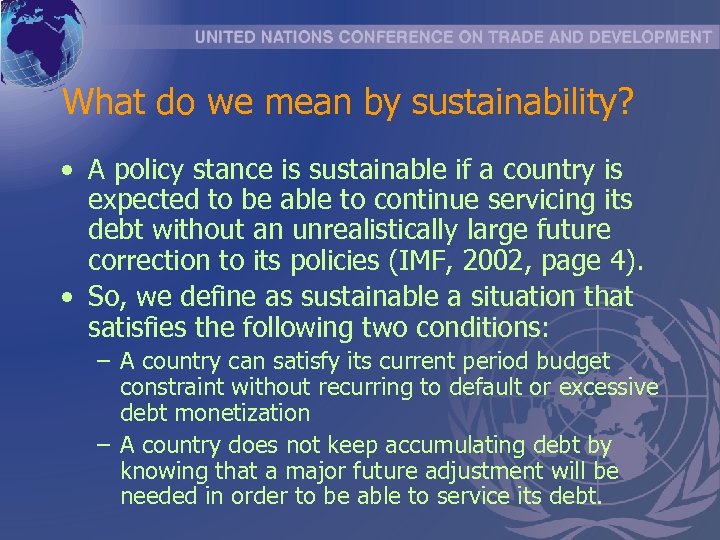
What do we mean by sustainability? • A policy stance is sustainable if a country is expected to be able to continue servicing its debt without an unrealistically large future correction to its policies (IMF, 2002, page 4). • So, we define as sustainable a situation that satisfies the following two conditions: – A country can satisfy its current period budget constraint without recurring to default or excessive debt monetization – A country does not keep accumulating debt by knowing that a major future adjustment will be needed in order to be able to service its debt.
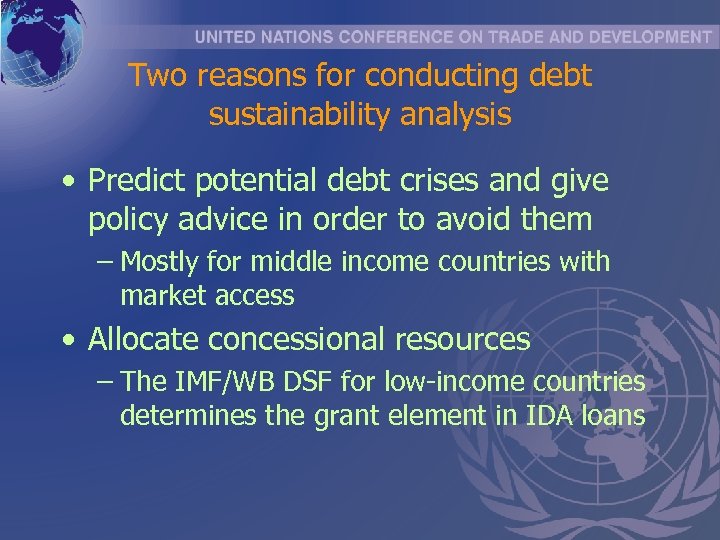
Two reasons for conducting debt sustainability analysis • Predict potential debt crises and give policy advice in order to avoid them – Mostly for middle income countries with market access • Allocate concessional resources – The IMF/WB DSF for low-income countries determines the grant element in IDA loans
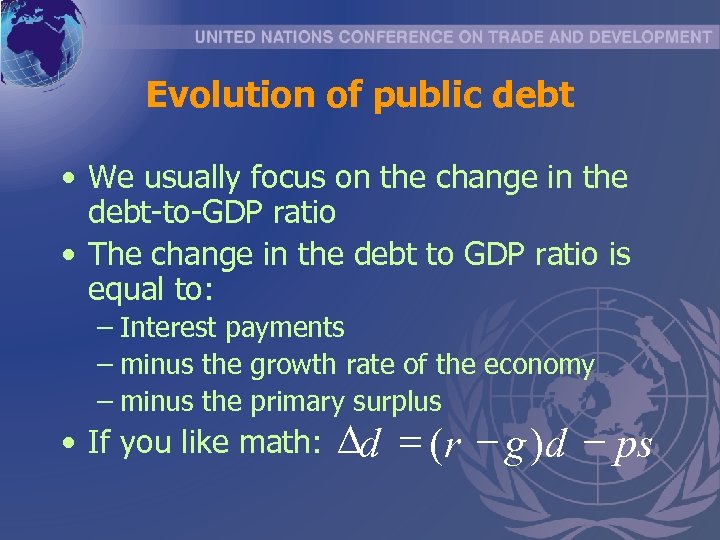
Evolution of public debt • We usually focus on the change in the debt-to-GDP ratio • The change in the debt to GDP ratio is equal to: – Interest payments – minus the growth rate of the economy – minus the primary surplus • If you like math: Dd = ( r - g ) d - ps
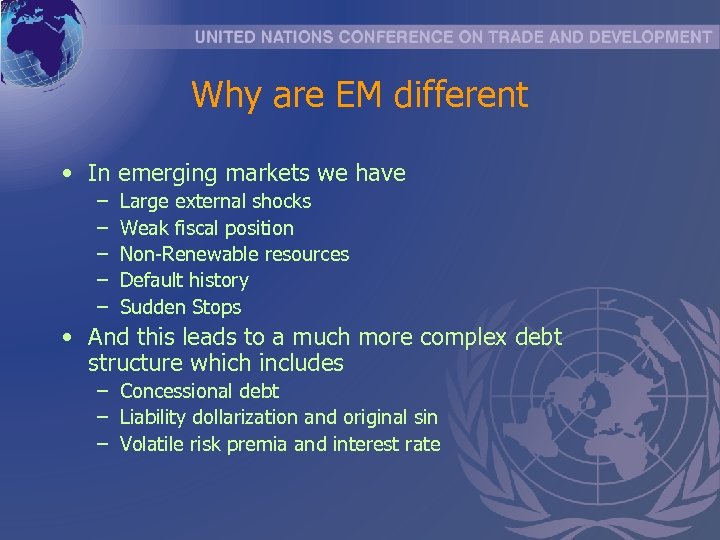
Why are EM different • In emerging markets we have – – – Large external shocks Weak fiscal position Non-Renewable resources Default history Sudden Stops • And this leads to a much more complex debt structure which includes – Concessional debt – Liability dollarization and original sin – Volatile risk premia and interest rate
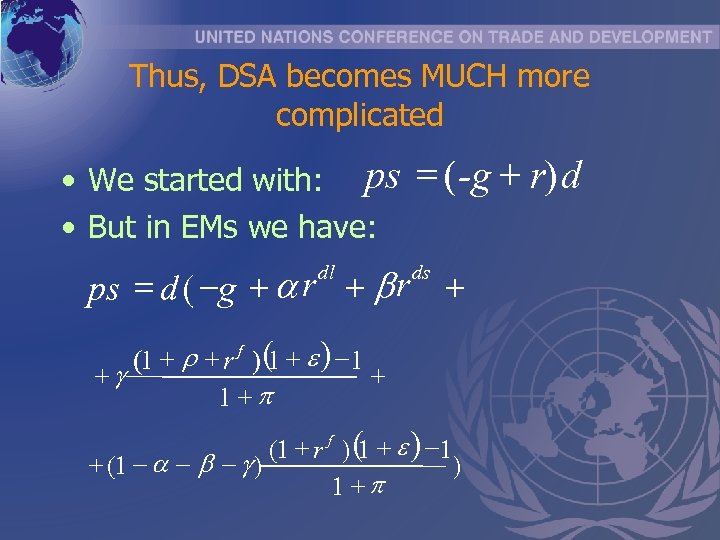
Thus, DSA becomes MUCH more complicated • We started with: ps • But in EMs we have: = ( -g + r) d ps = d ( -g + a r + b r + dl ds (1 + r f ) ( + e ) -1 1 +g + 1 +p (1 + r f ) ( + e ) -1 1 + (1 - a - b - g ) ) 1 +p
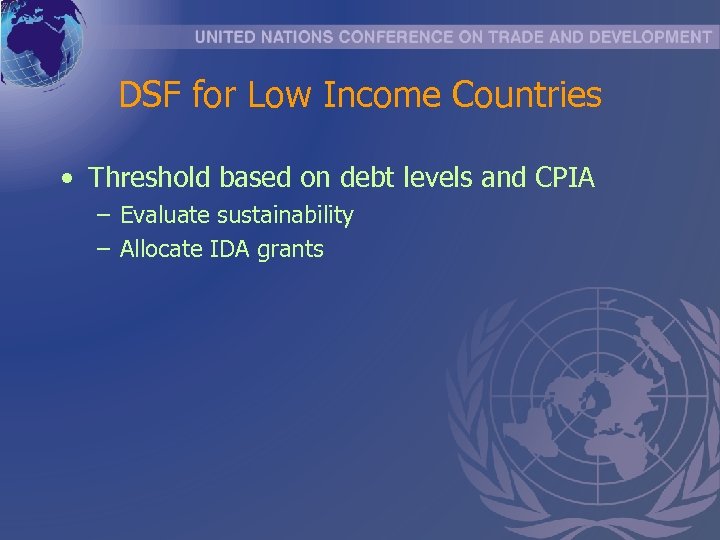
DSF for Low Income Countries • Threshold based on debt levels and CPIA – Evaluate sustainability – Allocate IDA grants
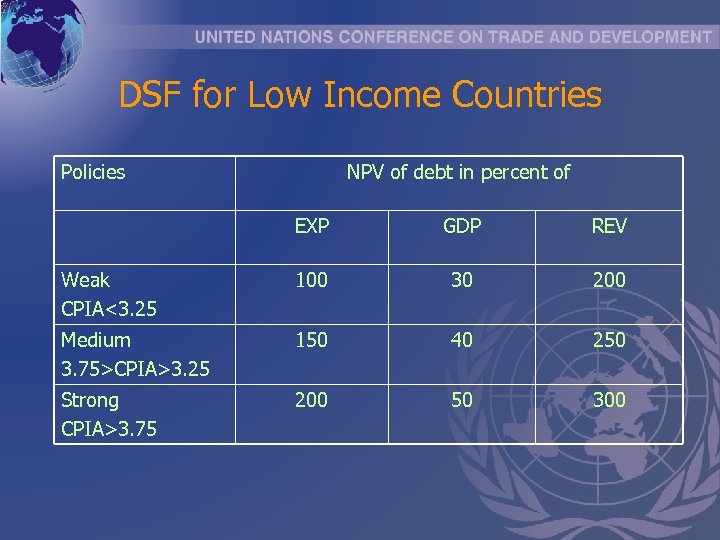
DSF for Low Income Countries Policies NPV of debt in percent of EXP GDP REV Weak CPIA<3. 25 100 30 200 Medium 3. 75>CPIA>3. 25 150 40 250 Strong CPIA>3. 75 200 50 300
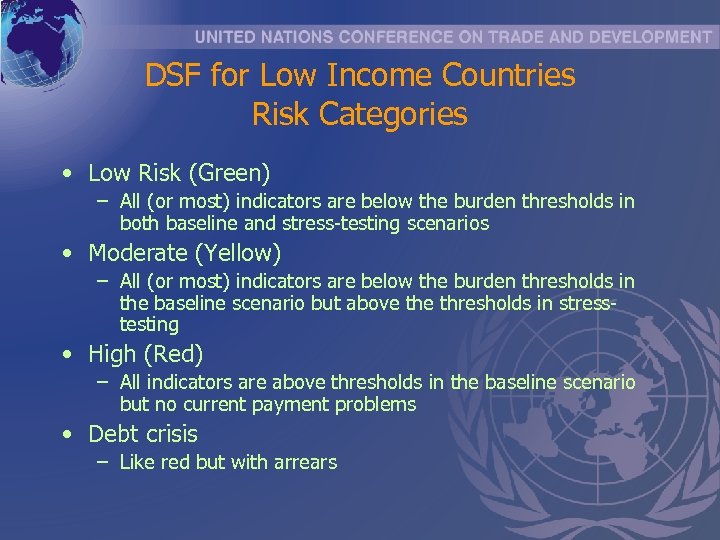
DSF for Low Income Countries Risk Categories • Low Risk (Green) – All (or most) indicators are below the burden thresholds in both baseline and stress-testing scenarios • Moderate (Yellow) – All (or most) indicators are below the burden thresholds in the baseline scenario but above thresholds in stresstesting • High (Red) – All indicators are above thresholds in the baseline scenario but no current payment problems • Debt crisis – Like red but with arrears
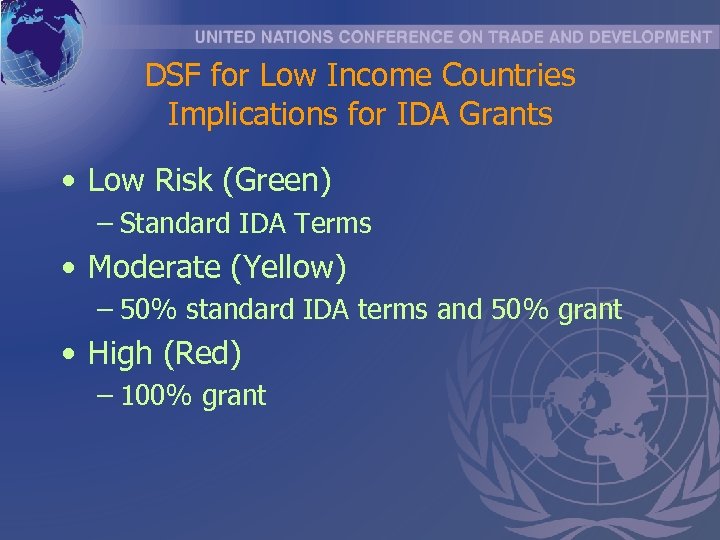
DSF for Low Income Countries Implications for IDA Grants • Low Risk (Green) – Standard IDA Terms • Moderate (Yellow) – 50% standard IDA terms and 50% grant • High (Red) – 100% grant
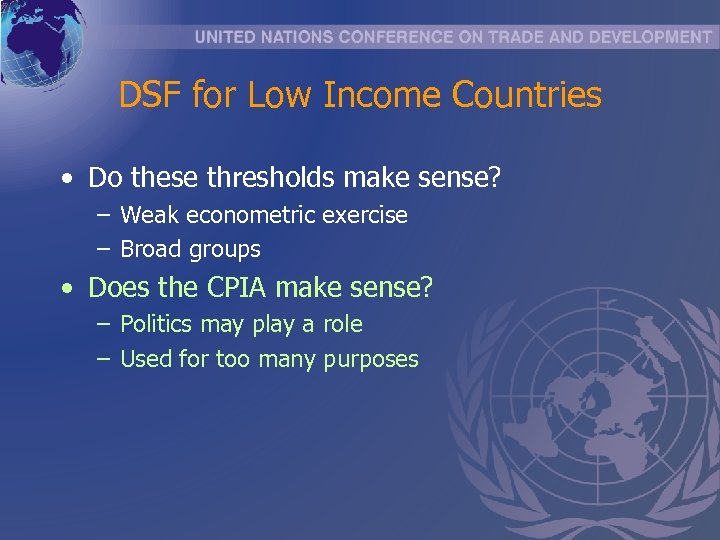
DSF for Low Income Countries • Do these thresholds make sense? – Weak econometric exercise – Broad groups • Does the CPIA make sense? – Politics may play a role – Used for too many purposes

Want to learn more? • UNCTAD E-course on Debt Sustainability Analysis
The Risks of Sovereign Finance Ugo Panizza Debt and Finance Analysis Unit DGDS UNCTAD http: //upanizza. googlepages. com
Скачать презентацию The Risks of Sovereign Finance Ugo Panizza Debt
8f0944c8a3f1a71a9032cc51db4ccf16.ppt