


 Скачать презентацию The Rise of the National Socialists Germany
nazi ideology.ppt
- Количество слайдов: 14
 The Rise of the National Socialists & Germany 19331938 Back to Authoritarianism Introduction to Modern Germany Week Eight, Sem 1 Underline = hyperlink
 Ancestry Various locations - combined trends – – Realpolitik (Bismarck) Nationalism (Johann Fichte) Godless humanism (Friedrich Nietzsche) Racial theories (Houston Stewart Chamberlain & Comte de Gobineau = extremes of Darwinism; Aryan triumph over lesser races) – Italian fascism; Stalin’s control methodology Post WW 2 view: roots of German authoritarianism and nationalism German historians e. g. Ritter (1955) unprecedented social & economic pressures of 1920 s & 1930 s Bracher (1978) - combination of two
 Mein Kampf Cohesion: Nazi programme 1920 (before Hitler) Mein Kampf (My Struggle): written during imprisonment after 1923 coup; published 1925 No precise manifesto for govt. But showed principles. Central: basis of state not class or economy but race: need to eliminate alien elements who would weaken / corrupt ethnic community (Volksgemeinschaft) = Jews - international conspiracy Also: Lebensraum (Living space) - at expense of other races e. g. Russia
 The Führerprinzip Doctrine of political authority Unquestioning obedience to chief Personal authority Appealed to those who thought democracy had failed
 Socialist Element But: views not unanimous Socialist element crucial to some e. g. former soldiers in S. A. Gregor and Otto Strasser: led left wing faction But: Hitler couldn’t restore strong government without support of capitalist forces – didn’t want to alienate them Negative cohesion through hate Key: anti-semitism. Origins?
 The Hitlerian ‘Vision’ Defeat of external enemies Reunion of all Germans in one state Destruction of Jews, Marxists, and other internal enemies Picture of great united society of all patriotic Germans united in working for the glory and harmony of the fatherland Fanatical devotion to a fanatical Führer
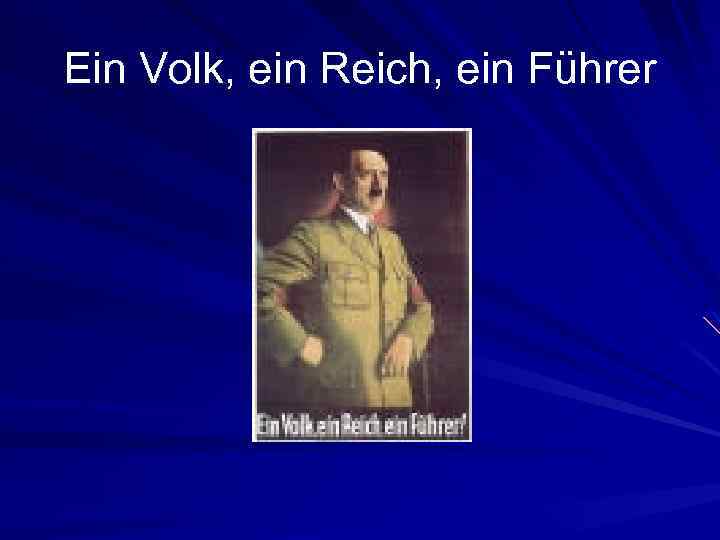 Ein Volk, ein Reich, ein Führer
 ‘Drittes Reich’ National Socialist Dictatorship 1933 -1945 Implied continuity (HRE, Kaiserreich) ‘Das dritte Reich’ (1923) by Arthur Moeller van den Bruck Use of term banned by Ministry of Propaganda in 1939
 National Socialism Ideology German Manifestation of Fascism (cf. Italy, France, Spain, GB, Hungary etc) Anti-Semitism Myth of the Volksgemeinschaft Racist Policy Anti-Communist; Anti-Capitalist(? ) Anti. Modern
 Nazi Germany 1933 -1938 Gleichschaltung Bücherverbrennung (10. 5. 1933) Book burning Reichskulturkammer (Reich Cultural Chamber) founded 22. 9. 1933, to encourage all forms of artistic creation on behalf of Nazi ideology. The Chamber was linked to the Ministerium für Volksaufklärung und Propaganda under Joseph Goebbels divided into seven subordinated chambers for literature, music, films, theatre, radio, fine arts, and press. All were directed by Goebbels.
 Taking control Gleichschaltung – ‘co-ordination’ Destruction of all groups that could limit his power E. g. Law against Formation of New Parties (July 1933) January 1934 Provincial Assemblies abolished (Lander) – Nazi governors (Reichstatthalter) in their place Trades Unions disbanded Infiltration of Nazis
 Institutions that compromised Too powerful to be coerced Industry support for Nazis e. g. steel magnate Fritz Thyssen Catholic Church – Concordat (July 1933) Nazis would not interfere in Church education – church not in politics German army (Reichswehr) – common interests Commander in chief and War Minister forced out
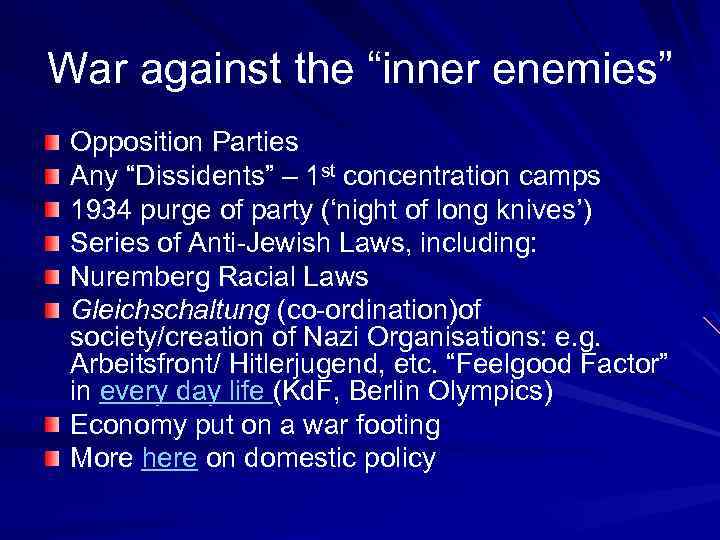 War against the “inner enemies” Opposition Parties Any “Dissidents” – 1 st concentration camps 1934 purge of party (‘night of long knives’) Series of Anti-Jewish Laws, including: Nuremberg Racial Laws Gleichschaltung (co-ordination)of society/creation of Nazi Organisations: e. g. Arbeitsfront/ Hitlerjugend, etc. “Feelgood Factor” in every day life (Kd. F, Berlin Olympics) Economy put on a war footing More here on domestic policy
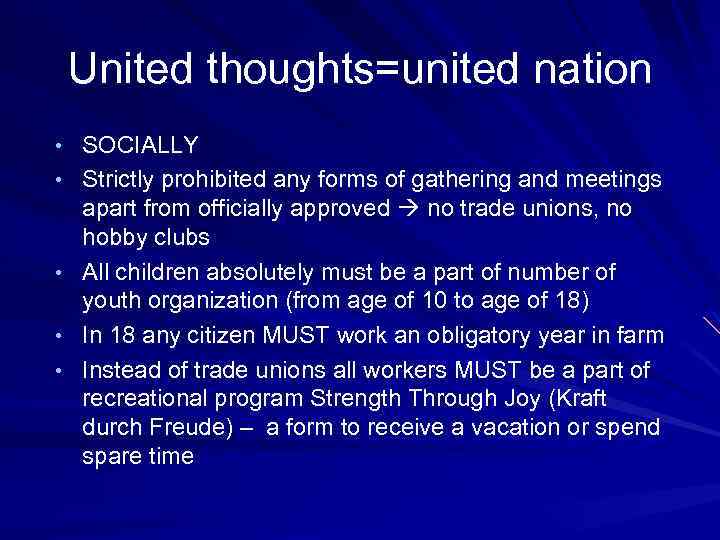 United thoughts=united nation • SOCIALLY • Strictly prohibited any forms of gathering and meetings • • • apart from officially approved no trade unions, no hobby clubs All children absolutely must be a part of number of youth organization (from age of 10 to age of 18) In 18 any citizen MUST work an obligatory year in farm Instead of trade unions all workers MUST be a part of recreational program Strength Through Joy (Kraft durch Freude) – a form to receive a vacation or spend spare time