 Скачать презентацию The Rights Stuff Digital Rights Management Robby Robson
e5bdc90323eec01ee016e46b29807150.ppt
- Количество слайдов: 45



The “Rights Stuff” Digital Rights Management Robby Robson President, Eduworks Corporation Chair, IEEE Learning Technology Standards Committee rrobson@eduworks. com
My Background • Eduworks – Help organizations design and implement e-Learning strategy and technology – Help vendors understand e-learning market and design products – Work in standards • Personal – Recovering academic (mathematics, education reform, academic administration) – Not a lawyer • Know about DRM through work with standards, clients, and research projects
Conversation Outline • • Digital Rights Management (What is it? ) Ten Challenges of DRM • • Rights Expression Languages Discussion 1. Enforcement 2. Heterogeneous Content 3. Heterogeneous Application Domains 4. The Legal Landscape 5. Complex Technology 6. Complex Content 7. Federated Repositories 8. Services and Distribution 9. Standardization 10. DRM as Part of an Overall Content Strategy
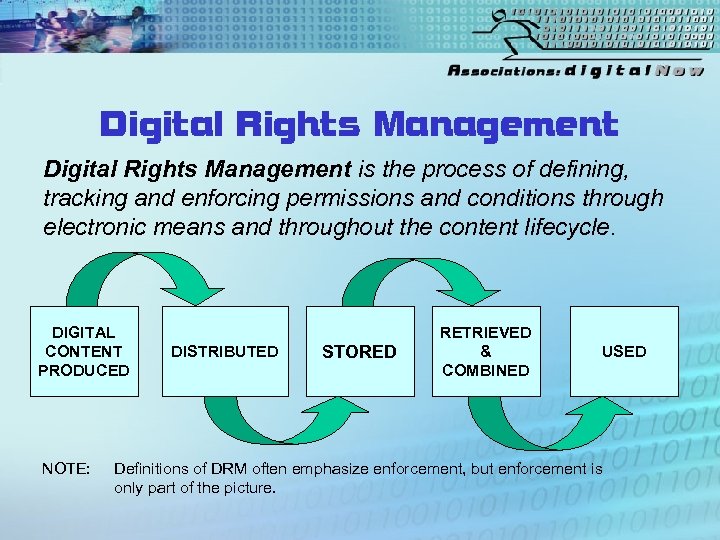
Digital Rights Management is the process of defining, tracking and enforcing permissions and conditions through electronic means and throughout the content lifecycle. DIGITAL CONTENT PRODUCED NOTE: DISTRIBUTED STORED RETRIEVED & COMBINED USED Definitions of DRM often emphasize enforcement, but enforcement is only part of the picture.
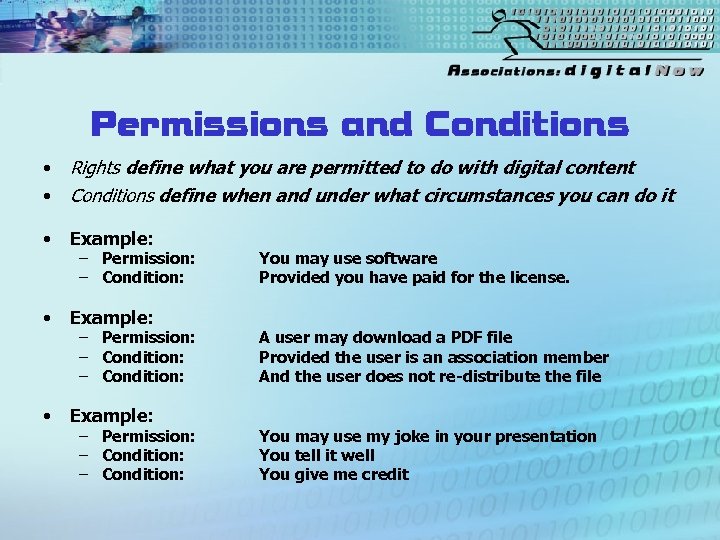
Permissions and Conditions • • Rights define what you are permitted to do with digital content Conditions define when and under what circumstances you can do it • Example: – Permission: – Condition: – Permission: – Condition: You may use software Provided you have paid for the license. A user may download a PDF file Provided the user is an association member And the user does not re-distribute the file You may use my joke in your presentation You tell it well You give me credit
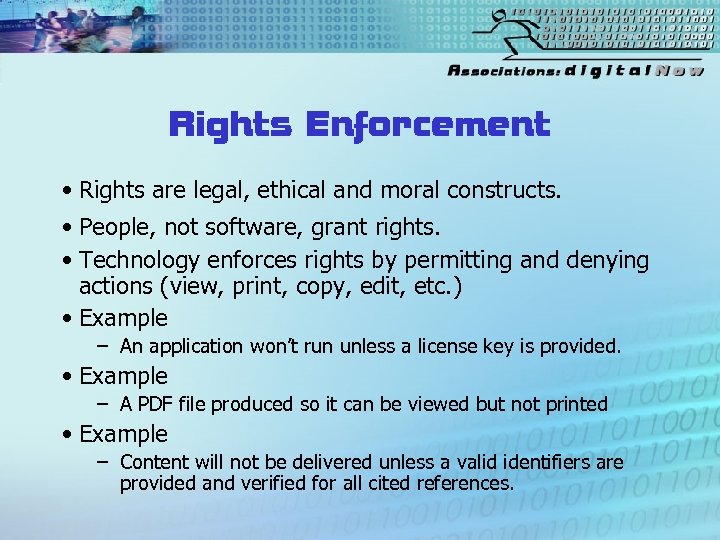
Rights Enforcement • Rights are legal, ethical and moral constructs. • People, not software, grant rights. • Technology enforces rights by permitting and denying actions (view, print, copy, edit, etc. ) • Example – An application won’t run unless a license key is provided. • Example – A PDF file produced so it can be viewed but not printed • Example – Content will not be delivered unless a valid identifiers are provided and verified for all cited references.
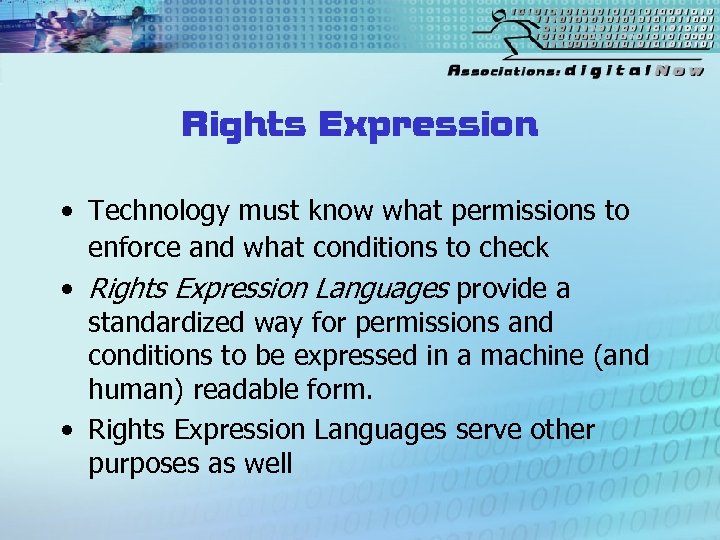
Rights Expression • Technology must know what permissions to enforce and what conditions to check • Rights Expression Languages provide a standardized way for permissions and conditions to be expressed in a machine (and human) readable form. • Rights Expression Languages serve other purposes as well
Assumption There are reasons and requirements to express and enforce conditions and permissions
Challenges
Challenge #1: Enforcement • Authentication and Authorization – Of people (and agents and services) – Of object (e. g. , through digital watermarks) • Prevention and Protection – Through software and hardware keys (e. g. , e-books, Palladium, etc. ) • Enforcement through the justice system • Enforcement is NOT the topic of this presentation
Challenge #2: Heterogeneous Content • Content Runs on Many Platforms – Windows, Unix, Mac, Internet, Intranet • Content Comes in Many Formats – Text, Video, Audio, e-Books, PDF, Flash, Windows Media, MP 3, etc.
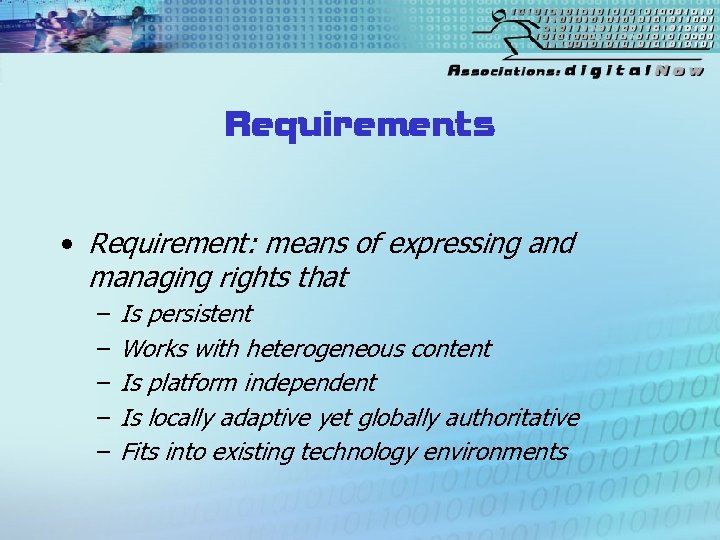
Requirements • Requirement: means of expressing and managing rights that – Is persistent – Works with heterogeneous content – Is platform independent
Challenge #3: Heterogeneous Application Domains • Heterogeneous Stakeholders – Authors, Publishers, Distributors, Consumers • Heterogeneous Cultures & Communities – – Education and Training Private, Public, not for profit Linguistic and Political Specialized Communities of Practice
Requirements • Requirement: means of expressing and managing rights that – – Is persistent Works with heterogeneous content Is platform independent Is locally adaptive yet globally authoritative
Challenge # 4: The Legal Landscape • Copyright – Changes over time – Differs from country to country – Was meant for something else • Patents – Apply to intellectual property – Apply to DRM technology
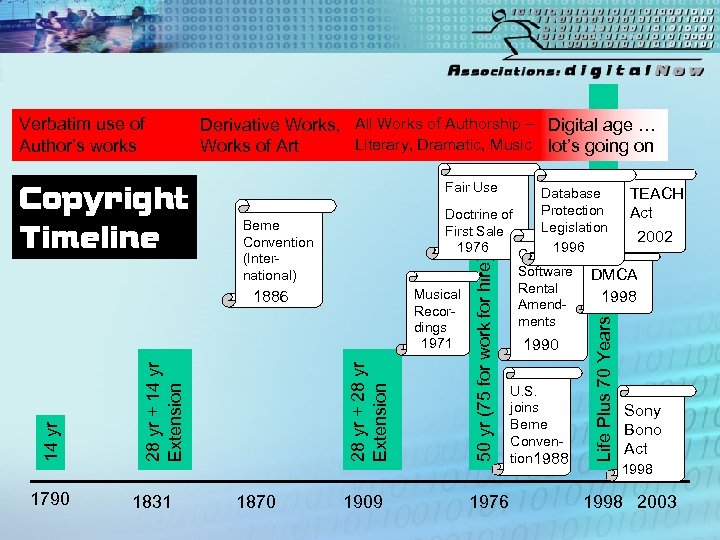
Fair Use Database Protection Doctrine of Legislation First Sale 1976 1996 Computer 1909 1976 Musical Recordings 1971 1790 28 yr + 14 yr Extension 14 yr 1886 1831 1870 Software Rental Amendments 1990 U. S. joins Berne Convention 1988 TEACH Act 2002 DMCA 1998 Life Plus 70 Years Berne Convention (International) 50 yr (75 for work for hire) Copyright Timeline Derivative Works, All Works of Authorship – Digital age … Literary, Dramatic, Music lot’s going on Works of Art 28 yr + 28 yr Extension Verbatim use of Author’s works Sony Bono Act 1998 2003
Example: The TEACH Act • Technology, Education and Copyright Harmonization Act • The TEACH Act grants and exemption – ONLY to accredited non-profit educational institutions – ONLY for the online equivalent of displays and performances that are shown as part of a class under instructor supervision • THE TEACH Act requires – Institutions to have and follow copyright policies – Institutions to use technological protection against unauthorized, unintended and illegal use
Copyright Diversity • In the former British Colonies: – Assignable – Fair use and “work made for hire” • On the European Continent – Right of the author • Different in Asia • The fundamental act of transmitting and processing data is copying
Patents • Enforcement Technology is patented • Cryptographic techniques are patented • DRM is subject to patents – Content. Guard • • • Association of usage rights to content. A grammar to define rights or conditions. Persistent protection. Distribution of composite digital content. Fee accounting and reporting associated with the distribution or use of content. – Inter. Trust (now Sony) • Standards may be subject to “Reasonable and Non-Discriminatory (RAND)” patents
Challenge #5: Complex Technology • Interactions with – – Content Management Systems Integrated Library Systems Learning Management Systems Authoring Environments
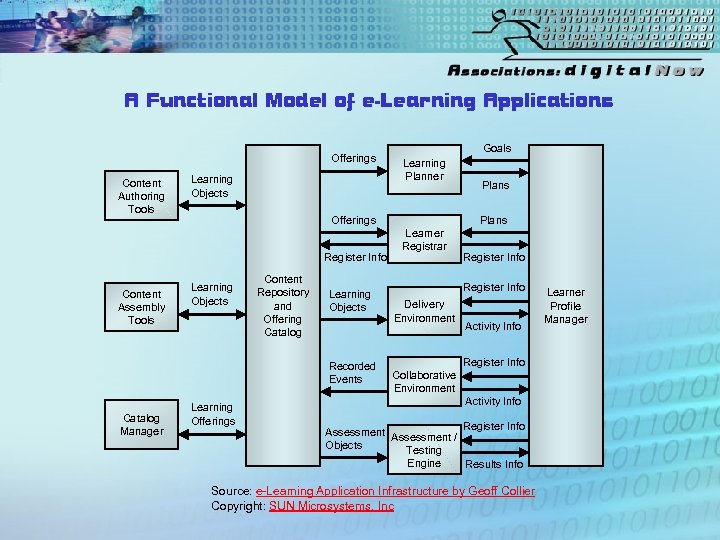
A Functional Model of e-Learning Applications Offerings Content Authoring Tools Learning Objects Offerings Register Info Content Assembly Tools Learning Objects Content Repository and Offering Catalog Learning Objects Recorded Events Catalog Manager Goals Learning Planner Learning Offerings Plans Learner Registrar Register Info Delivery Environment Collaborative Environment Activity Info Register Info Assessment / Objects Testing Engine Results Info Source: e-Learning Application Infrastructure by Geoff Collier Copyright: SUN Microsystems, Inc Learner Profile Manager
Requirements • Requirement: means of expressing and managing rights that – – – Is persistent Works with heterogeneous content Is platform independent Is locally adaptive yet globally authoritative Fits into existing technology environments
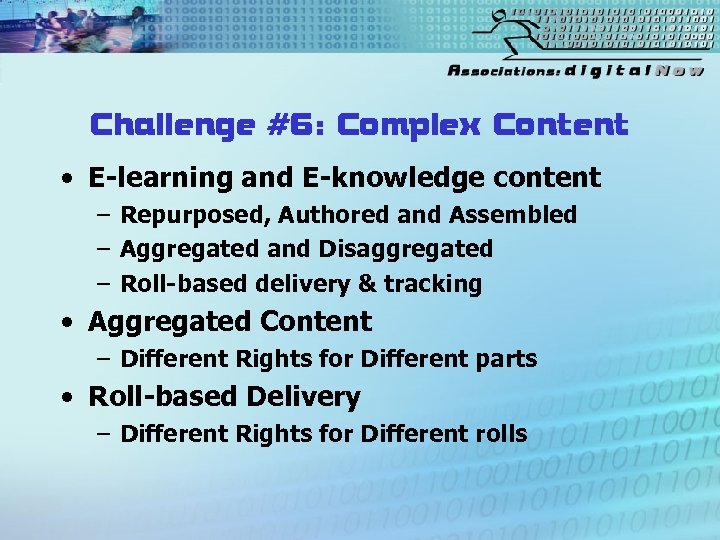
Challenge #6: Complex Content • E-learning and E-knowledge content – Repurposed, Authored and Assembled – Aggregated and Disaggregated – Roll-based delivery & tracking • Aggregated Content – Different Rights for Different parts • Roll-based Delivery – Different Rights for Different rolls
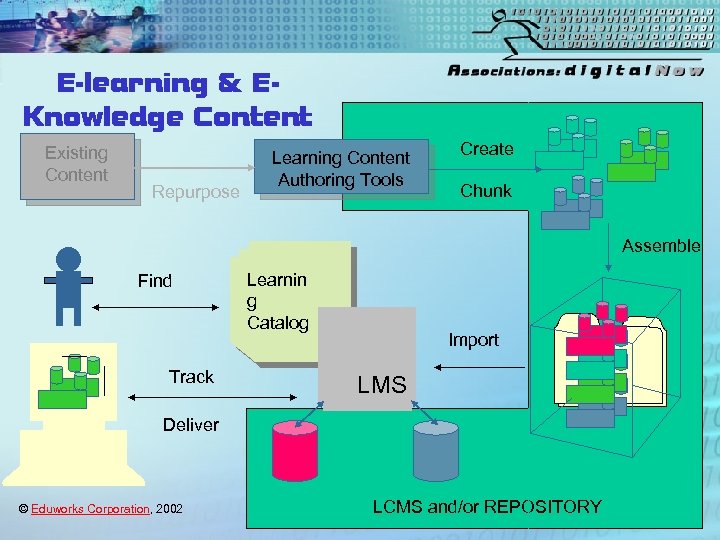
E-learning & EKnowledge Content Existing Content Repurpose Learning Content Authoring Tools Create Chunk Assemble Find Track Learnin g Catalog Import LMS Deliver © Eduworks Corporation, 2002 LCMS and/or REPOSITORY
Requirements • Requirement: means of expressing and managing rights that – – – Is persistent Works with heterogeneous content Is platform independent Is locally adaptive yet globally authoritative Fits into existing technology environments Is compatible with existing standards
Challenge # 7: Federated Repositories and Searches • Repositories have two parts – Content – Metadata (descriptions of content and pointers to the content) • Repositories are combined by – Harvesting and combining metadata – Harvesting and combining content – Searching multiple repositories at once • Where and how are rights managed?
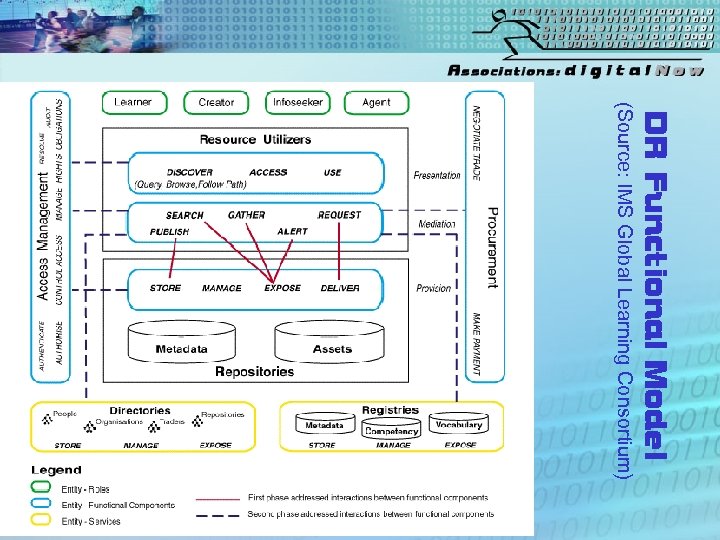
DR Functional Model (Source: IMS Global Learning Consortium)
Requirements • Requirement: means of expressing and managing rights that – – – – Is persistent Works with heterogeneous content Is platform independent Is locally adaptive yet globally authoritative Fits into existing technology environments Is compatible with existing standards Works in highly distributed settings
Challenge # 8: Services and Attribution • Web Services – Different view of the world – Access and use of services as important as access and use of objects • Attribution – Intellectual Property is about attribution as well as money
Requirements • Requirement: means of expressing and managing rights that – – – – – Is persistent Works with heterogeneous content Is platform independent Is locally adaptive yet globally authoritative Fits into existing technology environments Is compatible with existing standards Works in highly distributed settings Applies beyond traditional content Is a true standard Supports organizational content strategies
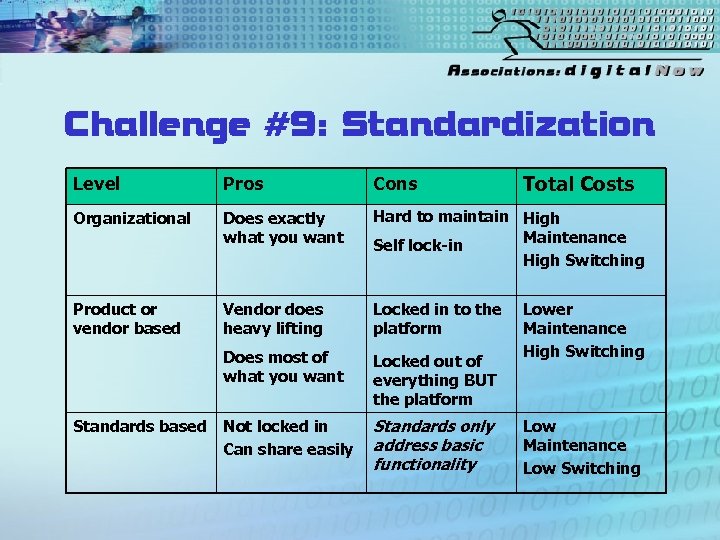
Challenge #9: Standardization Total Costs Level Pros Cons Organizational Does exactly what you want Hard to maintain High Maintenance Self lock-in High Switching Product or vendor based Vendor does heavy lifting Locked in to the platform Does most of what you want Locked out of everything BUT the platform Not locked in Can share easily Standards only address basic functionality Standards based Lower Maintenance High Switching Low Maintenance Low Switching
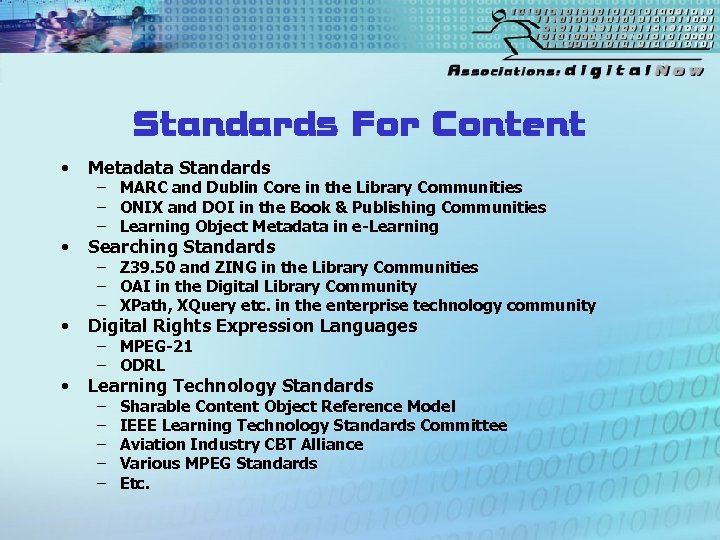
Standards For Content • Metadata Standards • Searching Standards • Digital Rights Expression Languages • Learning Technology Standards – MARC and Dublin Core in the Library Communities – ONIX and DOI in the Book & Publishing Communities – Learning Object Metadata in e-Learning – Z 39. 50 and ZING in the Library Communities – OAI in the Digital Library Community – XPath, XQuery etc. in the enterprise technology community – MPEG-21 – ODRL – – – Sharable Content Object Reference Model IEEE Learning Technology Standards Committee Aviation Industry CBT Alliance Various MPEG Standards Etc.
Requirements • Requirement: means of expressing and managing rights that – – – – – Is persistent Works with heterogeneous content Is platform independent Is locally adaptive yet globally authoritative Fits into existing technology environments Is compatible with existing standards Works in highly distributed settings Applies beyond traditional content Is a true standard
Challenge #10: DRM As Part of an Overall Content Strategy • Organizations Develop Content Strategies to – Gain efficiency through uniform policies – Improve workflows by providing a common understanding of the structure of content – Exchange of content with other organizations – Inform acquisition of content – Inform internal and external content creation – Guide management, workflow and technology decisions
Content Strategy Components • • Business and Service Goals Content Models Technology Reference Models Internal and external policies And • Rights Management
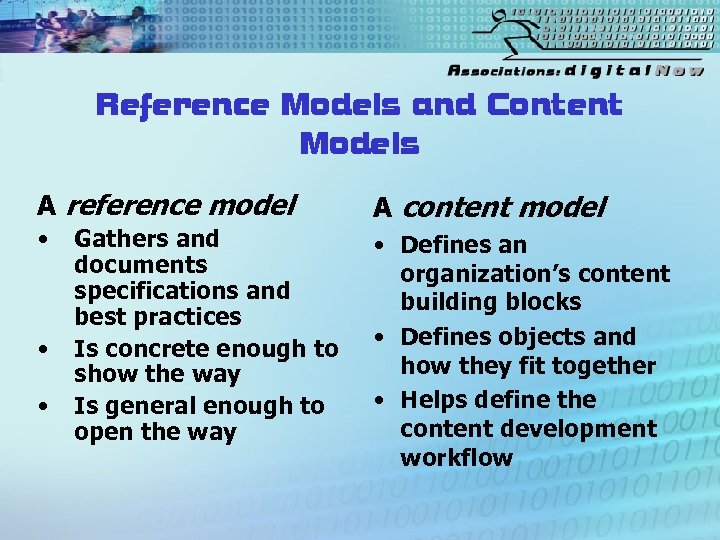
Reference Models and Content Models A reference model • • • Gathers and documents specifications and best practices Is concrete enough to show the way Is general enough to open the way A content model • Defines an organization’s content building blocks • Defines objects and how they fit together • Helps define the content development workflow
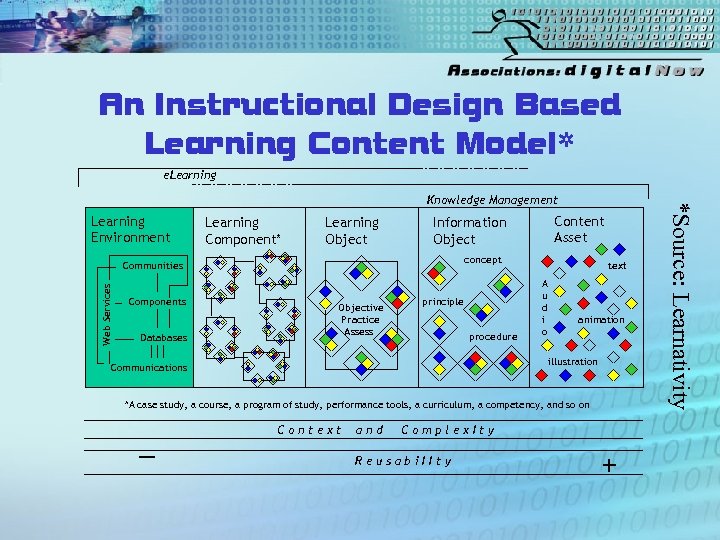
An Instructional Design Based Learning Content Model* e. Learning Environment Learning Component* Learning Object concept Web Services Communities Components Databases Content Asset Information Objective Practice Assess principle procedure text A u d i o animation illustration Communications *A case study, a course, a program of study, performance tools, a curriculum, a competency, and so on _ Context and Complex. Ity Reusabi. IIty + *Source: Learnativity Knowledge Management
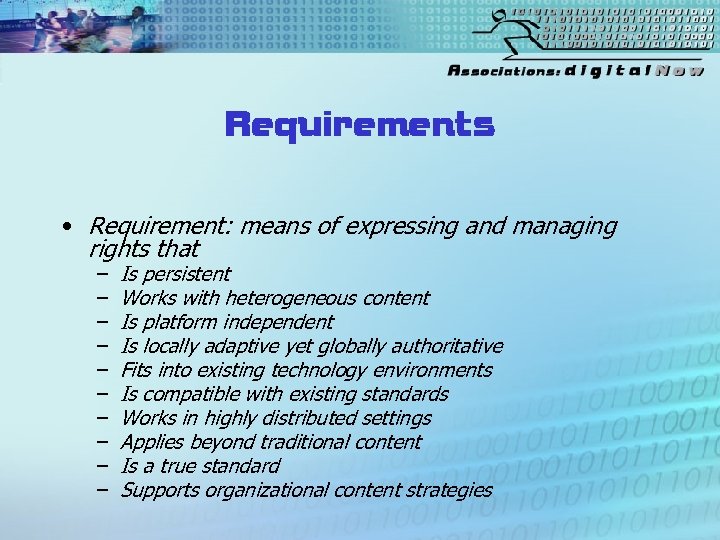
Requirements • Requirement: means of expressing and managing rights that – – – – – Is persistent Works with heterogeneous content Is platform independent Is locally adaptive yet globally authoritative Fits into existing technology environments Is compatible with existing standards Works in highly distributed settings Applies beyond traditional content Is a true standard Supports organizational content strategies
Rights Expression Languages A Key Idea A Possible Solution
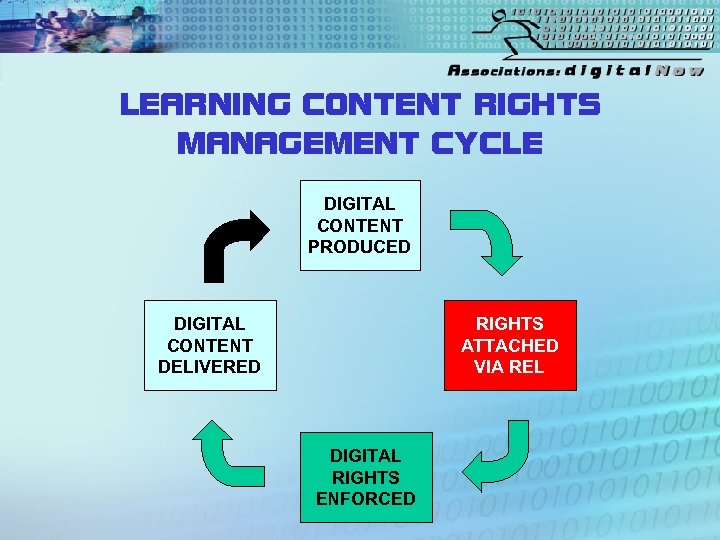
LEARNING CONTENT RIGHTS MANAGEMENT CYCLE DIGITAL CONTENT PRODUCED DIGITAL CONTENT DELIVERED RIGHTS ATTACHED VIA REL DIGITAL RIGHTS ENFORCED
Digital Rights Standards • DRM standards are being developed on an international level • Foremost among these are activities taking place within the Moving Picture Experts Group (MPEG) under ISO – Working on comprehensive set of DRM interoperability standards – Furthest progressed towards standardization – Most likely to be adopted by product vendors and content producers
The MPEG Rights Expression Language • MPEG REL creates digital “licenses” that –Record and express permissions and conditions –Express conditions for issuing new licenses • Applications can read, write and enforce permissions and conditions in a standard way • Only “positive” rights are expressed • As content moves from system to system, licenses generate a “virtual paper trail” documenting organizational diligence and adherence to laws and agreements
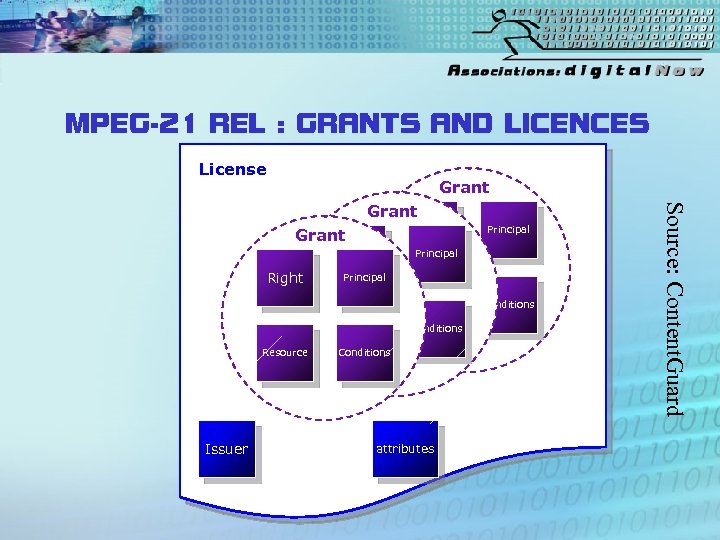
MPEG-21 REL : GRANTS AND LICENCES License Grant Right Principal Resource Issuer Principal Conditions attributes Conditions Source: Content. Guard Grant
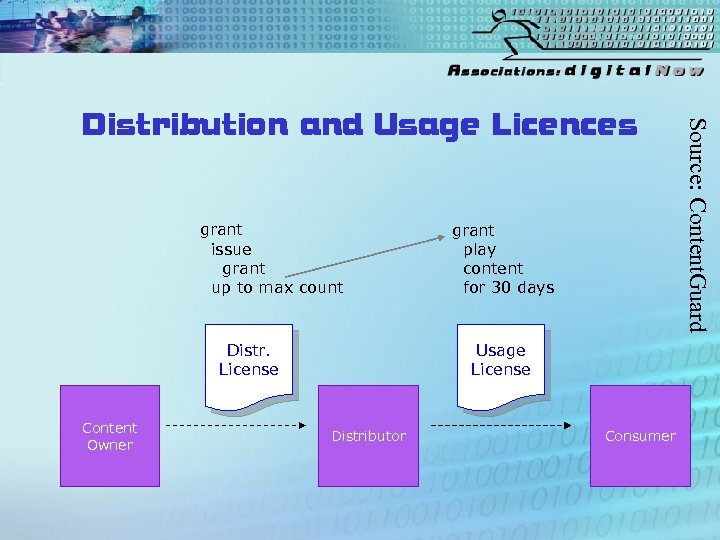
grant issue grant up to max count Distr. License Content Owner grant play content for 30 days Usage License Distributor Consumer Source: Content. Guard Distribution and Usage Licences
(Continued) Discussion Robby Robson Eduworks Corporation rrobson@eduworks. com
Скачать презентацию The Rights Stuff Digital Rights Management Robby Robson
e5bdc90323eec01ee016e46b29807150.ppt