


 Скачать презентацию The Rich vs The Middle Married Couple Two
ef564a9ac3a2dd69e269f22be44f50fb.ppt
- Количество слайдов: 24
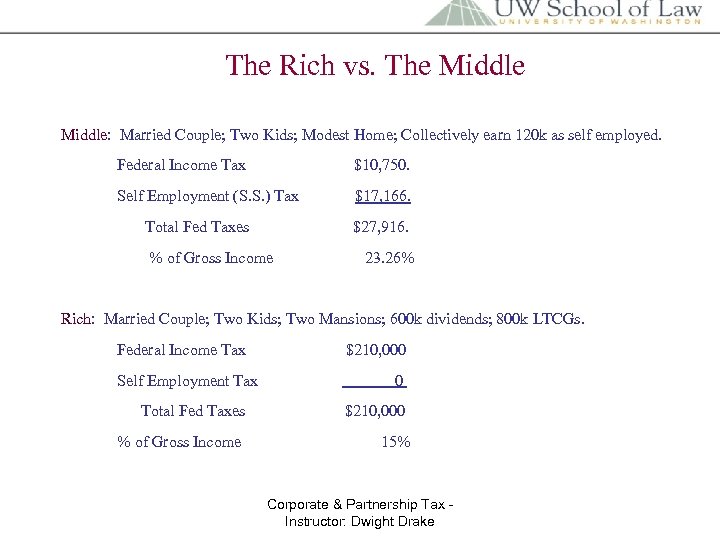 The Rich vs. The Middle: Married Couple; Two Kids; Modest Home; Collectively earn 120 k as self employed. Federal Income Tax $10, 750. Self Employment (S. S. ) Tax $17, 166. Total Fed Taxes $27, 916. % of Gross Income 23. 26% Rich: Married Couple; Two Kids; Two Mansions; 600 k dividends; 800 k LTCGs. Federal Income Tax Self Employment Tax Total Fed Taxes % of Gross Income $210, 000 0 $210, 000 15% Corporate & Partnership Tax Instructor: Dwight Drake
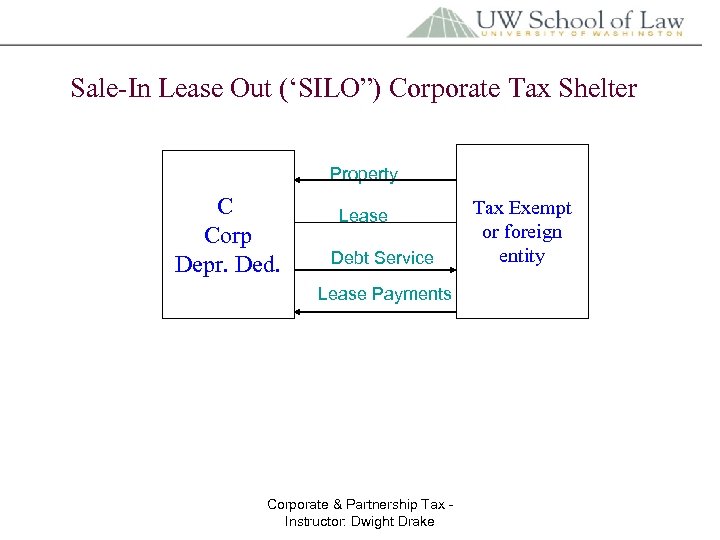 Sale-In Lease Out (‘SILO”) Corporate Tax Shelter Property C Corp Depr. Ded. Lease Debt Service Lease Payments Corporate & Partnership Tax Instructor: Dwight Drake Tax Exempt or foreign entity
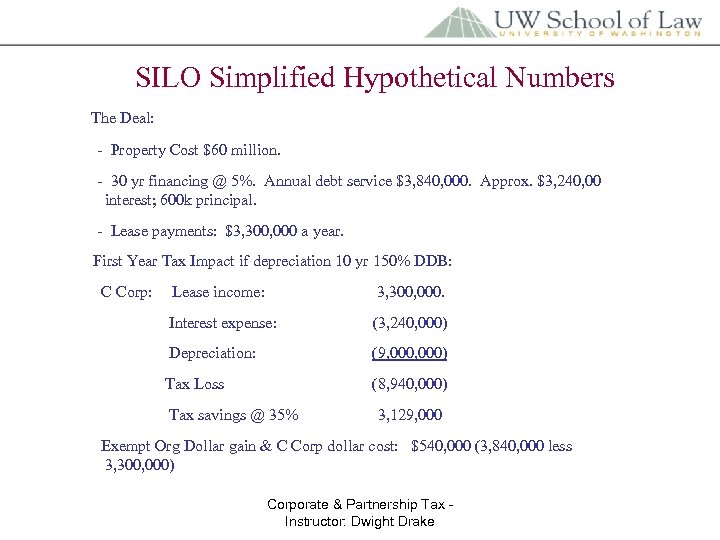 SILO Simplified Hypothetical Numbers The Deal: - Property Cost $60 million. - 30 yr financing @ 5%. Annual debt service $3, 840, 000. Approx. $3, 240, 00 interest; 600 k principal. - Lease payments: $3, 300, 000 a year. First Year Tax Impact if depreciation 10 yr 150% DDB: C Corp: Lease income: 3, 300, 000. Interest expense: (3, 240, 000) Depreciation: (9, 000) Tax Loss (8, 940, 000) Tax savings @ 35% 3, 129, 000 Exempt Org Dollar gain & C Corp dollar cost: $540, 000 (3, 840, 000 less 3, 300, 000) Corporate & Partnership Tax Instructor: Dwight Drake
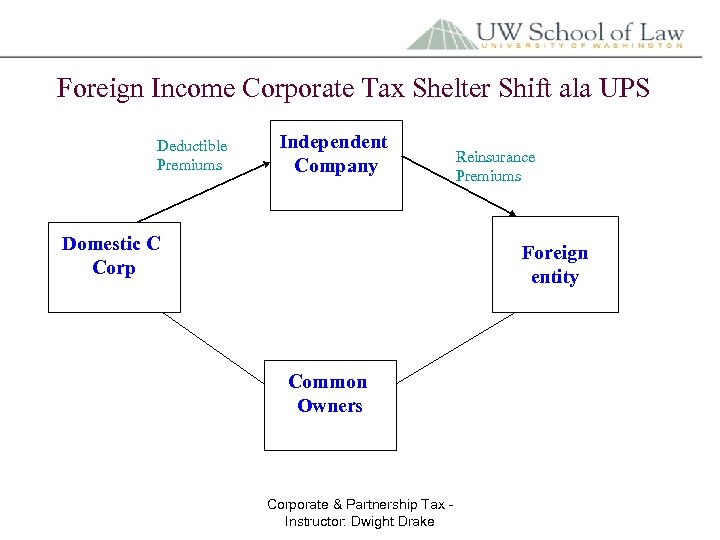 Foreign Income Corporate Tax Shelter Shift ala UPS Deductible Premiums Independent Company Domestic C Corp Reinsurance Premiums Foreign entity Common Owners Corporate & Partnership Tax Instructor: Dwight Drake
 C Corp Shelter Attacks 1. New Section 470 Anti-SILO Provision: Protection fund less than 20% of basis; min. 20% equity investment if lease over 5 yrs; lessee not bear risk of loss if lease over 5 yrs; if over 7 yr class life, any lessee option price must be FMV at time of exercise. 2. Expanded information reporting requirements under 6011. 3. Extended statute of limitations for listed transactions under 6501. 4. New failure to disclose penalty under 6707 A. 5. New accuracy related penalty for listed and reportable transactions under 6662 A. 6. Interest deduction denied on underpayments per redesigned 163(m). 7. New penalties for individuals failure to report, not maintaining investor lists, for tax shelter promoters, failure to report foreign accounts. 8. Expanded authority to enjoin material advisors. 9. Confidentiality exception for professionals on tax shelters. 10. Senate attempts at “non-business propose” and “changed economic position” standards. House has refused to play ball. Only a matter of time. Corporate & Partnership Tax Instructor: Dwight Drake
 Check The Box Game Pre – 1997 - Big fear was partnership or LLC taxable deemed “association” taxable as C corp. - Two Given Factors: Associates Business Objective - Four Determinative Factors (Must Flunk Two): Continuity of Life Central Management Limited Liability Free Interest Transferability Corporate & Partnership Tax Instructor: Dwight Drake
 Check The Box Game Post – 1996 - Corporate Characteristic Test Gone. - Corporation is taxed as corp – C or S. - Partnership or LLC taxes as partnership unless elect to be taxed as C or S corp. Effective up to 75 days before and 12 months after election. - Sole owner non-corp is disregarded entity, taxed as sole proprietorship. - Pre-97 entities keep status, except for solos. - No change for 60 months – unless IRS approval or 50% change in ownership. Corporate & Partnership Tax Instructor: Dwight Drake
 Check The Box Game Tax consequences of change: From partnership to C status: Deemed contribution of assets for stock, followed by liquidation with stock distributed to owners. From C status to partnership: Deemed asset distribution by corp to shareholders (very expensive tax wise), followed by contribution of assets to new partnership. Corporate & Partnership Tax Instructor: Dwight Drake
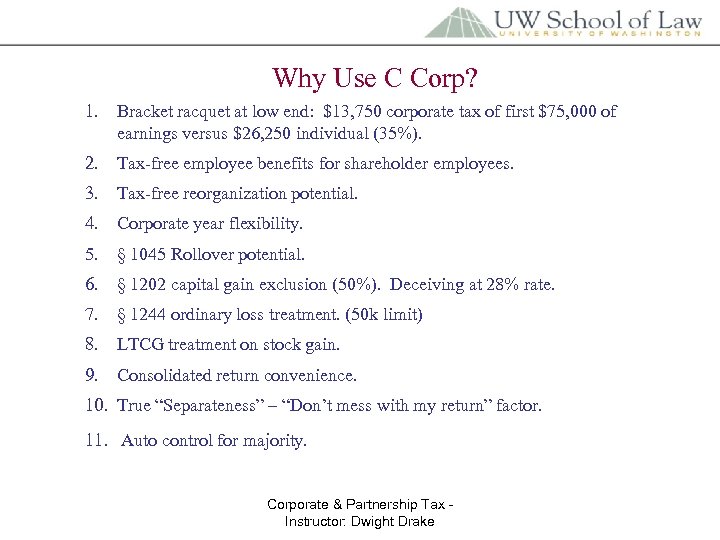 Why Use C Corp? 1. Bracket racquet at low end: $13, 750 corporate tax of first $75, 000 of earnings versus $26, 250 individual (35%). 2. Tax-free employee benefits for shareholder employees. 3. Tax-free reorganization potential. 4. Corporate year flexibility. 5. § 1045 Rollover potential. 6. § 1202 capital gain exclusion (50%). Deceiving at 28% rate. 7. § 1244 ordinary loss treatment. (50 k limit) 8. LTCG treatment on stock gain. 9. Consolidated return convenience. 10. True “Separateness” – “Don’t mess with my return” factor. 11. Auto control for majority. Corporate & Partnership Tax Instructor: Dwight Drake
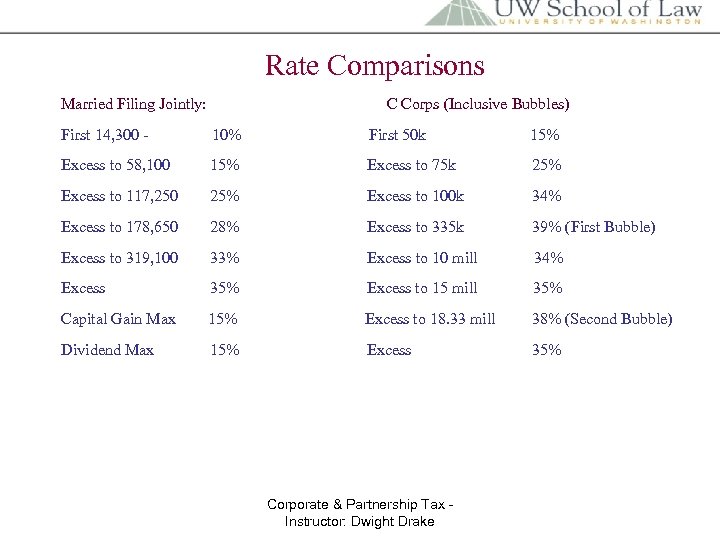 Rate Comparisons Married Filing Jointly: C Corps (Inclusive Bubbles) First 14, 300 - 10% First 50 k 15% Excess to 58, 100 15% Excess to 75 k 25% Excess to 117, 250 25% Excess to 100 k 34% Excess to 178, 650 28% Excess to 335 k 39% (First Bubble) Excess to 319, 100 33% Excess to 10 mill 34% Excess 35% Excess to 15 mill 35% Capital Gain Max 15% Excess to 18. 33 mill 38% (Second Bubble) Dividend Max 15% Excess 35% Corporate & Partnership Tax Instructor: Dwight Drake
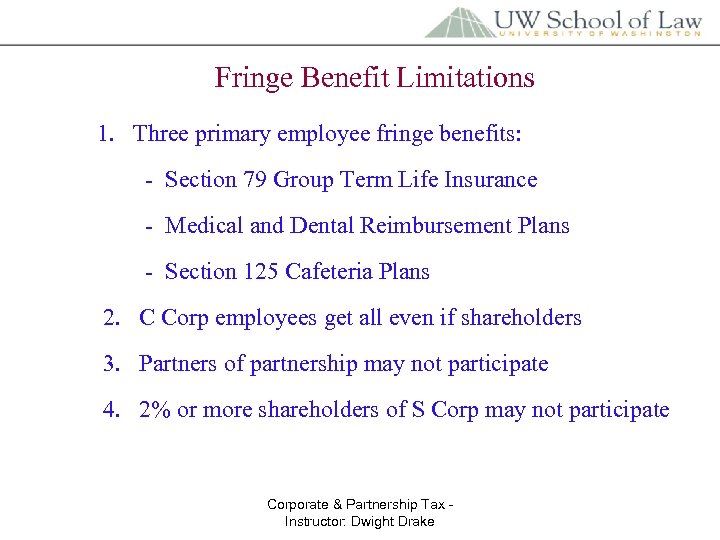 Fringe Benefit Limitations 1. Three primary employee fringe benefits: - Section 79 Group Term Life Insurance - Medical and Dental Reimbursement Plans - Section 125 Cafeteria Plans 2. C Corp employees get all even if shareholders 3. Partners of partnership may not participate 4. 2% or more shareholders of S Corp may not participate Corporate & Partnership Tax Instructor: Dwight Drake
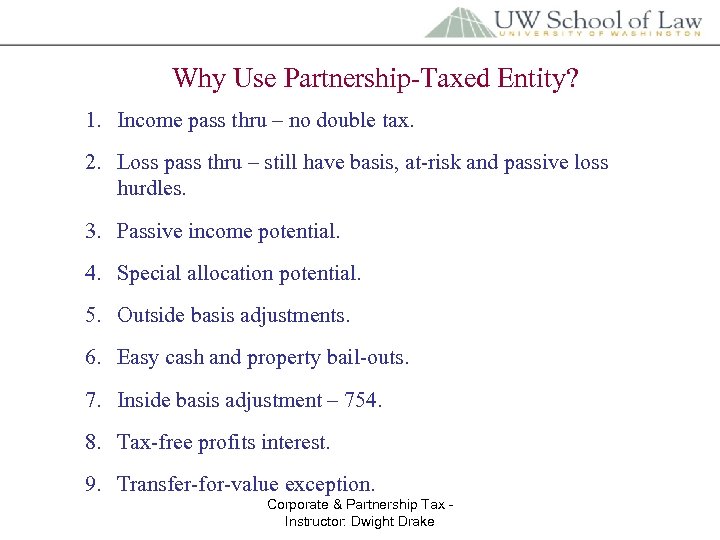 Why Use Partnership-Taxed Entity? 1. Income pass thru – no double tax. 2. Loss pass thru – still have basis, at-risk and passive loss hurdles. 3. Passive income potential. 4. Special allocation potential. 5. Outside basis adjustments. 6. Easy cash and property bail-outs. 7. Inside basis adjustment – 754. 8. Tax-free profits interest. 9. Transfer-for-value exception. Corporate & Partnership Tax Instructor: Dwight Drake
 S Corp Eligibility Requirements (§ 1361) 1. Eligible Corps – no banks or insurance companies, affiliated group member only if “Qualified Subchapter S Subsidiary” – 100% owned by S corp and election to disregard QSSS as tax entity. 2. Shareholder number: 100 max. Married couple count one. Families (6 generations deep) may count as one. If fiduciary holds, look thru to beneficiaries. 3. Eligible shareholders: No corps, partnerships, nonresident aliens, or ineligible trusts. Estate’s, qualified pension trusts and some charitable trusts OK. 4. One Class of Stock. Voting differences only allowed. Corporate & Partnership Tax Instructor: Dwight Drake
 Trusts That Work With S Election 1. Voting trusts 2. Grantor trusts 3. Testamentary trusts that were grantor trusts – for 2 years following death of grantor. 4. Testamentary trusts that receive S corp stock under will – but only for 2 years following death. 5. “QSST” - Qualified Subchapter S Trusts. Requires: Only one beneficiary; all income distributed annually to US citizen or resident; Elect QSST status and treated as owner of S corp stock for tax purposes. QTIP Trust classic example. 6. “ESBT” – Electing Small Business Trust. Requires: All beneficiaries qualified S corp shareholders; all interests received by gift or bequest, not purchase; trust S corp income taxed at highest individual marginal rates. Advantage: allows multiple Bs and income sprinkling. Corporate & Partnership Tax Instructor: Dwight Drake
 Straight Debt Huge Safe Harbor 1361(c)(5) 1. Unconditional promise to pay on demand or at specified time. 2. Interest rate and payments not contingent on profits or discretion. 3. No convertibility 4. Creditor actively and regularly engaged in lending money or is individual, estate or trust that would be eligible S corp shareholder. 5. Note: If safe harbor met, excess interest may still not be treated as interest for tax purposes. Corporate & Partnership Tax Instructor: Dwight Drake
 Why Use S Corporation? 1. Income pass thru – no double tax. 2. Loss pass thru – still have basis, at-risk and passive loss hurdles. Basis hurdle tougher. 3. Passive income potential. 4. Outside basis adjustments. 5. Bail-outs – easier than C, harder than partnership. 6. Tax-free reorg potential. 7. Full capital gains benefit on stock sale. 8. Easier self employment tax planning. 9. Multiple entity consolidation with QSSS. 10. Auto majority control potential. Corporate & Partnership Tax Instructor: Dwight Drake
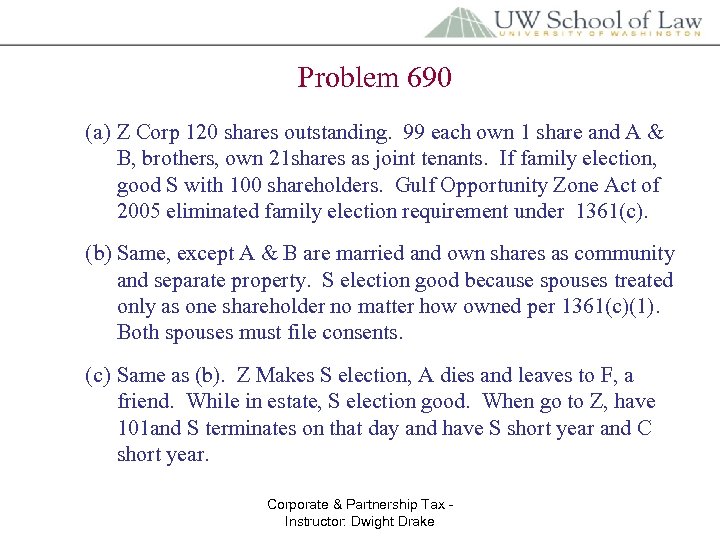 Problem 690 (a) Z Corp 120 shares outstanding. 99 each own 1 share and A & B, brothers, own 21 shares as joint tenants. If family election, good S with 100 shareholders. Gulf Opportunity Zone Act of 2005 eliminated family election requirement under 1361(c). (b) Same, except A & B are married and own shares as community and separate property. S election good because spouses treated only as one shareholder no matter how owned per 1361(c)(1). Both spouses must file consents. (c) Same as (b). Z Makes S election, A dies and leaves to F, a friend. While in estate, S election good. When go to Z, have 101 and S terminates on that day and have S short year and C short year. Corporate & Partnership Tax Instructor: Dwight Drake
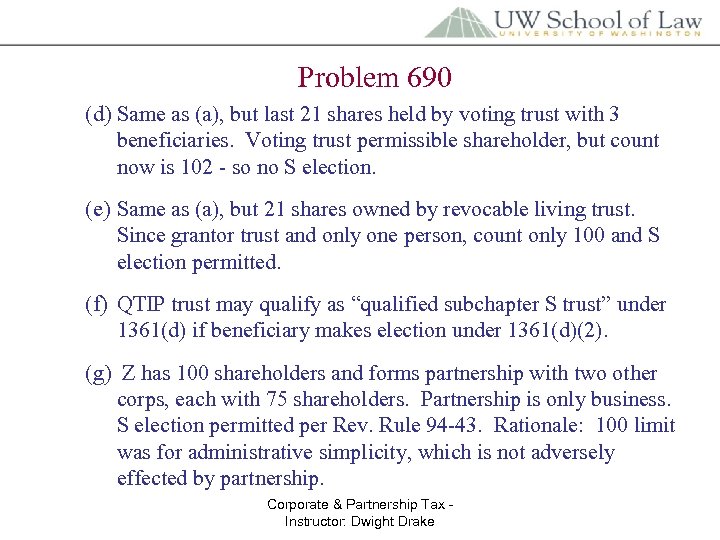 Problem 690 (d) Same as (a), but last 21 shares held by voting trust with 3 beneficiaries. Voting trust permissible shareholder, but count now is 102 - so no S election. (e) Same as (a), but 21 shares owned by revocable living trust. Since grantor trust and only one person, count only 100 and S election permitted. (f) QTIP trust may qualify as “qualified subchapter S trust” under 1361(d) if beneficiary makes election under 1361(d)(2). (g) Z has 100 shareholders and forms partnership with two other corps, each with 75 shareholders. Partnership is only business. S election permitted per Rev. Rule 94 -43. Rationale: 100 limit was for administrative simplicity, which is not adversely effected by partnership. Corporate & Partnership Tax Instructor: Dwight Drake
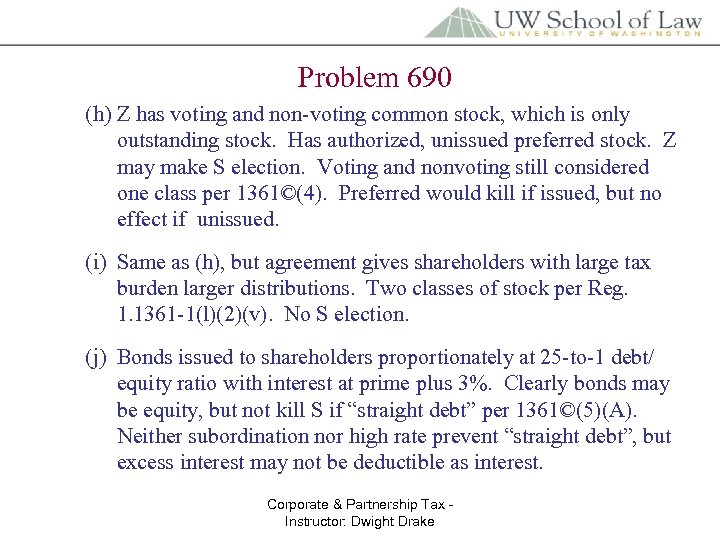 Problem 690 (h) Z has voting and non-voting common stock, which is only outstanding stock. Has authorized, unissued preferred stock. Z may make S election. Voting and nonvoting still considered one class per 1361©(4). Preferred would kill if issued, but no effect if unissued. (i) Same as (h), but agreement gives shareholders with large tax burden larger distributions. Two classes of stock per Reg. 1. 1361 -1(l)(2)(v). No S election. (j) Bonds issued to shareholders proportionately at 25 -to-1 debt/ equity ratio with interest at prime plus 3%. Clearly bonds may be equity, but not kill S if “straight debt” per 1361©(5)(A). Neither subordination nor high rate prevent “straight debt”, but excess interest may not be deductible as interest. Corporate & Partnership Tax Instructor: Dwight Drake
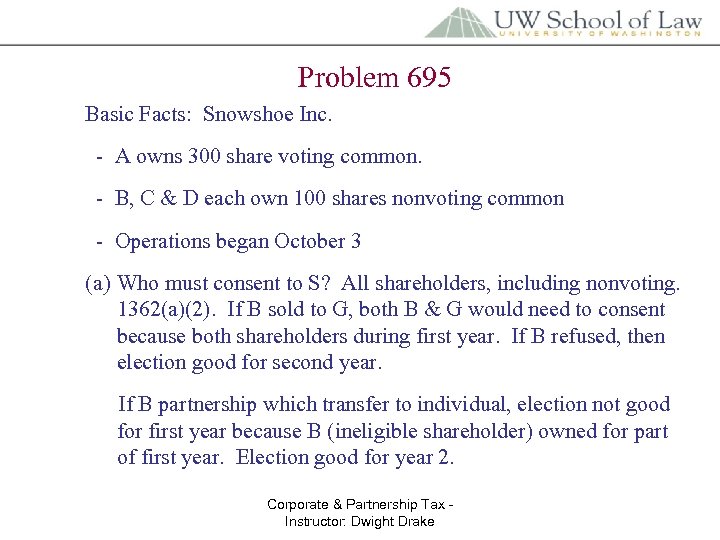 Problem 695 Basic Facts: Snowshoe Inc. - A owns 300 share voting common. - B, C & D each own 100 shares nonvoting common - Operations began October 3 (a) Who must consent to S? All shareholders, including nonvoting. 1362(a)(2). If B sold to G, both B & G would need to consent because both shareholders during first year. If B refused, then election good for second year. If B partnership which transfer to individual, election not good for first year because B (ineligible shareholder) owned for part of first year. Election good for year 2. Corporate & Partnership Tax Instructor: Dwight Drake
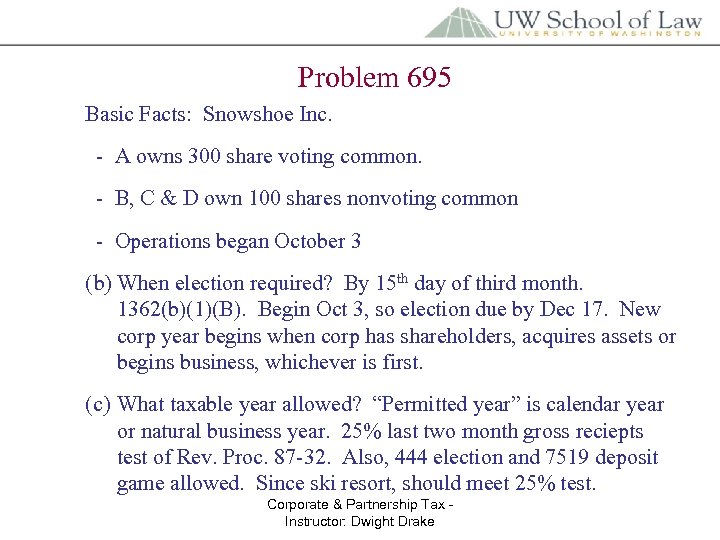 Problem 695 Basic Facts: Snowshoe Inc. - A owns 300 share voting common. - B, C & D own 100 shares nonvoting common - Operations began October 3 (b) When election required? By 15 th day of third month. 1362(b)(1)(B). Begin Oct 3, so election due by Dec 17. New corp year begins when corp has shareholders, acquires assets or begins business, whichever is first. (c) What taxable year allowed? “Permitted year” is calendar year or natural business year. 25% last two month gross reciepts test of Rev. Proc. 87 -32. Also, 444 election and 7519 deposit game allowed. Since ski resort, should meet 25% test. Corporate & Partnership Tax Instructor: Dwight Drake
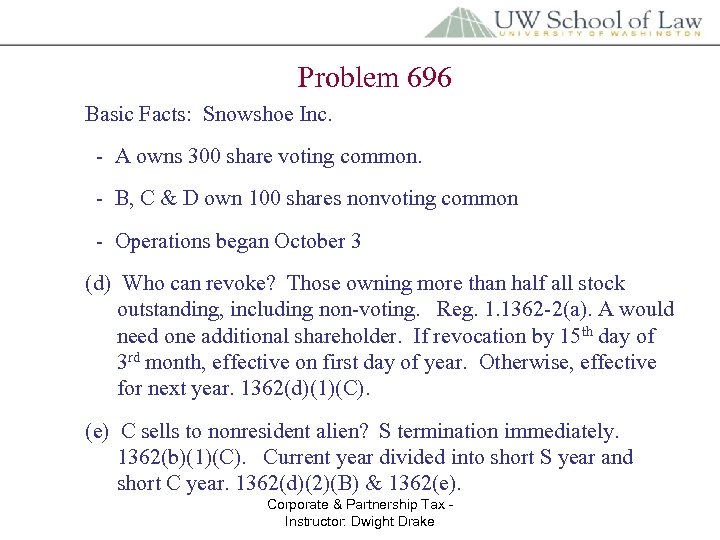 Problem 696 Basic Facts: Snowshoe Inc. - A owns 300 share voting common. - B, C & D own 100 shares nonvoting common - Operations began October 3 (d) Who can revoke? Those owning more than half all stock outstanding, including non-voting. Reg. 1. 1362 -2(a). A would need one additional shareholder. If revocation by 15 th day of 3 rd month, effective on first day of year. Otherwise, effective for next year. 1362(d)(1)(C). (e) C sells to nonresident alien? S termination immediately. 1362(b)(1)(C). Current year divided into short S year and short C year. 1362(d)(2)(B) & 1362(e). Corporate & Partnership Tax Instructor: Dwight Drake
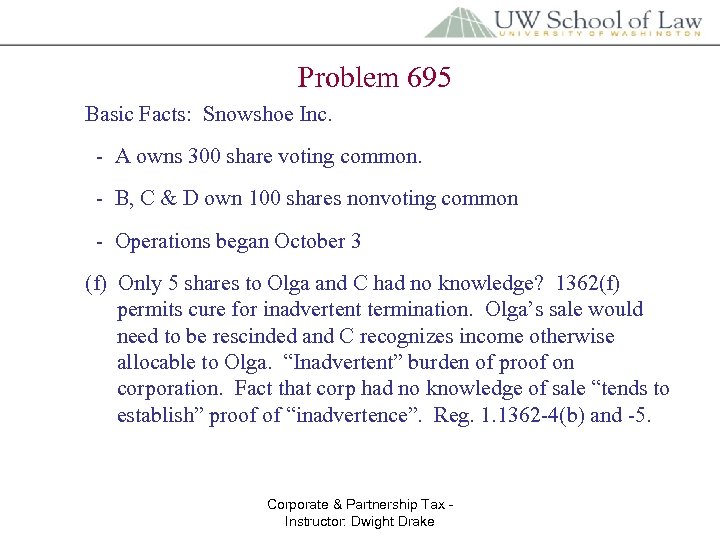 Problem 695 Basic Facts: Snowshoe Inc. - A owns 300 share voting common. - B, C & D own 100 shares nonvoting common - Operations began October 3 (f) Only 5 shares to Olga and C had no knowledge? 1362(f) permits cure for inadvertent termination. Olga’s sale would need to be rescinded and C recognizes income otherwise allocable to Olga. “Inadvertent” burden of proof on corporation. Fact that corp had no knowledge of sale “tends to establish” proof of “inadvertence”. Reg. 1. 1362 -4(b) and -5. Corporate & Partnership Tax Instructor: Dwight Drake
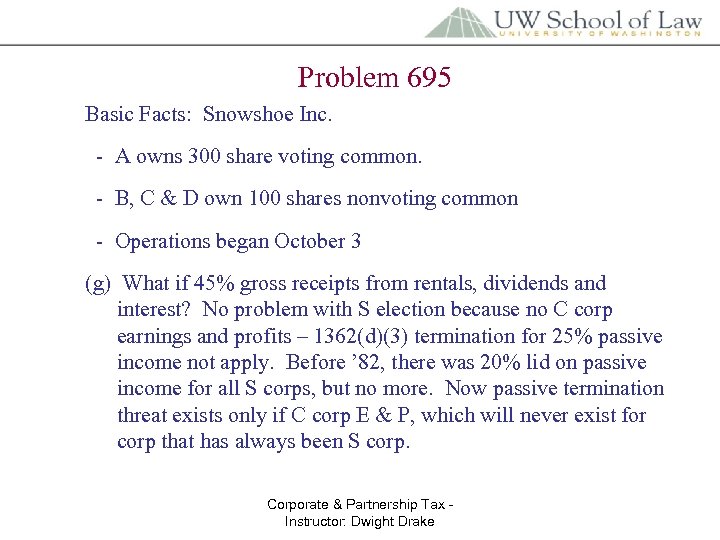 Problem 695 Basic Facts: Snowshoe Inc. - A owns 300 share voting common. - B, C & D own 100 shares nonvoting common - Operations began October 3 (g) What if 45% gross receipts from rentals, dividends and interest? No problem with S election because no C corp earnings and profits – 1362(d)(3) termination for 25% passive income not apply. Before ’ 82, there was 20% lid on passive income for all S corps, but no more. Now passive termination threat exists only if C corp E & P, which will never exist for corp that has always been S corp. Corporate & Partnership Tax Instructor: Dwight Drake