


 Скачать презентацию The Revolutions Of 1848 The Springtime of Peoples
66b240701189a2d840224a5a3af09ab0.ppt
- Количество слайдов: 36
 The Revolutions Of 1848 “The Springtime of Peoples” Ms. Susan M. Pojer Horace Greeley HS Chappaqua, NY
 Pre-1848 Tensions: Long-Term G Industrialization § Economic challenges to rulers. § Rapid urbanization. § Challenges to the artisan class. G Population doubled in the 18 c § Food supply problems Malthus G Ideological Challenges § Liberalism, nationalism, democracy, socialism. G Romanticism G Repressive Measures § Carlsbad Decrees [Prus. ] § Six Acts [Eng. ] § Secret police created in many European states.
 Pre-1848 Tensions: Short-Term G Agricultural Crises § Poor cereal harvests • prices rose 60% in one year. § Potato blight Ireland • Prices rose 135% for food in one year! G Financial Crises § Investment bubbles burst railways, iron, coal. § Unemployment increased rapidly [esp. among the artisan class]. Working & middle classes are now joined in misery as are the urban and agricultural peasantry!
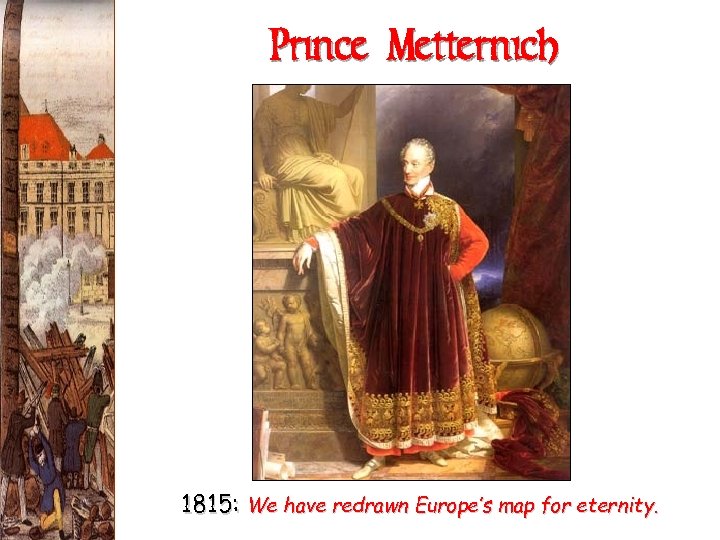 Prince Metternich 1815: We have redrawn Europe’s map for eternity.
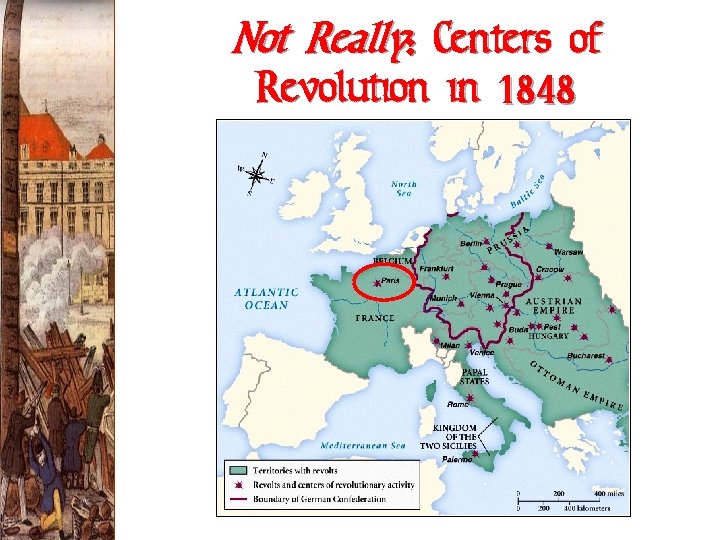 Not Really: Centers of Revolution in 1848
 No Coherent Organized Revolutions G Many different reasons for revolutionary activities. § Reactions to long- and short-term causes. G Competing ideologies in different countries. G Different revolutionary leaders, aims, and goals in different countries. G Some countries had no revolutions: § England. § Russia.
 The HAPSBURG EMPIRE
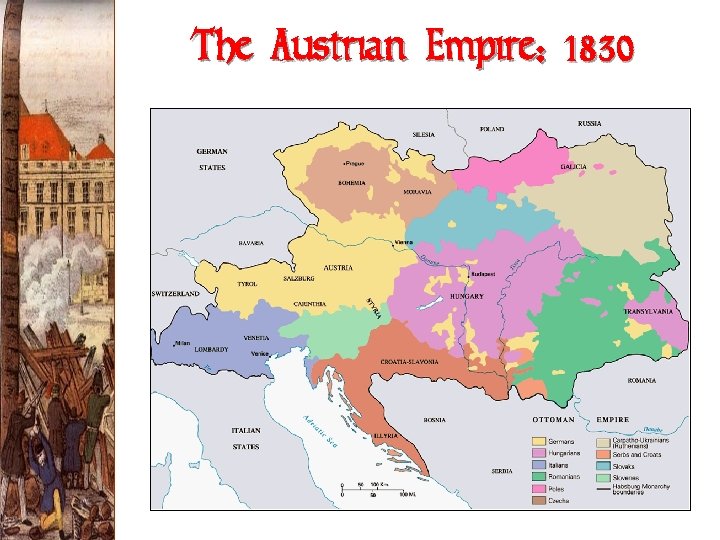 The Austrian Empire: 1830
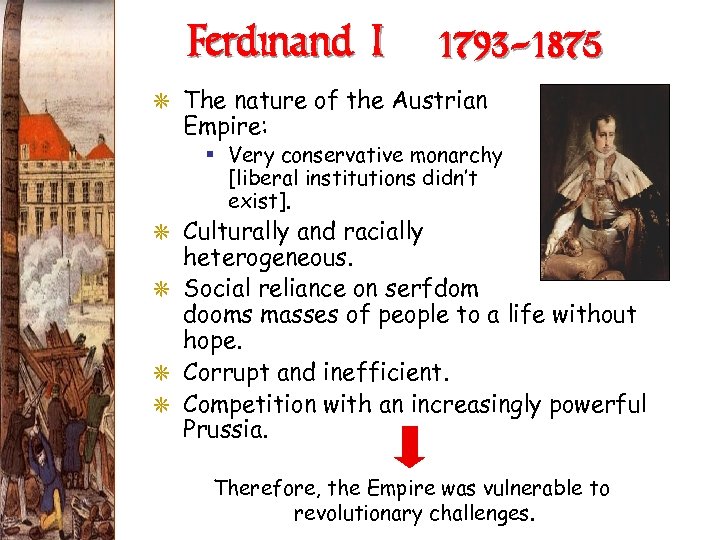 Ferdinand I (1793 -1875) G The nature of the Austrian Empire: § Very conservative monarchy [liberal institutions didn’t exist]. G Culturally and racially heterogeneous. G Social reliance on serfdom dooms masses of people to a life without hope. G Corrupt and inefficient. G Competition with an increasingly powerful Prussia. Therefore, the Empire was vulnerable to revolutionary challenges.
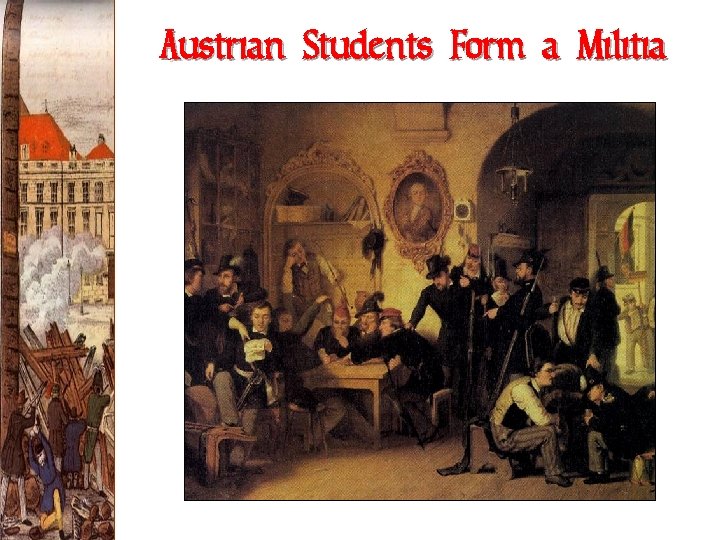 Austrian Students Form a Militia
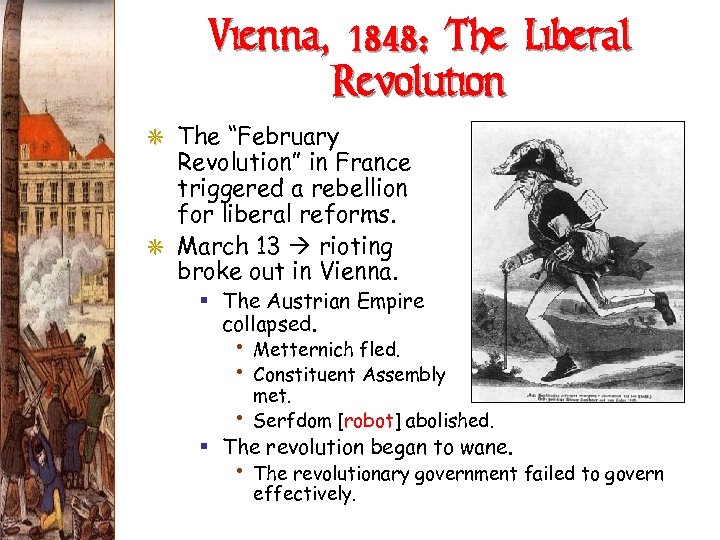 Vienna, 1848: The Liberal Revolution G The “February Revolution” in France triggered a rebellion for liberal reforms. G March 13 rioting broke out in Vienna. § The Austrian Empire collapsed. • • • Metternich fled. Constituent Assembly met. Serfdom [robot] abolished. § The revolution began to wane. • The revolutionary government failed to govern effectively.
![The New Austrian Emperor Franz Joseph I [r. 1848 -1916]](https://present5.com/presentation/66b240701189a2d840224a5a3af09ab0/image-12.jpg "The New Austrian Emperor Franz Joseph I [r. 1848 -1916]") The New Austrian Emperor Franz Joseph I [r. 1848 -1916]
The New Austrian Emperor Franz Joseph I [r. 1848 -1916]
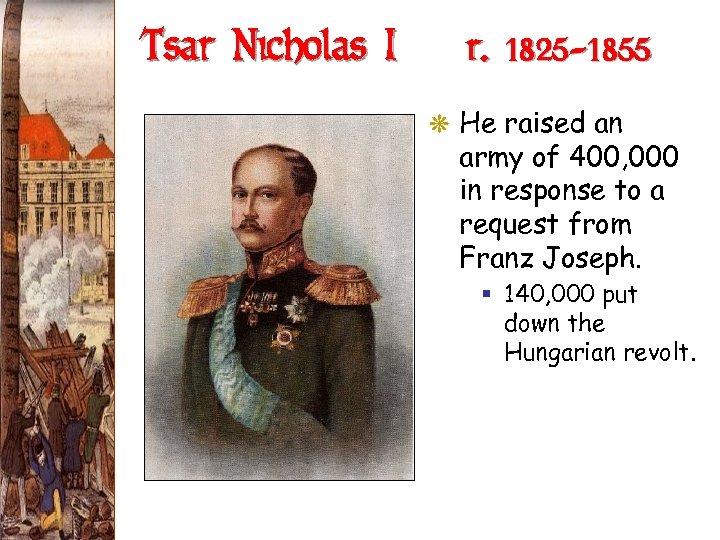 Tsar Nicholas I (r. 1825 -1855) G He raised an army of 400, 000 in response to a request from Franz Joseph. § 140, 000 put down the Hungarian revolt.
 Italy
Italy
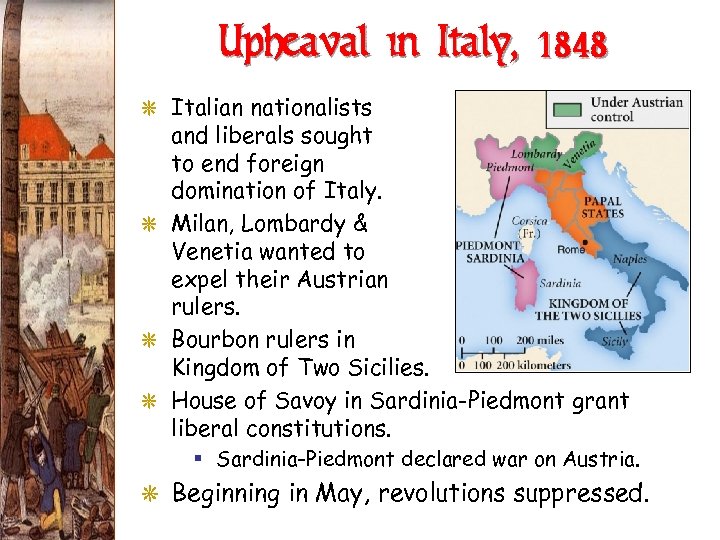 Upheaval in Italy, 1848 G Italian nationalists and liberals sought to end foreign domination of Italy. G Milan, Lombardy & Venetia wanted to expel their Austrian rulers. G Bourbon rulers in Kingdom of Two Sicilies. G House of Savoy in Sardinia-Piedmont grant liberal constitutions. § Sardinia-Piedmont declared war on Austria. G Beginning in May, revolutions suppressed.
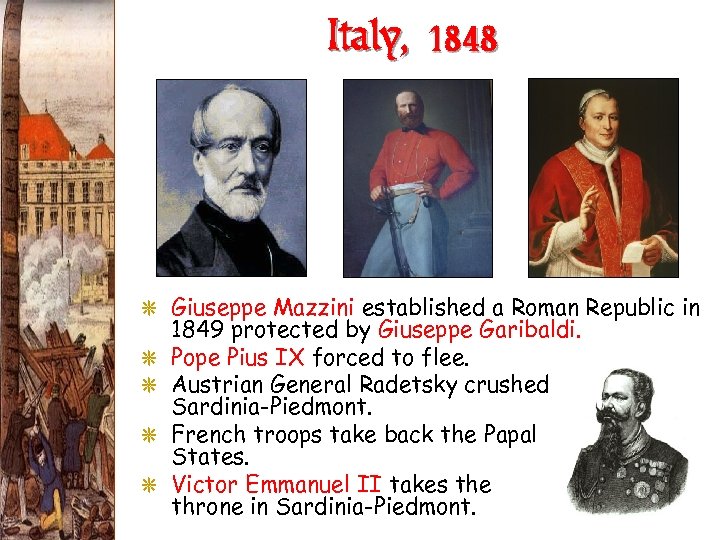 Italy, 1848 G Giuseppe Mazzini established a Roman Republic in 1849 protected by Giuseppe Garibaldi. G Pope Pius IX forced to flee. G Austrian General Radetsky crushed Sardinia-Piedmont. G French troops take back the Papal States. G Victor Emmanuel II takes the throne in Sardinia-Piedmont.
 Reasons for Failure in Italy G Rural people did not support the revolutions. § Revolutionaries focused mainly on urban middle classes. G The revolutionaries were not united. § Fear of radicals among moderates lead to the collapse of the revolutions. G Lack of leadership and administrative experience among the revolutionaries.
 The German States
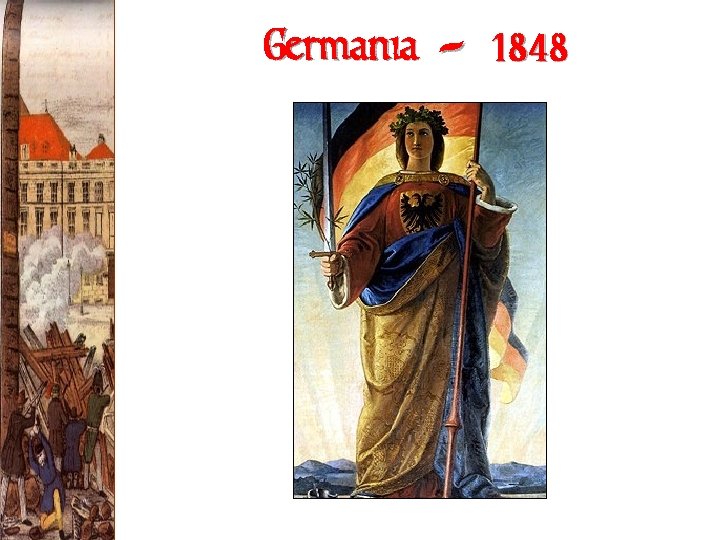 Germania - 1848
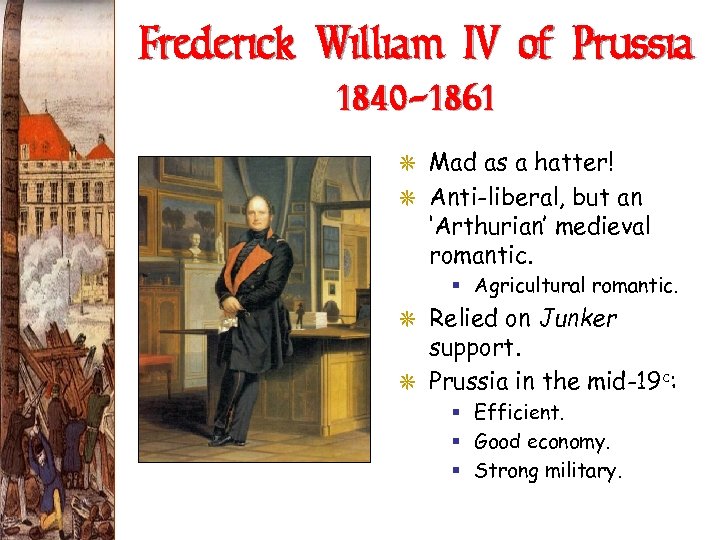 Frederick William IV of Prussia (1840 -1861) G Mad as a hatter! G Anti-liberal, but an ‘Arthurian’ medieval romantic. § Agricultural romantic. G Relied on Junker support. G Prussia in the mid-19 c: § Efficient. § Good economy. § Strong military.
 The Germans Follow the French G After the February French revolutions, there were many riots in minor German states. G Austria and Prussia expected to intervene to crush these revolts, BUT: § Vienna Revolution led to the fall of Metternich. § Berlin riots • • • Prussian army efficiently suppressed the revolutionaries. King Frederick William IV withdraws the troops and hand the Prussia liberals a big victory! Other Princedoms collapse when Prussia’s nerve fails.
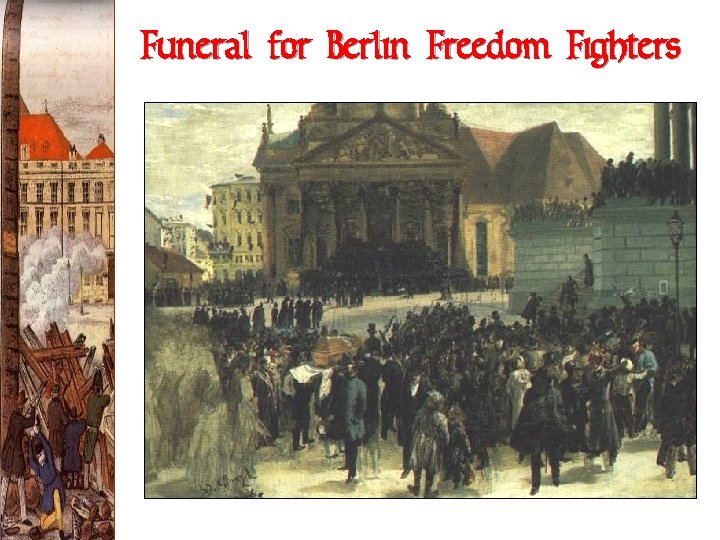 Funeral for Berlin Freedom Fighters
 The Frankfurt Assembly G German liberals are overjoyed! G German National Assembly established in Frankfurt: § Universal suffrage. § Delegates mostly from the middle class. § Debate over the nature of the state monarchy of Habsburgs or Hohenzollerns? § They chose the Austrian Habsburg Archduke John rather than the King of Prussia. • • He was a well-known liberal sympathizer. But they couldn’t guarantee the loyalty of the Prussian Army.
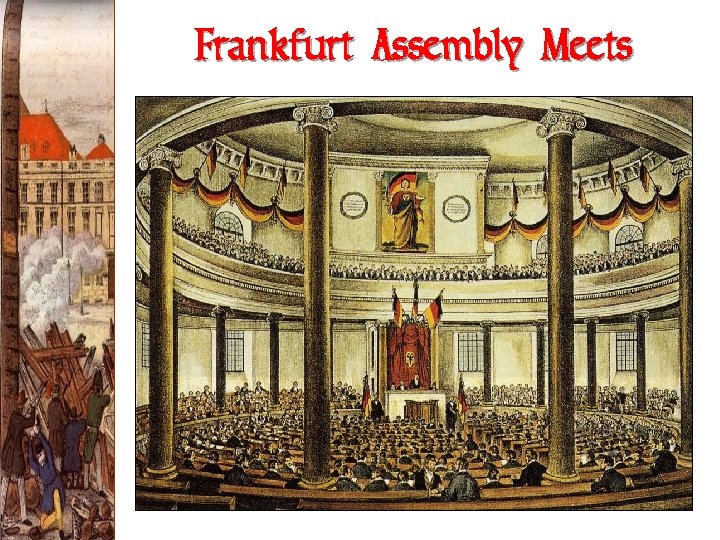 Frankfurt Assembly Meets
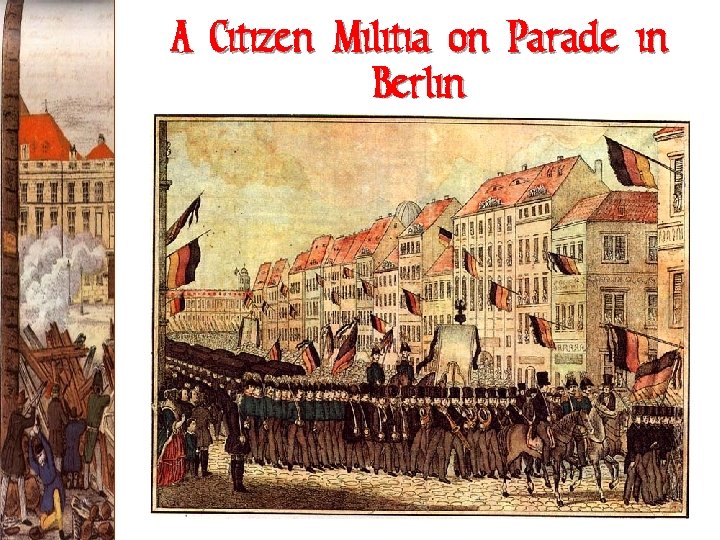 A Citizen Militia on Parade in Berlin
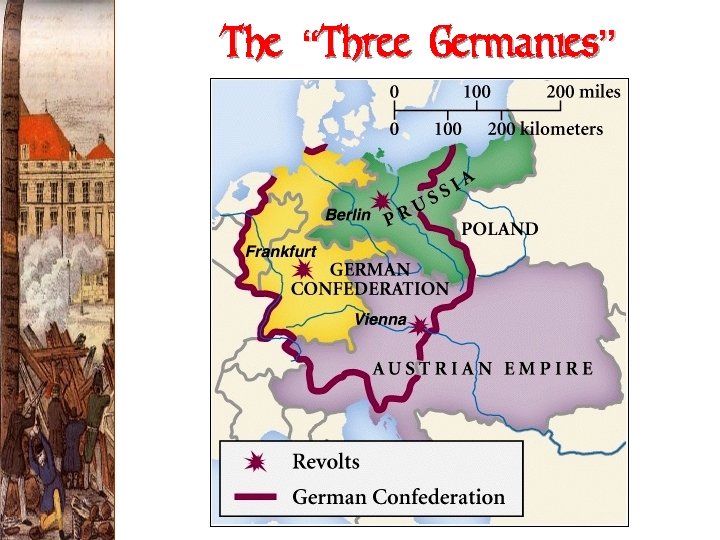 The “Three Germanies”
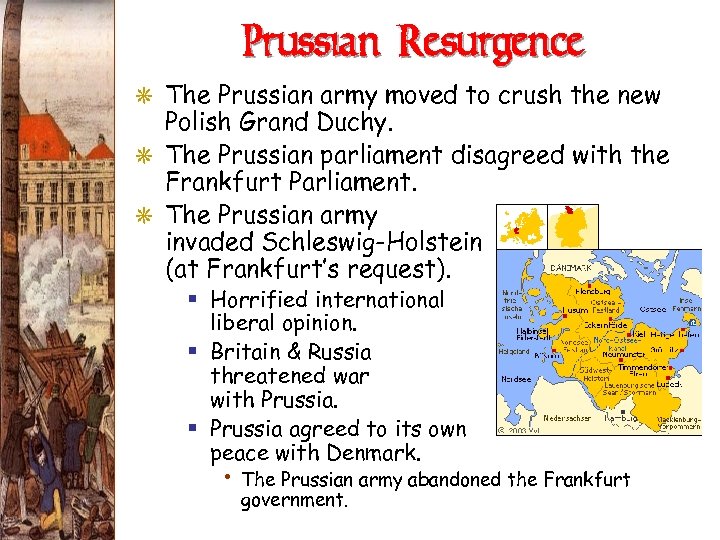 Prussian Resurgence G The Prussian army moved to crush the new Polish Grand Duchy. G The Prussian parliament disagreed with the Frankfurt Parliament. G The Prussian army invaded Schleswig-Holstein (at Frankfurt’s request). § Horrified international liberal opinion. § Britain & Russia threatened war with Prussia. § Prussia agreed to its own peace with Denmark. • The Prussian army abandoned the Frankfurt government.
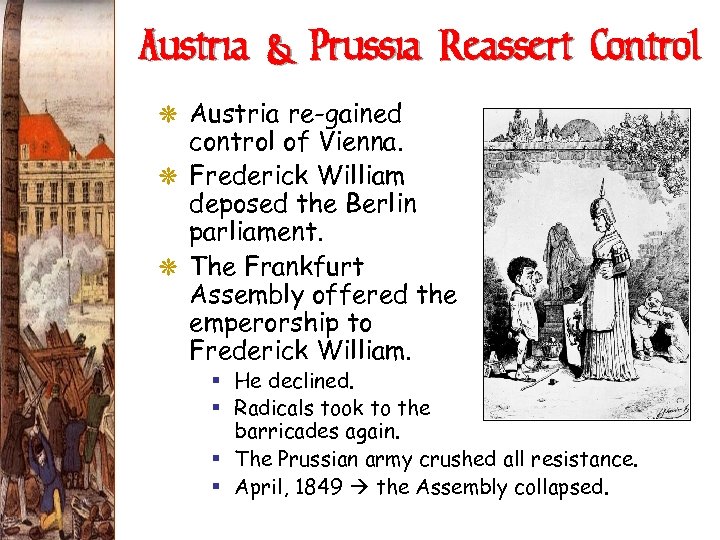 Austria & Prussia Reassert Control G Austria re-gained control of Vienna. G Frederick William deposed the Berlin parliament. G The Frankfurt Assembly offered the emperorship to Frederick William. § He declined. § Radicals took to the barricades again. § The Prussian army crushed all resistance. § April, 1849 the Assembly collapsed.
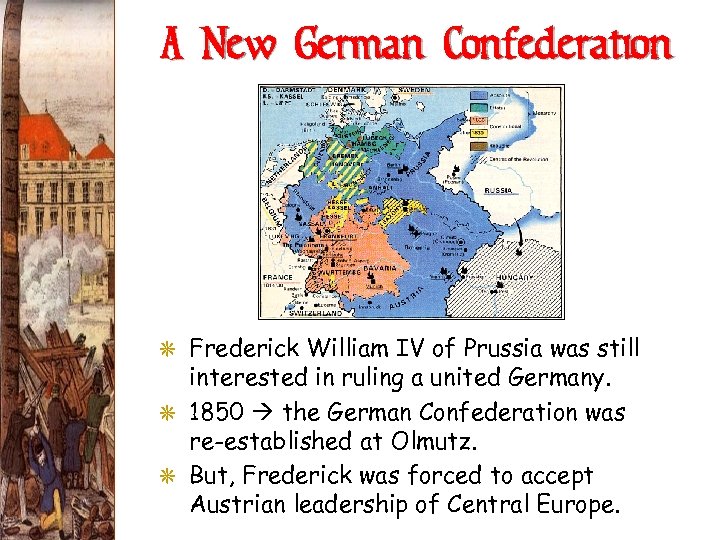 A New German Confederation G Frederick William IV of Prussia was still interested in ruling a united Germany. G 1850 the German Confederation was re-established at Olmutz. G But, Frederick was forced to accept Austrian leadership of Central Europe.
 Liberalism Discredited in Germany G Little popular support. G The union of liberals and democrats didn’t last. G Rule of force was the only winner! G There was a massive exodus of liberal intelligentsia. § Militarism, hierarchy, and statism were triumphant! § Capitalists followed suit.
 THE AFTERMATH
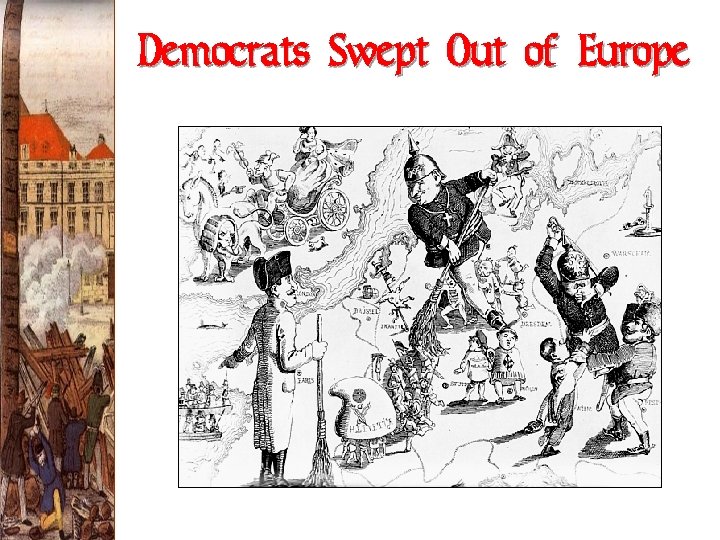 Democrats Swept Out of Europe
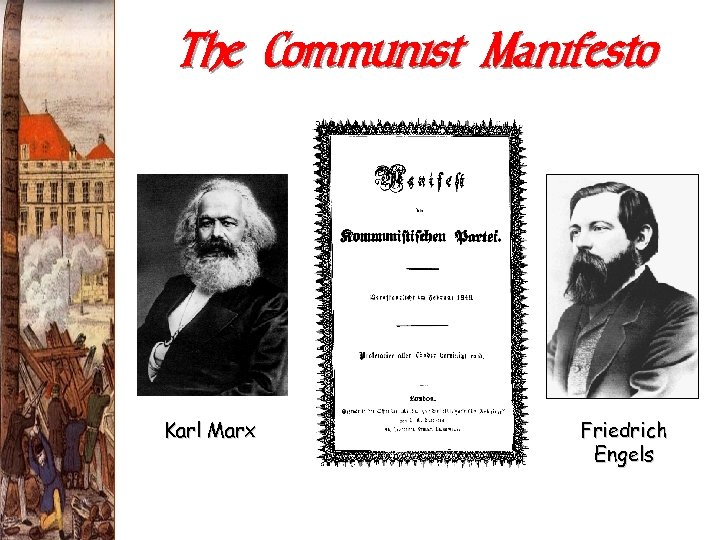 The Communist Manifesto Karl Marx Friedrich Engels
 Why did the 1848 Revolutions Fail? G They failed to attract popular support from the working classes. G The middle classes led these revolutions, but as they turned radical, the middle class held back. G Nationalism divided more than united. G Where revolutions were successful, the Old Guard was left in place and they turned against the revolutionaries. G Some gains lasted [abolition of serfdom, etc. ] G BUT, in the long term, most liberal gains would be solidified by the end of the 19 c: § The unification of Germany and Italy. § The collapse of the Hapsburg Empire at the end of World War I.
 The Bottom Line G It looked like the Conservative forces had triumphed. G BUT… § Things had changed forever. § Economic/social problems continued to be constant challenges to the ruling order. § Conservatives would have to make concessions in order to stay in power. § Many of the limited Liberal achievements remained permanent.
 Some Bibliographic Sources G “The Revolutions of 1848” by R. Folmer. St. Joseph’s H. S. (PPT). G “The Revolutions of 1848” by Stephen Luscombe. (PPT).