


 Скачать презентацию The Return to Soft Dollar Pegging in East
2dc56028d4c9b7c80dfad16a1094cf3a.ppt
- Количество слайдов: 42
 The Return to Soft Dollar Pegging in East Asia Mitigating Conflicted Virtue Ronald Mc. Kinnon Stanford University and Gunther Schnabl Tübingen University October 2004
 The Exchange Rate Debate in the 1990 s Before 1997, East Asian countries, except for Japan, “softly” pegged their exchange rates to the U. S. dollar. 1997 -98 Crisis: Thailand, Indonesia, Philippines, Korea, and Malaysia are attacked and devalue—with bankruptcies and economic downturns spreading contagiously. The IMF blames the soft pegging for encouraging over borrowing and current account deficits leading unsustainable dollar and yen debts. It warns against any return to dollar pegging. Williamson (2000), Kawai (2002), Ogawa and Ito (2002)—suggest weighting the Japanese yen more heavily in the currency baskets of the smaller East Asian economies in the face of wide fluctuations in the yen/dollar rate.
 The Debate In the New Millennium By 2004, the East Asian “crisis” and non crisis economies had returned to soft dollar pegging. China and Hong Kong retained hard pegs through the crisis, and Malaysia pegged in Sept 1998 at 3. 8 ringgit per dollar. Even the yen/dollar rate is more stable. But now all East Asian countries run large current account surpluses —even with net inflows of FDI (China). Only massive foreign official interventions kept their exchange rates from appreciating in 2003 and early 2004 Influential articles by Dooley, Folkerts-Landau, and Garber (2003)(2004) argue that East Asian countries on the dollar’s “periphery” are deliberately undervaluing their currencies to stimulate exports to the U. S. at the “center” to promote development. Intensified pressure from the IMF, the G-7, and the U. S. Treasury, for China to appreciate: “There should be more flexible currencies, not only for China but the whole of Asia” Rodrigo de Rato, IMF Managing Director, 29 Sept 2004 at IMF-World Bank Meetings in Washington.
 This Paper and Mc. Kinnon Book (2005) The Case for Asian Dollar Pegs p East Asian economies n Have sufficient fiscal and monetary control to target exchange rates, but have more difficulty targeting domestic inflation independently. n Are becoming highly integrated economically with more than 50% of trade with each other. They need stable cross rates of exchange. n Debtor countries have “original sin” and creditors have “conflicted virtue” making foreign exchange risks more difficult to hedge.
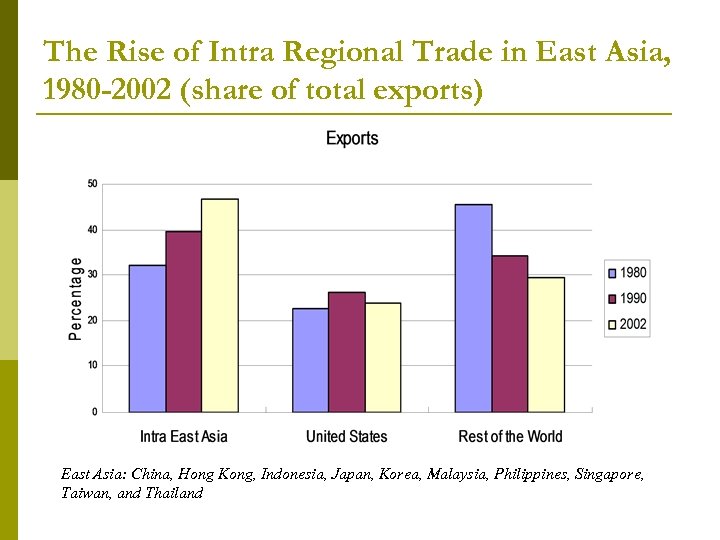 The Rise of Intra Regional Trade in East Asia, 1980 -2002 (share of total exports) East Asia: China, Hong Kong, Indonesia, Japan, Korea, Malaysia, Philippines, Singapore, Taiwan, and Thailand
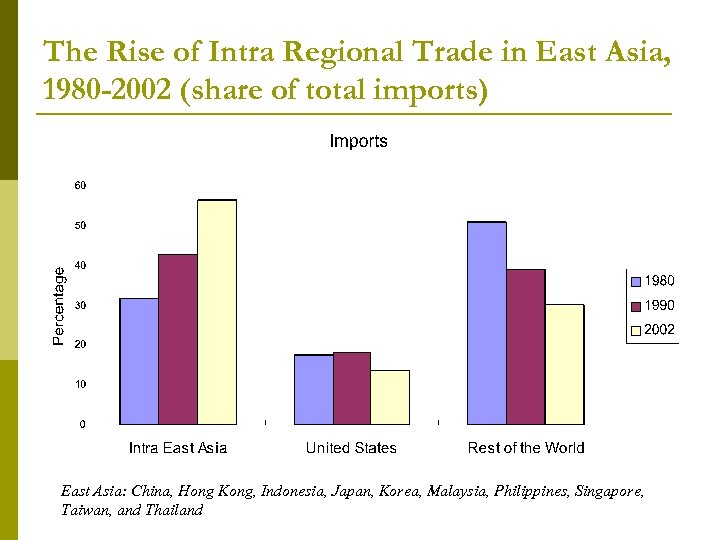 The Rise of Intra Regional Trade in East Asia, 1980 -2002 (share of total imports) East Asia: China, Hong Kong, Indonesia, Japan, Korea, Malaysia, Philippines, Singapore, Taiwan, and Thailand
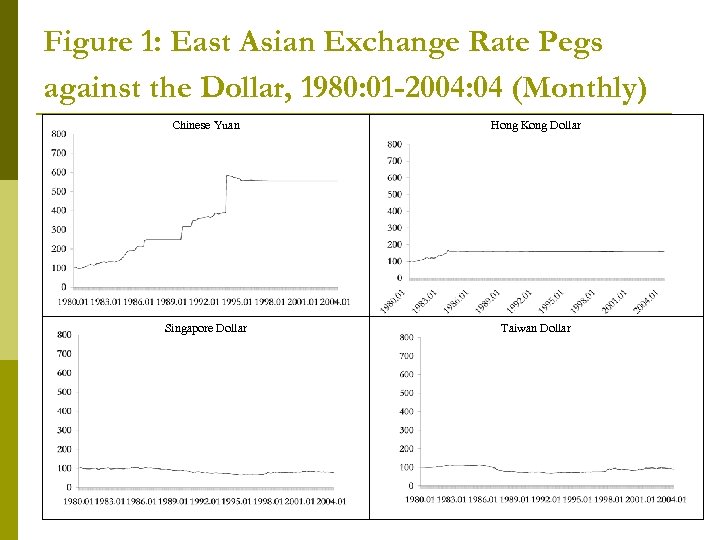 Figure 1: East Asian Exchange Rate Pegs against the Dollar, 1980: 01 -2004: 04 (Monthly) Chinese Yuan Hong Kong Dollar Singapore Dollar Taiwan Dollar
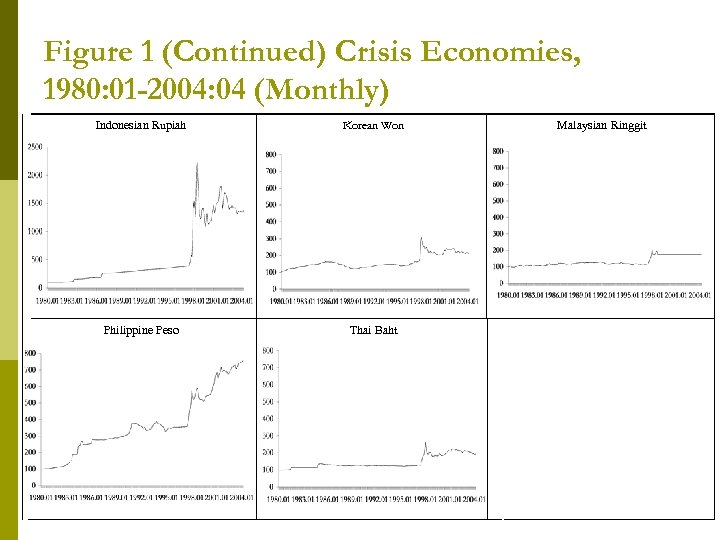 Figure 1 (Continued) Crisis Economies, 1980: 01 -2004: 04 (Monthly) Indonesian Rupiah Korean Won Philippine Peso Thai Baht Malaysian Ringgit
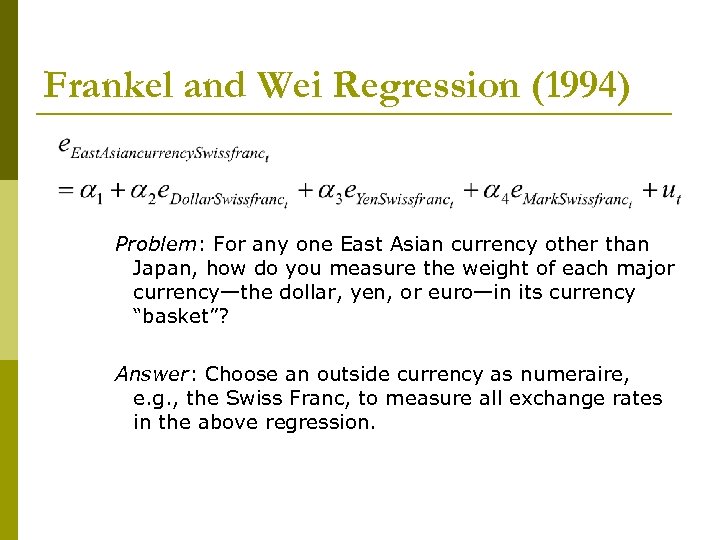 Frankel and Wei Regression (1994) Problem: For any one East Asian currency other than Japan, how do you measure the weight of each major currency—the dollar, yen, or euro—in its currency “basket”? Answer: Choose an outside currency as numeraire, e. g. , the Swiss Franc, to measure all exchange rates in the above regression.
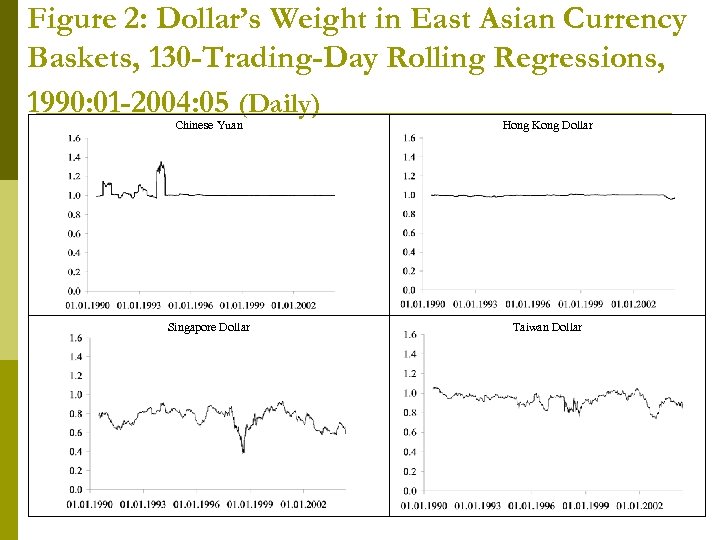 Figure 2: Dollar’s Weight in East Asian Currency Baskets, 130 -Trading-Day Rolling Regressions, 1990: 01 -2004: 05 (Daily) Chinese Yuan Hong Kong Dollar Singapore Dollar Taiwan Dollar
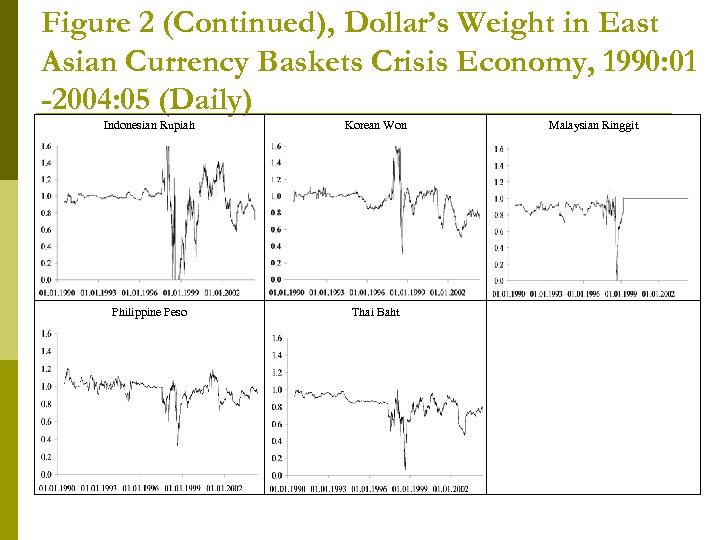 Figure 2 (Continued), Dollar’s Weight in East Asian Currency Baskets Crisis Economy, 1990: 01 -2004: 05 (Daily) Indonesian Rupiah Korean Won Philippine Peso Malaysian Ringgit Thai Baht
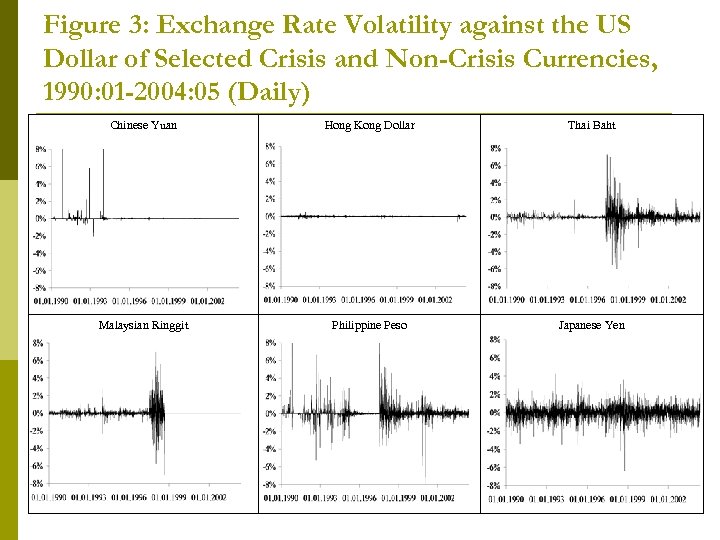 Figure 3: Exchange Rate Volatility against the US Dollar of Selected Crisis and Non-Crisis Currencies, 1990: 01 -2004: 05 (Daily) Chinese Yuan Hong Kong Dollar Thai Baht Malaysian Ringgit Philippine Peso Japanese Yen
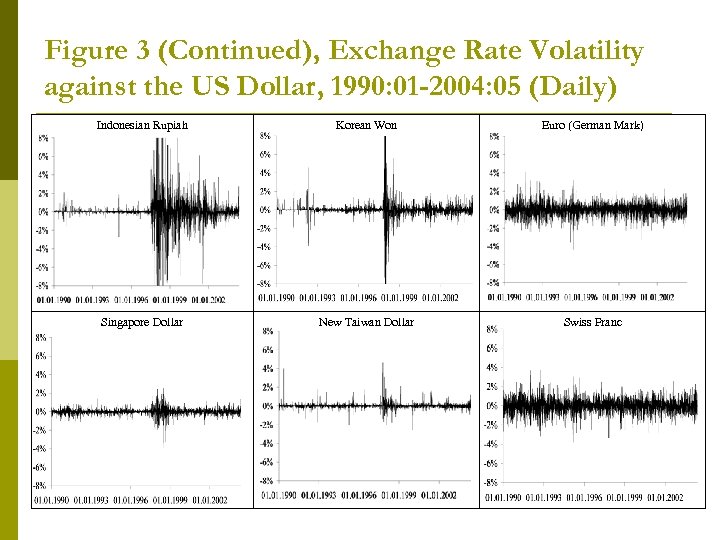 Figure 3 (Continued), Exchange Rate Volatility against the US Dollar, 1990: 01 -2004: 05 (Daily) Indonesian Rupiah Korean Won Euro (German Mark) Singapore Dollar New Taiwan Dollar Swiss Franc
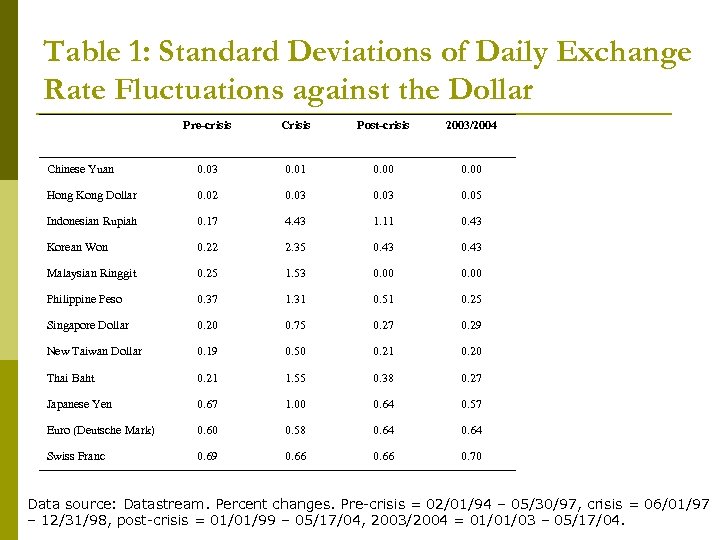 Table 1: Standard Deviations of Daily Exchange Rate Fluctuations against the Dollar Pre-crisis Crisis Post-crisis 2003/2004 Chinese Yuan 0. 03 0. 01 0. 00 Hong Kong Dollar 0. 02 0. 03 0. 05 Indonesian Rupiah 0. 17 4. 43 1. 11 0. 43 Korean Won 0. 22 2. 35 0. 43 Malaysian Ringgit 0. 25 1. 53 0. 00 Philippine Peso 0. 37 1. 31 0. 51 0. 25 Singapore Dollar 0. 20 0. 75 0. 27 0. 29 New Taiwan Dollar 0. 19 0. 50 0. 21 0. 20 Thai Baht 0. 21 1. 55 0. 38 0. 27 Japanese Yen 0. 67 1. 00 0. 64 0. 57 Euro (Deutsche Mark) 0. 60 0. 58 0. 64 Swiss Franc 0. 69 0. 66 0. 70 Data source: Datastream. Percent changes. Pre-crisis = 02/01/94 – 05/30/97, crisis = 06/01/97 – 12/31/98, post-crisis = 01/01/99 – 05/17/04, 2003/2004 = 01/01/03 – 05/17/04.
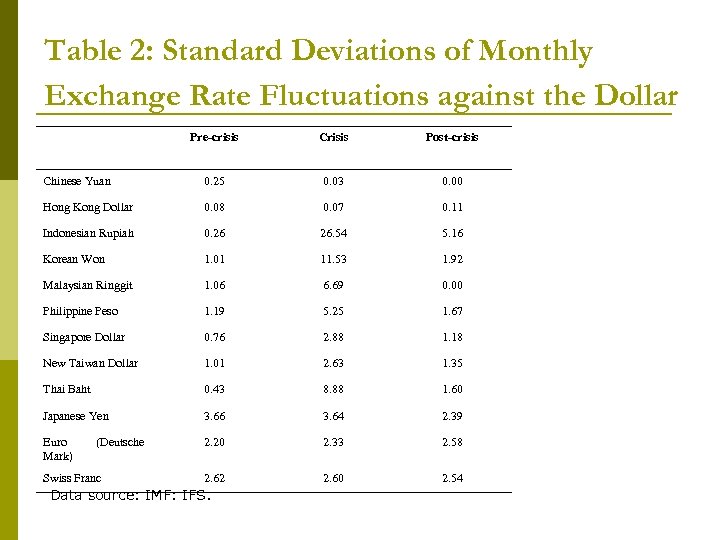 Table 2: Standard Deviations of Monthly Exchange Rate Fluctuations against the Dollar Pre-crisis Crisis Post-crisis Chinese Yuan 0. 25 0. 03 0. 00 Hong Kong Dollar 0. 08 0. 07 0. 11 Indonesian Rupiah 0. 26 26. 54 5. 16 Korean Won 1. 01 11. 53 1. 92 Malaysian Ringgit 1. 06 6. 69 0. 00 Philippine Peso 1. 19 5. 25 1. 67 Singapore Dollar 0. 76 2. 88 1. 18 New Taiwan Dollar 1. 01 2. 63 1. 35 Thai Baht 0. 43 8. 88 1. 60 Japanese Yen 3. 66 3. 64 2. 39 Euro Mark) 2. 20 2. 33 2. 58 2. 62 2. 60 2. 54 (Deutsche Swiss Franc Data source: IMF: IFS.
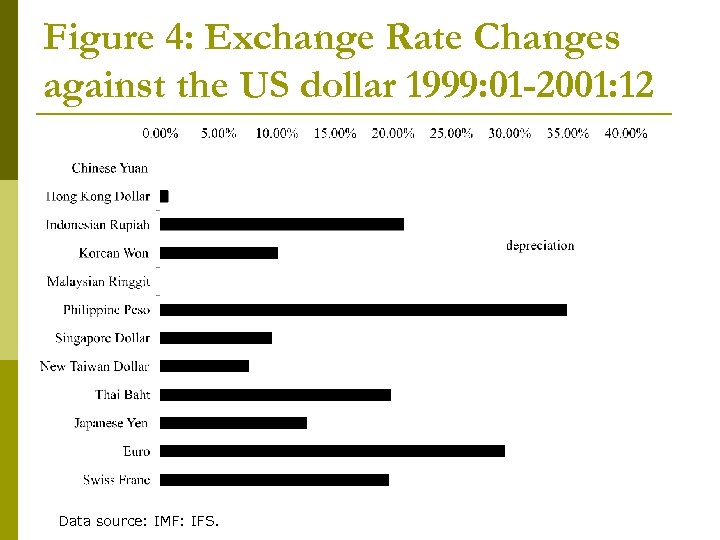 Figure 4: Exchange Rate Changes against the US dollar 1999: 01 -2001: 12 Data source: IMF: IFS.
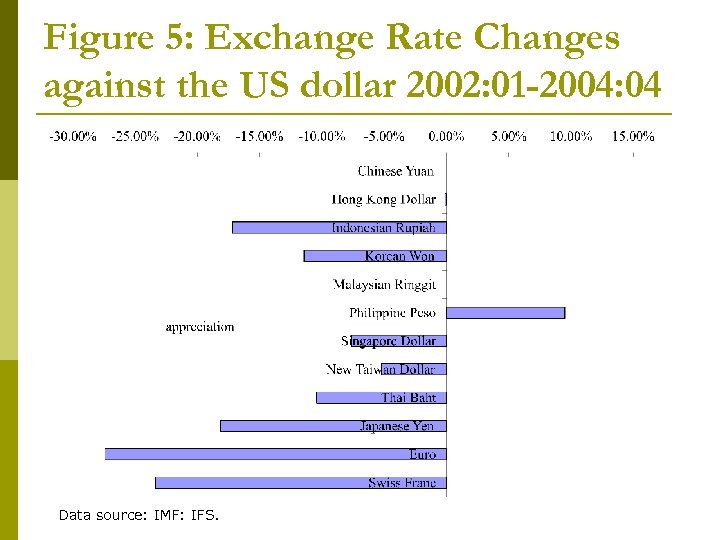 Figure 5: Exchange Rate Changes against the US dollar 2002: 01 -2004: 04 Data source: IMF: IFS.
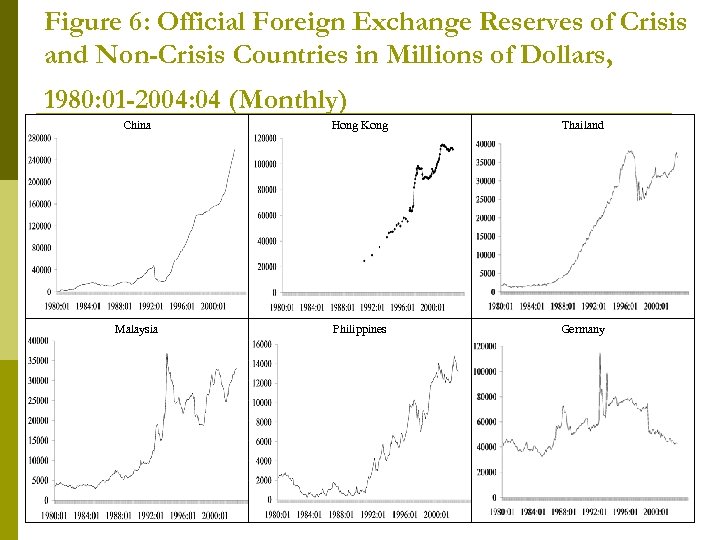 Figure 6: Official Foreign Exchange Reserves of Crisis and Non-Crisis Countries in Millions of Dollars, 1980: 01 -2004: 04 (Monthly) China Hong Kong Thailand Malaysia Philippines Germany
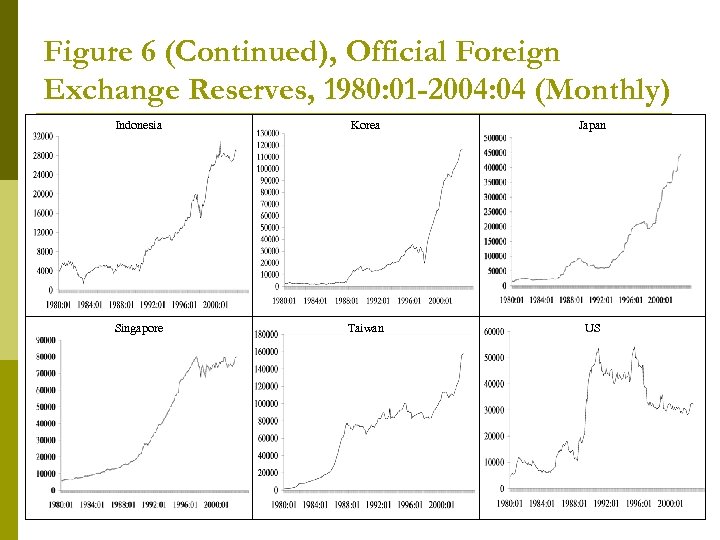 Figure 6 (Continued), Official Foreign Exchange Reserves, 1980: 01 -2004: 04 (Monthly) Indonesia Korea Japan Singapore Taiwan US
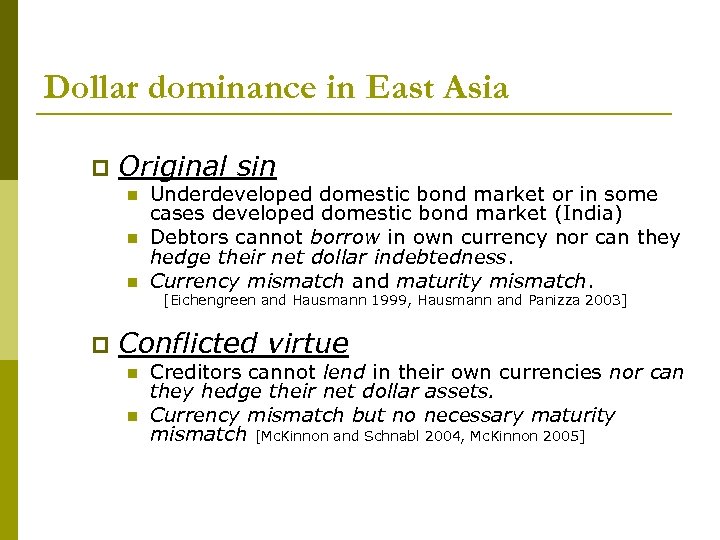 Dollar dominance in East Asia p Original sin n Underdeveloped domestic bond market or in some cases developed domestic bond market (India) Debtors cannot borrow in own currency nor can they hedge their net dollar indebtedness. Currency mismatch and maturity mismatch. [Eichengreen and Hausmann 1999, Hausmann and Panizza 2003] p Conflicted virtue n n Creditors cannot lend in their own currencies nor can they hedge their net dollar assets. Currency mismatch but no necessary maturity mismatch [Mc. Kinnon and Schnabl 2004, Mc. Kinnon 2005]
 Conflicted virtue p High-saving countries lend to foreigners in the form of current account surpluses. However, as the stock of dollar claims cumulates: n n Foreigners start complaining that the country’s ongoing flow of trade surpluses is unfair and the result of having an undervalued currency. Domestic holders of dollar assets worry more about a self-sustaining run into the domestic currency forcing an appreciation.
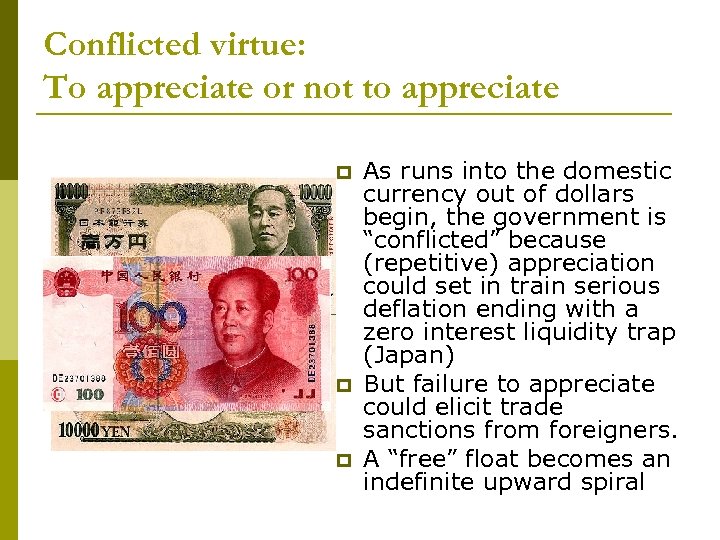 Conflicted virtue: To appreciate or not to appreciate p p p As runs into the domestic currency out of dollars begin, the government is “conflicted” because (repetitive) appreciation could set in train serious deflation ending with a zero interest liquidity trap (Japan) But failure to appreciate could elicit trade sanctions from foreigners. A “free” float becomes an indefinite upward spiral
 The story of Japan (I) p p There were repetitive appreciations of yen from 1970 s to mid-’ 90 s under mercantile pressure from trade partners―particularly the United States, but trade surpluses continued to cumulate. Reason: n Exchange rate changes only determine domestic inflation or deflation, not trade balance. The simpleminded elasticities approach is invalid in financially open economies. [Mc. Kinnon and Ohno 1997]
 Do exchange rate changes necessarily bring Bo. P balance? p Elasticity model n p Bo. P balance through current account changes if Marshall-Lerner condition holds. Mc. Kinnon and Ohno in Dollar and Yen (1997): n n Inflationary/deflationary pressure only. Indeterminate CA effect in the short term because of domestic absorption effect.
 The story of Japan (II) p Negative risk premium n n [Goyal and Mc. Kinnon 2003] To maintain portfolio balance, Japanese financial institutions demand a higher return on dollars (which is riskier given the volatility in exchange rate). The internationally determined dollar asset return thus pushes down the yen interest rate. It finally forced Japan into the zero interest liquidity trap by the end of 1996.
 Is China like Japan? p China has a big advantage over Japan: n p The RMB exchange rate has been and can be more credibly maintained at the current level without disturbing domestic price level. And a disadvantage: n China’s net FDI inflows are much larger than Japan’s. FDI can be seen as illiquid liabilities but imposes liquid dollar claims.
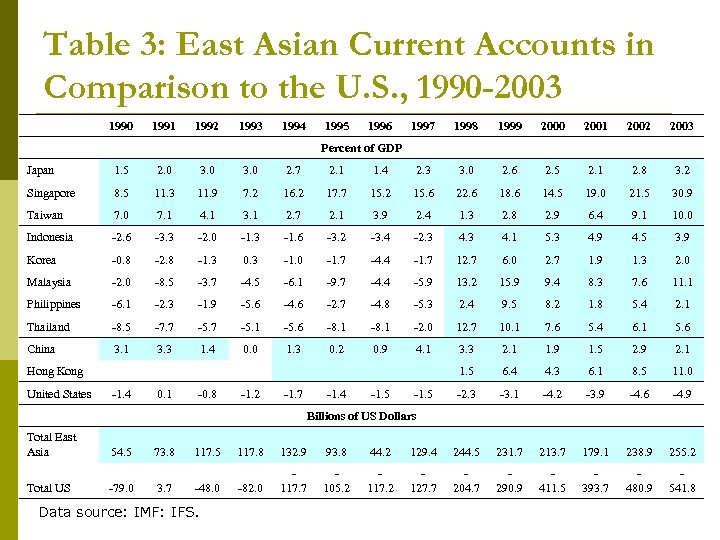 Table 3: East Asian Current Accounts in Comparison to the U. S. , 1990 -2003 1990 1991 1992 1993 1994 1995 1996 1997 1998 1999 2000 2001 2002 2003 Percent of GDP Japan 1. 5 2. 0 3. 0 2. 7 2. 1 1. 4 2. 3 3. 0 2. 6 2. 5 2. 1 2. 8 3. 2 Singapore 8. 5 11. 3 11. 9 7. 2 16. 2 17. 7 15. 2 15. 6 22. 6 18. 6 14. 5 19. 0 21. 5 30. 9 Taiwan 7. 0 7. 1 4. 1 3. 1 2. 7 2. 1 3. 9 2. 4 1. 3 2. 8 2. 9 6. 4 9. 1 10. 0 Indonesia -2. 6 -3. 3 -2. 0 -1. 3 -1. 6 -3. 2 -3. 4 -2. 3 4. 1 5. 3 4. 9 4. 5 3. 9 Korea -0. 8 -2. 8 -1. 3 0. 3 -1. 0 -1. 7 -4. 4 -1. 7 12. 7 6. 0 2. 7 1. 9 1. 3 2. 0 Malaysia -2. 0 -8. 5 -3. 7 -4. 5 -6. 1 -9. 7 -4. 4 -5. 9 13. 2 15. 9 9. 4 8. 3 7. 6 11. 1 Philippines -6. 1 -2. 3 -1. 9 -5. 6 -4. 6 -2. 7 -4. 8 -5. 3 2. 4 9. 5 8. 2 1. 8 5. 4 2. 1 Thailand -8. 5 -7. 7 -5. 1 -5. 6 -8. 1 -2. 0 12. 7 10. 1 7. 6 5. 4 6. 1 5. 6 China 3. 1 3. 3 1. 4 0. 0 1. 3 0. 2 0. 9 4. 1 3. 3 2. 1 1. 9 1. 5 2. 9 2. 1 1. 5 6. 4 4. 3 6. 1 8. 5 11. 0 0. 1 -0. 8 -1. 2 -1. 7 -1. 4 -1. 5 -2. 3 -3. 1 -4. 2 -3. 9 -4. 6 -4. 9 Hong Kong United States -1. 4 Billions of US Dollars Total East Asia 54. 5 73. 8 117. 5 117. 8 132. 9 93. 8 44. 2 129. 4 244. 5 231. 7 213. 7 179. 1 238. 9 255. 2 Total US -79. 0 3. 7 -48. 0 -82. 0 117. 7 105. 2 117. 2 127. 7 204. 7 290. 9 411. 5 393. 7 480. 9 541. 8 Data source: IMF: IFS.
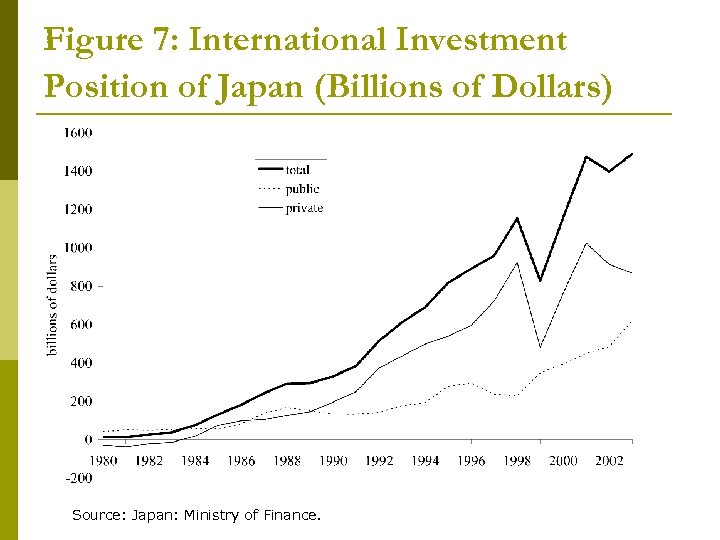 Figure 7: International Investment Position of Japan (Billions of Dollars) Source: Japan: Ministry of Finance.
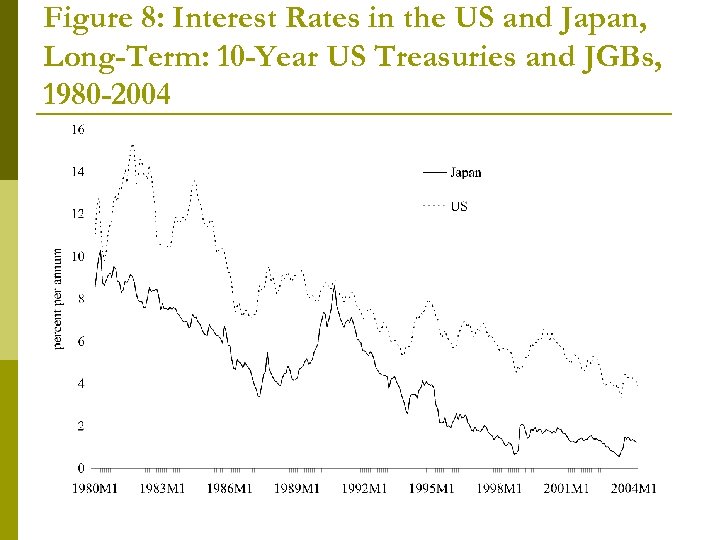 Figure 8: Interest Rates in the US and Japan, Long-Term: 10 -Year US Treasuries and JGBs, 1980 -2004
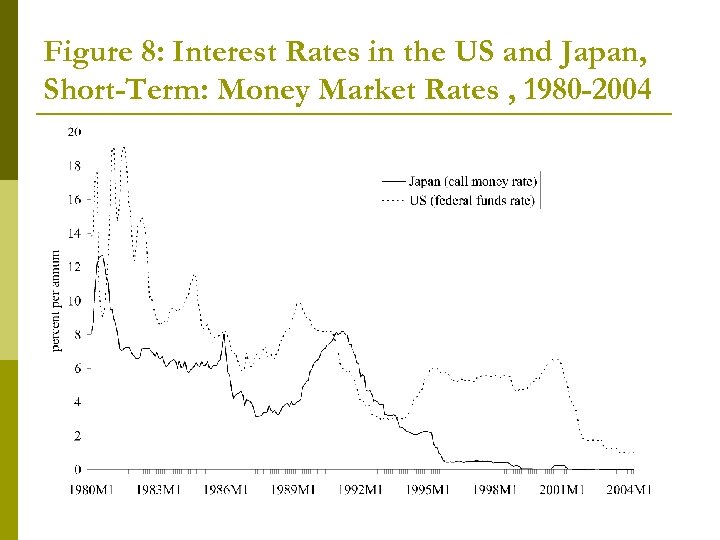 Figure 8: Interest Rates in the US and Japan, Short-Term: Money Market Rates , 1980 -2004
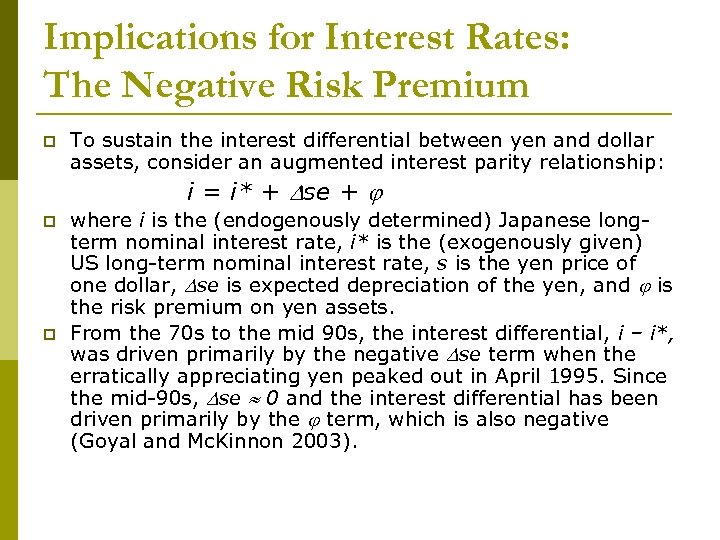 Implications for Interest Rates: The Negative Risk Premium p To sustain the interest differential between yen and dollar assets, consider an augmented interest parity relationship: i = i* + se + p p where i is the (endogenously determined) Japanese longterm nominal interest rate, i* is the (exogenously given) US long-term nominal interest rate, s is the yen price of one dollar, se is expected depreciation of the yen, and is the risk premium on yen assets. From the 70 s to the mid 90 s, the interest differential, i – i*, was driven primarily by the negative se term when the erratically appreciating yen peaked out in April 1995. Since the mid-90 s, se 0 and the interest differential has been driven primarily by the term, which is also negative (Goyal and Mc. Kinnon 2003).
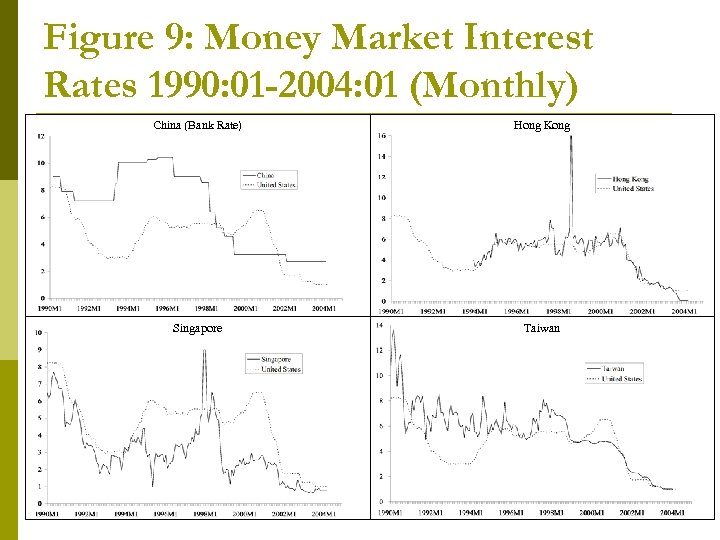 Figure 9: Money Market Interest Rates 1990: 01 -2004: 01 (Monthly) China (Bank Rate) Hong Kong Singapore Taiwan
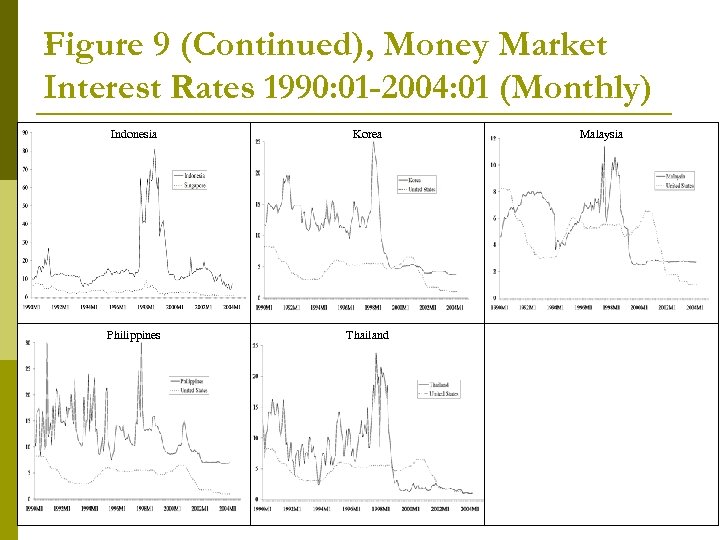 Figure 9 (Continued), Money Market Interest Rates 1990: 01 -2004: 01 (Monthly) Indonesia Korea Philippines Malaysia Thailand
 Interest Differentials, Portfolio Balance, and the Impossibility Free Floating p p As dollar claims accumulate, a sufficiently large interest differential to induce private portfolio holdings of dollars becomes unsustainable—as in Japan when yen interest rates approach zero. The problem worsens when US interest rates are unusually low, as in 2003 -04. Then, increasing official foreign exchange reserves become the dominant mode of financing Asian current account surpluses. And the private unwillingness to hold dollars makes a free float impossible.
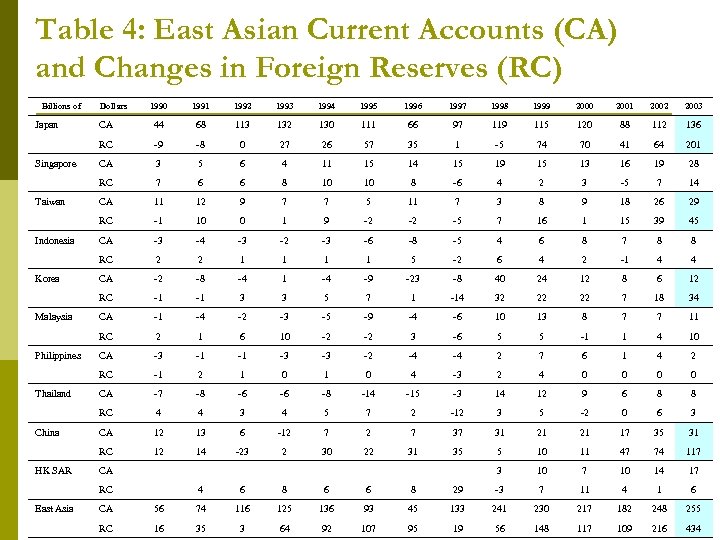 Table 4: East Asian Current Accounts (CA) and Changes in Foreign Reserves (RC) Billions of Dollars 1990 1991 1992 1993 1994 1995 1996 1997 1998 1999 2000 2001 2002 2003 Japan CA 44 68 113 132 130 111 66 97 119 115 120 88 112 136 RC -9 -8 0 27 26 57 35 1 -5 74 70 41 64 201 Singapore CA 3 5 6 4 11 15 14 15 19 15 13 16 19 28 RC 7 6 6 8 10 10 8 -6 4 2 3 -5 7 14 Taiwan CA 11 12 9 7 7 5 11 7 3 8 9 18 26 29 RC -1 10 0 1 9 -2 -2 -5 7 16 1 15 39 45 Indonesia CA -3 -4 -3 -2 -3 -6 -8 -5 4 6 8 7 8 8 RC 2 2 1 1 5 -2 6 4 2 -1 4 4 Korea CA -2 -8 -4 1 -4 -9 -23 -8 40 24 12 8 6 12 RC -1 -1 3 3 5 7 1 -14 32 22 22 7 18 34 Malaysia CA -1 -4 -2 -3 -5 -9 -4 -6 10 13 8 7 7 11 RC 2 1 6 10 -2 -2 3 -6 5 5 -1 1 4 10 Philippines CA -3 -1 -1 -3 -3 -2 -4 -4 2 7 6 1 4 2 RC -1 2 1 0 4 -3 2 4 0 0 Thailand CA -7 -8 -6 -6 -8 -14 -15 -3 14 12 9 6 8 8 RC 4 4 3 4 5 7 2 -12 3 5 -2 0 6 3 China CA 12 13 6 -12 7 37 31 21 21 17 35 31 RC 12 14 -23 2 30 22 31 35 5 10 11 47 74 117 HK SAR CA 3 10 7 10 14 17 RC 4 6 8 6 6 8 29 -3 7 11 4 1 6 East Asia CA 56 74 116 125 136 93 45 133 241 230 217 182 248 255 RC 16 35 3 64 92 107 95 19 56 148 117 109 216 434
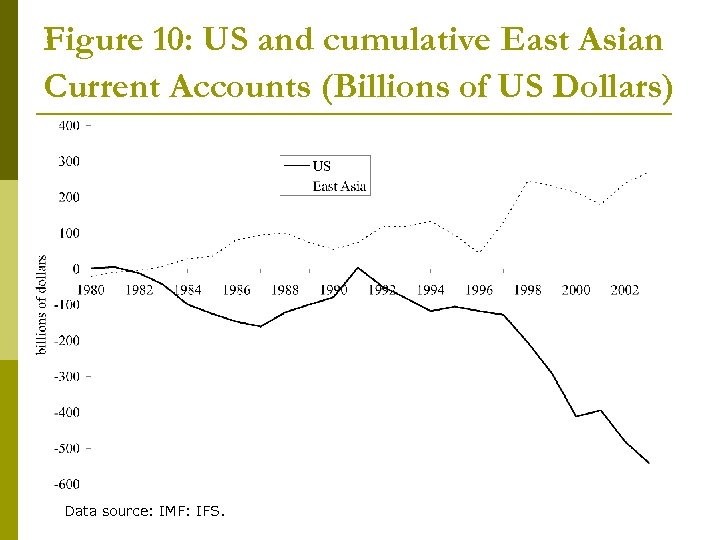 Figure 10: US and cumulative East Asian Current Accounts (Billions of US Dollars) Data source: IMF: IFS.
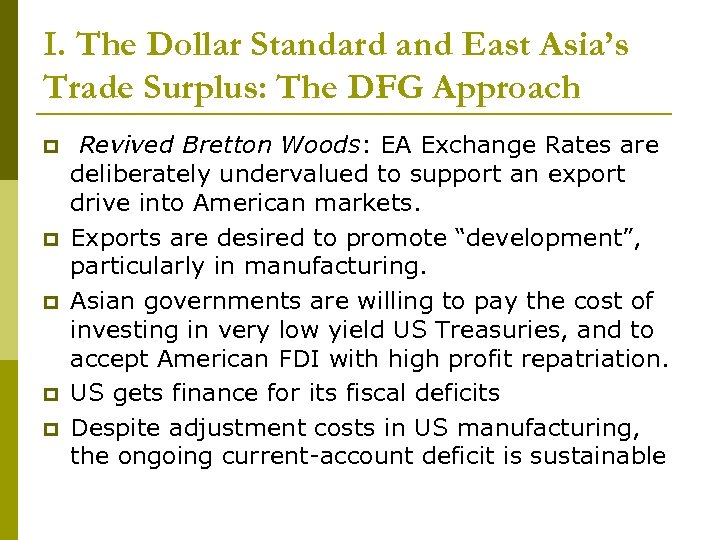 I. The Dollar Standard and East Asia’s Trade Surplus: The DFG Approach p p p Revived Bretton Woods: EA Exchange Rates are deliberately undervalued to support an export drive into American markets. Exports are desired to promote “development”, particularly in manufacturing. Asian governments are willing to pay the cost of investing in very low yield US Treasuries, and to accept American FDI with high profit repatriation. US gets finance for its fiscal deficits Despite adjustment costs in US manufacturing, the ongoing current-account deficit is sustainable
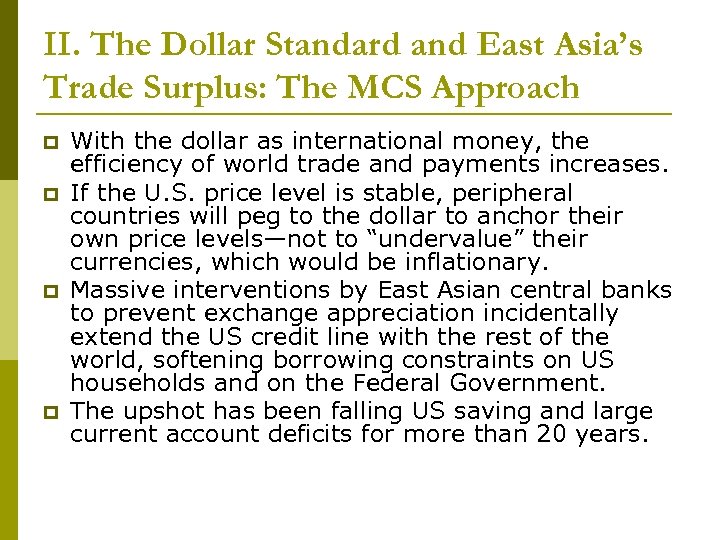 II. The Dollar Standard and East Asia’s Trade Surplus: The MCS Approach p p With the dollar as international money, the efficiency of world trade and payments increases. If the U. S. price level is stable, peripheral countries will peg to the dollar to anchor their own price levels—not to “undervalue” their currencies, which would be inflationary. Massive interventions by East Asian central banks to prevent exchange appreciation incidentally extend the US credit line with the rest of the world, softening borrowing constraints on US households and on the Federal Government. The upshot has been falling US saving and large current account deficits for more than 20 years.
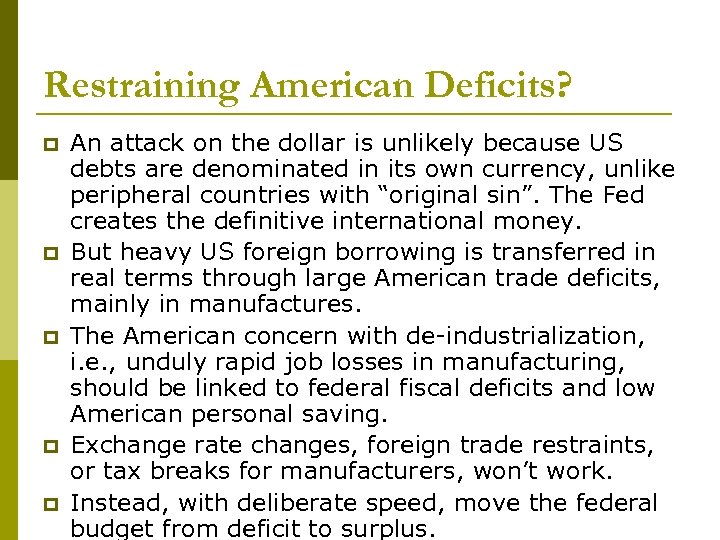 Restraining American Deficits? p p p An attack on the dollar is unlikely because US debts are denominated in its own currency, unlike peripheral countries with “original sin”. The Fed creates the definitive international money. But heavy US foreign borrowing is transferred in real terms through large American trade deficits, mainly in manufactures. The American concern with de-industrialization, i. e. , unduly rapid job losses in manufacturing, should be linked to federal fiscal deficits and low American personal saving. Exchange rate changes, foreign trade restraints, or tax breaks for manufacturers, won’t work. Instead, with deliberate speed, move the federal budget from deficit to surplus.
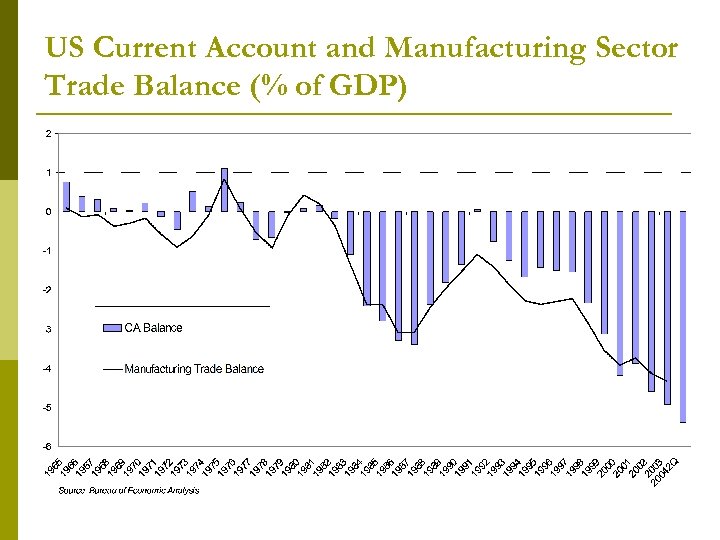 US Current Account and Manufacturing Sector Trade Balance (% of GDP)
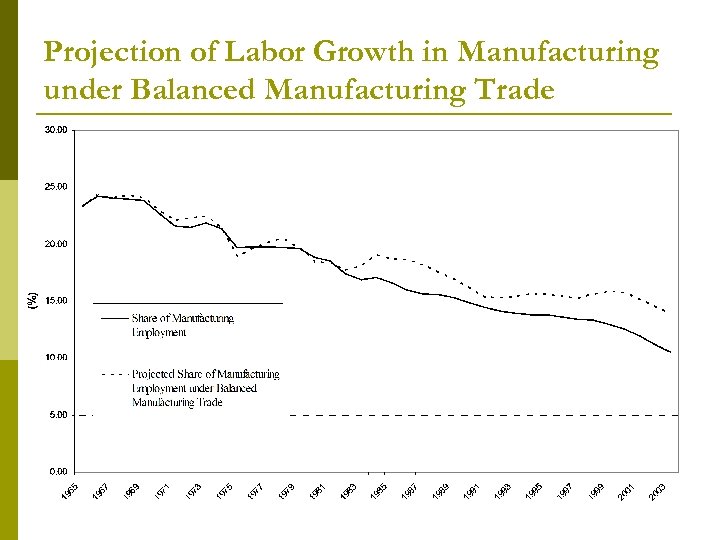 Projection of Labor Growth in Manufacturing under Balanced Manufacturing Trade
 Conclusions for East Asia p p Collectively pegging to the dollar enlarges the zone of stable dollar prices far beyond trade with the United States: stronger mutual anchoring of national price levels Anchors against the threat of appreciation and deflation in creditor countries with “conflicted virtue”—while stabilizing mutual cross rates of exchange. Important for Japan and China. Mutual exchange stability is a public good among integrated economies. An “Asian euro” is but a distant possibility, so keying on the dollar is now the only feasible intra Asian mechanism for securing exchange stability.