 Скачать презентацию The Return Of The Other Eurocentrism vs Globalism
928d00a8d809c788639168c8a0c3b10d.ppt
- Количество слайдов: 26



The Return Of The Other Eurocentrism vs. Globalism Presentation by Juliana and Judit
PLAN • Eurocentrism – I round: Ø Civil society as a Western concept • Eurocentrism – II round: ØEuromarxism as a context ØBrenner’s argument • Critique • Synthesis
DEFINITION EUROCENTRISM: • Form of ethnocentrism • Being centered on Europe or the Europeans, especially reflecting a tendency to interpret the world in terms of western and especially European values and experiences • The belief that European culture is superior to all others • An inability to appreciate Non-European cultures • An inability to see a common humanity and human condition facing all women and men in all cultures and societies beneath the surface variations in social and cultural traditions
Civil Society EUROPEAN CONCEPT • Free market and Democracy ØRepresentation ØParliamentary government ØPluralistic – individualistic ØJustice and laws ØHuman rights ØRationality and ØModern knowledge system
Civil Society WESTERN CONCEPT OF THE OTHER • Formulated as “lack”, which means: ØAuthoritarian ØAbsolutist regime ØStatic ØDespotism ØIrrational ØStagnant and oriental mode of production
Goody’s Critique on Eurocentism • • Extreme universalism vs. cultural relativism Achievements of Mesopotamia and Arab Near East Indian and Chinese trade systems in Antiquity Eastern knowledge systems – Sung encyclopedias Different kinds of democracy and representation Not identical but similar regimes Examples: ØCivil society in pre-colonial Africa ØCommunities with alternative lifestyle in Asia
Euromarxism as a Context • Post Vietnam radical thought • Reactionary Euromarxism • Brenner’s article needs to be placed in the context of this debate
Brenner on Capitalism • "Agrarian class structure and economic development in pre-industrial Europe” (1976) ØMarxist critique • "The origins of capitalist development: A critique of Neo -Smithian Marxism” (1977) Ørestatement of theory about the European origins of capitalism Øcritique of "Third-Worldist" deviations in modern radical scholarship Two main characteristics: eurocentrism and diffusionism
R. Brenner’s “Agrarian Roots of European Capitalism” • Social-property systems (class & property): ØHistorically developed ØImpose the course of the economic evolution (income distribution & productive forces development) • Feudalism case – economic stagnation and involution: ØClass reproducing strategies, incompatible with requirements of growth ØDeclining productivity and socio-economic crisis
![Feudalism mechanism of class reproduction MORE! lords [surplus extraction by means of extra-economic compulsion]](https://present5.com/presentation/928d00a8d809c788639168c8a0c3b10d/image-10.jpg "Feudalism mechanism of class reproduction MORE! lords [surplus extraction by means of extra-economic compulsion]")
Feudalism mechanism of class reproduction MORE! lords [surplus extraction by means of extra-economic compulsion] classes FOOD, MASTER… peasants [production for subsistence] • No specializations of productive units • No systematic reinvestments of surpluses • No technical innovation
The Breakthrough • SELF-SUSTAINING GROWTH Ø Breakthrough of the system of lordly surplus extraction by means of extra-economic compulsory ØUndermining the process of full peasant ownership of the land
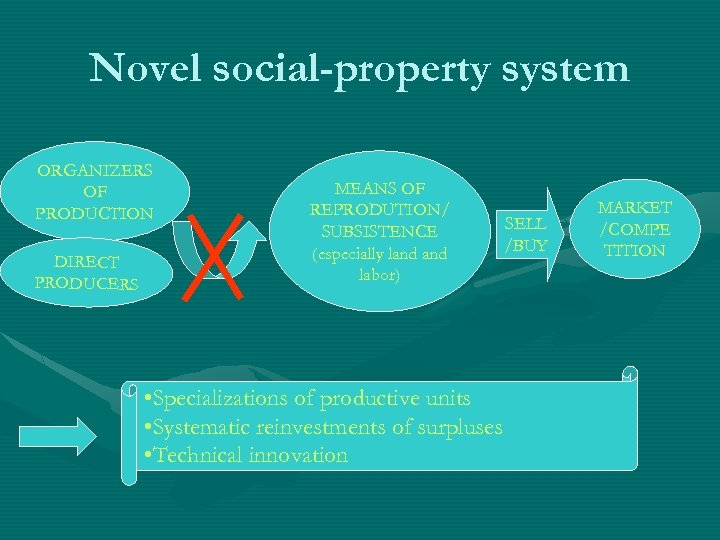
Novel social-property system ORGANIZERS OF PRODUCTION DIRECT PRODUCERS MEANS OF REPRODUTION/ SUBSISTENCE (especially land labor) • Specializations of productive units • Systematic reinvestments of surpluses • Technical innovation SELL /BUY MARKET /COMPE TITION
Differences within Europe • Different long-term processes of class formation in the various regions ØDemographic growth and declining labor productivity ØVarious property settlement in different places ØDifferent forms and outcomes of the class conflicts as response to it • There was no simple “unilinear drift” towards capitalism by economic evolution – no trans-historical laws
England • Aristocracy ØHigh level of solidarity ØSelf-organization (military obligatory) ØCommon interests ØNeed of their mutual relationship regulation ØTotal law domination on peasantry • Monarchy ØIncreasing capacity as a reflection on the aristocracy coherence ØKing’s law to freeman (exception of the unfree peasants) ØReintensification of the seigneur power ØDecentralized surplus extraction by extra-economic compulsion
England • Peasantry ØHighly dependant on aristocracy ØEven density of the population ØSeparated from the land • Economy development ØCompetitive rates of land ØExport (wool, cloth production) ØIndustrial employment based on wage labor ØIncrease of agricultural production ØEconomic differentiation of the peasantry – no choice but compete and innovate • End of political and economical fusion
France • Aristocracy Ø Competing feudal lords Ø Involved in the king’s court as employed Ø Conditional domination over the peasantry • From monarchy to absolutism as new form of centralism Ø Extreme fragmentarisation Ø Lack of effective political organization Ø Centralized system of surplus extraction over the aristocracy (king’s household) Ø Accepting peasants’ appeals on lords Ø Custom laws Ø Tax office state Ø Loyalty through private proper rights – private property in public sphere
France • Peasantry ØUnited peasantry community which can not be expelled from land ØPeasant mobility ØRoyal taxes, collected by peasantry ØGreater consumption possibilities – more surplus of their own to reinvenst ØPopulation growth ØStrengthening of the peasantry brought renewal of the old peasant-base economy ØPulverization and leveling of the peasantry
Economy Comparison • ENGLAND Ø Capitalistic-agricultural system Ø Commercial economy based on high quality production Ø Export - import economy Ø Independent regional specialization • FRANCE Ø Peasant possessors Ø Static type of agricultural system ü Once and for all ü No qualitative agricultural improvement and innovation development for economic growth

Criticism • Dobb-Sweezy debate • Blaut • Andre Gunder Frank
Jim Blaut • England is nothing special ØAsia, Africa showed the same level of development in terms of: • Untied peasantry, cash tenancy, rural wage labor, large scale production for sale, peasant struggle, urban processes, commercial activities • Why Europe? ØLocation and accessibility ØColonial accumulation was the basic external cause of European emergence
Andre Gunder Frank • Key point: Belief in the continuous history and development of a single world system in Afro-Eurasia for at least 5, 000 years. • Emphasis on Øtrade relations Øprocess of capital accumulation Øcenter-periphery structure is one of the characteristics of the world system Øalternation between hegemony and rivalry Ølong economic cycles of ascending and descending phases
Wallerstein versus Gunder • Discontinuity versus continuity ”The West first bought itself a third class seat on the Asian economic train, then leased a whole railway carriage, and only in the nineteenth century managed to displace Asians from the locomotive” (Gunder)
Implications • • • European exceptonalism is a myth It is no use to talk of modes and transitions "The ceaseless quest of modern historians looking for the 'origins' and roots of capitalism is not much better than the alchemist's search for the philosopher's stone that transforms base metal into gold. " Indeed, that is the case not only for the origins and roots, but the very existence and meaning of "capitalism. " So, best just forget about it, and get on with our inquiry into the reality of "universal history, wie es eigentlich gewesen ist. ” (Chaudhuri)
Has capitalism ever been born? • The rise of Europe represented a hegemonic shift from East to West • It is impossible to specify what sets the present world system apart from previous ones ØCeaseless accumulation ØTrinity of center/periphery, A/B phased cycles, and hegemony/ rivalry
How to do history? • Gunder’s recommendations • And yours? What do we gain and lose with each approach?
 Скачать презентацию The Return Of The Other Eurocentrism vs Globalism
928d00a8d809c788639168c8a0c3b10d.ppt