


 Скачать презентацию The response to high magnetic fields of the
138cb87a7a3ccb54488bb9fad51cea28.ppt
- Количество слайдов: 15
 The response to high magnetic fields of the Vacuum Phototriodes for the Compact Muon Solenoid endcap electromagnetic calorimeter K W Bell 1, R M Brown 1, D J A Cockerill 1, P S Flower 1, P R Hobson 2, D C Imrie 2, B W Kennedy 1, A L Lintern 1, O Sharif 2, M Sproston 1, J H Williams 1 1 CLRC - Rutherford Appleton Laboratory, Chilton, Didcot, OX 11 0 QX UK 2 Brunel University, Department of Electronic and Computer Engineering, Uxbridge, UB 8 3 PH, UK Poster presented at the 3 rd Beaune Conference on New Developments in Photodetection Beaune, France, 17 -21 June, 2002
 Motivation • The endcap electromagnetic calorimeter of the Compact Muon Solenoid detector at the LHC needs fast, radiation tolerant photodetectors with moderate gain. • Neutron radiation levels, particularly as , are too high for 10 year operation of silicon photodetectors. • The photodetectors can be closely aligned with the axial 4 T magnetic field inside CMS. • Photodetectors need to cover the end face of lead tungstate scintillator crystals, these will allow 26 mm diameter devices. • Lead tungstate emission spectrum is well matched to bialkali photocathodes. Solution: Vacuum Phototriodes (VPT)
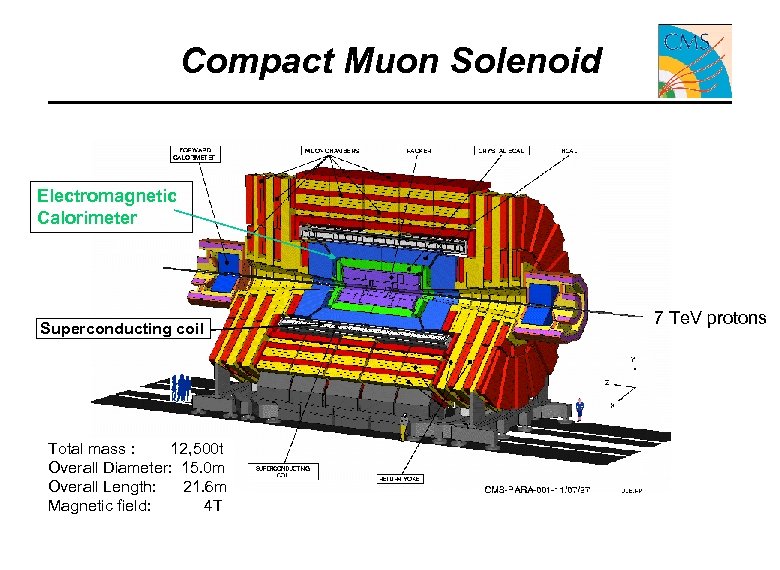 Compact Muon Solenoid Electromagnetic Calorimeter Superconducting coil Total mass : 12, 500 t Overall Diameter: 15. 0 m Overall Length: 21. 6 m Magnetic field: 4 T 7 Te. V protons
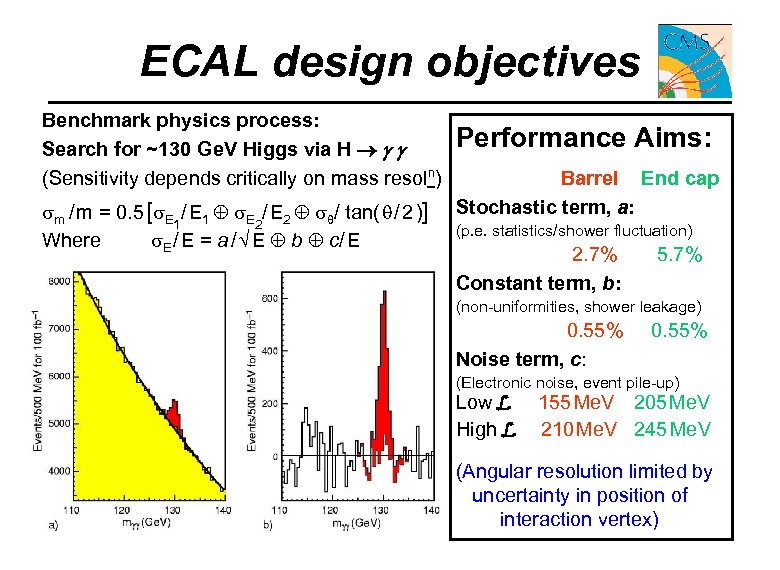 ECAL design objectives Benchmark physics process: Search for ~130 Ge. V Higgs via H (Sensitivity depends critically on mass resoln) m / m = 0. 5 [ E 1/ E 1 E 2/ E 2 / tan( / 2 )] Where E / E = a / E b c/ E Performance Aims: Barrel End cap Stochastic term, a: (p. e. statistics/shower fluctuation) 2. 7% Constant term, b: 5. 7% (non-uniformities, shower leakage) 0. 55% Noise term, c: 0. 55% (Electronic noise, event pile-up) Low L High L 155 Me. V 205 Me. V 210 Me. V 245 Me. V (Angular resolution limited by uncertainty in position of interaction vertex)
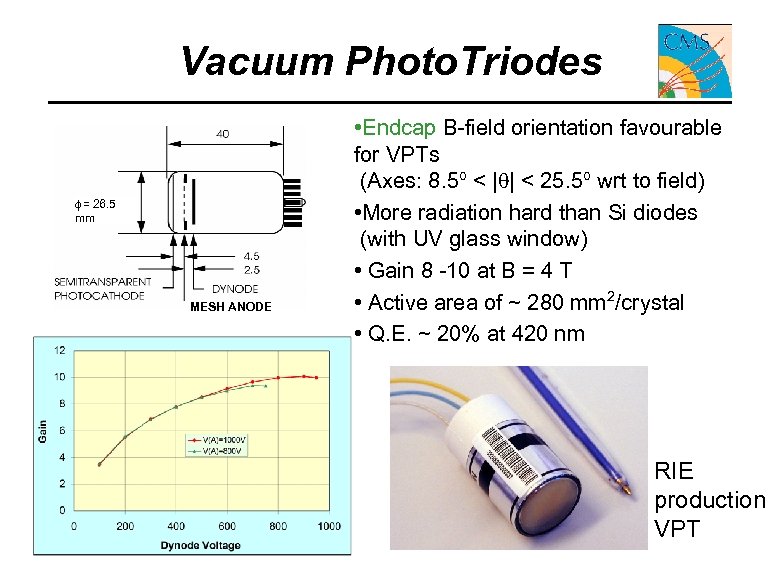 Vacuum Photo. Triodes = 26. 5 mm MESH ANODE • Endcap B-field orientation favourable for VPTs (Axes: 8. 5 o < | | < 25. 5 o wrt to field) • More radiation hard than Si diodes (with UV glass window) • Gain 8 -10 at B = 4 T • Active area of ~ 280 mm 2/crystal • Q. E. ~ 20% at 420 nm RIE production VPT
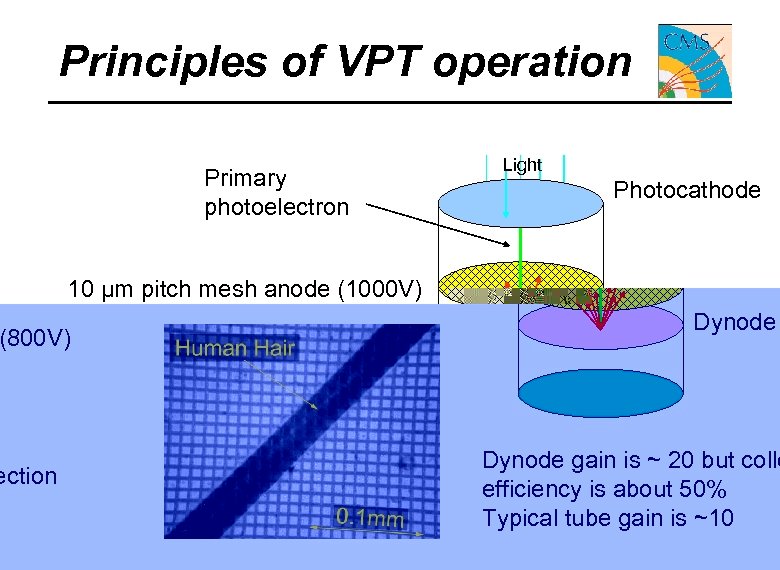 Principles of VPT operation Light Primary photoelectron Photocathode 10 µm pitch mesh anode (1000 V) Dynode (800 V) Dynode gain is ~ 20 but collection efficiency is about 50% Typical tube gain is ~10
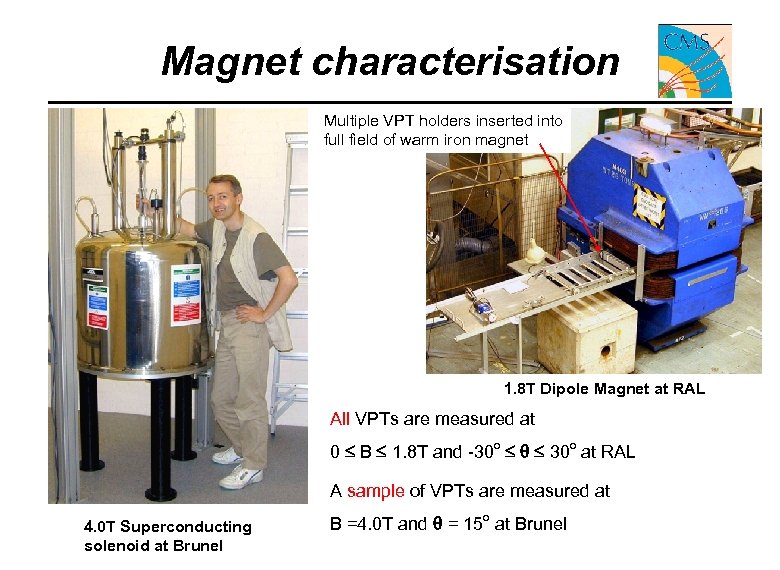 Magnet characterisation Multiple VPT holders inserted into full field of warm iron magnet 1. 8 T Dipole Magnet at RAL All VPTs are measured at 0 B 1. 8 T and -30 o at RAL A sample of VPTs are measured at 4. 0 T Superconducting solenoid at Brunel B =4. 0 T and = 15 o at Brunel
 0 to 1. 8 T System at RAL • Tubes normally measured at angles from -30° to +30° • Relative response measured at fields from 0 T to 1. 8 T • Noise and dark currents measured too. • Great care taken to ensure uniform photocathode illumination with blue LED • Multiple tubes measured simultaneously (currently 24 per run) • DAQ system is RS 232 based and uses Lab. View to provide the control and user interface • ADC system is CAMAC based
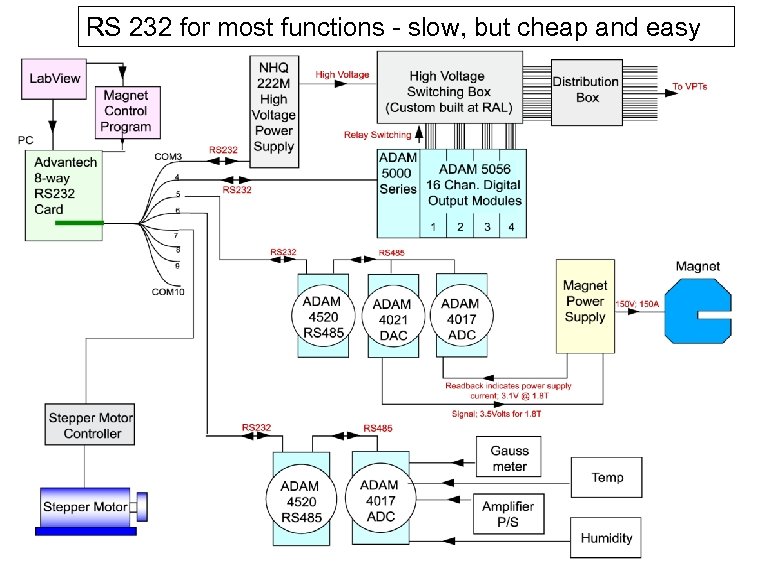 RS 232 for most functions - slow, but cheap and easy
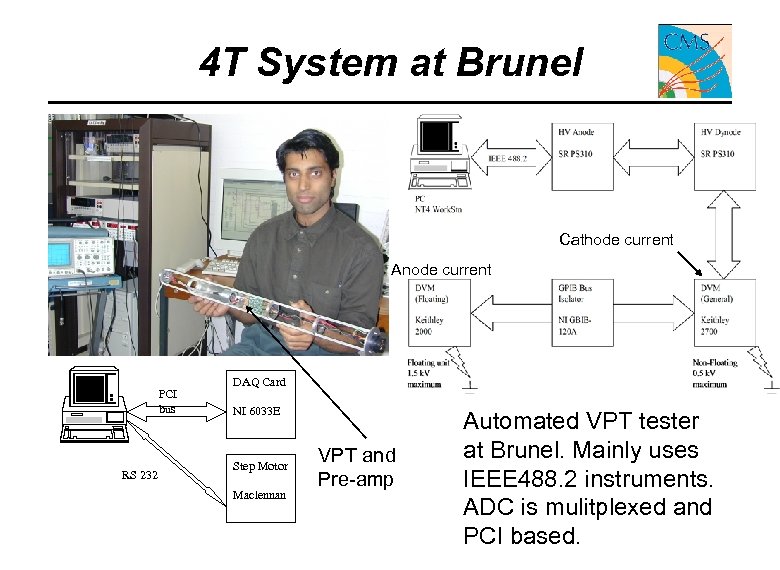 4 T System at Brunel Cathode current Anode current PCI bus RS 232 DAQ Card NI 6033 E Step Motor Maclennan VPT and Pre-amp Automated VPT tester at Brunel. Mainly uses IEEE 488. 2 instruments. ADC is mulitplexed and PCI based.
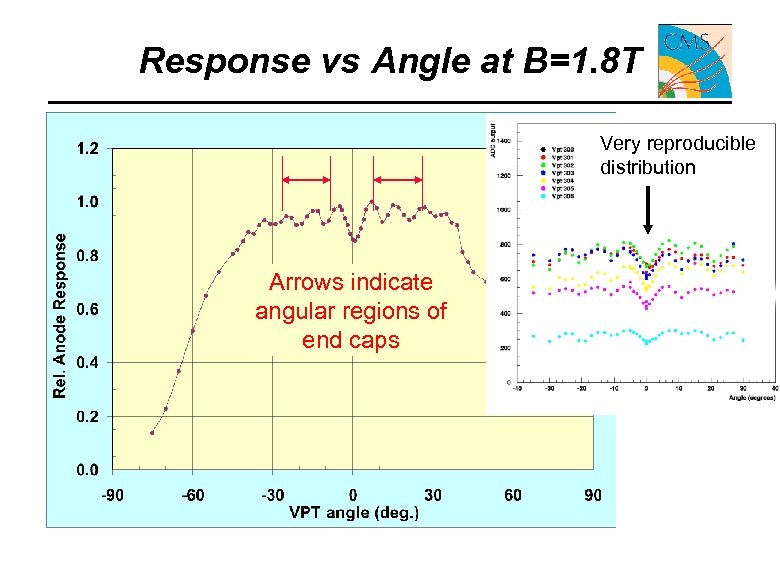 Response vs Angle at B=1. 8 T Very reproducible distribution Arrows indicate angular regions of end caps
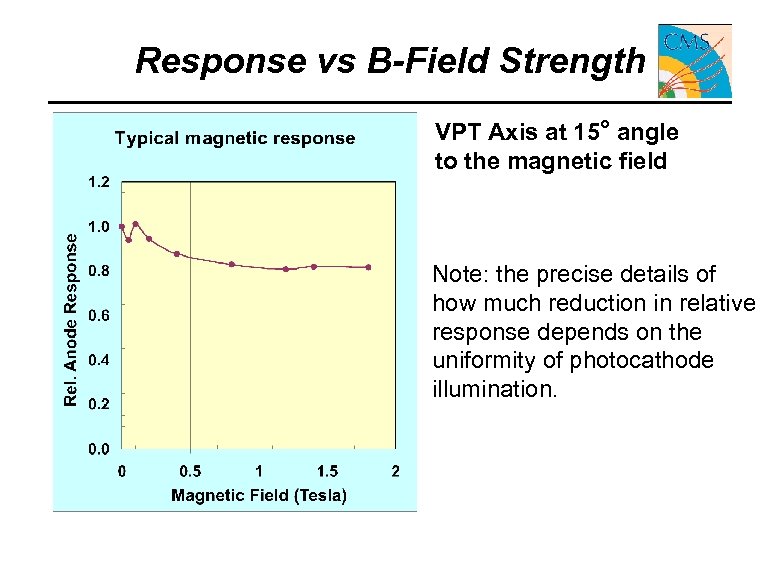 Response vs B-Field Strength VPT Axis at 15 o angle to the magnetic field Note: the precise details of how much reduction in relative response depends on the uniformity of photocathode illumination.
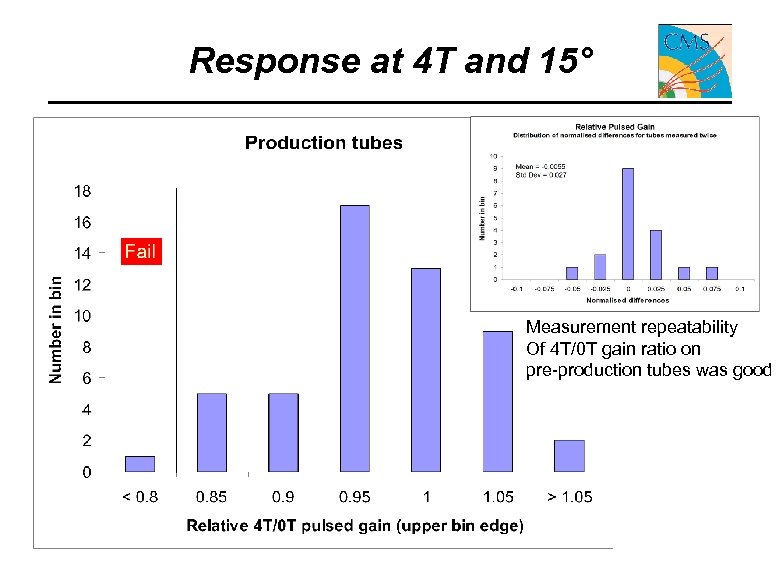 Response at 4 T and 15° Measurement repeatability Of 4 T/0 T gain ratio on pre-production tubes was good
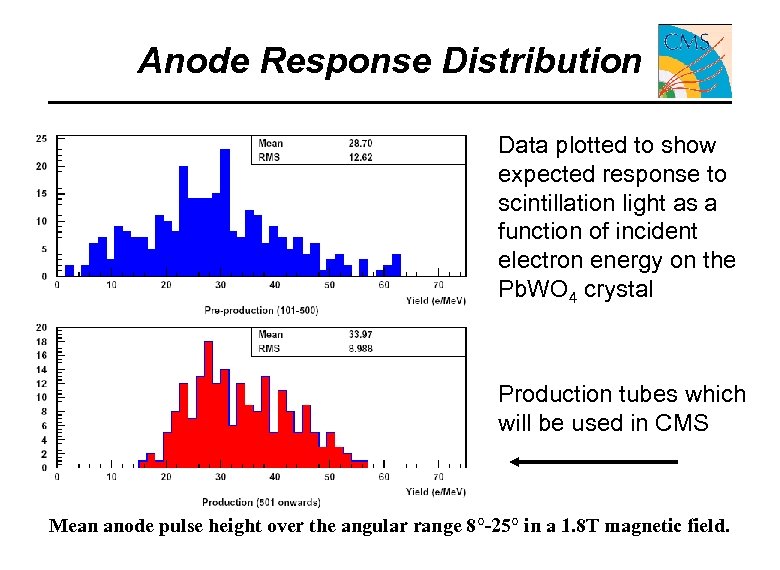 Anode Response Distribution Data plotted to show expected response to scintillation light as a function of incident electron energy on the Pb. WO 4 crystal Production tubes which will be used in CMS Mean anode pulse height over the angular range 8°-25° in a 1. 8 T magnetic field.
 Summary · A new generation of fine-mesh VPTs has been developed to satisfy the high magnetic field/radiation hardness requirements of CMS operating at the Large Hadron Collider, CERN · An automated characterisation facility based at Brunel and RAL has been commissioned to handle 15000 devices over three years · The performance of over 800 of the 1400 production VPTs from RIE has been measured to date. · Nearly all tubes pass the acceptance tests. · Only one tube passing the 1. 8 T tests failed at 4 T We would like to acknowledge support from PPARC (UK) and INTAS (EU).