 Скачать презентацию The relation between cognitive task complexity and linguistic
b0b1bbdc5679e5aba5944a782c06062c.ppt
- Количество слайдов: 30



The relation between cognitive task complexity and linguistic performance in L 2 writing Folkert Kuiken & Ineke Vedder ACLC, University of Amsterdam, The Netherlands Task Based Language Teaching, Leuven September 22, 2005

Pick a holiday destination and persuade a friend to join you
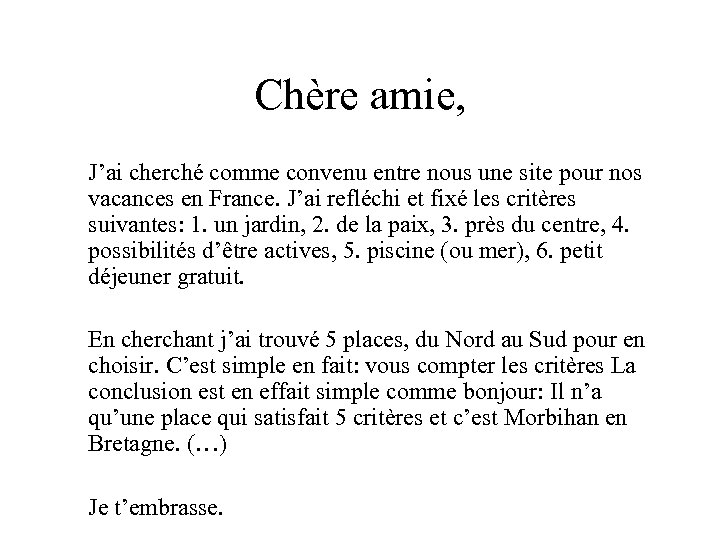
Chère amie, J’ai cherché comme convenu entre nous une site pour nos vacances en France. J’ai refléchi et fixé les critères suivantes: 1. un jardin, 2. de la paix, 3. près du centre, 4. possibilités d’être actives, 5. piscine (ou mer), 6. petit déjeuner gratuit. En cherchant j’ai trouvé 5 places, du Nord au Sud pour en choisir. C’est simple en fait: vous compter les critères La conclusion est en effait simple comme bonjour: Il n’a qu’une place qui satisfait 5 critères et c’est Morbihan en Bretagne. (…) Je t’embrasse.
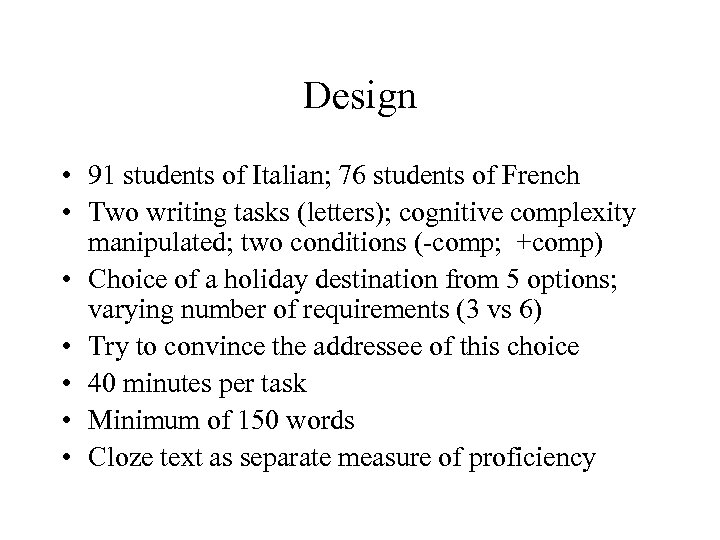
Design • 91 students of Italian; 76 students of French • Two writing tasks (letters); cognitive complexity manipulated; two conditions (-comp; +comp) • Choice of a holiday destination from 5 options; varying number of requirements (3 vs 6) • Try to convince the addressee of this choice • 40 minutes per task • Minimum of 150 words • Cloze text as separate measure of proficiency
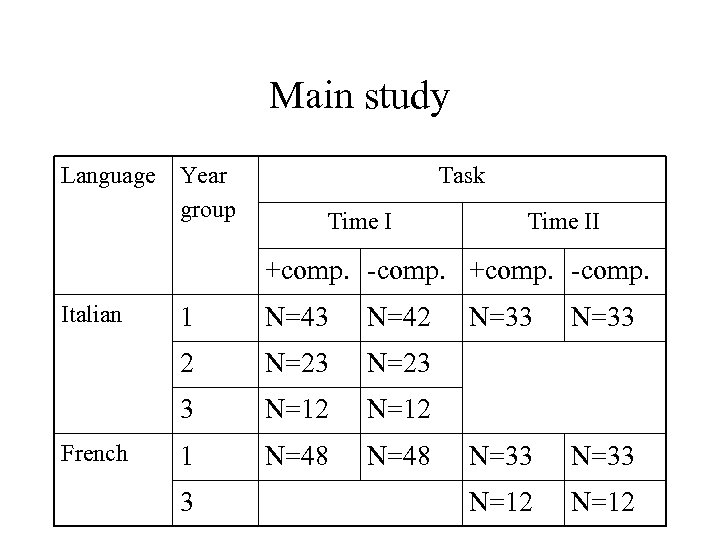
Main study Language Year group Task Time II +comp. -comp. Italian N=43 N=42 2 N=23 3 French 1 N=12 1 N=48 3 N=33 N=12
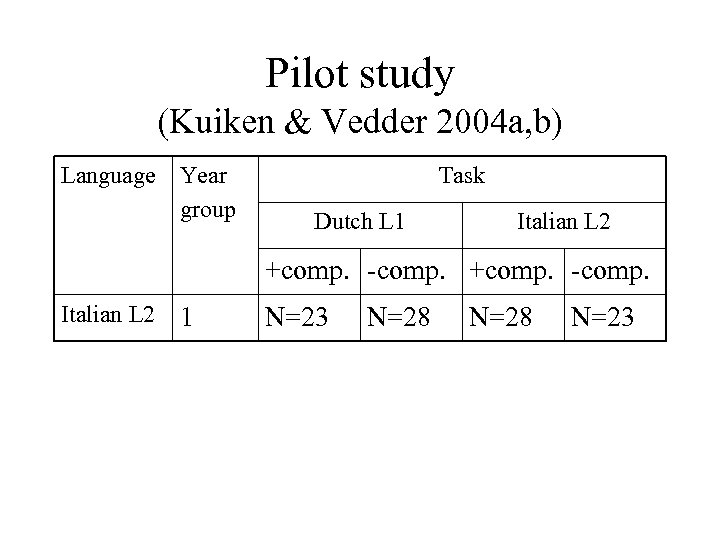
Pilot study (Kuiken & Vedder 2004 a, b) Language Year group Task Dutch L 1 Italian L 2 +comp. -comp. Italian L 2 1 N=23 N=28 N=23
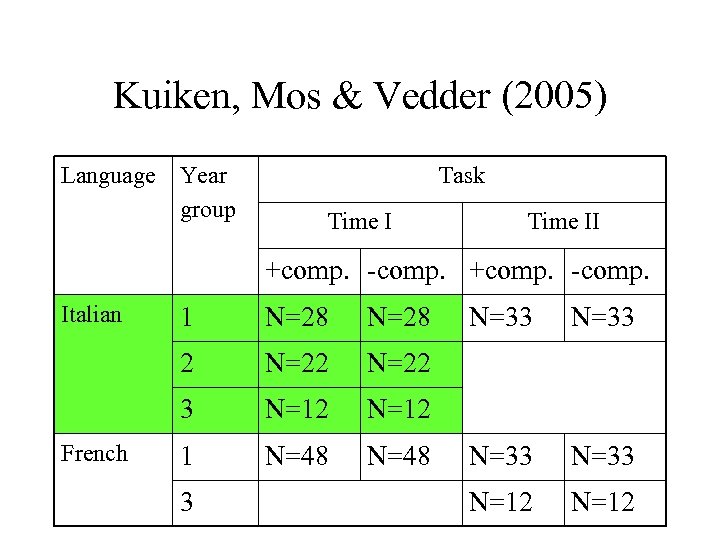
Kuiken, Mos & Vedder (2005) Language Year group Task Time II +comp. -comp. Italian N=28 2 N=22 3 French 1 N=12 1 N=48 3 N=33 N=12
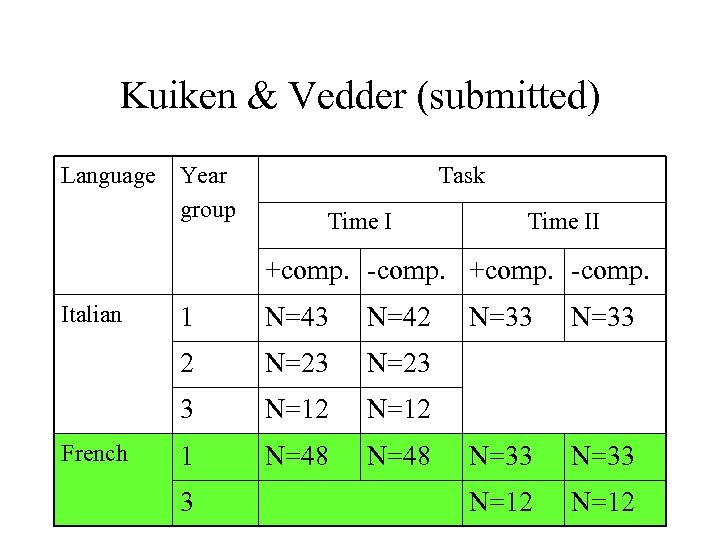
Kuiken & Vedder (submitted) Language Year group Task Time II +comp. -comp. Italian N=43 N=42 2 N=23 3 French 1 N=12 1 N=48 3 N=33 N=12
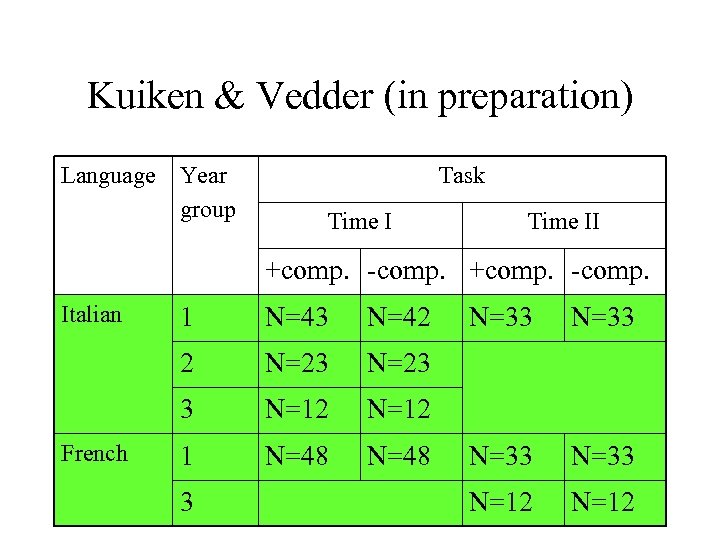
Kuiken & Vedder (in preparation) Language Year group Task Time II +comp. -comp. Italian N=43 N=42 2 N=23 3 French 1 N=12 1 N=48 3 N=33 N=12
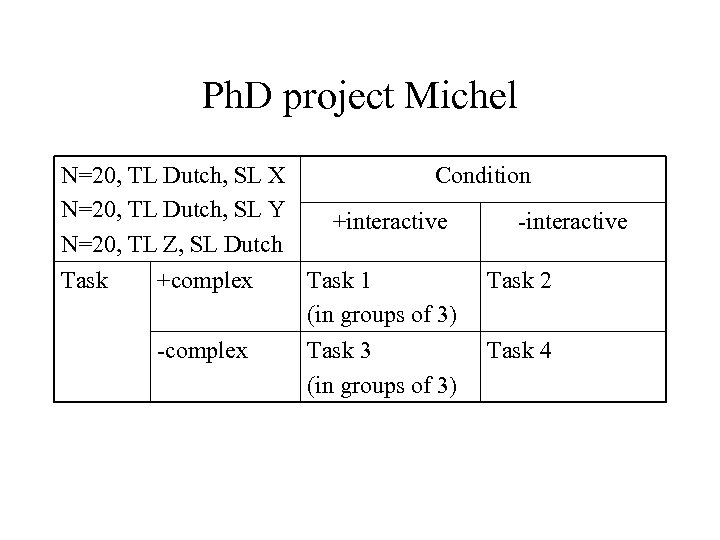
Ph. D project Michel N=20, TL Dutch, SL X N=20, TL Dutch, SL Y N=20, TL Z, SL Dutch Task +complex -complex Condition +interactive Task 1 (in groups of 3) Task 3 (in groups of 3) -interactive Task 2 Task 4
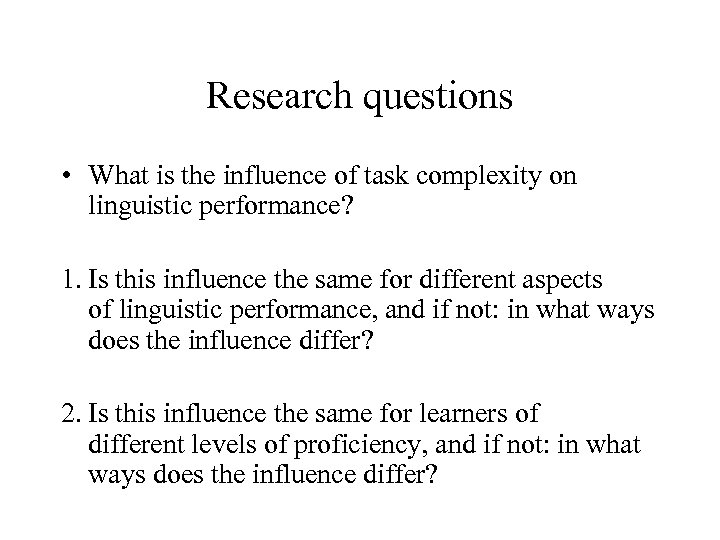
Research questions • What is the influence of task complexity on linguistic performance? 1. Is this influence the same for different aspects of linguistic performance, and if not: in what ways does the influence differ? 2. Is this influence the same for learners of different levels of proficiency, and if not: in what ways does the influence differ?
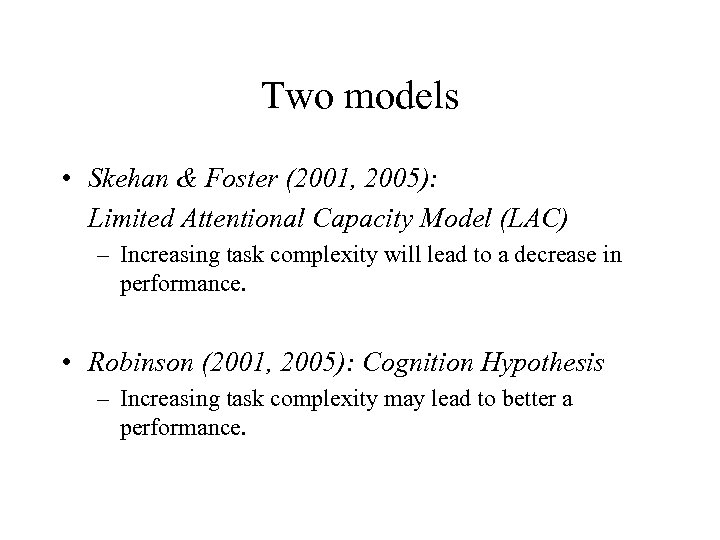
Two models • Skehan & Foster (2001, 2005): Limited Attentional Capacity Model (LAC) – Increasing task complexity will lead to a decrease in performance. • Robinson (2001, 2005): Cognition Hypothesis – Increasing task complexity may lead to better a performance.
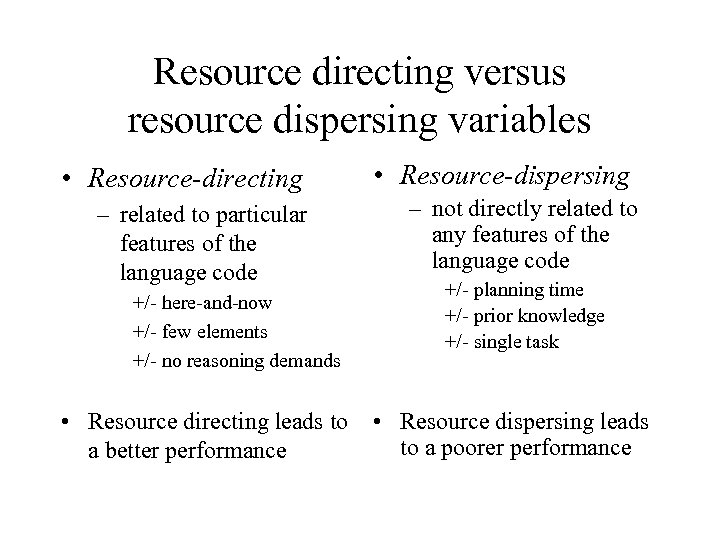
Resource directing versus resource dispersing variables • Resource-directing – related to particular features of the language code +/- here-and-now +/- few elements +/- no reasoning demands • Resource directing leads to a better performance • Resource-dispersing – not directly related to any features of the language code +/- planning time +/- prior knowledge +/- single task • Resource dispersing leads to a poorer performance
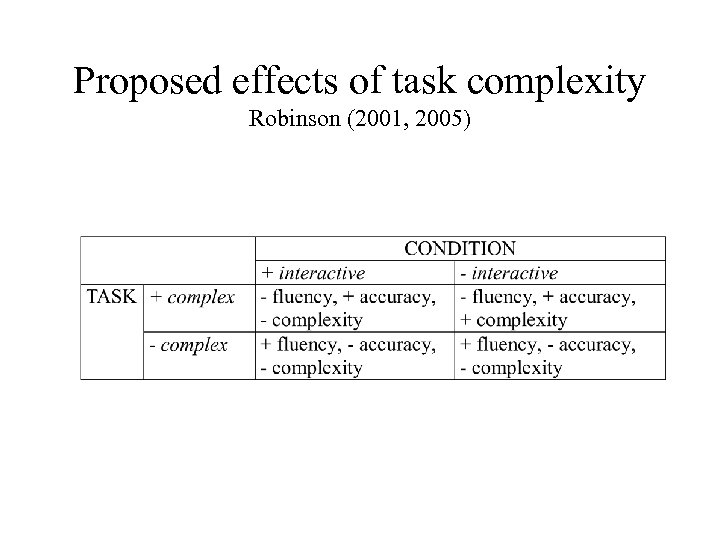
Proposed effects of task complexity Robinson (2001, 2005)
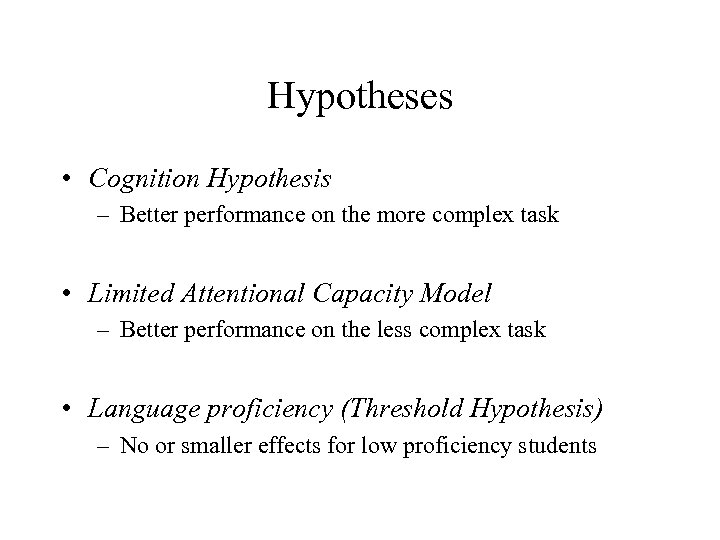
Hypotheses • Cognition Hypothesis – Better performance on the more complex task • Limited Attentional Capacity Model – Better performance on the less complex task • Language proficiency (Threshold Hypothesis) – No or smaller effects for low proficiency students
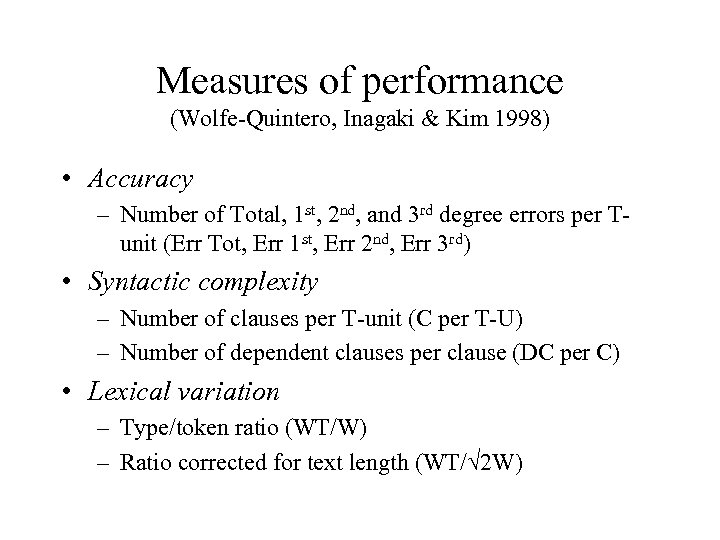
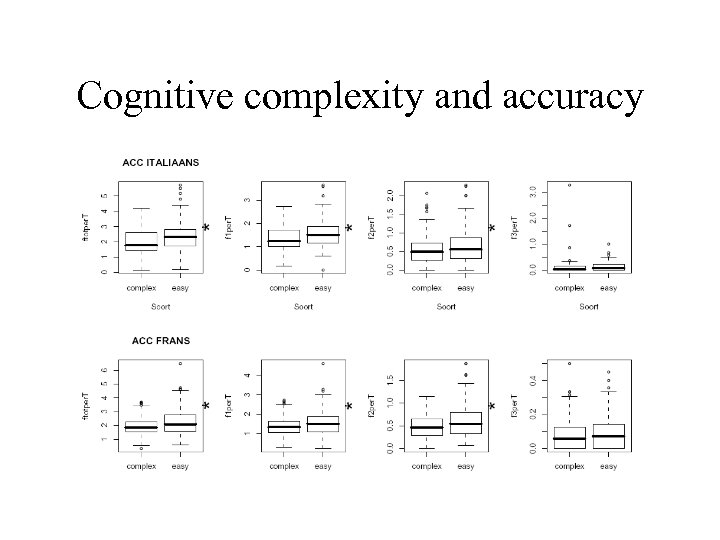
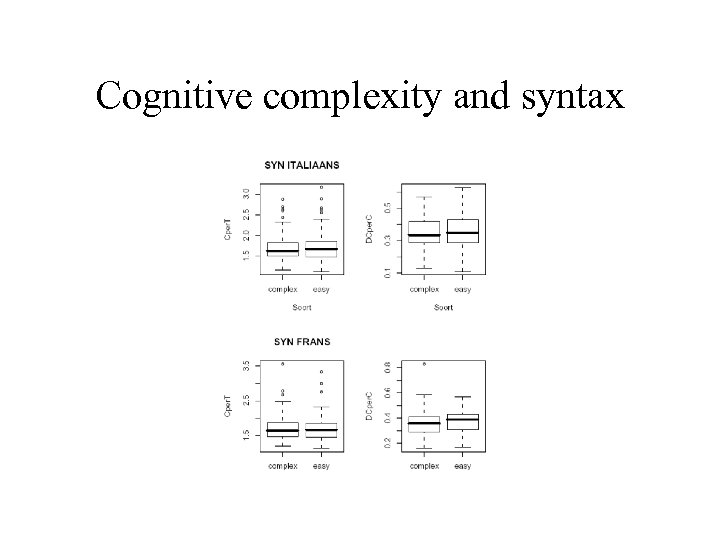
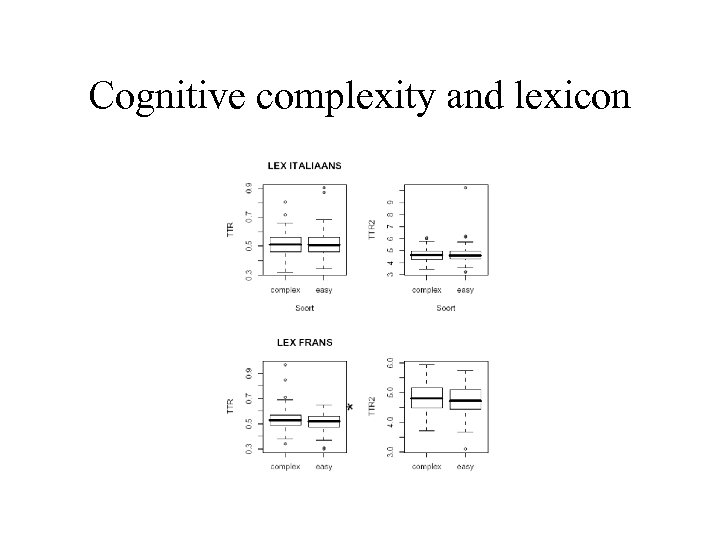
Measures of performance (Wolfe-Quintero, Inagaki & Kim 1998) • Accuracy – Number of Total, 1 st, 2 nd, and 3 rd degree errors per Tunit (Err Tot, Err 1 st, Err 2 nd, Err 3 rd) • Syntactic complexity – Number of clauses per T-unit (C per T-U) – Number of dependent clauses per clause (DC per C) • Lexical variation – Type/token ratio (WT/W) – Ratio corrected for text length (WT/√ 2 W)
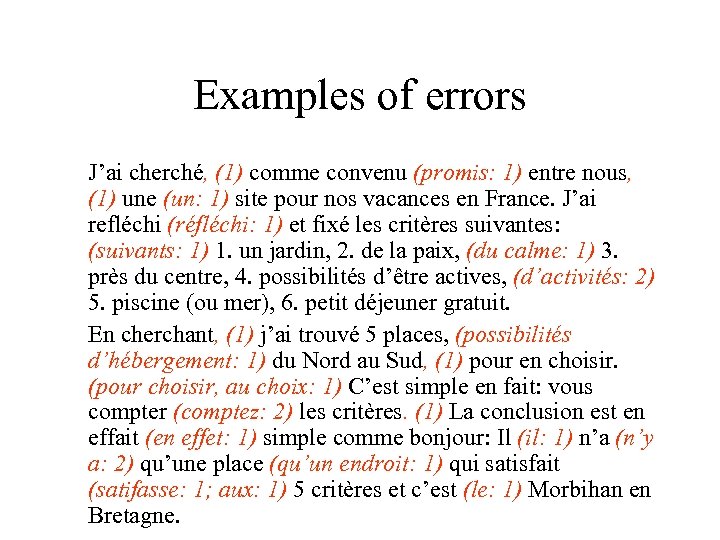
Examples of errors J’ai cherché, (1) comme convenu (promis: 1) entre nous, (1) une (un: 1) site pour nos vacances en France. J’ai refléchi (réfléchi: 1) et fixé les critères suivantes: (suivants: 1) 1. un jardin, 2. de la paix, (du calme: 1) 3. près du centre, 4. possibilités d’être actives, (d’activités: 2) 5. piscine (ou mer), 6. petit déjeuner gratuit. En cherchant, (1) j’ai trouvé 5 places, (possibilités d’hébergement: 1) du Nord au Sud, (1) pour en choisir. (pour choisir, au choix: 1) C’est simple en fait: vous compter (comptez: 2) les critères. (1) La conclusion est en effait (en effet: 1) simple comme bonjour: Il (il: 1) n’a (n’y a: 2) qu’une place (qu’un endroit: 1) qui satisfait (satifasse: 1; aux: 1) 5 critères et c’est (le: 1) Morbihan en Bretagne.
Results 1 • Research question 1 – What is the influence of task complexity on linguistic performance with respect to accuracy, syntax and lexicon?
Cognitive complexity and accuracy
Cognitive complexity and syntax
Cognitive complexity and lexicon
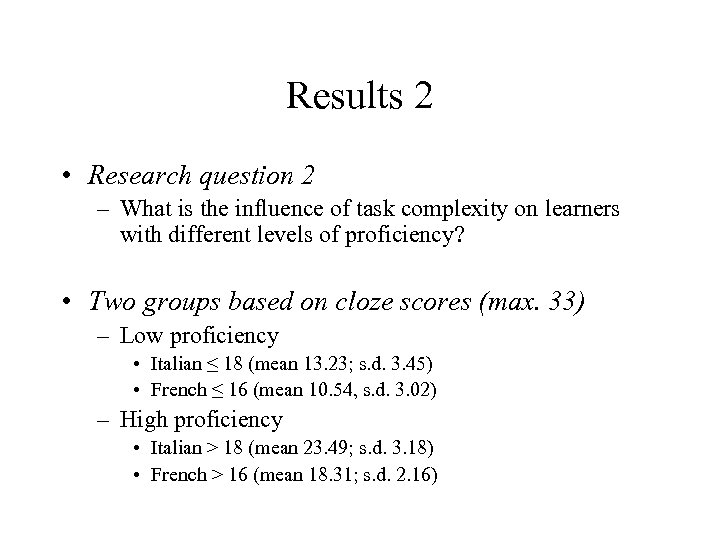
Results 2 • Research question 2 – What is the influence of task complexity on learners with different levels of proficiency? • Two groups based on cloze scores (max. 33) – Low proficiency • Italian ≤ 18 (mean 13. 23; s. d. 3. 45) • French ≤ 16 (mean 10. 54, s. d. 3. 02) – High proficiency • Italian > 18 (mean 23. 49; s. d. 3. 18) • French > 16 (mean 18. 31; s. d. 2. 16)
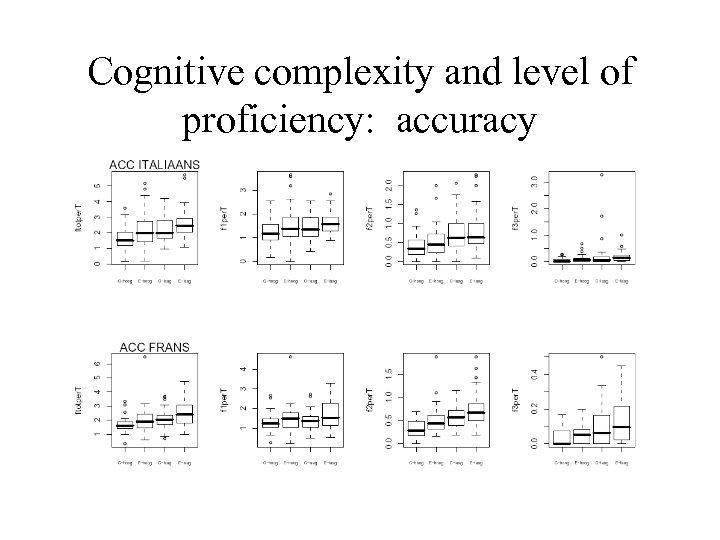
Cognitive complexity and level of proficiency: accuracy
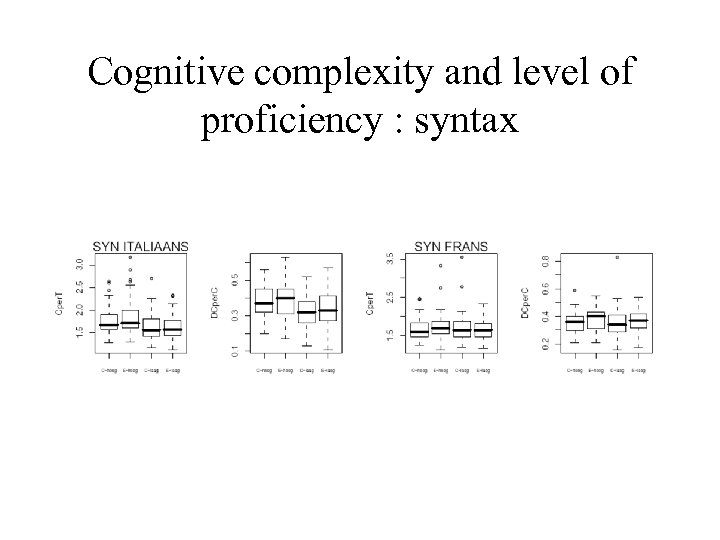
Cognitive complexity and level of proficiency : syntax
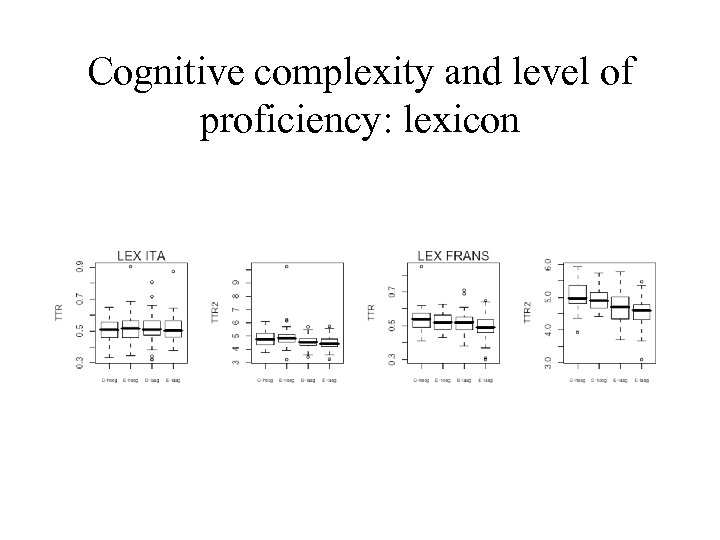
Cognitive complexity and level of proficiency: lexicon
Results 3: Summary • Accuracy – Italian and French: lower error ratios on the more complex task (Err Tot, Err 1 st, Err 2 nd) + Cognition Hypothesis, - LAC Model • Syntactic complexity and lexical variation – Italian and French: no significant differences for syntactic complexity or lexical complexity - Cognition Hypothesis, - LAC Model • Language proficiency – Italian and French: the effects of cognitive complexity are not related to language proficiency
Discussion 1 • Syntactic complexity, lexical variation – Why neither evidence for the Cognitìon Hypothesis nor for the LAC Model? • How can cognitive complexity best be operationalized? • How can linguistic performance best be measured? • What may be concluded if we focus on particular syntactic structures and use of more specific interlanguage sensitive measures? • What may we learn from the use of more qualitative measures (e. g. Lexical Frequency Profile)?
Discussion 2 • Accuracy – Analysis type of error which decreases in +complex condition: syntactic, lexical, morphological errors, other? – Further investigation role of attention: where does the increase in attention (+complex condition) come from? Attentional capacity which is not used in the -complex condition? Decrease of attention on other aspects of performance?
Discussion 3 • Language proficiency – Further investigation into the role of language proficiency? • Teaching practice – Is increasing task complexity beneficial? (fewer errors; no negative effects regarding syntactic complexity and lexical variation!)
Addresses • Folkert Kuiken, f. kuiken@uva. nl • Ineke Vedder, i. vedder@uva. nl • Amsterdam Center for Language and Communication (ACLC), aclc-fgw@uva. nl Spuistraat 210 1012 VT Amsterdam The Netherlands
Скачать презентацию The relation between cognitive task complexity and linguistic
b0b1bbdc5679e5aba5944a782c06062c.ppt