


 Скачать презентацию The REGULATORY World of Generation and Transmission Jeff
cd939150ab38a5a3ea7833580b74b4bc.ppt
- Количество слайдов: 34
 The REGULATORY World of Generation and Transmission Jeff Kaman Manager, Energy Section Iowa Utilities Board 2008 OCT 20
 Why Regulation? • • Substitute for competition? States: state PUC Federal: FERC Overlap, jurisdictions: – State: IDNR, Legislative – Federal/National: FERC, NRC, OPS, NERC • State Legislature, U. S. Congress are “Super Regulators” • Other states similar. Details, authorities, policies, personalities may be different.
 Iowa Utilities Board (State utility “commission”) • Iowa Code (legislature). Board (commission) created by Iowa Code Chapter 476. • Iowa Administrative Code – Board/agency rules implementing legislative direction • Docket procedures • Types of proceedings (examples): – – Setting Rates Siting Rate Design / Class Cost of Service (and many more)
 IUB Mission The Iowa Utilities Board regulates utilities to ensure that reasonably priced, reliable, environmentally responsible, and safe utility services are available to all Iowans, supporting economic growth and opportunity.
 IUB Vision The Iowa Utilities Board will continue to be a nationally recognized leader in utilities regulation to assure: • Consumers receive the best value in utility services. • Utilities receive an opportunity to earn a fair return on their investment in regulated services. • Services are provided in a safe, reliable, and environmentally responsible manner. • Economic growth is supported by ensuring utility services adequate to meet new customer demand with a diversified portfolio of generation sources. • Consumers have access to the information they need to make informed choices about their utility services. • Consumers are educated about energy efficiency and the effect they can have on demand for utility services. • Competitive markets develop where effective. • All market participants receive fair treatment.
 Whom We Regulate • Investor owned gas & electric utilities for rates & service, etc. • Consumer and government-owned gas & electric for service, etc. • Transmission siting • Water, ever-decreasing telecom (but still busy), negligible rail
 Regulatory Processes • Similar in many states, FERC, (but with different authorities and philosophies) • Generally quasi-judicial • Contested cases with “commission” or “board” (or ALJ) adjudicating • Open meetings, open records. Possible confidential material. • Ex-parte communications – Once a filing is received, no “one-off” communications with parties are allowed. – State PUCs, FERC are similar.
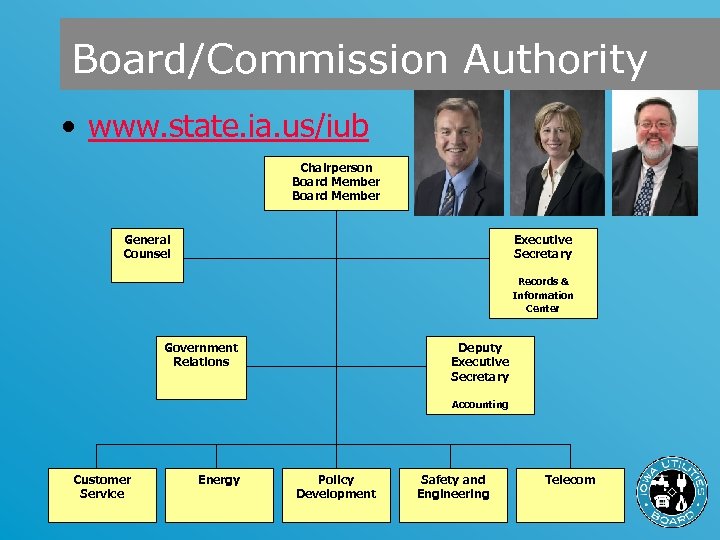 Board/Commission Authority • www. state. ia. us/iub Chairperson Board Member General Counsel Executive Secretary Records & Information Center Government Relations Deputy Executive Secretary Accounting Customer Service Energy Policy Development Safety and Engineering Telecom
 Office of the Consumer Advocate Represents Iowa consumers and the public interest in all forums with the goal of maintaining safe, reliable, reasonablypriced, and nondiscriminatory utility services for all consumers in all market settings while informing and educating the public on utility related issues.
 Filings • • Tariffs Complaints (customer or utility vs. utility) Notice of Inquiry Investigation Energy Efficiency Proceedings Alternative Energy Producers Environmental Plan and Budget Service Territory changes, “Reorganization, ” Mergers & Acquisitions, etc. • Generation Siting • Transmission Siting • Ratemaking
 Establishing a record • Parties make their cases • “Record” for the proceeding: – Initial filings, testimony, exhibits – Intervention/rebuttals – Hearing • Case may be settled • The Board can accept or reject a settlement • If required, commissioners preside over a hearing; witnesses are called, parties cross-examine and make their cases. • Staff review & recommendations. Board decides based on the record. • Parties may request rehearing, then appeal to courts.
 Transmission Siting • Iowa Code Chapter 478 • 199 IAC Chapter 11, Franchise required: – Capable of 69 k. V or more, outside of cities, 1 mile or more – Not applic if on utility or customer land • Filing includes: Route selection; Maps; description of public use; Right of Way; Eminent Domain • One filing for each county • 25 year maximum transmission line franchise – extensions to term required
 Transmission Siting (cont’d) • Public Info Meeting at least 30 days before filing • Proceeding, possible hearing, etc. • Usually ALJ hears, subject to appeal and Board review • Decision criteria: Iowa Code Chapter 478. 4 requires that the Board make a finding that the proposed line or lines are necessary to serve a public use and represents a reasonable relationship to an overall plan of transmitting electricity in the public interest.
 Generation Siting • Iowa Code Chapter 476 A • 199 IAC Chapter 24 • Public informational meeting not less than 30 days prior to filing • Decision criteria: – Consistent with 476. 53, economics, not detrimental to reliable and adequate service – Will operate pursuant to certificate & rules – Reasonable land use & reasonable environmentally considering availability and economics of alternatives
 Generation • • • Alliant’s proposed Marshalltown plant LS Power’s proposed Waterloo plant Wind projects by Mid. American, Alliant Wind projects by independents Reliability and System Impact Other States’ authorities: – High: May have IRP requirement (WI) – Medium: Need? Reasonableness? Least cost? – Low: Retail choice states have less authority
 Reorganization • Mergers & Acquisitions, Service Territory changes, Asset sales, etc. • 199 IAC Chapter 32 • 199 IAC Chapter 31 – accounting, affiliates, etc.
 Alternative Energy Producer • PURPA is federal standard that must be considered in state rules • 199 IAC Chapter 15 • 476 B, 476 C state tax credits for renewable energy
 Energy Efficiency Proceeding • 199 IAC Chapter 35 • EE Program includes: – EE: like appliance efficiency (k. Wh) – Peak Load reductions: like industrial interruptible loads; residential AC unit cycling – Possible inclusion of price responsive demand? Difficult to draw the grey line. • Electric EE, Natural Gas EE • Major review now, hot topic in Iowa legislature
 Ratemaking • 199 IAC Chapter 26 • Note that utilities keep separate books for gas distribution, electric distribution, unregulated affiliates, etc. • No “single-issue ratemaking”
 Setting Rates • General Considerations – – Capital Structure Cost of Capital and Cost of Equity ROE Determine revenue requirement • Rate Design/Class Cost of Service • T Costs: – – State rate base ISO Attachment “O” via FERC Bundled Rates Etc.
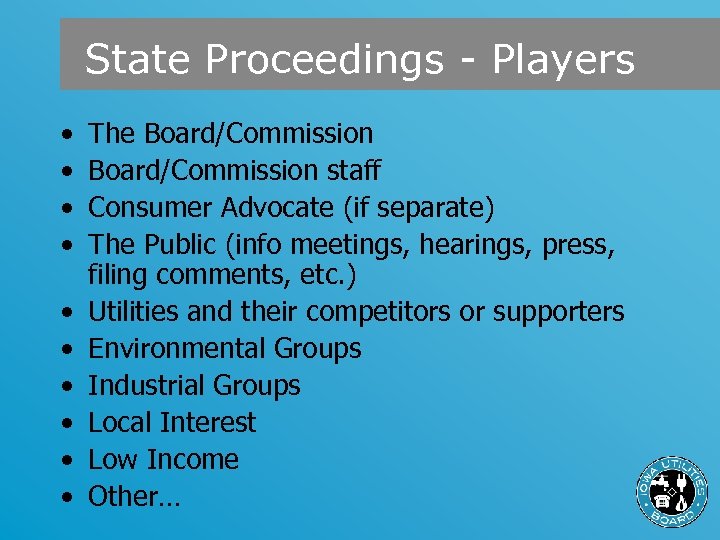 State Proceedings - Players • • • The Board/Commission staff Consumer Advocate (if separate) The Public (info meetings, hearings, press, filing comments, etc. ) Utilities and their competitors or supporters Environmental Groups Industrial Groups Local Interest Low Income Other…
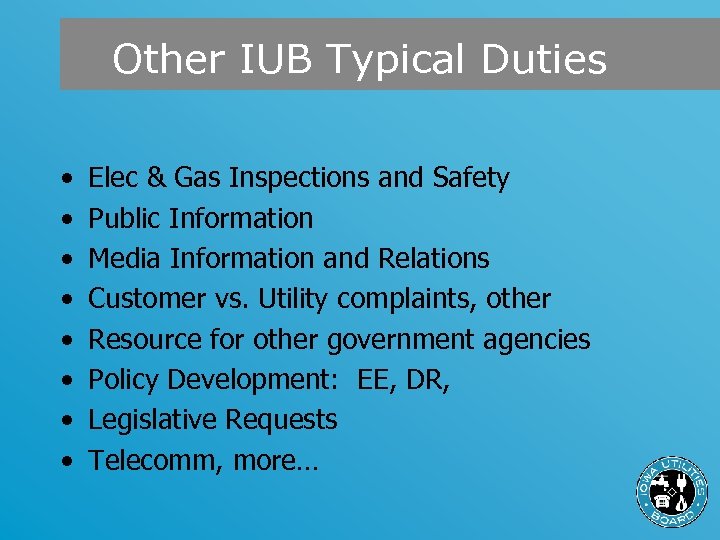 Other IUB Typical Duties • • Elec & Gas Inspections and Safety Public Information Media Information and Relations Customer vs. Utility complaints, other Resource for other government agencies Policy Development: EE, DR, Legislative Requests Telecomm, more…
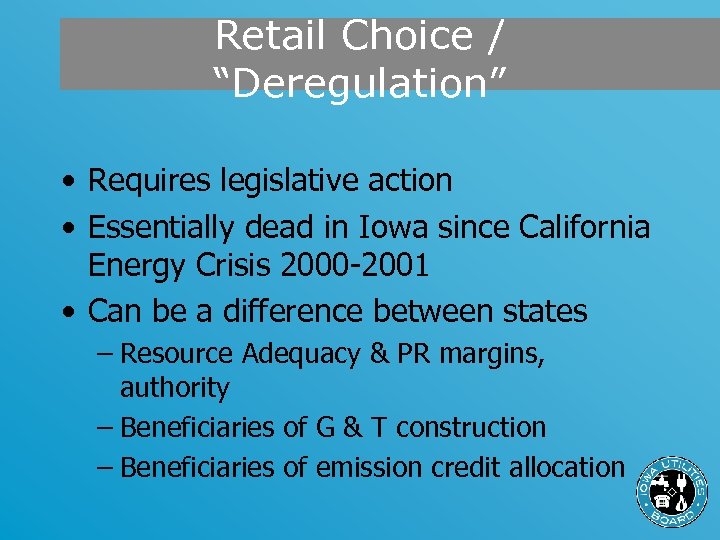 Retail Choice / “Deregulation” • Requires legislative action • Essentially dead in Iowa since California Energy Crisis 2000 -2001 • Can be a difference between states – Resource Adequacy & PR margins, authority – Beneficiaries of G & T construction – Beneficiaries of emission credit allocation
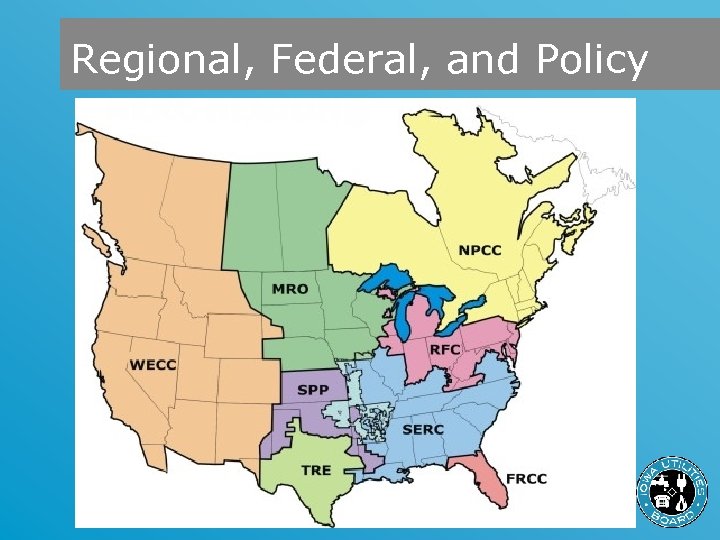 Regional, Federal, and Policy
 Organized Electricity Markets • Federal Policy – FERC Orders • • • ISO’s, RTO’s Energy Prices Results Market Monitoring ISO’s/RTO’s and planning
 OMS and other Regional State Entities • Joint effort of states in an RTO • Ex: OMS, OPSI, SPP RSC, New England • Organization of MISO States (OMS): – 14 states and Manitoba – 20 filings at FERC last year – Participate, advocate, vote at MISO stakeholder meetings – Agree when we can, speak to MISO and FERC with as much unity and clarity as possible. – IUB Chair John Norris is President of OMS
 G, T Jurisdiction • States have authority for Resource Adequacy • Problems: – Regional markets produce free riders? – Regional markets adequate incentive to build? – Capacity market is a bad word for many, me included. $ increase but haven’t worked. • MISO recent Module E filing • MISO, for example, needs to make G assumptions in T planning • FERC has reliability authority – what would it take for them to use it for G? • Some suggest let the market decide what RA and reliability is worth paying for. Is it okay to assume it will get built?
 National Issues • Carbon • Transmission Issues – – – – Getting T built T Cost recovery, valuation, economics Piecemeal or planned? Queue: the tail wagging the dog T Corridors and siting authority Incentive rates “Smart Grid” • Generation/Resource Issues – Separate from T plan, OATT – Types: coal, nuclear, wind, gas, solar, PHEV, DR, EE • Ratepayer Issues: – Cost – Competitive markets, RTOs, market monitoring – Environment
 Studies Underway, National Portfolios • Modifications to RTO queue processes • Routine planning (MISO’s MTEP’s) • Eastern Wind Integration Transmission Study (EWITS) • Regional Generation Outlet Study • Joint Coordinated System Plan
 JCSP for MISO, SPP, PJM, TVA, ISO NE, NYISO • Meets requirement for long-range planning for multiple RTOs • Incorporates current (~5%) and potential for 20% federal RPS • Results: – $50 B transmission for ~ 5% – $80 B transmission for 20%
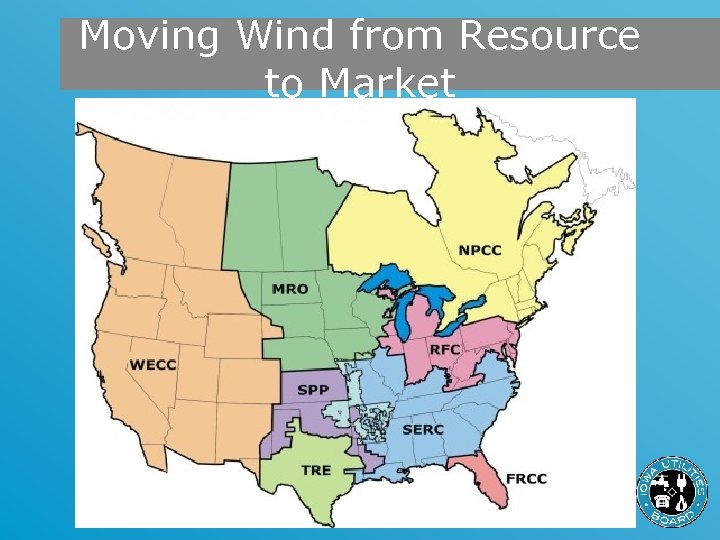 Moving Wind from Resource to Market
 JCSP Wind Maps • www. jcspstudy. org
 Transmission Initiative and Objectives • Upper Midwest Transmission Development Initiative (UMTDI) • 5 -State Effort (IA, MN, ND, SD, WI) announced by Governors Sept 18, 2008 • RPS’s enacted and Renewable Goals • Objectives: – Transmission Solution (easy) – Allocate the Costs (ugly) • Why good? • Governors’ offices, utility commissions, Midwest ISO, stakeholders; open
 IUB Contact Information 350 Maple Street Des Moines, Iowa 50319 -0069 515. 281. 3839 877. 565. 4450 Iubcustomer@iub. state. ia. us www. state. ia. us/iub