 Скачать презентацию THE REACTIONARY 1850 s Many observers agreed
0939ccaad977b54172b77440b3acd1e6.ppt
- Количество слайдов: 25



THE “REACTIONARY” 1850 s • Many observers agreed with Engels that “feudal reaction” triumphed in 1849, but Blackbourn questions that argument. • Prussia’s Frederick William IV sought to unify Germany in 1849/50 but abandoned that effort at Austria’s demand. • In the 1850 s Prussian elections meant little, because there was no free press or freedom of association. • But the Prussian government did become responsive to “public opinion” and sought to give all property owners good reason to support the government.
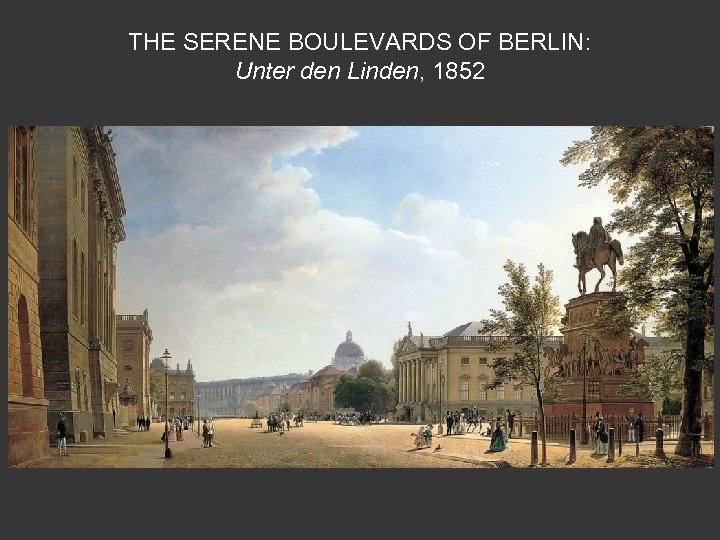
THE SERENE BOULEVARDS OF BERLIN: Unter den Linden, 1852
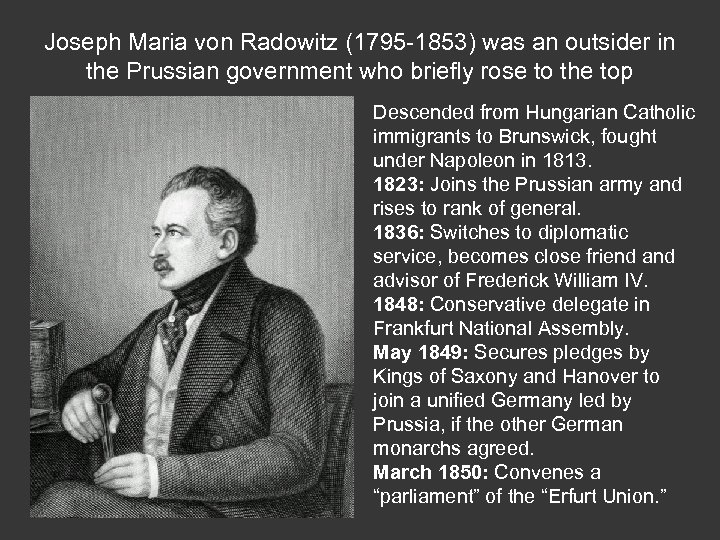
Joseph Maria von Radowitz (1795 -1853) was an outsider in the Prussian government who briefly rose to the top Descended from Hungarian Catholic immigrants to Brunswick, fought under Napoleon in 1813. 1823: Joins the Prussian army and rises to rank of general. 1836: Switches to diplomatic service, becomes close friend advisor of Frederick William IV. 1848: Conservative delegate in Frankfurt National Assembly. May 1849: Secures pledges by Kings of Saxony and Hanover to join a unified Germany led by Prussia, if the other German monarchs agreed. March 1850: Convenes a “parliament” of the “Erfurt Union. ”
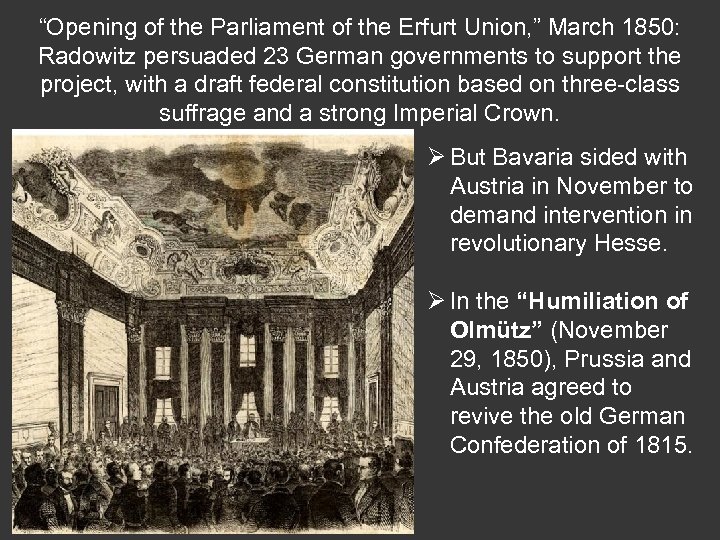
“Opening of the Parliament of the Erfurt Union, ” March 1850: Radowitz persuaded 23 German governments to support the project, with a draft federal constitution based on three-class suffrage and a strong Imperial Crown. Ø But Bavaria sided with Austria in November to demand intervention in revolutionary Hesse. Ø In the “Humiliation of Olmütz” (November 29, 1850), Prussia and Austria agreed to revive the old German Confederation of 1815.
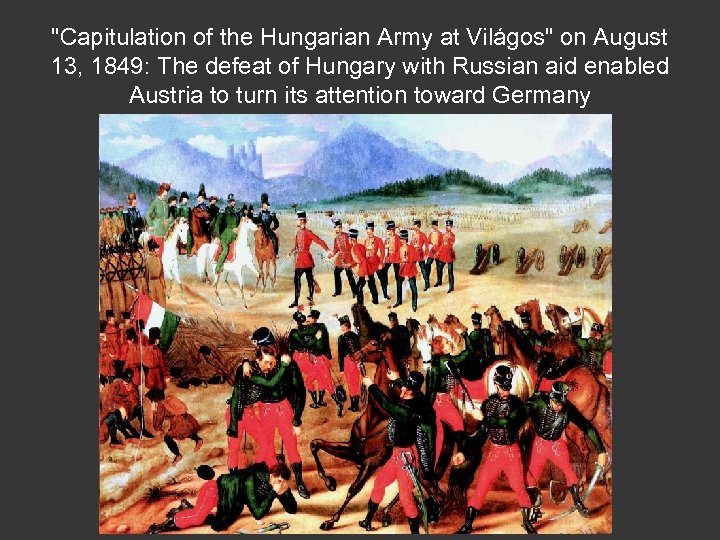
"Capitulation of the Hungarian Army at Világos" on August 13, 1849: The defeat of Hungary with Russian aid enabled Austria to turn its attention toward Germany
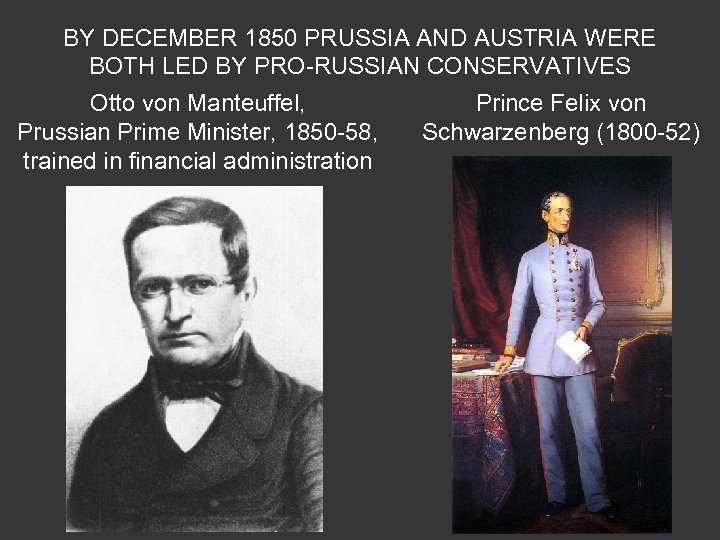
BY DECEMBER 1850 PRUSSIA AND AUSTRIA WERE BOTH LED BY PRO-RUSSIAN CONSERVATIVES Otto von Manteuffel, Prussian Prime Minister, 1850 -58, trained in financial administration Prince Felix von Schwarzenberg (1800 -52)
MANTEUFFEL ADOPTED SHREWD REFORMS TO MAKE THE GOVERNMENT MORE POPULAR • FOR PEASANTS: Government-subsidized loans to purchase land: – 1811 -48: 240, 000 new peasant freeholds. – 1850 -65: 640, 000 new peasant freeholds. – Prussia’s landowning peasants became reliably conservative thereafter. • FOR ARTISANS: Guilds revive in the 1850 s as voluntary chambers, deputized by the government to oversee vocational training and consumer protection. • FOR BUSINESSMEN: Regional “Chambers of Commerce and Industry” gain the right to publish reports on business conditions and advise the new “Ministry of Commerce. ”
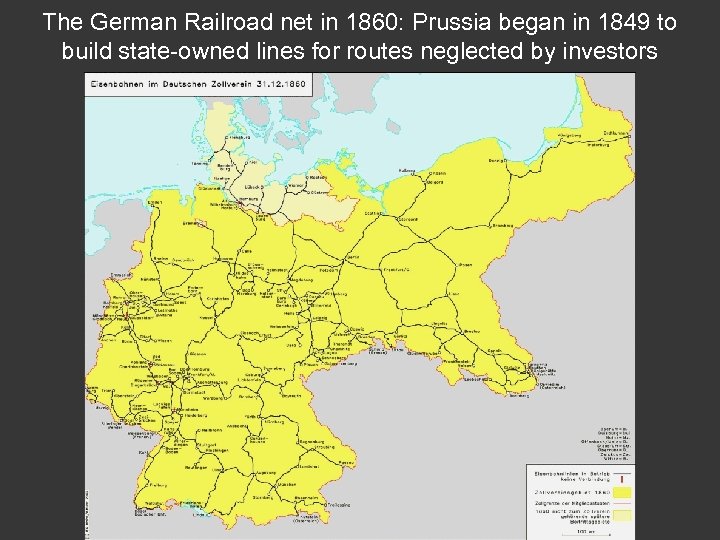
The German Railroad net in 1860: Prussia began in 1849 to build state-owned lines for routes neglected by investors
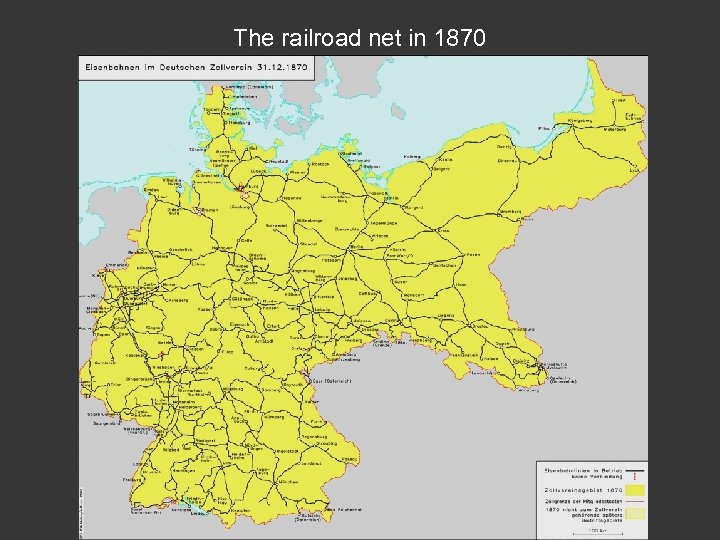
The railroad net in 1870
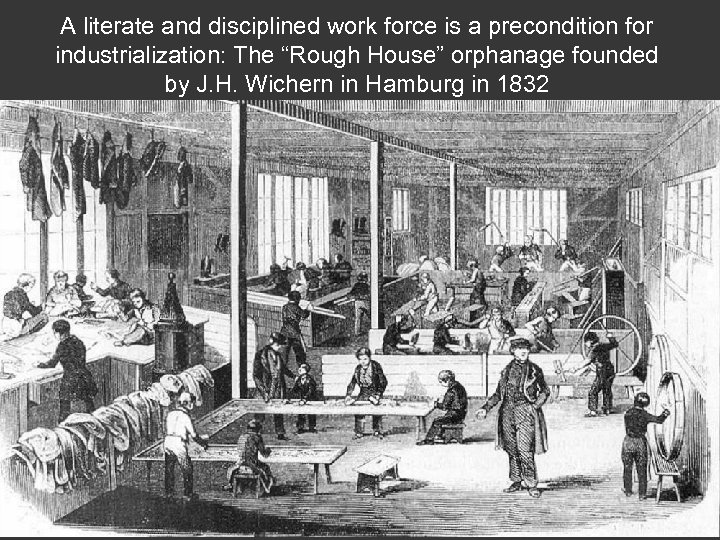
A literate and disciplined work force is a precondition for industrialization: The “Rough House” orphanage founded by J. H. Wichern in Hamburg in 1832
PRO-BUSINESS REFORMS IN PRUSSIA • A separate Ministry of Commerce was created in 1848. • Chambers of Commerce gain the right to publish annual reports and petition the authorities. • Prussia rejects Austrian pressure for an Austro-German Customs Union, and persuades Hanover to join the Zollverein in 1851. • “Limited liability” encourages the foundation of 120 joint stock corporations. • Prussia accepts the “universal” joint-stock investment banks pioneered by France (1852) and Hesse (Darmstadt Bank, 1853); David Hansemann founds the “Discount Company” in Berlin, 1856. • The “Joint Ownership Law” of 1851 privatized the coal mines, and output soared.
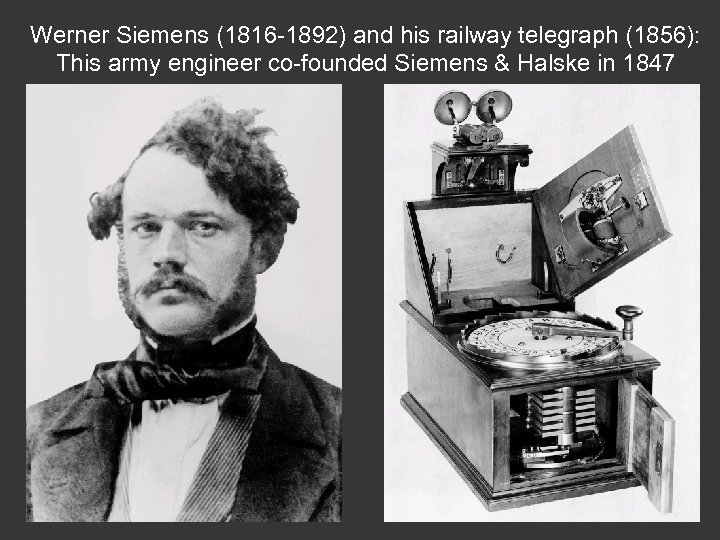
Werner Siemens (1816 -1892) and his railway telegraph (1856): This army engineer co-founded Siemens & Halske in 1847
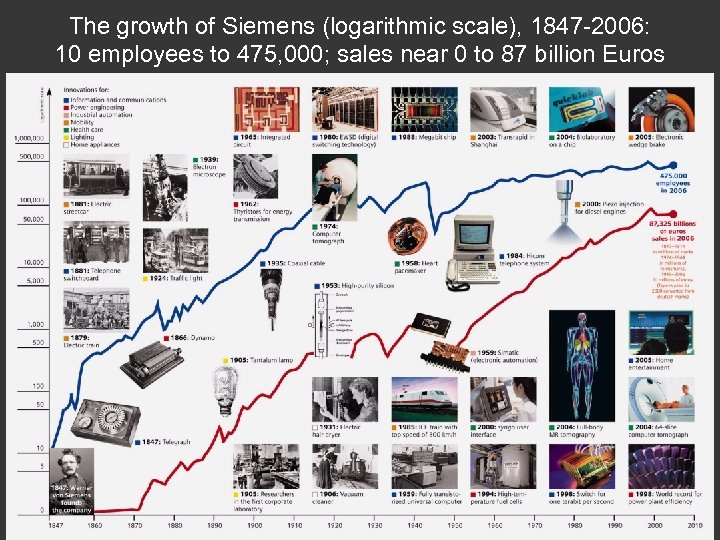
The growth of Siemens (logarithmic scale), 1847 -2006: 10 employees to 475, 000; sales near 0 to 87 billion Euros
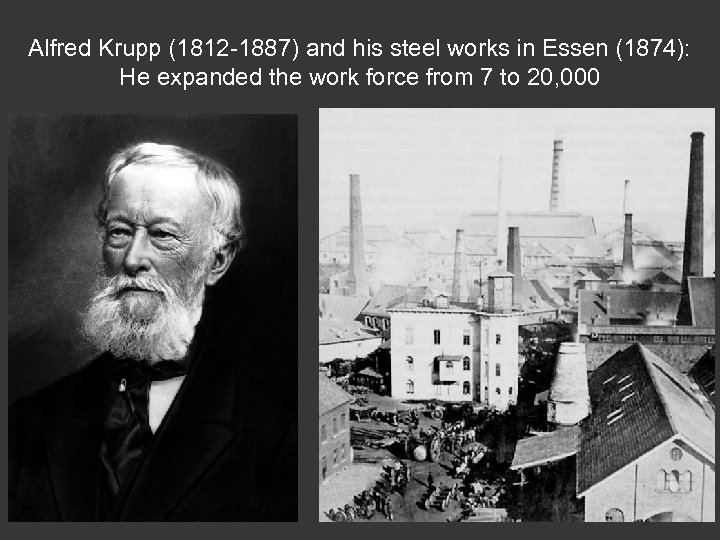
Alfred Krupp (1812 -1887) and his steel works in Essen (1874): He expanded the work force from 7 to 20, 000
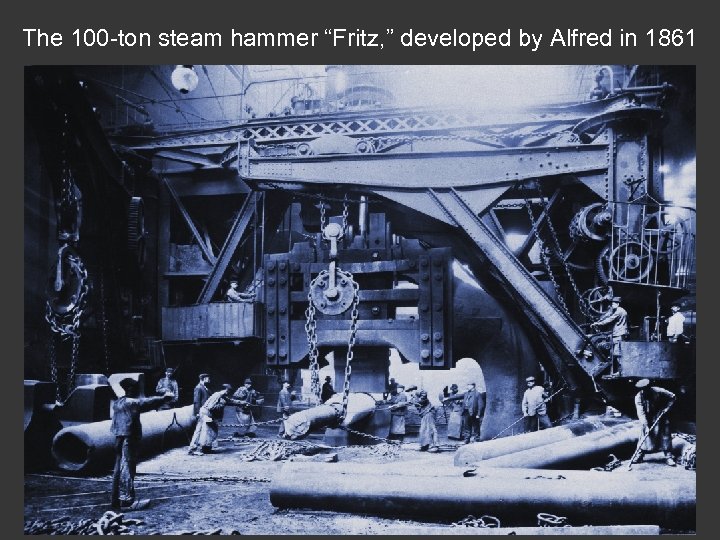
The 100 -ton steam hammer “Fritz, ” developed by Alfred in 1861
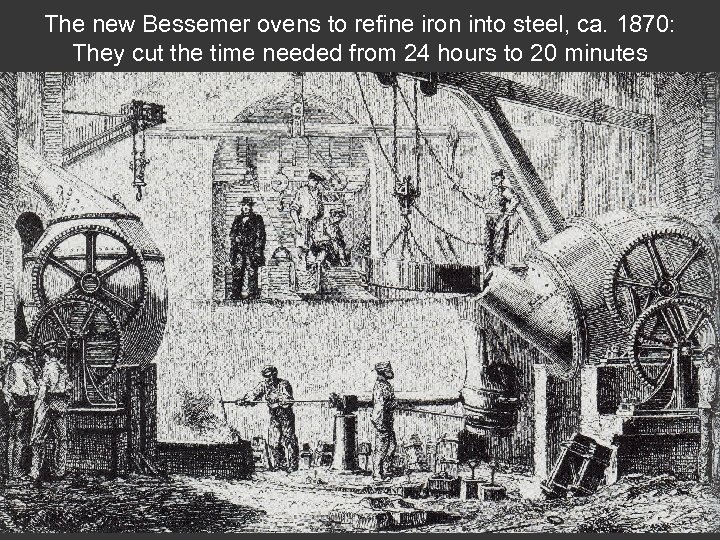
The new Bessemer ovens to refine iron into steel, ca. 1870: They cut the time needed from 24 hours to 20 minutes
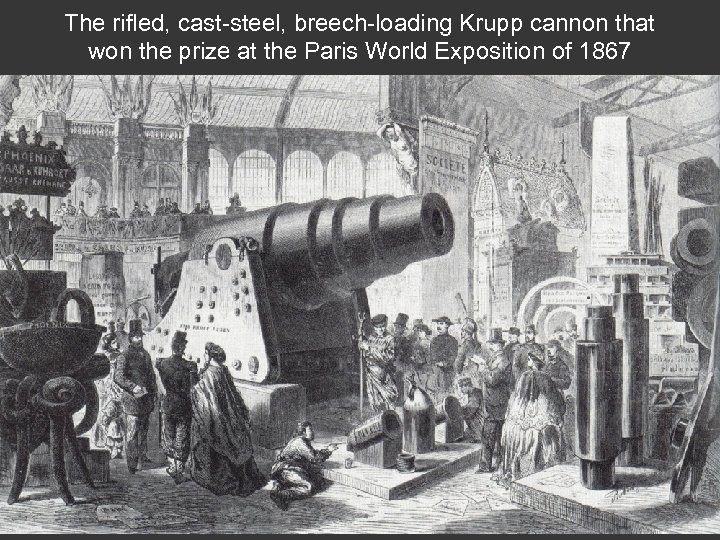
The rifled, cast-steel, breech-loading Krupp cannon that won the prize at the Paris World Exposition of 1867
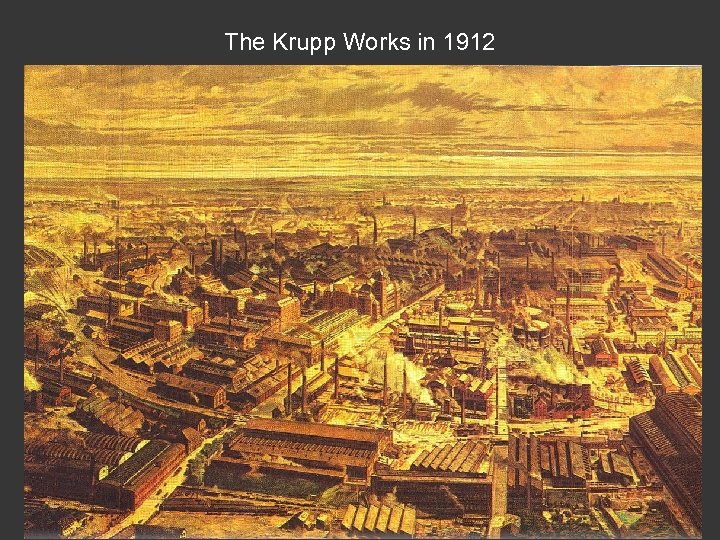
The Krupp Works in 1912
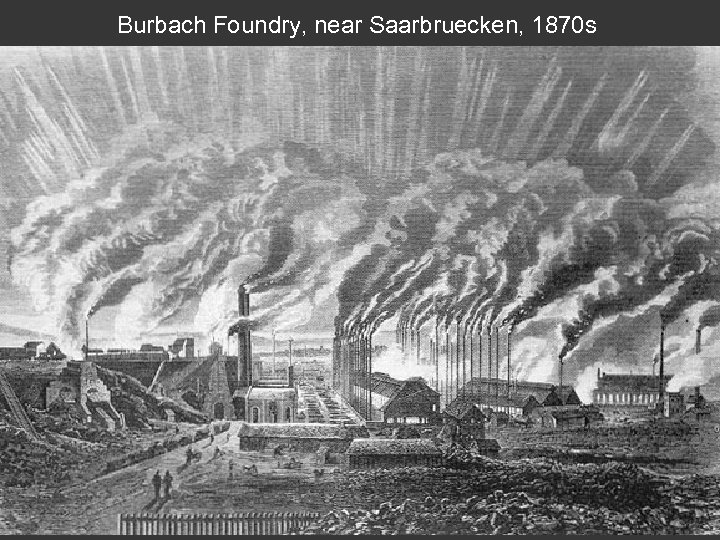
Burbach Foundry, near Saarbruecken, 1870 s
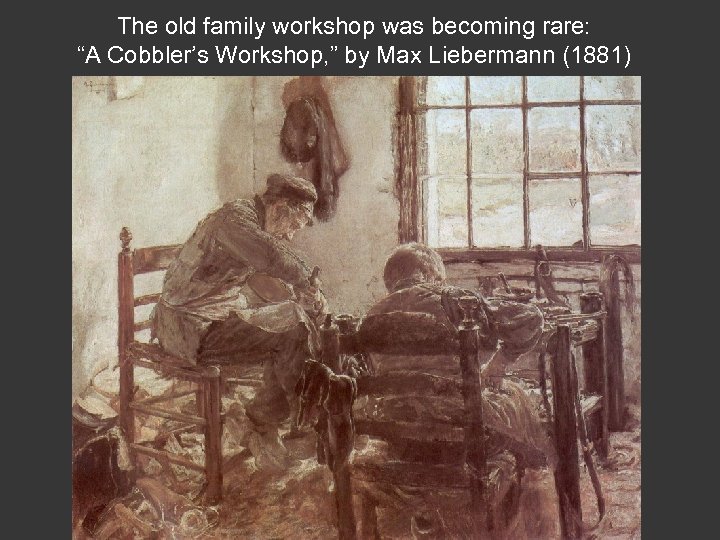
The old family workshop was becoming rare: “A Cobbler’s Workshop, ” by Max Liebermann (1881)
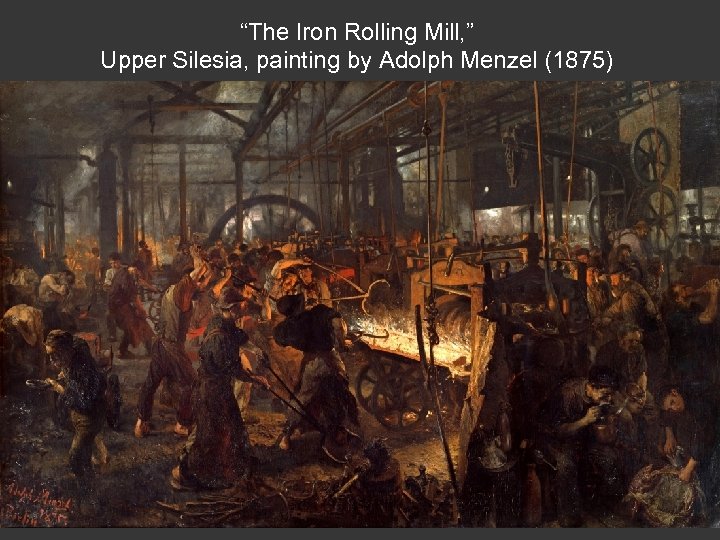
“The Iron Rolling Mill, ” Upper Silesia, painting by Adolph Menzel (1875)
Luther taught that “all callings are holy, ” but according to Marx, capitalism leads to “alienated labor” (entfremdete Arbeit) 1. An elaborate division of labor leaves each worker involved only in a small step in the production process. 2. The worker has no control over the organization of the work process. 3. The worker has no control over the disposition of the product. “Alienated labor” provides no sense of emotional fulfillment; people ONLY do it to earn a living.
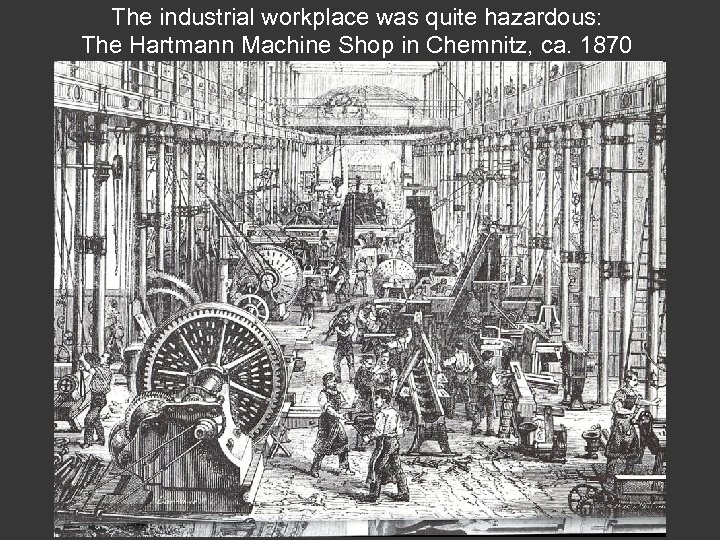
The industrial workplace was quite hazardous: The Hartmann Machine Shop in Chemnitz, ca. 1870
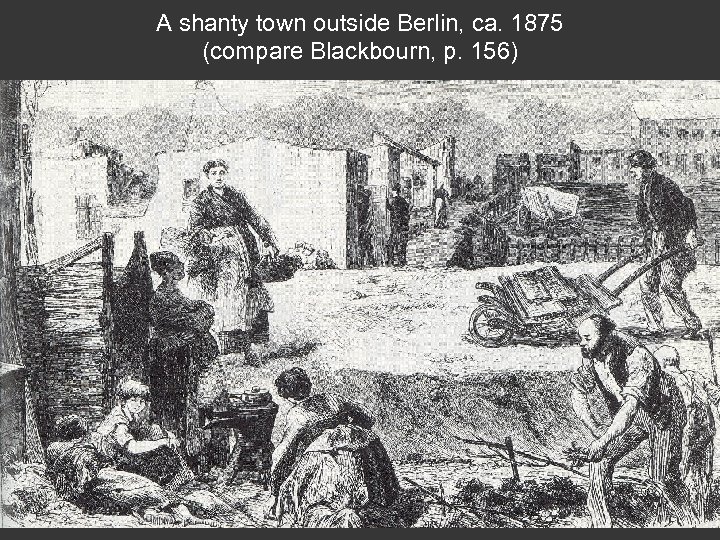
A shanty town outside Berlin, ca. 1875 (compare Blackbourn, p. 156)
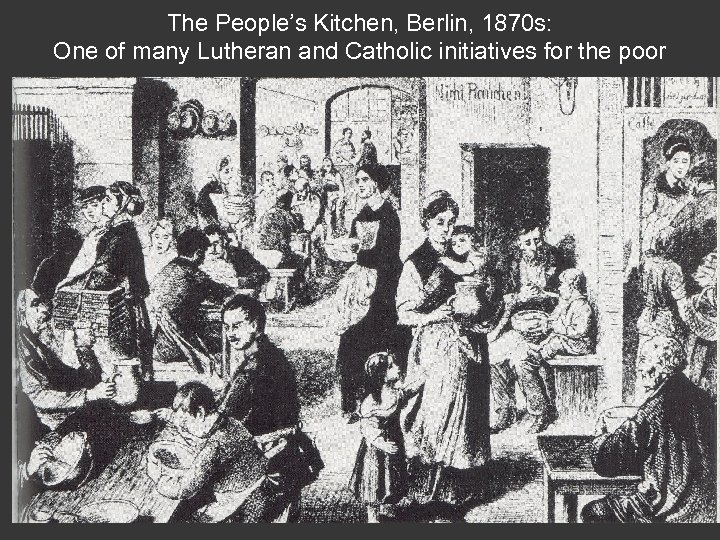
The People’s Kitchen, Berlin, 1870 s: One of many Lutheran and Catholic initiatives for the poor
Скачать презентацию THE REACTIONARY 1850 s Many observers agreed
0939ccaad977b54172b77440b3acd1e6.ppt