


 Скачать презентацию The Rare Symmetry Violating Processes Project Jonathan Kotcher
d51ccb74c2c977912500b3699afb9853.ppt
- Количество слайдов: 49
 The Rare Symmetry Violating Processes Project Jonathan Kotcher RSVP Preliminary Baseline Review 6 -8 April 2005 Brookhaven National Laboratory
 Outline • • • Overview of Projects RSVP Timelines Organization Project Status Development of Project Plan MREFC Cost Summaries Running Beams for RSVP: Logistics & Costs Schedule Management: Milestones, Labor Profiles Management Contingency Change Control Funding Flow Conclusions 2 J. Kotcher RSVP Preliminary Baseline Review April 6 -8, 2005
 KOPIO Scientific Collaboration Arizona State University J. R. Comfort, J. Figgins University of British Columbia, Canada D. Bryman, M. Hasinoff, J. Ives Brookhaven National Laboratory D. Beavis, I. -H. Chiang, A. Etkin, J. W. Glenn, A. Hanson, D. Jaffe, S. Kettell, D. Lazarus, K. Li, L. Littenberg, G. Redlinger, C. Scarlett, M. Sivertz, R. Strand University of Cincinnati K. Kinoshita IHEP, Protvino, Russia G. Britvich, V. Burtovoy, S. Chernichenko, L. Landsberg, A. Lednev, V. Obraztsov, R. Rogalev, V. Semenov, M. Shapkin, I. Shein, A. Soldatov, N. Tyurin, V. Vassil’chenko, D. Vavilov, A. Yanovich INR, Moscow, Russia A. Ivashkin, D. Ishuk, M. Khabibullin, A. Khotjanzev, Y. Kudenko, A. Levchenko, O. Mineev, A. Vasiljev, N. Yeshov 80 scientists, 10 graduate students, KEK, Japan M. Kobayashi 19 institutions, 6 countries Kyoto University of Education, Japan R. Takashima Kyoto University, Japan H. Morii, Y. Nakajima, T. Nomura, N. Sasao, T. Sumida, N. Taniguchi, H. Yokoyama University of Montreal, Canada J. -P. Martin University of New Mexico B. Bassalleck, N. Bruner, D. E. Fields, J. Lowe, T. L. Thomas INFN, University of Perugia, Italy E. Imbergamo, A. Nappi, M. Valdata, M. Viti Stony Brook University N. Cartiglia, I. Christidi, M. Marx, P. Rumerio, R. D. Schamberger TRIUMF, Vancouver, Canada P. Amaudruz, M. Barnes, J. Doornbos, P. Gumplinger, R. Henderson, N. Khan, J. Mildenberger, A. Miller, A. Mitra, T. Numao, R. Poutissou, F. Retiere, A. Sher, G. Wait Tsinghua University, Beijing, China S. Chen University of Virginia E. Frlez, D. Pocanic Virginia Polytechnic Institute and State University M. Blecher, N. Graham, A. Hatzikoutelis Yale University G. Atoyan, S. K. Dhawan, V. Issakov, A. Poblaguev, M. E. Zeller University of Zurich, Switzerland P. Robmann, P. Truol, A. van der Schaaf, S. Scheu 3 J. Kotcher RSVP Preliminary Baseline Review April 6 -8, 2005
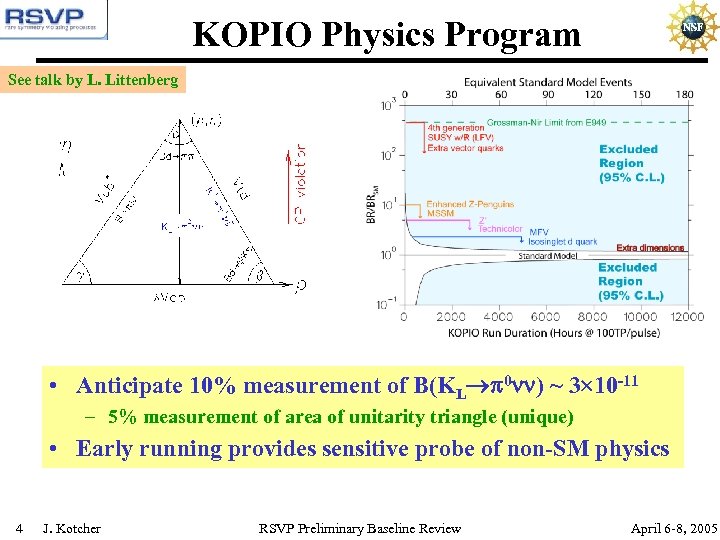 KOPIO Physics Program See talk by L. Littenberg • Anticipate 10% measurement of B(KL 0 ) ~ 3 10 -11 – 5% measurement of area of unitarity triangle (unique) • Early running provides sensitive probe of non-SM physics 4 J. Kotcher RSVP Preliminary Baseline Review April 6 -8, 2005
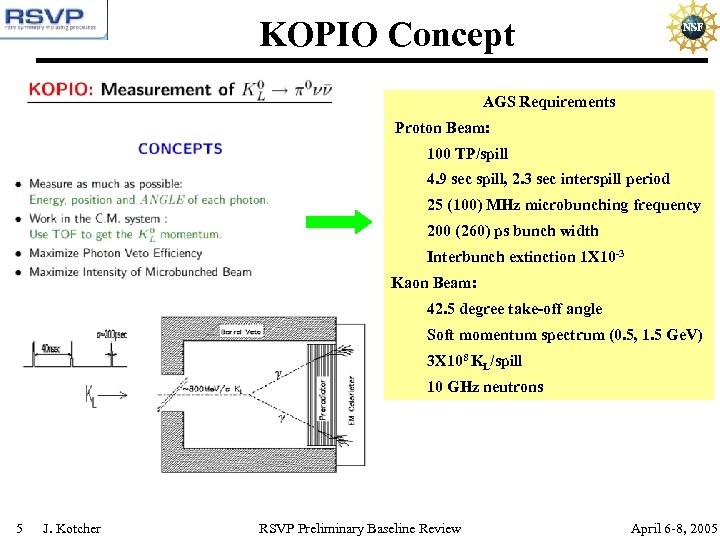 KOPIO Concept AGS Requirements Proton Beam: 100 TP/spill 4. 9 sec spill, 2. 3 sec interspill period 25 (100) MHz microbunching frequency 200 (260) ps bunch width Interbunch extinction 1 X 10 -3 Kaon Beam: 42. 5 degree take-off angle Soft momentum spectrum (0. 5, 1. 5 Ge. V) 3 X 10⁸ KL/spill 10 GHz neutrons 5 J. Kotcher RSVP Preliminary Baseline Review April 6 -8, 2005
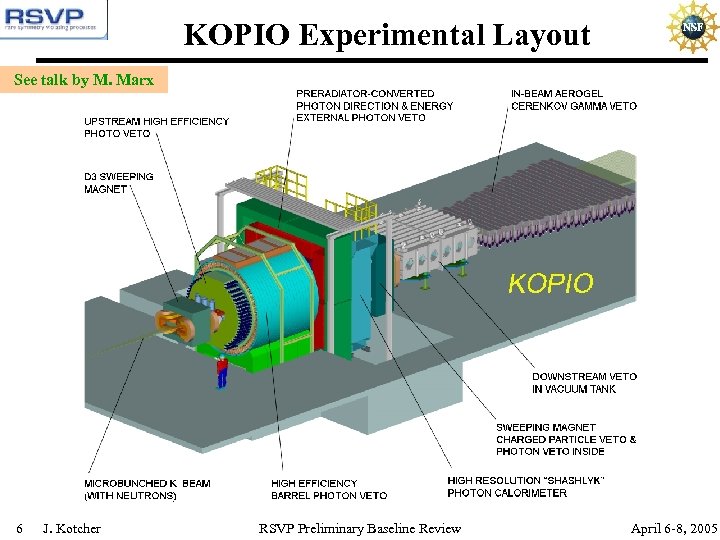 KOPIO Experimental Layout See talk by M. Marx 6 J. Kotcher RSVP Preliminary Baseline Review April 6 -8, 2005
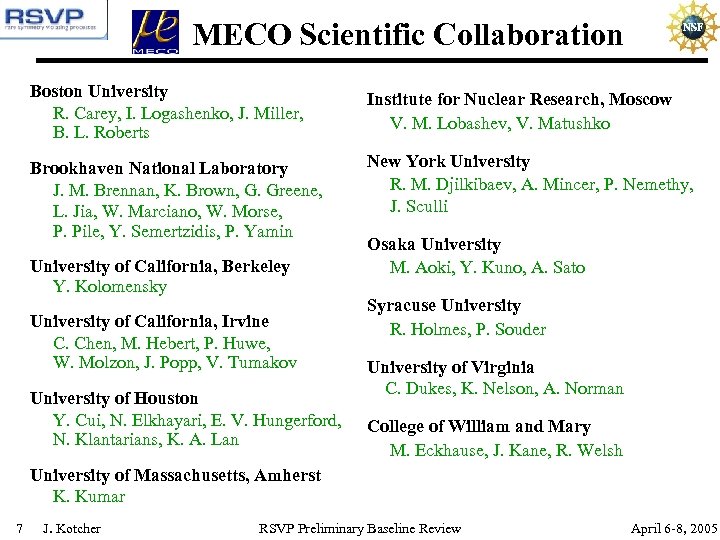 MECO Scientific Collaboration Boston University R. Carey, I. Logashenko, J. Miller, B. L. Roberts Institute for Nuclear Research, Moscow V. M. Lobashev, V. Matushko Brookhaven National Laboratory J. M. Brennan, K. Brown, G. Greene, L. Jia, W. Marciano, W. Morse, P. Pile, Y. Semertzidis, P. Yamin New York University R. M. Djilkibaev, A. Mincer, P. Nemethy, J. Sculli University of California, Berkeley Y. Kolomensky University of California, Irvine C. Chen, M. Hebert, P. Huwe, W. Molzon, J. Popp, V. Tumakov University of Houston Y. Cui, N. Elkhayari, E. V. Hungerford, N. Klantarians, K. A. Lan Osaka University M. Aoki, Y. Kuno, A. Sato Syracuse University R. Holmes, P. Souder University of Virginia C. Dukes, K. Nelson, A. Norman College of William and Mary M. Eckhause, J. Kane, R. Welsh University of Massachusetts, Amherst K. Kumar 7 J. Kotcher RSVP Preliminary Baseline Review April 6 -8, 2005
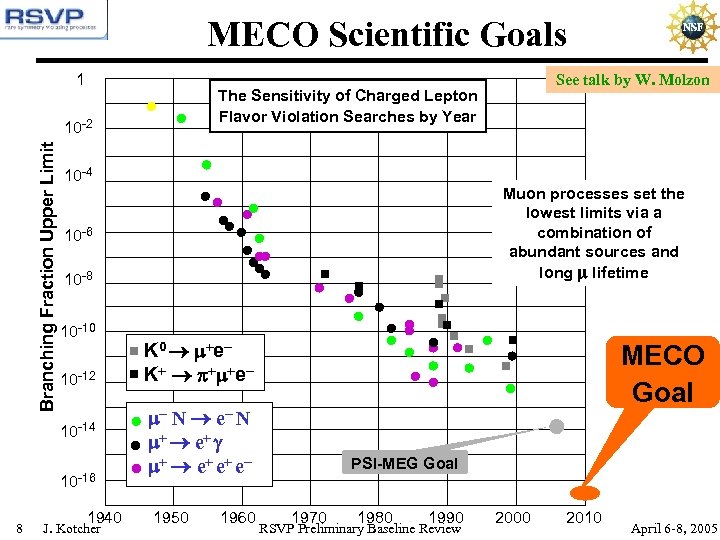 MECO Scientific Goals 1 The Sensitivity of Charged Lepton Flavor Violation Searches by Year Branching Fraction Upper Limit 10 -2 10 -4 Muon processes set the lowest limits via a combination of abundant sources and long lifetime 10 -6 10 -8 10 -10 10 -12 10 -14 10 -16 8 See talk by W. Molzon 1940 J. Kotcher K 0 +e. K+ + +e- MECO Goal - N e- N + e+ e+ e 1950 1960 PSI-MEG Goal 1970 1980 1990 RSVP Preliminary Baseline Review 2000 2010 April 6 -8, 2005
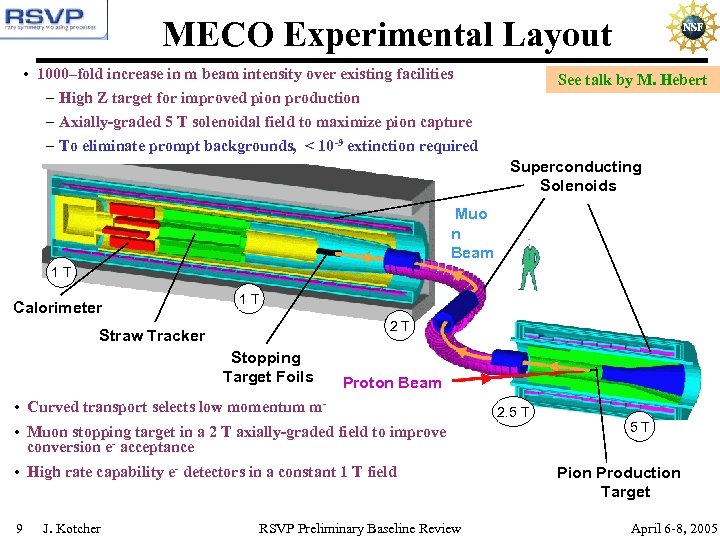 MECO Experimental Layout • 1000–fold increase in m beam intensity over existing facilities – High Z target for improved pion production – Axially-graded 5 T solenoidal field to maximize pion capture – To eliminate prompt backgrounds, < 10 -9 extinction required See talk by M. Hebert Superconducting Solenoids Muo n Beam 1 T Calorimeter 1 T 2 T Straw Tracker Stopping Target Foils Proton Beam • Curved transport selects low momentum m • Muon stopping target in a 2 T axially-graded field to improve conversion e- acceptance • High rate capability e- detectors in a constant 1 T field 9 J. Kotcher RSVP Preliminary Baseline Review 2. 5 T 5 T Pion Production Target April 6 -8, 2005
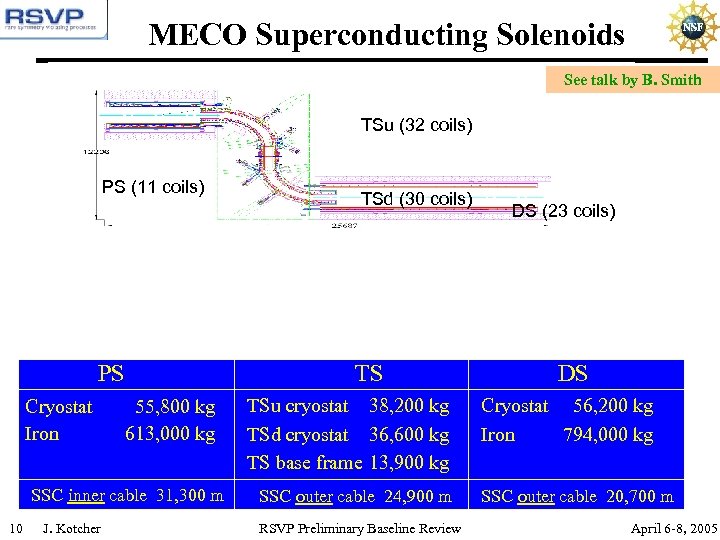 MECO Superconducting Solenoids See talk by B. Smith TSu (32 coils) PS (11 coils) PS Cryostat Iron TS 55, 800 kg 613, 000 kg SSC inner cable 31, 300 m 10 J. Kotcher TSd (30 coils) TSu cryostat 38, 200 kg TSd cryostat 36, 600 kg TS base frame 13, 900 kg SSC outer cable 24, 900 m RSVP Preliminary Baseline Review DS (23 coils) DS Cryostat 56, 200 kg Iron 794, 000 kg SSC outer cable 20, 700 m April 6 -8, 2005
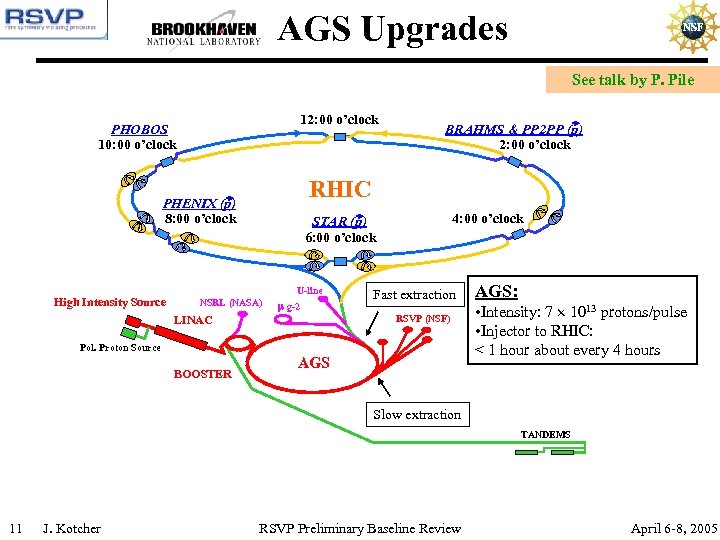 AGS Upgrades See talk by P. Pile 12: 00 o’clock PHOBOS 10: 00 o’clock RHIC PHENIX (p) 8: 00 o’clock High Intensity Source BRAHMS & PP 2 PP (p) 2: 00 o’clock 4: 00 o’clock STAR (p) 6: 00 o’clock U-line NSRL (NASA) g-2 Fast extraction RSVP (NSF) LINAC Pol. Proton Source BOOSTER AGS: • Intensity: 7 1013 protons/pulse • Injector to RHIC: < 1 hour about every 4 hours Slow extraction TANDEMS 11 J. Kotcher RSVP Preliminary Baseline Review April 6 -8, 2005
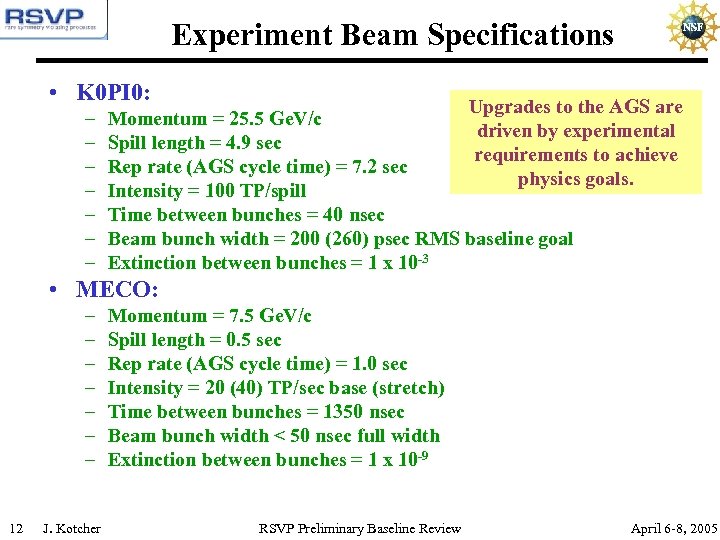 Experiment Beam Specifications • K 0 PI 0: – – – – Upgrades to the AGS are Momentum = 25. 5 Ge. V/c driven by experimental Spill length = 4. 9 sec requirements to achieve Rep rate (AGS cycle time) = 7. 2 sec physics goals. Intensity = 100 TP/spill Time between bunches = 40 nsec Beam bunch width = 200 (260) psec RMS baseline goal Extinction between bunches = 1 x 10 -3 • MECO: – – – – 12 J. Kotcher Momentum = 7. 5 Ge. V/c Spill length = 0. 5 sec Rep rate (AGS cycle time) = 1. 0 sec Intensity = 20 (40) TP/sec base (stretch) Time between bunches = 1350 nsec Beam bunch width < 50 nsec full width Extinction between bunches = 1 x 10 -9 RSVP Preliminary Baseline Review April 6 -8, 2005
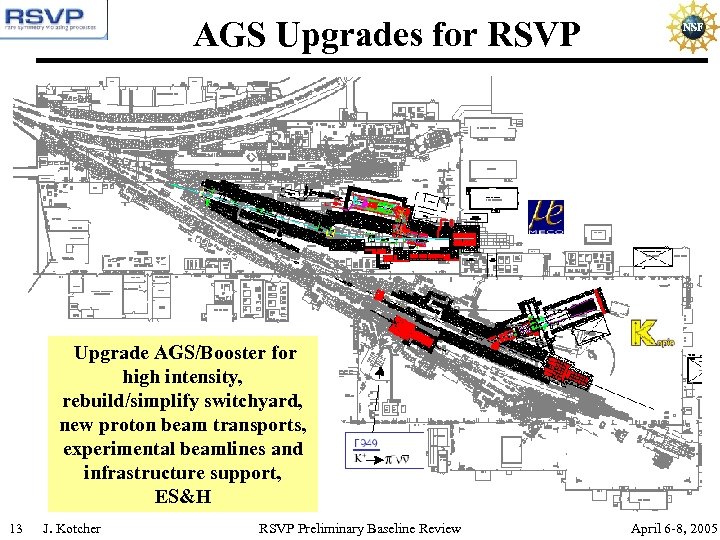 AGS Upgrades for RSVP Upgrade AGS/Booster for high intensity, rebuild/simplify switchyard, new proton beam transports, experimental beamlines and infrastructure support, ES&H 13 J. Kotcher RSVP Preliminary Baseline Review April 6 -8, 2005
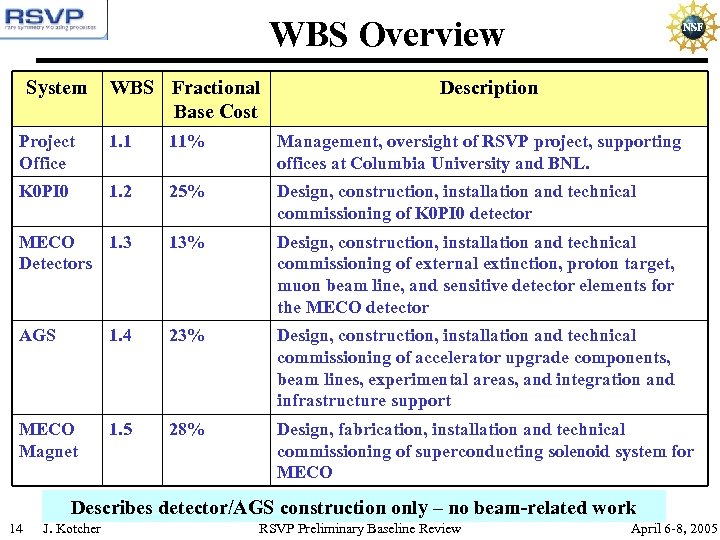 WBS Overview System WBS Fractional Base Cost Description Project Office 1. 1 11% Management, oversight of RSVP project, supporting offices at Columbia University and BNL. K 0 PI 0 1. 2 25% Design, construction, installation and technical commissioning of K 0 PI 0 detector MECO 1. 3 Detectors 13% Design, construction, installation and technical commissioning of external extinction, proton target, muon beam line, and sensitive detector elements for the MECO detector AGS 1. 4 23% Design, construction, installation and technical commissioning of accelerator upgrade components, beam lines, experimental areas, and integration and infrastructure support MECO Magnet 1. 5 28% Design, fabrication, installation and technical commissioning of superconducting solenoid system for MECO Describes detector/AGS construction only – no beam-related work 14 J. Kotcher RSVP Preliminary Baseline Review April 6 -8, 2005
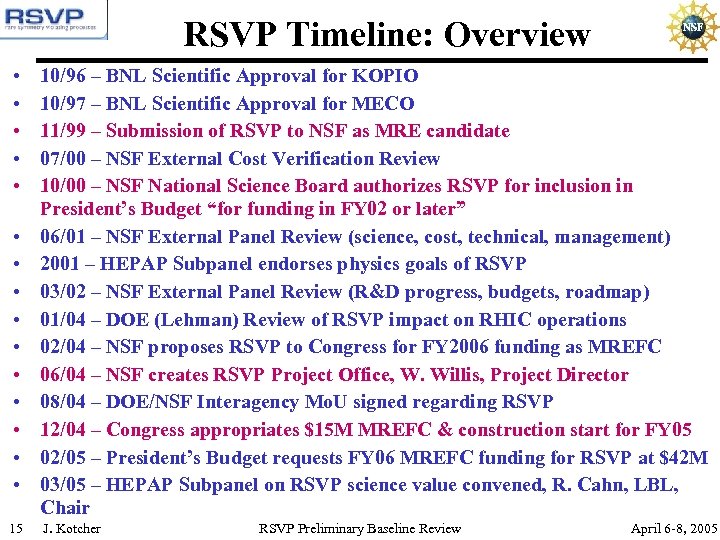 RSVP Timeline: Overview • • • • 15 10/96 – BNL Scientific Approval for KOPIO 10/97 – BNL Scientific Approval for MECO 11/99 – Submission of RSVP to NSF as MRE candidate 07/00 – NSF External Cost Verification Review 10/00 – NSF National Science Board authorizes RSVP for inclusion in President’s Budget “for funding in FY 02 or later” 06/01 – NSF External Panel Review (science, cost, technical, management) 2001 – HEPAP Subpanel endorses physics goals of RSVP 03/02 – NSF External Panel Review (R&D progress, budgets, roadmap) 01/04 – DOE (Lehman) Review of RSVP impact on RHIC operations 02/04 – NSF proposes RSVP to Congress for FY 2006 funding as MREFC 06/04 – NSF creates RSVP Project Office, W. Willis, Project Director 08/04 – DOE/NSF Interagency Mo. U signed regarding RSVP 12/04 – Congress appropriates $15 M MREFC & construction start for FY 05 02/05 – President’s Budget requests FY 06 MREFC funding for RSVP at $42 M 03/05 – HEPAP Subpanel on RSVP science value convened, R. Cahn, LBL, Chair J. Kotcher RSVP Preliminary Baseline Review April 6 -8, 2005
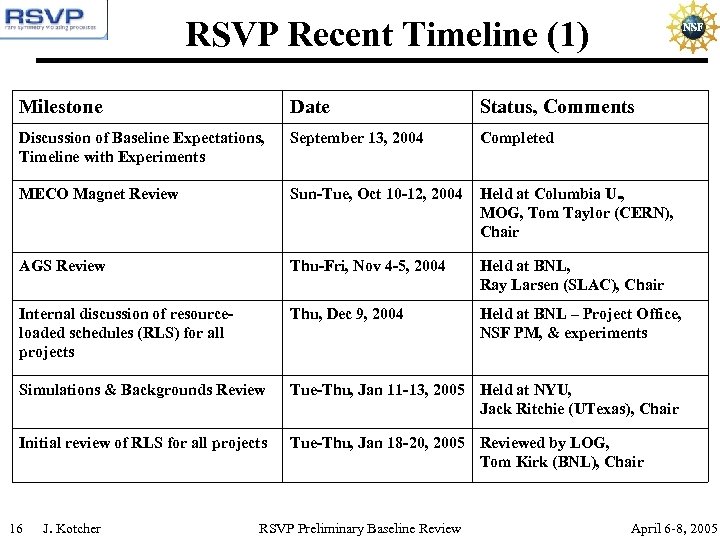 RSVP Recent Timeline (1) Milestone Date Status, Comments Discussion of Baseline Expectations, Timeline with Experiments September 13, 2004 Completed MECO Magnet Review Sun-Tue, Oct 10 -12, 2004 Held at Columbia U. , MOG, Tom Taylor (CERN), Chair AGS Review Thu-Fri, Nov 4 -5, 2004 Held at BNL, Ray Larsen (SLAC), Chair Internal discussion of resourceloaded schedules (RLS) for all projects Thu, Dec 9, 2004 Held at BNL – Project Office, NSF PM, & experiments Simulations & Backgrounds Review Tue-Thu, Jan 11 -13, 2005 Held at NYU, Jack Ritchie (UTexas), Chair Initial review of RLS for all projects Tue-Thu, Jan 18 -20, 2005 Reviewed by LOG, Tom Kirk (BNL), Chair 16 J. Kotcher RSVP Preliminary Baseline Review April 6 -8, 2005
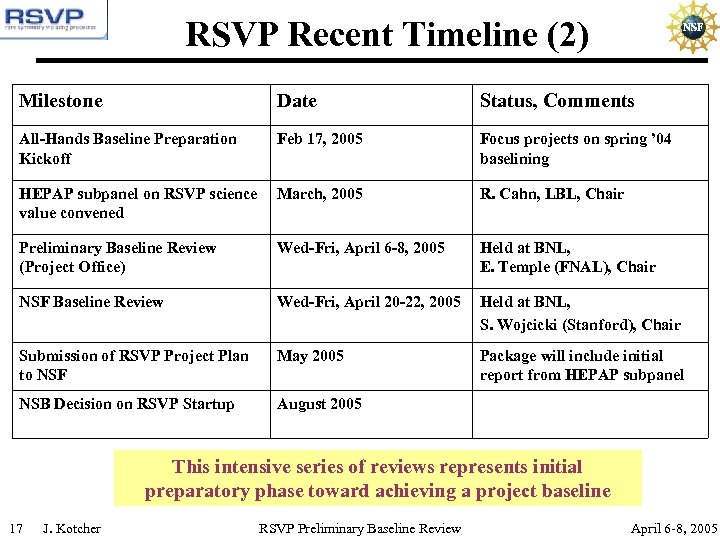 RSVP Recent Timeline (2) Milestone Date Status, Comments All-Hands Baseline Preparation Kickoff Feb 17, 2005 Focus projects on spring ’ 04 baselining HEPAP subpanel on RSVP science March, 2005 value convened R. Cahn, LBL, Chair Preliminary Baseline Review (Project Office) Wed-Fri, April 6 -8, 2005 Held at BNL, E. Temple (FNAL), Chair NSF Baseline Review Wed-Fri, April 20 -22, 2005 Held at BNL, S. Wojcicki (Stanford), Chair Submission of RSVP Project Plan to NSF May 2005 Package will include initial report from HEPAP subpanel NSB Decision on RSVP Startup August 2005 This intensive series of reviews represents initial preparatory phase toward achieving a project baseline 17 J. Kotcher RSVP Preliminary Baseline Review April 6 -8, 2005
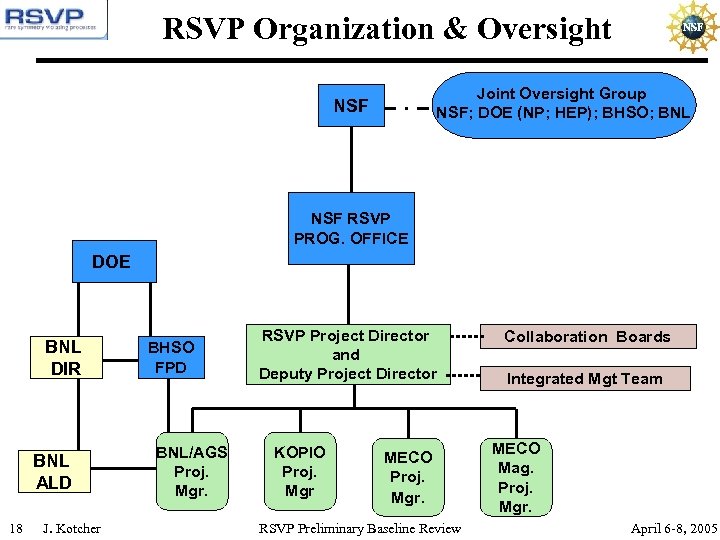 RSVP Organization & Oversight Joint Oversight Group NSF; DOE (NP; HEP); BHSO; BNL NSF RSVP PROG. OFFICE DOE BNL DIR BNL ALD 18 J. Kotcher BHSO FPD BNL/AGS Proj. Mgr. RSVP Project Director and Deputy Project Director KOPIO Proj. Mgr MECO Proj. Mgr. RSVP Preliminary Baseline Review Collaboration Boards Integrated Mgt Team MECO Mag. Proj. Mgr. April 6 -8, 2005
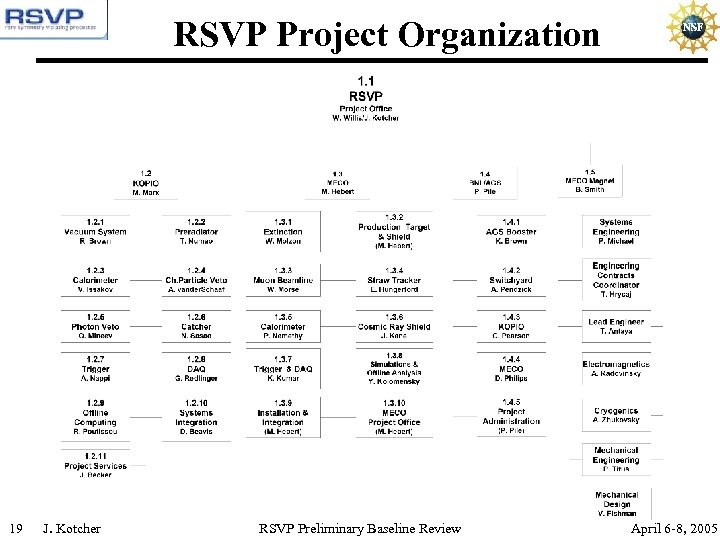 RSVP Project Organization 19 J. Kotcher RSVP Preliminary Baseline Review April 6 -8, 2005
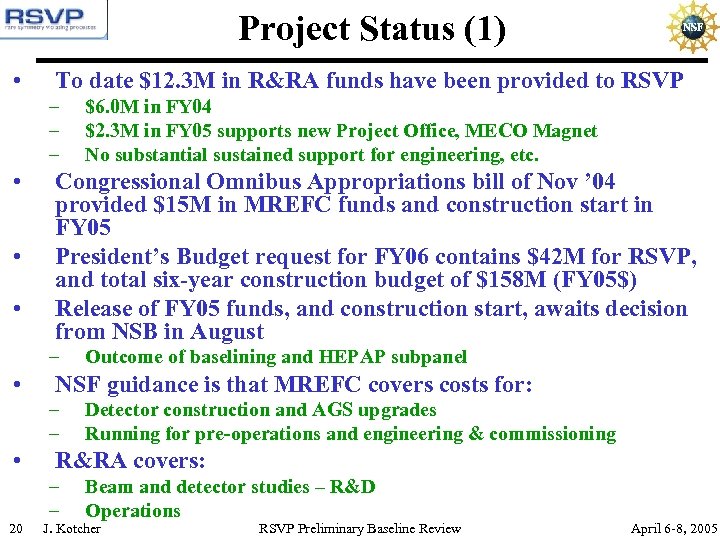 Project Status (1) • To date $12. 3 M in R&RA funds have been provided to RSVP – – – • • • Congressional Omnibus Appropriations bill of Nov ’ 04 provided $15 M in MREFC funds and construction start in FY 05 President’s Budget request for FY 06 contains $42 M for RSVP, and total six-year construction budget of $158 M (FY 05$) Release of FY 05 funds, and construction start, awaits decision from NSB in August – • 20 Outcome of baselining and HEPAP subpanel NSF guidance is that MREFC covers costs for: – – • $6. 0 M in FY 04 $2. 3 M in FY 05 supports new Project Office, MECO Magnet No substantial sustained support for engineering, etc. Detector construction and AGS upgrades Running for pre-operations and engineering & commissioning R&RA covers: – – Beam and detector studies – R&D Operations J. Kotcher RSVP Preliminary Baseline Review April 6 -8, 2005
 Project Status (2) • Projects have not had benefit of extensive R&D funds – No opportunity for detailed engineering designs – Some systems more advanced than others, but all are still in conceptual stage • Construction outlay is understood to include funds for engineering design and development • Given this, approach has been to develop a project plan that includes all currently anticipated needs and costs • Contingencies have been applied that attempt to take into proper account the maturity of the designs – Risk assessments integrated wherever possible – Back-up designs considered wherever resources, time permit • All cost, contingency, schedule, and manpower estimates shown are extracted from these resource-loaded schedules • While these experiments are very challenging, none of the proposed detector or accelerator systems push current limits of technology 21 J. Kotcher RSVP Preliminary Baseline Review April 6 -8, 2005
 Magnet Oversight Group (MOG) • MECO Magnet is cost and schedule driver for RSVP – Single most expensive, technically demanding item • Standing Magnet Oversight Committee (MOG) established to serve in ongoing advisory capacity to Project Director: – – Elwyn Baynham (Rutherford Appleton Laboratory) Gene Fisk (Fermilab) Herman ten Kate (CERN) Tom Taylor, Chair (CERN) • Now serves as technical advisor to Project Office on magnet – Akira Yamamoto (KEK) • First review held October 10 -12, 2004 at Columbia University • Comments, recommendations geared toward reduction of risks of all kinds • Recommendations being considered, integrated by Magnet Project Team (see talk by B. Smith) 22
 Recommendations from Oct ’ 04 MOG • Technical – – – – • Schedule – – • 23 Schedule is tight More time should be allocated for the contract process Time for model coil work should be included Time for installation and commissioning appears to be short Cost – – • Change the PS from bath to conduction cooled Reduce the number of coils Make test windings to validate conductor, winding and insulation technologies Reduce the number of power supply circuits, and conductors, if possible An all-analog quench detection system was recommended in place of the digital system proposed Conduct a failure analysis of the magnet Design and start construction of tooling for a full scale model test coil Allocation of 10% to profit appears low Labor rates look low Cost is based on 2004 prices; should be changed to 2006 prices Purchasing overhead at 15% appears low Management – Risk in attempting award to a single vendor is too high; buy in parts (greater number of procurements) – Carry out industrial studies through an RFI – Strengthen the team at MIT for design and procurement; keep the technical work there – Increase the role of BNL since the magnet will be installed, commissioned and operated there J. Kotcher RSVP Preliminary Baseline Review April 6 -8, 2005
 Project Tools • RSVP using same project tools as US ATLAS – MS Project for schedule & cost – For now, using EXCEL for WBS dictionaries, complementary cost information • ACCESS will be implemented for additional cost tracking, WBS dictionaries/definitions, etc. – Technical & financial monthly status reports highly automated – Building web-based interface (including to ACCESS) to facilitate remote project tracking • This has allowed for efficient, timely project ramp up – Much BNL infrastructure, expertise exists in use of these tools – Proven successful application in US ATLAS, agencies have signed off on their use, output – New tools would require major reinvestment in time, money, personnel, gains questionable. Resources more wisely spent elsewhere in project. • Have opted to upgrade from MS Project 2000 to 2003 – Earned value calculated directly in MS Project, will be used for reporting 24 J. Kotcher RSVP Preliminary Baseline Review April 6 -8, 2005
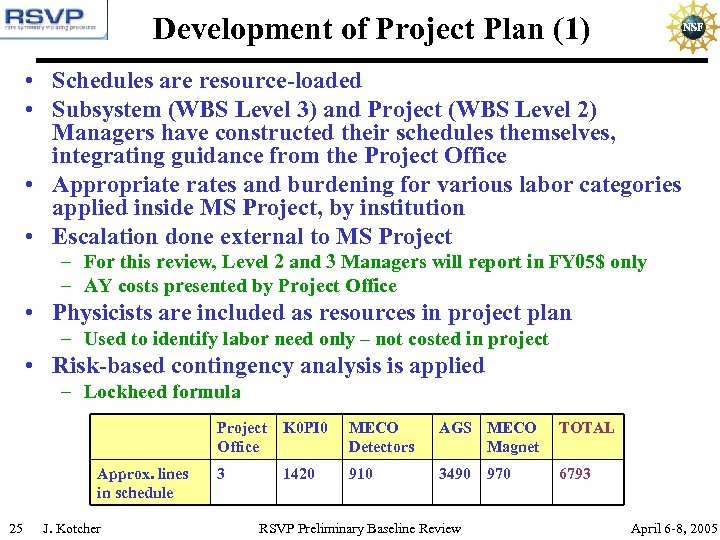 Development of Project Plan (1) • Schedules are resource-loaded • Subsystem (WBS Level 3) and Project (WBS Level 2) Managers have constructed their schedules themselves, integrating guidance from the Project Office • Appropriate rates and burdening for various labor categories applied inside MS Project, by institution • Escalation done external to MS Project – For this review, Level 2 and 3 Managers will report in FY 05$ only – AY costs presented by Project Office • Physicists are included as resources in project plan – Used to identify labor need only – not costed in project • Risk-based contingency analysis is applied – Lockheed formula Project K 0 PI 0 Office Approx. lines in schedule 25 J. Kotcher MECO Detectors AGS MECO Magnet TOTAL 3 910 3490 6793 1420 RSVP Preliminary Baseline Review 970 April 6 -8, 2005
 Development of Project Plan (2) • Examples of elements provided to Committee: (http: //rsvp. bnl. gov/Project_Office/Reviews/RSVPPBRApr 2005 A. htm) – – – – – Conceptual Design Reports Project Management Plan WBS dictionaries, bases of estimate Backup cost books Risk assessments Cost summaries Schedules in MS Project (mpp) format Plenary and breakout presentations Reports, presentations from previous reviews • In addition to the plenary presentations, talks from the WBS Level 3 subsystem managers have been selected by Committee Chair for presentation at the breakouts – Some additional talks from the Level 3 Managers are also available for presentation (see Project Managers at breakout sessions) 26 J. Kotcher RSVP Preliminary Baseline Review April 6 -8, 2005
 Guidance for Project Development • Jan 05: Project Office agrees to NSF directive to prepare for April baseline • Project Office proposed cap on RSVP detector construction costs, which was accepted by agency: – $240 M in FY 05$ – 45% total contingency, based on US Atlas/DZero experience • Projects have designed to cost, according to Project Office guidelines • Project caps based on Project Manager’s estimates presented in early CY 05 • Final guidelines (in burdened FY 05$): – – – Project Office: $20 M K 0 PI 0: $55 M (NSF contribution) MECO Detectors: $24 M AGS: $40 M MECO Magnet: $56 M • Guidance for cost caps includes risk-based assessment of contingency, based on Lockheed guidelines 27 J. Kotcher RSVP Preliminary Baseline Review April 6 -8, 2005
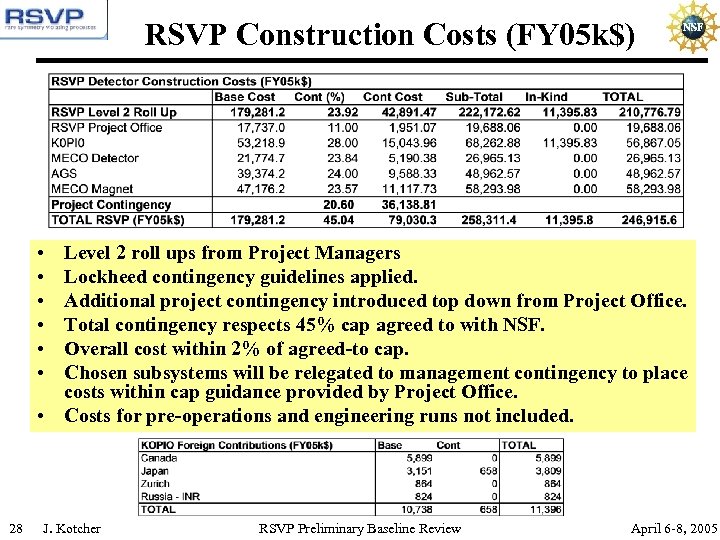 RSVP Construction Costs (FY 05 k$) • • • Level 2 roll ups from Project Managers Lockheed contingency guidelines applied. Additional project contingency introduced top down from Project Office. Total contingency respects 45% cap agreed to with NSF. Overall cost within 2% of agreed-to cap. Chosen subsystems will be relegated to management contingency to place costs within cap guidance provided by Project Office. • Costs for pre-operations and engineering runs not included. 28 J. Kotcher RSVP Preliminary Baseline Review April 6 -8, 2005
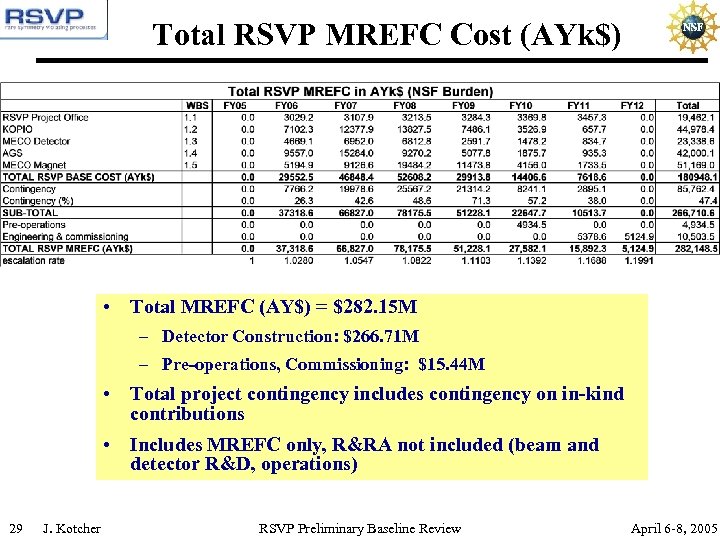 Total RSVP MREFC Cost (AYk$) • Total MREFC (AY$) = $282. 15 M – Detector Construction: $266. 71 M – Pre-operations, Commissioning: $15. 44 M • Total project contingency includes contingency on in-kind contributions • Includes MREFC only, R&RA not included (beam and detector R&D, operations) 29 J. Kotcher RSVP Preliminary Baseline Review April 6 -8, 2005
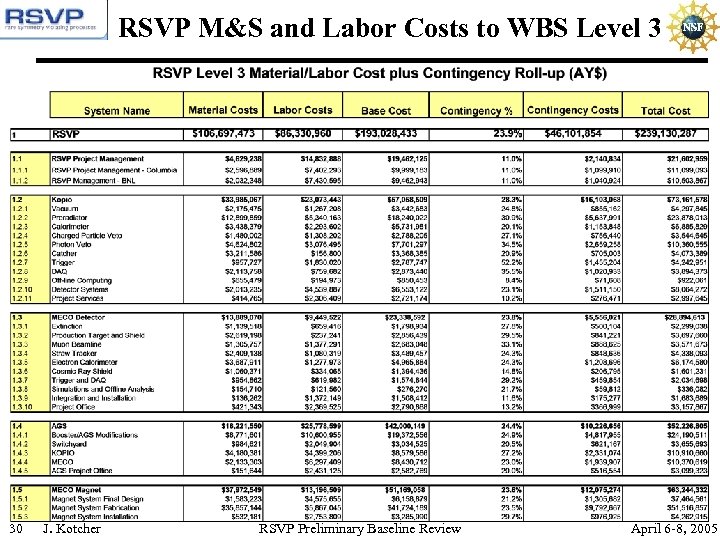 RSVP M&S and Labor Costs to WBS Level 3 30 J. Kotcher RSVP Preliminary Baseline Review April 6 -8, 2005
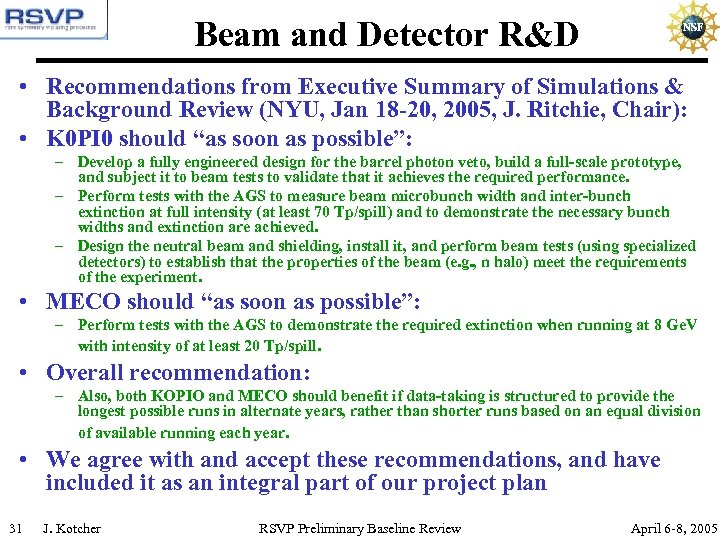 Beam and Detector R&D • Recommendations from Executive Summary of Simulations & Background Review (NYU, Jan 18 -20, 2005, J. Ritchie, Chair): • K 0 PI 0 should “as soon as possible”: – Develop a fully engineered design for the barrel photon veto, build a full-scale prototype, and subject it to beam tests to validate that it achieves the required performance. – Perform tests with the AGS to measure beam microbunch width and inter-bunch extinction at full intensity (at least 70 Tp/spill) and to demonstrate the necessary bunch widths and extinction are achieved. – Design the neutral beam and shielding, install it, and perform beam tests (using specialized detectors) to establish that the properties of the beam (e. g. , n halo) meet the requirements of the experiment. • MECO should “as soon as possible”: – Perform tests with the AGS to demonstrate the required extinction when running at 8 Ge. V with intensity of at least 20 Tp/spill. • Overall recommendation: – Also, both KOPIO and MECO should benefit if data-taking is structured to provide the longest possible runs in alternate years, rather than shorter runs based on an equal division of available running each year. • We agree with and accept these recommendations, and have included it as an integral part of our project plan 31 J. Kotcher RSVP Preliminary Baseline Review April 6 -8, 2005
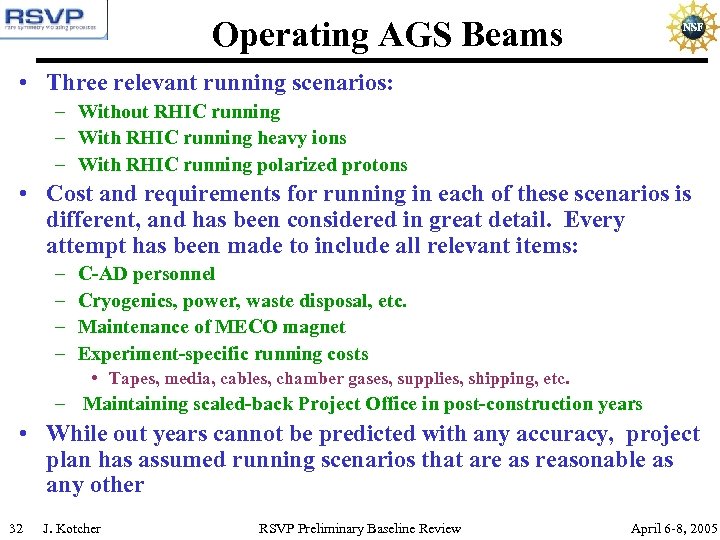 Operating AGS Beams • Three relevant running scenarios: – Without RHIC running – With RHIC running heavy ions – With RHIC running polarized protons • Cost and requirements for running in each of these scenarios is different, and has been considered in great detail. Every attempt has been made to include all relevant items: – – C-AD personnel Cryogenics, power, waste disposal, etc. Maintenance of MECO magnet Experiment-specific running costs • Tapes, media, cables, chamber gases, supplies, shipping, etc. – Maintaining scaled-back Project Office in post-construction years • While out years cannot be predicted with any accuracy, project plan has assumed running scenarios that are as reasonable as any other 32 J. Kotcher RSVP Preliminary Baseline Review April 6 -8, 2005
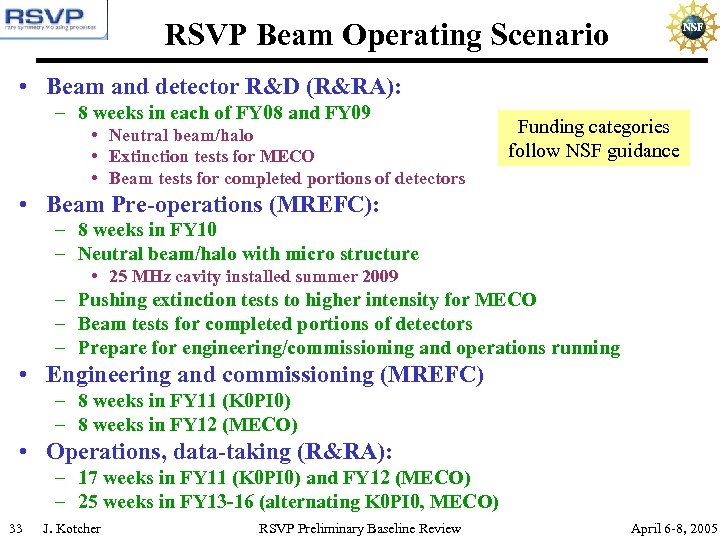 RSVP Beam Operating Scenario • Beam and detector R&D (R&RA): – 8 weeks in each of FY 08 and FY 09 • Neutral beam/halo • Extinction tests for MECO • Beam tests for completed portions of detectors Funding categories follow NSF guidance • Beam Pre-operations (MREFC): – 8 weeks in FY 10 – Neutral beam/halo with micro structure • 25 MHz cavity installed summer 2009 – Pushing extinction tests to higher intensity for MECO – Beam tests for completed portions of detectors – Prepare for engineering/commissioning and operations running • Engineering and commissioning (MREFC) – 8 weeks in FY 11 (K 0 PI 0) – 8 weeks in FY 12 (MECO) • Operations, data-taking (R&RA): – 17 weeks in FY 11 (K 0 PI 0) and FY 12 (MECO) – 25 weeks in FY 13 -16 (alternating K 0 PI 0, MECO) 33 J. Kotcher RSVP Preliminary Baseline Review April 6 -8, 2005
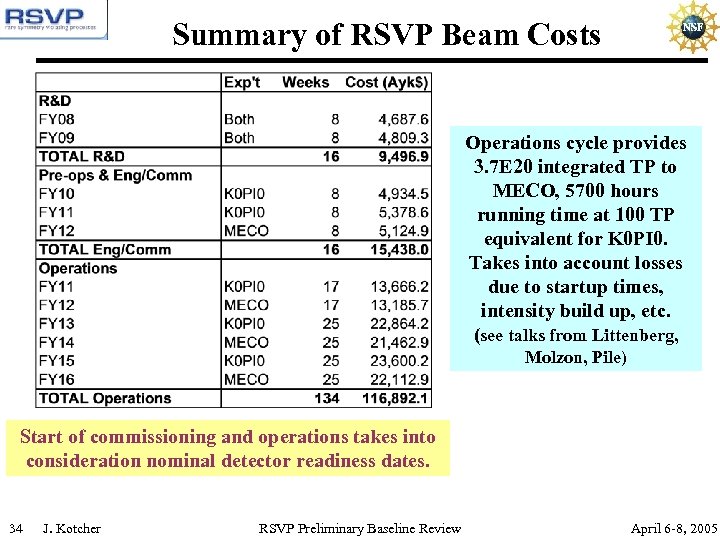 Summary of RSVP Beam Costs Operations cycle provides 3. 7 E 20 integrated TP to MECO, 5700 hours running time at 100 TP equivalent for K 0 PI 0. Takes into account losses due to startup times, intensity build up, etc. (see talks from Littenberg, Molzon, Pile) Start of commissioning and operations takes into consideration nominal detector readiness dates. 34 J. Kotcher RSVP Preliminary Baseline Review April 6 -8, 2005
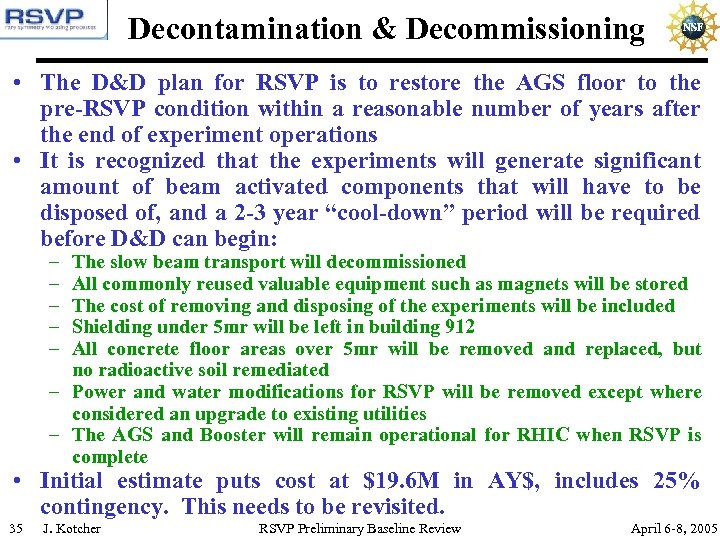 Decontamination & Decommissioning • The D&D plan for RSVP is to restore the AGS floor to the pre-RSVP condition within a reasonable number of years after the end of experiment operations • It is recognized that the experiments will generate significant amount of beam activated components that will have to be disposed of, and a 2 -3 year “cool-down” period will be required before D&D can begin: – – – The slow beam transport will decommissioned All commonly reused valuable equipment such as magnets will be stored The cost of removing and disposing of the experiments will be included Shielding under 5 mr will be left in building 912 All concrete floor areas over 5 mr will be removed and replaced, but no radioactive soil remediated – Power and water modifications for RSVP will be removed except where considered an upgrade to existing utilities – The AGS and Booster will remain operational for RHIC when RSVP is complete • Initial estimate puts cost at $19. 6 M in AY$, includes 25% contingency. This needs to be revisited. 35 J. Kotcher RSVP Preliminary Baseline Review April 6 -8, 2005
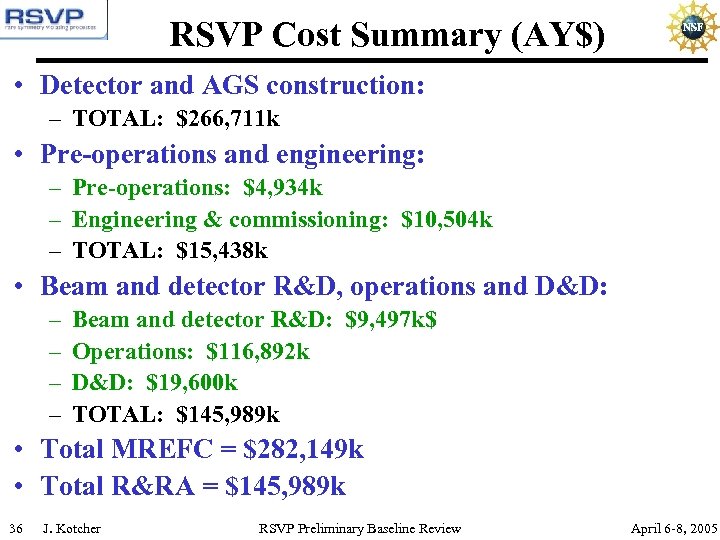 RSVP Cost Summary (AY$) • Detector and AGS construction: – TOTAL: $266, 711 k • Pre-operations and engineering: – Pre-operations: $4, 934 k – Engineering & commissioning: $10, 504 k – TOTAL: $15, 438 k • Beam and detector R&D, operations and D&D: – – Beam and detector R&D: $9, 497 k$ Operations: $116, 892 k D&D: $19, 600 k TOTAL: $145, 989 k • Total MREFC = $282, 149 k • Total R&RA = $145, 989 k 36 J. Kotcher RSVP Preliminary Baseline Review April 6 -8, 2005
 Schedule Methodology • Schedules contain no explicit float – reflect nominal duration for completion • In order to do everything possible to keep pace, we intend to manage to this aggressive schedule • Four tiers of schedule milestones are being constructed: – – Level 4, held by sub-system managers to track their projects Level 3, held by WBS Level 2 Project Managers Level 2, held by Project Office Level 1, held by NSF • Milestone selections, and hierarchical assignments, in progress • Explicit float added to Level 1 milestones that describe anticipated schedule contingency – 15%, but not less than 6 months • Early ramp up is most difficult period - we will gain in momentum, personnel, understanding how to manage ourselves more effectively • Contingency back-end loaded to ameliorate delays • Production Readiness Reviews also being incorporated 37 J. Kotcher RSVP Preliminary Baseline Review April 6 -8, 2005
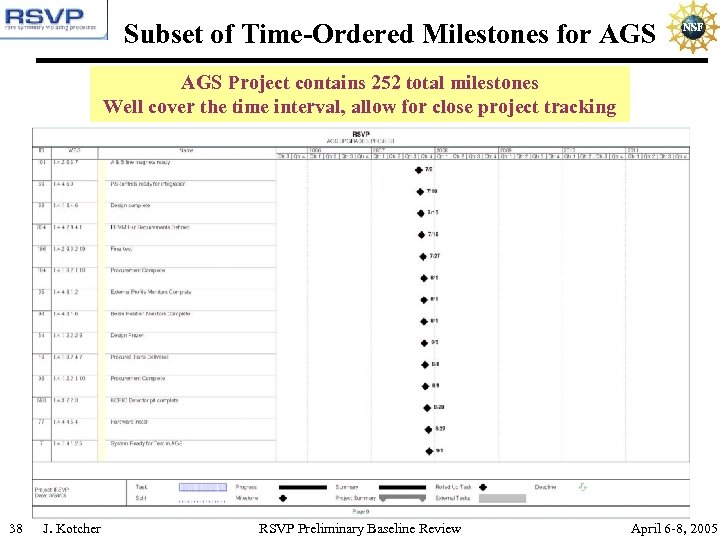 Subset of Time-Ordered Milestones for AGS Project contains 252 total milestones Well cover the time interval, allow for close project tracking 38 J. Kotcher RSVP Preliminary Baseline Review April 6 -8, 2005
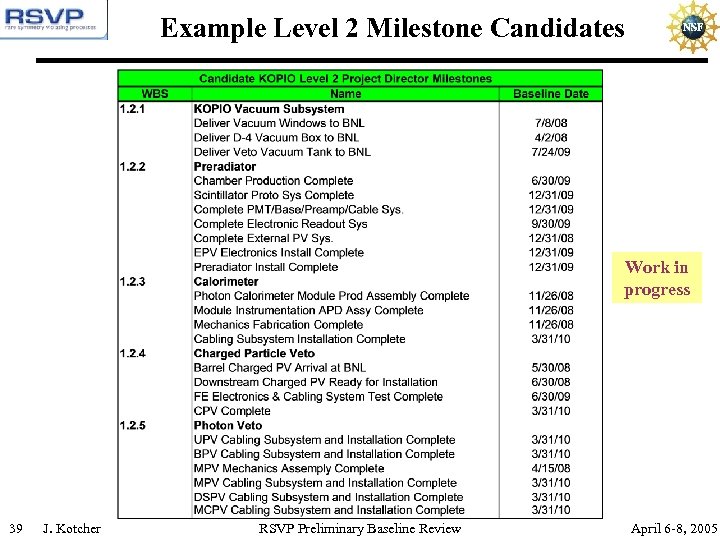 Example Level 2 Milestone Candidates Work in progress 39 J. Kotcher RSVP Preliminary Baseline Review April 6 -8, 2005
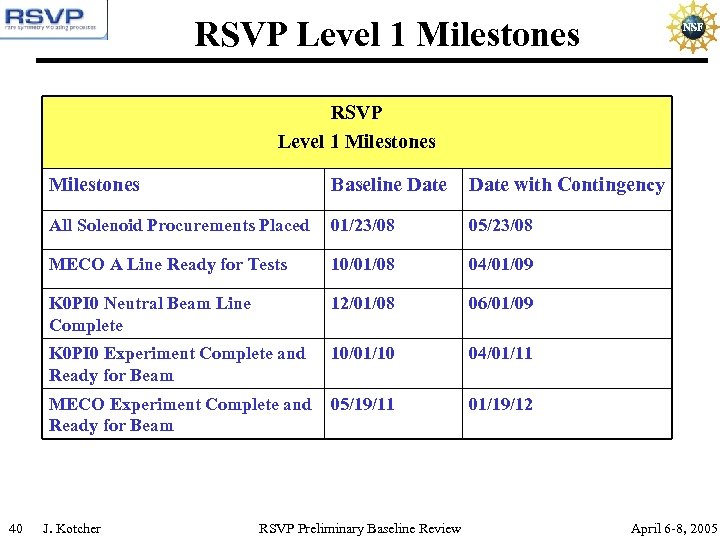 RSVP Level 1 Milestones Date with Contingency All Solenoid Procurements Placed 01/23/08 05/23/08 MECO A Line Ready for Tests 10/01/08 04/01/09 K 0 PI 0 Neutral Beam Line Complete 12/01/08 06/01/09 K 0 PI 0 Experiment Complete and Ready for Beam 10/01/10 04/01/11 MECO Experiment Complete and 05/19/11 Ready for Beam 40 Baseline Date 01/19/12 J. Kotcher RSVP Preliminary Baseline Review April 6 -8, 2005
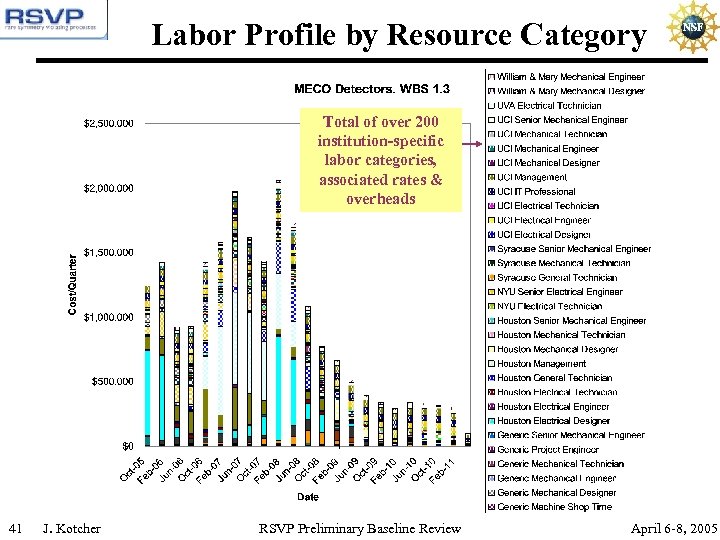 Labor Profile by Resource Category Total of over 200 institution-specific labor categories, associated rates & overheads 41 J. Kotcher RSVP Preliminary Baseline Review April 6 -8, 2005
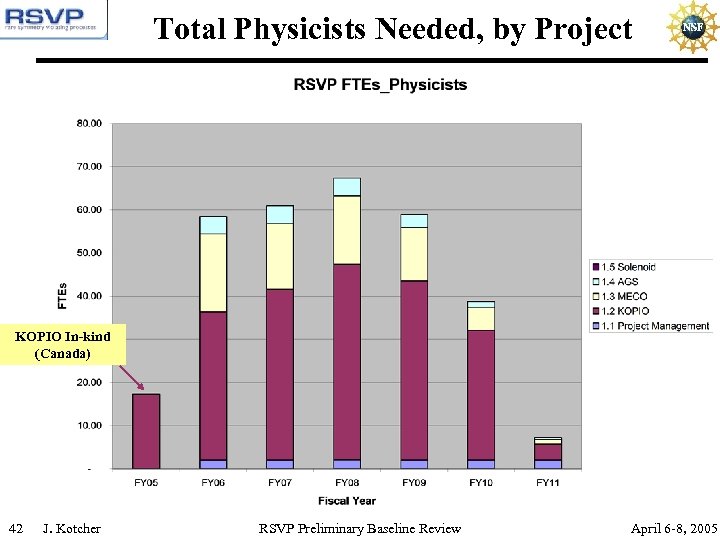 Total Physicists Needed, by Project KOPIO In-kind (Canada) 42 J. Kotcher RSVP Preliminary Baseline Review April 6 -8, 2005
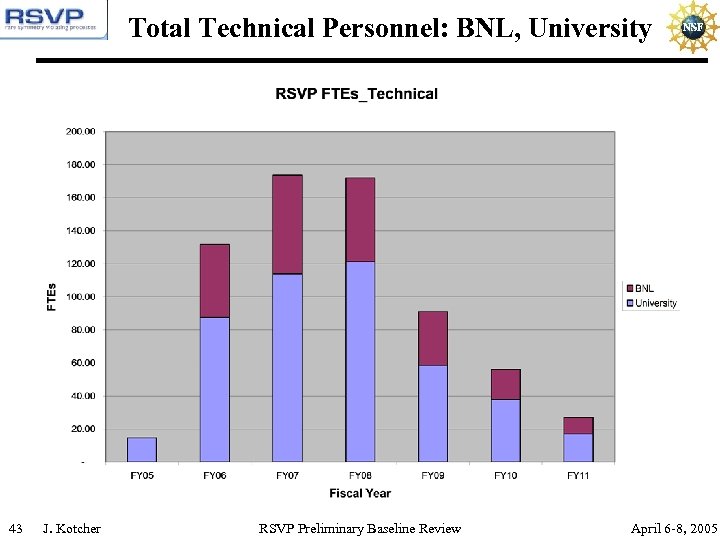 Total Technical Personnel: BNL, University 43 J. Kotcher RSVP Preliminary Baseline Review April 6 -8, 2005
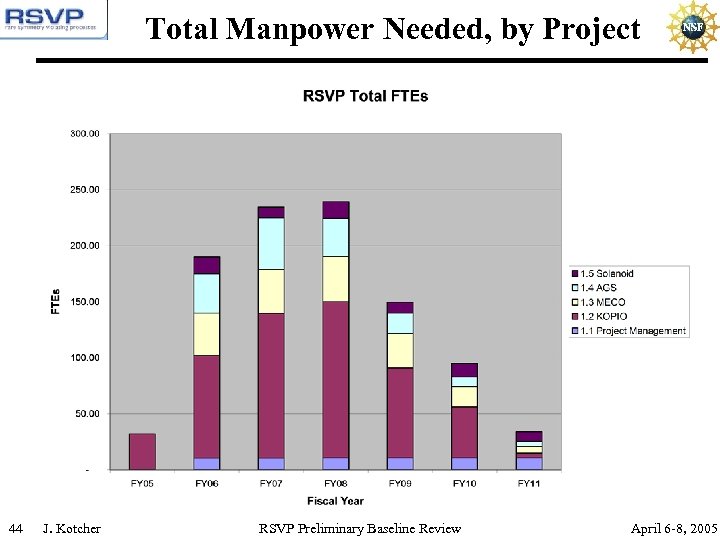 Total Manpower Needed, by Project 44 J. Kotcher RSVP Preliminary Baseline Review April 6 -8, 2005
 Management Contingency • While we intend to pursue the full scope as described, experience has shown that alternatives beyond the usual cost/schedule contingency are often needed in order to contain cost • In addition, some designs in RSVP require some maturation before construction money is released – Further studies, simplifications, potential cost savings • Cost caps were also not met • Some subsystems will therefore be held in management contingency, pursued at discretion of PO, in consultation with PMgrs. – Launch based on many things: cost performance, technical status and maturity of design, results from further simulations, etc. • List of such systems is not fixed – will evolve with time, and our understanding of how to best optimize available resources • Ultimate goal is to optimize physics capabilities of final product within funding, resource, and schedule constraints • Does not change cost of project 45 J. Kotcher RSVP Preliminary Baseline Review April 6 -8, 2005
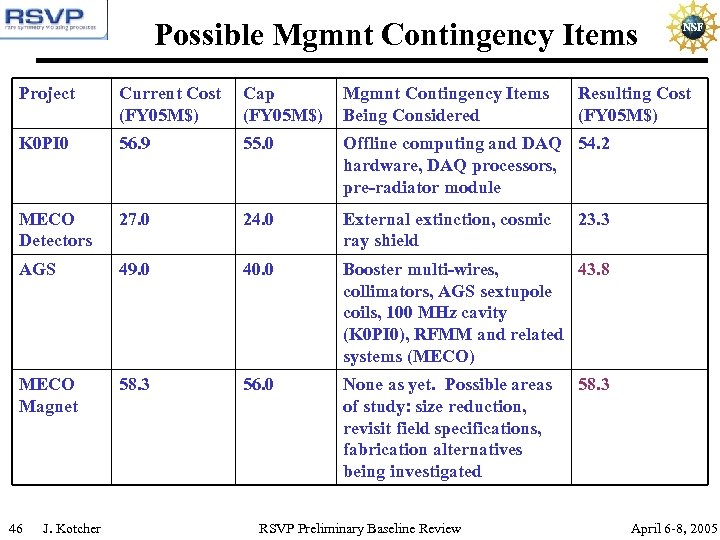 Possible Mgmnt Contingency Items Project Current Cost Cap (FY 05 M$) Mgmnt Contingency Items Being Considered K 0 PI 0 56. 9 55. 0 Offline computing and DAQ 54. 2 hardware, DAQ processors, pre-radiator module MECO Detectors 27. 0 24. 0 External extinction, cosmic ray shield AGS 49. 0 40. 0 Booster multi-wires, 43. 8 collimators, AGS sextupole coils, 100 MHz cavity (K 0 PI 0), RFMM and related systems (MECO) MECO Magnet 58. 3 56. 0 None as yet. Possible areas of study: size reduction, revisit field specifications, fabrication alternatives being investigated 46 J. Kotcher RSVP Preliminary Baseline Review Resulting Cost (FY 05 M$) 23. 3 58. 3 April 6 -8, 2005
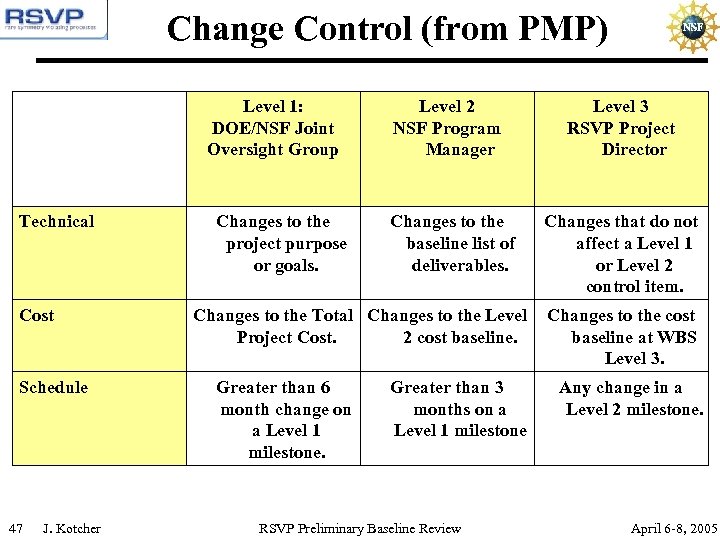 Change Control (from PMP) Level 1: DOE/NSF Joint Oversight Group Technical Cost Schedule 47 J. Kotcher Changes to the project purpose or goals. Level 2 NSF Program Manager Changes to the baseline list of deliverables. Level 3 RSVP Project Director Changes that do not affect a Level 1 or Level 2 control item. Changes to the Total Changes to the Level Changes to the cost Project Cost. 2 cost baseline at WBS Level 3. Greater than 6 month change on a Level 1 milestone. Greater than 3 months on a Level 1 milestone RSVP Preliminary Baseline Review Any change in a Level 2 milestone. April 6 -8, 2005
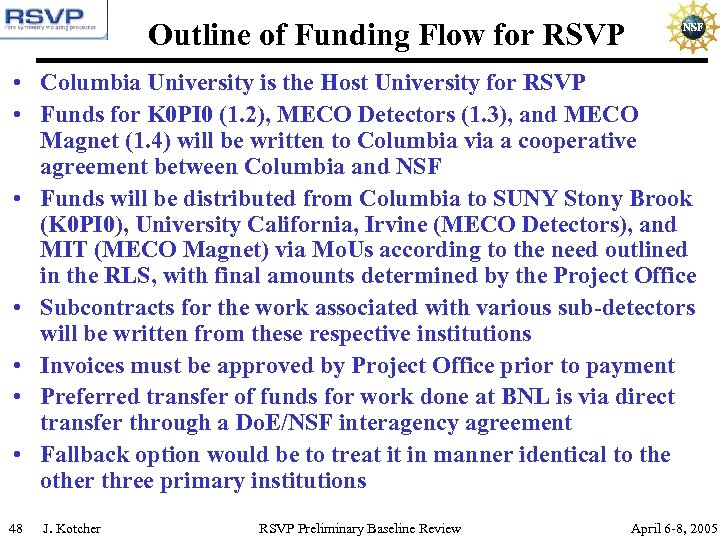 Outline of Funding Flow for RSVP • Columbia University is the Host University for RSVP • Funds for K 0 PI 0 (1. 2), MECO Detectors (1. 3), and MECO Magnet (1. 4) will be written to Columbia via a cooperative agreement between Columbia and NSF • Funds will be distributed from Columbia to SUNY Stony Brook (K 0 PI 0), University California, Irvine (MECO Detectors), and MIT (MECO Magnet) via Mo. Us according to the need outlined in the RLS, with final amounts determined by the Project Office • Subcontracts for the work associated with various sub-detectors will be written from these respective institutions • Invoices must be approved by Project Office prior to payment • Preferred transfer of funds for work done at BNL is via direct transfer through a Do. E/NSF interagency agreement • Fallback option would be to treat it in manner identical to the other three primary institutions 48 J. Kotcher RSVP Preliminary Baseline Review April 6 -8, 2005
 Closing Remarks • RSVP Experiments represent exciting physics, among the most cogent probes of the sensitivity frontier the field has to offer • An opportunity to lay foundation for a first-rate physics program that will operate well into the next decade • Preparation for this review has demonstrated just how enthusiastic and dedicated the experimenters and project personnel are about mounting these efforts, building the experiments, getting to the science • The Project Office thanks the Committee for their help and hard work, and very much look forward to your comments and recommendations 49 J. Kotcher RSVP Preliminary Baseline Review April 6 -8, 2005