


 Скачать презентацию The Railways as Parents of a City The
5df5ed2c589fc17ee45a38d7d1914e25.ppt
- Количество слайдов: 73
 The Railways as Parents of a City The building of three railways as the primary catalyst for the birth of the City of Red Deer Central Alberta Historical Society Red Deer May 15, 2013
 The North-South Corridor n n n The City of Red Deer owes its location and position as the transportation and distribution centre of Central Alberta to a great extent to the building of and decisions made by the various railways in its early years Other communities in Central Alberta often prospered or perished, as well as their locations determined by the coming of the railway For more than 60 years, the railway stations in numerous communities were the focal point for transportation and communication, and to some extent, the social and business fabric of towns large and small
 Prologue
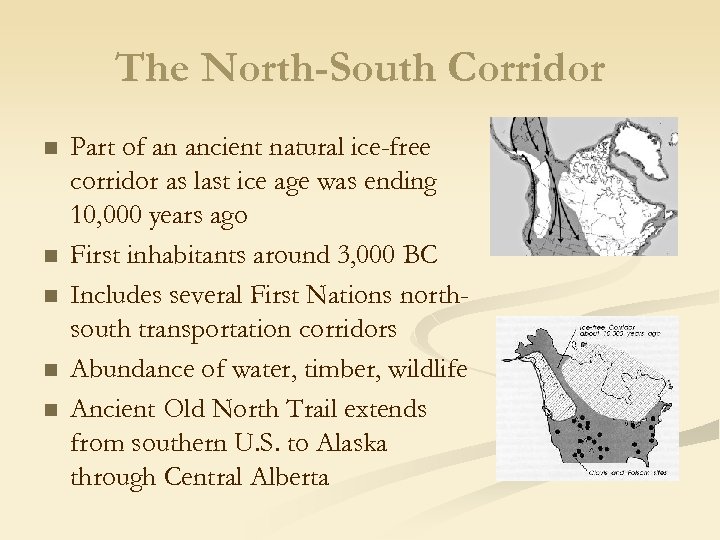 The North-South Corridor n n n Part of an ancient natural ice-free corridor as last ice age was ending 10, 000 years ago First inhabitants around 3, 000 BC Includes several First Nations northsouth transportation corridors Abundance of water, timber, wildlife Ancient Old North Trail extends from southern U. S. to Alaska through Central Alberta
 The North-South Corridor n n Old North Trail loosely-defined series of foot paths that had winter and summer routes used by First Nations tribes and later by fur traders Central branch crossed Red Deer River at ‘The Crossing’ west of Red Deer or alternately near Innisfail West branch along foothills of Rockies Wolf Track extended from Edmonton area to near present-day Lacombe to Rocky Mountain House
 North-South Corridor n n n In the south, trade route developed from Fort Benton, Montana to Fort Whoop-Up (Lethbridge) NWMP arrived 1875, set up Fort Mac. Leod and Fort Calgary, linking the two posts with a trail using portions of Old North Trail Little to no settlement in Central Alberta
 East-West Corridor n n n Fur trading posts and missions developed along the North Saskatchewan River corridor using river to move goods Carlton Trail linked Winnipeg and Edmonton Settlements developed at Fort Edmonton, St. Albert, Fort Saskatchewan, Rocky Mountain House and several other locations along corridor
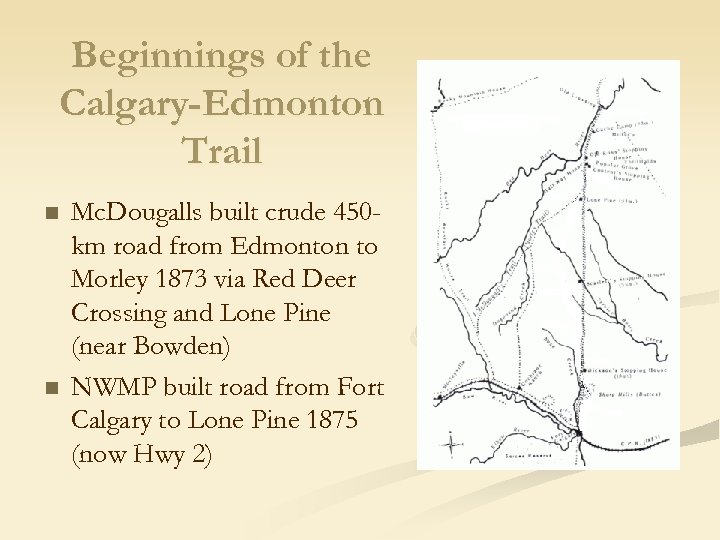 Beginnings of the Calgary-Edmonton Trail n n Mc. Dougalls built crude 450 km road from Edmonton to Morley 1873 via Red Deer Crossing and Lone Pine (near Bowden) NWMP built road from Fort Calgary to Lone Pine 1875 (now Hwy 2)
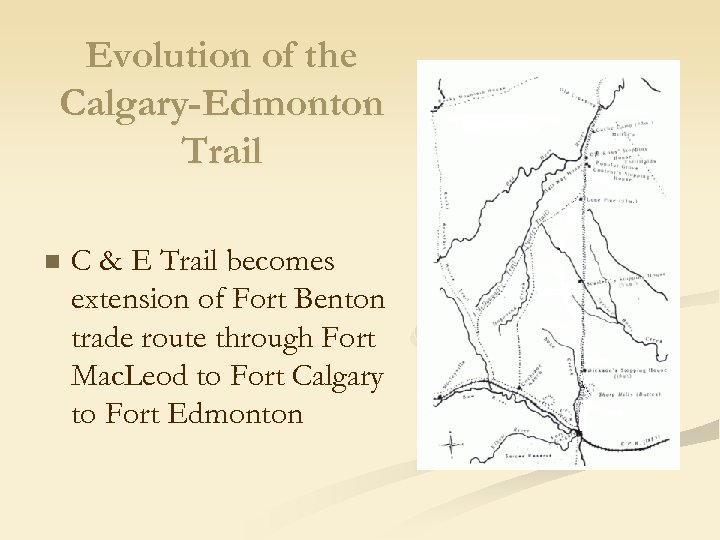 Evolution of the Calgary-Edmonton Trail n C & E Trail becomes extension of Fort Benton trade route through Fort Mac. Leod to Fort Calgary to Fort Edmonton
 Arrival of the CPR in Alberta
 Northern Route Identified n n Original proposed route of transcontinental railway was surveyed farther north than ultimately located where there were already settlements and the area was more suitable for agricultural development; route located south of South Saskatchewan River and north of Battle River; telegraph line built Southern route ultimately chosen, in part to discourage U. S. railways from branching northward
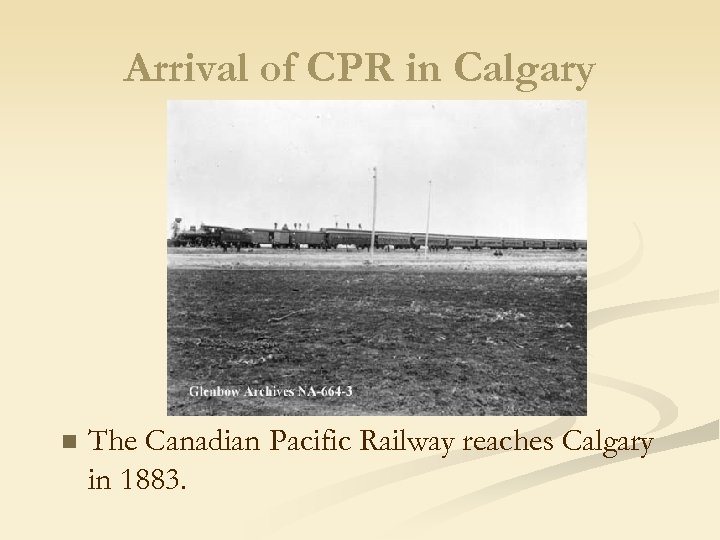 Arrival of CPR in Calgary n The Canadian Pacific Railway reaches Calgary in 1883.
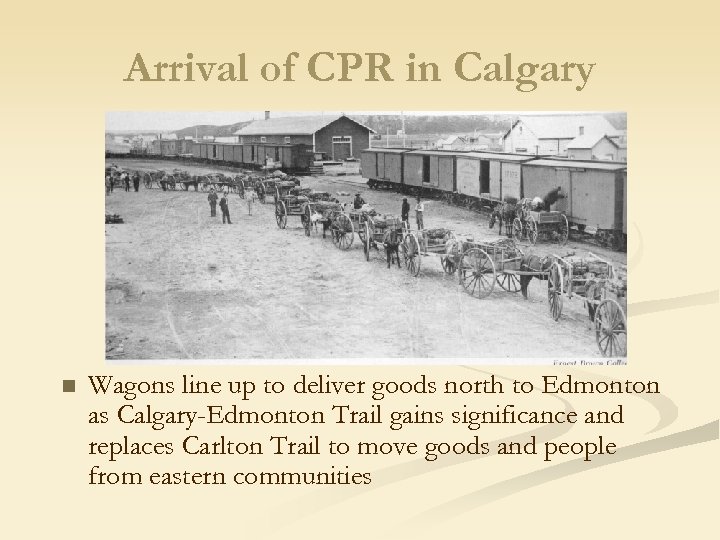 Arrival of CPR in Calgary n Wagons line up to deliver goods north to Edmonton as Calgary-Edmonton Trail gains significance and replaces Carlton Trail to move goods and people from eastern communities
 The Calgary. Edmonton Trail
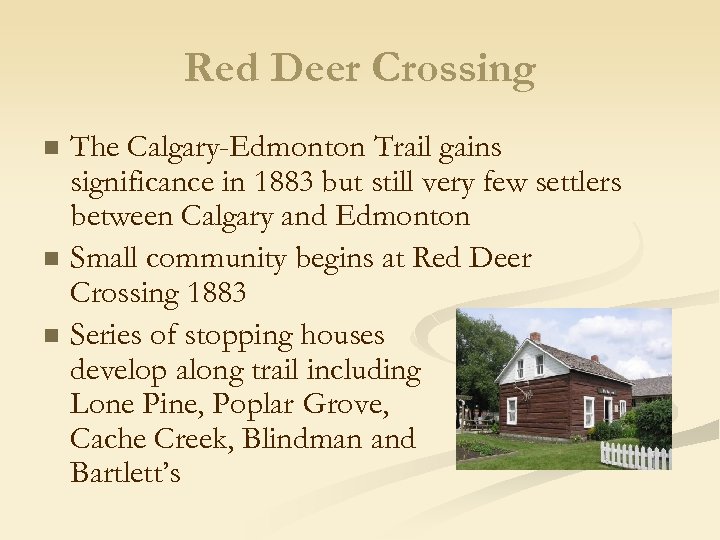 Red Deer Crossing n n n The Calgary-Edmonton Trail gains significance in 1883 but still very few settlers between Calgary and Edmonton Small community begins at Red Deer Crossing 1883 Series of stopping houses develop along trail including Lone Pine, Poplar Grove, Cache Creek, Blindman and Bartlett’s
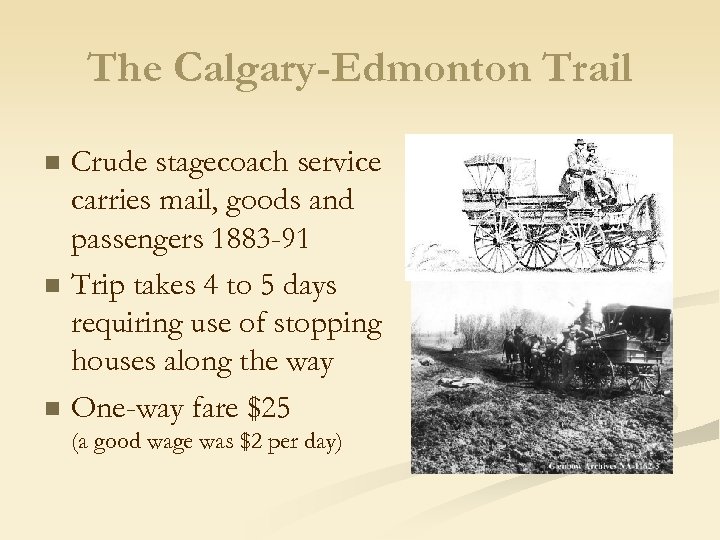 The Calgary-Edmonton Trail n n n Crude stagecoach service carries mail, goods and passengers 1883 -91 Trip takes 4 to 5 days requiring use of stopping houses along the way One-way fare $25 (a good wage was $2 per day)
 Key Decision Makers that formed Red Deer’s future
 John T. Moore n n n Managing Director of the Saskatchewan Land Homestead Company. Visits Red Deer 1881. Company purchases 115, 000 acres of land around Red Deer in 1882 at $2/acre Moves to Red Deer in 1901 and secures charter for Alberta Central Railway Elected to Legislative Assembly 1905
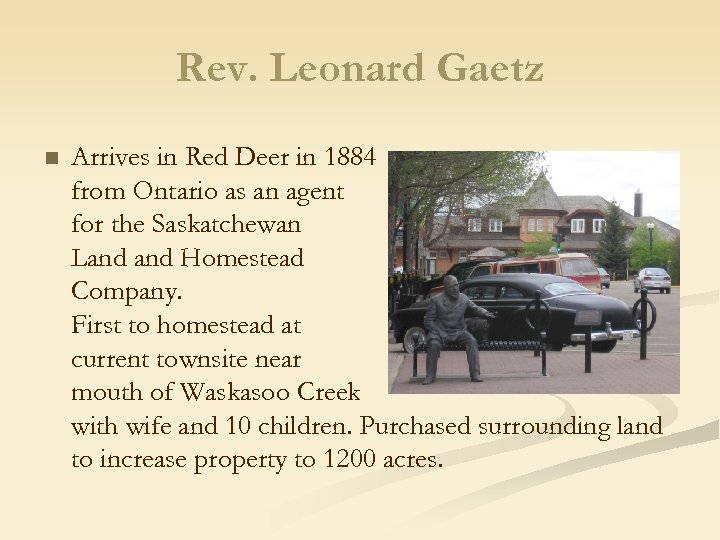 Rev. Leonard Gaetz n Arrives in Red Deer in 1884 from Ontario as an agent for the Saskatchewan Land Homestead Company. First to homestead at current townsite near mouth of Waskasoo Creek with wife and 10 children. Purchased surrounding land to increase property to 1200 acres.
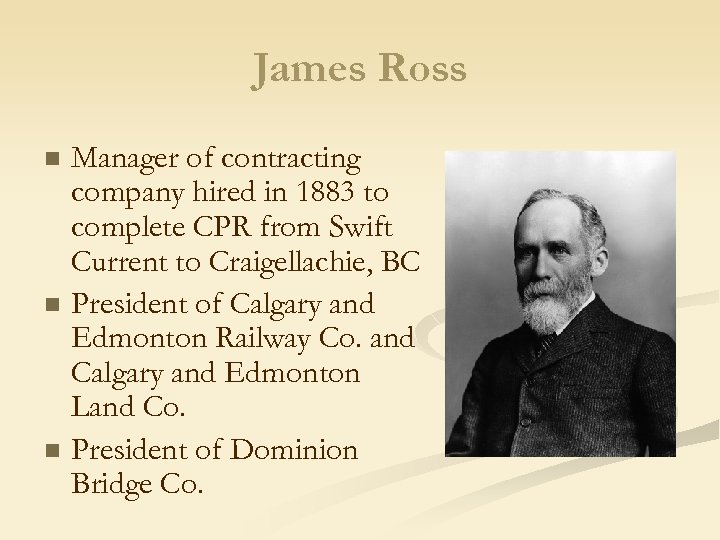 James Ross n n n Manager of contracting company hired in 1883 to complete CPR from Swift Current to Craigellachie, BC President of Calgary and Edmonton Railway Co. and Calgary and Edmonton Land Co. President of Dominion Bridge Co.
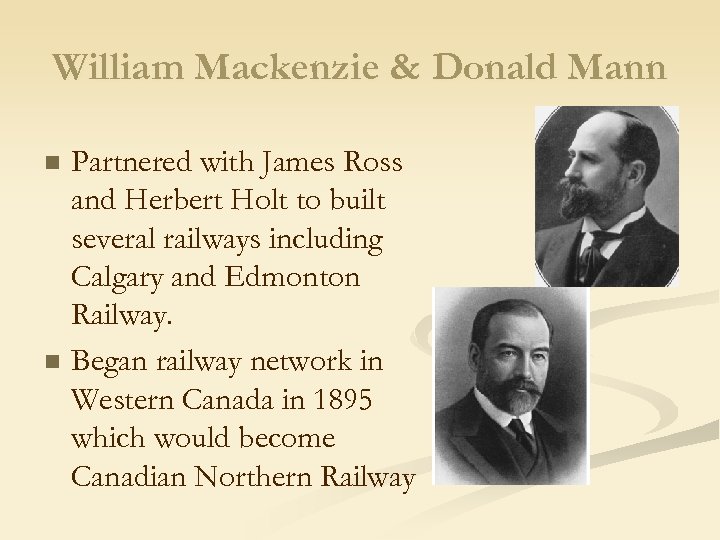 William Mackenzie & Donald Mann n n Partnered with James Ross and Herbert Holt to built several railways including Calgary and Edmonton Railway. Began railway network in Western Canada in 1895 which would become Canadian Northern Railway
 The Calgary and Edmonton Railway
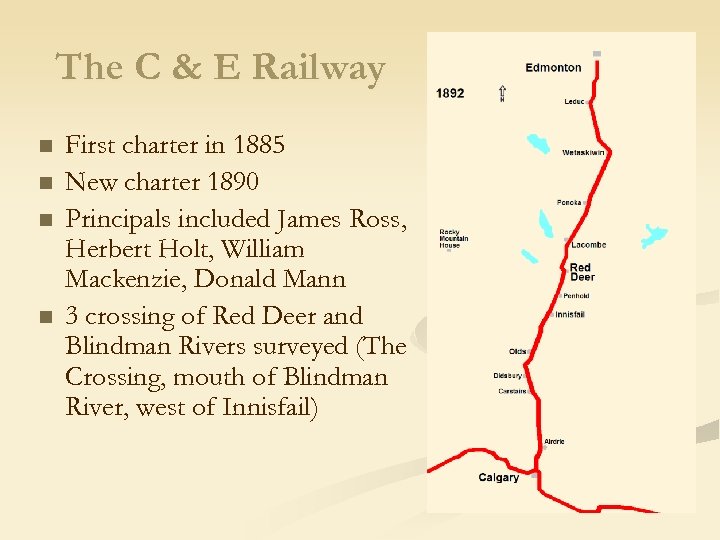 The C & E Railway n n First charter in 1885 New charter 1890 Principals included James Ross, Herbert Holt, William Mackenzie, Donald Mann 3 crossing of Red Deer and Blindman Rivers surveyed (The Crossing, mouth of Blindman River, west of Innisfail)
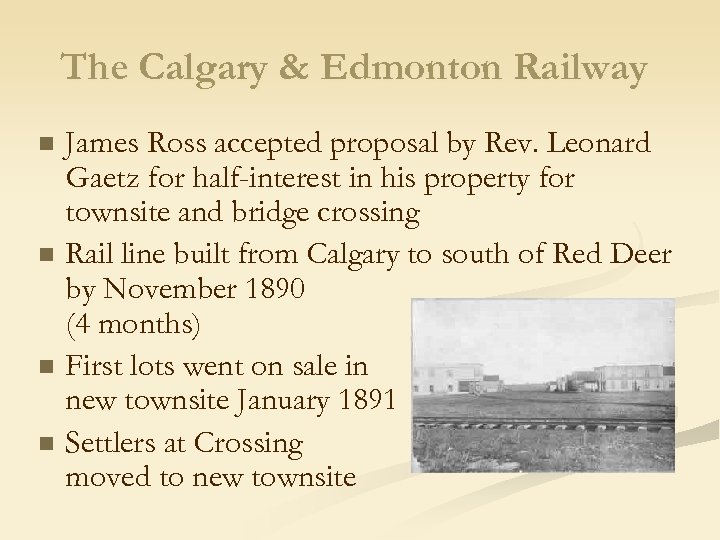 The Calgary & Edmonton Railway n n James Ross accepted proposal by Rev. Leonard Gaetz for half-interest in his property for townsite and bridge crossing Rail line built from Calgary to south of Red Deer by November 1890 (4 months) First lots went on sale in new townsite January 1891 Settlers at Crossing moved to new townsite
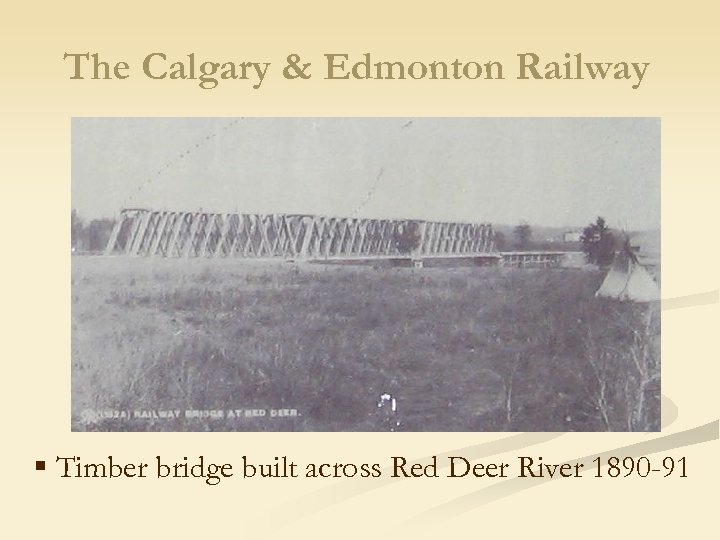 The Calgary & Edmonton Railway § Timber bridge built across Red Deer River 1890 -91
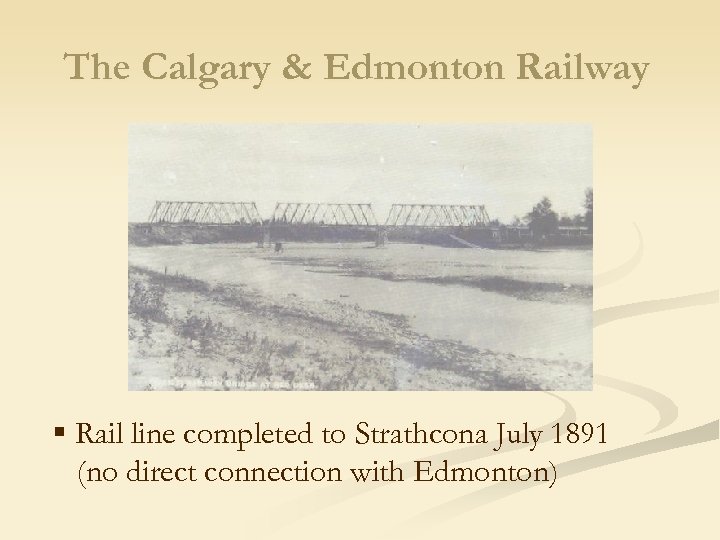 The Calgary & Edmonton Railway § Rail line completed to Strathcona July 1891 (no direct connection with Edmonton)
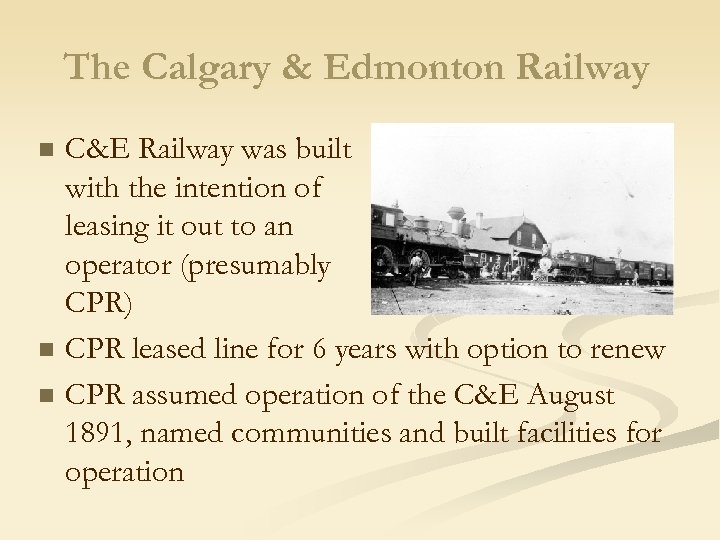 The Calgary & Edmonton Railway n n n C&E Railway was built with the intention of leasing it out to an operator (presumably CPR) CPR leased line for 6 years with option to renew CPR assumed operation of the C&E August 1891, named communities and built facilities for operation
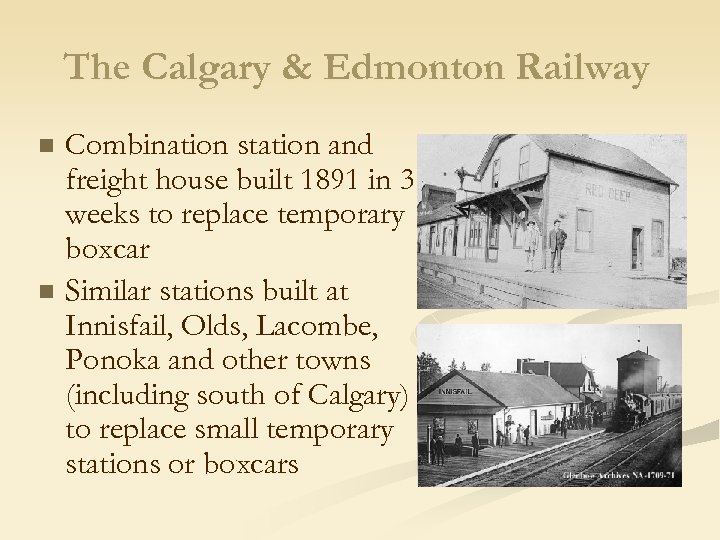 The Calgary & Edmonton Railway n n Combination station and freight house built 1891 in 3 weeks to replace temporary boxcar Similar stations built at Innisfail, Olds, Lacombe, Ponoka and other towns (including south of Calgary) to replace small temporary stations or boxcars
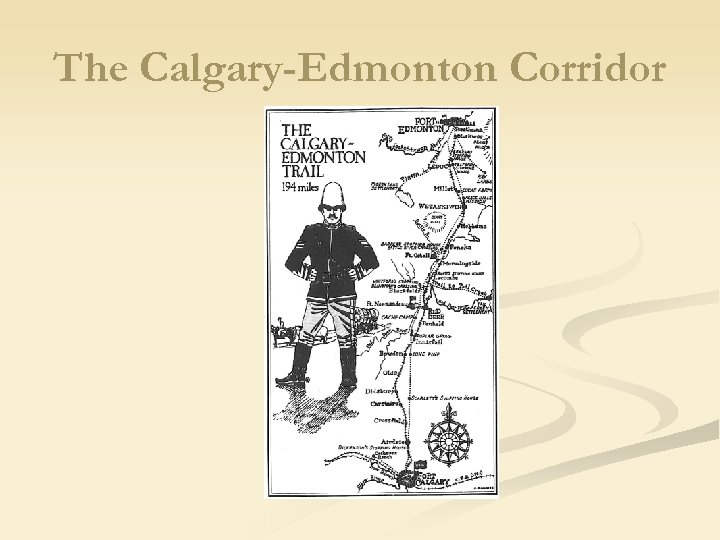 The Calgary-Edmonton Corridor
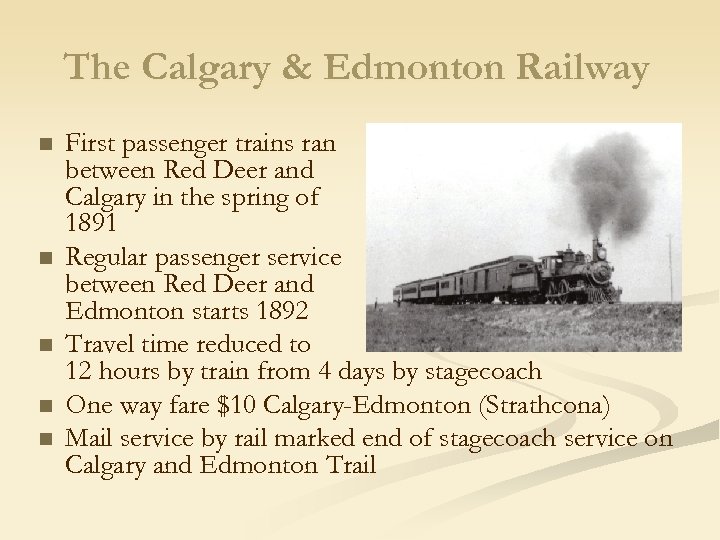 The Calgary & Edmonton Railway n n n First passenger trains ran between Red Deer and Calgary in the spring of 1891 Regular passenger service between Red Deer and Edmonton starts 1892 Travel time reduced to 12 hours by train from 4 days by stagecoach One way fare $10 Calgary-Edmonton (Strathcona) Mail service by rail marked end of stagecoach service on Calgary and Edmonton Trail
 Red Deer Becomes Railway Town
 The Calgary & Edmonton Railway n n By 1900, the C&E Railway is the most profitable railway of its size in Canada Population of Red Deer in 1901 at 323, similar to or smaller than, populations of Lacombe and Innisfail In 1905 CPR expands Red Deer yards and opens two branchlines originating in Red Deer – Lacombe to Alix and Wetaskiwin to Camrose Red Deer population mushrooms to 1, 500
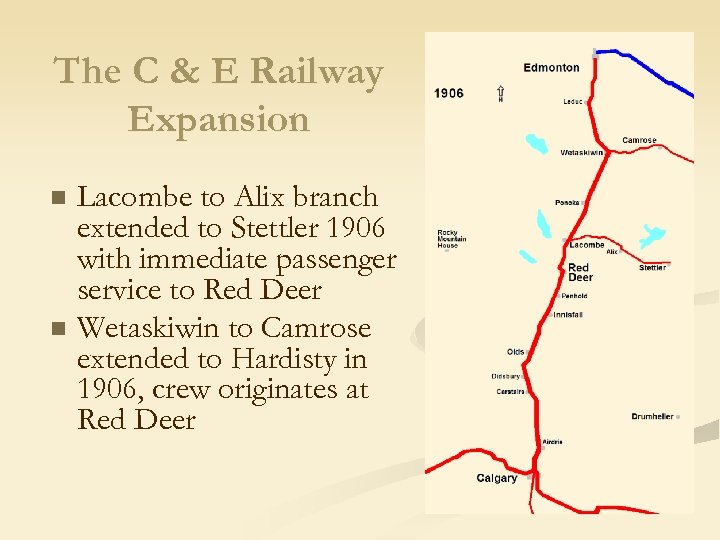 The C & E Railway Expansion n n Lacombe to Alix branch extended to Stettler 1906 with immediate passenger service to Red Deer Wetaskiwin to Camrose extended to Hardisty in 1906, crew originates at Red Deer
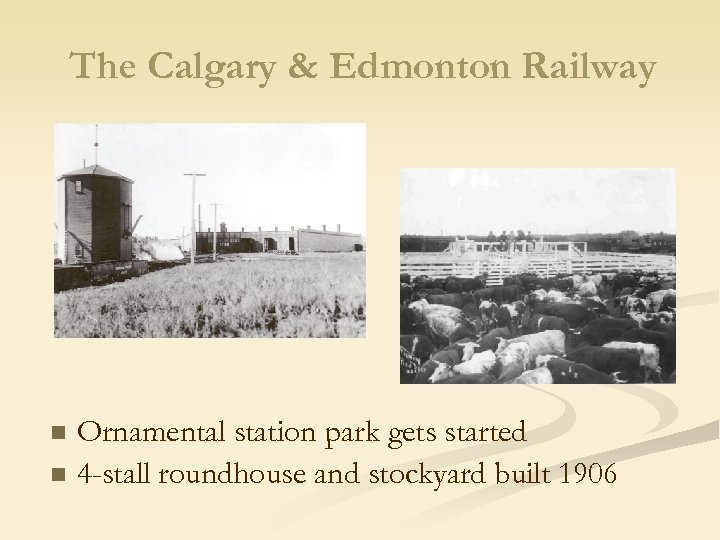 The Calgary & Edmonton Railway n n Ornamental station park gets started 4 -stall roundhouse and stockyard built 1906
 The Calgary & Edmonton Railway n n n Upgrades to facilities included 70 -foot turntable and expansion of roundhouse to 10 stalls Construction of elevated gravitational timber coal tipple 1907 dominated skyline CPR became primary employer, customer and supplier for town and remained so for decades
 Competition for the CPR
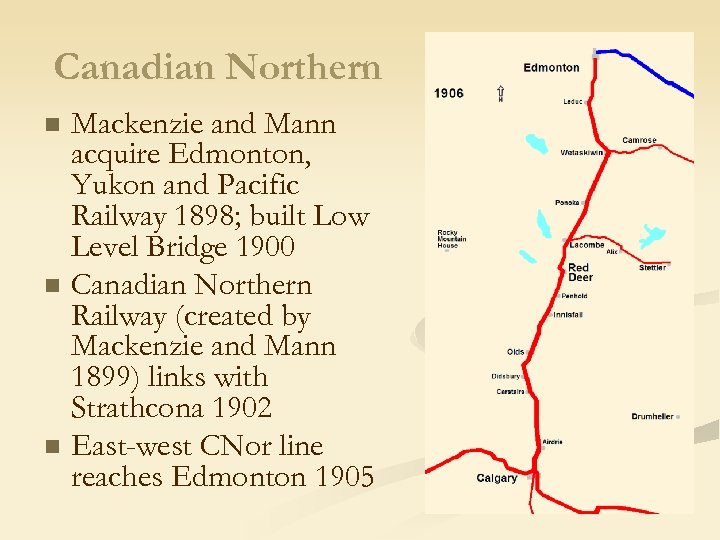 Canadian Northern n Mackenzie and Mann acquire Edmonton, Yukon and Pacific Railway 1898; built Low Level Bridge 1900 Canadian Northern Railway (created by Mackenzie and Mann 1899) links with Strathcona 1902 East-west CNor line reaches Edmonton 1905
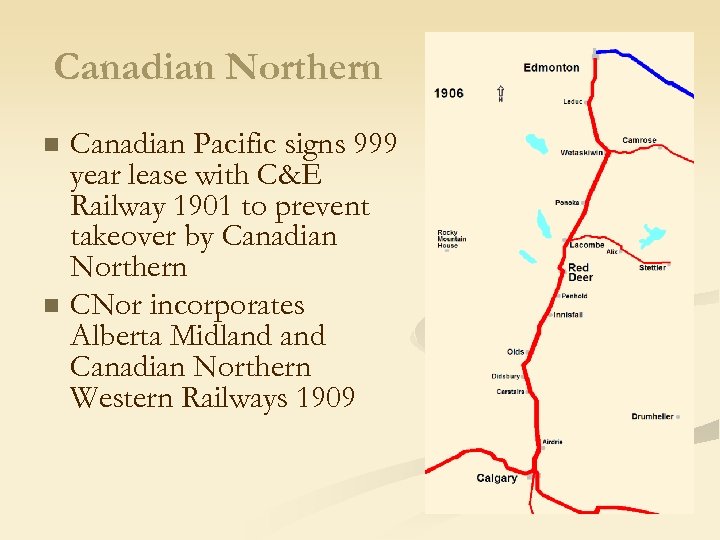 Canadian Northern n n Canadian Pacific signs 999 year lease with C&E Railway 1901 to prevent takeover by Canadian Northern CNor incorporates Alberta Midland Canadian Northern Western Railways 1909
 Red Deer Becomes CPR Division Point
 The Calgary & Edmonton Railway n n n Various improvements since 1905 indicate something big on the horizon CPR negotiated arrangement with town for double the amount of water Red Deer officially announced as divisional point in 1908 establishing Red Deer as the distribution and transportation centre of Central Alberta
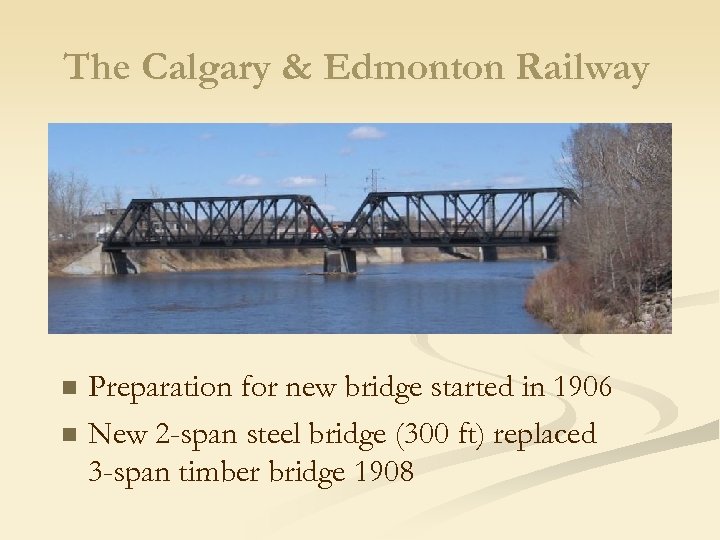 The Calgary & Edmonton Railway n n Preparation for new bridge started in 1906 New 2 -span steel bridge (300 ft) replaced 3 -span timber bridge 1908
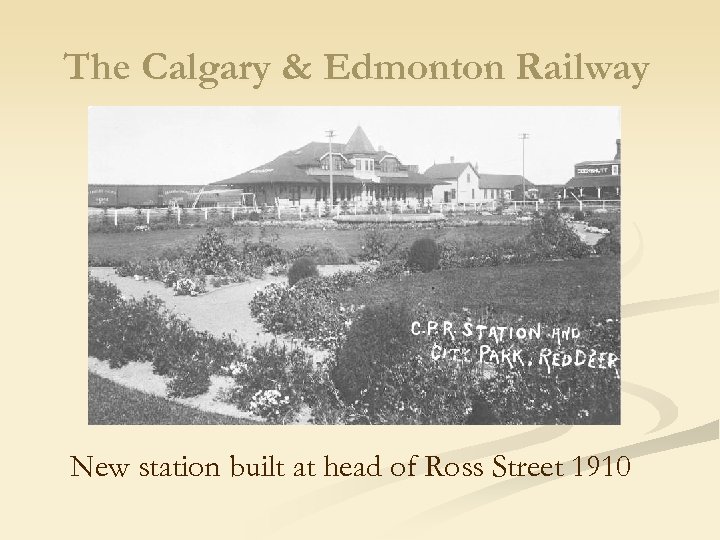 The Calgary & Edmonton Railway New station built at head of Ross Street 1910
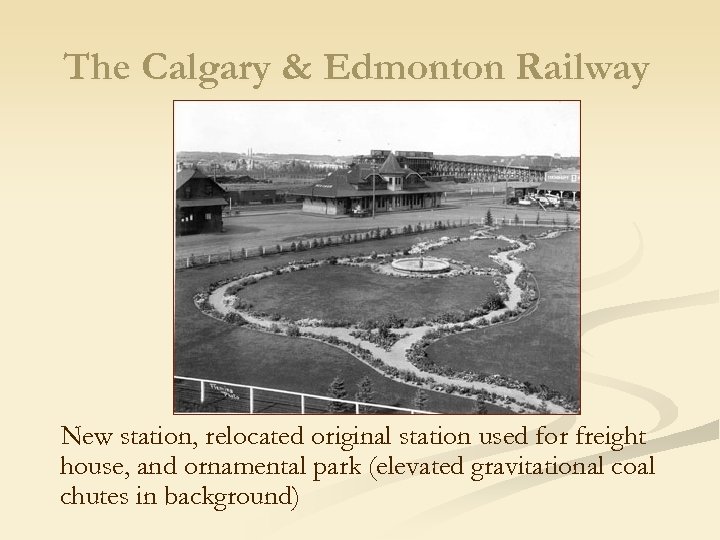 The Calgary & Edmonton Railway New station, relocated original station used for freight house, and ornamental park (elevated gravitational coal chutes in background)
 The Alberta Central Railway
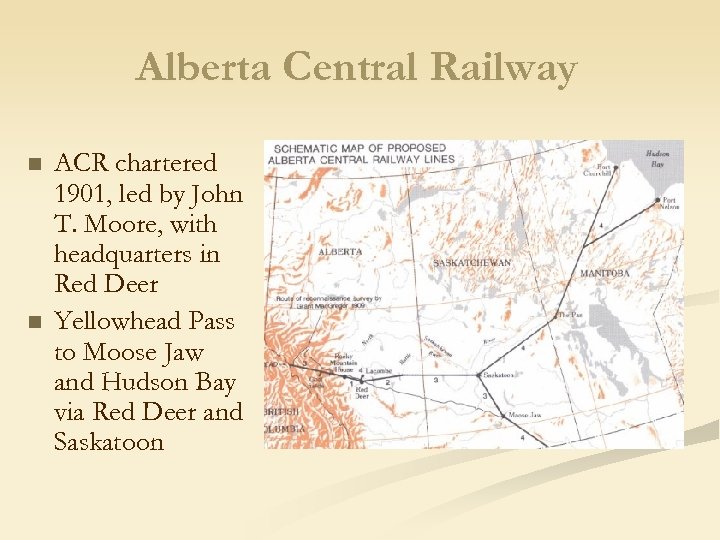 Alberta Central Railway n n ACR chartered 1901, led by John T. Moore, with headquarters in Red Deer Yellowhead Pass to Moose Jaw and Hudson Bay via Red Deer and Saskatoon
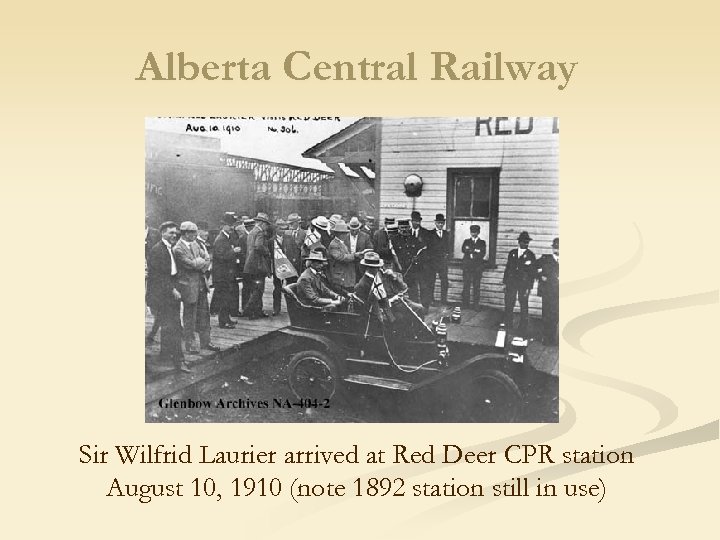 Alberta Central Railway Sir Wilfrid Laurier arrived at Red Deer CPR station August 10, 1910 (note 1892 station still in use)
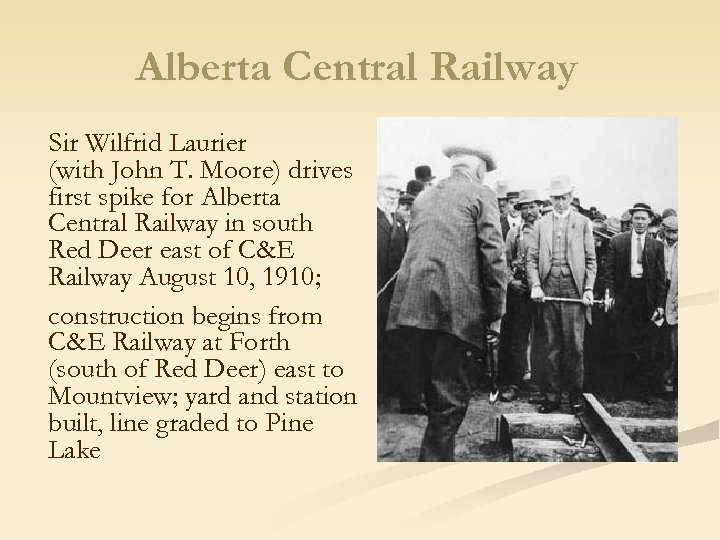 Alberta Central Railway Sir Wilfrid Laurier (with John T. Moore) drives first spike for Alberta Central Railway in south Red Deer east of C&E Railway August 10, 1910; construction begins from C&E Railway at Forth (south of Red Deer) east to Mountview; yard and station built, line graded to Pine Lake
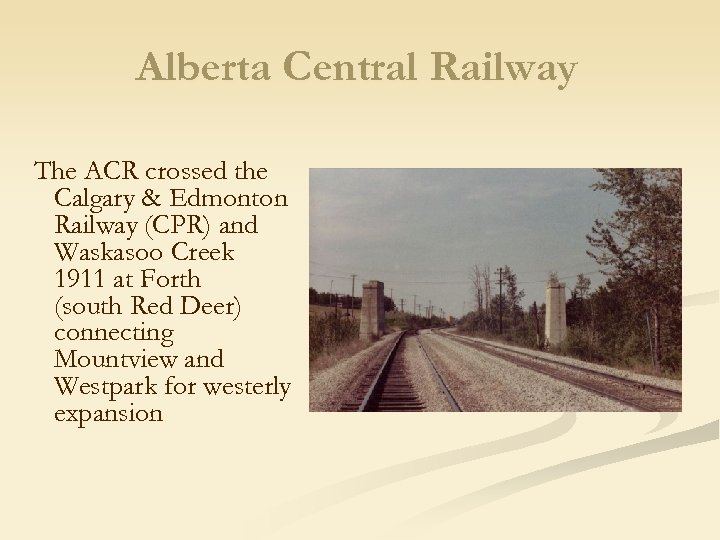 Alberta Central Railway The ACR crossed the Calgary & Edmonton Railway (CPR) and Waskasoo Creek 1911 at Forth (south Red Deer) connecting Mountview and Westpark for westerly expansion
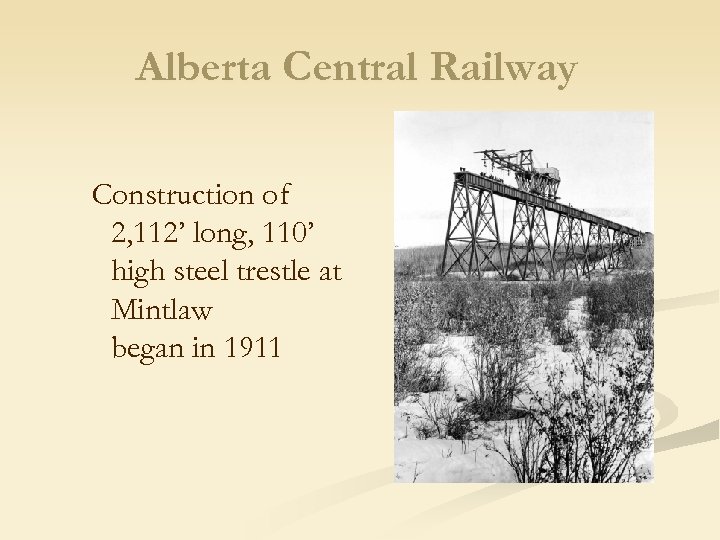 Alberta Central Railway Construction of 2, 112’ long, 110’ high steel trestle at Mintlaw began in 1911
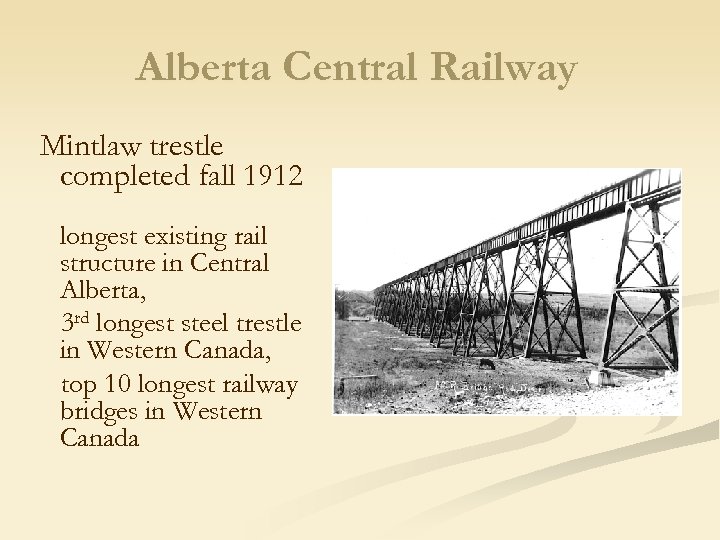 Alberta Central Railway Mintlaw trestle completed fall 1912 longest existing rail structure in Central Alberta, 3 rd longest steel trestle in Western Canada, top 10 longest railway bridges in Western Canada
 Canadian Northern Western Railway
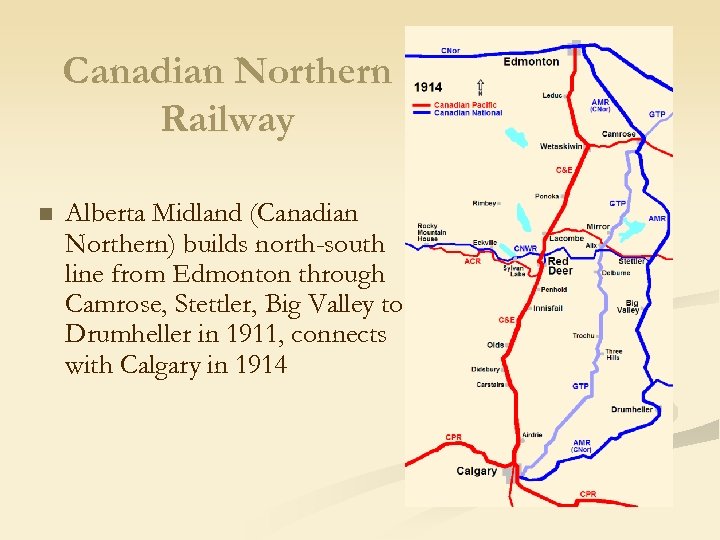 Canadian Northern Railway n Alberta Midland (Canadian Northern) builds north-south line from Edmonton through Camrose, Stettler, Big Valley to Drumheller in 1911, connects with Calgary in 1914
 Canadian Northern Western Railway n n Martin Nordegg invited William Mackenzie and Donald Mann to build rail line to Brazeau coal fields 1908 after being refused by Canadian Pacific Railway Mackenzie and Mann created subsidiary of Canadian Northern Railway called Canadian Northern Western Railway in order to receive provincial subsidies Mackenzie and Mann chose route to Rocky Mountain House parallel to Alberta Central Railway Standard for track building inferior to ACR so progress could be made quickly
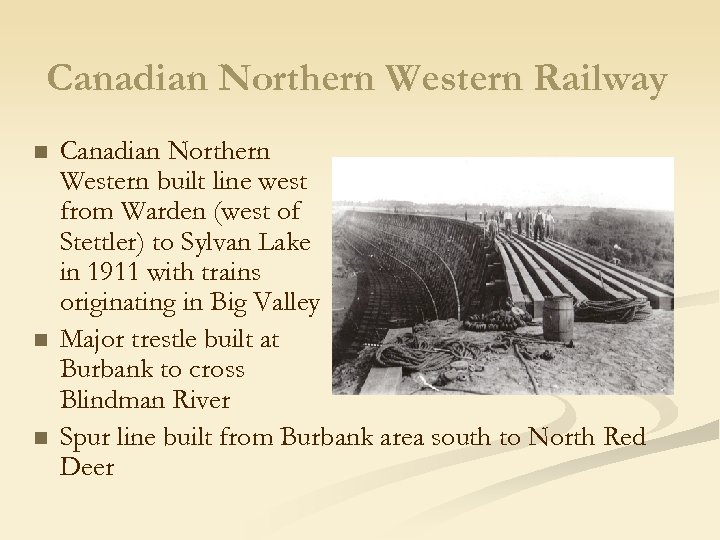 Canadian Northern Western Railway n n n Canadian Northern Western built line west from Warden (west of Stettler) to Sylvan Lake in 1911 with trains originating in Big Valley Major trestle built at Burbank to cross Blindman River Spur line built from Burbank area south to North Red Deer
 Canadian Northern Western Railway n n n Several confrontations with competing Alberta Central Railway The building of two railways along with other improvements in and around Red Deer created prosperity for town and area farmers Canadian Northern Western reached Rocky Mountain House in 1912, Nordegg in 1914
 The Alberta Central Railway Goes Bankrupt
 Alberta Central Railway Due to high cost of construction of a high standard rail line, including the construction of 2 major bridges (Mintlaw and Rocky Mountain House), and the inflationary effects of competing with the Canadian Northern Western Railway, the Alberta Central Railway went bankrupt in 1911 The CPR leased the line, then took it over as a whollyowned subsidiary in 1912 and completed construction between Red Deer and Rocky Mountain House by 1914
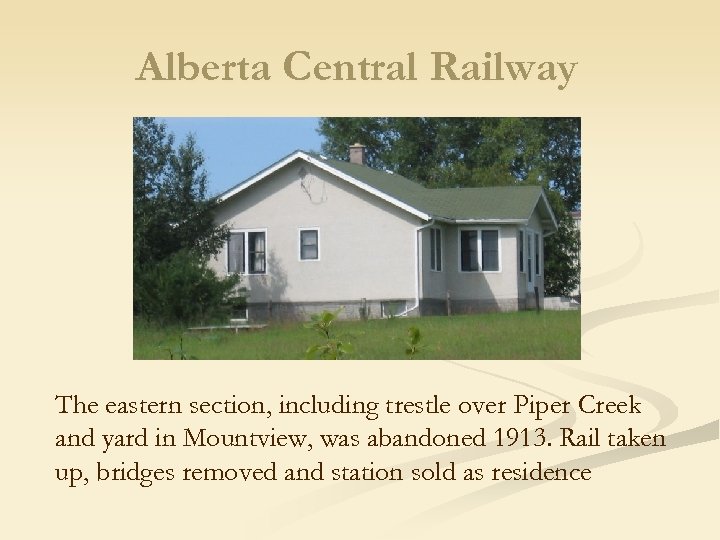 Alberta Central Railway The eastern section, including trestle over Piper Creek and yard in Mountview, was abandoned 1913. Rail taken up, bridges removed and station sold as residence
 Red Deer Becomes a City
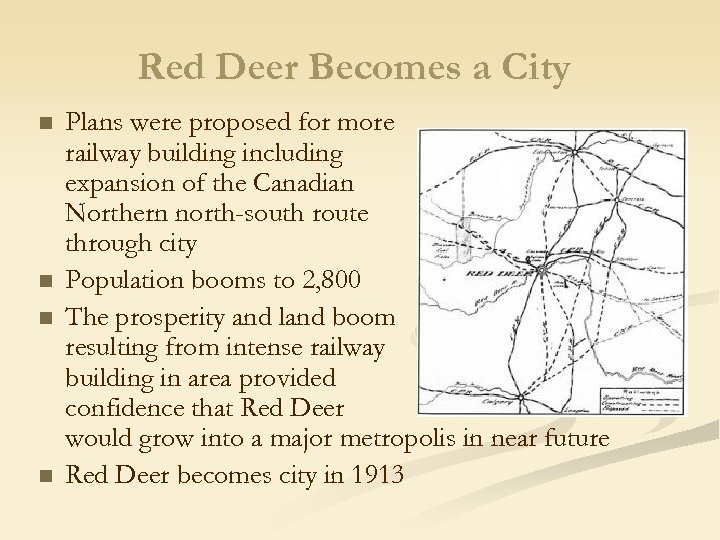 Red Deer Becomes a City n n Plans were proposed for more railway building including expansion of the Canadian Northern north-south route through city Population booms to 2, 800 The prosperity and land boom resulting from intense railway building in area provided confidence that Red Deer would grow into a major metropolis in near future Red Deer becomes city in 1913
 Red Deer Becomes a City n n n Economic boom came to sudden end with a recession and outbreak of World War One Population remained steady at around 2, 800 for several years However, Red Deer had been assured of its dominant position as Central Alberta’s transportation and distribution centre as a result of the many decisions and developments of three railways in the previous 2 decades
 Epilogue
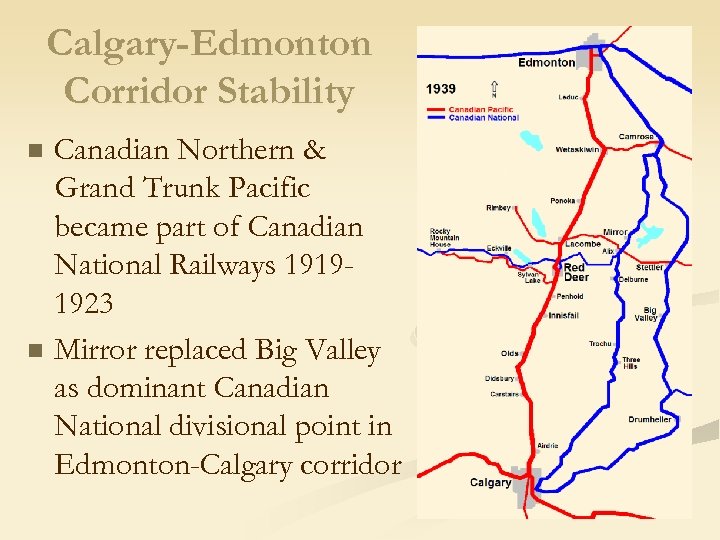 Calgary-Edmonton Corridor Stability n n Canadian Northern & Grand Trunk Pacific became part of Canadian National Railways 19191923 Mirror replaced Big Valley as dominant Canadian National divisional point in Edmonton-Calgary corridor
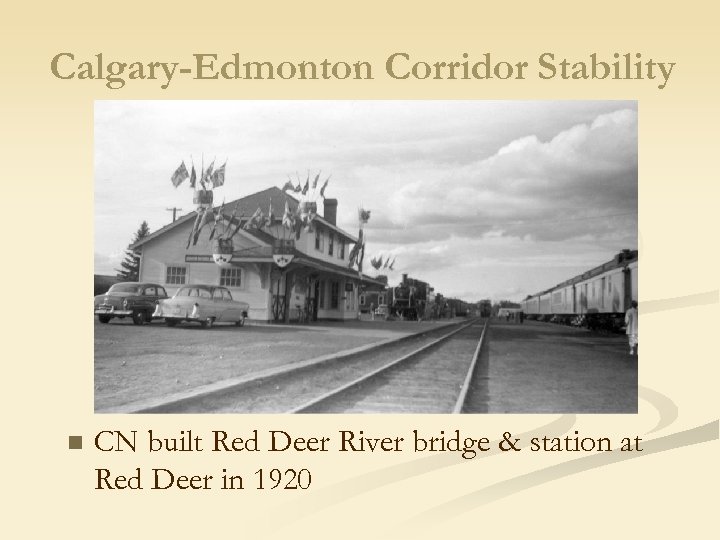 Calgary-Edmonton Corridor Stability n CN built Red Deer River bridge & station at Red Deer in 1920
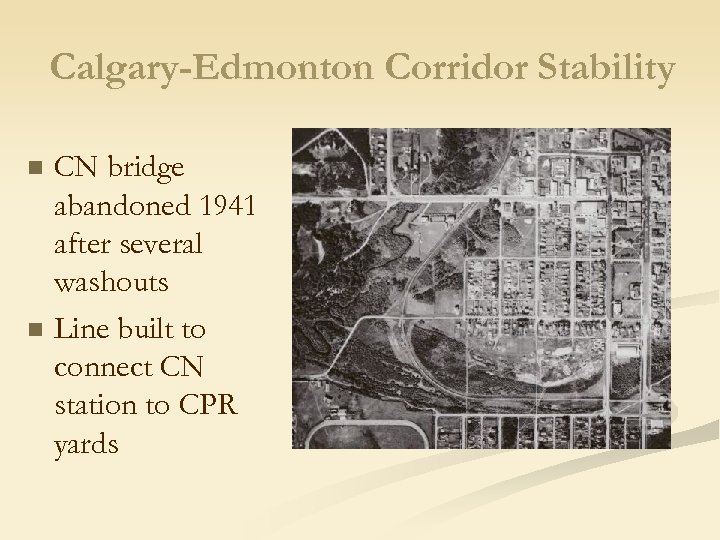 Calgary-Edmonton Corridor Stability n n CN bridge abandoned 1941 after several washouts Line built to connect CN station to CPR yards
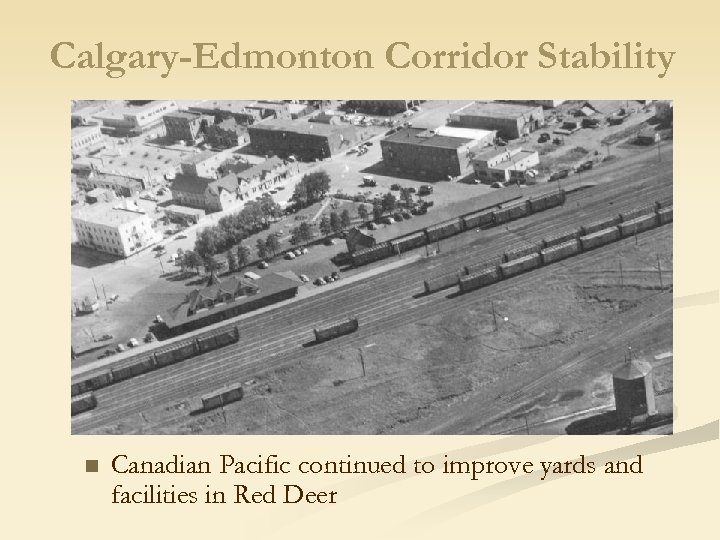 Calgary-Edmonton Corridor Stability n Canadian Pacific continued to improve yards and facilities in Red Deer
 Calgary-Edmonton Corridor Stability n n n Gravitational coal chutes converted to mechanical type in 1923 and trestle removed Steam-era facilities were maintained until 1955 -60 Ornamental station park converted to parking lot in 1960 Roundhouse demolished 1963 Older grain elevators replaced by modern ones between 1948 and late 1950 s
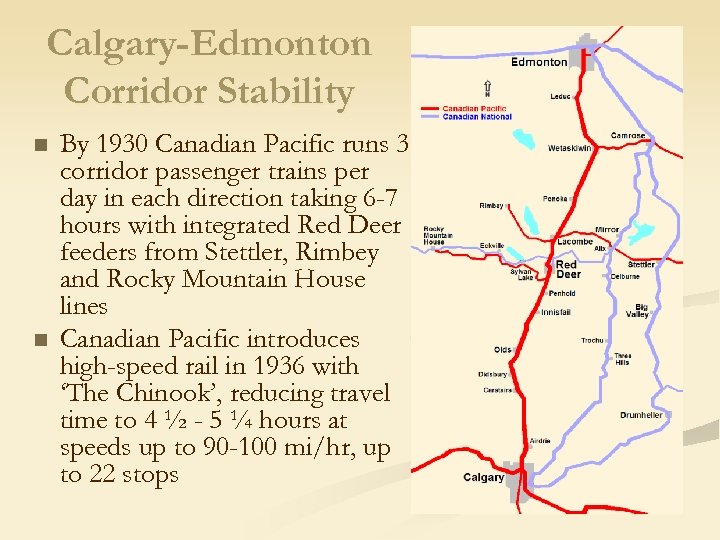 Calgary-Edmonton Corridor Stability n n By 1930 Canadian Pacific runs 3 corridor passenger trains per day in each direction taking 6 -7 hours with integrated Red Deer feeders from Stettler, Rimbey and Rocky Mountain House lines Canadian Pacific introduces high-speed rail in 1936 with ‘The Chinook’, reducing travel time to 4 ½ - 5 ¼ hours at speeds up to 90 -100 mi/hr, up to 22 stops
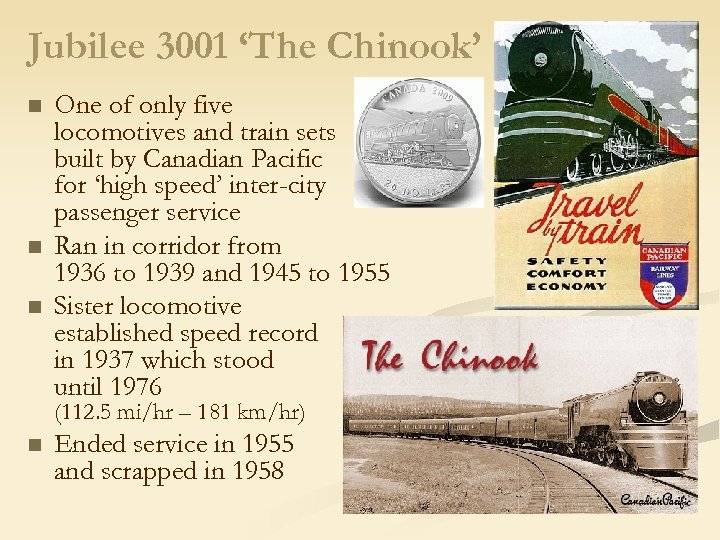 Jubilee 3001 ‘The Chinook’ n n n One of only five locomotives and train sets built by Canadian Pacific for ‘high speed’ inter-city passenger service Ran in corridor from 1936 to 1939 and 1945 to 1955 Sister locomotive established speed record in 1937 which stood until 1976 (112. 5 mi/hr – 181 km/hr) n Ended service in 1955 and scrapped in 1958
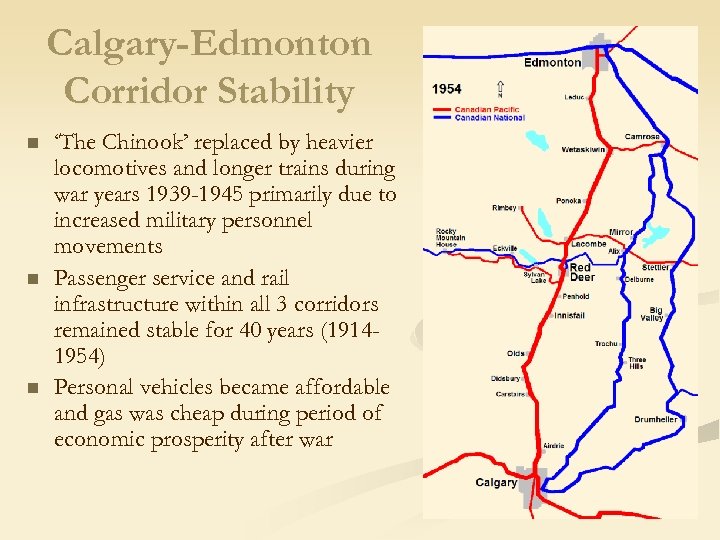 Calgary-Edmonton Corridor Stability n n n ‘The Chinook’ replaced by heavier locomotives and longer trains during war years 1939 -1945 primarily due to increased military personnel movements Passenger service and rail infrastructure within all 3 corridors remained stable for 40 years (19141954) Personal vehicles became affordable and gas was cheap during period of economic prosperity after war
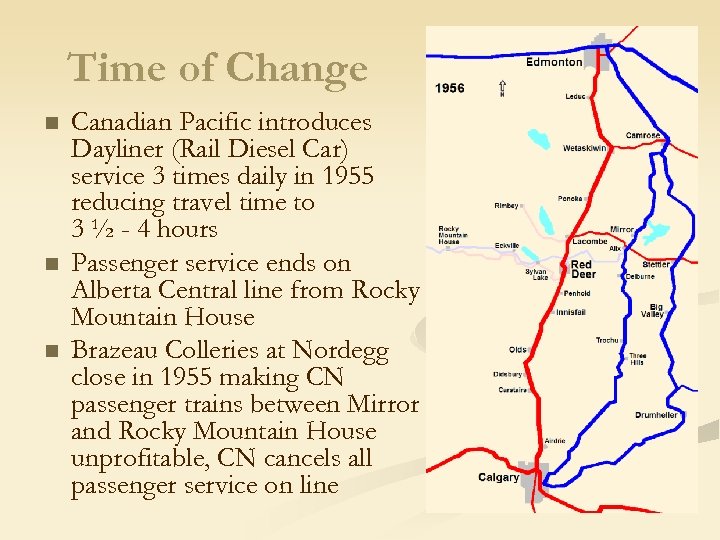 Time of Change n n n Canadian Pacific introduces Dayliner (Rail Diesel Car) service 3 times daily in 1955 reducing travel time to 3 ½ - 4 hours Passenger service ends on Alberta Central line from Rocky Mountain House Brazeau Colleries at Nordegg close in 1955 making CN passenger trains between Mirror and Rocky Mountain House unprofitable, CN cancels all passenger service on line
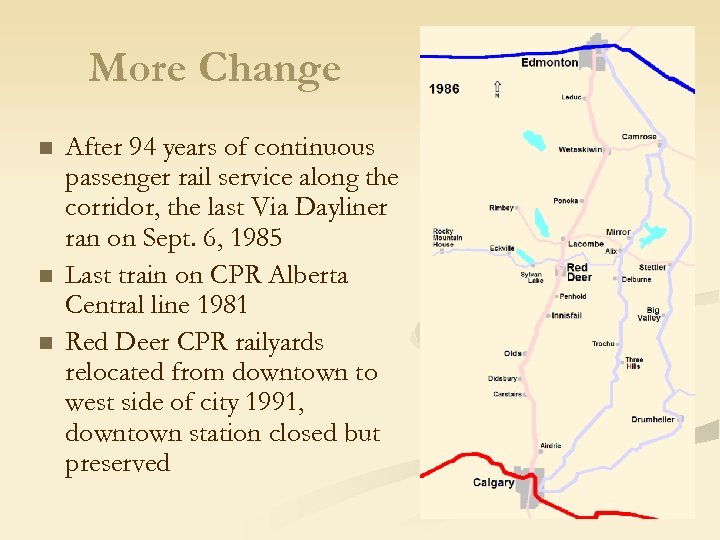 More Change n n n After 94 years of continuous passenger rail service along the corridor, the last Via Dayliner ran on Sept. 6, 1985 Last train on CPR Alberta Central line 1981 Red Deer CPR railyards relocated from downtown to west side of city 1991, downtown station closed but preserved
 The Railways as Parents of a City For more information on the history of Central Alberta’s railways, visit: www. Forth. Junction. com Central Alberta Historical Society Red Deer May 15, 2013