


 Скачать презентацию The race for 100 Sn History and
2c70164429126963c5ca89bf73d86383.ppt
- Количество слайдов: 31
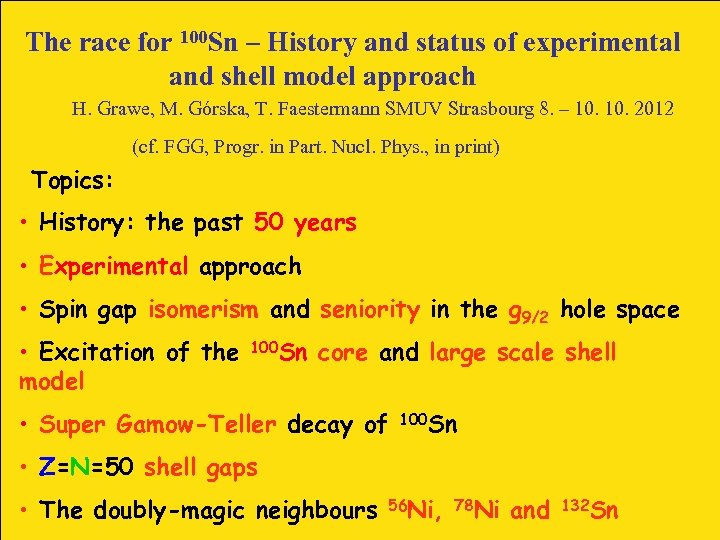 The race for 100 Sn – History and status of experimental and shell model approach H. Grawe, M. Górska, T. Faestermann SMUV Strasbourg 8. – 10. 2012 (cf. FGG, Progr. in Part. Nucl. Phys. , in print) Topics: • History: the past 50 years • Experimental approach • Spin gap isomerism and seniority in the g 9/2 hole space • Excitation of the model 100 Sn core and large scale shell • Super Gamow-Teller decay of 100 Sn • Z=N=50 shell gaps • The doubly-magic neighbours 56 Ni, 78 Ni and 132 Sn
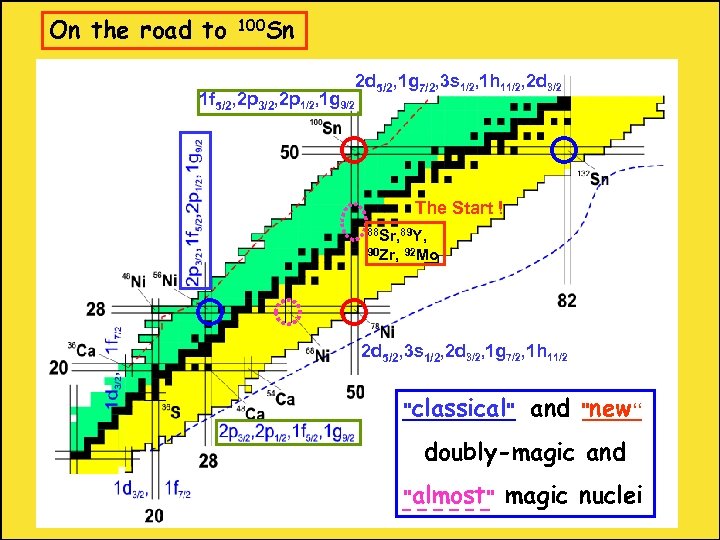 On the road to 100 Sn 1 f 5/2, 2 p 3/2, 2 p 1/2, 1 g 9/2 2 d 5/2, 1 g 7/2, 3 s 1/2, 1 h 11/2, 2 d 3/2 The Start ! 88 Sr, 89 Y, 90 Zr, 92 Mo 2 d 5/2, 3 s 1/2, 2 d 3/2, 1 g 7/2, 1 h 11/2 "classical" and "new‘‘ doubly-magic and "almost" magic nuclei
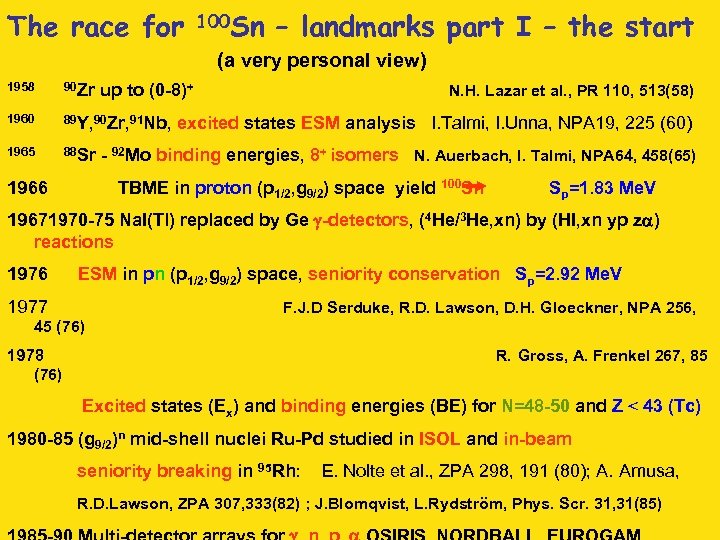 The race for 100 Sn – landmarks part I – the start (a very personal view) 1958 90 Zr 1960 89 Y, 90 Zr, 91 Nb, 1965 88 Sr 1966 up to (0 -8)+ N. H. Lazar et al. , PR 110, 513(58) excited states ESM analysis I. Talmi, I. Unna, NPA 19, 225 (60) - 92 Mo binding energies, 8+ isomers N. Auerbach, I. Talmi, NPA 64, 458(65) TBME in proton (p 1/2, g 9/2) space yield 100 Sn Sp=1. 83 Me. V 19671970 -75 Na. I(Tl) replaced by Ge g-detectors, (4 He/3 He, xn) by (HI, xn yp za) reactions 1976 ESM in pn (p 1/2, g 9/2) space, seniority conservation Sp=2. 92 Me. V 1977 F. J. D Serduke, R. D. Lawson, D. H. Gloeckner, NPA 256, 45 (76) 1978 (76) R. Gross, A. Frenkel 267, 85 Excited states (Ex) and binding energies (BE) for N=48 -50 and Z < 43 (Tc) 1980 -85 (g 9/2)n mid-shell nuclei Ru-Pd studied in ISOL and in-beam seniority breaking in 95 Rh: E. Nolte et al. , ZPA 298, 191 (80); A. Amusa, R. D. Lawson, ZPA 307, 333(82) ; J. Blomqvist, L. Rydström, Phys. Scr. 31, 31(85)
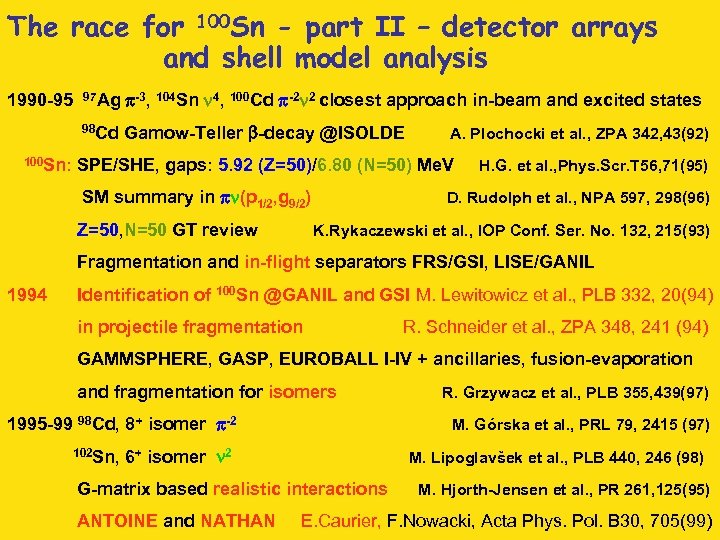 The race for 100 Sn - part II – detector arrays and shell model analysis 100 Sn: 97 Ag p-3, 104 Sn n 4, 100 Cd p-2 n 2 closest approach in-beam and excited states 98 Cd 1990 -95 Gamow-Teller b-decay @ISOLDE A. Plochocki et al. , ZPA 342, 43(92) SPE/SHE, gaps: 5. 92 (Z=50)/6. 80 (N=50) Me. V SM summary in pn(p 1/2, g 9/2) Z=50, N=50 GT review H. G. et al. , Phys. Scr. T 56, 71(95) D. Rudolph et al. , NPA 597, 298(96) K. Rykaczewski et al. , IOP Conf. Ser. No. 132, 215(93) Fragmentation and in-flight separators FRS/GSI, LISE/GANIL 1994 Identification of 100 Sn @GANIL and GSI M. Lewitowicz et al. , PLB 332, 20(94) in projectile fragmentation R. Schneider et al. , ZPA 348, 241 (94) GAMMSPHERE, GASP, EUROBALL I-IV + ancillaries, fusion-evaporation and fragmentation for isomers 1995 -99 98 Cd, 8+ isomer p-2 102 Sn, M. Górska et al. , PRL 79, 2415 (97) 6+ isomer n 2 M. Lipoglavšek et al. , PLB 440, 246 (98) G-matrix based realistic interactions ANTOINE and NATHAN R. Grzywacz et al. , PLB 355, 439(97) M. Hjorth-Jensen et al. , PR 261, 125(95) E. Caurier, F. Nowacki, Acta Phys. Pol. B 30, 705(99)
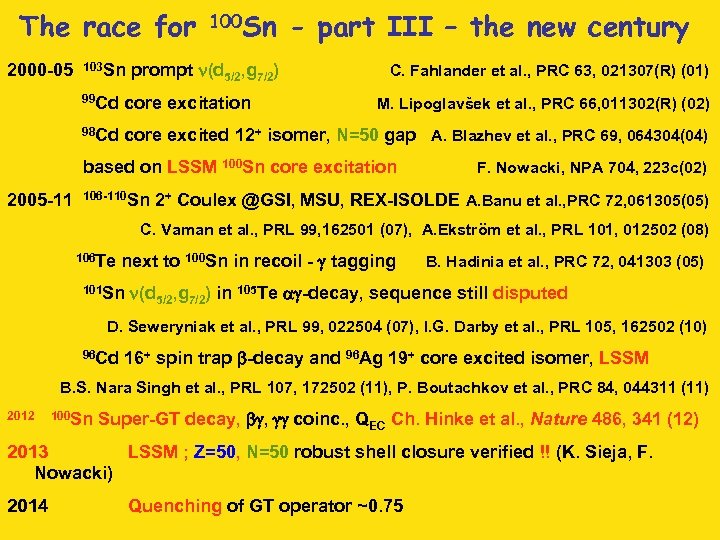 The race for 2000 -05 103 Sn 100 Sn prompt n(d 5/2, g 7/2) - part III – the new century C. Fahlander et al. , PRC 63, 021307(R) (01) 99 Cd core excitation 98 Cd core excited 12+ isomer, N=50 gap A. Blazhev et al. , PRC 69, 064304(04) M. Lipoglavšek et al. , PRC 66, 011302(R) (02) based on LSSM 100 Sn core excitation 2005 -11 106 -110 Sn F. Nowacki, NPA 704, 223 c(02) 2+ Coulex @GSI, MSU, REX-ISOLDE A. Banu et al. , PRC 72, 061305(05) C. Vaman et al. , PRL 99, 162501 (07), A. Ekström et al. , PRL 101, 012502 (08) 106 Te next to 100 Sn in recoil - g tagging 101 Sn B. Hadinia et al. , PRC 72, 041303 (05) n(d 5/2, g 7/2) in 105 Te ag-decay, sequence still disputed D. Seweryniak et al. , PRL 99, 022504 (07), I. G. Darby et al. , PRL 105, 162502 (10) 96 Cd 16+ spin trap b-decay and 96 Ag 19+ core excited isomer, LSSM B. S. Nara Singh et al. , PRL 107, 172502 (11), P. Boutachkov et al. , PRC 84, 044311 (11) 2012 100 Sn Super-GT decay, bg, gg coinc. , QEC Ch. Hinke et al. , Nature 486, 341 (12) 2013 LSSM ; Z=50, N=50 robust shell closure verified !! (K. Sieja, F. Nowacki) 2014 Quenching of GT operator ~0. 75
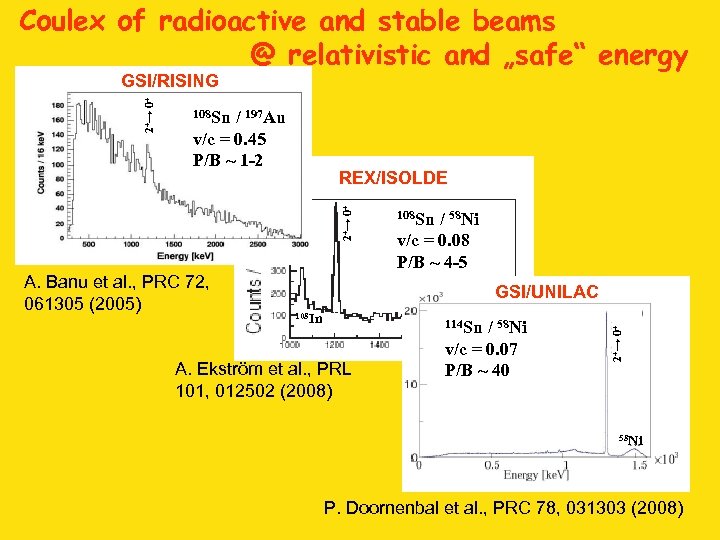 Coulex of radioactive and stable beams @ relativistic and „safe“ energy 108 Sn / 197 Au v/c = 0. 45 P/B ~ 1 -2 REX/ISOLDE 2+→ 0+ A. Banu et al. , PRC 72, 061305 (2005) 108 Sn / 58 Ni v/c = 0. 08 P/B ~ 4 -5 GSI/UNILAC 108 In 114 Sn A. Ekström et al. , PRL 101, 012502 (2008) / 58 Ni v/c = 0. 07 P/B ~ 40 2+→ 0+ GSI/RISING 58 Ni P. Doornenbal et al. , PRC 78, 031303 (2008)
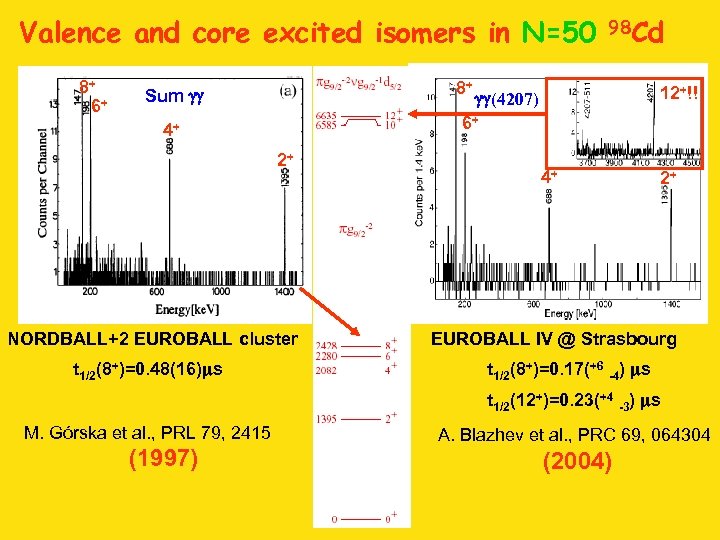 Valence and core excited isomers in N=50 8+ 6+ 8+ Sum gg 12+!! gg(4207) 6+ 4+ 2+ NORDBALL+2 EUROBALL cluster t 1/2(8+)=0. 48(16)ms 98 Cd 4+ 2+ EUROBALL IV @ Strasbourg t 1/2(8+)=0. 17(+6 -4) ms t 1/2(12+)=0. 23(+4 -3) ms M. Górska et al. , PRL 79, 2415 (1997) A. Blazhev et al. , PRC 69, 064304 (2004)
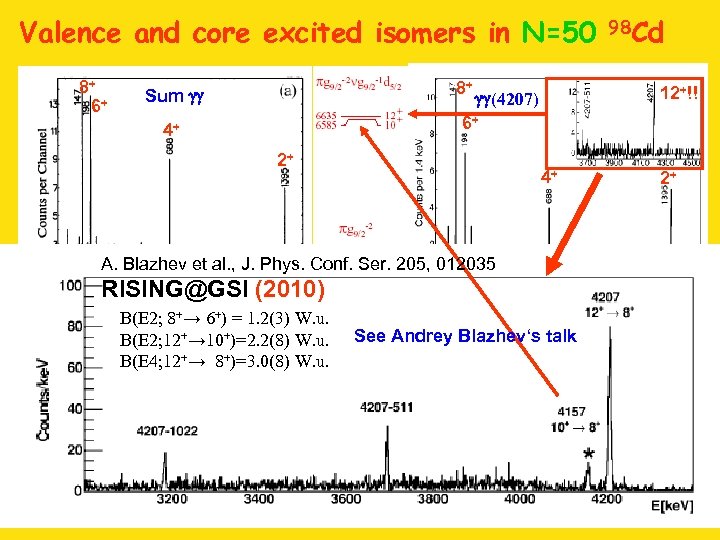 Valence and core excited isomers in N=50 8+ 6+ 8+ Sum gg 98 Cd 12+!! gg(4207) 6+ 4+ 2+ A. Blazhev et al. , J. Phys. Conf. Ser. 205, 012035 RISING@GSI (2010) B(E 2; 8+→ 6+) = 1. 2(3) W. u. NORDBALL+2 EUROBALL)=2. 2(8) W. u. B(E 2; 12+→ 10+ cluster B(E 4; 12+→ 8+ t (8+)=0. 48(16)ms )=3. 0(8) W. u. 1/2 See Andrey Blazhev‘s talk Strasbourg EUROBALL IV @ t 1/2(8+)=0. 17(+6 -4) ms t 1/2(12+)=0. 23(+4 -3) ms M. Górska et al. , PRL 79, 2415 (1997) A. Blazhev et al. , PRC 69, 064304 (2004)
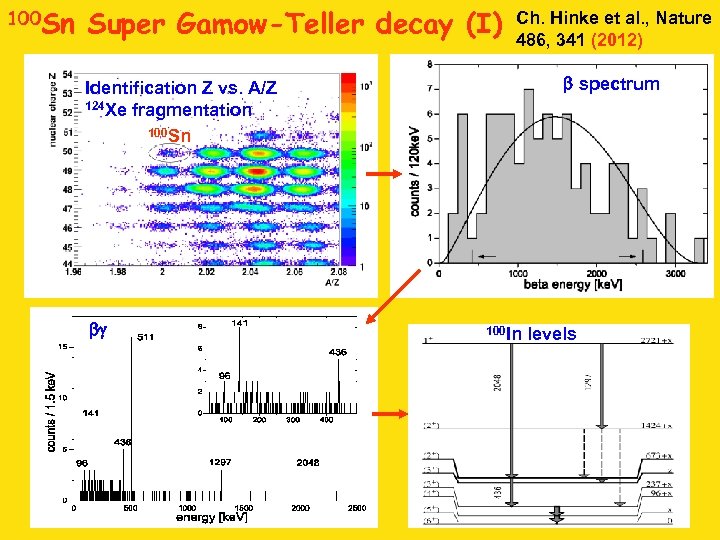 100 Sn Super Gamow-Teller decay (I) Ch. Hinke et al. , Nature 486, 341 (2012) b spectrum Identification Z vs. A/Z 124 Xe fragmentation 100 Sn bg 100 In levels
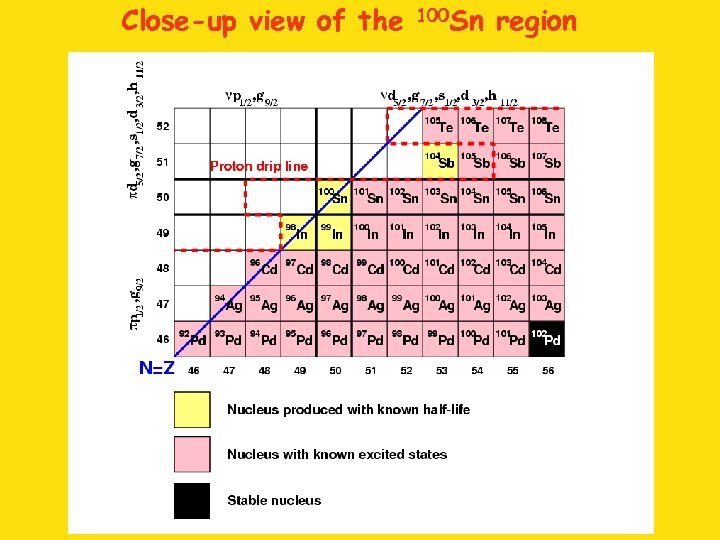 Close-up view of the 100 Sn region
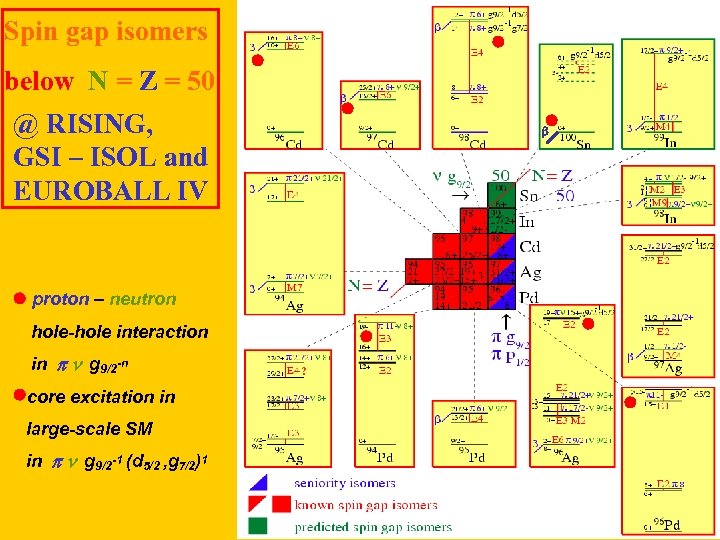 Spin gap isomers below N = Z = 50 @ RISING, GSI – ISOL and EUROBALL IV b • proton – neutron hole-hole interaction in p n g 9/2 -n • core excitation in large-scale SM in p n g 9/2 -1 (d 5/2 , g 7/2)1 ?
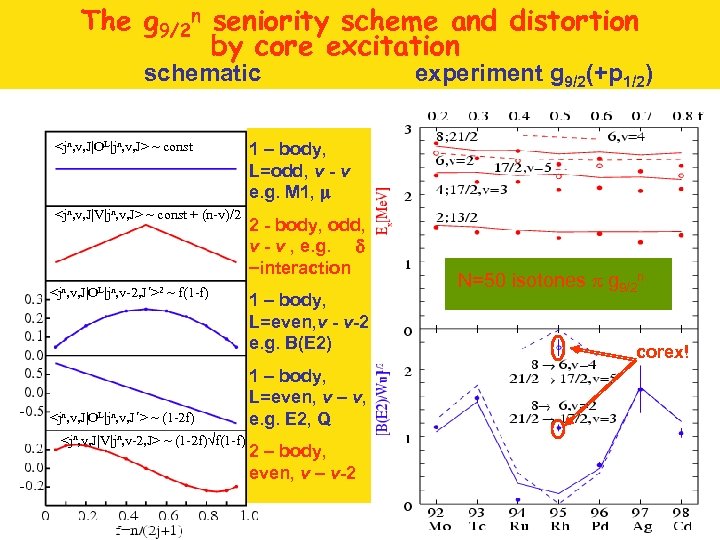 The g 9/2 n seniority scheme and distortion by core excitation schematic
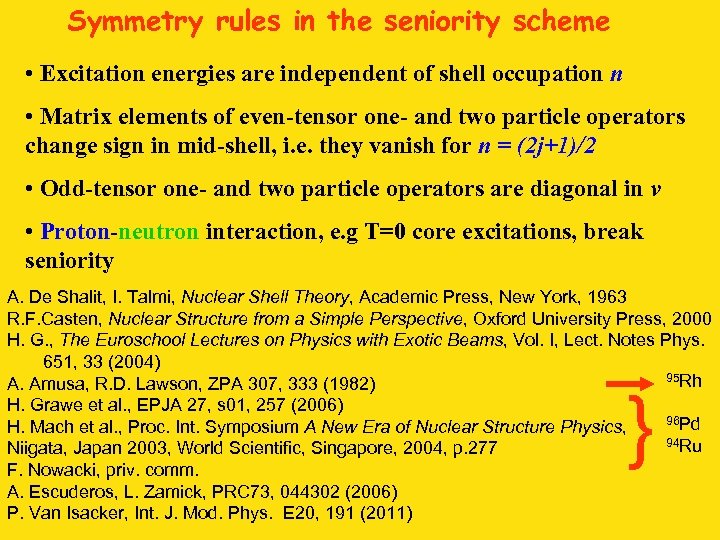 Symmetry rules in the seniority scheme • Excitation energies are independent of shell occupation n • Matrix elements of even-tensor one- and two particle operators change sign in mid-shell, i. e. they vanish for n = (2 j+1)/2 • Odd-tensor one- and two particle operators are diagonal in v • Proton-neutron interaction, e. g T=0 core excitations, break seniority A. De Shalit, I. Talmi, Nuclear Shell Theory, Academic Press, New York, 1963 R. F. Casten, Nuclear Structure from a Simple Perspective, Oxford University Press, 2000 H. G. , The Euroschool Lectures on Physics with Exotic Beams, Vol. I, Lect. Notes Phys. 651, 33 (2004) 95 Rh A. Amusa, R. D. Lawson, ZPA 307, 333 (1982) H. Grawe et al. , EPJA 27, s 01, 257 (2006) 96 Pd H. Mach et al. , Proc. Int. Symposium A New Era of Nuclear Structure Physics, 94 Ru Niigata, Japan 2003, World Scientific, Singapore, 2004, p. 277 F. Nowacki, priv. comm. A. Escuderos, L. Zamick, PRC 73, 044302 (2006) P. Van Isacker, Int. J. Mod. Phys. E 20, 191 (2011) }
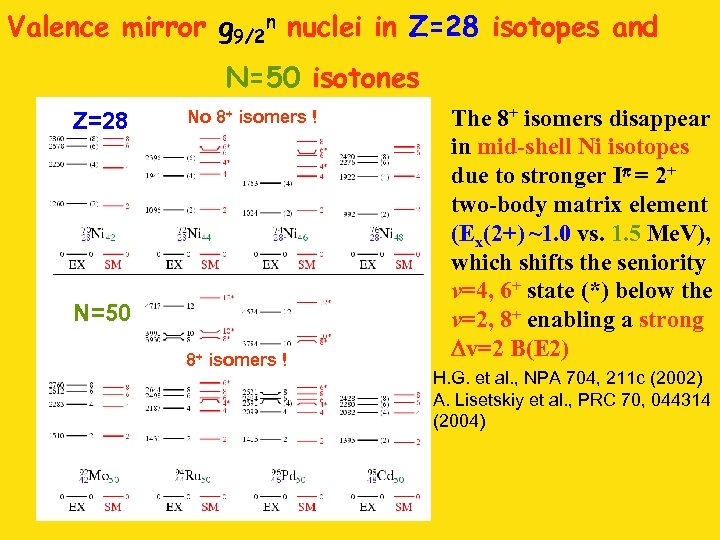 Valence mirror g 9/2 n nuclei in Z=28 isotopes and N=50 isotones Z=28 No 8+ isomers ! N=50 8+ isomers ! The 8+ isomers disappear in mid-shell Ni isotopes due to stronger Ip = 2+ two-body matrix element (Ex(2+) ~1. 0 vs. 1. 5 Me. V), which shifts the seniority v=4, 6+ state (*) below the v=2, 8+ enabling a strong Dv=2 B(E 2) H. G. et al. , NPA 704, 211 c (2002) A. Lisetskiy et al. , PRC 70, 044314 (2004)
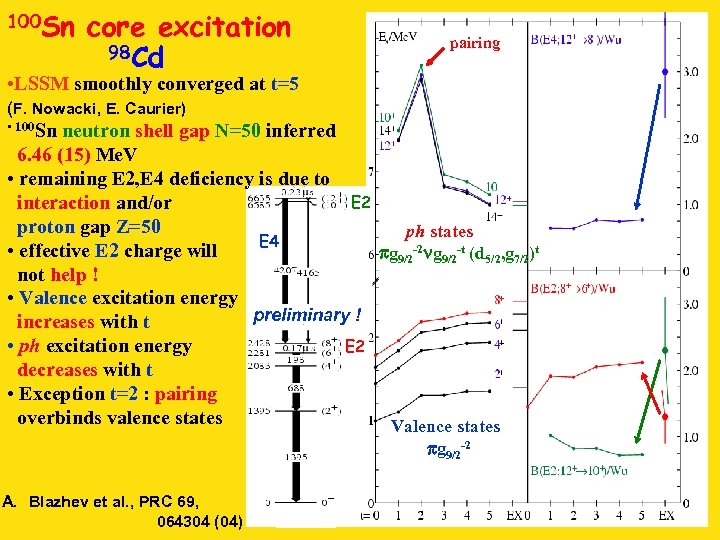 100 Sn core excitation 98 Cd pairing • LSSM smoothly converged at t=5 (F. Nowacki, E. Caurier) • 100 Sn neutron shell gap N=50 inferred 6. 46 (15) Me. V • remaining E 2, E 4 deficiency is due to E 2 interaction and/or proton gap Z=50 ph states E 4 • effective E 2 charge will pg 9/2 -2 ng 9/2 -t (d 5/2, g 7/2)t A. Blazhev et al. , PRC 69, 064304 not help ! • Valence excitation energy preliminary ! increases with t • ph excitation energy E 2 decreases with t • Exception t=2 : pairing overbinds valence states Valence states pg 9/2 -2 A. Blazhev et al. , PRC 69, 064304 (04)
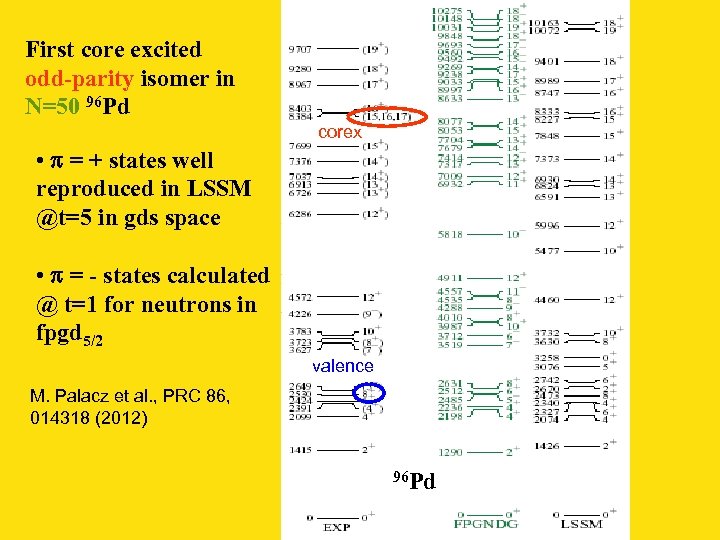 First core excited odd-parity isomer in N=50 96 Pd corex • p = + states well reproduced in LSSM @t=5 in gds space • p = - states calculated @ t=1 for neutrons in fpgd 5/2 valence M. Palacz et al. , PRC 86, 014318 (2012) 96 Pd
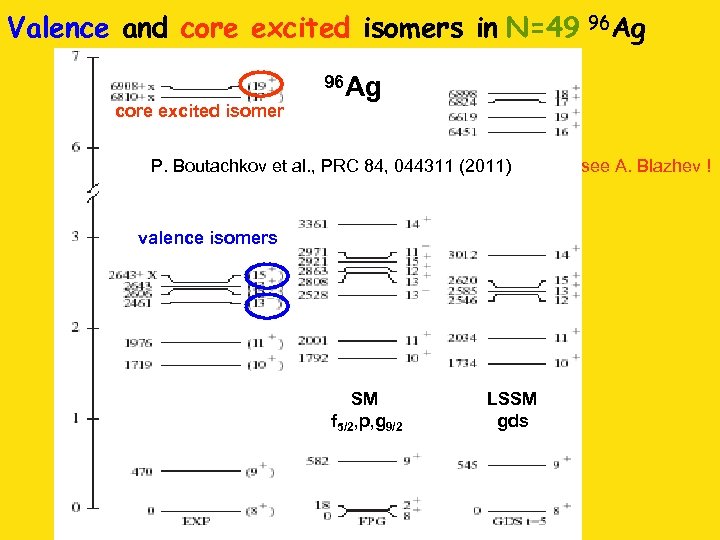 Valence and core excited isomers in N=49 96 Ag core excited isomer 96 Ag P. Boutachkov et al. , PRC 84, 044311 (2011) valence isomers SM f 5/2, p, g 9/2 LSSM gds see A. Blazhev !
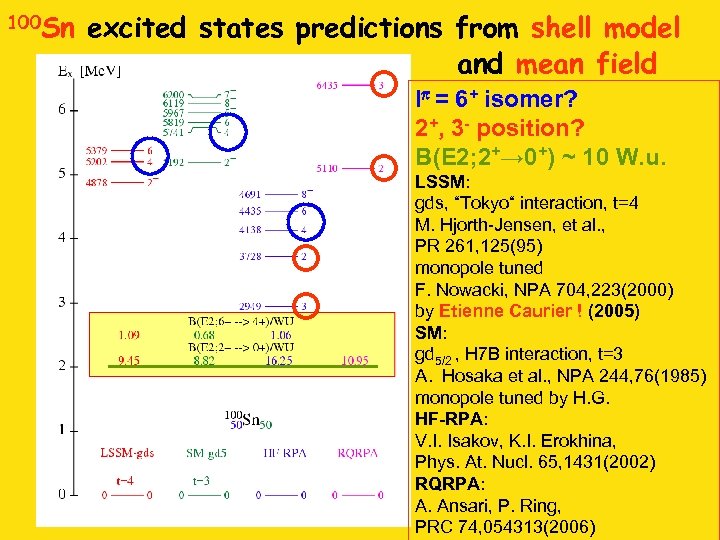 100 Sn excited states predictions from shell model and mean field Ip = 6+ isomer? 2+, 3 - position? B(E 2; 2+→ 0+) ~ 10 W. u. LSSM: gds, “Tokyo“ interaction, t=4 M. Hjorth-Jensen, et al. , PR 261, 125(95) monopole tuned F. Nowacki, NPA 704, 223(2000) by Etienne Caurier ! (2005) SM: gd 5/2 , H 7 B interaction, t=3 A. Hosaka et al. , NPA 244, 76(1985) monopole tuned by H. G. HF-RPA: V. I. Isakov, K. I. Erokhina, Phys. At. Nucl. 65, 1431(2002) RQRPA: A. Ansari, P. Ring, PRC 74, 054313(2006)
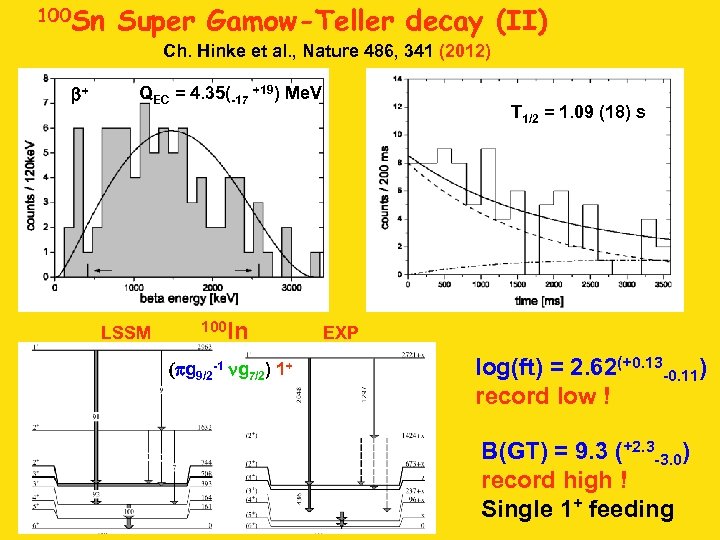 100 Sn Super Gamow-Teller decay (II) Ch. Hinke et al. , Nature 486, 341 (2012) b+ QEC = 4. 35(-17 +19) Me. V LSSM 100 In (pg 9/2 -1 ng 7/2) 1+ T 1/2 = 1. 09 (18) s EXP log(ft) = 2. 62(+0. 13 -0. 11) record low ! B(GT) = 9. 3 (+2. 3 -3. 0) record high ! Single 1+ feeding
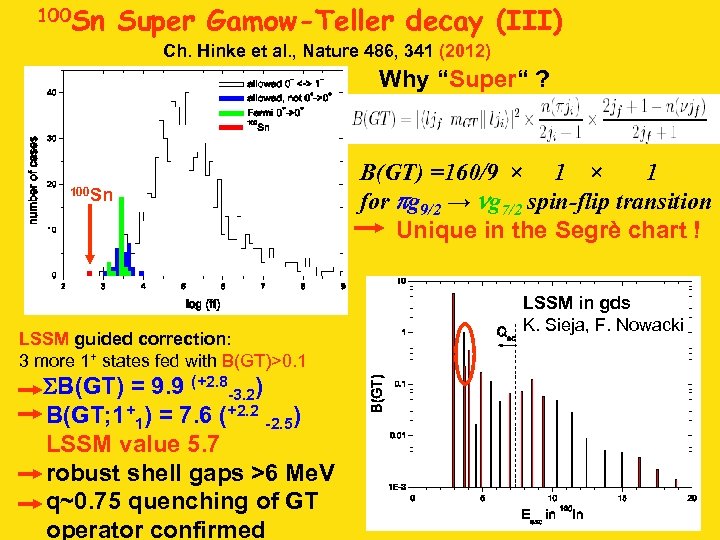 100 Sn Super Gamow-Teller decay (III) Ch. Hinke et al. , Nature 486, 341 (2012) Why “Super“ ? 100 Sn LSSM guided correction: 3 more 1+ states fed with B(GT)>0. 1 SB(GT) = 9. 9 (+2. 8 -3. 2) B(GT; 1+1) = 7. 6 (+2. 2 -2. 5) LSSM value 5. 7 robust shell gaps >6 Me. V q~0. 75 quenching of GT operator confirmed B(GT) =160/9 × 1 for pg 9/2 → ng 7/2 spin-flip transition Unique in the Segrè chart ! LSSM in gds K. Sieja, F. Nowacki
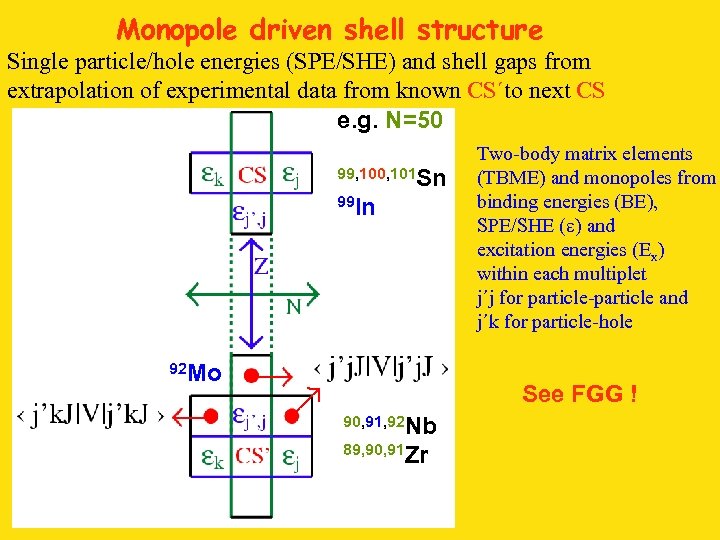 Monopole driven shell structure Single particle/hole energies (SPE/SHE) and shell gaps from extrapolation of experimental data from known CS´to next CS e. g. N=50 99, 100, 101 Sn 99 In 92 Mo Two-body matrix elements (TBME) and monopoles from binding energies (BE), SPE/SHE (e) and excitation energies (Ex) within each multiplet j´j for particle-particle and j´k for particle-hole See FGG ! 90, 91, 92 Nb 89, 90, 91 Zr
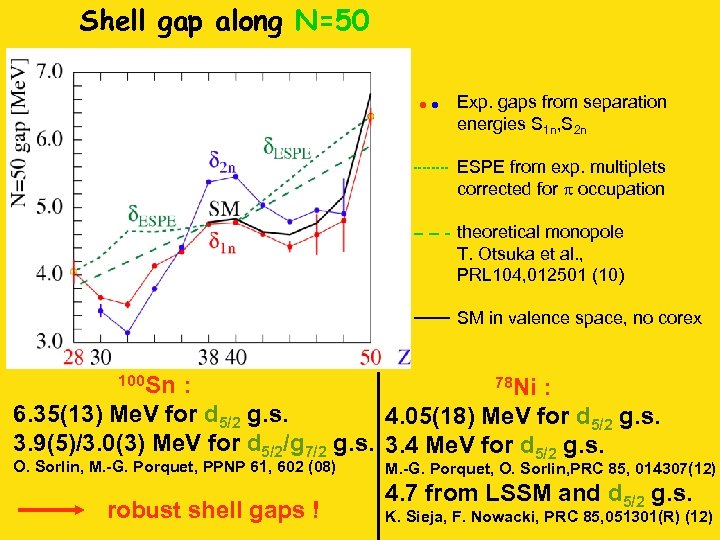 Shell gap along N=50 Exp. gaps from separation energies S 1 n, S 2 n ESPE from exp. multiplets corrected for p occupation theoretical monopole T. Otsuka et al. , PRL 104, 012501 (10) SM in valence space, no corex 100 Sn 78 Ni : : 6. 35(13) Me. V for d 5/2 g. s. 4. 05(18) Me. V for d 5/2 g. s. 3. 9(5)/3. 0(3) Me. V for d 5/2/g 7/2 g. s. 3. 4 Me. V for d 5/2 g. s. O. Sorlin, M. -G. Porquet, PPNP 61, 602 (08) robust shell gaps ! M. -G. Porquet, O. Sorlin, PRC 85, 014307(12) 4. 7 from LSSM and d 5/2 g. s. K. Sieja, F. Nowacki, PRC 85, 051301(R) (12)
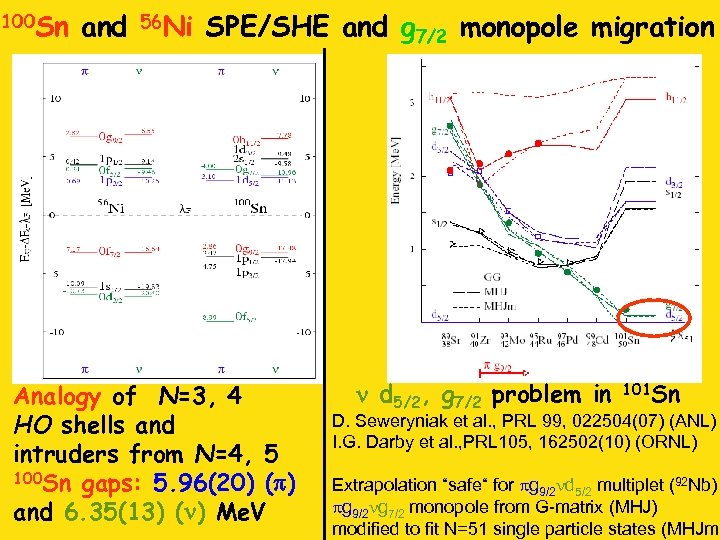 100 Sn and 56 Ni SPE/SHE and g 7/2 monopole migration Analogy of N=3, 4 HO shells and intruders from N=4, 5 100 Sn gaps: 5. 96(20) (p) and 6. 35(13) (n) Me. V n d 5/2, g 7/2 problem in 101 Sn D. Seweryniak et al. , PRL 99, 022504(07) (ANL) I. G. Darby et al. , PRL 105, 162502(10) (ORNL) Extrapolation “safe“ for pg 9/2 nd 5/2 multiplet (92 Nb) pg 9/2 ng 7/2 monopole from G-matrix (MHJ) modified to fit N=51 single particle states (MHJm)
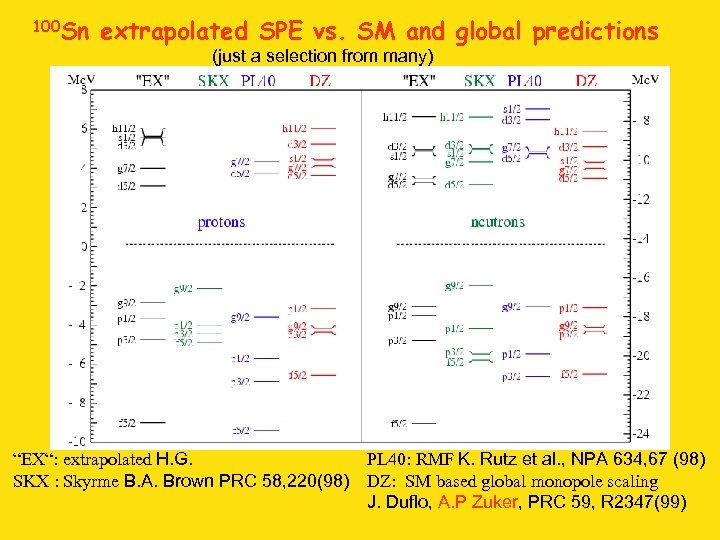 100 Sn extrapolated SPE vs. SM and global predictions (just a selection from many) “EX“: extrapolated H. G. SKX : Skyrme B. A. Brown PRC 58, 220(98) PL 40: RMF K. Rutz et al. , NPA 634, 67 (98) DZ: SM based global monopole scaling J. Duflo, A. P Zuker, PRC 59, R 2347(99)
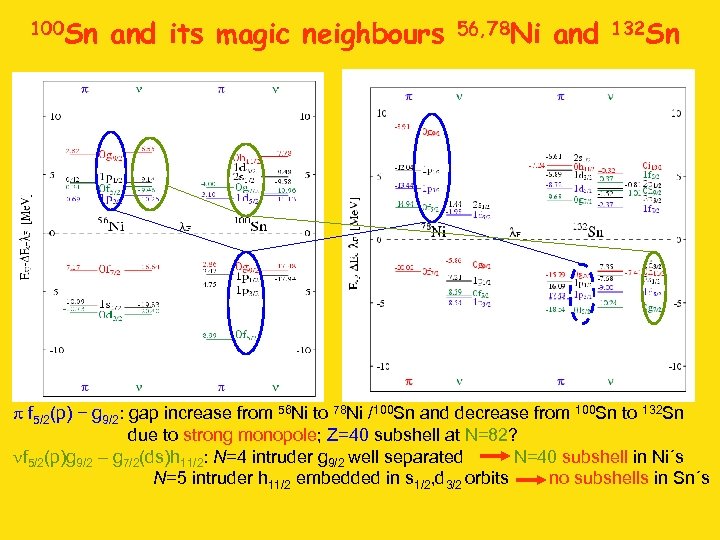 100 Sn and its magic neighbours 56, 78 Ni and 132 Sn p f 5/2(p) − g 9/2: gap increase from 56 Ni to 78 Ni /100 Sn and decrease from 100 Sn to 132 Sn due to strong monopole; Z=40 subshell at N=82? nf 5/2(p)g 9/2 – g 7/2(ds)h 11/2: N=4 intruder g 9/2 well separated N=40 subshell in Ni´s N=5 intruder h 11/2 embedded in s 1/2, d 3/2 orbits no subshells in Sn´s
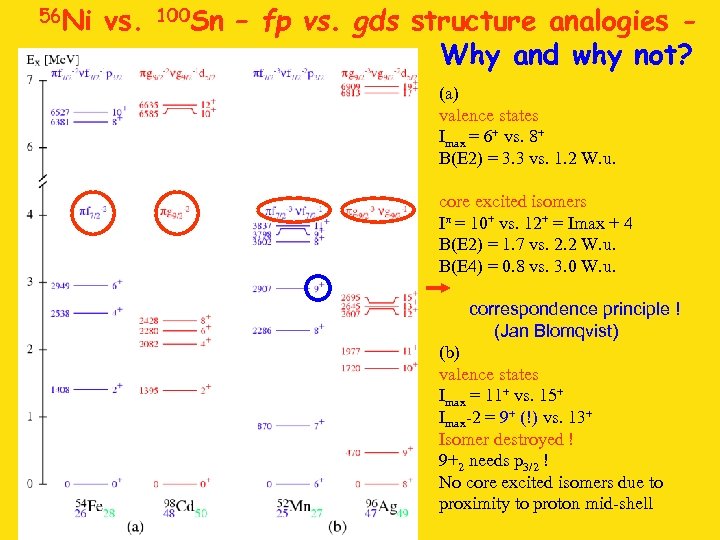 56 Ni vs. 100 Sn – fp vs. gds structure analogies Why and why not? (a) valence states Imax = 6+ vs. 8+ B(E 2) = 3. 3 vs. 1. 2 W. u. core excited isomers Ip = 10+ vs. 12+ = Imax + 4 B(E 2) = 1. 7 vs. 2. 2 W. u. B(E 4) = 0. 8 vs. 3. 0 W. u. correspondence principle ! (Jan Blomqvist) (b) valence states Imax = 11+ vs. 15+ Imax-2 = 9+ (!) vs. 13+ Isomer destroyed ! 9+2 needs p 3/2 ! No core excited isomers due to proximity to proton mid-shell
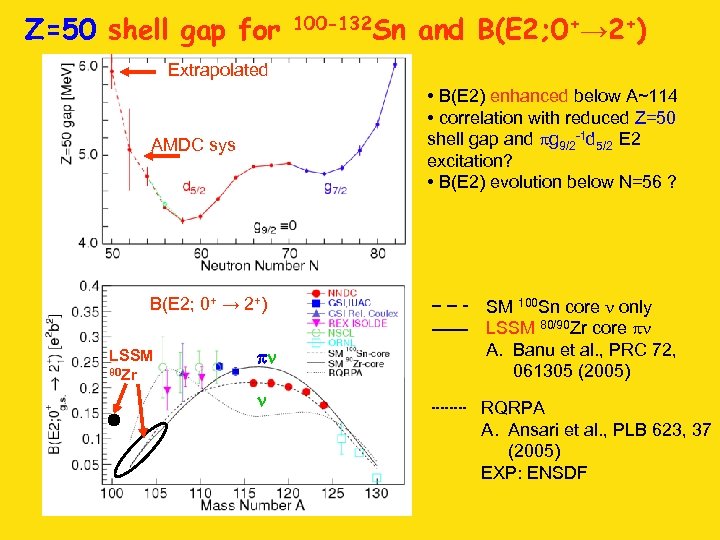 Z=50 shell gap for 100 -132 Sn and B(E 2; 0+→ 2+) Extrapolated • B(E 2) enhanced below A~114 • correlation with reduced Z=50 shell gap and pg 9/2 -1 d 5/2 E 2 excitation? • B(E 2) evolution below N=56 ? AMDC sys B(E 2; 0+ → 2+) LSSM 80 Zr pn n SM 100 Sn core n only LSSM 80/90 Zr core pn A. Banu et al. , PRC 72, 061305 (2005) RQRPA A. Ansari et al. , PLB 623, 37 (2005) EXP: ENSDF
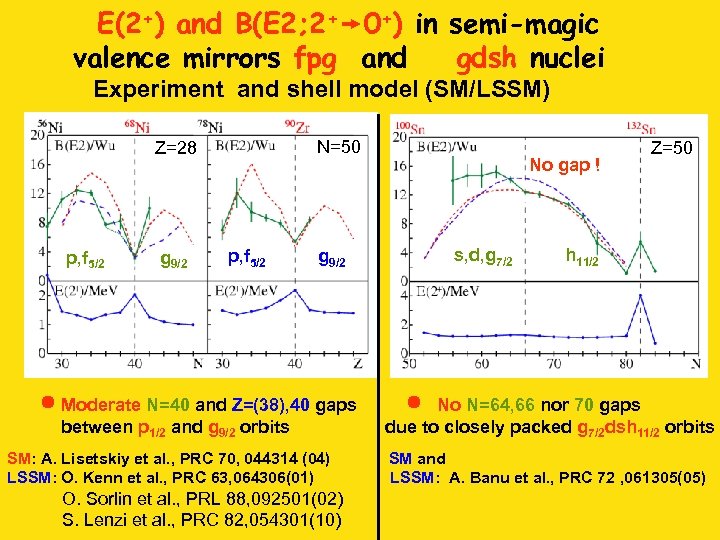 E(2+) and B(E 2; 2+ 0+) in semi-magic valence mirrors fpg and gdsh nuclei Experiment and shell model (SM/LSSM) N=50 Z=28 p, f 5/2 g 9/2 Moderate N=40 and Z=(38), 40 gaps between p 1/2 and g 9/2 orbits SM: A. Lisetskiy et al. , PRC 70, 044314 (04) LSSM: O. Kenn et al. , PRC 63, 064306(01) O. Sorlin et al. , PRL 88, 092501(02) S. Lenzi et al. , PRC 82, 054301(10) No gap ! s, d, g 7/2 Z=50 h 11/2 No N=64, 66 nor 70 gaps due to closely packed g 7/2 dsh 11/2 orbits SM and LSSM: A. Banu et al. , PRC 72 , 061305(05)
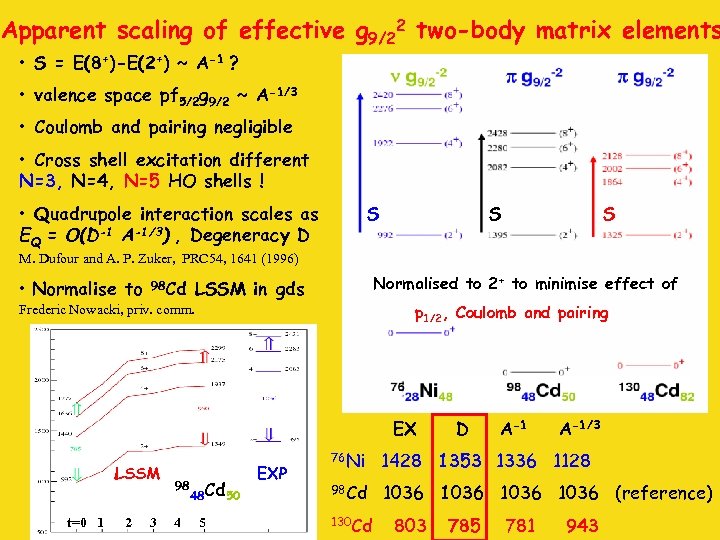 Apparent scaling of effective g 9/22 two-body matrix elements • S = E(8+)-E(2+) ~ A-1 ? • valence space pf 5/2 g 9/2 ~ A-1/3 • Coulomb and pairing negligible • Cross shell excitation different N=3, N=4, N=5 HO shells ! • Quadrupole interaction scales as EQ = O(D-1 A-1/3) , Degeneracy D S S S M. Dufour and A. P. Zuker, PRC 54, 1641 (1996) • Normalise to 98 Cd Normalised to 2+ to minimise effect of LSSM in gds p 1/2, Coulomb and pairing Frederic Nowacki, priv. comm. EX LSSM t=0 1 2 3 98 4 48 Cd 50 5 EXP D A-1/3 76 Ni 1428 1353 1336 1128 98 Cd 1036 (reference) 130 Cd 803 785 781 943
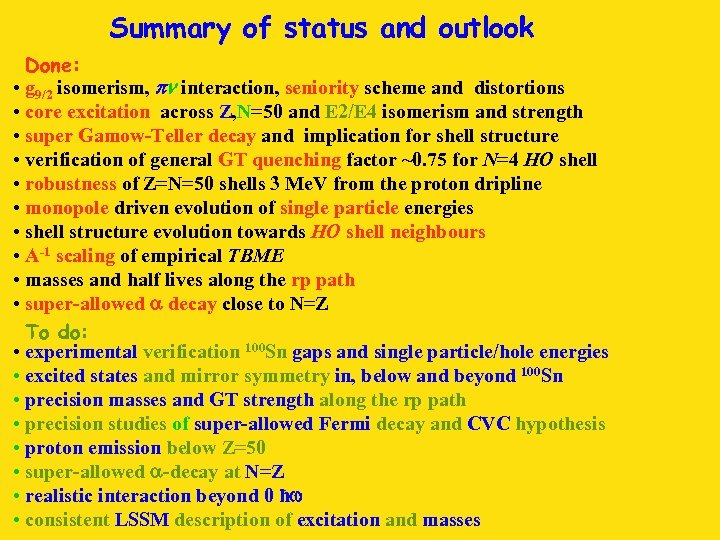 Summary of status and outlook Done: • g 9/2 isomerism, pn interaction, seniority scheme and distortions • core excitation across Z, N=50 and E 2/E 4 isomerism and strength • super Gamow-Teller decay and implication for shell structure • verification of general GT quenching factor ~0. 75 for N=4 HO shell • robustness of Z=N=50 shells 3 Me. V from the proton dripline • monopole driven evolution of single particle energies • shell structure evolution towards HO shell neighbours • A-1 scaling of empirical TBME • masses and half lives along the rp path • super-allowed a decay close to N=Z To do: • experimental verification 100 Sn gaps and single particle/hole energies • excited states and mirror symmetry in, below and beyond 100 Sn • precision masses and GT strength along the rp path • precision studies of super-allowed Fermi decay and CVC hypothesis • proton emission below Z=50 • super-allowed a-decay at N=Z • realistic interaction beyond 0 ħ • consistent LSSM description of excitation and masses
 Collaborations EUROBALL I-IV, the home of European Gamma Arrays RISING Rare ISotope INvestigation at GSI EURICA EUroball Riken Cluster Array Pre. SPEC Pre- (HI-DE-SPEC) campaign @GSI plus AGATA Advanced Gamma Tracking Array SM 2 Strasbourg-Madrid Shell Model Special thanks go to: A. T. G. K. Blazhev, P. Boutachkov, B. A. Brown, E. Caurier, Faestermann, M. Górska, Ch. Hinke, M. Hjorth-Jensen, Martinez-Pinedo, B. S. Nara Singh, F. Nowacki, T. Otsuka, Sieja