


 Скачать презентацию The Quality of U S and Florida Math
2336a6e6b0b243902a5acfd5846e5584.ppt
- Количество слайдов: 64
 The Quality of U. S. and Florida Math Instruction Compared with Singapore, a Recognized World Leader Florida Mathematics Standards September 2006 Tallahassee, Florida Alan Ginsburg* U. S. Department of Education *Opinions are those of the presenters and do not necessarily reflect the views of the U. S. Department of Education 1
 Presentation Outline 1. Singapore’s world-class math performance 2. Overview of Singapore’s education system 3. Comparison of Singapore-Florida math standards 4. Comparison of Singapore-U. S. on other math system components : textbooks, assessments and teachers 5. Results of Singapore textbook pilots in the U. S. 6. Implications for adopting/adapting Singapore approaches to improve Florida’s math results 2
 Singapore Has a World-class Mathematics System with Quality Components Aligned to Produce Students Who Learn Mathematics to Mastery l Highly logical national mathematics standards l Mathematically rich problem-based textbooks l Challenging mathematics assessments l Highly qualified mathematics teachers whose pedagogy centers on teaching to mastery l Special assistance from an expert teacher to its mathematically slower students along with an alternative framework 3
 1. Mathematics Performance Why Care About U. S. Primary-Level? l “In our K-12 we were doing okay at the fourth-grade level, we were doing middle-of-the-road in the eighth grade, and by twelve grade we were hovering near the bottom in international tests related to math. ” Tracy Koon, Intel’s director of corporate affairs, quoted in T. Friedman, The World Is Flat (2005) 4
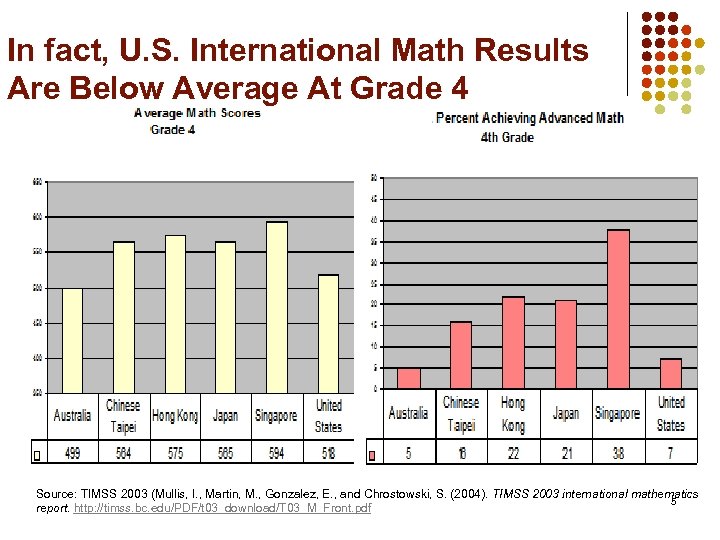 In fact, U. S. International Math Results Are Below Average At Grade 4 Source: TIMSS 2003 (Mullis, I. , Martin, M. , Gonzalez, E. , and Chrostowski, S. (2004). TIMSS 2003 international mathematics 5 report. http: //timss. bc. edu/PDF/t 03_download/T 03_M_Front. pdf
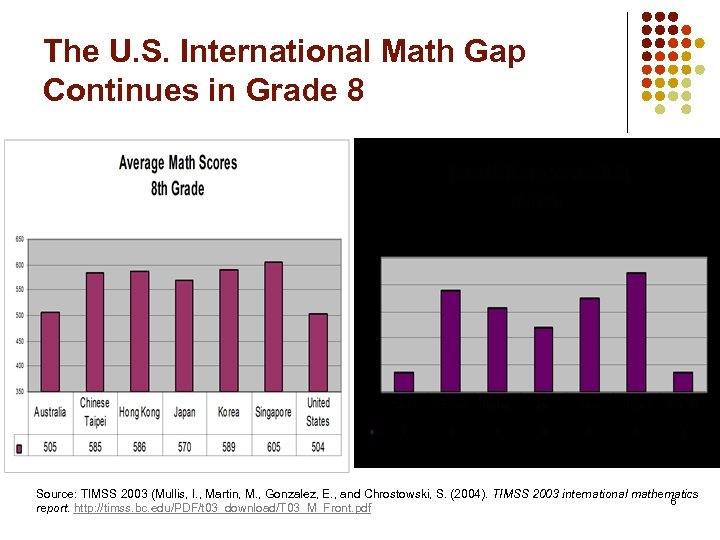 The U. S. International Math Gap Continues in Grade 8 Source: TIMSS 2003 (Mullis, I. , Martin, M. , Gonzalez, E. , and Chrostowski, S. (2004). TIMSS 2003 international mathematics 6 report. http: //timss. bc. edu/PDF/t 03_download/T 03_M_Front. pdf
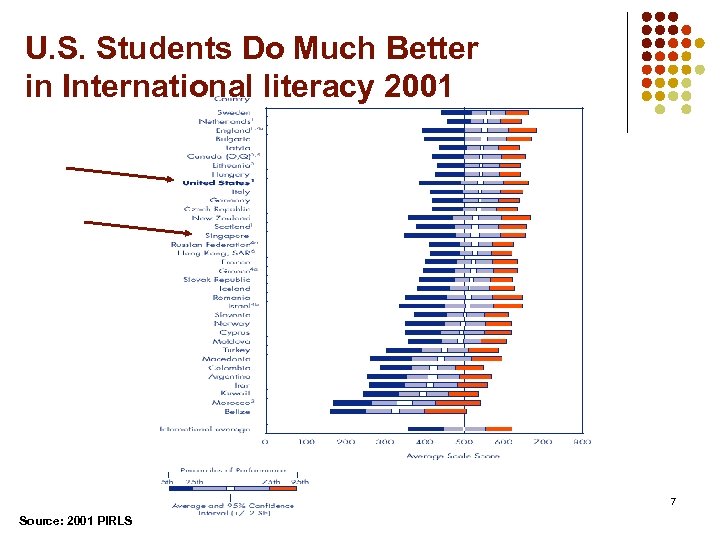 U. S. Students Do Much Better in International literacy 2001 7 Source: 2001 PIRLS
 Mathematics Are Gateway Courses to College and Jobs l COLLEGE. 71 percent of low-income students who took algebra I and geometry went to college, only 27 percent of low-income students who did not take algebra I and geometry went on to college. (U. S. Dept. of Education) l JOBS. An applicant for a production associate’s job at a modern automobile plant would have to score roughly 300 points or higher on the NAEP math test to meet company proficiency requirements -- almost half of all 17 -year-olds cannot do math at that level. (Murnane & Levy, Teaching the New Basic Skills) 8
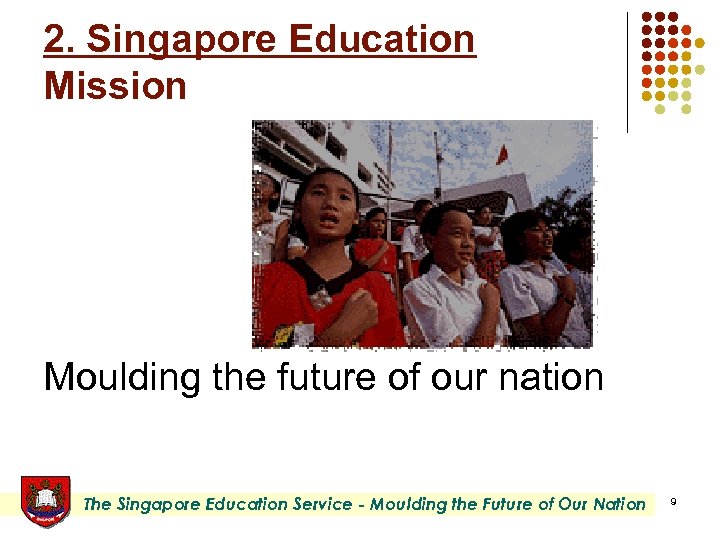 2. Singapore Education Mission Moulding the future of our nation The Singapore Education Service - Moulding the Future of Our Nation 9
 Primary System Emphasis on Learning Core Content l Literacy & Numeracy l Bilingualism English language as the medium of instruction l Every child would have the opportunity to learn his/her mother tongue to as high a level as he/she is capable of l The Singapore Education Service - Moulding the Future of Our Nation 10
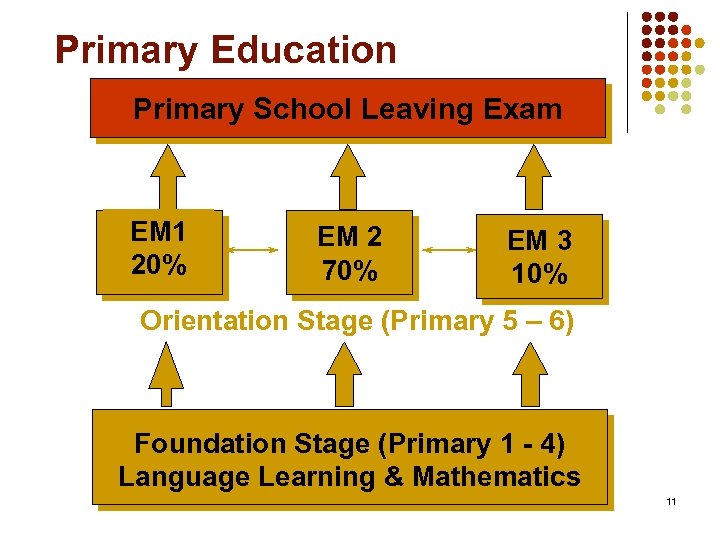 Primary Education Primary School Leaving Exam EM 1 20% EM 2 70% EM 3 10% Orientation Stage (Primary 5 – 6) Foundation Stage (Primary 1 - 4) Language Learning & Mathematics 11
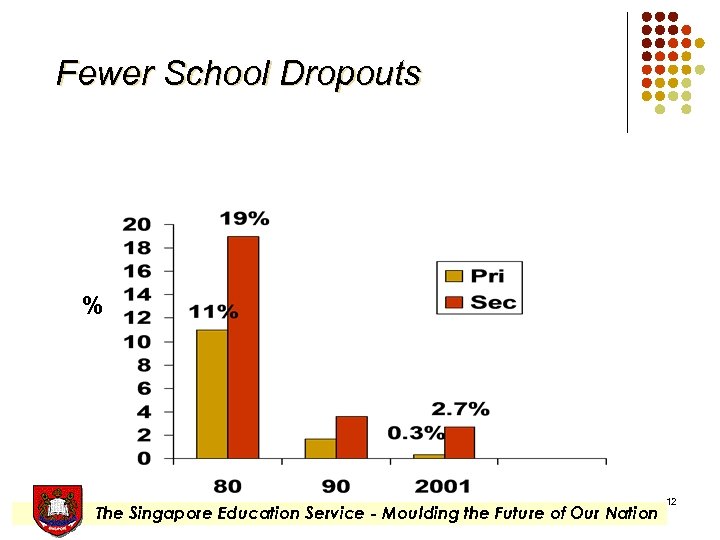 Fewer School Dropouts % Year The Singapore Education Service - Moulding the Future of Our Nation 12
 Is Singapore Too Different from the U. S. ? l Size: 500, 000 Pupils: A little bigger than the Chicago Public Schools and a little smaller than Connecticut. l Population: Racially diverse student body: 75% Chinese, 15% Malaysian, and 10 % Indian l Work ethic: Singapore students are 2. 5 times as likely as U. S. students to receive high-levels of math homework (8 th grade TIMSS). 13
 Singapore Workers Are Strong on Implementation, Weaker on Innovation l “We come from a very conscientious culture. You tell our people what to do, they’ll follow the rules, they’ll do it. The downside is they are not as creative. We fixed that by having a U. S-based R&D team that’s doing more advanced research. ” Sim Wong Hoo CEO Creative Technologies Singapore Newsweek Feb. 21, 2005 14
 3. Math Standards Should l Aim to develop in students a set of desired mathematical proficiencies l Logically and clearly organize math topics l l sequence around the internal logic of mathematics cover a few core math topics in-depth at each grade be specific and clear about content Provide for student diversity in learning math 15
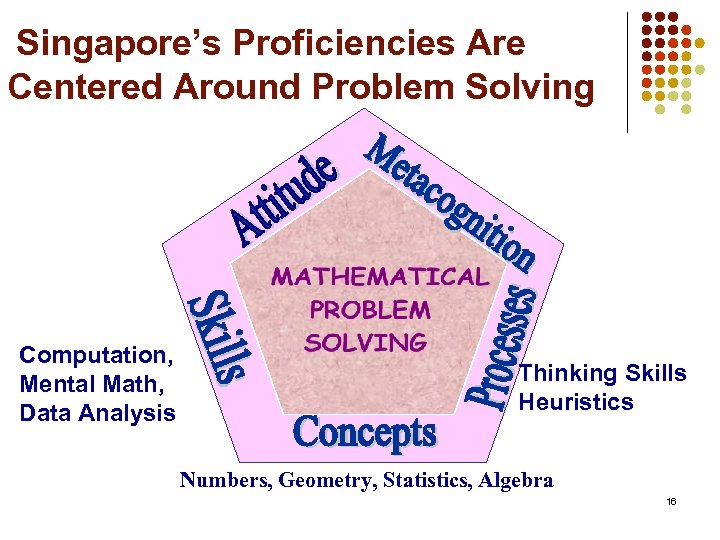 Singapore’s Proficiencies Are Centered Around Problem Solving Computation, Mental Math, Data Analysis Thinking Skills Heuristics Numbers, Geometry, Statistics, Algebra 16
 Florida’s Desired Math Proficiencies? 17
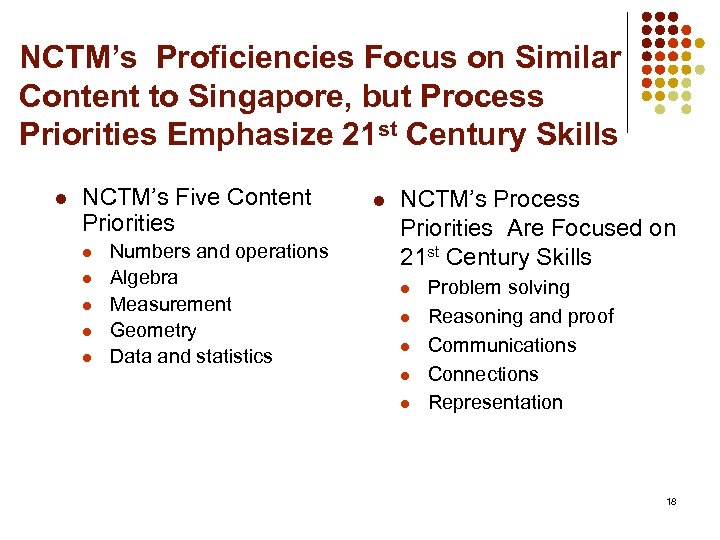 NCTM’s Proficiencies Focus on Similar Content to Singapore, but Process Priorities Emphasize 21 st Century Skills l NCTM’s Five Content Priorities l l l Numbers and operations Algebra Measurement Geometry Data and statistics l NCTM’s Process Priorities Are Focused on 21 st Century Skills l l l Problem solving Reasoning and proof Communications Connections Representation 18
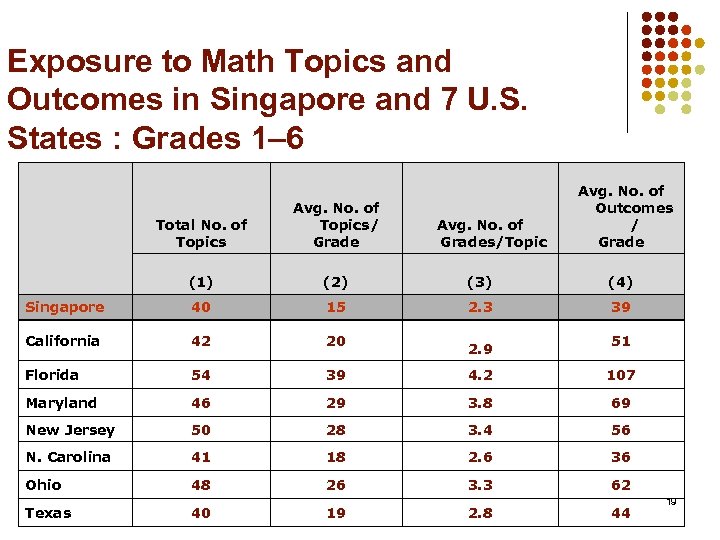 Exposure to Math Topics and Outcomes in Singapore and 7 U. S. States : Grades 1– 6 Avg. No. of Outcomes / Grade Total No. of Topics Avg. No. of Topics/ Grade (1) (2) (3) (4) Singapore 40 15 2. 3 39 California 42 20 Florida 54 39 4. 2 107 Maryland 46 29 3. 8 69 New Jersey 50 28 3. 4 56 N. Carolina 41 18 2. 6 36 Ohio 48 26 3. 3 62 Texas 40 19 2. 8 44 Avg. No. of Grades/Topic 2. 9 51 19
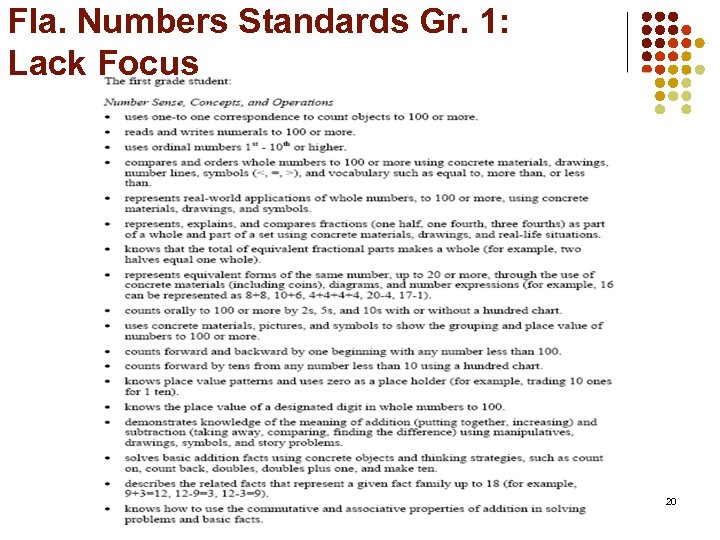 Fla. Numbers Standards Gr. 1: Lack Focus 20
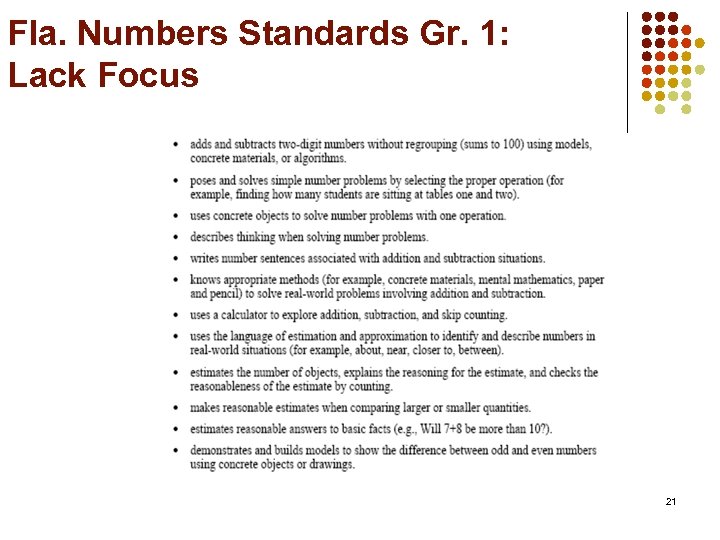 Fla. Numbers Standards Gr. 1: Lack Focus 21
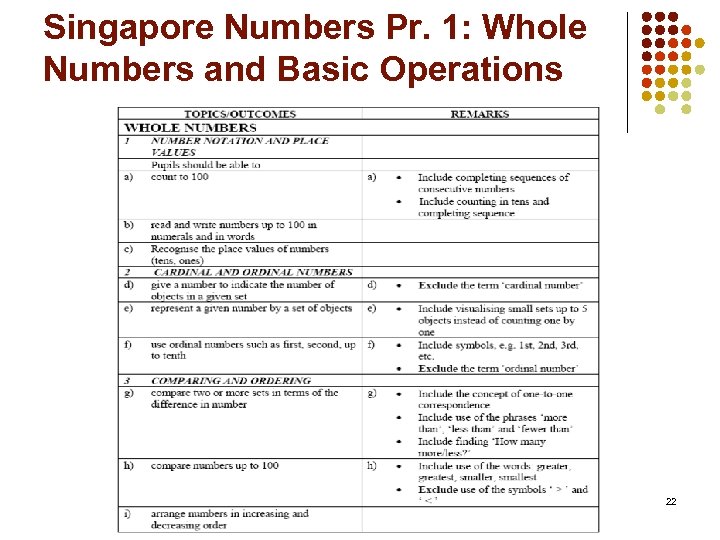 Singapore Numbers Pr. 1: Whole Numbers and Basic Operations 22
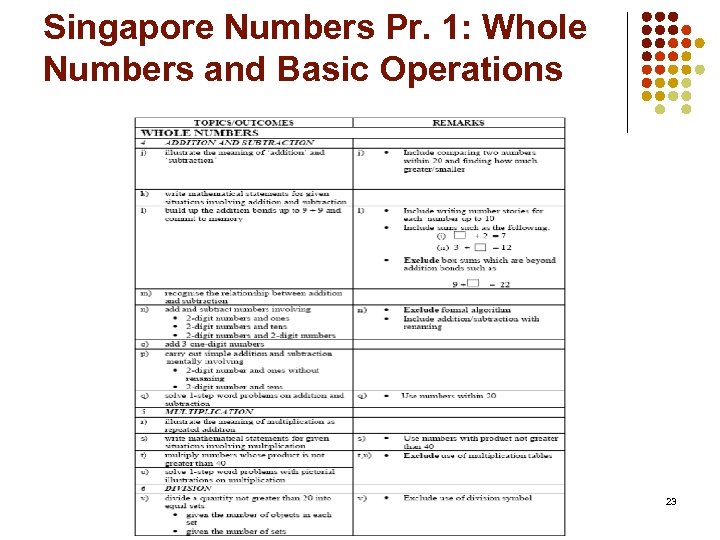 Singapore Numbers Pr. 1: Whole Numbers and Basic Operations 23
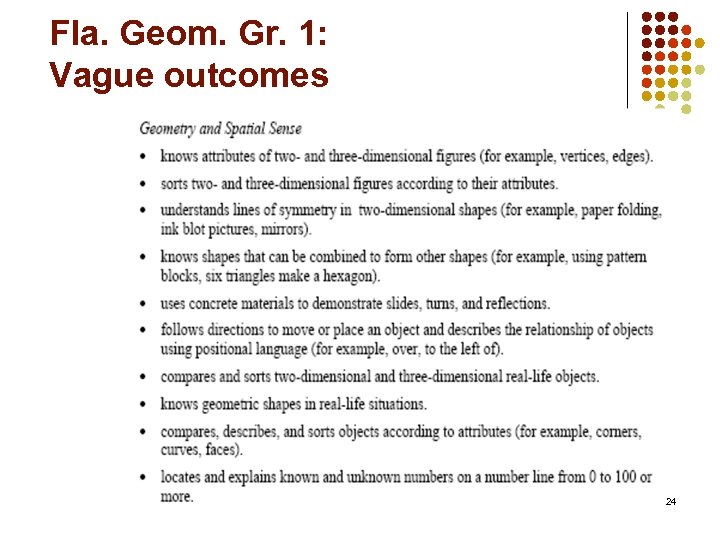 Fla. Geom. Gr. 1: Vague outcomes 24
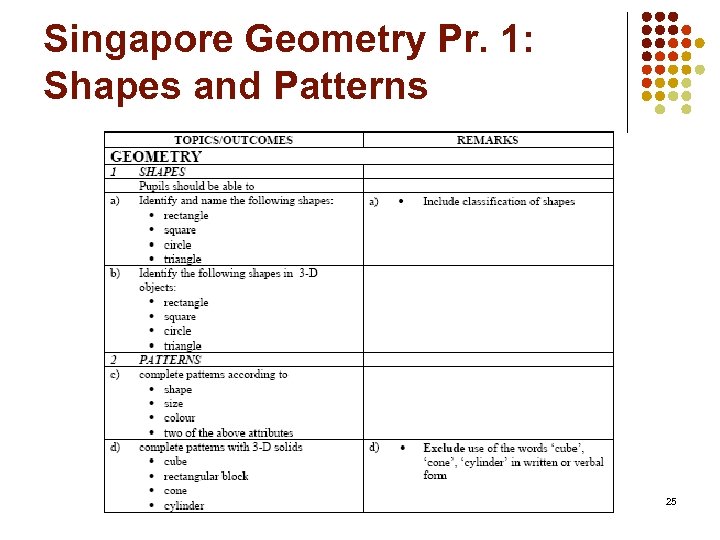 Singapore Geometry Pr. 1: Shapes and Patterns 25
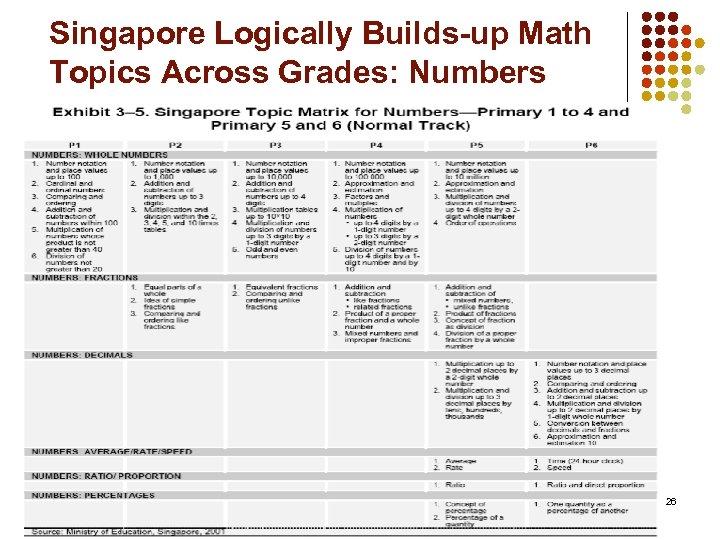 Singapore Logically Builds-up Math Topics Across Grades: Numbers 26
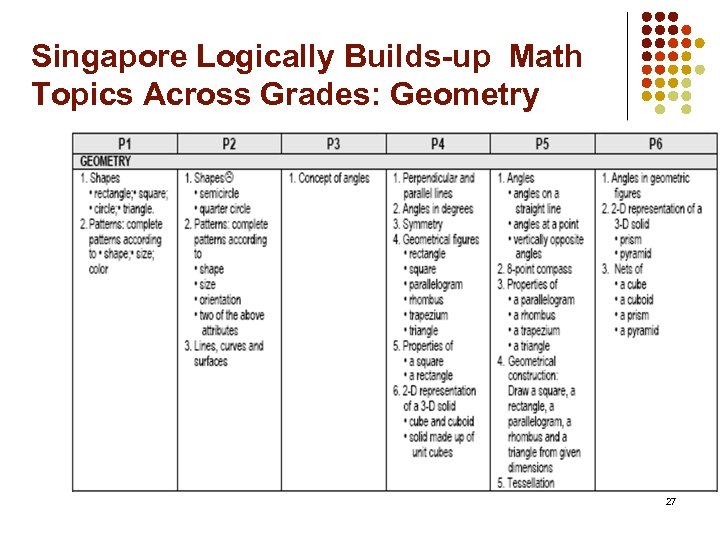 Singapore Logically Builds-up Math Topics Across Grades: Geometry 27
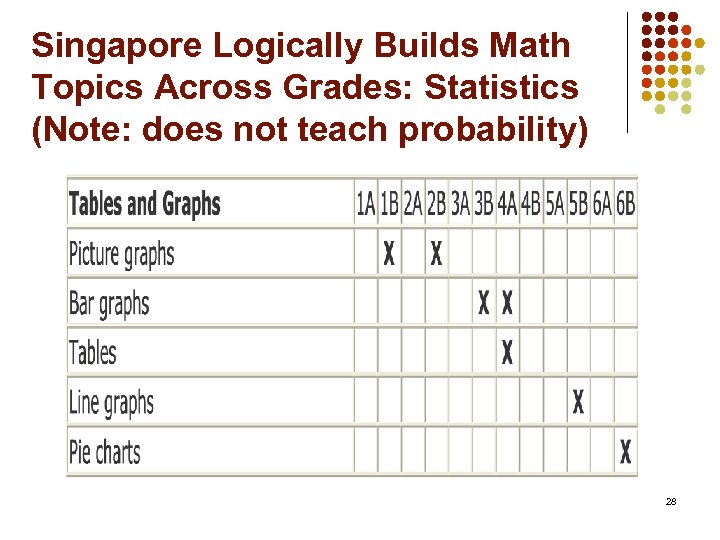 Singapore Logically Builds Math Topics Across Grades: Statistics (Note: does not teach probability) 28
 Singapore Limits Use of Calculators in Early Grades; Florida Does Not l Singapore: calculators not allowed grades 16; 2007 will allow calculators grades 5 -6. l Florida Grade 1: uses calculators to explore addition, subtraction, and skip counting 29
 Singapore’s Framework Addresses Atrisk Students: U. S. State Frameworks (including Florida) Do Not l Singapore l Identify students for supplementary after-school instruction by a specially-trained teacher (Grade 1+). l U. S. l State frameworks don’t differentiate students. Traditionally, compensatory education is often taught by untrained teacher aides. l Weaker math students identified for special track with more math instruction and similar content but at a slower pace (Grades 56) l No Child Left Behind holds students to same standards and highly-qualified teachers. l Students are streamed based on their Primary School Leaving Exam scores(Grade 7+) l No Child Left Behind holds schools rather than students 30 accountable.
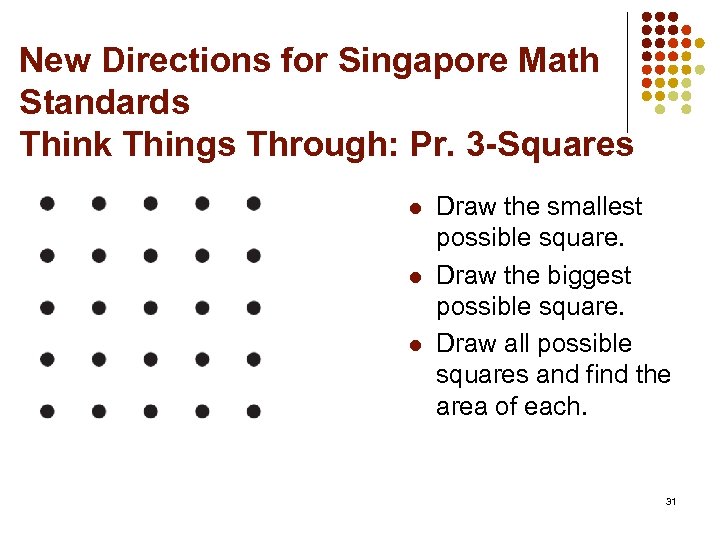 New Directions for Singapore Math Standards Think Things Through: Pr. 3 -Squares l l l Draw the smallest possible square. Draw the biggest possible square. Draw all possible squares and find the area of each. 31
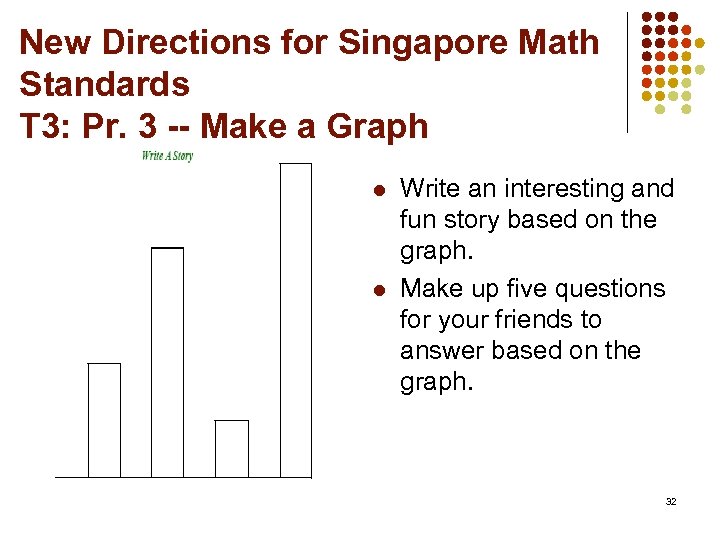 New Directions for Singapore Math Standards T 3: Pr. 3 -- Make a Graph l l Write an interesting and fun story based on the graph. Make up five questions for your friends to answer based on the graph. 32
 New Directions for Standards: China Integrates Science Into Math to Foster Applications l “In math during the middle school and high school period, China tries to link math more closely with science problems. The purposes of this are as follows: l To adapt to the increasing tendency of science development. Chinese educators and scientists believe that integration could be one of the developmental directions. l To make math more vivid and less boring. Math could not be just logical explanations and abstract signals any longer and might have something to do with everybody’s daily life. l To train student scientific spirit. Students shall be prepared to develop creativity and be ready to solve practical problems, not just memorizing this and that. ” MOE China 33
 Science Examples Could Support Different Math Strands l Geometry: Vectors forces l Algebraic equations: F=MA (linear); projectile motion (parabolic) l Numbers: Speed of light l Statistics and measurement: inquiry science 34
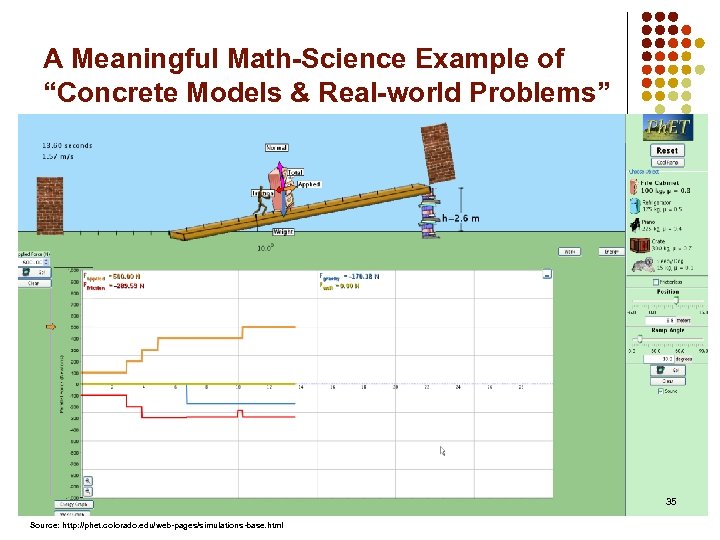 A Meaningful Math-Science Example of “Concrete Models & Real-world Problems” 35 Source: http: //phet. colorado. edu/web-pages/simulations-base. html
 4. Comparison of Singapore-U. S. on other math system components a. Textbooks b. Assessments c. Teachers 36
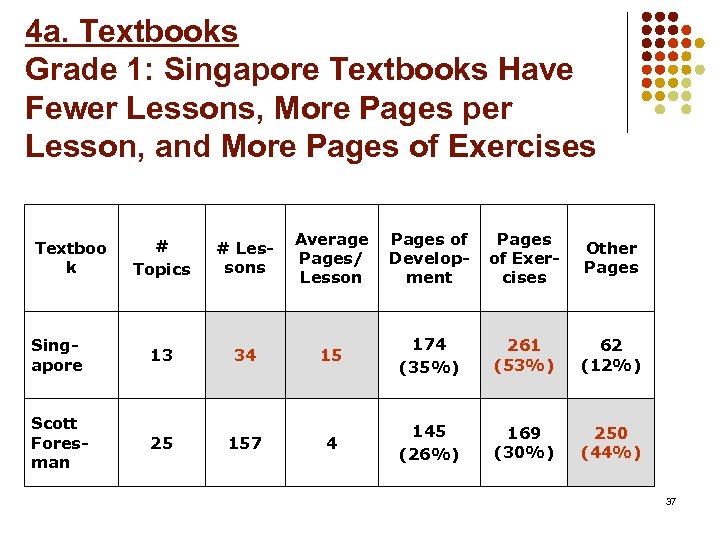 4 a. Textbooks Grade 1: Singapore Textbooks Have Fewer Lessons, More Pages per Lesson, and More Pages of Exercises # Topics # Lessons Average Pages/ Lesson Pages of Development Pages of Exercises Other Pages Singapore 13 34 15 174 (35%) 261 (53%) 62 (12%) Scott Foresman 25 157 4 145 (26%) 169 (30%) 250 (44%) Textboo k 37
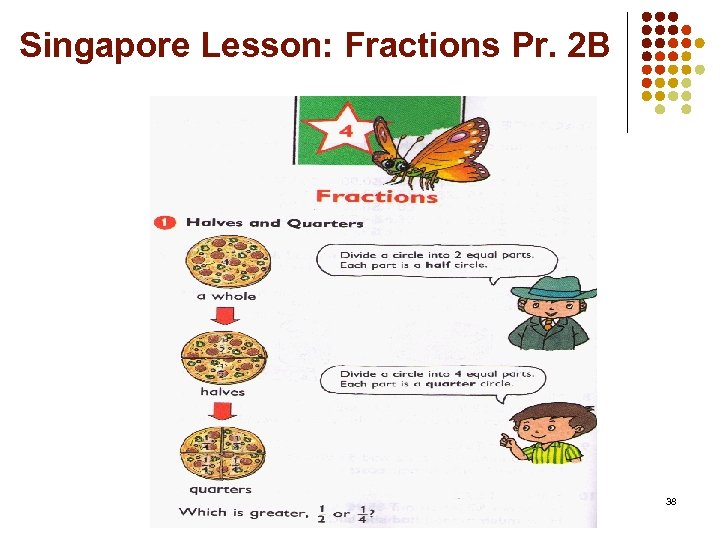 Singapore Lesson: Fractions Pr. 2 B 38
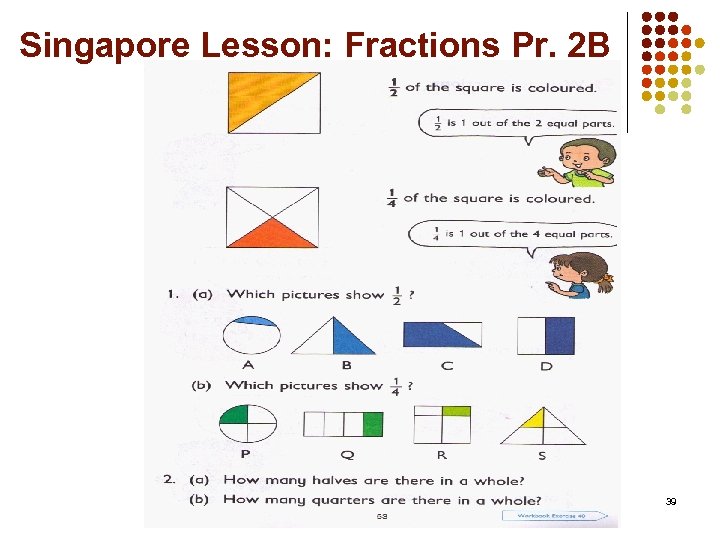 Singapore Lesson: Fractions Pr. 2 B 39
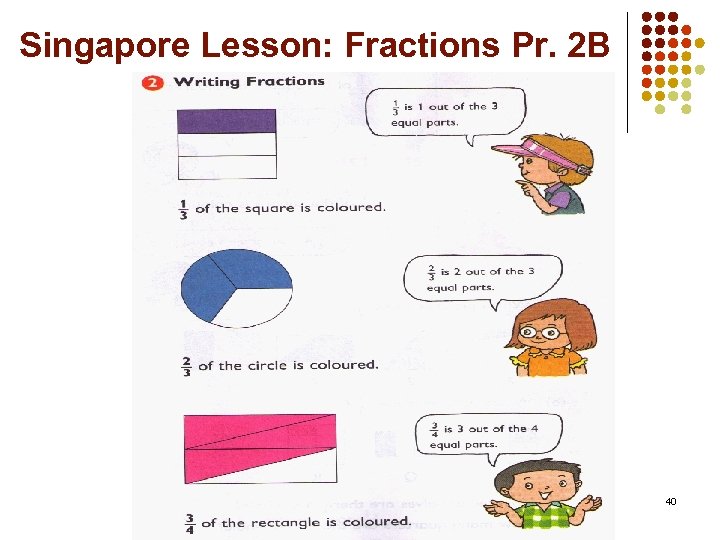 Singapore Lesson: Fractions Pr. 2 B 40
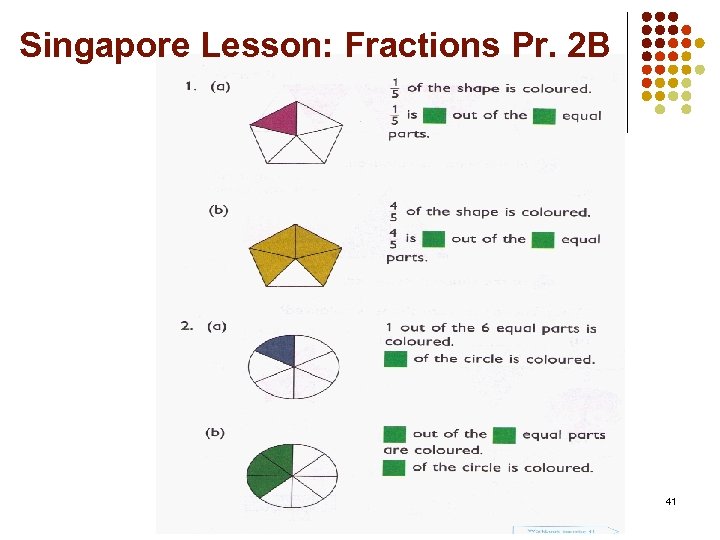 Singapore Lesson: Fractions Pr. 2 B 41
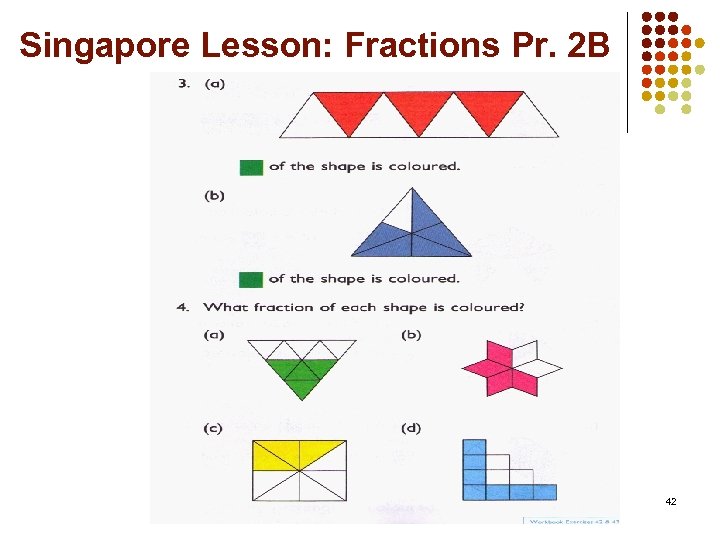 Singapore Lesson: Fractions Pr. 2 B 42
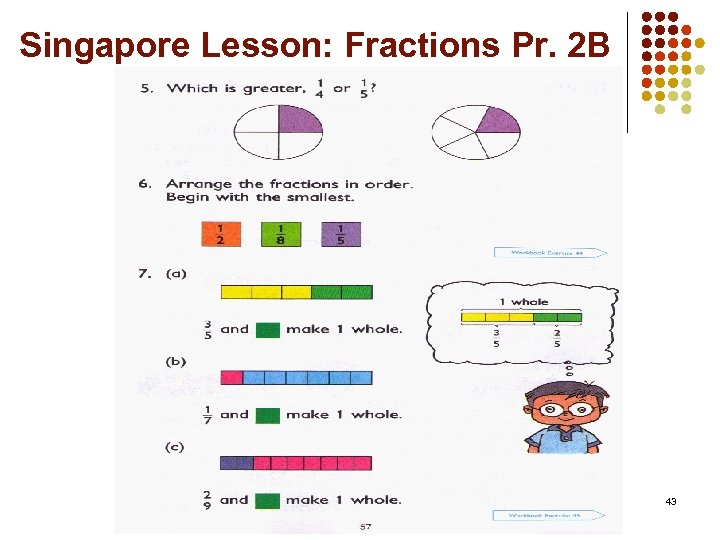 Singapore Lesson: Fractions Pr. 2 B 43
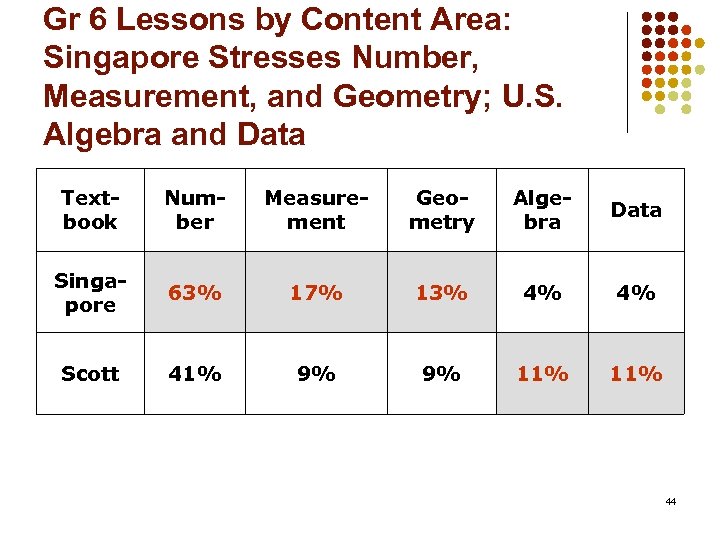 Gr 6 Lessons by Content Area: Singapore Stresses Number, Measurement, and Geometry; U. S. Algebra and Data Textbook Number Measurement Geometry Algebra Data Singapore 63% 17% 13% 4% 4% Scott 41% 9% 9% 11% 44
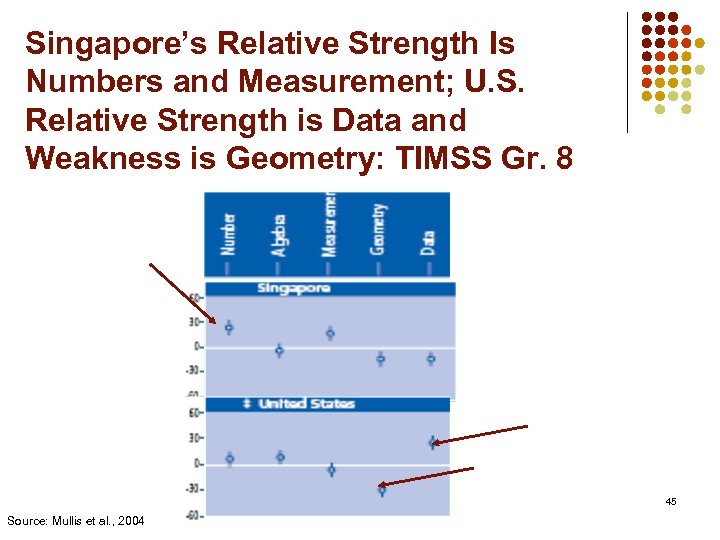 Singapore’s Relative Strength Is Numbers and Measurement; U. S. Relative Strength is Data and Weakness is Geometry: TIMSS Gr. 8 45 Source: Mullis et al. , 2004
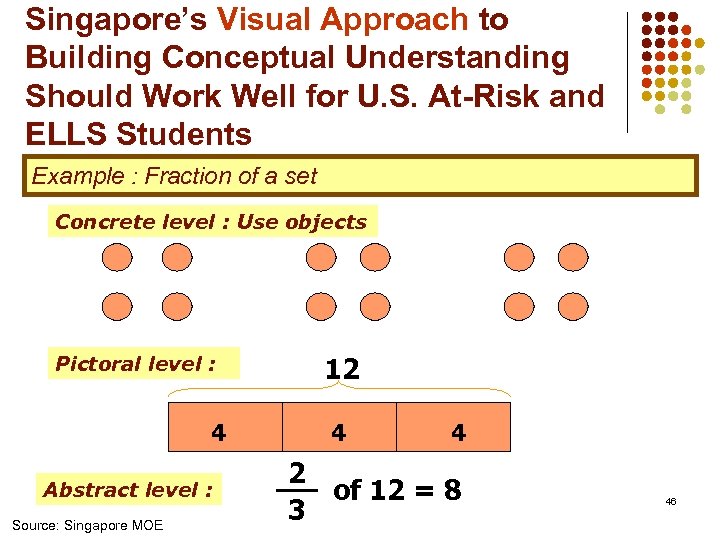 Singapore’s Visual Approach to Building Conceptual Understanding Should Work Well for U. S. At-Risk and ELLS Students Example : Fraction of a set Concrete level : Use objects Pictoral level : 4 Abstract level : Source: Singapore MOE 12 4 4 2 of 12 = 8 3 46
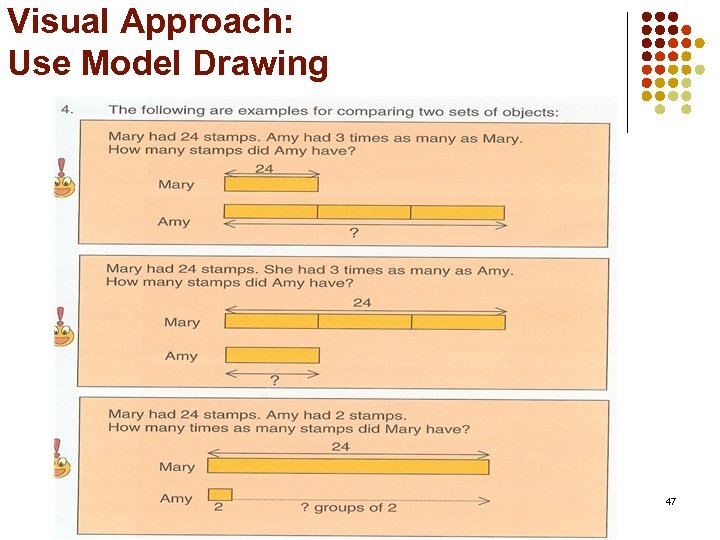 Visual Approach: Use Model Drawing 47
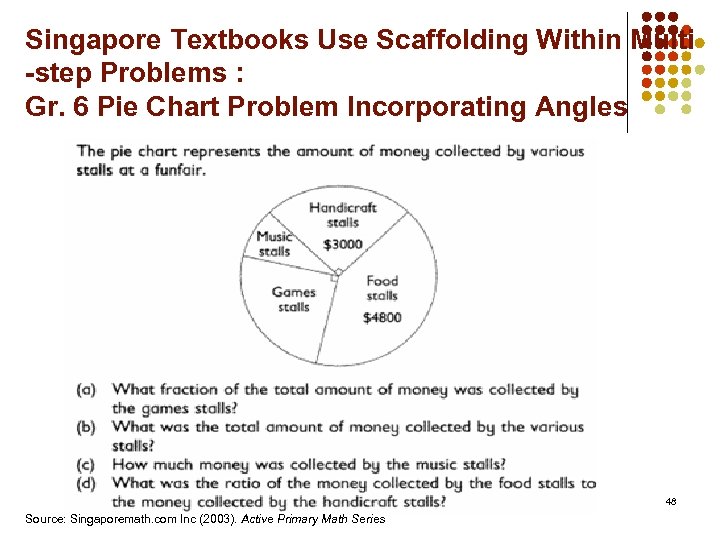 Singapore Textbooks Use Scaffolding Within Multi -step Problems : Gr. 6 Pie Chart Problem Incorporating Angles 48 Source: Singaporemath. com Inc (2003). Active Primary Math Series
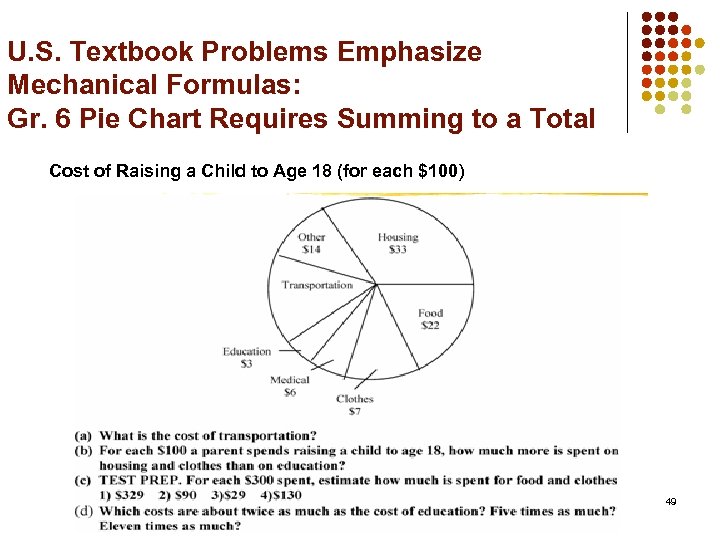 U. S. Textbook Problems Emphasize Mechanical Formulas: Gr. 6 Pie Chart Requires Summing to a Total Cost of Raising a Child to Age 18 (for each $100) 49
 4 b. Assessments What we examined l Singapore Grade 6 Primary School Leaving Exam l U. S. NAEP Grades 6 and 8 l Five State Assessments at Grades 6 and 8 50
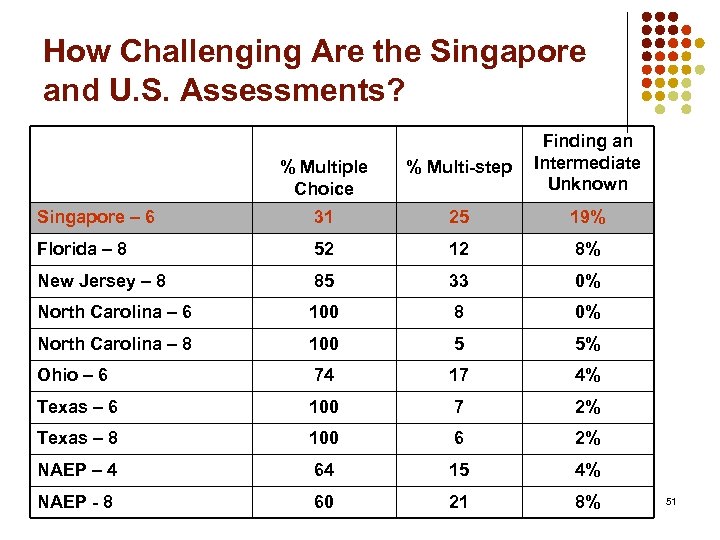 How Challenging Are the Singapore and U. S. Assessments? % Multiple Choice % Multi-step Finding an Intermediate Unknown Singapore – 6 31 25 19% Florida – 8 52 12 8% New Jersey – 8 85 33 0% North Carolina – 6 100 8 0% North Carolina – 8 100 5 5% Ohio – 6 74 17 4% Texas – 6 100 7 2% Texas – 8 100 6 2% NAEP – 4 64 15 4% NAEP - 8 60 21 8% 51
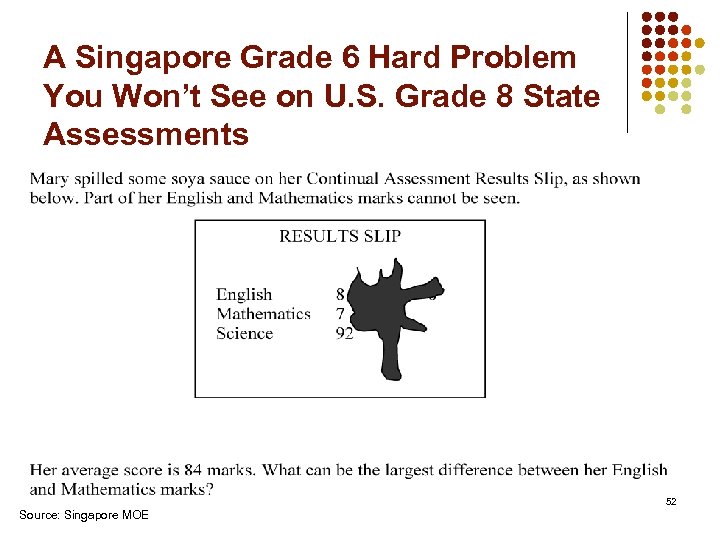 A Singapore Grade 6 Hard Problem You Won’t See on U. S. Grade 8 State Assessments 52 Source: Singapore MOE
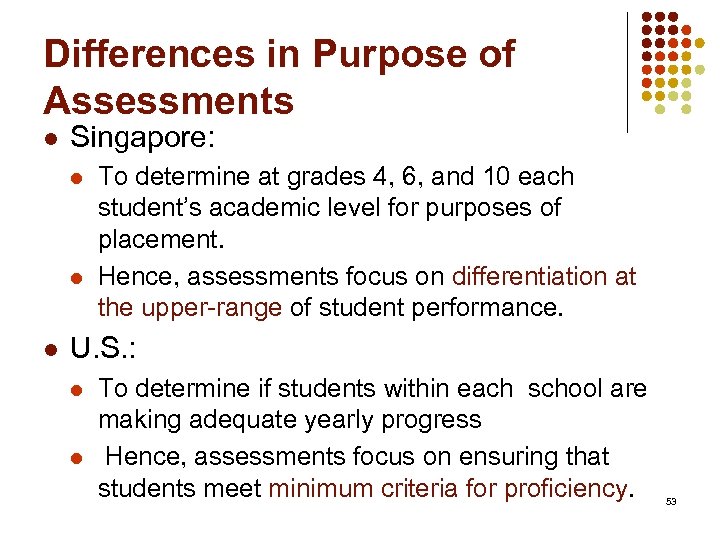 Differences in Purpose of Assessments l Singapore: l l l To determine at grades 4, 6, and 10 each student’s academic level for purposes of placement. Hence, assessments focus on differentiation at the upper-range of student performance. U. S. : l l To determine if students within each school are making adequate yearly progress Hence, assessments focus on ensuring that students meet minimum criteria for proficiency. 53
 4 c. Teachers What we looked at l Teacher preparation in Singapore’s National Institute of Education and U. S. typical schools of education. l Professional development in Singapore and U. S. 54
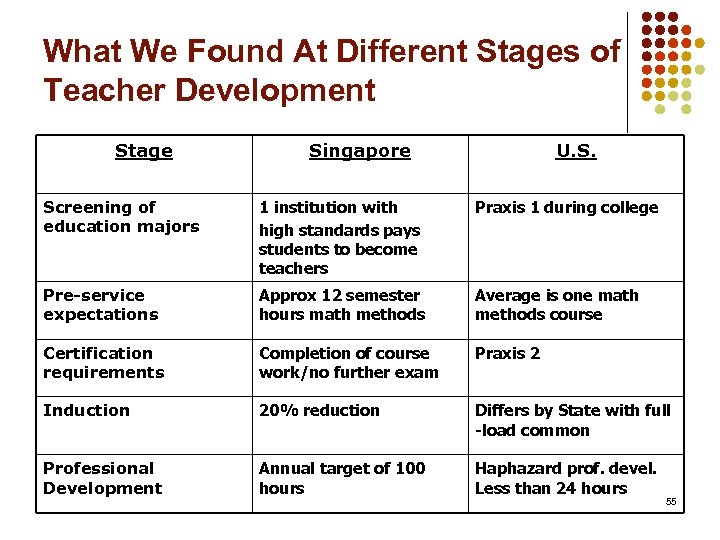 What We Found At Different Stages of Teacher Development Stage Singapore U. S. Screening of education majors 1 institution with high standards pays students to become teachers Praxis 1 during college Pre-service expectations Approx 12 semester hours math methods Average is one math methods course Certification requirements Completion of course work/no further exam Praxis 2 Induction 20% reduction Differs by State with full -load common Professional Development Annual target of 100 hours Haphazard prof. devel. Less than 24 hours 55
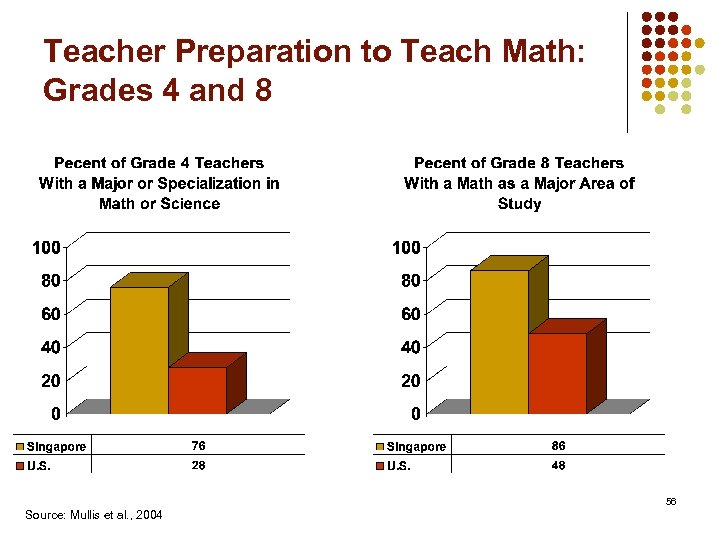 Teacher Preparation to Teach Math: Grades 4 and 8 56 Source: Mullis et al. , 2004
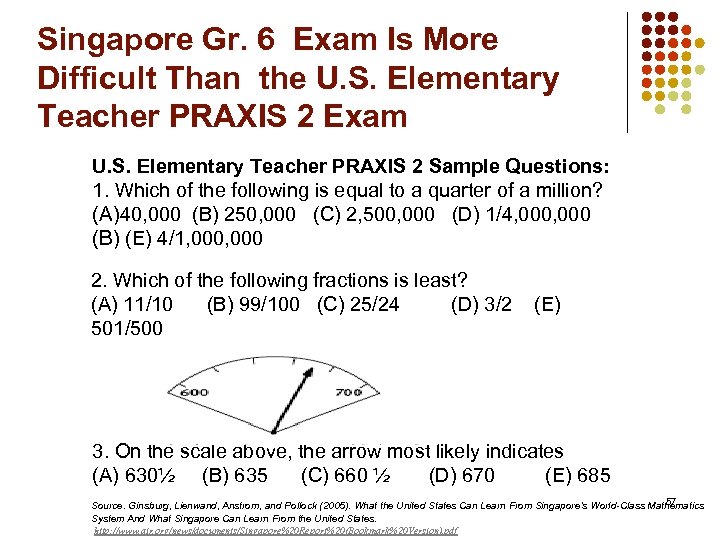 Singapore Gr. 6 Exam Is More Difficult Than the U. S. Elementary Teacher PRAXIS 2 Exam U. S. Elementary Teacher PRAXIS 2 Sample Questions: 1. Which of the following is equal to a quarter of a million? (A)40, 000 (B) 250, 000 (C) 2, 500, 000 (D) 1/4, 000 (B) (E) 4/1, 000 2. Which of the following fractions is least? (A) 11/10 (B) 99/100 (C) 25/24 (D) 3/2 501/500 (E) 3. On the scale above, the arrow most likely indicates (A) 630½ (B) 635 (C) 660 ½ (D) 670 (E) 685 57 Source. Ginsburg, Lienwand, Anstrom, and Pollock (2005). What the United States Can Learn From Singapore’s World-Class Mathematics System And What Singapore Can Learn From the United States. http: //www. air. org/news/documents/Singapore%20 Report%20(Bookmark%20 Version). pdf
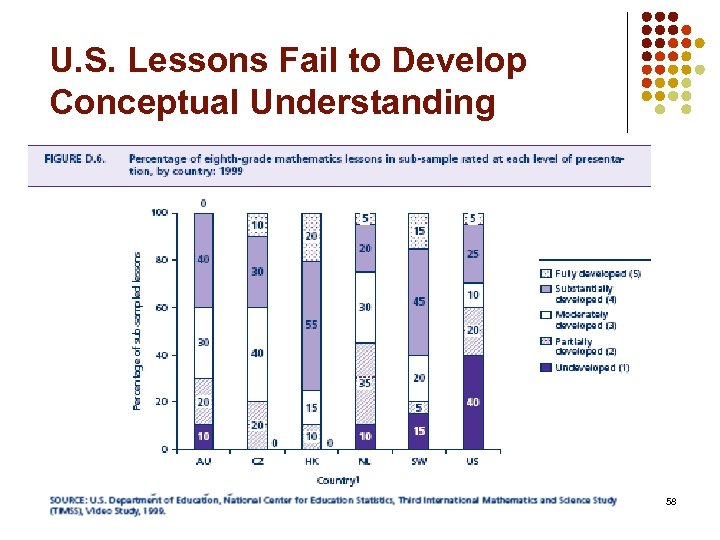 U. S. Lessons Fail to Develop Conceptual Understanding 58
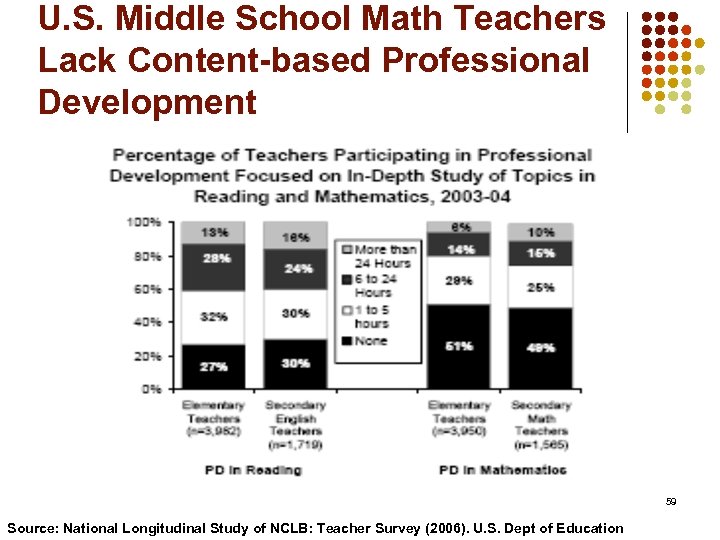 U. S. Middle School Math Teachers Lack Content-based Professional Development 59 Source: National Longitudinal Study of NCLB: Teacher Survey (2006). U. S. Dept of Education
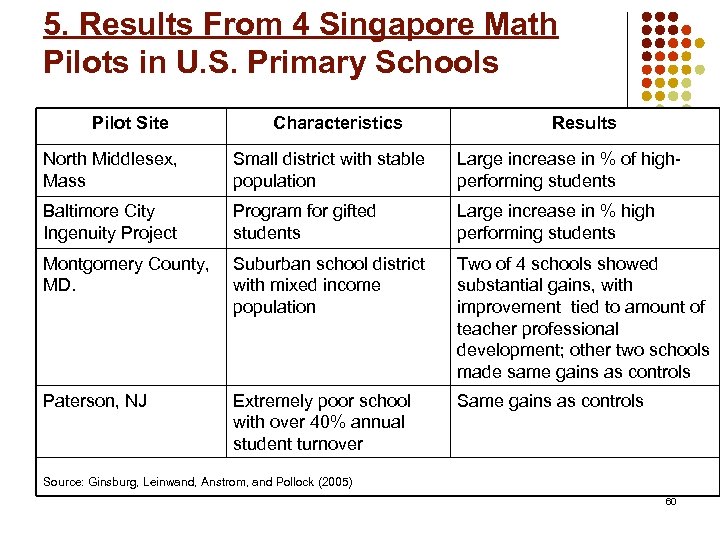 5. Results From 4 Singapore Math Pilots in U. S. Primary Schools Pilot Site Characteristics Results North Middlesex, Mass Small district with stable population Large increase in % of highperforming students Baltimore City Ingenuity Project Program for gifted students Large increase in % high performing students Montgomery County, MD. Suburban school district with mixed income population Two of 4 schools showed substantial gains, with improvement tied to amount of teacher professional development; other two schools made same gains as controls Paterson, NJ Extremely poor school with over 40% annual student turnover Same gains as controls Source: Ginsburg, Leinwand, Anstrom, and Pollock (2005) 60
 6. Implications and Actions: Bottom Line l Our major finding is that the components of Singapore’s system – frameworks, texts, tests and teacher prep – are carefully aligned AND all of these components reflect a higher quality than comparable components in U. S. l But there a few 21 st Century features of the U. S. system that Florida should build upon, but we need to do a better job. 61
 Implications of Singapore Math for Florida’s Standards Reforms l Adopt highly logical mathematics standards (e. g. , Singapore) l Define desired student mathematics proficiencies so as to balance mathematics concepts, skills, and strategies l Organize standards to clearly and visually portray the sequencing of core mathematics topics across grades l Identify fewer mathematics topics per grade and for each topic describe a deeper set of desired mathematics outcomes l Sequence mathematical topics across grades to build on prior knowledge rather than repeat topics l Consider standards that explicitly recognize the diversity in students’ mathematics performance l Leap ahead by incorporating standards that encourage the reinforcement of 21 st Century mathematics proficiencies 62
 Implications of Singapore Math for Reforming Florida’s Mathematics System l Standards need to be made instructionally meaningful through aligned textbooks and assessments l Teachers will require in-depth professional development in understanding and teaching the deeper mathematics content l Consider launching l l Singapore Math textbook pilots in Florida Benchmarking Promising Practices in highly successful sites to guide improvements 63
 Please Email for further information l Email: alan. ginsburg@ed. gov 64