


 Скачать презентацию The Puzzlemaker s Survival Kit Scott Kim — scottkim
02aaca25d9d15f271c9f6fd612d89a7c.ppt
- Количество слайдов: 84
 The Puzzlemaker’s Survival Kit Scott Kim -- scottkim. com March 6, 2003 -- Game Developers Conference
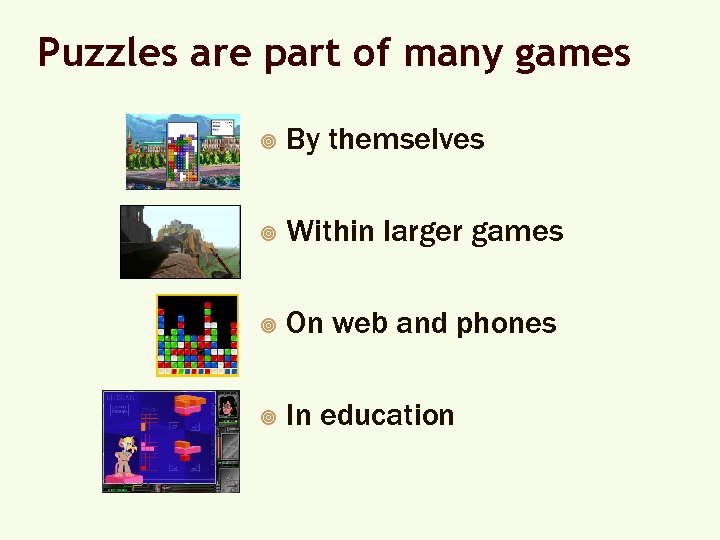 Puzzles are part of many games ¥ By themselves ¥ Within larger games ¥ On web and phones ¥ In education
 But how do you… Design a good puzzle? ¥ Get started? ¥ Produce levels efficiently? ¥ Match puzzles to your audience? ¥
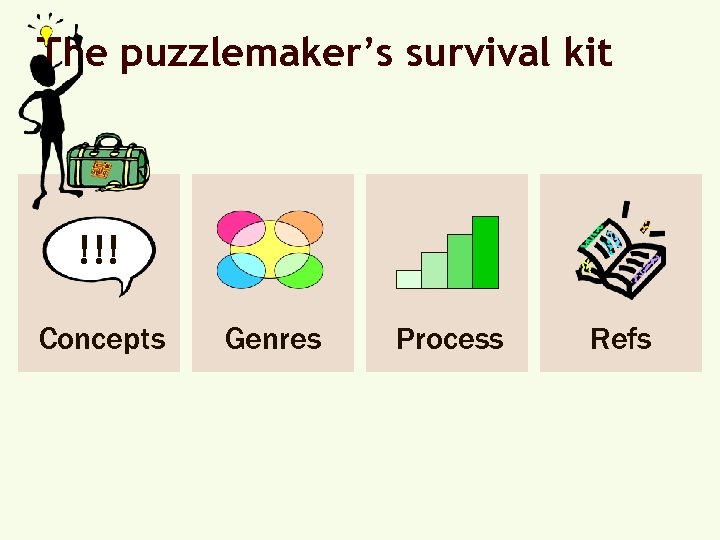 The puzzlemaker’s survival kit !!! Concepts Genres Process Refs
 CONCEPTS !!! Behind all puzzles
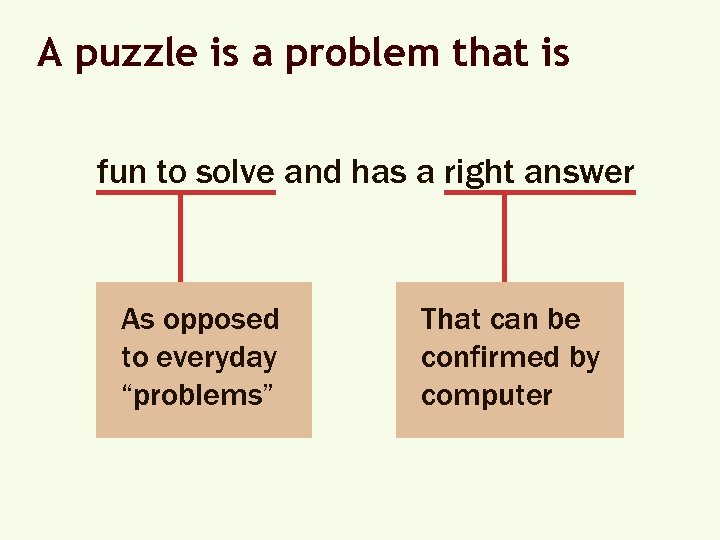 A puzzle is a problem that is fun to solve and has a right answer As opposed to everyday “problems” That can be confirmed by computer
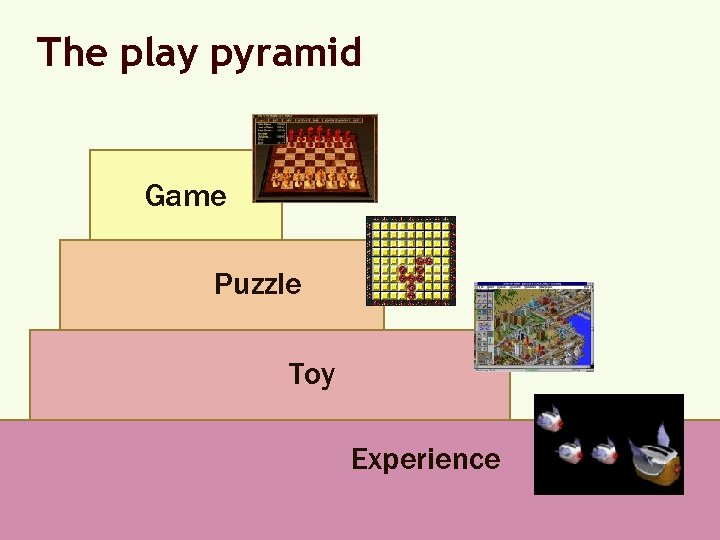 The play pyramid Game Puzzle Toy Experience
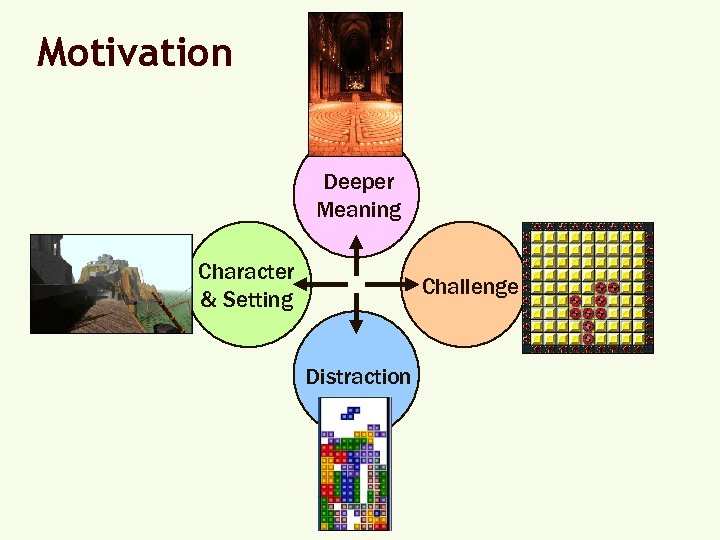 Motivation Deeper Meaning Character & Setting Challenge Distraction
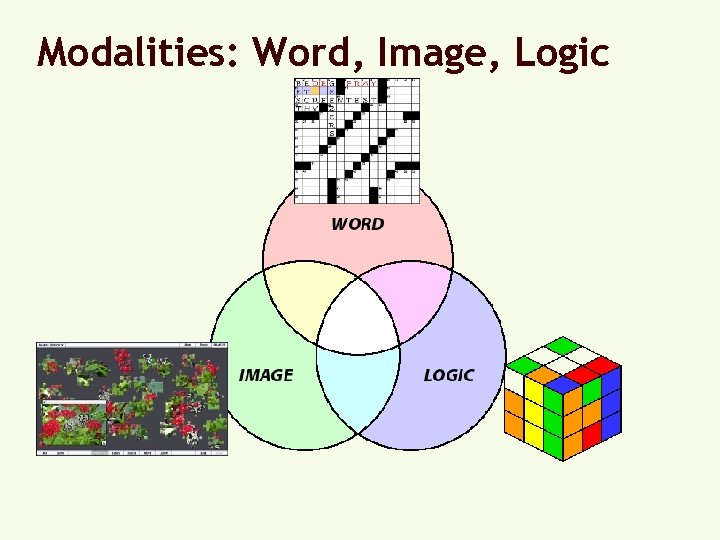 Modalities: Word, Image, Logic
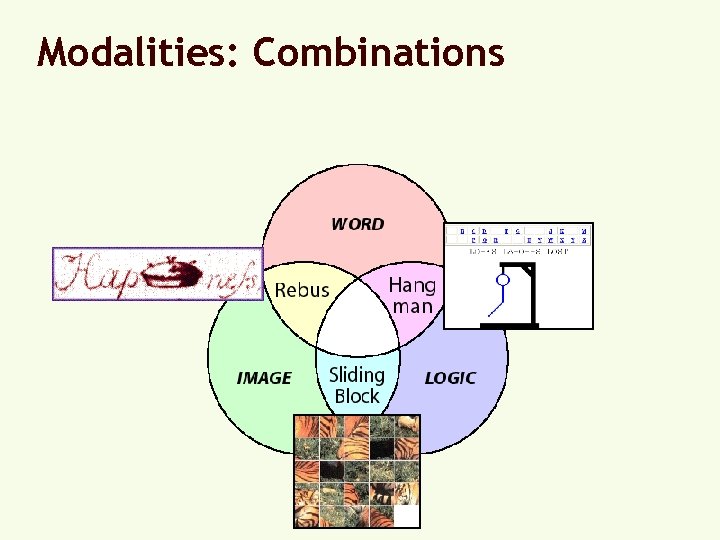 Modalities: Combinations
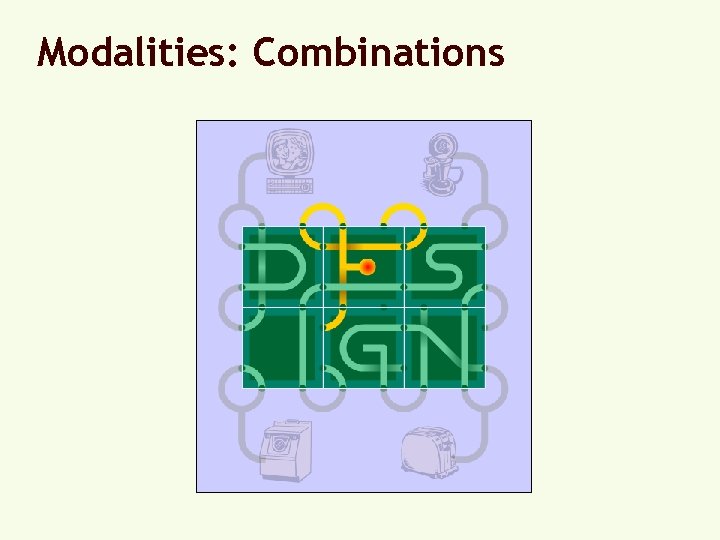 Modalities: Combinations
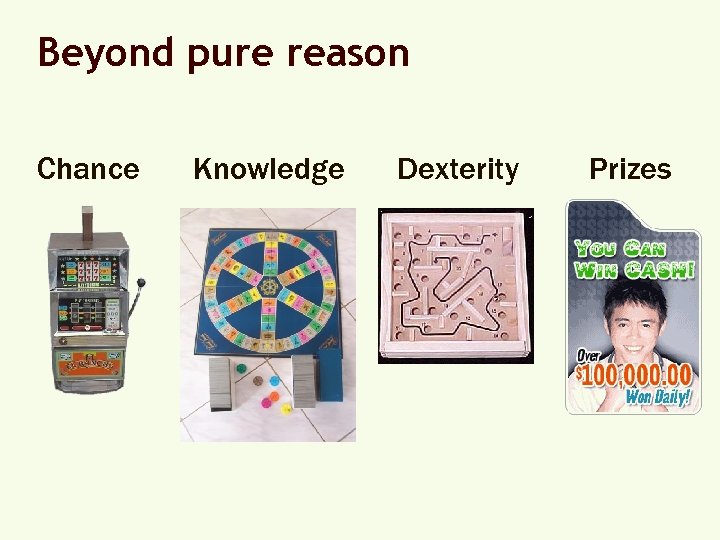 Beyond pure reason Chance Knowledge Dexterity Prizes
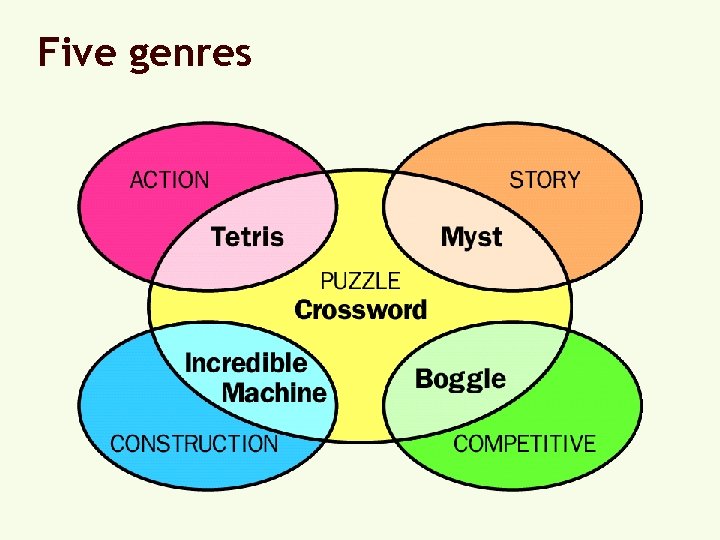 Five genres
 GENRES 1. Action–Puzzle
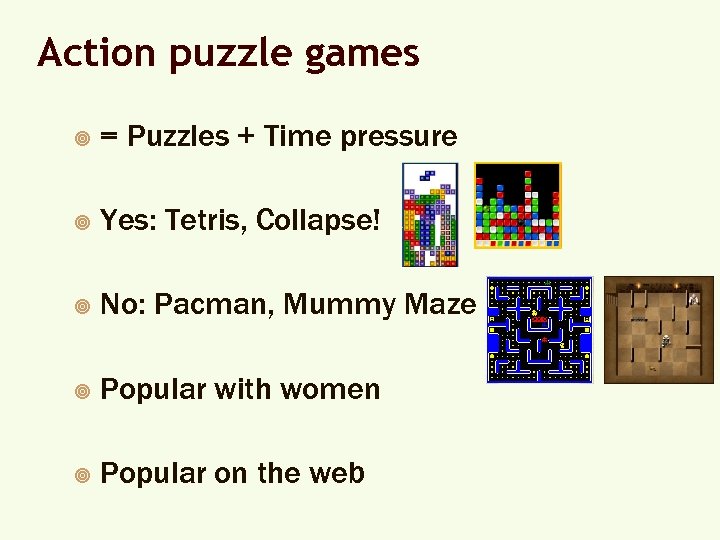 Action puzzle games ¥ = Puzzles + Time pressure ¥ Yes: Tetris, Collapse! ¥ No: Pacman, Mummy Maze ¥ Popular with women ¥ Popular on the web
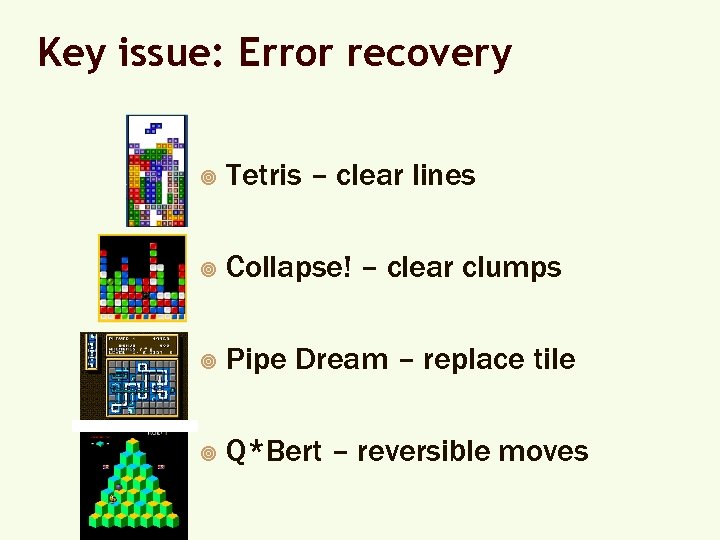 Key issue: Error recovery ¥ Tetris – clear lines ¥ Collapse! – clear clumps ¥ Pipe Dream – replace tile ¥ Q*Bert – reversible moves
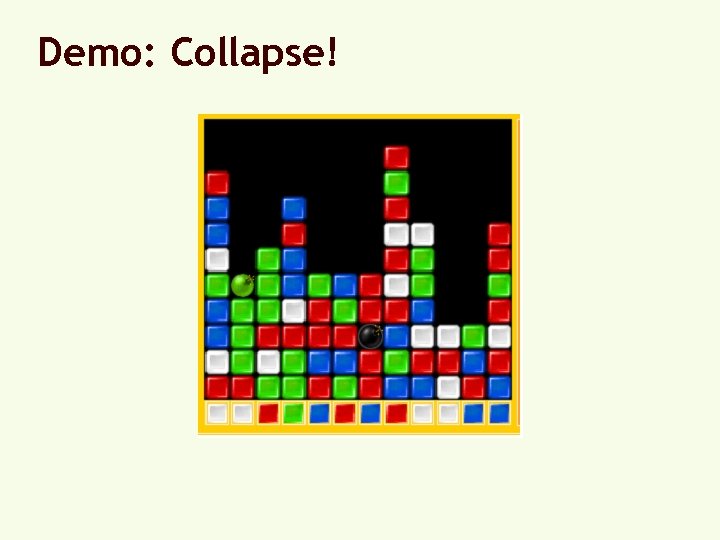 Demo: Collapse!
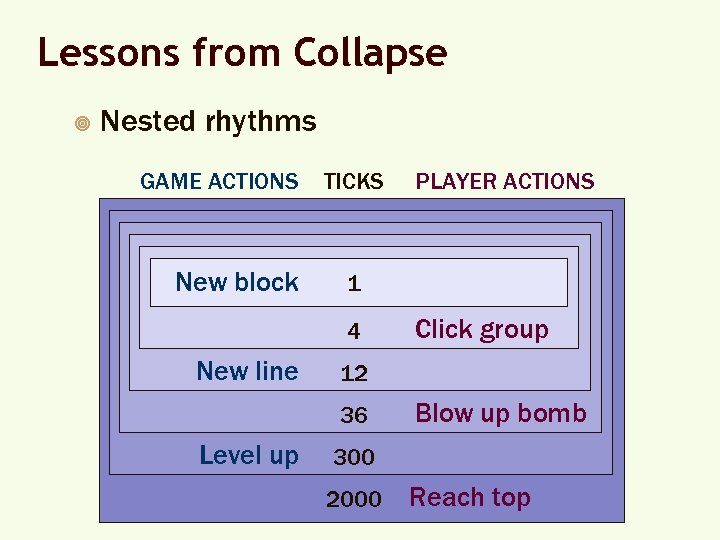 Lessons from Collapse ¥ Nested rhythms GAME ACTIONS New block TICKS 1 4 New line Click group 12 36 Level up PLAYER ACTIONS Blow up bomb 300 2000 Reach top
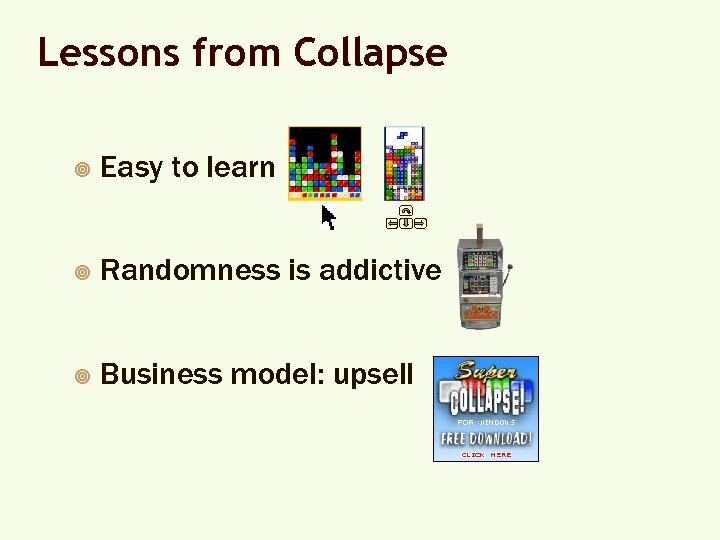 Lessons from Collapse ¥ Easy to learn ¥ Randomness is addictive ¥ Business model: upsell
 GENRES 2. Story–Puzzle
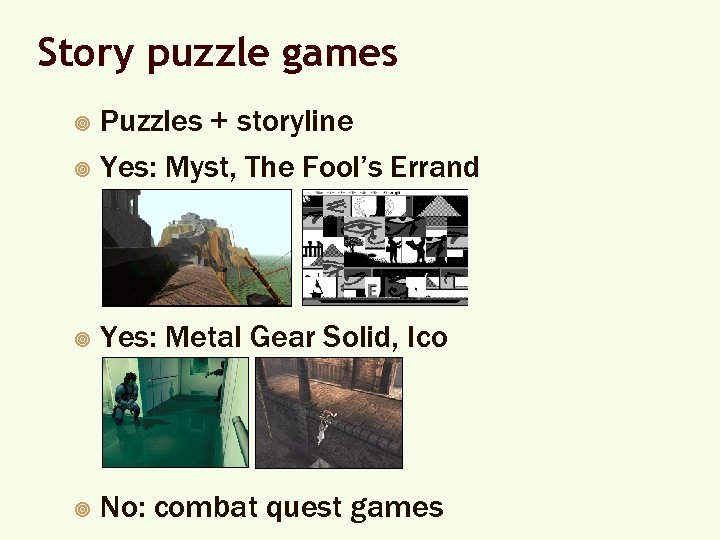 Story puzzle games Puzzles + storyline ¥ Yes: Myst, The Fool’s Errand ¥ ¥ Yes: Metal Gear Solid, Ico ¥ No: combat quest games
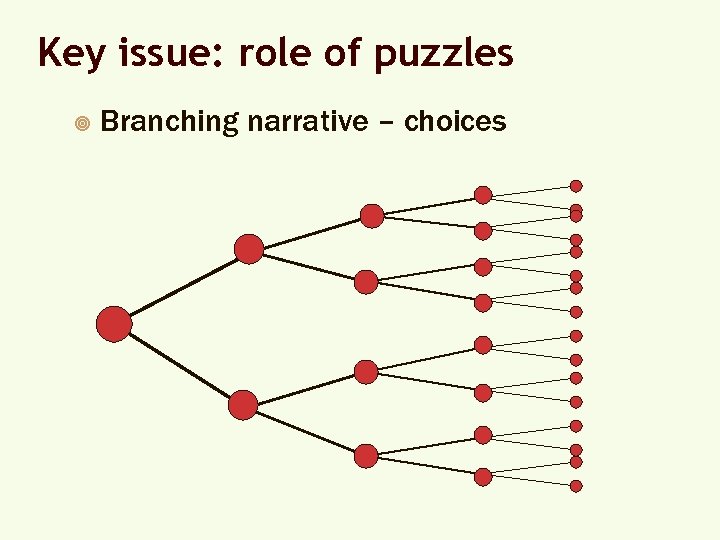 Key issue: role of puzzles ¥ Branching narrative – choices
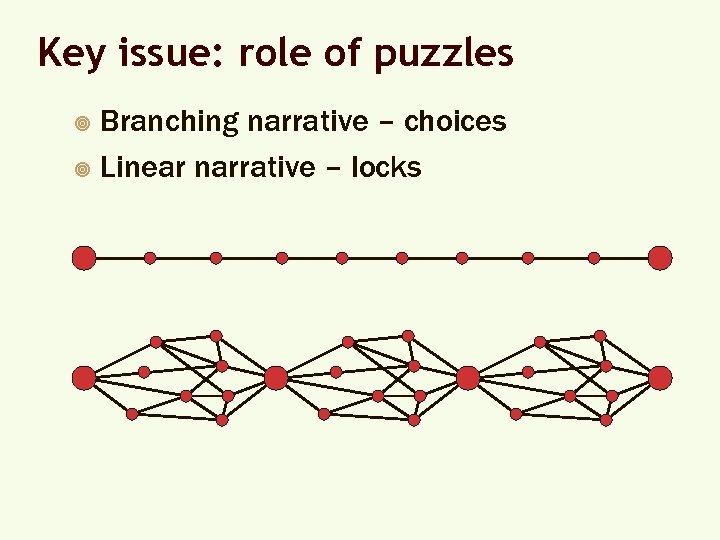 Key issue: role of puzzles Branching narrative – choices ¥ Linear narrative – locks ¥
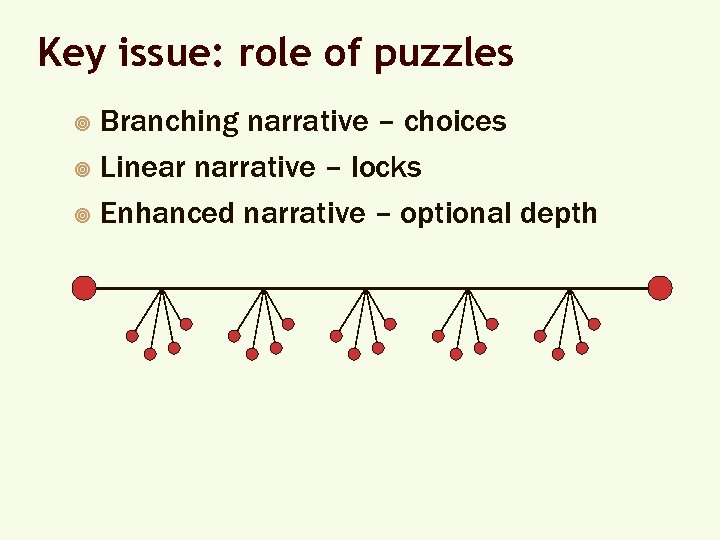 Key issue: role of puzzles Branching narrative – choices ¥ Linear narrative – locks ¥ Enhanced narrative – optional depth ¥
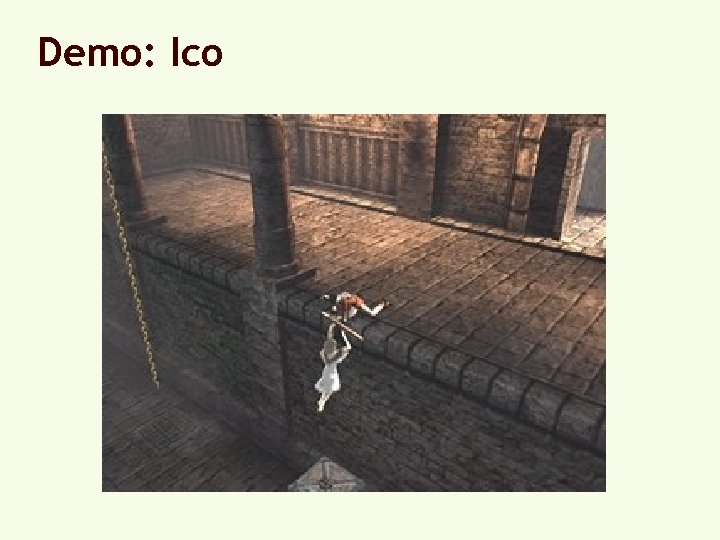 Demo: Ico
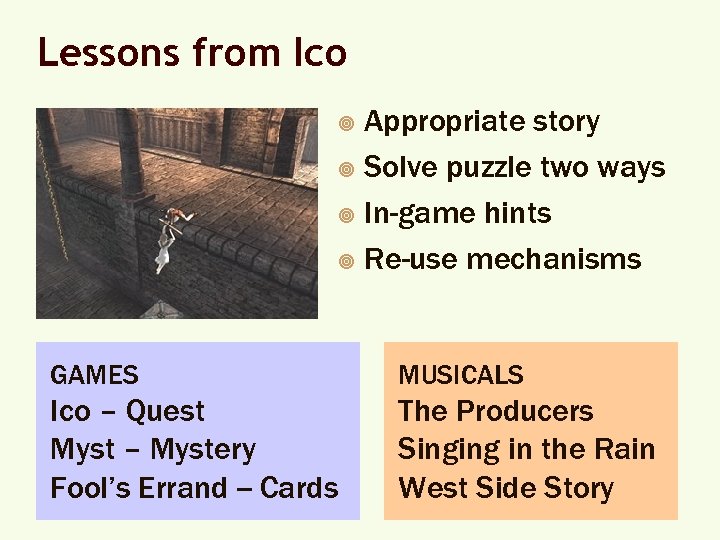 Lessons from Ico Appropriate story ¥ Solve puzzle two ways ¥ In-game hints ¥ Re-use mechanisms ¥ GAMES MUSICALS Ico – Quest Myst – Mystery Fool’s Errand -- Cards The Producers Singing in the Rain West Side Story
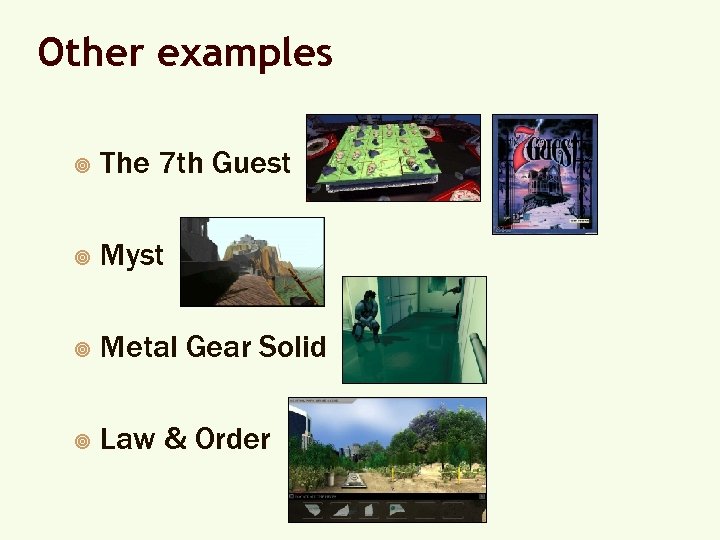 Other examples ¥ The 7 th Guest ¥ Myst ¥ Metal Gear Solid ¥ Law & Order
 GENRES 3. Competitive–Puzzle
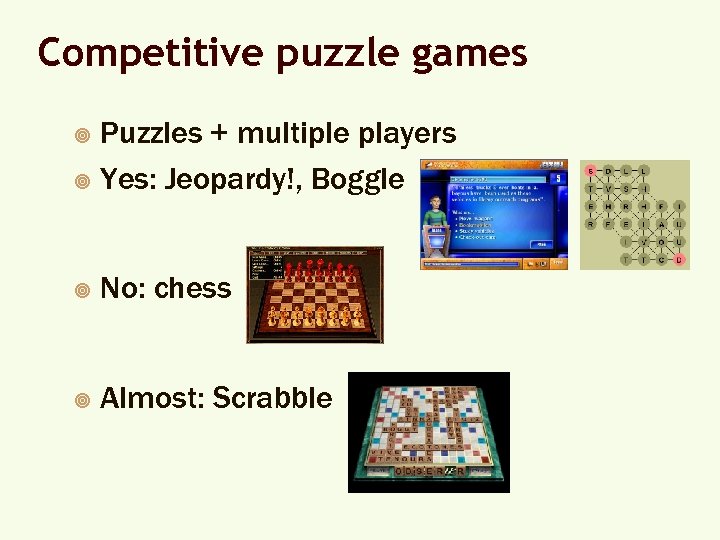 Competitive puzzle games Puzzles + multiple players ¥ Yes: Jeopardy!, Boggle ¥ ¥ No: chess ¥ Almost: Scrabble
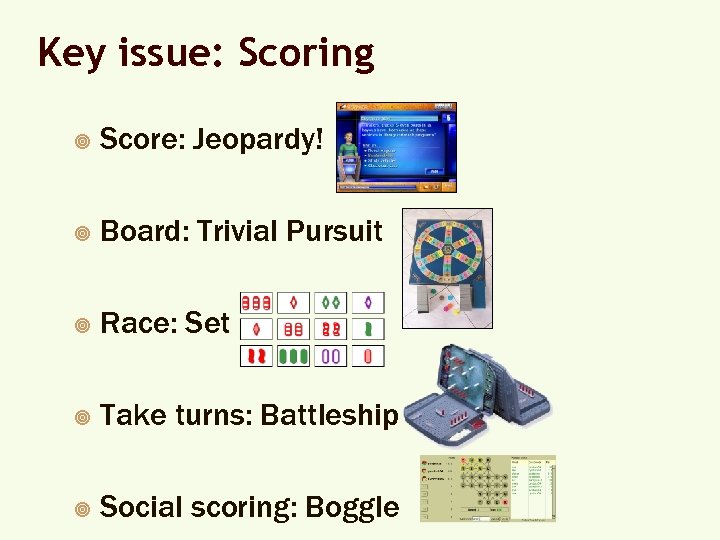 Key issue: Scoring ¥ Score: Jeopardy! ¥ Board: Trivial Pursuit ¥ Race: Set ¥ Take turns: Battleship ¥ Social scoring: Boggle
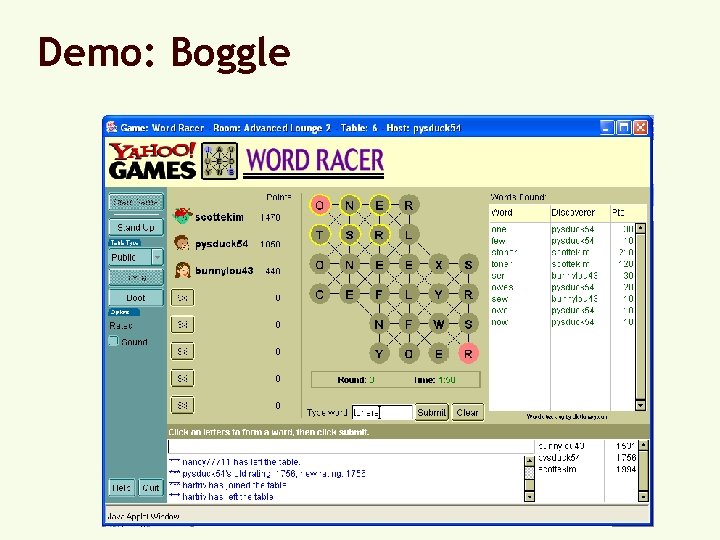 Demo: Boggle
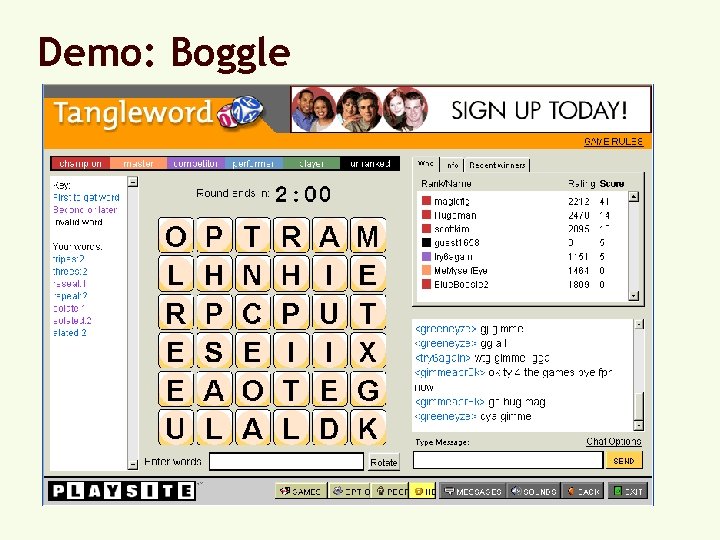 Demo: Boggle
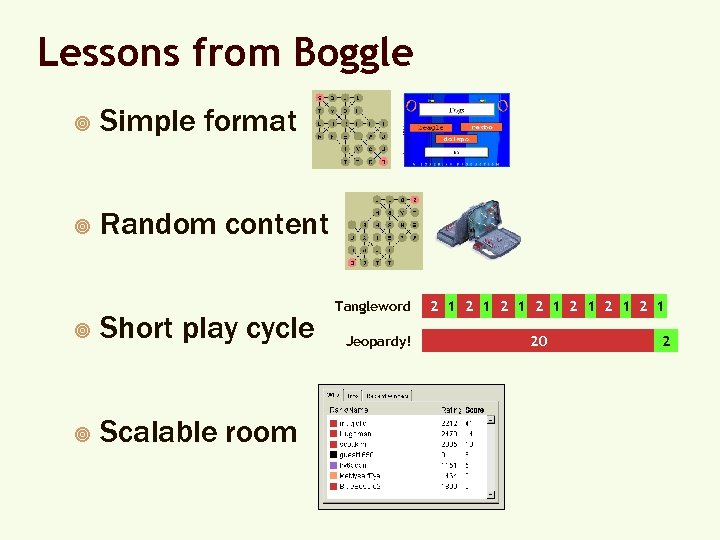 Lessons from Boggle ¥ Simple format ¥ Random content ¥ Short play cycle ¥ Scalable room Tangleword Jeopardy! 2 1 2 1 20 2
 GENRES 4. Construction–Puzzle
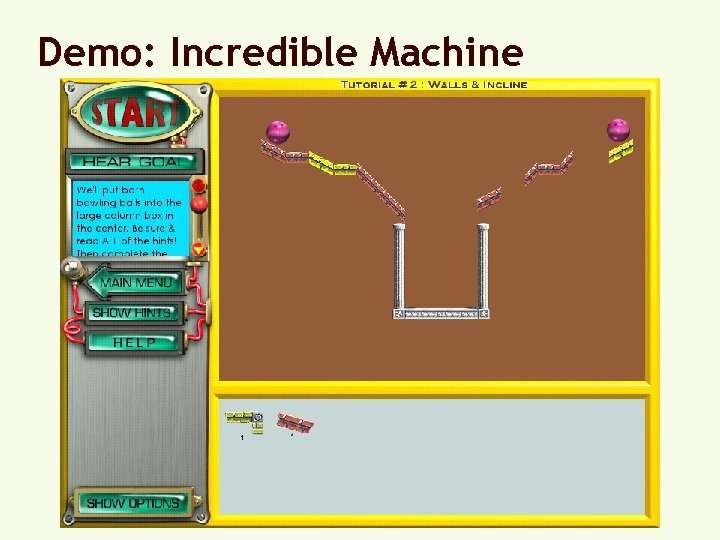
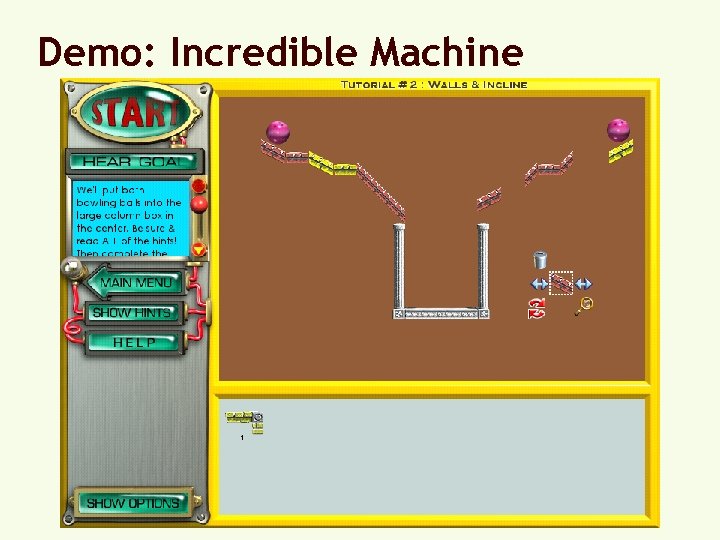
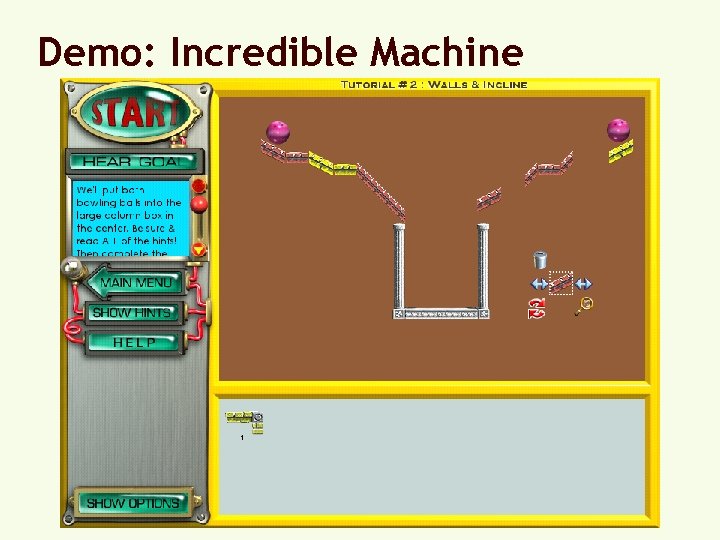
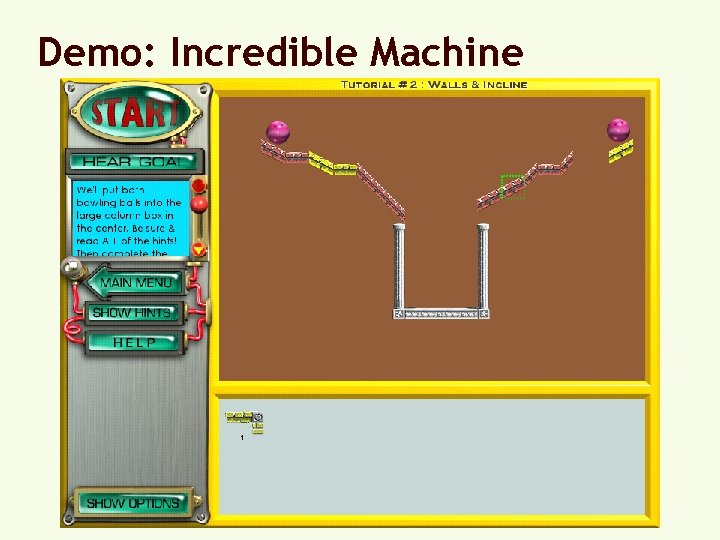
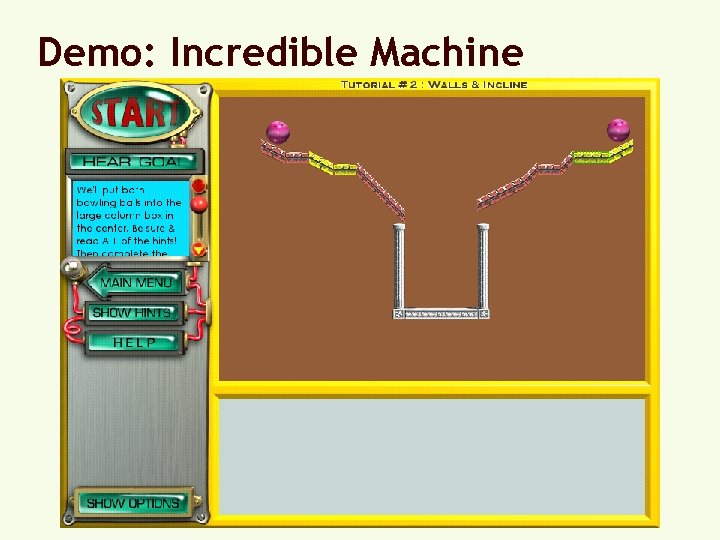
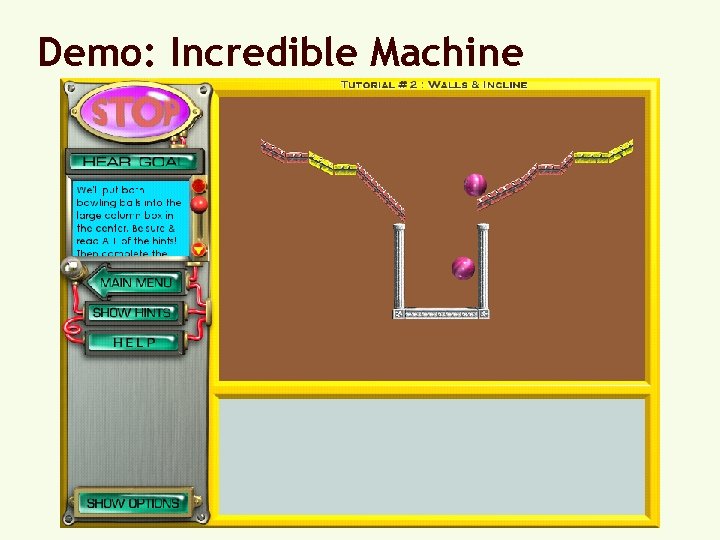
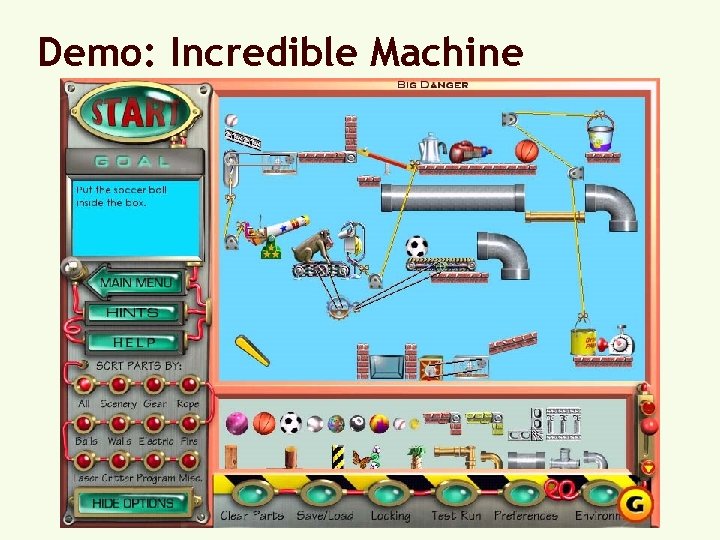
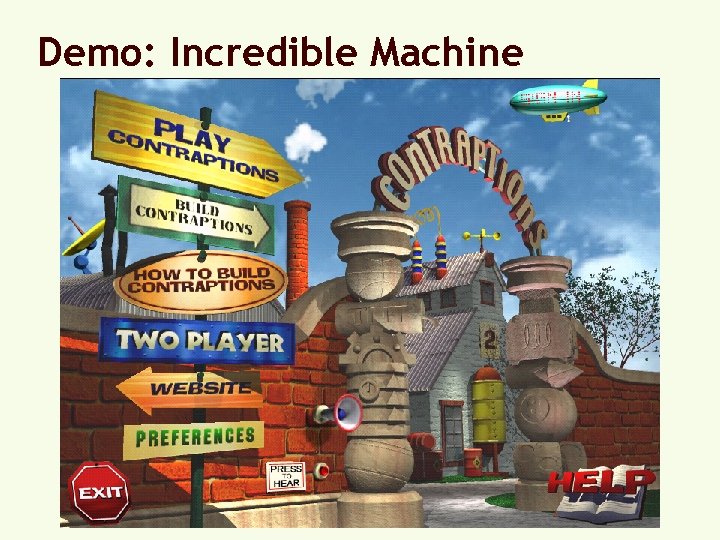
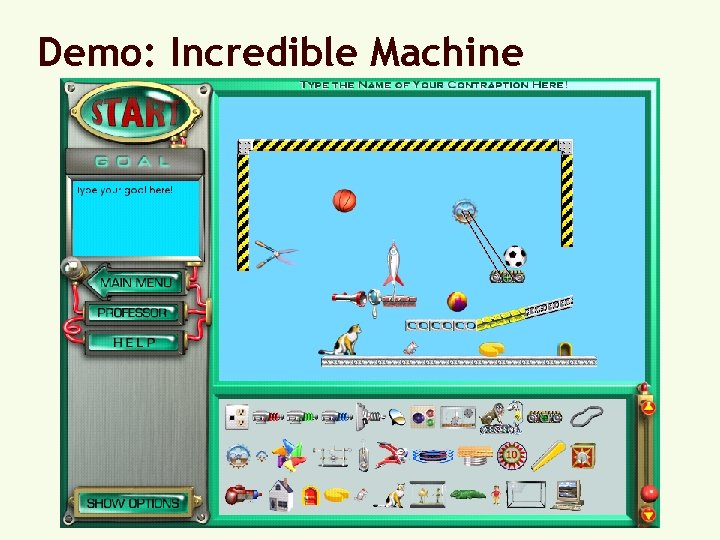
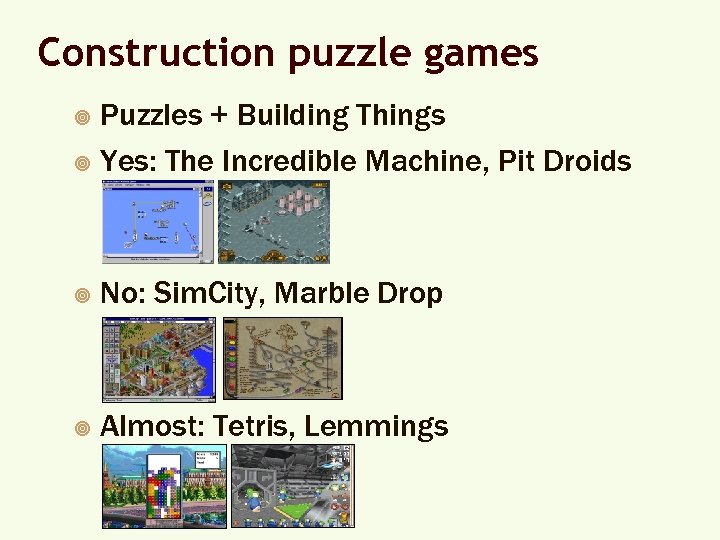 Construction puzzle games Puzzles + Building Things ¥ Yes: The Incredible Machine, Pit Droids ¥ ¥ No: Sim. City, Marble Drop ¥ Almost: Tetris, Lemmings
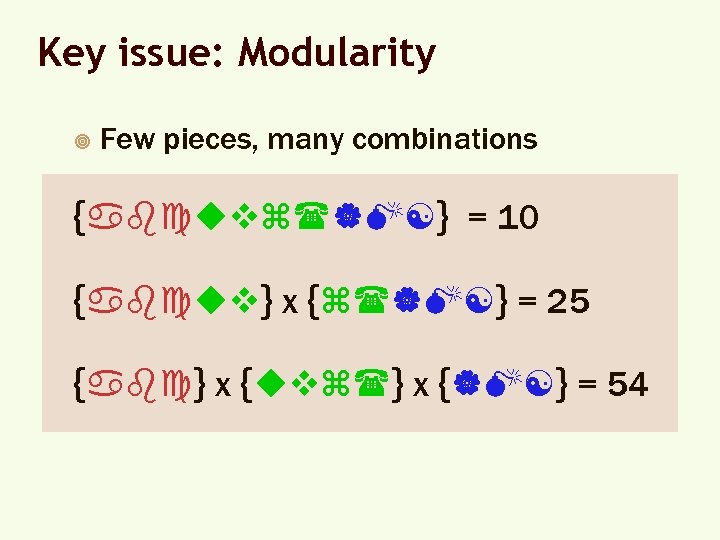 Key issue: Modularity ¥ Few pieces, many combinations {abcuvz(|M[} = 10 {abcuv} x {z(|M[} = 25 {abc} x {uvz(} x {|M[} = 54
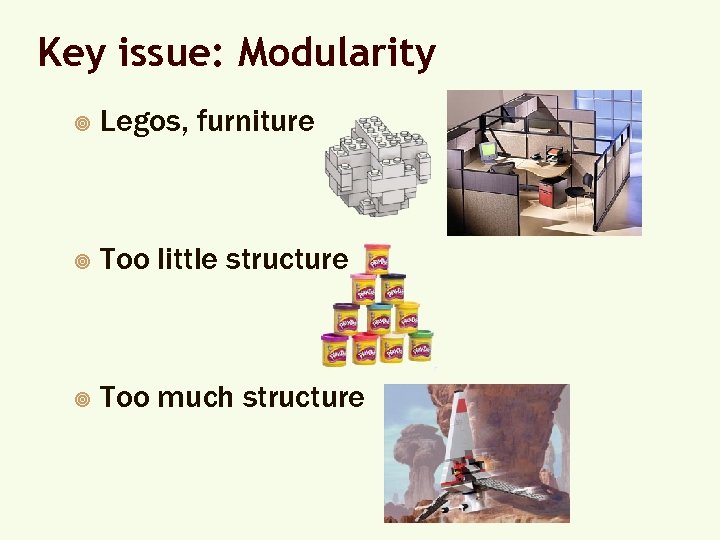 Key issue: Modularity ¥ Legos, furniture ¥ Too little structure ¥ Too much structure
 Demo: Incredible Machine
 Demo: Incredible Machine
 Demo: Incredible Machine
 Demo: Incredible Machine
 Demo: Incredible Machine
 Demo: Incredible Machine
 Demo: Incredible Machine
 Demo: Incredible Machine
 Demo: Incredible Machine
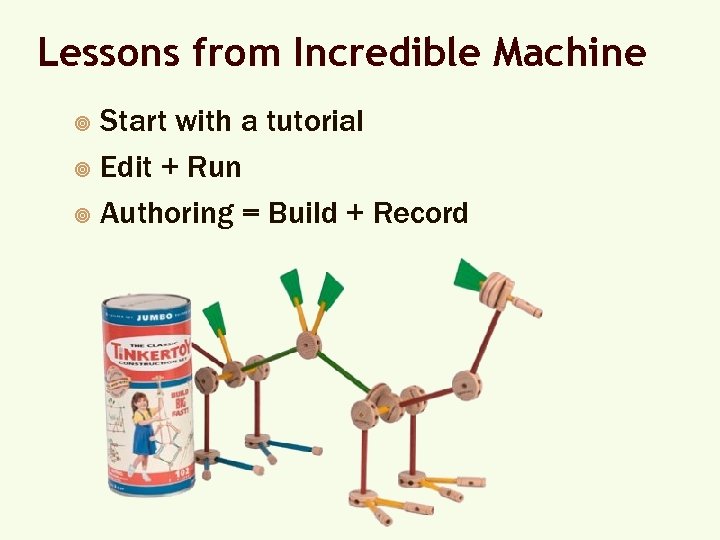 Lessons from Incredible Machine Start with a tutorial ¥ Edit + Run ¥ Authoring = Build + Record ¥
 GENRES 5. Pure Puzzle
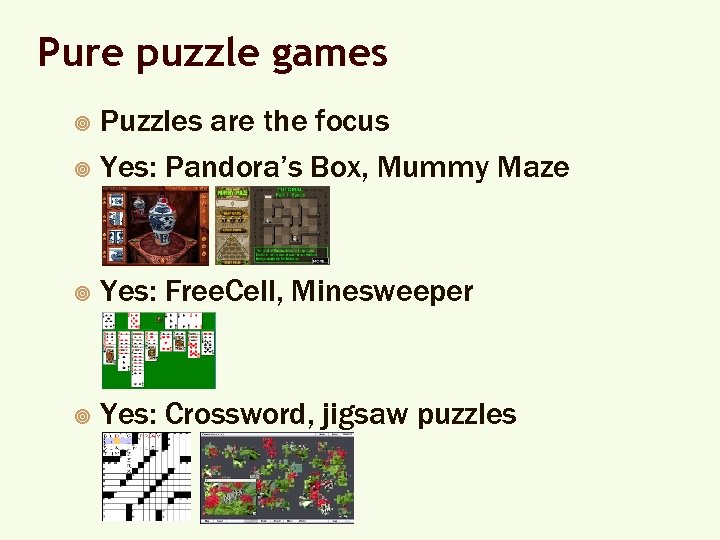 Pure puzzle games Puzzles are the focus ¥ Yes: Pandora’s Box, Mummy Maze ¥ ¥ Yes: Free. Cell, Minesweeper ¥ Yes: Crossword, jigsaw puzzles
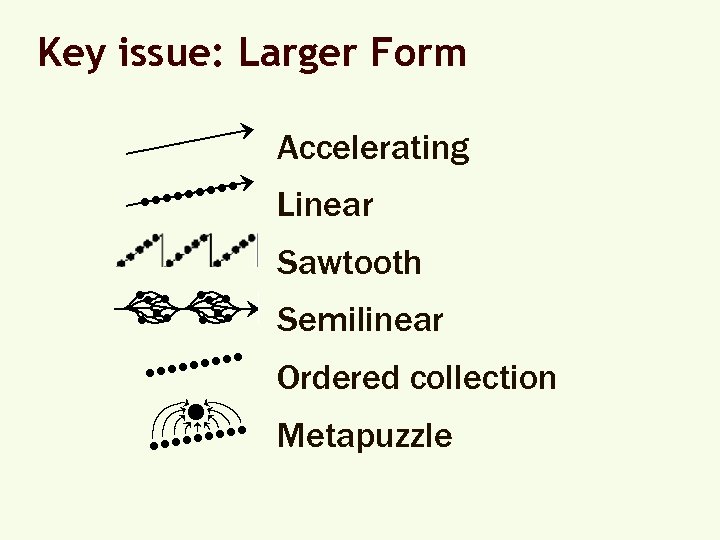 Key issue: Larger Form Accelerating Linear Sawtooth Semilinear Ordered collection Metapuzzle
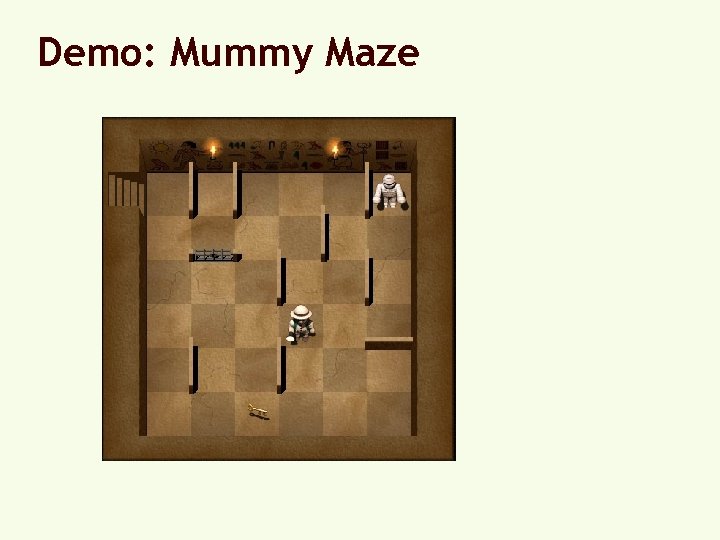 Demo: Mummy Maze
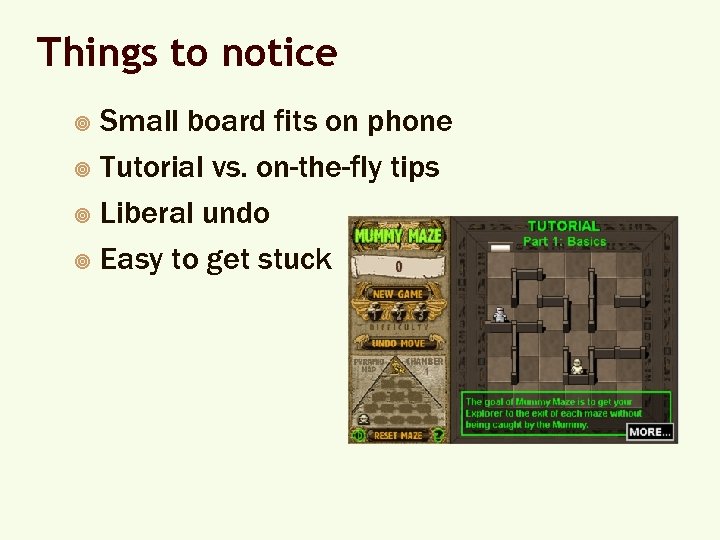 Things to notice Small board fits on phone ¥ Tutorial vs. on-the-fly tips ¥ Liberal undo ¥ Easy to get stuck ¥
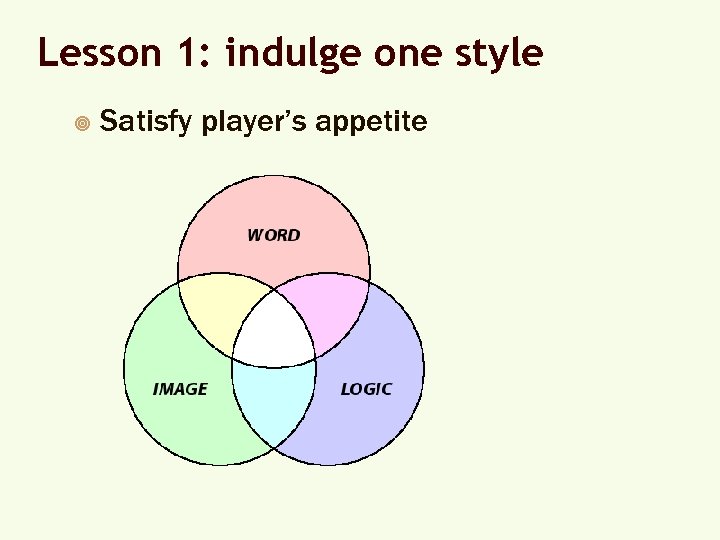 Lesson 1: indulge one style ¥ Satisfy player’s appetite
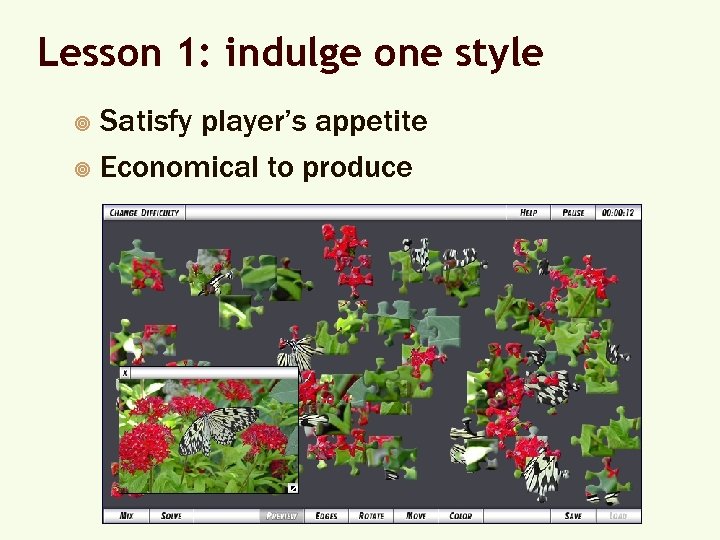 Lesson 1: indulge one style Satisfy player’s appetite ¥ Economical to produce ¥
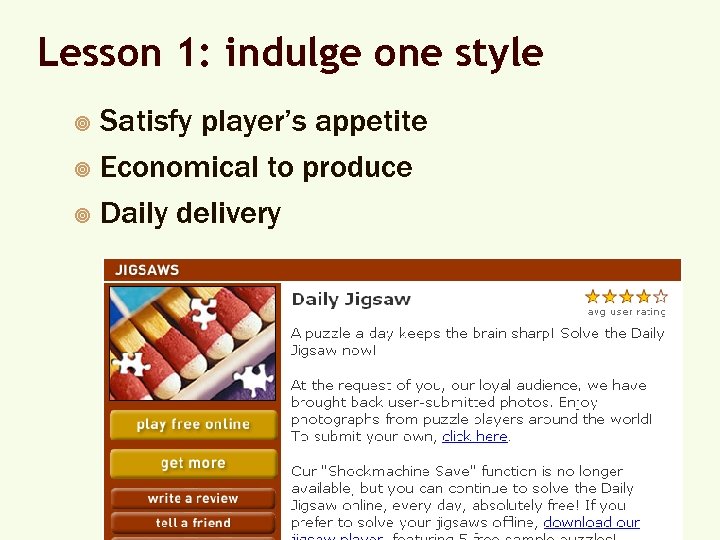 Lesson 1: indulge one style Satisfy player’s appetite ¥ Economical to produce ¥ Daily delivery ¥
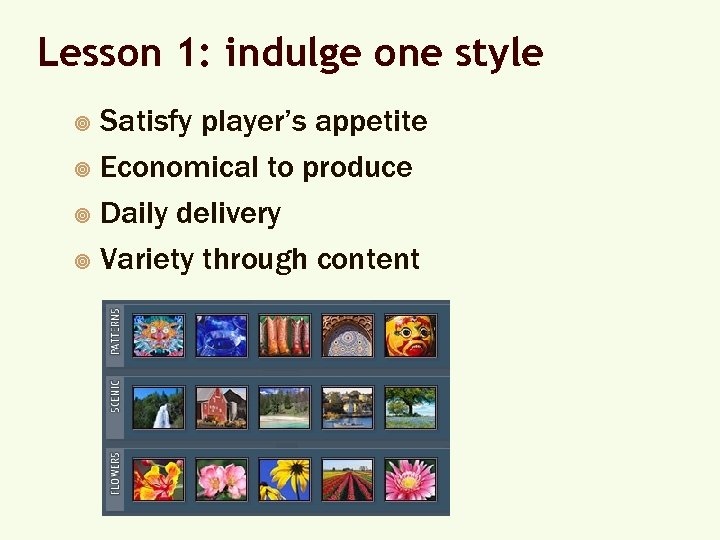 Lesson 1: indulge one style Satisfy player’s appetite ¥ Economical to produce ¥ Daily delivery ¥ Variety through content ¥
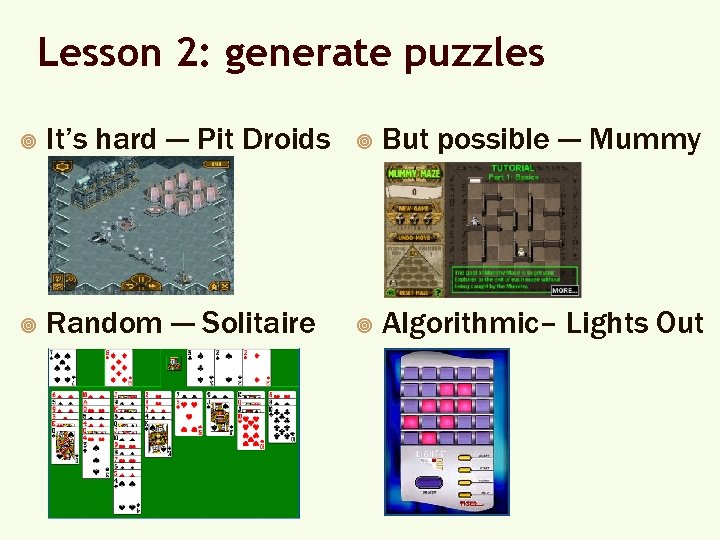 Lesson 2: generate puzzles ¥ It’s hard --- Pit Droids ¥ But possible --- Mummy ¥ Random --- Solitaire ¥ Algorithmic– Lights Out
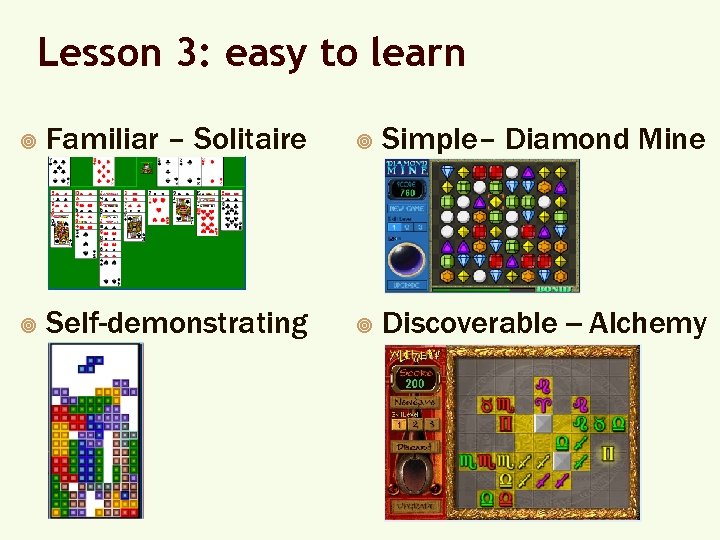 Lesson 3: easy to learn ¥ Familiar – Solitaire ¥ Simple– Diamond Mine ¥ Self-demonstrating ¥ Discoverable -- Alchemy
 PROCESS Eight steps to a finished game
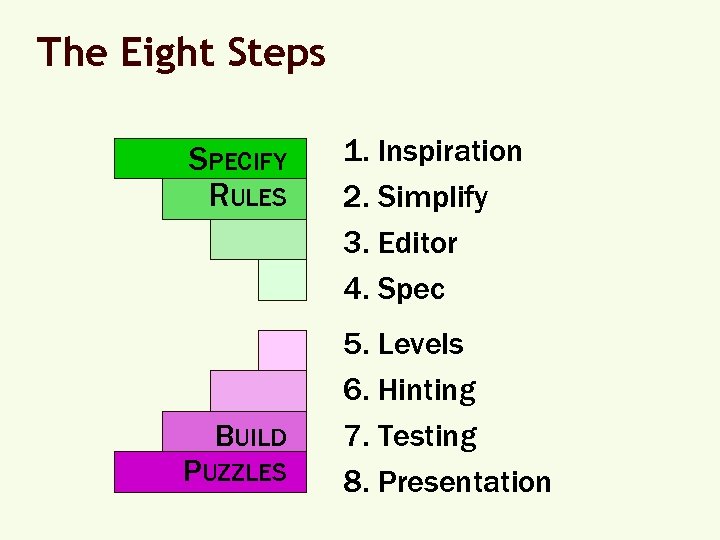 The Eight Steps SPECIFY RULES BUILD PUZZLES 1. Inspiration 2. Simplify 3. Editor 4. Spec 5. Levels 6. Hinting 7. Testing 8. Presentation
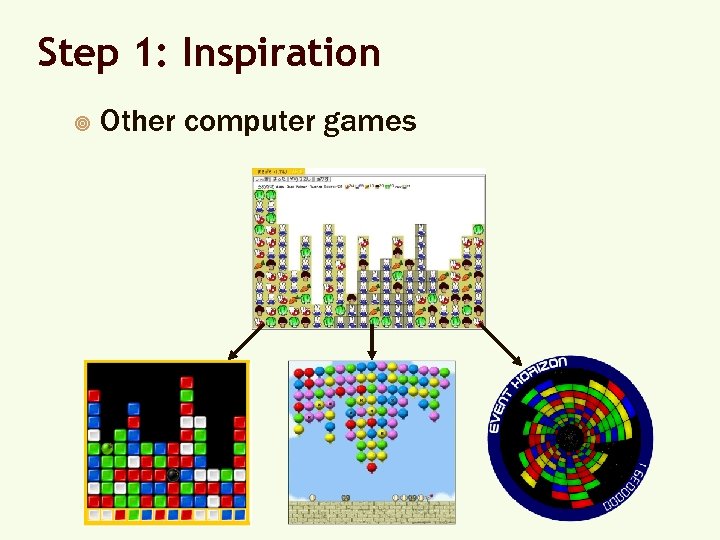 Step 1: Inspiration ¥ Other computer games
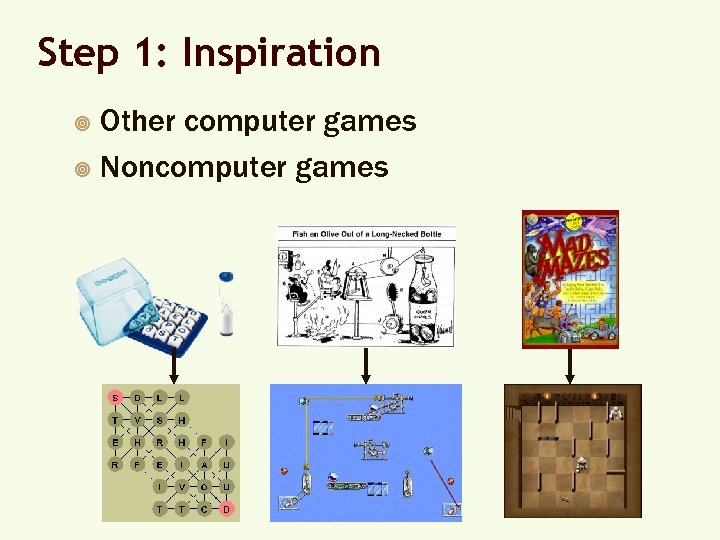 Step 1: Inspiration Other computer games ¥ Noncomputer games ¥
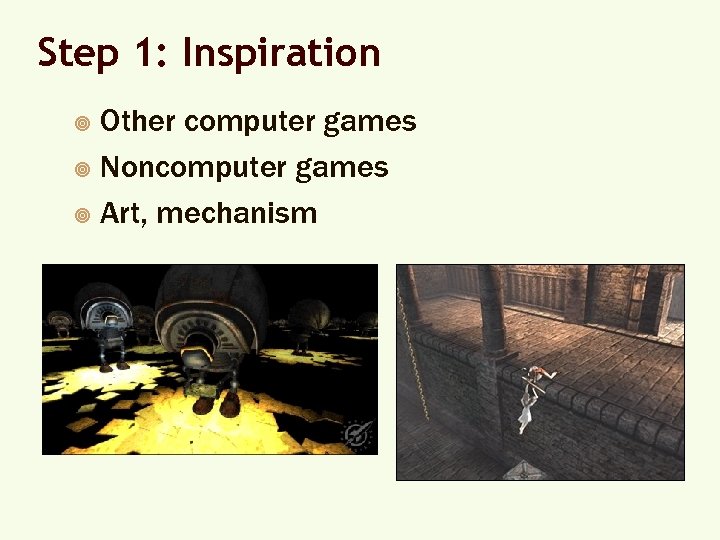 Step 1: Inspiration Other computer games ¥ Noncomputer games ¥ Art, mechanism ¥
 Step 1: Inspiration Other computer games ¥ Noncomputer games ¥ Art, mechanism ¥ Subject matter ¥
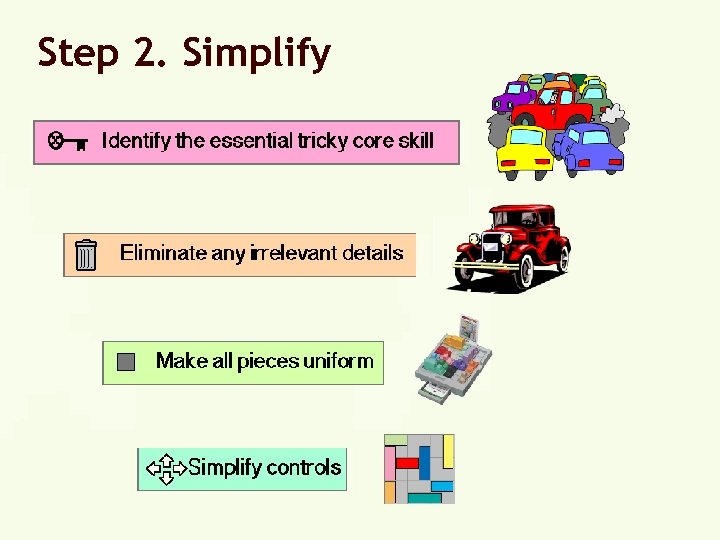 Step 2. Simplify
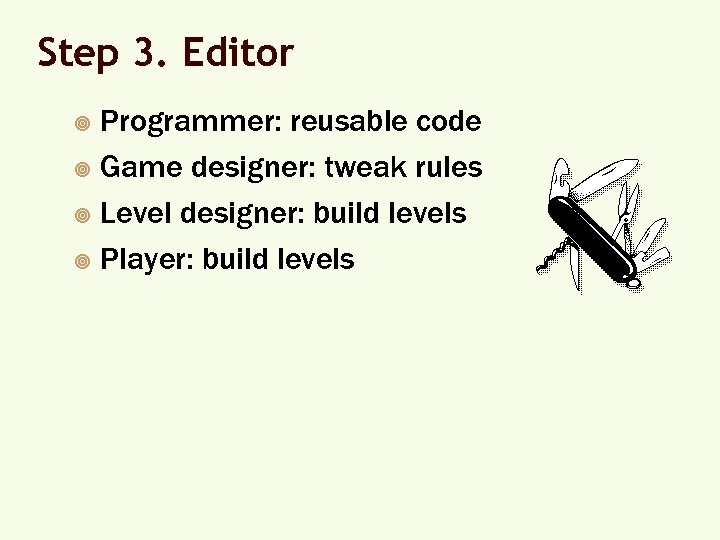 Step 3. Editor Programmer: reusable code ¥ Game designer: tweak rules ¥ Level designer: build levels ¥ Player: build levels ¥
 4. Spec Board — grid, network, irregular, none ¥ Pieces — shape, image, attribute, supply ¥ Moves — sequential, side effect, primary ¥ Goal — exact match, partial, condition ¥
 5. Level design Start with bang ¥ Teach techniques ¥ Paint a picture ¥ Develop a theme ¥
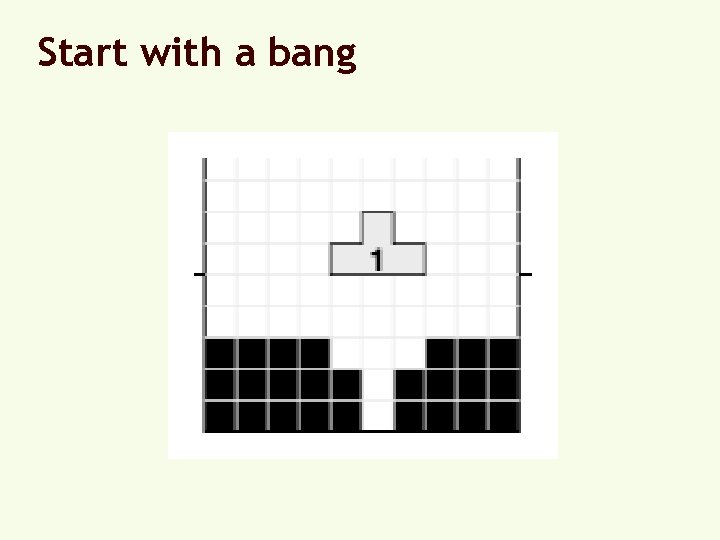 Start with a bang
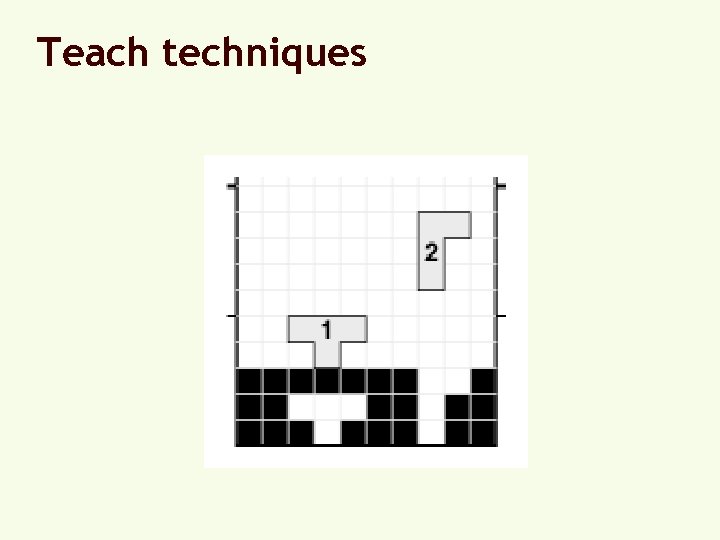 Teach techniques
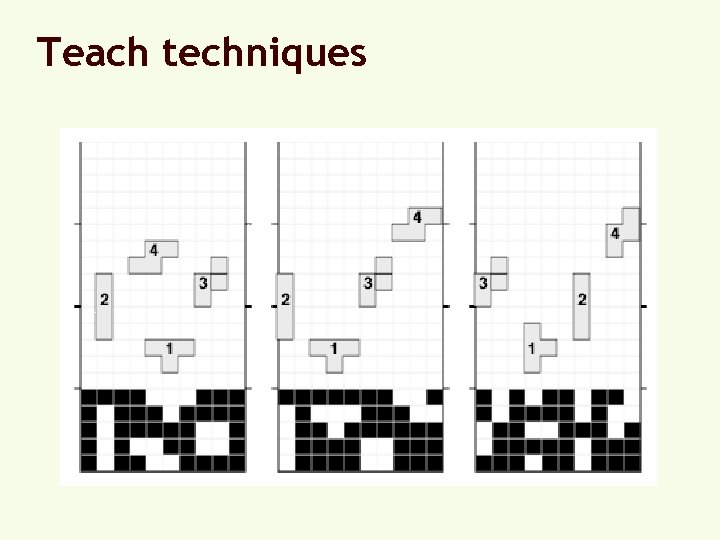 Teach techniques
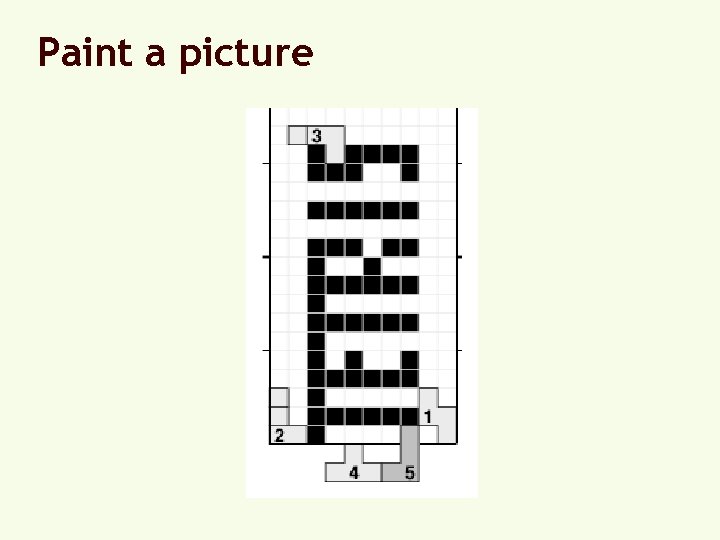 Paint a picture
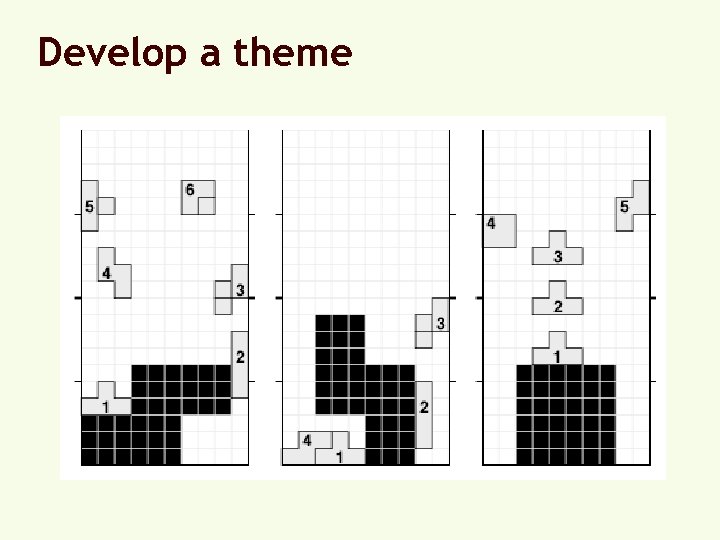 Develop a theme
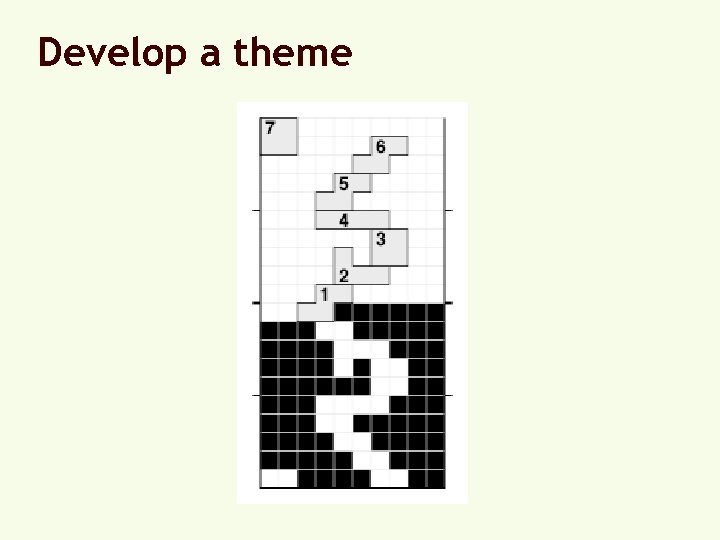 Develop a theme
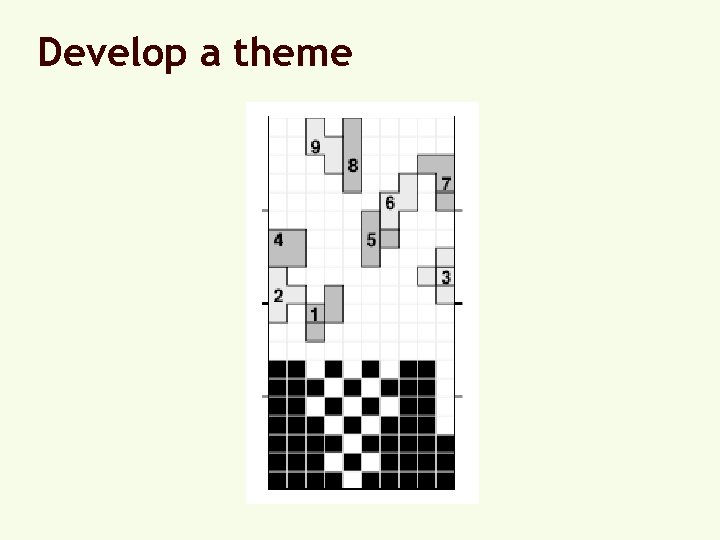 Develop a theme
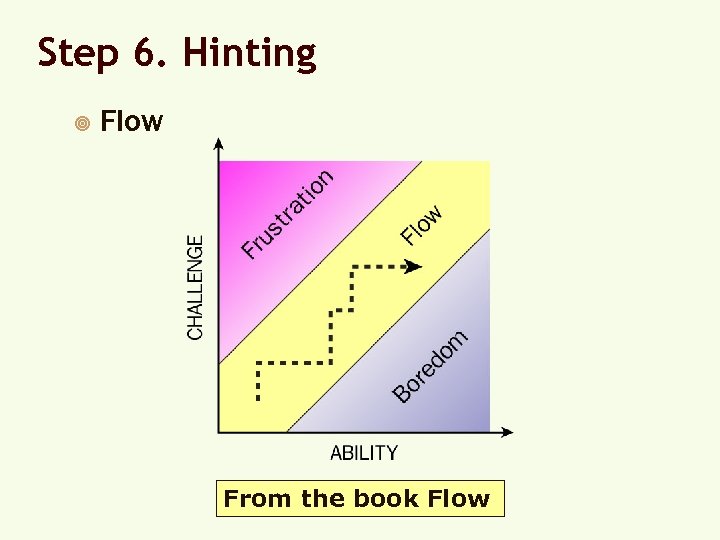 Step 6. Hinting ¥ Flow From the book Flow
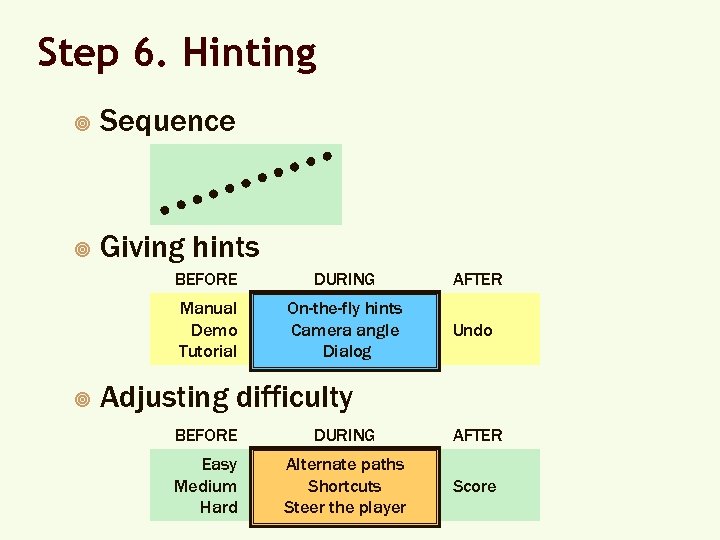 Step 6. Hinting ¥ Sequence ¥ Giving hints BEFORE AFTER Manual Demo Tutorial ¥ DURING On-the-fly hints Camera angle Dialog Undo Adjusting difficulty BEFORE DURING AFTER Easy Medium Hard Alternate paths Shortcuts Steer the player Score
 Step 7. Testing Are the rules clear? ¥ How hard is it? ¥ Are there other solutions? ¥ Is it fun? ¥
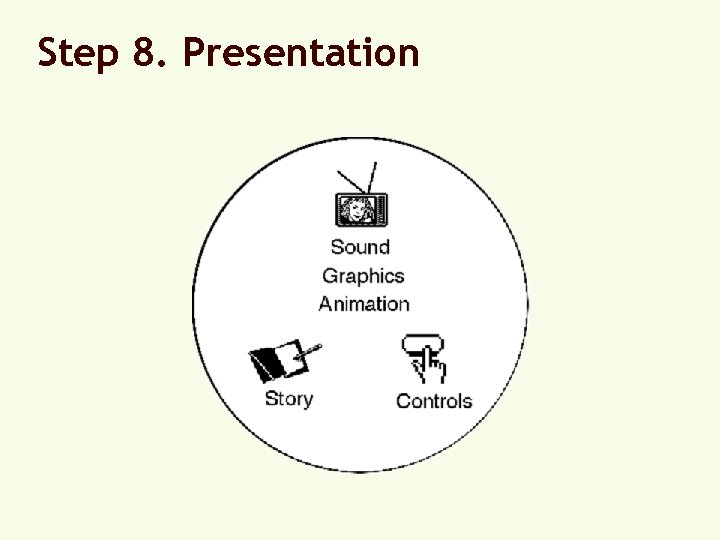 Step 8. Presentation
 References
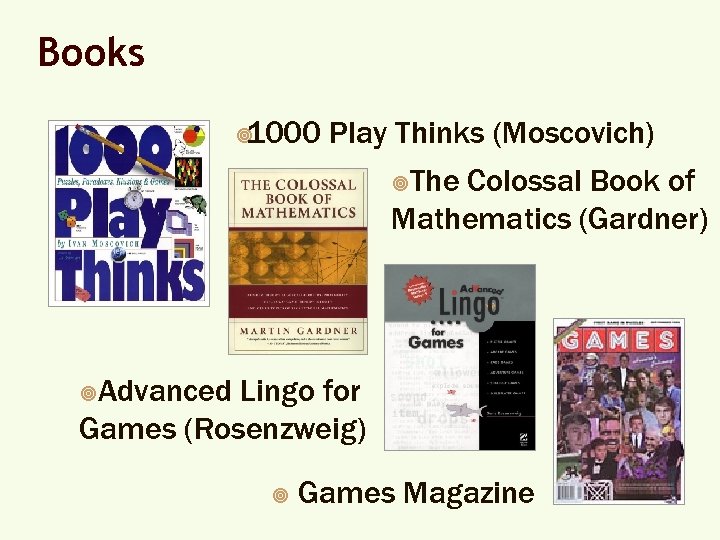 Books ¥ 1000 Play Thinks (Moscovich) ¥The Colossal Book of Mathematics (Gardner) ¥Advanced Lingo for Games (Rosenzweig) ¥ Games Magazine
 Web sites ¥ Shockwave. com ¥ Mathpuzzle. com ¥ Puzzles. com ¥ Rubiks. com
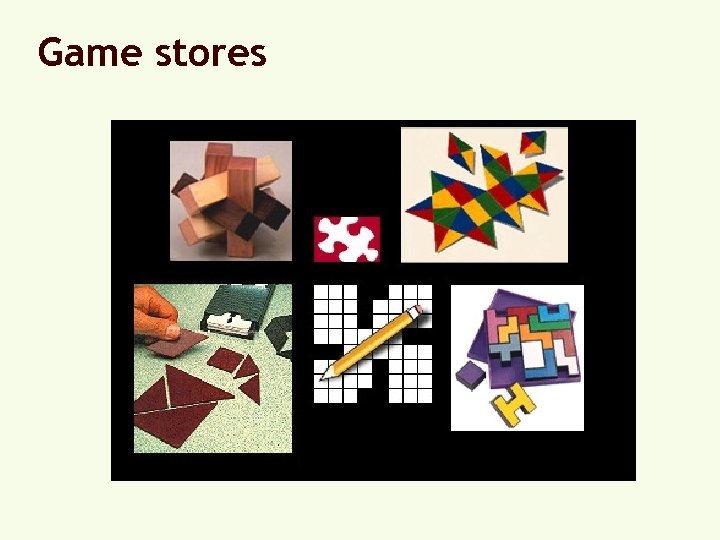 Game stores
 For slides from this talk, visit scottkim. com Scott Kim, scott@scottkim. com, 650 -728 -8582 Copyright 2003 Scott Kim Images of games copyrighted by their companies