 Скачать презентацию The Purposes Served by Elections Even after
elections.pptx
- Количество слайдов: 29



The Purposes Served by Elections
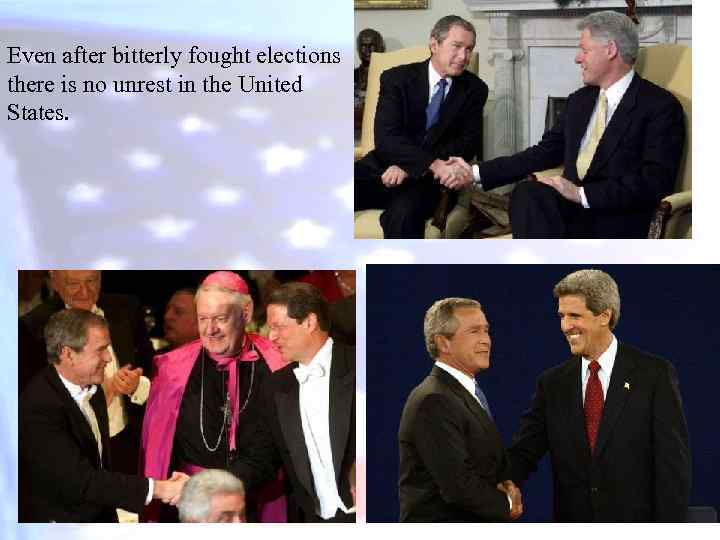
Even after bitterly fought elections there is no unrest in the United States.
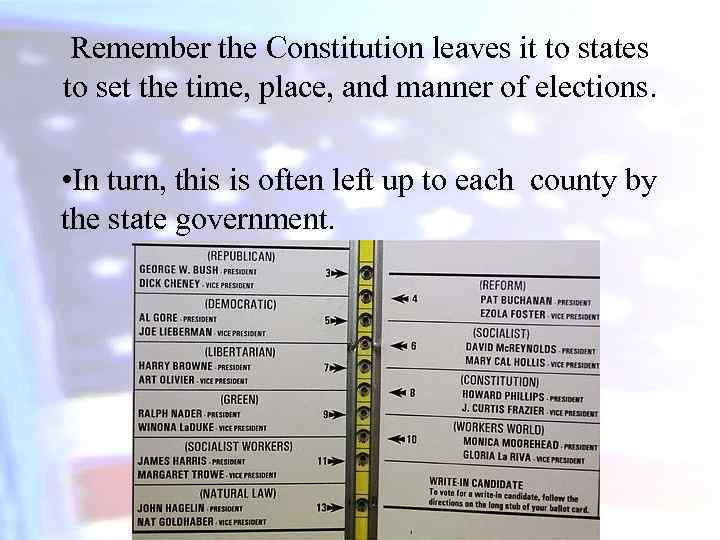
Remember the Constitution leaves it to states to set the time, place, and manner of elections. • In turn, this is often left up to each county by the state government.
Different Kinds of Elections • Primary Elections • General Elections
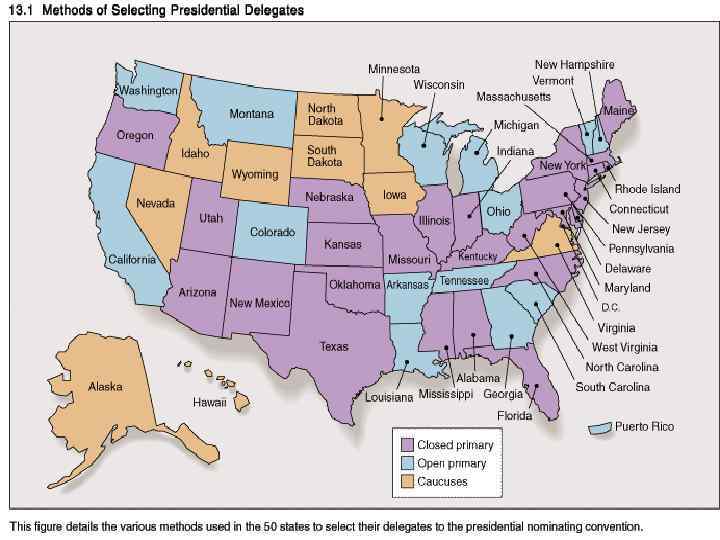
Primary Elections • This election decides who will be the party’s nominee in the general election. • Generally, turnout in these is low. • Candidates must appeal to the party’s activist “hard core”.
Presidential Elections • The presidential election is held every four years on the Tuesday after the first Monday in November. • It is really an election campaign fought state by state.
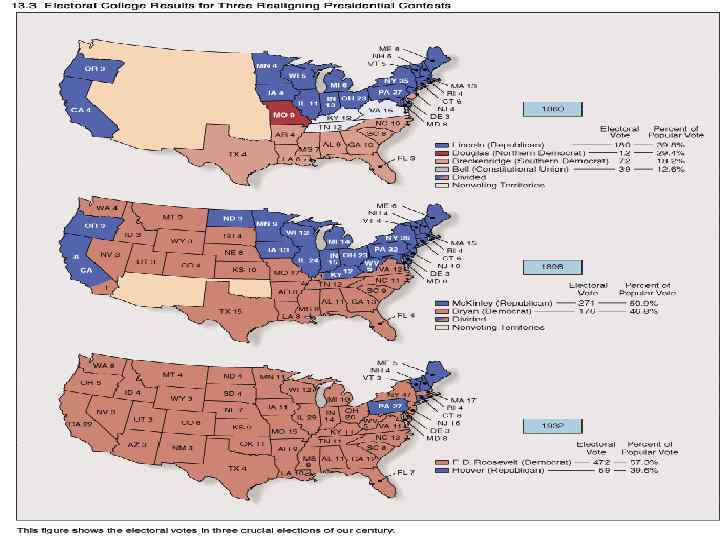
Electoral College • The Electoral College was a compromise created by the Framers to ensure that the president was chosen intelligently and with the input of each of the states. • The number of electors is determined by the federal representation for each state. • For example, California has 52 members of the House of Representatives and 2 Senators – 54 electoral votes.
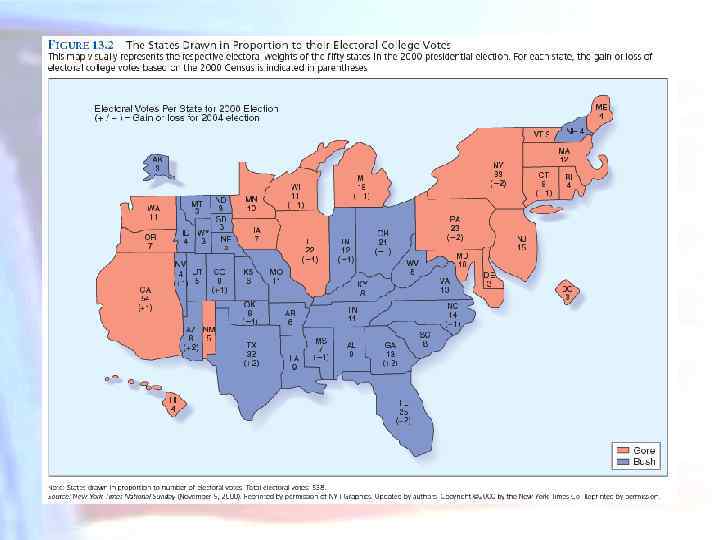
Electoral College • There a total of 538 electoral votes (535 members of Congress and 3 for the District of Columbia) • A majority of 270 wins the presidency. • Just as George W. Bush did in 2000, a candidate can win a majority of electoral votes with a minority of popular votes and still be elected to the office.
Patterns of Presidential Elections • Party Realignments are rare occurrences in which existing party affiliations change dramatically. • Secular Realignment is the gradual shifting of party coalitions.
Congressional Elections In Congressional elections: • candidates tend to be less visible. • most candidates are or were state legislators. • name recognition is often the most important battle of the campaign. • candidates receive little media coverage.
The usual pattern in the United States is: • During the Presidential election year, usually the winner’s party picks up seats in Congress. • This is called riding the President’s coattails.
Then in the next mid term election • Usually the President’s party gets punished and loses seats in Congress. • President Bush and the Republicans broke this pattern for the first time since 1934 in the 2002 midterm elections.
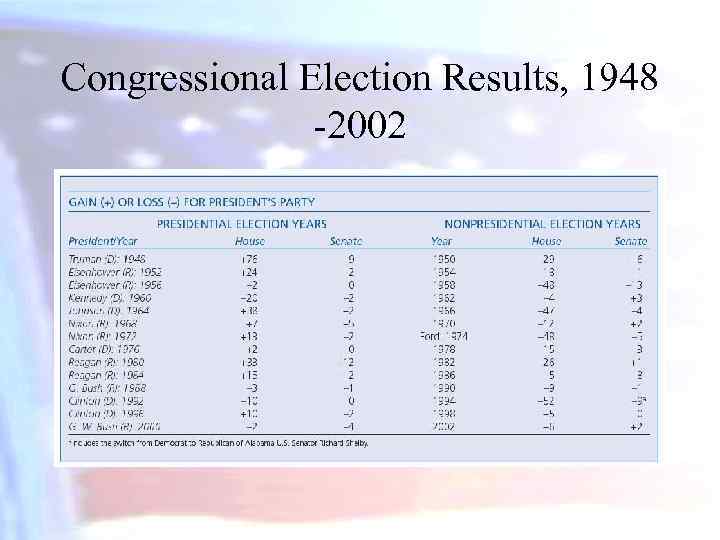
Congressional Election Results, 1948 -2002
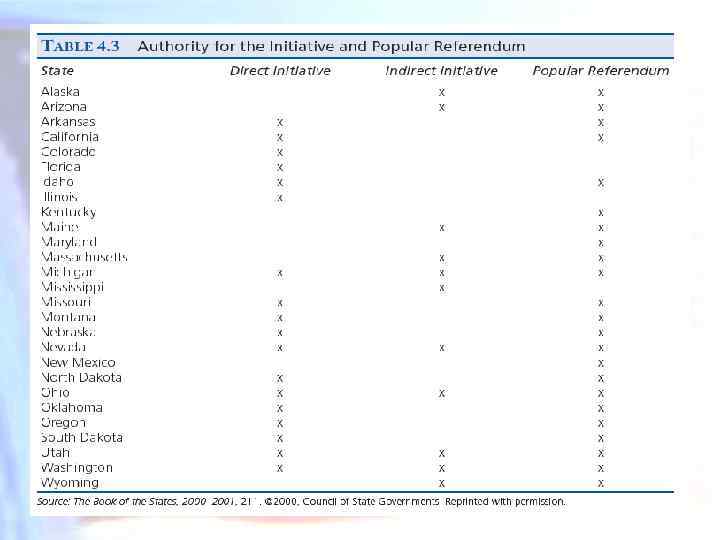
24 States and Washington D. C. allow for Initiative, Referendum, and Recall Elections Initiatives allow citizens to propose legislation and submit it to popular vote. A referendum allows the legislature to submit proposed legislation for popular approval. Recall elections allow citizens to remove someone from office.
Who Votes? • Income – people with higher incomes have a higher tendency to vote. • Education-the higher one’s level of education, the more likely they are to vote. • Age – older people tend to vote more often than younger people (less than half of eligible 18 -24 year olds are registered to vote). • Race – in general, whites tend to vote more regularly than African-Americans (this may be due to income and education rather than race).
SES- socioeconomic standing is the strongest factor in surveys • This is a combined estimate of someone’s wealth and education. • Why would people with higher incomes and education be more likely to vote?
Voting Behavior Voter Participation • About 40% of the eligible adult population votes regularly. • About 25% are occasional voters. • About 35% rarely or never vote.
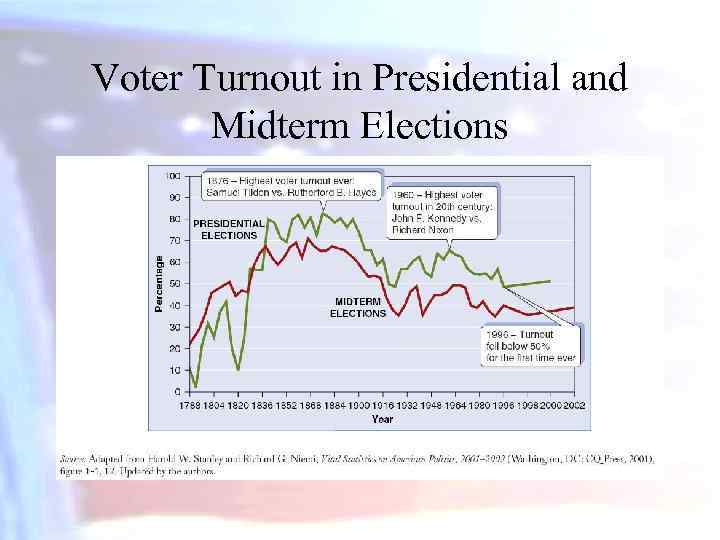
Voter Turnout in Presidential and Midterm Elections
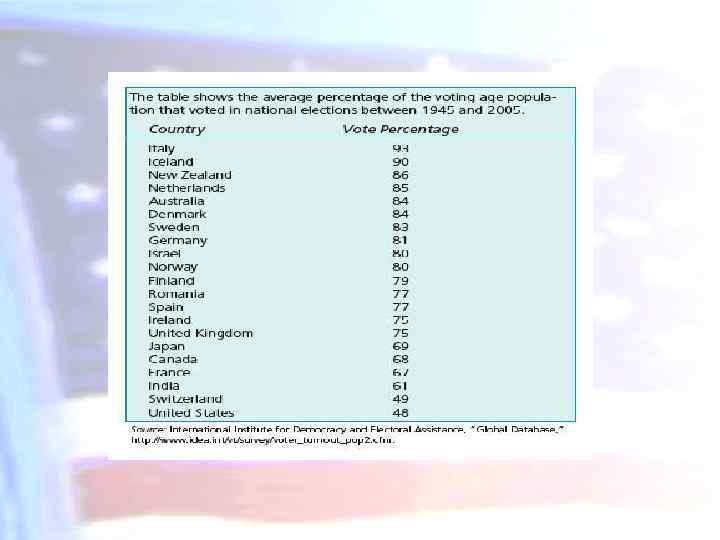
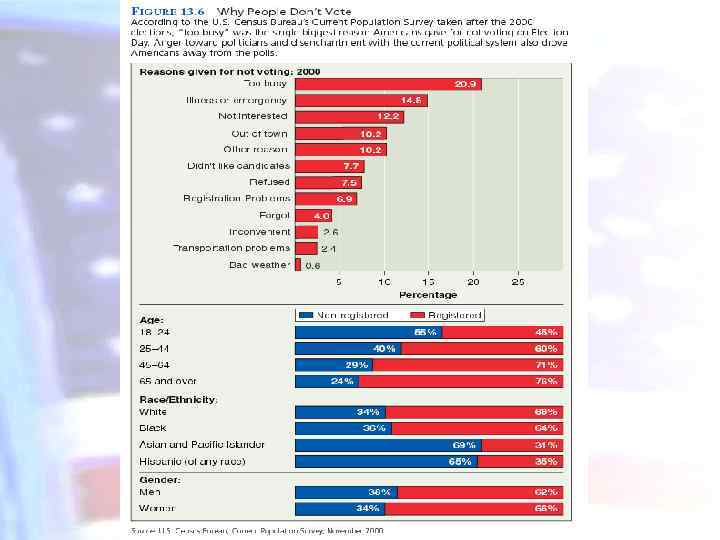
Does Low Voter Turnout Matter? • Is low voter turnout a problem in a democracy? • Do we want the uninformed or poor and uneducated voting? Might they make bad decisions?
Reforming the Electoral Process • Some possibilities: • Abolition of the electoral college • The establishment of a permanent congressional district scheme • Create bipartisan panels for redistricting • Restructuring campaign finance laws
Improving Turnout • Make election day a holiday? • Make registration easier? • Same day registration?
Скачать презентацию The Purposes Served by Elections Even after
elections.pptx