


 Скачать презентацию The Purchasing Function An Overview Chapter 1
f6d5ae8d98ec2c45c34f123b11b42fbb.ppt
- Количество слайдов: 32
 The Purchasing Function: An Overview Chapter 1
 Objectives • Describe commerce • Outline the purchasing function • Analyze the optimal goals of selection and procurement • Describe the desired attributes and knowledge required of a buyer
 Objectives (cont’d. ) • Describe a storeroom policies and procedures manual • Differentiate among the various types of sellers and how to best work with them
 Objectives (cont’d. ) • Distinguish among the various purchasing options and contracts available to buyers • Identify the benefits of a healthy buyer– seller relationship
 Historical Perspectives in Trade • Early humans were hunter-gatherers – Agriculture (seed planting) began later • Trade (commerce) is the voluntary exchange of goods or services – First form of trade was bartering – When currency was invented, selling and buying became separate transactions
 The Goals of Selection and Procurement • Selection – Choosing from available alternatives – A spec and a detailed description of what is needed guides selection • Procurement – Systematic exchange of payment for goods or services between buyer and seller
 An Optimal Goal • Optimal purchasing – Matches the specific characteristics of the product with the specific needs of the business
 An Optimal Goal (cont’d. ) • Considerations that are evaluated – Product attributes – Supplier attributes – Delivery requirements – Sanitation – Dependability
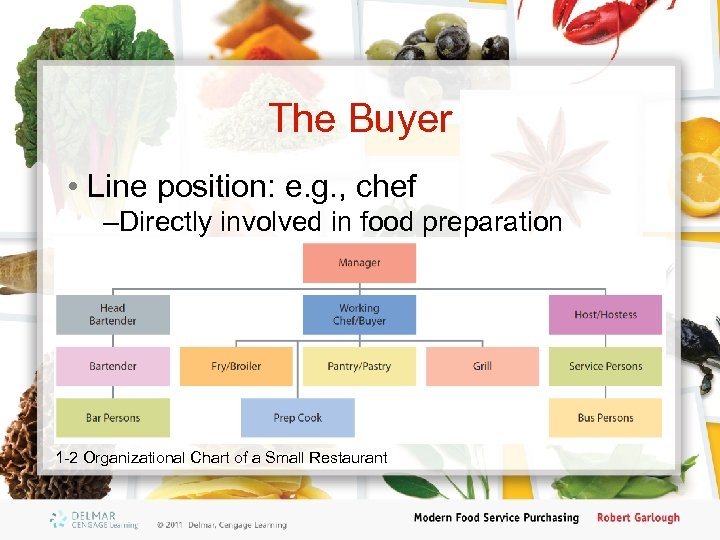 The Buyer • Line position: e. g. , chef –Directly involved in food preparation 1 -2 Organizational Chart of a Small Restaurant
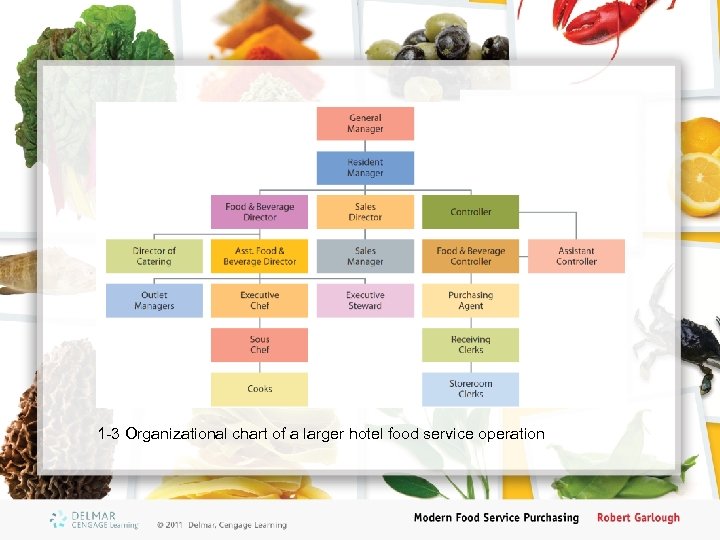 1 -3 Organizational chart of a larger hotel food service operation
 Required Attributes and Knowledge • Ethical standards – Honest and fair treatment of all • Conceptual skills – Understands relationships between functions and how actions affect society • Communication skills – Listen to and articulate needs
 Required Attributes and Knowledge (cont’d. ) • • • Mathematical skills Computer skills Market awareness Understand laws of commerce Product knowledge – Obtained by exposure to various forms of food products
 Storeroom Policies and Procedures • Develop a policies and procedures manual – Addresses who does what and when in purchasing – Includes supplier selection criteria – Guidelines on sales calls and accepting gifts from suppliers
 The Seller • Buyer must establish mutually satisfying relationships with sellers (purveyors) • When sellers are successful: – They can broaden their product line – There are more to choose from, ensuring competitive pricing
 Selecting Sellers • Respect is important • Research food service resources – Internet commerce – Local suppliers – National distributors • Broadline distributors have wide product range
 Selecting Sellers (cont’d. ) • Set up an introductory meeting – Prepare a list of questions to ask – Keep the meeting to one hour • Inspect the purveyor’s facilities – Look for sanitary conditions and practices
 Establishing Purchasing Options and Contracts • Inquire about purchasing options – Formal or informal arrangements • Depends on size and structure of seller’s organization or buyer’s business – Cooperative buying • Group formed to buy directly from source in large quantities
 Purchasing Service and Maintenance Contracts • Food service operators enter into contracts with outside service vendors – Some examples: • Pest control, waste removal and recycling, cleaning, facility and equipment maintenance, laundry and linen supply, bookkeeping, legal, insurance, utilities, advertising, flowers and plants, and vending machines
 Informal Buying Practices • Practiced by smaller operations where chef or owner does the buying • Advantages of informal buying – Takes little time away from daily operations – Varying quantity needs can be addressed – Urgent needs may be addressed quickly – Take advantage of price fluctuations
 Formal Buying Practices • Bid buying – Buyer requests price quotation from sellers • Cost plus fixed fee buying – Agreement with distributor fixed markup above their costs
 Formal Buying Practices (cont’d. ) • Volume buying and warehousing – Goods are held by supplier and delivered as needed • Prime vendor contracts – Similar to cost plus fixed fee but multiple vendors are used
 Formal Buying Practices (cont’d. ) • Long term contracts – Based on fixed prices; delivered as needed • Hedging (forward buying) – Buying quantities before they are needed to avoid price increases – If price falls, buyer loses
 The Buying Process • Buying occurs after menu planning is completed • Buying consists of three major steps – Identifying the need – Planning for the purchase – Making the purchase
 Identifying the Need • Determine stock levels – Consider shelf life – Minimum quantity known as safety stock • Consider normal usage rates • Determine whether additional quantities are needed for special events
 Planning for the Purchase • Determine rate at which operation uses the items • Compare quantities needed with stock on hand • Prepare an order sheet • Consider urgency of needing products
 Making the Purchase • List of selected and approved suppliers • Identify local retailers that carry product • Create an order record – Column for each vendor on the form • Completed order forms saved in a secure location • Use purchase order or blanket P. O.
 Making the Purchase (cont’d. ) • Standing orders – Volume commitment for daily delivery • Daily orders – Delivered within 24 hours • Drop shipments – Seller arranges for wholesaler or manufacturer to deliver to buyer directly
 Buyer-Seller Relations: A Win-Win Approach • Relationships between buyers and sellers should be mutually beneficial – When both parties consider relationship advantageous, future business together is sought after and encouraged
 Conducting Sales Meetings • Regularly scheduled and planned in advance • Negotiate purchases – Create partnerships – Understand the needs of both parties – Know yourself
 Supplier Performance Evaluation • Evaluate both the product and the process • Develop a cross-functional team to identify priorities that should be evaluated – Define most important factors to evaluate – Determine a rating scale
 Ethical and Professional Standards and Practices • Management should articulate ethical standards of the organization • Management may not benefit personally from the company’s financial gains • Do not allow conflict of interest • Avoid tips, supplier gifts, or bonuses
 Summary • Buyers and sellers should strive for a mutually beneficial relationship • Many different types of purchasing exist • Developing a policies and procedures manual is important • Evaluating suppliers and maintaining ethical standards key for success