 Скачать презентацию The Public in Public Management Andrew Graham
49b9d29f0c31d72a8e01274e194ba041.ppt
- Количество слайдов: 49



The Public in Public Management Andrew Graham
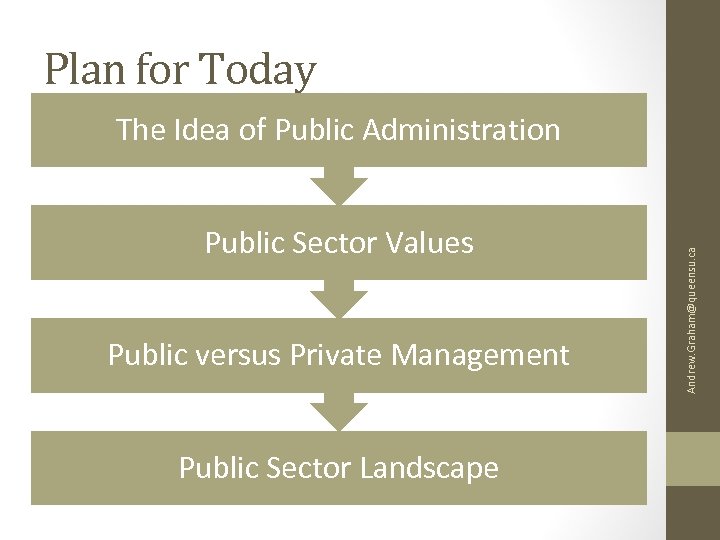
Plan for Today Public Sector Values Public versus Private Management Public Sector Landscape Andrew. Graham@queensu. ca The Idea of Public Administration
Andrew. Graham@queensu. ca The Idea of Public Administration
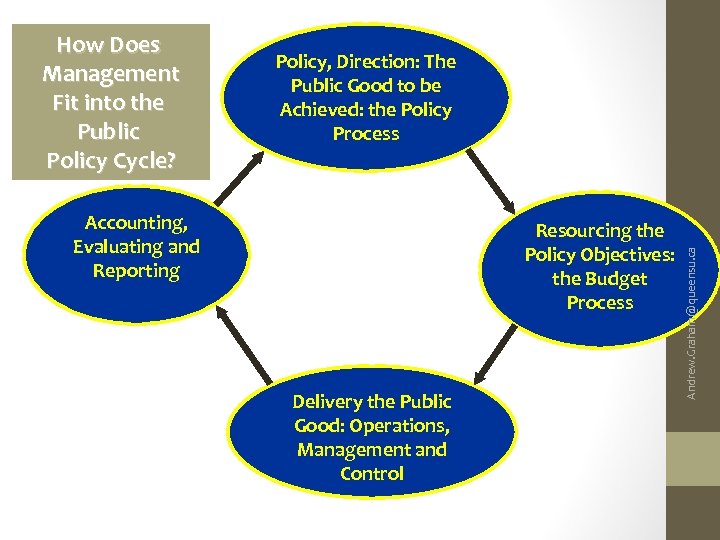
Policy, Direction: The Public Good to be Achieved: the Policy Process Accounting, Evaluating and Reporting Resourcing the Policy Objectives: the Budget Process Delivery the Public Good: Operations, Management and Control Andrew. Graham@queensu. ca How Does Management Fit into the Public Policy Cycle?
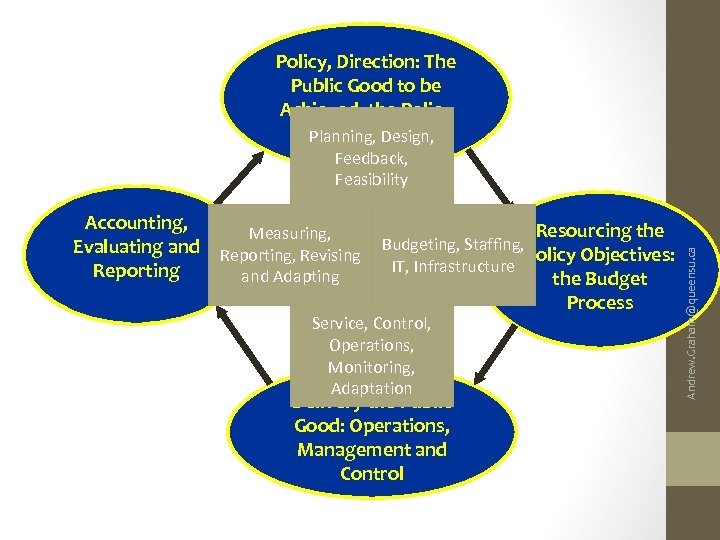
Policy, Direction: The Public Good to be Achieved: the Policy Process Planning, Design, Feedback, Feasibility Measuring, Reporting, Revising and Adapting Resourcing the Budgeting, Staffing, Policy Objectives: IT, Infrastructure Service, Control, Operations, Monitoring, Adaptation Delivery the Public Good: Operations, Management and Control the Budget Process Andrew. Graham@queensu. ca Accounting, Evaluating and Reporting
Is it what governments do? Is it direct action or indirect? Examples? Is it public policy? Is it defined and confined in law? Is regulation public administration? Is it patronage, spreading out the public purse? Is it theft? Is it collective protection of the weak and guardian of fairness? • Is it a profession? • Is it just management? Can it exist without management? • • Andrew. Graham@queensu. ca What is public administration?
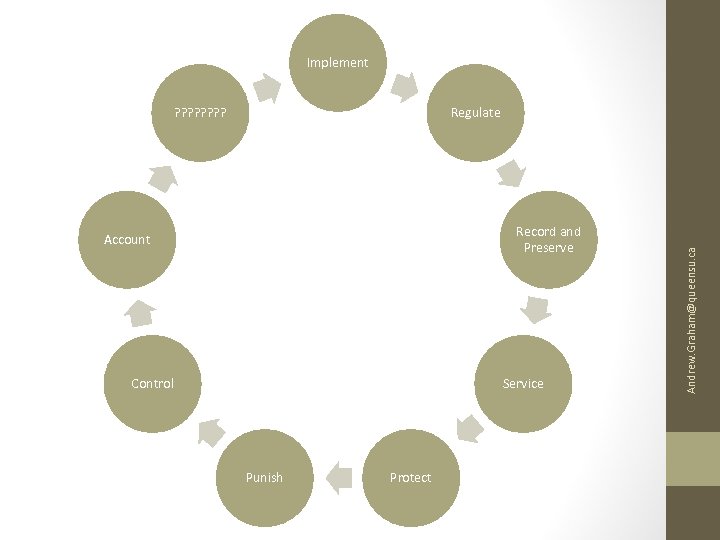
Implement Regulate Record and Preserve Account Control Service Punish Protect Andrew. Graham@queensu. ca ? ? ? ?
• Laws or legally founded rules that create the structure of the administrative apparatus of the state. • Delegation through law of specific powers and responsibilities to the administrative apparatus to carry on the work of government • Continuing democratic supervision of administrative activities through the executive which directs activities within the public administration apparatus. . . • Accountability vested in the political executive to the legislature. Andrew. Graham@queensu. ca Defining characteristics of public administration
• A non-political administrative apparatus that is subject to policy direction but not partisan. • Forms of interaction between policy makers and policy implementers • Forms of interaction among policy makers, implementers and those affected by the policies • Delivery of services based on law and public resources • Oversight of delivery by others Andrew. Graham@queensu. ca Defining characteristics of public administration
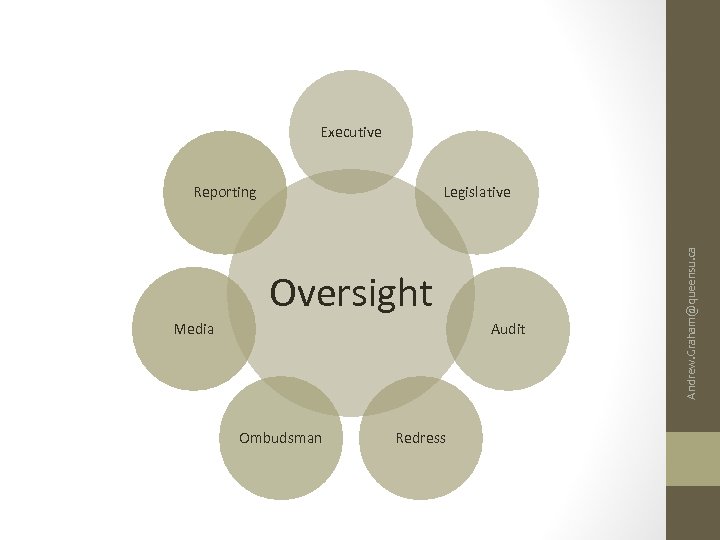
Executive Legislative Oversight Media Audit Ombudsman Redress Andrew. Graham@queensu. ca Reporting
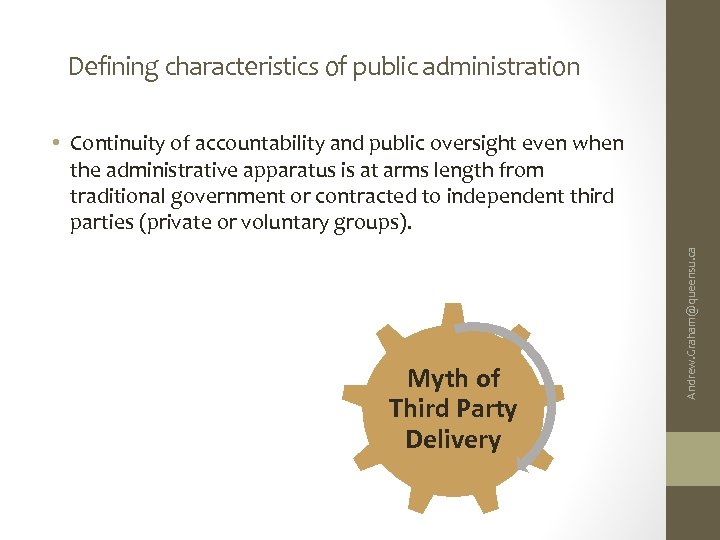
Defining characteristics of public administration Myth of Third Party Delivery Andrew. Graham@queensu. ca • Continuity of accountability and public oversight even when the administrative apparatus is at arms length from traditional government or contracted to independent third parties (private or voluntary groups).
Andrew. Graham@queensu. ca Ten Minutes: Five Public Sector Values in Canada and their impact on delivering public goods.
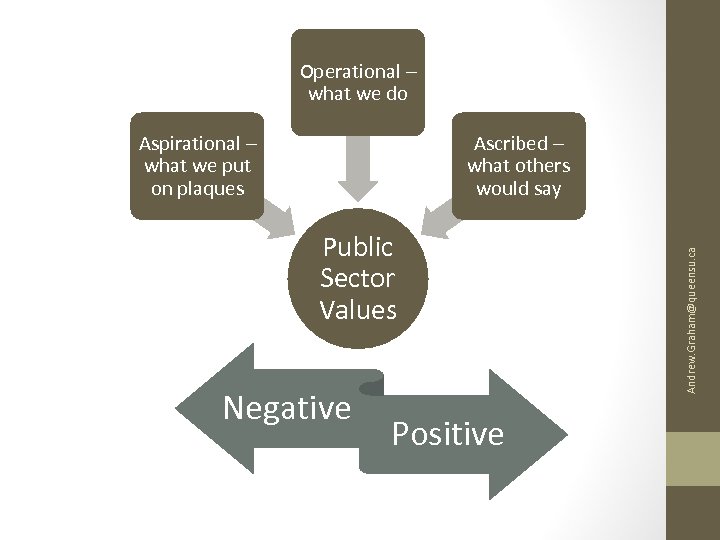
Operational – what we do Ascribed – what others would say Public Sector Values Negative Positive Andrew. Graham@queensu. ca Aspirational – what we put on plaques
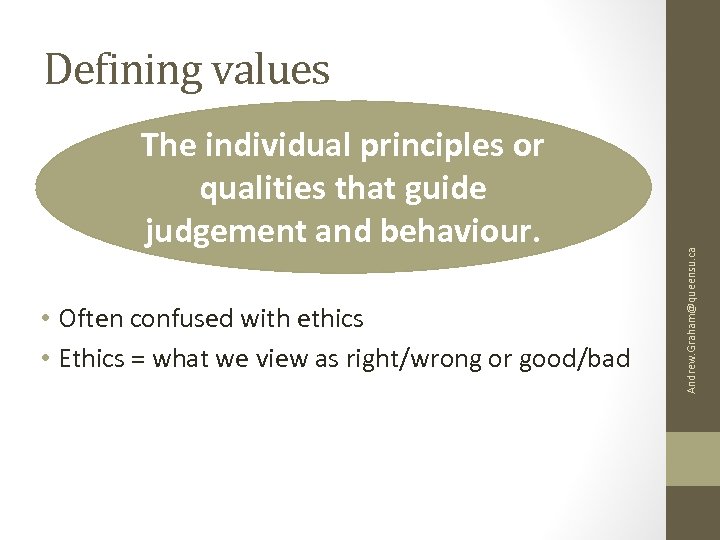
The individual principles or qualities that guide judgement and behaviour. • Often confused with ethics • Ethics = what we view as right/wrong or good/bad Andrew. Graham@queensu. ca Defining values
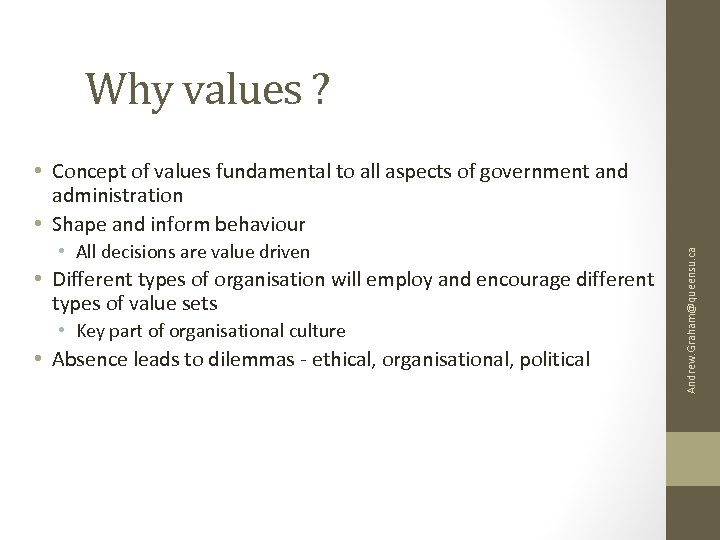
Why values ? • All decisions are value driven • Different types of organisation will employ and encourage different types of value sets • Key part of organisational culture • Absence leads to dilemmas - ethical, organisational, political Andrew. Graham@queensu. ca • Concept of values fundamental to all aspects of government and administration • Shape and inform behaviour
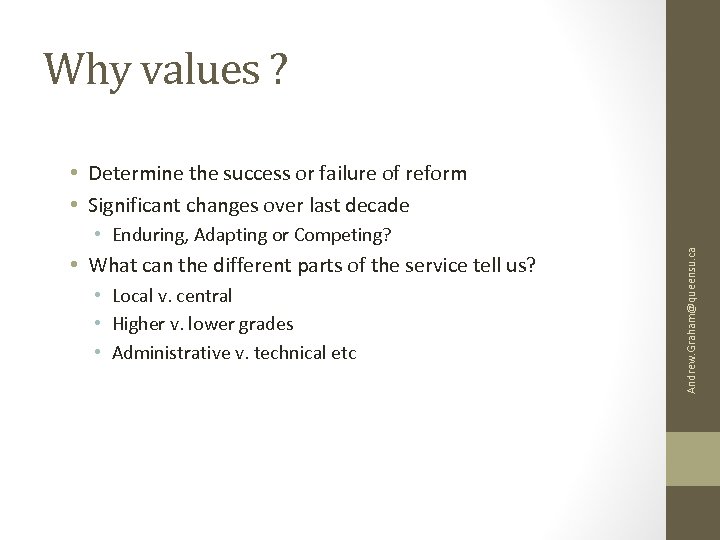
Why values ? • Determine the success or failure of reform • Significant changes over last decade • What can the different parts of the service tell us? • Local v. central • Higher v. lower grades • Administrative v. technical etc Andrew. Graham@queensu. ca • Enduring, Adapting or Competing?
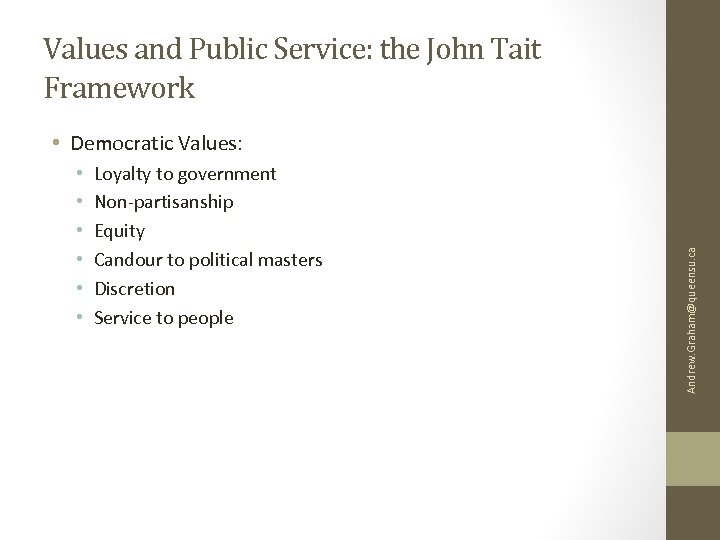
Values and Public Service: the John Tait Framework • • • Loyalty to government Non-partisanship Equity Candour to political masters Discretion Service to people Andrew. Graham@queensu. ca • Democratic Values:
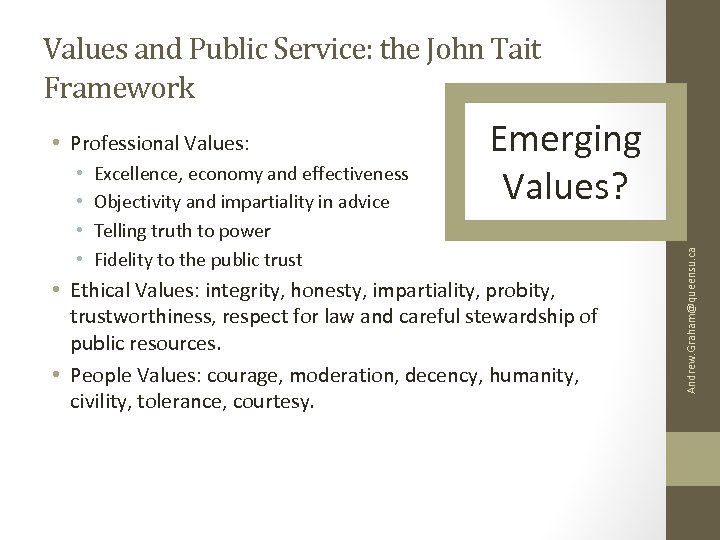
Values and Public Service: the John Tait Framework • • Excellence, economy and effectiveness Objectivity and impartiality in advice Telling truth to power Fidelity to the public trust Emerging Values? • Ethical Values: integrity, honesty, impartiality, probity, trustworthiness, respect for law and careful stewardship of public resources. • People Values: courage, moderation, decency, humanity, civility, tolerance, courtesy. Andrew. Graham@queensu. ca • Professional Values:
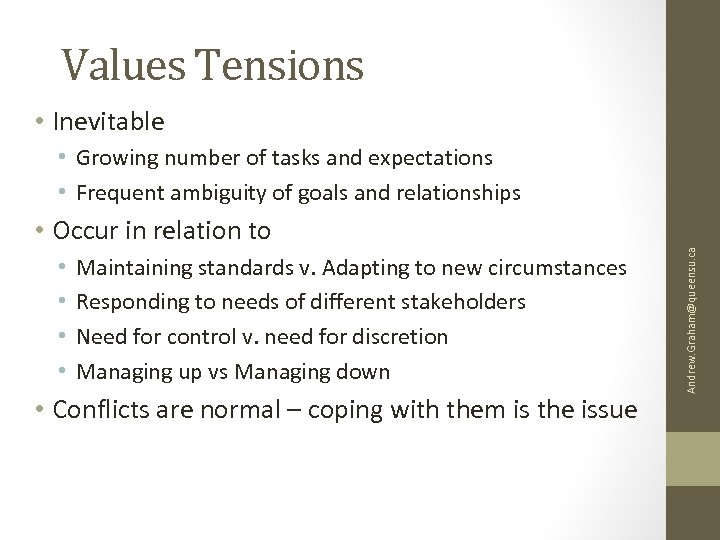
Values Tensions • Inevitable • Growing number of tasks and expectations • Frequent ambiguity of goals and relationships • • Maintaining standards v. Adapting to new circumstances Responding to needs of different stakeholders Need for control v. need for discretion Managing up vs Managing down • Conflicts are normal – coping with them is the issue Andrew. Graham@queensu. ca • Occur in relation to
• Discuss an experience that one member of the table had or that you saw in another organization where values were in conflict. • Prepare to share it with the group. • We can then discuss such conflicts with these stories. Andrew. Graham@queensu. ca Table Discussion: Tell a Story
Bureaucratic Values: Are They Always Bad? • What are the bad old bureaucratic values? • Do these necessarily contradict the public interest?
Challenges to traditional values • New modes of governance – state and market • • NPM or market-based reforms Agencies – ORNGE, Cancer Ontario, LCBO Generational shifts More information, more openly available with less control over its use What else? Andrew. Graham@queensu. ca • Greater fluidity, stakeholders
• Savoie, 2006, arguing that even Westminster models vested roles in management to bureaucrats, but they remained essentially anonymous: this is changing • Clearer in municipal government, hospital and educational administration • Agencies are more visible • Emergence of more visible pubic administrators working for government with a strong penchant for message control Andrew. Graham@queensu. ca Seen but not Heard? Does the public manager have a personality?
Andrew. Graham@queensu. ca Public Versus Private Management
Public versus Private: a whole lot of difference? • Discussion: 2. What are the principles differences between public and private sector management and administration? What are elements that are the same? Andrew. Graham@queensu. ca 1.
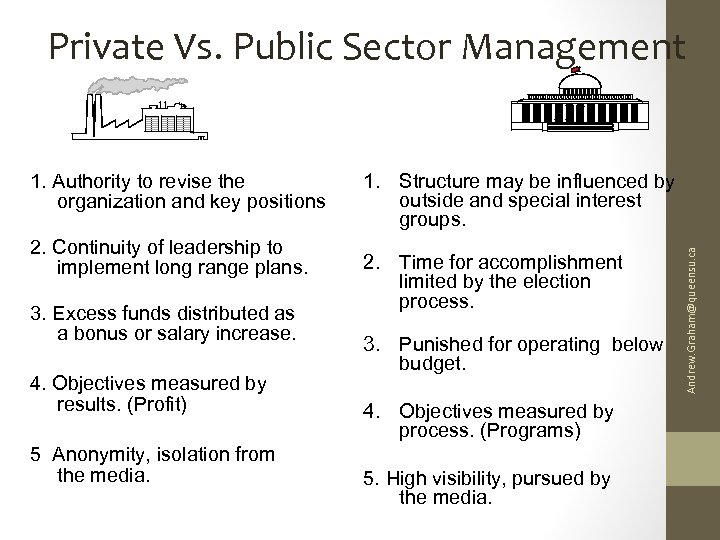
Private Vs. Public Sector Management 2. Continuity of leadership to implement long range plans. 3. Excess funds distributed as a bonus or salary increase. 4. Objectives measured by results. (Profit) 5 Anonymity, isolation from the media. 1. Structure may be influenced by outside and special interest groups. 2. Time for accomplishment limited by the election process. 3. Punished for operating below budget. 4. Objectives measured by process. (Programs) 5. High visibility, pursued by the media. Andrew. Graham@queensu. ca 1. Authority to revise the organization and key positions
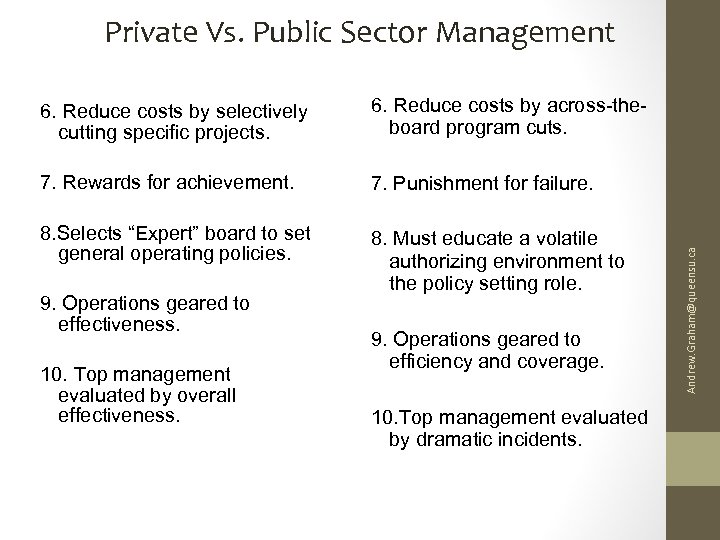
Private Vs. Public Sector Management 6. Reduce costs by across-theboard program cuts. 7. Rewards for achievement. 7. Punishment for failure. 8. Selects “Expert” board to set general operating policies. 8. Must educate a volatile authorizing environment to the policy setting role. 9. Operations geared to effectiveness. 10. Top management evaluated by overall effectiveness. 9. Operations geared to efficiency and coverage. 10. Top management evaluated by dramatic incidents. Andrew. Graham@queensu. ca 6. Reduce costs by selectively cutting specific projects.
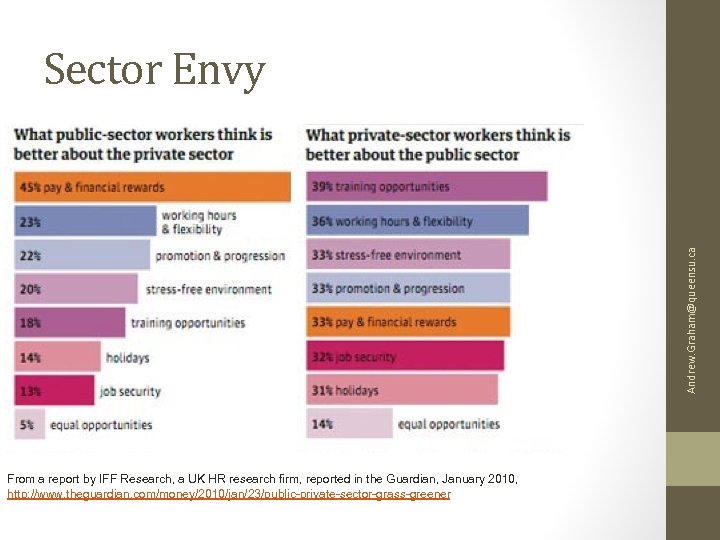
Andrew. Graham@queensu. ca Sector Envy From a report by IFF Research, a UK HR research firm, reported in the Guardian, January 2010, http: //www. theguardian. com/money/2010/jan/23/public-private-sector-grass-greener
Andrew. Graham@queensu. ca Is the private sector more efficient than the public sector?
• Commercial organisations are risk averse. • Profit margins are easier to secure where there is predictability. • But much of what the public sector does is relatively unbounded • Public sector’s capacity for risk pooling and cross subsidy can actually permit it to take on more risk Andrew. Graham@queensu. ca Heretical View: Risk averse nature of private sector organisations
Andrew. Graham@queensu. ca The Public Sector Landscape
- Fred Thompson, The Three Faces of Public Management, International Public Management Review, 2008 Andrew. Graham@queensu. ca “Managers are always on “rough ground” where values, feelings, affect, and ambiguities are simultaneously in play. ”
• • • Complexity Interoperability Inter-dependence Contested results Breadth of instrumentality Contingency response and redundancy Andrew. Graham@queensu. ca Public Sector Management Landscape
• Today, a strong focus on what is wrong in public administration • Do the values of efficiency and service actually conflict with values of social support and community sustainability? • Do threats such as terrorism trump due process? • Is the value that public administration adds changing? From social welfare to security interoperability? Andrew. Graham@queensu. ca Does public administration have a values problem?
Bureaucracy: What Government Agencies Do and Why They Do It Andrew. Graham@queensu. ca “Public management. . . is a world of settled institutions designed to allow imperfect people to use flawed procedures to cope with insoluble problems. ” - James Q. Wilson
• At the heart of public administration, even at times of change, is the notion of a predictable, stable support to the democratic process, even at times of change. • “While reform, change, and adaptation of contemporary national administrative systems may be nearly universal, it follows centuries of reform, change, and adaptation that have resulted in national institutions whose function is to guarantee a certain stability and continuity in democratic governance. ” Laurence Lynn, “Public Management: Old and New” Andrew. Graham@queensu. ca Key Themes
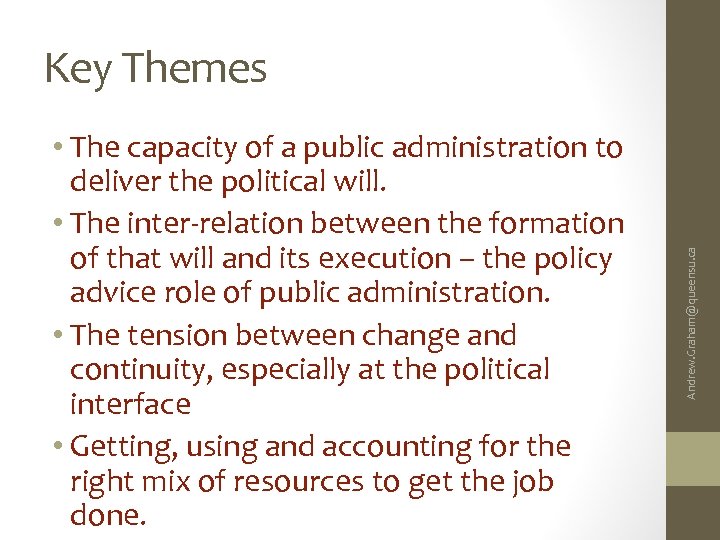
• The capacity of a public administration to deliver the political will. • The inter-relation between the formation of that will and its execution – the policy advice role of public administration. • The tension between change and continuity, especially at the political interface • Getting, using and accounting for the right mix of resources to get the job done. Andrew. Graham@queensu. ca Key Themes
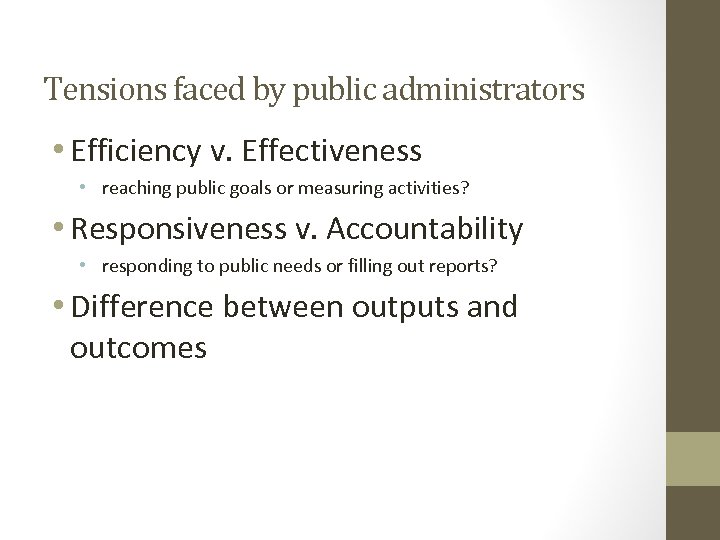
Tensions faced by public administrators • Efficiency v. Effectiveness • reaching public goals or measuring activities? • Responsiveness v. Accountability • responding to public needs or filling out reports? • Difference between outputs and outcomes
Andrew. Graham@queensu. ca And then there is New Public Management…… 39
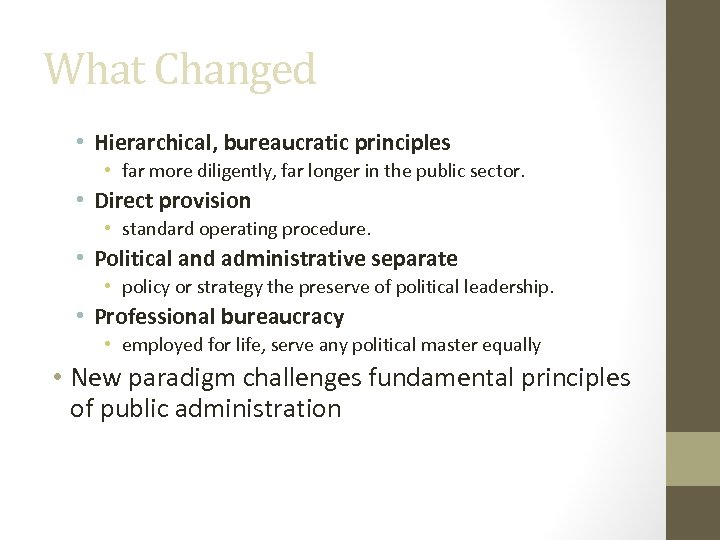
What Changed • Hierarchical, bureaucratic principles • far more diligently, far longer in the public sector. • Direct provision • standard operating procedure. • Political and administrative separate • policy or strategy the preserve of political leadership. • Professional bureaucracy • employed for life, serve any political master equally • New paradigm challenges fundamental principles of public administration
Old Models Fall • Delivery by bureaucracy is not the only way to provide government goods and services. • Flexible management systems pioneered by the private sector are being adopted by governments. • Governments can operate indirectly. • Political and administrative matters intertwined • Public demands better accountability • Case for unusual employment conditions weaker.
New public management: central doctrines • No book but… • • • focus on management, not policy performance appraisal and efficiency disaggregation of public bureaucracies user-pay relationships use of quasi-markets and contracting out to foster competition cost-cutting; output targets; limited-term contracts; monetary’ incentives; freedom to manage.
NPM: implies • Substantial changes for personnel • Osborne and Gaebler: • government needs to be ‘reinvented’ • bureaucracy neither necessary nor efficient • other means should be used. • “Entrepreneurial governments” promote competition between service providers. • Pushing control into the community • Measure performance by outcomes.
NPM: the mission • • Redefine clients as customers Offer choices Prevent problems before they emerge Earning money, not simply spending it Decentralise authority Participatory management Preference for market mechanisms Energising all sectors — public, private and voluntary — to solve their community’s problems.
NPM: the legacy • Great focus on measurement • Greater involvement of private (profit and not-for-profit) in delivery • Disaggregation of policy formulation • Rise of agencies and arms-length organizations within government • Clear issues of how to exercise accountability for these • Novel financing arrangements • Transfer of risk to private sector Andrew. Graham@queensu. ca • Much has changed in public administration as a result of NPM • Scattered and inconsistent • Some trends very clearly would have spun out on their own:
• Concepts of complexity and globalization • An increasing number of public policy issues call for the active contribution of many actors across and beyond government • Working in networks • Working through others Andrew. Graham@queensu. ca Emergence of the New Governance
• Government as steering not delivering • Concept of nudge • Value challenges: non-traditional relationships, less process control leads to less outcome control, forces a concept of policy design based on reverse engineering • A riskier landscape with less direct control • Concept of resilience and capacity to respond to unpredictable outcomes and events Andrew. Graham@queensu. ca Emergence of the New Governance
Emergence of the New Governance: Value Challenges “Above all, it may be time to rediscover some very old concepts of the public good, collective interests, democracy, civics and citizenship and to explore their meaning in the changing landscape of today’s reality. ” - Jocelyn Bourgon, Public Purpose, Government Authority and Collective Power Andrew. Graham@queensu. ca • Collaborative Values • Citizen engagement • Holding onto core values
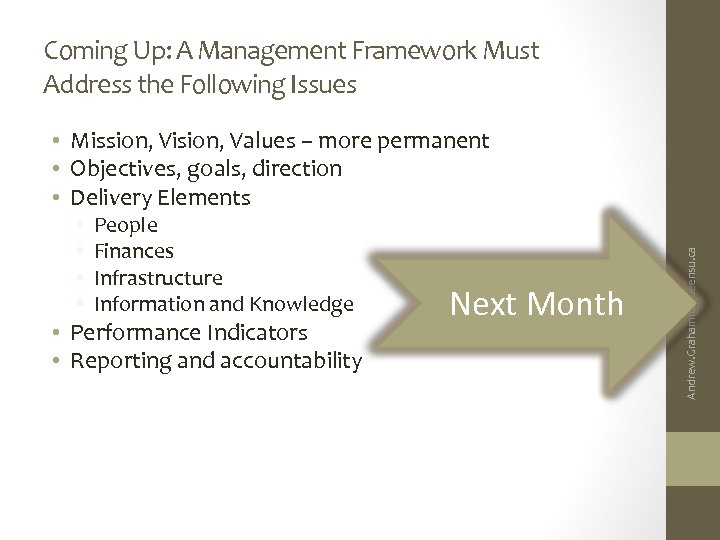
Coming Up: A Management Framework Must Address the Following Issues • • People Finances Infrastructure Information and Knowledge • Performance Indicators • Reporting and accountability Next Month Andrew. Graham@queensu. ca • Mission, Vision, Values – more permanent • Objectives, goals, direction • Delivery Elements
Скачать презентацию The Public in Public Management Andrew Graham
49b9d29f0c31d72a8e01274e194ba041.ppt