


 Скачать презентацию The Psychological issues for young people Trafficked for
de7e8c87e9ee4aea56db6c2414c82333.ppt
- Количество слайдов: 27
 The Psychological issues for young people Trafficked for Domestic Servitude Josie Dale Mental Health Psychotherapist Josie@afruca. org 25 th May 2016
 Africans Unite Against Child Abuse (AFRUCA) The premier charity promoting the rights and welfare of African children in the UK 5 key areas of work: • Awareness raising on child rights • Policy & Advocacy • Training, Research and Advisory services • Community and international development • Service provision
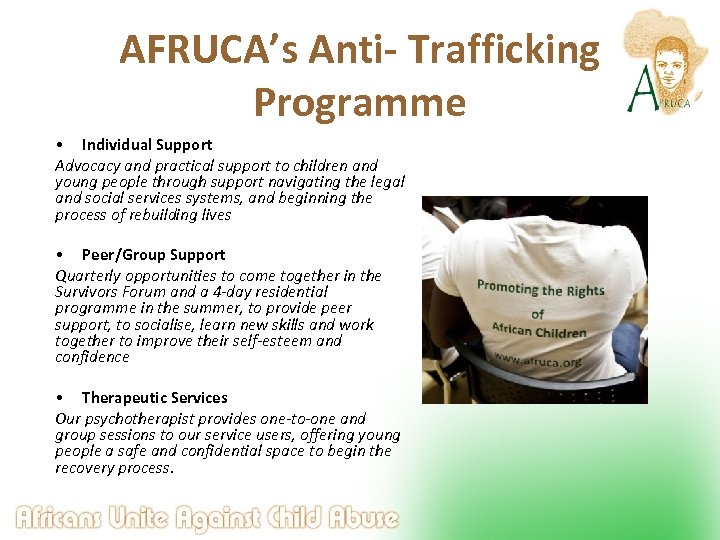 AFRUCA’s Anti- Trafficking Programme • Individual Support Advocacy and practical support to children and young people through support navigating the legal and social services systems, and beginning the process of rebuilding lives • Peer/Group Support Quarterly opportunities to come together in the Survivors Forum and a 4 -day residential programme in the summer, to provide peer support, to socialise, learn new skills and work together to improve their self-esteem and confidence • Therapeutic Services Our psychotherapist provides one-to-one and group sessions to our service users, offering young people a safe and confidential space to begin the recovery process.
 AFRUCA’s Anti- Trafficking Programme • Policy AFRUCA sits on a number of advisory boards, multi-agency groups and working groups to influence policies and practices to counter human trafficking. We regularly present at various national and regional conferences, and provided detailed input into the Modern Slavery Act. • Advocacy Work closely with crime prevention agencies, social services and legal experts in the investigation of cases, often acting as an expert witness in immigration and criminal cases • Awareness Raising Run educational and sensitisation programmes to help improve knowledge and understanding of the issue of human trafficking and how to help protect victims, both to the African and black community and frontline workers. We also publish information pamphlets and educational materials on child trafficking
 Specialist Therapeutic Service Provide 1: 1 and group psychotherapy for trafficked children and YP Offer a consultation service in recognising and understanding the psychological complexity of children/YP trafficked from Africa Specialist training for social services, foster carers, mental health services or any external services Psychological assessments and report writing for courts or social services For further information, contact Josie Dale (josie@afruca. org)
 Training We can present bespoke trainings on the following topics: ü Working with diversity ü Safeguarding Children: Working with Black/African Children and Families ü Child Abuse Linked to a Belief in Witchcraft and Juju ü Female Genital Mutilation (FGM) as a Child Safeguarding Issue ü Safeguarding African Children Trafficked into the UK ü Safeguarding in Black Faith Organisations in the West Midlands Contact Halilat Yusuf (training@afruca. org)
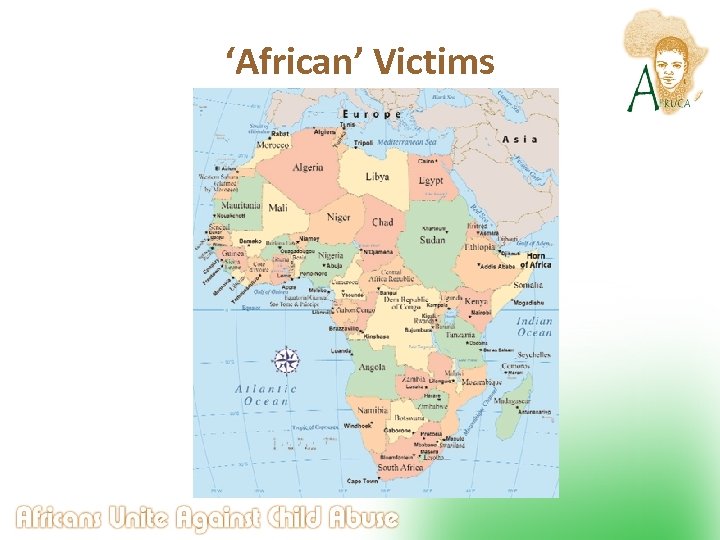 ‘African’ Victims
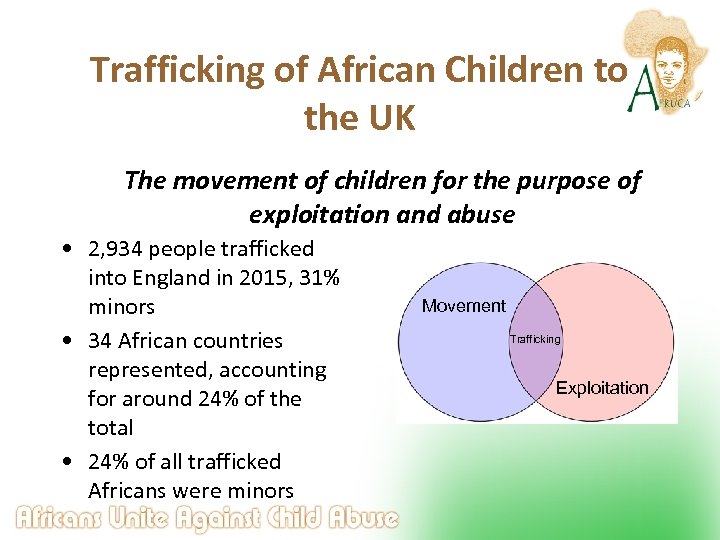 Trafficking of African Children to the UK The movement of children for the purpose of exploitation and abuse • 2, 934 people trafficked into England in 2015, 31% minors • 34 African countries represented, accounting for around 24% of the total • 24% of all trafficked Africans were minors Movement Trafficking Exploitation
 Private Fostering restavec, omo-odo ‘Cultural Norm’ in many African countries - long established coping mechanism for poor families - Can enable children to access basic needs such as education and healthcare - Domestic work and childcare accepted chores for children - It can be mutually beneficial BUT it can be prone to abuse: • Huge power differential – ‘savior’ exploiter and the ‘grateful’ child • Parents’ support • Thin line between child abuse/labour and “housework”.
 Private Fostering linked to Domestic Servitude Children/parents convinced that they will get better opportunities for work and/or education, either in their home country, or in the UK Subjected to: • Work without rest, no days off, or pay • Long hours and no breaks • Malnourished • Lack of access to education/healthcare • Controlled and isolated • Interpersonal violence (physical and sexual) • Documents taken from them
 What is Trafficking for domestic servitude? “It is an invisible form of exploitation which is extremely difficult to detect due to the hidden nature of the work provided. Domestic work takes place out of sight in private households which isolates the victim/worker. It is mostly perpetrated by the private employer who is the main beneficiary of the forced labour. She/he is both recruiter and exploiter. Trafficking for domestic servitude covers common features: subjugation and obligation, low or no salary, no days off, psychological, physical and /or sexual violence; restricted freedom/movement no private life. The individual lives in the house of family and is constantly at their disposal and mercy.
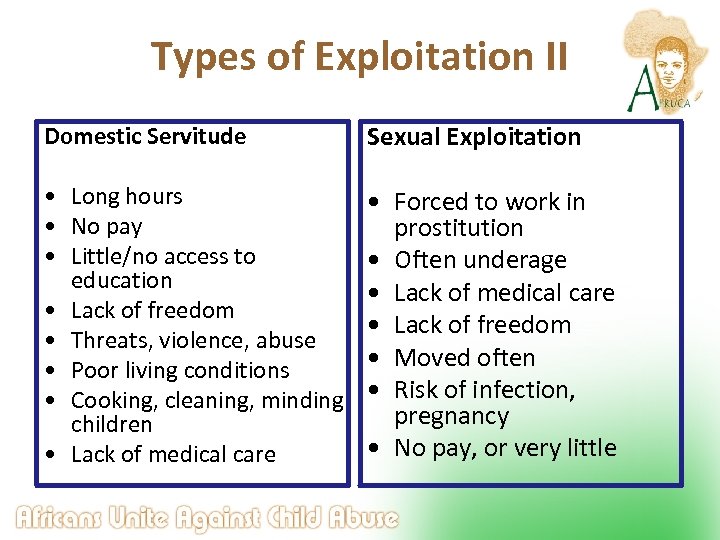 Types of Exploitation II Domestic Servitude Sexual Exploitation • Long hours • No pay • Little/no access to education • Lack of freedom • Threats, violence, abuse • Poor living conditions • Cooking, cleaning, minding children • Lack of medical care • Forced to work in prostitution • Often underage • Lack of medical care • Lack of freedom • Moved often • Risk of infection, pregnancy • No pay, or very little
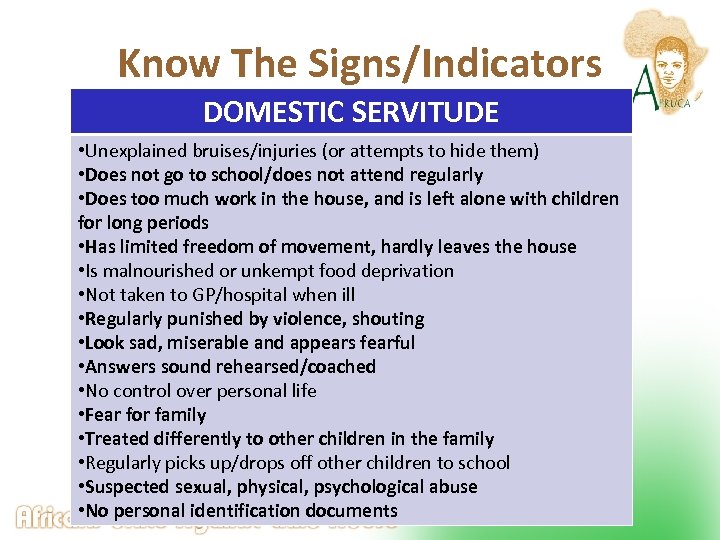 Know The Signs/Indicators DOMESTIC SERVITUDE • Unexplained bruises/injuries (or attempts to hide them) • Does not go to school/does not attend regularly • Does too much work in the house, and is left alone with children for long periods • Has limited freedom of movement, hardly leaves the house • Is malnourished or unkempt food deprivation • Not taken to GP/hospital when ill • Regularly punished by violence, shouting • Look sad, miserable and appears fearful • Answers sound rehearsed/coached • No control over personal life • Fear for family • Treated differently to other children in the family • Regularly picks up/drops off other children to school • Suspected sexual, physical, psychological abuse • No personal identification documents
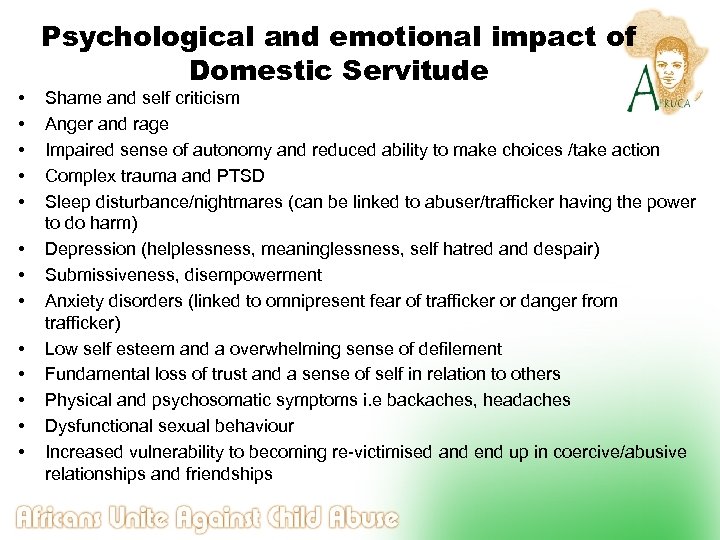 • • • • Psychological and emotional impact of Domestic Servitude Shame and self criticism Anger and rage Impaired sense of autonomy and reduced ability to make choices /take action Complex trauma and PTSD Sleep disturbance/nightmares (can be linked to abuser/trafficker having the power to do harm) Depression (helplessness, meaninglessness, self hatred and despair) Submissiveness, disempowerment Anxiety disorders (linked to omnipresent fear of trafficker or danger from trafficker) Low self esteem and a overwhelming sense of defilement Fundamental loss of trust and a sense of self in relation to others Physical and psychosomatic symptoms i. e backaches, headaches Dysfunctional sexual behaviour Increased vulnerability to becoming re-victimised and end up in coercive/abusive relationships and friendships
 High levels of Shame and self criticism • Low self esteem as a direct result of enslavement, psychological abuse, deprivation and violence • During sensitive developmental years young people trafficked for domestic servitude can suffer abuse which directly affects their self esteem and self image e. g. being called house girl/boy/slave; being dressed in cast off clothes and being denied essential sanitary items. • Name calling and encouraging other children in household to mock or beat them is humiliating • Victims report being forced live like animals
 High levels of Shame and self criticism • In all cases autonomy and sense of self as a valid person is violated • Results in enormous difficulty in being kind to themselves, feeling warmth or being self compassionate (Gilbert 2005; Ogden 2006; Van der Hart 2006)
 Memory and recall • Many victims suffer with difficulties with memory and the ability to accurately recall traumatic events or organise them in chronological order. A female trafficked as a teenager speaking at her psychological assessment: ‘I just can’t remember, I can’t hold information in my head’’
 Self harm • Self harm is a form of coping with overwhelming emotions such as shame, guilt anxiety and anger. It is common with victims who have experienced interpersonal violence. • People who have suffered this form of abuse sometimes self harm in away that relates to what they have experienced, for example rape victims harming genitalia
 Hyper arousal to fear and danger • Being constantly on guard which reflects their experience of being controlled and watched whilst enslaved • Victims can have an exaggerated startled response • Can cause social isolation to avoid panic attacks and social anxiety
 Complex traumatic events & experiences that are: 1) Repetitive, prolonged, or cumulative 2 ) Most often interpersonal, involving direct harm, exploitation, and maltreatment including neglect/abandonment/antipathy by primary caregivers or other ostensibly responsible adults 3) Often occur at developmentally vulnerable times in the victim's life, especially in early childhood or adolescence but can also occur later in life and in conditions of vulnerability associated with disability/ disempowerment/dependency/age /infirmity etc
 Complex trauma symptoms Alterations in the regulation of impulses, e. g. • difficulty with modulation of anxiety and/or anger, . • tendencies towards self-destructiveness. • unhelpful self-soothing methods/behaviours Alterations in attention and consciousness leading to e. g. • amnesias (forgetting traumatic events) • dissociative episodes (where one feels detached from ones mental processes or body) • depersonalization. Somatisation and/or medical problems. • This is where psychological distress converts into a physical symptom
 Complex trauma Alterations in self perception predominantly: • negative and involving a chronic sense of guilt • responsibility, and ongoing feelings of intense shame. Alterations in perception of the perpetrator including: incorporation of his or her belief system. Alterations in relationship to others e. g. • not being able to trust the motives of others • not being able to feel intimate with them. Alterations in systems of meaning. • Chronically abused and traumatized individuals often feel hopeless about finding anyone to understand them or their suffering.
 • The cognitive model of emotional disorders suggests that on the basis of experience people form conclusions (beliefs and assumptions) about them selves, other people, the world and spirituality • Negative experience equals negative conclusions
 Core beliefs • Core beliefs are defined as fundamental, inflexible, absolute, and generalized beliefs that people hold about themselves, others, the world, and/or the future (J. S. Beck, 2011; K. S. Dobson, 2012). • When a core belief is inaccurate, unhelpful, and/or judgmental (e. g. , “I am worthless”), it has a profound effect on a persons self-concept, sense of self-efficacy, and continued vulnerability to mood disturbance. • Core beliefs typically center around themes of lovability (e. g. , “I am undesirable”), adequacy (“I am incompetent”), and/or helplessness (e. g. , “I am trapped”).
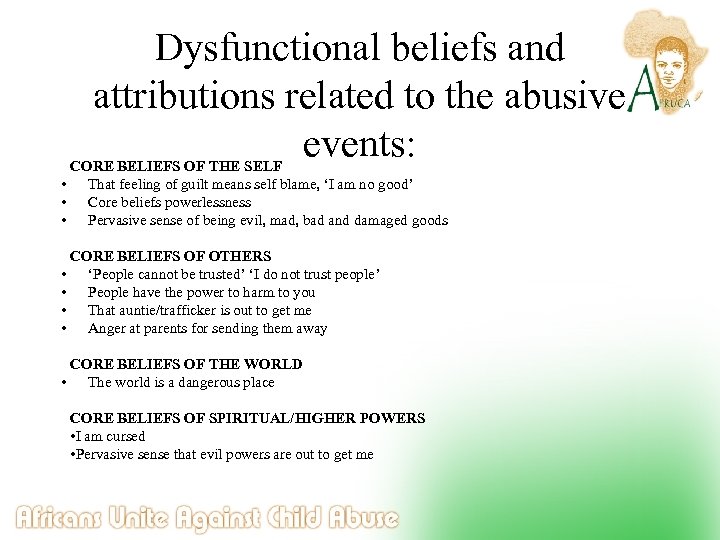 Dysfunctional beliefs and attributions related to the abusive events: CORE BELIEFS OF THE SELF • That feeling of guilt means self blame, ‘I am no good’ • Core beliefs powerlessness • Pervasive sense of being evil, mad, bad and damaged goods CORE BELIEFS OF OTHERS • ‘People cannot be trusted’ ‘I do not trust people’ • People have the power to harm to you • That auntie/trafficker is out to get me • Anger at parents for sending them away CORE BELIEFS OF THE WORLD • The world is a dangerous place CORE BELIEFS OF SPIRITUAL/HIGHER POWERS • I am cursed • Pervasive sense that evil powers are out to get me
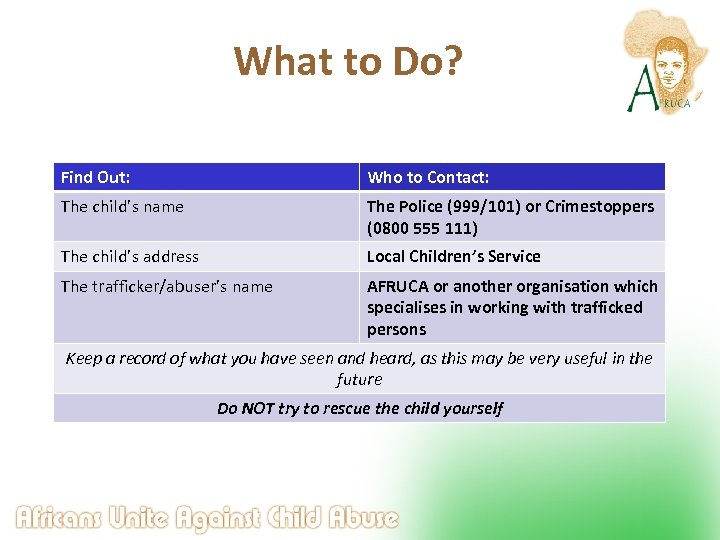 What to Do? Find Out: Who to Contact: The child’s name The Police (999/101) or Crimestoppers (0800 555 111) The child’s address Local Children’s Service The trafficker/abuser’s name AFRUCA or another organisation which specialises in working with trafficked persons Keep a record of what you have seen and heard, as this may be very useful in the future Do NOT try to rescue the child yourself
 Thank You London Unit 3 D/F Leroy House 436 Essex Road London N 1 3 QP Tel: 02077042261 Manchester AFRUCA Centre for Children and Families Phoenix Mill 20 Piercy Street Ancoats Manchester M 4 7 HY Tel: 0161 205 9274 Website: www. afruca. org Contact: Josie@afruca. org; info@afruca. org